by Steve | Nov 18, 2016 | In the News, Perspective E-Newsletter

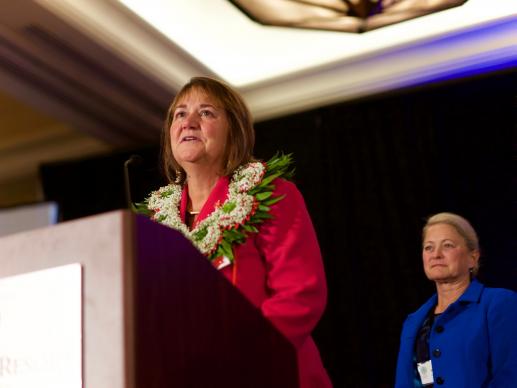
Bishop Julius Trimble
By Walter Fenton-
A group of seventeen clergy and laity in the Iowa Annual Conference have filed a complaint against Bishop Julius Trimble of the Indiana Episcopal Area.
In a letter addressed to Bishop Gregory Palmer, president of the North Central Jurisdiction College of Bishops, the group said, “With reluctance, we write to lodge a formal complaint against Bishop Julius Trimble, Indiana Area, for the following chargeable offense: ‘Disobedience to the order and discipline of The United Methodist Church.’ In addition, we believe Bishop Trimble has exhibited an unwillingness to do the work of ministry, entailed in the office of bishop.”
The complaint stems from Trimbles’ decision to dismiss a complaint filed against the Rev. Anna Blaedel while he was still serving the Iowa Episcopal Area earlier this year. At the 2016 Iowa Annual Conference Blaedel requested a point of privilege to announce to the gathered assembly, “I am a ‘self-avowed practicing homosexual.’ Or, in my language,” she continued, “I am out, queer, partnered clergy.”
As intended, Blaedel’s very public announcement stirred controversy and debate throughout the connection and elicited a complaint against her. Pastors, particularly in Iowa, found themselves fielding questions and comments from concerned laity about her provocative announcement and wanting to know how the bishop would respond to such a blatant admission of defiance. Trimble, without public comment, dismissed the complaint on his second to last day as bishop of the Iowa Episcopal Area, offering no explanation for his quiet, eleventh hour decision.
“We were disappointed in the way Trimble handled the complaint,” said Chris Downey, a lay member in the conference and one of the complainants. “If he thought Blaedel’s admission was in defiance of the Discipline, then he should’ve proceeded accordingly. If he did not, he should’ve had the courage of his convictions. He should’ve openly told the people of the Iowa Annual Conference why he had no intention of holding Blaedel accountable to her ordination vows.”
Clergy and laity in the Indiana Annual Conference who have become aware of Trimble’s dismissal of the complaint have also expressed dismay with his decision.
“I understand that being a bishop can be a challenge at times, but no one forces a clergy member to assume the role, they freely accept it, and of course most quietly campaign for it,” said Rev. Riley Case, a retired clergy member of the Indiana Annual Conference and a well respected commentator and historian. “However, once you assume the job you ought to be willing to carry out the duties accordingly, or at least explain why you don’t intend to carry out some of them.”
The complaint against Trimble will be handled by select members of the North Central Jurisdiction’s Episcopal Committee in what is known as a supervisory process. It will bring together those who filed the complaint and the “respondent” (Bishop Trimble in this case) in an effort to reach a just resolution that would avoid the necessity of a church trial.
Many do not think much will come of the complaint because the jurisdictional colleges of bishops are loathe to hold one another accountable regarding cases having to do with the church’s sexual ethics and its teachings on marriage. Retired Bishop Melvin Talbert has presided at two same-sex weddings in the last three years and he has experienced no adverse consequences for doing so.
It is also evident that a number of the bishops in the North Central Jurisdiction are out of touch with rank-and-file United Methodists regarding these matters. Many United Methodists believe the church’s teachings on marriage and the practice of homosexuality are grounded in Scripture, tradition, reason, and experience, and therefore are where the church should be on these matters. However, it is increasingly apparent that some bishops reject the will of the General Conference and have no intention of fulfilling their responsibility to hold clergy accountable to the Book of Discipline.
Some laity and clergy believe the failure of certain bishops to act in these cases lacks integrity and is condescending. Increasingly, concerned laity are responding by instructing their local church treasurers to keep all their tithes and gifts in the local church rather than forwarding a portion of them to the annual conferences. Some local churches have also decided to withhold or escrow their apportionments until bishops begin fulfilling their duties to maintain the good order and discipline of the church.
And at this stage, no one knows for sure how many United Methodists are quietly withholding gifts and tithes, and what effect it is having on local churches’ ability to pay 100 percent of their apportionments. But if mainline denominations that have liberalized their teachings on marriage and ordination are any indication, the UM Church is likely to see giving slow or drop off in 2016 and 2017.
It is regrettable that it has come to this, but United Methodists who support the church’s polity and teachings have come to the conclusion that their episcopal leaders are dismissive of their concerns and that some bishops clearly believe their own opinions should supersede the will of the General Conference and the Book of Discipline.
Walter Fenton is a United Methodist clergy person and an analyst for Good News.
by Steve | Nov 14, 2016 | In the News, Perspective E-Newsletter

Bishop David Bard
By Walter Fenton-
Bishop David Bard, the newly appointed leader of the Michigan Episcopal Area, has signed-off on a frivolous and insulting “just resolution” of a complaint filed against the Rev. Michael Tupper, a retired clergyman in the West Michigan Annual Conference.
Bard’s endorsement falls under the category of “it would be funny” were it not so damaging to the integrity and unity of The United Methodist Church. And coming just a few months into his tenure, it calls into question his willingness to defend the church’s polity and uphold its teachings. At a minimum, his decision to endorse the Tupper resolution suggests he will only do so selectively.
Tupper, a now retired elder in the West Michigan Annual Conference, presided at his daughter’s same-sex wedding in 2014. A complaint was filed against him that eventuated in a “just resolution” endorsed by the now retired Bishop Deborah Kiesey. The resolution included no adverse consequences for Tupper’s actions, nor did it even elicit from him a promise not to preside at future same-sex services.
Not surprisingly, he defied the church again by presiding at another same-sex union in July 2015. A complaint was dutifully filed and Bishop Kiesey sought to dispense of it in the same manner as the first one. However, Tupper, who wanted publicity drawn to the church’s teachings against such weddings, demanded a church trial, believing his guilty plea and the loss of his ministerial credentials would move the denomination to radically liberalize its teachings on marriage.
Late this summer Tupper finally relented in his demand for a trial. Given the details of the just resolution Bard endorsed, there’s little wonder why he did. The resolution rewards the guilty and afflicts the innocent.

Rev. Michael Tupper
According to two provisions in the resolution, Tupper and the Counsel for the Church, the Rev. Elbert Paul Dulworth, “will set up Training Sessions for all Michigan [Staff Parish Relations Committee (SPRC)] chairpersons to attend in the spring of 2017 in helping them to set up a process of discernment in every local church during the fall of 2017 regarding their readiness to accept the appointment of a gay clergyperson.”
And lest clergy think they can escape the mocking resolution, Tupper and Dulworth were also given the task of setting up a “Training Session for all Michigan clergy in the spring of 2017 to offer pastoral care for LGBTQI individuals who are considering marriage or ordained ministry.”
Never mind that both provisions either skate close to or across the lines established by the church. Bard evidently believes laity who volunteer to serve in the time consuming role of SPRC chair and pastors who have plenty on their plates should travel many miles and waste valuable time in order to attend training sessions designed by a clergyperson who has willingly and knowingly violated the Book of Discipline. The not so hidden goals of both sessions is to teach laity and clergy how to become party to violating the church’s teachings. Presumably, even clergy and laity who are committed to upholding the denomination’s understanding of Christian marriage are expected to turn out for these teach-ins.
“This just resolution is a rejection of the authority of General Conference,” said the Rev. John Grenfell, Jr., a former Detroit Annual Conference district superintendent and a long time advocate for clergy and laity in church disputes. “It grants permission to two elders to redefine the life and mission of the church, when only General Conference can do that. Laity and pastors have the responsibility to support the order and discipline of The United Methodist Church, not attend programs that undermine and reject the guidelines of holy conferencing.”
Bard’s endorsement of the resolution signals his willingness to at least selectively tolerate and even reward open defiance of the church’s polity and its teachings. This will not bode well for an episcopal area that is already facing significant drops in worship attendance and church membership. And it will further demoralize laity and clergy who stand-up for the church’s good order and integrity, and expect its leaders to do the same.
Walter Fenton is a United Methodist clergy person and an analyst for Good News.
by Steve | Nov 11, 2016 | In the News


by Steve | Oct 31, 2016 | In the News, Perspective E-Newsletter
By Walter Fenton
Earlier this week the Council of Bishops of The United Methodist Church announced the 32 people who will serve on its Special Commission on a Way Forward. Eleven laity, 11 elders, eight bishops, and two deacons were selected. Three additional bishops will serve as moderators. (Our friends at United Methodist News Service have helpfully listed the commission members HERE.)
The bishops, at the May 2016 General Conference in Portland, Oregon, proposed the creation of the special commission, and it was approved by the conference’s delegates. The commission is charged with perhaps the most challenging task given to a body since the formation of the UM Church in 1968. Its mandate includes “a complete examination and possible revision of every paragraph in our Book of Discipline regarding human sexuality,” and finding some way to maintain church unity despite deep differences regarding the church’s sexual ethics, its teachings on marriage, and increasingly, over its polity.
The Rev. Karen Oliveto. UMNS photo.
During the late spring and summer of this year, its work was made even more daunting by serial acts of ecclesial defiance regarding the church’s teachings and its ordination standards. Several annual conferences and two jurisdictions took actions in direct opposition to those reaffirmed by the General Conference. Chief among them was the Western Jurisdiction’s election of the Rev. Dr. Karen Oliveto as a bishop of the whole church. Oliveto, who now presides over the Mountain Sky Episcopal Area, is married to her female partner, who is a deaconess in the UM Church.
While people across the connection expressed their hopes and prayers for the newly appointed commission and its work, others offered mild to severe critiques of its composition.
“We feel erased and disappeared in the mission statement of the Commission,” wrote a group of more than 60 openly lesbian, gay, bisexual, transgender, queer or questioning United Methodist clergy and clergy candidates in a statement entitled, “United Methodist Queer Clergy Respond to Naming of Special Commission.” It noted that “only two self-identified LGBTQI persons” were selected as members, and protested that their “lives and the ministries entrusted to [them] will be on the agenda of a body whose make-up is unfairly hegemonic.”
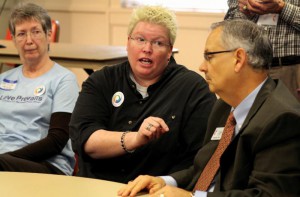
Rev. Amy DeLong
Love Prevails, a UM affiliated LGBTQ+ advocacy group, posted on its Facebook page that “the Commission is not representative of LGBTQ diversity, much less does it represent an LGBTQ majority,” something it pressed for earlier this summer. According to UMNS, the Rev. Amy DeLong, one of the organizations leaders, “found it ‘startling and unconscionable’ that there are no out lesbians or transgender individuals on the commission.”
Still others voiced support for the commission, but also had regrets. “It is problematic to include [caucus group] employees as voting members of the commission,” wrote the Rev. Jeremy Smith, a progressive blogger based in Portland, Oregon. “Their jobs are contingent on their caucus group boards, which is quite a collision of the role to discern a path forward that their boards may not approve of.”
Smith specifically cited Matt Berryman, president of the pro-gay advocacy group Reconciling Ministries Network, the Rev. Tom Lambrecht, vice-president of Good News, and Pat Miller, executive director of the Confessing Movement.
We’re biased of course, but we’re delighted Lambrecht and Miller were included on the commission. And while we differ with Berryman on a number of issues, we are not troubled by his inclusion as well.
Lambrecht and Miller have earned the respect of leaders across the theological spectrum. They have participated in numerous roundtable discussions, spoken at annual conferences, and have always respectfully engaged with those who are in disagreement with the church’s polity, sexual ethics, and teachings on marriage. We are confident they will only enhance the work of the commission, and will act out of conscience and their affection for the church.
Along with Berryman, Lambrecht and Miller represent important and dedicated constituencies in the church. A failure to include knowledgeable representatives from each of these groups would have immediately imperiled the commission’s chances of bringing forward a plan that could gain the broad support necessary for a way forward.
The commission’s charge is not an enviable one, and no one will be surprised if it cannot reach consensus and present a viable plan for the church’s consideration. The hour is late, so they will have to work thoughtfully and deliberately in the months ahead, and therefore the members deserve our thoughts and prayers.
We are disappointed it took the Council of Bishops five months to appoint the commission. We fear valuable time for deliberation and crafting recommendations has been lost. Even more importantly – and particularly in light of all the defiance, the approval of so-called “just resolutions,” the quiet dismissals of valid complaints, and the provocative election of Oliveto – the bishops’ delay further eroded the trust rank-and-file United Methodists have in their leadership and the institution as a whole.
Most, if not all, of the proceedings at General Conference, projected an alarming sense of institutional paralysis, and a disheartening sense that the long and acrimonious debate over the church’s sexual ethics, now amplified by routine and flagrant acts of ecclesial defiance, will go on indefinitely.
In a church facing a major demographic crisis in the coming decade, it is now imperative that its bishops act swiftly and boldly to maintain the good order and integrity of the church. No one doubts their faithfulness, passion for the church, and commitment to building bridges to keep the church unified. However, as laudable as all those attributes are, the necessity of finding consensus around a definitive resolution, and the courage to lead is what they need most to exhibit in the coming months.
by Steve | Oct 26, 2016 | Magazine, Magazine Articles, Sept-Oct 2016
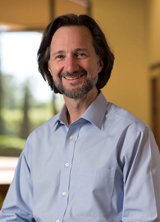
Rev. Rob Renfroe
By Rob Renfroe-
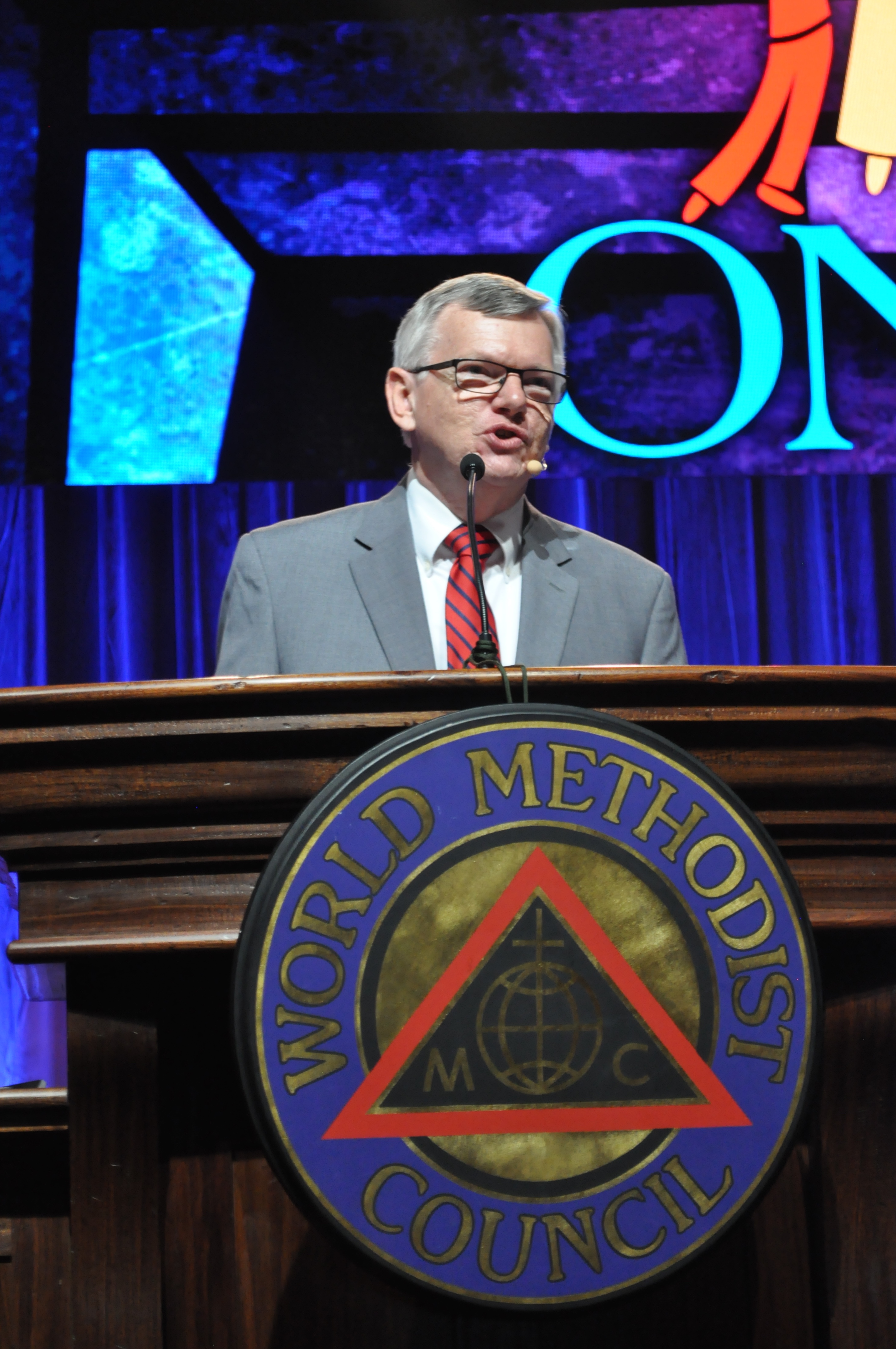
Many people were shocked, actually offended, when Dr. Ted Campbell told the World Methodist Conference, “The question at this point is not whether we divide or not. That, I fear, is a given now.” A United Methodist elder and noted history professor at Southern Methodist University’s Perkins School of Theology, Campbell told a large crowd gathered in Houston, Texas, on September 1, that it is unlikely that the denomination can hold together.
Such admissions are not usually made in public, especially by persons of Dr. Campbell’s stature. However, behind closed doors, others representing The United Methodist Church are making the same prediction. One bishop told me that coming out of the bishop’s commission, “There will be some kind of structural separation. I hope we can maintain some connection around our central mission of making disciples, but structural separation will be the end result.”
Another bishop was even more blunt in his remarks to me: “We may be able to maintain some kind of connection, but the structural separation that will occur as a result of the commission will be so different than where the church is today, that ten years ago it would have been referred to as schism.”
Several leading “centrist” pastors have come to the same conclusion. One put it simply, “I think separation is inevitable.” Another who had been a supporter of A Third Way was even more pointed in his remarks. “We all know we’re going to split. All this happy talk about staying together is just a bunch of nonsense.”
The election of the Rev. Karen Oliveto to the episcopacy has increased the likelihood that The United Methodist Church will not be able to remain in its present form. Though our Book of Discipline states that self-avowed practicing homosexuals may not serve in ordained ministry, Oliveto is legally married to her long-time partner, another woman. Still, the Western Jurisdiction chose her to become one of our newest bishops. This came on top of at least nine annual conferences and two jurisdictional conferences that have committed to not “conform or comply” with the parts of the Discipline they disagree with. This leaves many of our evangelical churches trying to maintain what Methodism has always been in parts of the country where the church has left them.
The response has been predictable. Some churches are withholding their apportionments and others have retained legal counsel to determine how they might leave the denomination. The election of the Rev. Gene Robinson as bishop by the Episcopal Church set in motion a chain of events that led many Episcopal congregations to eventually create a new denomination, the Anglican Church in North America.
I take no joy in believing that there may be a separation within the UM Church, whether we maintain some connection or not. This is the church I love. This is the church where I found Jesus, or better, where he found me. This is the church that has nurtured and discipled me. And this is the church that has affirmed my gifts and my calling. And I will be forever grateful to The United Methodist Church.
I do not rejoice that we have arrived at this place. But I am hopeful that we are moving towards a new beginning.
I can see a new Methodist movement, either within the UM Church or, if it must be, outside of it.
It will be a movement that is not top down, but bottom up. One where boards and agencies actually serve the local church and are responsible to us. One where we are organized like a missional force that wants to change the world, not like a bloated bureaucracy.
I can see a movement where we don’t argue over the authority of Scripture or what the Bible teaches about sexuality. Where our seminaries prepare godly men and women to do ministry instead of being schools of religion where some faculty members don’t believe in our doctrines, and teach the latest theological fads that have no power to change the world and that will be forgotten within a generation.
It will be a movement that has freedom to plant evangelical churches on the coasts and in northern urban centers where people will still respond to the Gospel of Jesus Christ if it is presented by servant communities with grace and truth.
I can see a Wesleyan movement that cares about the rejected, the outcast, and the marginalized – cares about them enough both to minister to their physical needs and to tell them how their sins can be forgiven and their souls can be saved.
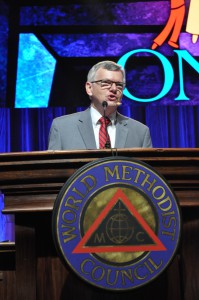
Dr. Ted Campbell. Photo courtesy of the World Methodist Council.
I can see a movement that you and I will be excited and proud to be a part of.
It will be a new Wesleyan expression for the 21st century. It will be filled with the power of God and the compassion of Christ that compels it into a lost world that needs Jesus.
There is a new day coming. And we are going to be a part of it. Those of you who are young will have decades to enjoy it and shape it and be blessed by it. Those of us who are older will one day before we die look back and say, “The Lord has done a new thing, and it was marvelous in our sight. And he was gracious enough to let us be a part of its beginning.”
Friends, my hope and my prayer is that we will walk into this new day together. This is no time to become discouraged or to grow weary. A better day is coming and it fills my heart with joy to think of us walking into it together for the glory of our Lord and Savior.
Rob Renfroe is the president and publisher of Good News.