by Steve | Oct 19, 2016 | In the News, Perspective E-Newsletter
During the first hour of its launch event in Chicago on October 7, leaders of the Wesleyan Covenant Association (WCA) were scrambling to find more chairs to accommodate the standing-room-only gathering, as well as swaying and clapping to the enthusiastic and impromptu participation of African United Methodists during the opening worship time – a visible reminder of the global nature of the denomination.

Rev. Dr. Jeff Greenway
“I am convinced God is doing a new thing among those of us who claim the historic, orthodox, evangelical, Wesleyan expression of our faith,” said the Rev. Dr. Jeff Greenway, lead pastor of Reynoldsburg (Ohio) United Methodist Church, in his presentation on the group’s purpose. “I believe we are planting seeds today – that when full grown – will bear the fruit of a vital Wesleyan witness and a dynamic Spirit-filled Methodism across the globe.”
The inaugural gathering was a high-energy mixture of affirmative messages on the Lordship of Jesus, the Wesleyan drive to transform the world through Christian discipleship and social holiness, and the centrality of the Scriptures in the life of the Church.
The Chicago event was also a show of solidarity to orthodox clergy and laity in sections of the church that no longer adhere to the global United Methodist views on marriage and sexuality. The day-long event culminated with a communion service overseen by two United Methodist bishops.

Bishop Mike Lowry
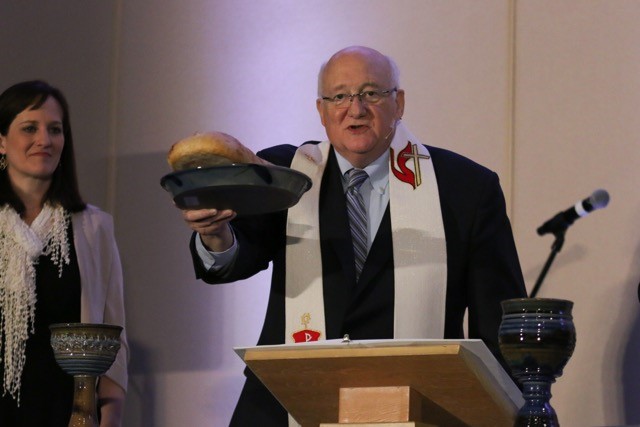
“We don’t live on the world’s wisdom, we do not exist on the world’s power,” said Bishop Mike Lowry of the Fort Worth Area of the Central Texas Conference, during his communion homily. “You know and I know it is Christ, the power of God and the wisdom of God. What is at stake for us in this struggle we are in is not ultimately the issue of human sexuality; what is at stake for us is who is Lord, who rules, who saves us. We preach Christ and Him crucified.”
Nicene Affirmation
Interspersed between messages calling for a revitalized Wesleyanism, WCA leaders crowd-sourced affirmation of its theological underpinnings, purpose, and moral principles. “We are reciting the Nicene Creed today without crossing our fingers behind our backs,” said Dr. Bill Arnold, professor of Old Testament at Asbury Theological Seminary, before leading the group in the ancient affirmation of faith.

Rev. Carolyn Moore
It also christened a new leadership team through audience affirmation by applause and “amens.” As the council members began their work together they elected Dr. Jeff Greenway as the group’s chairperson; the Rev. Carolyn Moore, pastor of Mosaic United Methodist Church outside of Augusta, Georgia, as vice chairperson; the Rev. Madeline Carrasco Henners, pastor of First United Methodist Church in Luling Texas, as secretary; and Ferrell Coppedge, lay leader of Mt. Bethel United Methodist Church in Marietta, Georgia, as treasurer.
With more than 1,800 participants, the Donald E. Stevens Convention Center near O’Hare Airport in Chicago was flooded with enthusiastic United Methodists from every conference across the denomination in the United States and from ten conferences in Africa.
Chicago Statement
Through a “Chicago Statement” that was affirmed by a standing ovation and cheers, the group asked the Council of Bishops to “swiftly name the members” of the Commission on the Way Forward and “approve the call for a special General Conference in early 2018 to enable resolution of the conflict that divides us before further harm is done to United Methodist members, congregations, conferences, and ministries.”
“We believe it is imperative for the commission to propose a plan that calls for accountability and integrity to our covenant, and restores the good order of our church’s polity,” states the Declaration. “If the commission determines no such plan is possible, then we believe it should prepare a plan of separation that honors the consciences of all the people of the church and allows them to go forward in peace and good will.”
Preparing for Change

Rev. Rob Renfroe
In the midst of dissension and uncertainty within United Methodism, leaders of the Wesleyan Covenant Association say the group was formed in order to bring a unifying voice of hope and encouragement to evangelicals and traditionalists as they face the future.
“We don’t know what the future will bring,” said the Rev. Rob Renfroe, pastor of adult discipleship at The Woodlands (Texas) United Methodist Church, during his message to the group. “We are not here to promote schism. But we are not here to be naïve either. Change is coming to the United Methodist Church. We all know that. The bishops know that and many have said so publicly.”

Rev. Dr. Jerry Kulah
The Rev. Dr. Jerry Kulah, the West Africa Central Conference Coordinator of the UMC Africa Initiative, reminded the group about the importance of choosing the right way when two divergent paths are presented at a crossroad. “The only sustainable path to global unity of the people called United Methodist is total submission and loyalty to the Lordship of Jesus Christ, and an exclusive obedience to the Word of God as primary authority for faith and Christian living,” said Kulah, the dean of the Gbarnga School of Theology (United Methodist) in Liberia. “While we live within diverse cultures and religious worldviews, it is important that we love and embrace everyone, but we must continually live within God’s parameter of grace defined by Scripture.”
Tamed by Culture
“Wesley’s great fear was that the Methodist movement would – in a process that had happened again and again over the centuries – be tamed by the culture until it was nothing more than a docile lapdog,” said the Rev. Dr. Andrew Thompson, a Wesley scholar and pastor of First United Methodist Church in Springdale, Arkansas. “He was afraid that Methodism’s engagement with the culture would dilute it until it was a shell of its former self.”
In his opening sermon, the Rev. Kenneth Levingston, senior minister of Jones Memorial United Methodist Church in Houston, said that the “core of our struggle” is when men, women, and the Church attempt to put other things in God’s rightful place. “Salvation without sacrifice is a false god. Sanctification without submission is a false god,” he said. “Mercy and grace without truth and transformation are false gods. Social holiness without Scripture is a false god. Forgiveness without faithfulness is a false god. Redemption without renunciation of sin is a false god.
“Unity without covenant is a false god,” concluded Levingston.
Rescued for Something
Throughout the day, many of the speakers exhorted United Methodists to live out a vibrant form of Wesleyan Christianity, one that envelopes deep spirituality, passionate worship, and meaningful outreach for people of all walks of life, especially the downtrodden.

Rev. Jessica LaGrone
“We meet not just to find a way forward, but to remember how we found The Way, the Truth, and the Life in the first place,” said the Rev. Jessica LaGrone, Dean of the Chapel at Asbury Theological Seminary. “And to remember that to fully know life is not just to be rescued from something, but to be rescued for something. To become the rescued and transformed means to be those intent on the rescue and transformation of others.”
Wesleyan Covenant Association leaders announced during the afternoon session that they had run out of membership forms and encouraged participants to sign-up online.
by Steve | Oct 1, 2016 | Uncategorized
Clarification: In this space, Good News republished a widely-distributed email critique of the Wesleyan Covenant Association gathering in Chicago from a well-known denominational official in the North Central Jurisdiction.
“It’s ok to forward this email to friends and delegates of your choice,” read the email. In anticipation of its release, the official wrote: “I’d prefer to not get reactionary and hostile emails in response, if you can protect me from that.”
The email was sent to progressive activists around the denomination and was strategically forwarded to church members of a congregation associated with the WCA. Good News also received the forwarded email, and we assume other United Methodist news and opinion outlets did as well.
Among the observations (some peculiar) in the email:
• “No one looked poor. Khakis and button shirts mostly. Some suits, fewer polos.”
• “Submission to authority, whether Biblical or Spiritual, was a prominent theme. Songs included ‘On Christ the solid rock I stand’ and one with the lyric, ‘my one defense, my righteousness’”
• “The WCA rebrands the right-wing caucus group agenda as a centrist church…. they portrayed the left as a threat.”
• “If you don’t decode the language, little in the presentations is objectionable.”
• “Very disciplined message management was deployed. Presenters were using the same terms and were demonstrating a common approach to the intent of the meeting. No one drifted from the common message.”
• “They view themselves as martyrs for their beliefs. Their martyrdom indicates the depth of their faith.”
The writer of the email contacted our office to lodge a complaint about the posting of the text of the forwarded email on the Good News website. Although the email explicitly stated: “It’s ok to forward this email to friends and delegates of your choice,” the writer asked Good News to remove it from our website.
As a courtesy, Good News honored the request and removed the text of the controversial email for the past several months. We have posted this brief explanation in response to on-going questions about the forwarded email and our exchange.
For those curious about the various critiques of the WCA event in Chicago, please see the Rev. Walter Fenton’s tongue-in-cheek response HERE.
by Steve | Sep 22, 2016 | In the News, Perspective E-Newsletter
 With the election of the Rev. Karen Oliveto as a bishop of The United Methodist Church, a pastor who is married to another woman and therefore unqualified to assume the office, it is clear to most people that the church has reached a crisis point.
Thousands of people across the connection have endorsed a statement that will be shared with the Council of Bishops. To read the statement and add your endorsement, click HERE.
by Steve | Sep 22, 2016 | In the News, Perspective E-Newsletter
 By Walter Fenton-
Evangelical United Methodist Church (EUMC), one of the denomination’s fastest growing large churches, has decided to withhold paying its annual conference and general church apportionments. The Greenville, Ohio, congregation reached its decision in late August.
“The open defiance by annual conferences to ignore the Book of Discipline and defy the Word of God, and the Western Jurisdiction’s decision to elect a gay bishop compelled us to act,” said Matt Hamilton, chairman of the congregation’s leadership board.
According to the blogger Len Wilson, in 2014 the West Ohio church was the third fastest growing UM congregation with worship attendance over 1,000. It now averages approximately 1,200 to 1,300 people in attendance at five weekend worship services in a rural community with a population of just over 13,000.
“In the layperson’s workplace, if you sign a contract stating you’ll fulfill a certain job within a corporation, and then you fail to uphold your duties, you’d be terminated,” said Jill Steinbrunner, another member of the congregation’s leadership board. “EUMC is looking for the bishops to display clear and definitive support of biblical truths … and holding clergy accountable to their ordination vows and our Book of Discipline.”
Over the past several years the West Ohio Annual Conference, like many others, has witnessed challenges to the denomination’s sexual ethics and its teachings on same-sex marriage. In 2010, on a very narrow vote (948 to 920), the conference elected an openly gay man as its conference treasurer. He has been re-appointed to the post every year since. And earlier this year, just three days before the convening of General Conference, UM Pastor David Meredith made statewide news when he married his male partner at Broad Street UM Church in Columbus, Ohio. A complaint was filed in the case, but to date there has been no word of its resolution.
“EUMC has been increasingly alarmed at the way UM leaders have chosen to disregard the tenants of our church,” said Steinbrunner. “It has put more emphasis on maintaining unity than on teaching biblical truth and saving souls.”
The church recently joined a diverse mix of 20 other congregations in Darke County, Ohio, in an effort to share the Gospel with unchurched people. The initiative, called Time to Revive, has resulted in over 500 people making decisions for Christ.
“I am excited,” said Steinbrunner, “that the church is not only growing in the number of attendees, but more importantly, we’re seeing people growing in their depth of faith and knowledge of Christ. We’ve had dozens of people volunteer to meet one-on-one with people who have recently become Christians. It’s very exciting to witness.”
The congregation has a history of paying 100 percent of its apportionments, and both Steinbrunner and Hamilton said the board reached its decision reluctantly and after months of discussion and prayer.
According to Hamilton, the leadership team decided it could no longer, in good conscience, support a conference and general church that is failing to abide by its own polity and teachings.
He explained that the leadership team unanimously voted to withhold the apportionments. It then held a church-wide membership meeting to solicit feedback before moving forward. “Members were overwhelmingly supportive of our decision,” he said.
“If the bishops would enforce the Book of Discipline we could begin paying apportionments again,” he added. “But right now the general church is in chaos. In fact, our people feel like the bishops’ inability to maintain good order in the general church makes it more difficult for us to do our ministry. We’ll continue to do what we’ve been doing, but the bishops aren’t helping.”
Walter Fenton is a United Methodist clergy person and an analyst for Good News.
by Steve | Sep 12, 2016 | In the News, Press Releases
 By Thomas Lambrecht
When the New England Annual Conference passed a resolution at its recent gathering in defiance of the standards of the global United Methodist Church regarding ordination and homosexuality, a “question of law” was immediately requested.
When an annual or jurisdictional conference takes an action that appears contrary to the Book of Discipline, it can be challenged through a question of law requesting a ruling clarifying the legality of the action in question. It is first ruled on by a bishop and then reviewed by the Judicial Council. The bishop and the Judicial Council have the authority to overrule conference actions, and the Judicial Council’s ruling becomes the accepted understanding of church law.
In response to an “Action of Non-Conformity with the General Conference of The United Methodist Church” adopted by the New England Annual Conference on June 17, Bishop Sudarshana Devadhar has ruled in a question of law that the resolution is “in violation of the Discipline.”
The resolution stated that “the New England Annual Conference will not conform or comply with provisions of the Discipline which discriminate against LGBTQIA persons.” In short, the conference rejected the global church’s sexual ethics, standards on ordination, and its teachings on marriage.
The New England resolution was the first of five annual conferences pledging non-conformity with United Methodist teaching and policy. The others were, Desert Southwest, California-Nevada, Pacific Northwest, and California-Pacific. The Western Jurisdiction also adopted a resolution nearly identical to the New England one, as well as a resolution calling upon local churches and annual conferences in the jurisdiction to “not [comply] with the Book of Discipline whenever it denies full inclusion of a person based on their sexual orientation or gender identity in the life, ministry and leadership of The United Methodist Church.” If the Judicial Council upholds Bishop Devadhar’s ruling, all the similar resolutions adopted by other conferences would also be null and void.
The New England resolution contained a provision that conference members would “not participate in or conduct judicial procedures related to the Discipline’s prohibitions against LGBTQIA persons” that was ruled to violate the Discipline. A provision to “realign [the conference’s] funding to reflect these commitments, using no reserve funds to pay for judicial procedures related to the Discipline’s prohibitions against LGBTQIA persons” was also ruled to be in violation of the Discipline.
The resolution called for the conference to offer the same benefits to clergy and employees in same-sex marriages as are available to heterosexual marriages and their families. Devadhar ruled that this provision was legal, since conference benefits are not covered in the Discipline. However, a brief filed by the Rev. Michael Pike, the person who asked the question of law that led to Devadhar’s ruling, argues that the “conference may not offer benefits that contradict United Methodist Church policy.” To offer such benefits would “in effect condone behavior that The United Methodist Church disapproves.”
Bishop Devadhar acknowledged that his ruling was “a painful one to make.” He explained that, “as a United Methodist Bishop, I cannot challenge what I believe to be an unjust law by approving an illegal law.” Although not supportive of United Methodist teaching on marriage and human sexuality, Devadhar acted with integrity in this instance. We wish all our bishops and clergy would exhibit similar integrity.
Northeastern Jurisdiction Resolution
A resolution initially titled, “Stop the Church Trials: A Moratorium by Bishops Within the Northeastern Jurisdiction,” was passed by the Northeastern Jurisdictional Conference on July 14. The resolution was revised several times (including deleting the title), but ended by requesting “all CFA’s of the Annual Conferences of the jurisdiction to state that there are no funds available for initiating of investigations and trials based upon the sexual orientation or marital status of faithful United Methodists or involving clergy for conducting same-sex weddings.” The resolution passed by more than a two-thirds majority.
After the resolution was adopted, a question of law was raised. Bishop Mark Webb has ruled that the resolution “requests the CFAs and the annual conferences to violate Church law or, alternatively, discourages the enforcement of Church law. Either way, the Resolution would be null, void and of no effect.” In addition, Bishop Webb found that the “Resolution would also negate, ignore and violate … provisions in the Constitution,” making it unconstitutional.
Bishop Webb’s ruling will also be reviewed by the Judicial Council next April. If his ruling is affirmed, it would apply to any future resolutions attempting to negate or violate the Discipline in this way.
The Real Question
Given that these rulings are likely to be upheld by the Judicial Council, what does it mean that the resolutions of non-conformity will be ruled null and void? Will the annual conferences, bishops, and jurisdictional conferences that have publicly decided not to live within the bounds of the Discipline now suddenly acquiesce to follow Judicial Council rulings with which they disagree?
It is more likely that annual conferences, bishops, and jurisdictions will continue to ignore the parts of the Discipline that they disagree with, exacerbating the tensions and divisions within United Methodism. As Dr. Ted Campbell said recently at the World Methodist Conference, “When annual conferences declare that they will not follow the law of the church, I think that is in fact a division.”
Thomas Lambrecht is a United Methodist clergy person and the Vice President of Good News.