by Steve | Oct 26, 2016 | Magazine, Magazine Articles, Sept-Oct 2016
 By Kathy Gilbert-
After the deluge come the blessings. And four United Methodist pastors in Lafayette, Louisiana, are standing ready to pour those blessings back into their recovering communities. South Louisiana was hit by 6 trillion gallons of rainwater during August 11-13.
“Rain started on Thursday evening, and Friday it kept raining, and Saturday it kept raining, and I started to realize we had a big problem,” said the Rev. Drew Sutton, pastor of First United Methodist Church, Lafayette.
“For me, the awareness arose Saturday afternoon when I called a church member whose husband had recently had surgery and I could hear the tears in her voice. She said, ‘Water is in the house and I don’t know what to do.’ I told her I was on my way.”
By the time Sutton was able to get to her neighborhood the roads were impassable. The National Guard bringing in boats saved the couple. From the boat, Sutton said, he and others carried the couple through chest-deep water to get them to a family member’s home.
Pooling resources. A small group of pastors and congregation members gathered at Asbury United Methodist Church on Sunday night, August 14, and started making plans to pool their resources. “We just decided to be the church and we went out,” said the Rev. Susan Ferguson, associate pastor of Asbury.
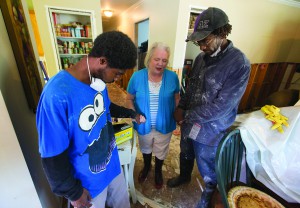
The Rev. Ramonalynn Bethley, pastor of Covenant United Methodist Church, deployed 600 flood buckets and sandwiches. The Rev. Robert Johnson, pastor of Louisiana Avenue United Methodist Church — who had an established ministry with the homeless — was out in the poorest areas of the city looking for people in need. Asbury United Methodist Church set up a disaster relief database.
“By Monday morning we were ready to deploy not just to our church members, but to our community,” Ferguson said. “We were out there in the community at the hour of their greatest need. Seeing them face to face, hugging them, praying with them. This was all over our community and we could not have done that if we weren’t working together,” Bethley said.
‘Thank heaven for the pastor.’ Johnson found a community of low-income people living in a large apartment complex with no food and no help. He forged a friendship with Kevin “Tony” Oliver, the complex’s maintenance man who was the spokesperson for the residents during the crisis. Food tables were set up for the frightened people — many of who are undocumented and afraid to come out of their soaked apartments.
“I thank heaven for the pastor who came out and handed out cleaning supplies and fed us,” said Oliver. “You couldn’t walk in the streets. I have never seen anything like it in my life; it came so fast and so sudden.” Oliver said the low-income complex includes lots of elderly and sick people as well as lots of children.
At one point during a tour of his neighborhood, Oliver said, “I think if God was in this community, it would be a much better community.” Smiling, Johnson, replied, “God is here. You just need spiritual guidance to give people hope.”
Leveling the playing field. “That’s what the flood has done, it has leveled the playing field, and we are all in this together. Barriers that separate us are hard to detect in a disaster. We start linking arms. We fall in love with one another as people. I am looking forward to that day when it really shows up in our churches,” Ferguson said.
Sutton agreed that “something mysterious” is happening. First United Methodist Church has been reading Romans 5:1-5, Sutton said, because a pastor from New Orleans shared those verses with him in the wake of Hurricane Katrina.
Paraphrasing the passage, Sutton said that suffering builds character, which brings help and hope that never disappoints and leads us into love of God. “To be part of that and to see our community enduring and to see the character unfolding by the power of the spirit through events is just really powerful to witness,” he said.
“It’s what the church should look like,” said Bethley. “It is what heaven looks like.”
Kathy Gilbert is a multimedia news reporter for United Methodist News Service. The Rev. Todd Rossnagel, director of communications strategies for the Louisiana Conference, contributed to this report.
by Steve | Oct 26, 2016 | Magazine, Magazine Articles, Sept-Oct 2016
 By Frank Decker-
I enjoy engaging in candid, truth-seeking conversations, especially with persons from other religious backgrounds. Recently I gave a ride to a congenial young Muslim man whom I learned was preparing to become an imam. On the way we had an interesting discussion, which turned to a passage in the Qur’an often translated from the original Arabic into English, “Oh Isa, (Jesus), I will take you and raise you to myself….” Many Muslims hold as a core belief that Jesus did not die but was taken up to heaven without death, and this verse is one often used to assert that belief.
Knowing that the Arabic meaning of this verse literally spoke about death, I asked my new friend why it was translated to state something else. His response to me was, “In this context the word does not mean ‘die.’” When I asked him how this interpretation came to be, he responded that this is how it is understood in Muslim tradition and it is what his teachers have taught him. I responded by encouraging him to earnestly study the translation of that verse rather than simply settle for the traditional interpretation. After all, it would be unfortunate for someone to miss an essential aspect of the gospel because of a dogma.
Of course, it is easy for me as a Christian to question the assumptions and beliefs of someone outside the context of my own faith tradition. I also must be willing to question whether or not I have assumptions that have been handed to me which may color my understanding of the gospel. After all, isn’t the essential challenge of the missionary to convey the transcendent message of Christ to another culture while carefully distinguishing that message from one’s own cultural and traditional impact upon that message? Failure to understand this distinction while bringing our message across cultures will cause our hosts to scratch their heads in bewilderment as we share our wonderful teachings on successful ministry, evangelistic methods, leadership, and other subjects that have captured Western Christian thinking, yet may not address the core needs of others.
I recall a conversation I had with a missionary from another agency while I was serving in Africa. His approach was so rooted in a certain theological distinctive that he was convinced I was a false messenger because we held differing views on predestination and eternal security. I remember thinking to myself at the time, “Did we both come across the Atlantic to argue about these things?” There is a world of hurting people who really don’t care about our finely-tuned theological arguments. But they do long to see the fruit of the Spirit in the lives of those who follow the Prince of Peace.
One of the books that we require our new missionaries to read is Misreading Scripture with Western Eyes by E. Randolph Richards and Brandon J. O’Brien. This book succinctly addresses our assumptions as Westerners concerning ethnicity, language, individualism, time, relationships, and other areas where we must recognize the cultural “glasses” that we wear when understanding the Bible. I have observed that there are at least two things that help us to appreciate the differences of others, while still being rooted in the essentials of our faith. One of these is exposure to different cultures and religious contexts; the other is simply a broadening of perspective that is likely to come with age and maturity.
My seminary professor – the late Dr. James W. Fowler – greatly challenged me with his research on the stages of faith. In fact, in presenting the latter stages (which he asserts rarely occur prior to middle age) as accompanied by a more expansive appreciation for that which is mysterious and paradoxical, I occasionally wondered if some of his ideas might not be heretical. The fact that I was in my early twenties and in my youthful enthusiasm had an answer for everything gives credence to Fowler’s research, I am sure.
When someone is cocksure of the truth, in their zeal they may behave in ways that contradict the main tenets of the very truth they profess. As Brene Brown commented in her TED Talk on vulnerability regarding the polarization of political and religious perspectives in our culture, “…we make everything that’s uncertain certain. Religion has gone from faith and mystery to certainty. ‘I’m right, you’re wrong. Shut up.’”
When we seek to engage persons from other religious perspectives we must, indeed, accept the reality of the inexplicable. In fact, I doubt if genuine dialogue can occur unless both parties are willing to accept the idea that God just might be greater than doctrinal formulations on which we rely. If we accept that possibility, then we have laid the foundation for significant mutual discovery and peace.
Frank Decker is the Vice President of Mission Training and Development for The Mission Society.
by Steve | Oct 26, 2016 | Magazine, Magazine Articles, Sept-Oct 2016
 By B.J. Funk-
Where is Popeye the Sailor Man and his can of spinach when The United Methodist Church needs him? In the good ol’ days of Methodism’s beginning, our church didn’t need to look for extra strength. We were strong. We had Popeye’s brains and brawn as a growing community of like-minded orthodox Christians.
John Wesley organized small groups of Christian men who learned to have intensive accountability. Within the strict guidelines of the Holy Club, members were asked a series of introspective questions every day. “Am I a hypocrite? Am I honest? Am I trustworthy? Am I praying? Am I prideful? Am I filled with self-pity?” Daily prayer and Bible study were expected.
When no one was looking, The United Methodist Church shifted direction, moving to a mountain slope filled with quick sand. Slowly, our structure began to slide and deteriorate as the quick sand started its strong pull downward. Few noticed.
In the Popeye cartoon, Olive Oyl is the skinny girlfriend who flirts with Popeye’s nemesis, the large and overbearing Bluto. Popeye only has to look beneath his shirt to find a can of spinach, which he gulps down in order to receive the strength needed to fight Bluto’s advances. Armed now with bulging muscles, Popeye stands secure and confident in his fight to save Olive Oyl from Bluto.
If Olive Oyl represents the institution called The United Methodist Church, and Bluto represents the spiritual forces aiming to destroy our church, then Popeye is those of us who love this church too much to allow the enemy to take us down. Throw us a can of spinach, because we plan to fight for our beloved United Methodist Church. We are not fighting against other United Methodists. We are fighting the rulers of darkness and spiritual wickedness. The enemy is not the person, different from you, sitting beside you on the pew. The enemy is those principalities stomping around in high places, fist-fighting, boxing, kicking, and wrestling with the good forces.
Scripture backs this up. “For we wrestle not against flesh and blood, but against principalities, against powers, against the rulers of the darkness of this world, against spiritual wickedness in high places” (Ephesians 6:4).
All the while these evil forces are mocking and laughing at us because those of us in the church have not recognized who the real enemy is. From their high realm above the heavens, they plan their strategy wisely, having started way before discord first rumbled at General Conferences more than forty years ago. In fact, those beginning seeds of dissension were stirring in 1729 when John Wesley was a student at Oxford. Most likely, when his heart was strangely warmed at Aldersgate, the rulers of the dark realm called a meeting and started mapping their plan for Methodism’s defeat.
While some yawned through sermons, these evil rulers lined up side by side, listening for Satan’s command. At some point Satan said, “Now,” and thousands of dark powers pulled back their bows and arrows and hit The United Methodist Church squarely in the heart.
Some of us were busy at that time having a bake sale for new carpet for our sanctuary. Others were arguing over the color of the new carpet. Still others started a petition to save money and keep the worn out and dingy carpet. People got their feelings hurt. Others pouted, convinced they were right. Still others left the church.
Soon, our differences became more apparent. Anger ruled for some. For others, complacency jumped beside apathy, and soon well-meaning Christians were spending much more time defending their cause and very little time defending the cause of Jesus.
Satan was pleased. He had long known if he could get Christians busy arguing over the cares of this world, then we would not have time to agree over God’s cares, like feeding the poor, reaching out to the lost, and loving others.
As we wake up to who the real enemy is, let us fight together for the survival of what John Wesley started.
Spinach anyone?
by Steve | Oct 24, 2016 | In the News
FOR IMMEDIATE RELEASE
October 24, 2016
Washington, D.C. The United Methodist Council of Bishops has announced the membership of the Commission on a Way Forward.
“After three months of diligent and prayerful discernment, we have selected 8 bishops, 11 laity, 12 elders and 1 deacon to serve on the Commission,” said Bishop Bruce R. Ough, president of the Council of Bishops. “This group is representative of our theological diversity.”
Ough said the makeup of the 32-member commission is roughly comparable to U.S. and Central Conference membership.
All of the members of the Commission have already indicated their willingness and availability to serve. The team of moderators — Bishop Ken Carter, Bishop Sandra Steiner-Ball and Bishop David Yemba — will soon convene the Commission to begin to organize their work and finalize their meeting schedule.
The Commission’s mission is to “bring together persons deeply committed to the future(s) of The United Methodist Church, with an openness to developing new relationships with each other and exploring the potential future(s) of our denomination in light of General Conference and subsequent annual, jurisdictional and central conference actions.”
The 2016 General Conference gave a specific mandate to the Council of Bishops to lead The United Methodist Church in discerning and proposing a way forward through the present impasse related to human sexuality and the consequent questions about unity and covenant.
The Commission is a group appointed by the Council of Bishops to assist the Council in fulfilling this mandate. As such, the Council has appointed bishops from across the global connection to serve on the Commission alongside laity and clergy. While clergy and laity will vote at a General Conference on these matters, the bishops have the responsibility to lead the church. Thus, the Commission is designed to inform the Council’s leadership of the General Conference. After hearing concerns that the proposed composition did not include enough laity, three additional laypersons were added from the original pool of more than 300 nominees.
At their fall meeting (October 30 – November 2), the Council will make a decision about a called General Conference and will review a plan to conduct additional and complementary work in annual conferences designed to broaden the conversation with hundreds of lay and clergy members.
The members of the Commission are:
MEMBERSHIP
Jorge Acevedo
USA, Florida, elder, male
Brian Adkins
USA, California, elder, male
Jacques Umembudi Akasa
Africa, Democratic Republic of Congo, laity, male
Tom Berlin
USA, Virginia, elder, male
Matt Berryman
USA, Illinois, laity, male
Helen Cunanan
Philippines, elder, female
David Field
Europe, Switzerland, laity, male
Ciriaco Francisco
Philippines, bishop, male
Grant Hagiya
USA, California, bishop, male
Aka Dago-Akribi Hortense
Africa, Côte d’Ivoire, laity, female
Scott Johnson
USA, New York, laity, male
Jessica Lagrone
USA, Kentucky, elder, female
Thomas Lambrecht
USA, Texas, elder, male
Myungae Kim Lee
USA, New York, laity, female
Julie Hager Love
USA, Kentucky, deacon, female
Mazvita Machinga
Africa, Zimbabwe, laity, female
Patricia Miller
USA, Indiana, laity, female
Mande Guy Muyombo
Africa, Democratic Republic of Congo, elder, male
Eben Nhiwatiwa
Africa, Zimbabwe, bishop, male
Dave Nuckols
USA, Minnesota, laity, male
Casey Langley Orr
USA, Texas, elder, female
Gregory Palmer
USA, Ohio, bishop, male
Donna Pritchard
USA, Oregon, elder, female
Tom Salsgiver
USA, Pennsylvania, elder, male
Robert Schnase
USA, Texas, bishop, male
Jasmine Rose Smothers
USA, Georgia, elder, female
Leah Taylor
USA, Texas, laity, female
Deborah Wallace-Padgett
USA, Alabama, bishop, female
Rosemarie Wenner
Europe, Germany, bishop, female
Alice Williams
USA, Florida, laity, female
John Wesley Yohanna
Africa, Nigeria, bishop, male
Alfiado S. Zunguza
Africa, Mozambique, elder, male
MODERATORS
Sandra Steiner Ball
USA, West Virginia, bishop, female
Kenneth Carter
USA, Florida, bishop, male
David Yemba
Africa, Democratic Republic of Congo, bishop, male

by Steve | Oct 24, 2016 | In the News, Perspective E-Newsletter
 By Walter Fenton-
Dear Theophilus, many have undertaken to set down an orderly account of the events that have recently been fulfilled among us, … so I too have decided, to at least write an account of what a few wise progressives are pretty sure happened in Chicago at the Wesleyan Covenant Association (WCA) Conference. True, only one of the three actually attended the event, but they’re all confident in their analysis, and even in some of their prognostications.
First, let me report some of the most shocking details about the event. According to one of the progressive commentators, himself from a predominantly white annual conference, most of the people who attended the event were “white.” Imagine that, in a U.S. church that is 94 percent white, most of the participants present in Chicago were white too. Even worse, many of them were wearing “khakis and button shirts.” But here’s the really bad news, according to this analyst, a “prominent theme” of the conference was “submission to authority, whether Biblical or Spiritual.” And to prove it, the participants sang songs that “included, ‘On Christ the solid rock I stand.'”
What is very important to know dear Theophilus, is that according to these sage observers “the [WCA] is not what they [sic] present to be.” So, if you don’t “decode the language,” you won’t be able to see how dangerous they are. These clever WCA people, we are told, are “very disciplined in message management.” They even claim to be “centrists,” and – another shocker – their Chicago conference had a “common approach” with “recurring themes.”
Fortunately, one of our progressive reporters has the powers to cut through the WCA’s disciplined message management and he can even decode its language. It’s obvious to him that “in practice and in composition, the WCA continues the dividing and eroding of the centrist qualities of the [UMC].” Although he has no close relationships with the presenters, and probably has never personally met most of the WCA’s leaders, from his perch he’s certain its “conveners, elected leadership, and supporters come heavily from the anti-gay culture warriors of the past 40 years.” In his insular groupthink world, his mere assertion is all that is needed to make this case. No need for messy things like citations and evidence for proving his accusation.
To be fair, dear Theophilus, these liberal scribes report how concerned they are about the unity of the church and therefore are worried about the disunity being promoted by the WCA. As evidence of the WCA’s determination to divide the church, they report that the conference in Chicago reaffirmed the UM Church’s doctrinal statements, spoke warmly of its polity, and, to make matters even worse, invited those present to stand and recite the Nicene Creed.
Unlike many progressive United Methodists who proudly style themselves as proponents of unity, the WCA did not encourage people to pick and choose their
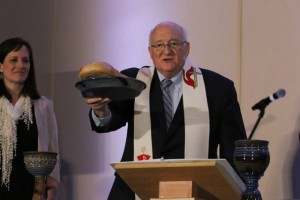
Bishop Mike Lowry celebrates Holy Communion.
preferred UM Church teachings. It didn’t go on record saying it would defy the church’s covenant and the will of the General Conference. And, finally, it did not provocatively push for the election of a bishop that would bring the church to the very edge of separation.
True, two bishops did celebrate Holy Communion, and one of them brazenly proclaimed, “we preach Christ and him crucified.” So in short, the WCA stubbornly adhered to Scripture and the church’s teachings, which, when decoded, clearly means they’re trying to divide the church.
Fortunately, dear Theophilus, the most wizened among our three commentators responded most thoughtfully to the conference with, “meh.” She reports that she’s seen groups come and go, and a gathering of 1,800 United Methodists is just so many small potatoes. Unlike all of those other unnamed and un-cited “[UM] commentators” who according to her “are all agog over the official launch of the WCA,” she fancies herself an unimpressed H.L. Mencken, our very own curmudgeon with a keyboard. It’s a wonder she deigned to dedicate a whole article to the paltry, little gathering.
But she did. And she can hardly constrain her contempt for these rabble-rousers. “In reality,” she writes, “the WCA offers little more than a new wineskin dressing up a very old wine that has turned to vinegar.” Mencken, indeed.
By the end of her “analysis,” however, the WCA is apparently more of a threat than she initially indicates. She darkly worries that the “[WCA’s] organizers have set up sufficient mechanisms to create their own denomination.” The small group also reminds her of “the hijacking of the 2016 General Conference by conservatives forces. It’s entirely possible,” she warns, “the WCA and its followers [that measly lot of 1,800?] could seek to hold the denomination hostage.” Yikes.
Dear Theophilus, I am sorry if this account is disconcerting, but I just wanted you to beware of a bunch of khaki clad people singing “On Christ the solid rock I stand.” Be warned, “There’s money behind this.” And as Lucy said to Charlie Brown, “It’s run by a big eastern syndicate you know.”

 By Kathy Gilbert-