by Steve | Dec 14, 2016 | Magazine, Magazine Articles, Nov-Dec 2016
 By Jerry Kulah-
Global United Methodism is at a crossroads and has to decide a path to its future. This is the time to carefully evaluate the past, understand the present, and anticipate a future consistent with our call by God to make disciples of Jesus Christ for the holistic transformation of the world.
In spite of the storm of life that may be raging in United Methodism, in spite of the attempt of some to take the church in a direction contrary to the teaching of Scripture, it is my prayer that God keeps The United Methodist Church moving forward and accomplishing God’s purpose for this generation.
Jeremiah 6:16 is an invitation from God through the prophet Jeremiah to the nation of Judah at a time when the nation was in a state of deep spiritual decline. Judah was at a crossroads of numerous choices that would determine her future. The spiritual climate was one characterized by gross disobedience and outright rejection of God’s word. Those leading the rebellion against God were the prophets, priests, judges, political leaders, and the people (Jeremiah 2:8-11; 5:1). We seem to see the church walking a similar path in contemporary society where some now think of the Word of God as being irrelevant, obsolete, and undesirable to govern the life of the people and ministries of the church.
The political and religious leaders at the time had turned their backs on God, and driven the nation into all kinds of perversions. The Word of God had become offensive to the people; everyone was following their own way. Idol worship, immorality, corruption of every kind was widespread. While national leaders were making bad political decisions, the priests and prophets were deceiving the people by offering them false peace and security. It was in the midst of such political and spiritual upheavals that God, in his love for his people, invited them at the crossroads, through the prophet Jeremiah.
Jeremiah declared, “This is what the Lord says: ‘Stand at the crossroads and look; ask for the ancient paths, ask where the good way is, and walk in it, and you will find rest for your souls. But you said, ‘We will not walk in it’” (Jeremiah 6:16).
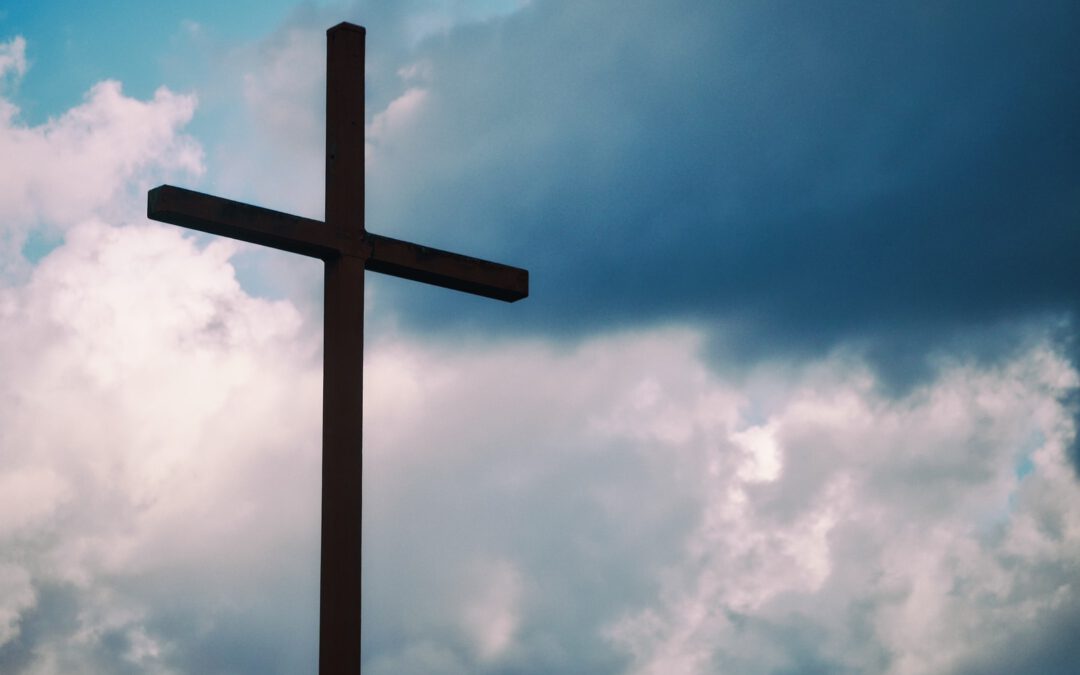
The Crossroads. A crossroads is a place of decision making on your life’s journey, where you make critical choices that might impact your life forever. It is a place where you either decide for God or against God; where you choose to follow God or follow your own gratification. A crossroads is a place where leaders guide and guard those they supervise in making the right decision for the common good, and for God’s glory. Crossroads also provide warning signs, make prophetic declarations, and give admonition to those who have drifted away from the path of God. We are all at the crossroads today.
Almighty God, in pursuit of reconciliation with his people, asked them to do four things at the crossroads of life.
1. Stand: To stand means to be spiritually alert, culturally sensitive, socially adaptable, intellectually informed, and to give careful attention to what God is doing in this time and season so that we might become a productive part of it.
The word, “stand” is a command, and it reminds us of a soldier standing on guard in full alertness for action. As soldiers of the Lord’s army, the Apostle Paul enjoins us to “stand firm. Let nothing move you. Always give yourselves fully to the work of the Lord, because you know that your labor in the Lord is not in vain” (1 Corinthians 15:58).
Moses used the same expression to encourage the fearful and terrified Israelites, when they were being pursued by the Egyptians to overtake them in the desert. He said to them, “Do not be afraid. Stand firm and you will see the deliverance the LORD will bring you today” (Exodus14:13).
Many United Methodists need this encouragement today to stand firm because the storms of life are raging within the UM Church. Things are falling apart regarding what we should believe about God and the Word. But the good news is that Christ has promised that he will build his Church, and the gates of Hell will not prevail against it (Matthew 16:18).
Are you standing firm in full alertness at the crossroads, or are you wandering about in every direction, like the Israelites in the wilderness? At the crossroads, it is time to stand for righteousness, to stand upon the truth of God’s infallible Word, to stand in faithfulness, in integrity, and in total submission to the will of God for our lives and for his Church.
2. Look: The word “look” means to observe, to take account of, to perceive, to discern, and to understand. We must have a clear vision for a better tomorrow, as to where God is leading this global Wesleyan community called The United Methodist Church.
As we look at the UM Church from a global perspective, what do we see? Do we see a growing or a declining church? Do we see leadership that is vision-driven and evangelistically-minded in pursuit of the purpose of God? Do we see spiritually healthy and growing pastors and members, or people who are spiritually ill and in need of a ‘balm from Gilead’ to heal their sin-sick souls? Based upon the state of United Methodism within your context, God is calling upon all of us to move forward with God’s agenda for the nations. And that agenda is to be the good news of God’s salvation to a world in need of hope and healing.
3. Ask: At the crossroads, God invites us to ask for the “ancient paths, the good way.” This is the way that leads to rest for our souls; the way that leads to love, peace and reconciliation with God and with one another.
Just as God led the Israelites from Egypt to the Promised Land by a pillar of cloud by day and a pillar of fire by night (Exodus 13:21-22), God is ever ready to lead the UM Church if we will ask him. When we ask, we shall receive (Matthew 7:7). Therefore, let us ask the Lord for the ancient path that leads the Church to righteousness, peace, and joy in the Holy Ghost. Let us ask the Lord for the way that leads the church to genuine repentance and submission to the will of God; and let us pursue the ancient path that leads us to making disciples of Jesus Christ for the transformation of the world.
4. Walk: God invites us to walk upon the ancient path. The ancient path is the holy, undiluted, and infallible Word of God (Psalm. 19:7-11; 119:105; II Timothy 3:16-17). It is the living and active word of God that is sharper than any double-edged sword; it is the Holy Scripture that penetrates the soul and spirit, and judges the thoughts and attitudes of the heart (Hebrews 4:12). The Word of God provides us guidance and direction into the future. As the Psalmist David points out, “Your Word is a lamp unto my feet and a light onto my path” (Psalm 119:105). God expects us to believe and obey so that we might be prosperous and successful (Joshua 1:8).
God’s challenge. Corresponding with these four directives, let the Wesleyan Covenant Association do its part to move forward with God’s agenda for the nations.
• Lead: We must lead and move forward with God’s agenda for God’s people (Joshua 1:2a). The way to lead is to serve faithfully and be a godly example to all.
• Be Courageous: We need to be very strong and courageous (1: 6-7), because we may encounter lots of discouragements along the way.
• Depend on God: We need to totally depend upon God to take possession of the land (vv. 2a-4); for victories over the enemies of the church (v. 5a); and for God’s presence and protection throughout the journey (1: 5b).
• Get a clear vision: We must have a clear vision from God as to what he wants the WCA to accomplish. And we must all embrace and pursue that vision. “Vision is the most potent weapon for world change,” says Bill Hybels. It is “the fuel that leaders run on, the energy that creates action; the fire that ignites the passion of followers. It is a clear call that sustains focused effort year after year, decade after decade, as people offer consistent and sacrificial service to God.”
• Christ-centered leadership: We must develop Christ-centered leadership across the jurisdictions and central conferences that are biblically committed to cast visions, set goals, mobilize the body of Christ, and overcome obstacles in order to reach the nations for Christ. In order to succeed in all of our endeavors, we must keep the Scripture primary for our faith and Christian living. And we must maintain a united, global perspective of the church.
• God’s Resources: We must rely upon God’s resources. God has promised to supply all of the resources (human, material, financial) we need for the journey. All we need to do is trust him, demonstrate good stewardship, and move forward with a holistic strategic plan for the WCA.
Final word. The only sustainable path to global unity of the people called United Methodist is total submission and loyalty to the Lordship of Jesus Christ, and an exclusive obedience to the Word of God as the primary authority for faith and Christian living. While we live within diverse cultures and religious worldviews, it is important that we love and embrace everyone, but we must continually live within God’s parameter of grace defined by Scripture.
Furthermore, we must endeavor to develop Christ-centered, mission-minded, and Holy Spirit-empowered leaders across our annual conferences, districts, and local churches who commit to making disciples of Jesus Christ for the transformation of the world. When we do these things, not only will we experience a new beginning, but the Holy Spirit of God will birth a season of revival amongst us that will result in the sustainable growth of The United Methodist Church around the world.
Jerry P. Kulah is the General Coordinator of the UMC Africa Initiative of the Central Conferences of Africa, and the dean of the Gbarnga School of Theology, a United Methodist seminary in Liberia. This article is adapted from Dr. Kulah’s address at the Wesleyan Covenant Association gathering in Chicago on October 7, 2016.
by Steve | Dec 14, 2016 | Magazine, Magazine Articles, Nov-Dec 2016

Jim Ramsay
By Jim Ramsay-
“I admire you for what you do. I would never be able to do that!” What missionary has not heard expressions such as this when visiting churches, friends, and support partners while on home assignment? In one church, I recall once being introduced with such incredibly gushing spiritual language that I wanted to sneak out the back. The Lord (and my wife) knew I was being overrated! While things may have tempered on this in recent years, there often still is the assumption that “foreign missionaries” are very high on the spiritual food chain. And the more remote the place they serve and the higher status job they “gave up” to go, the more impressive the spiritual resume.
There are two problems with this “missionary pedestal.” The first is for the missionary. It can generate unhealthy pride. People tend to fall off pedestals – the higher the pedestal, the longer the fall. The second and equal problem is when it is wrongly assumed that only super-spiritual people – those with a dramatic “calling” story or those who seem to “have it all together” – are the only ones who qualify for serving the Lord cross-culturally. Someone may conclude that the only way to do penance for not being enough of a spiritual giant to be a missionary is to get a good job and give financially to someone who is.
Not only is this attitude theologically unacceptable, but in today’s changing world of missions, it is not possible. If some decades ago the profile of a missionary was a theologically trained person prepared to go preach in a church somewhere else in the world, today that actually is the exception. In most of the places with the greatest need for a gospel witness, someone with that “preacher” profile is not likely to obtain a visa. Often a missionary in such a setting may not even be able to attend a local church, but can serve best by encouraging and discipling the local leaders. As a result, increasingly the work of missions requires people with skills that other nations deem helpful in areas that are conducive to building natural, organic relationships with the local people. As I have shared with our board of directors at The Mission Society, the day has come that we will do as well to recruit missionaries from engineering schools as from seminaries.
Joseph and his wife Melissa* felt called to serve in an Asian country that is doing all it can to keep missionaries out. Rather than quit his engineering job and go to seminary, Joseph kept his job when applying to The Mission Society. He and Melissa received the full training we provide to prepare them for cross-cultural service. Then Joseph found an engineering firm that has offices in that country and asked his supervisors if they would be willing to transfer him. Joseph and Melissa now live there where he works as an engineer. They are able to have regular friendships with co-workers and the people in their community.
In today’s global economy, Joseph and Melissa’s route can enable entry into nations and communities that would be very difficult to reach using traditional approaches. There are thousands of people who could be effective witnesses to the gospel in cross-cultural and even unreached settings if they were invited to rethink “what a missionary is.”
In addition to the possibility of moving into a cross-cultural setting in a country far from home, a person can also serve as a cross-cultural witness simply by intentionally locating in a community of recent immigrants to the United States. While occasional visits to such communities can have value, nothing is as effective as the incarnational model of Jesus “moving into the neighborhood” (John 1:14, The Message). Christians with normal, non-religious jobs can have an enormous gospel impact simply by intentionally living among people who are different, sharing life on life, and together seeking the Lord in that setting. I would hasten to add that even for those who serve like this in their “home country,” the need for good training in cross-cultural ministry and being connected for community care and support is still very important.
The era of missions is not over, but it is changing. It is not, nor has it ever been, just for the super spiritual. It simply requires God’s ordinary, fallible people seeing the world through God’s eyes and making themselves, their skills, their passions, and their weaknesses available to Him in whatever context He would place them.
*Pseudonyms used for security reasons.
Jim Ramsay is the vice president for Mission Ministries at The Mission Society (missionsociety.org; 770-446-1481). Jim and his family served 10 years in Kazakhstan.
by Steve | Dec 14, 2016 | Jan-Feb 2017
By B.J. Funk-
“I do not suppose that any man who is justified is a slave to sin: Yet I do suppose that sin remains (at least for a time) in all that are justified.”
– John Wesley
The serious Christian asks, “If I am a Christian, then does sin still dwell in me?” John Wesley says, “Yes,” and ponders his answer.
Is a justified man freed from all sin as soon as he is justified? Is there then no sin in his heart, or ever after unless he fall from grace? Wesley looks to Paul who said, “The flesh lusts against the Spirit and the Spirit against the flesh” (Galatians 5:17).
Paul repeats this when he writes to the believers at Corinth. He calls them “sanctified in Christ” in 1 Corinthians 1:2 and then moves just two chapters over to write that those whom he recently called sanctified are also worldly, showing jealousy and envy (1 Corinthians 3:1-3).
In 2 Corinthians 7:1 Paul exhorts believers to “cleanse themselves from all filthiness of flesh and spirit.” With those words, he makes it clear that those who are believers are not yet fully cleansed.
Wesley asks his reader, “What if a man reviles me, and I feel resentment? That resentment is ‘filthiness of spirit.’ I may refrain from saying anything, but that does not cleanse me from that filthiness of spirit.”
Wesley continues to explain that believers know they have a tendency to evil and a proneness to depart from God. Yet, at the same time they know they are of God and they feel His Spirit clearly. They are equally assured that sin is in them and that “Christ is in them, the hope of glory.”
I personally love this next statement from Wesley. “Can Christ be in the same heart where sin is? Undoubtedly He can; otherwise it never could be saved therefrom. Where the sickness is, there is the Physician” (italics mine).
It seems clear from this text that John Wesley fully believed that a saved soul still has the remnant of the old man inside. The wonderful news is, however, that, though sin remain, sin does not dominate the sanctified believer. A man may walk after the Spirit though he still feels the flesh lusting against the Spirit. Sin remains, but the difference is we are not a slave to sin.
Having sin in my life does not forfeit the favor of God. Giving way to sin does. Wesley sums up his teaching on sin with these words: “There are in every person, even after he is justified, two contrary principles, nature and grace, termed by St. Paul as the flesh and the Spirit. Although babes in Christ are sanctified, it is only in part. According to the measure of their faith, they are spiritual. Yet, in a degree, they are carnal. Believers know that they are in Christ, yet they also know that their heart is sometime ready to depart from Him.”
These next words of Wesley give clear meaning to this teaching. “It (feeling that a sanctified believer has no sin at all) cuts off all watching against our evil nature, against the Delilah which we are told is gone, though she is still lying in our bosom. It tears away the shield of weak believers, deprives them of their faith and so leaves them exposed to all the assaults of the world, the flesh and the devil.”
Wesley’s parting words in this sermon summarize his thoughts.
1) We are indeed renewed, cleansed, purified, sanctified the moment we truly believe in Christ.
2) Yet, we are not renewed, cleansed and purified altogether.
3) The flesh remains, though subdued, while it wars against the Spirit.
4) We must fight the good fight of faith, watch and pray, and put on the whole armor of God.
5) Even though we wrestle with principalities and powers and wicked spirits in high places, we seek to stand in the evil day, and having done all, to stand.
by Steve | Dec 13, 2016 | Magazine, Magazine Articles, Nov-Dec 2016
B.J. Funk
By B.J. Funk-
An ancient merchant had three lovely daughters. But due to a tragic turn of events, he had lost all hope that his daughters would be able to marry and live a happy life. It was the third century, and this businessman had lost his fortune when pirates pillaged his ship. His beautiful daughters were of marrying age, and without money he could give them no dowry. In those days, young women without a dowry had few options for survival. Many were forced into slavery or prostitution.
The father prayed around the clock that somehow God would grant a miracle for his family. A young Christian bishop discovered the plight of this man and his daughters. This bishop was a wealthy man, having received a large inheritance at the death of his parents. One evening, in the middle of the night, the bishop secretly slipped a sack of gold through a window into the merchant’s house. This timely gift saved the virtue of the man’s oldest daughter.
Later, another sack saved the second daughter. When the third sack came mysteriously in the night, the father was waiting up to see this mystery person. Immediately, he recognized the young bishop and tried to thank him.
The humble minister deflected the praise. “No, all thanks go to God, not to me.” This compassionate bishop believed literally Christ’s injunction that when we give, we should do so in secret, sacrificially in Christ’s name and not our own.
Through his timely gifts, Saint Nicholas helped to restore the hope of this family, and hundreds more in his community. But the ministry of Bishop Nicholas extended beyond giving gifts. History tells us that he was persecuted by the Roman authorities and imprisoned for his faith. Later, when Emperor Constantine made Christianity the state religion, Nicholas was released from prison.
After returning to his post as bishop, Nicholas was called upon to defend Christianity against the heresy of Arianism. A contemporary of Nicholas and an early church theologian, Arius taught that God the Father and God the Son did not exist together eternally. Arius also taught that the pre-incarnate Jesus was a divine being created by (and possibly inferior to) the Father at some point, before which the Son did not exist. Nicholas boldly defended the doctrine of the Trinity at the Council of Nicea. This was the first ecumenical council of the early Christian Church, and it produced the first uniform Christian doctrine – the Nicene Creed.
Throughout his ministry, Bishop Nicholas selflessly poured out his life and his fortune as he served the people in and around his home. Obeying Jesus’ words to “sell what you own and give the money to the poor,” Nicholas used his inheritance to assist the suffering, the sick, and the poor.
Through the centuries St. Nicholas has continued to be venerated by Roman Catholics and Orthodox Christians — and he is honored by Protestant Christians. By his example of generosity to those in need, St. Nicholas is a model of Christ’s call to selfless giving
In January 1809, Washington Irving published the satirical Knickerbocker’s History of New York, which made numerous references to a jolly St. Nicholas character. This was not a saintly European bishop, but rather a Dutch burgher with a clay pipe. The jolly elf image received a big boost in 1823 from a poem destined to become immensely popular, “A Visit from St. Nicholas,” — now better known as “The Night Before Christmas.
Beginning in 1863, Nast began a series of annual drawings in Harper’s Weekly that were inspired by the descriptions found in Washington Irving’s work. These drawings established a rotund Santa with flowing beard, fur garments, and a clay pipe. Nast drew his Santa until 1886, and his work had a major influence in creating the modern American Santa Claus.
Though the modern Santa does not resemble the original Saint Nick, history takes us back to a simple Christian bishop who loved God and loved people. Bishop Nicholas displayed his love through the giving of gifts, just as our Heavenly Father gave the gift of His Son to us that first Christmas morning 2000 years ago.
by Steve | Dec 9, 2016 | In the News, Perspective E-Newsletter
By Walter Fenton-
The United Methodist Church’s General Council on Finance and Administration (GCFA) reported a 2.9 percent decline in weekly worship attendance from 2014 to 2015. Some observers merely shrug when they hear about a 2.9 percent loss. It seems deceptively inconsequential.
The stark truth is that a 2.9 percent decline means a loss of 82,313 worshippers, the largest loss in the denomination’s 48-year history. On average, UM local churches in the U.S. collectively welcomed 2,832,239 to worship services each weekend in 2014. That number dropped to 2,749,926 in 2015.
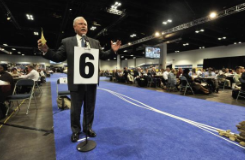
2012 General Conference delegate. Photo by Paul Jeffrey, UMNS.
The figure is considered a key indicator of the health and vitality of the church, and it is an important number for helping the GCFA construct the quadrennial budgets for the general church. Last year, when the GCFA learned that average worship attendance fell 2.6 percent from 2013 to 2014, it revised downward its budget proposals for the 2016 General Conference delegates.
While a 2.9 percent decline from one year to the next does not immediately threaten the church, cumulative drops of two percent or more are cause for grave concern. In four of the last six years the denomination has seen drops above that threshold.
Throughout much of the 1970s, 80s, and 90s, average worship attendance declined, but not precipitously so. While the rate dropped overall, there were years when average worship attendance actually increased. (The last time the denomination registered an increase in worship attendance was 2001, when the figure grew by 1.7 percent. Many church statisticians considered that rise an anomaly due to a resurgent, but brief interest in church attendance shortly after the 9/11 terrorist attacks. The UM Church was not alone in seeing an increase in 2001.)
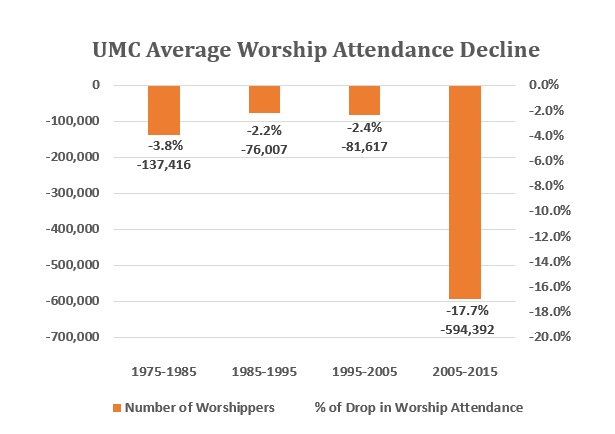
“Between 1974 and 2002, we lost an average of 4,720 in worship attendance per year,” said Dr. Don House, a professional economist and former chair of GCFA’s Economic Advisory Committee. “But a major shift occurred in 2002. The rate skyrocketed to an annual rate of 52,383 between 2002 and 2012, and now we’ve seen losses of 62,571 (2012-2013), 75,671 (2013-2014), and 82,313 between 2014 and 2015. This is not sustainable.”
Generally, declining rates of worship attendance have a knock-on effect. As local churches see fewer and fewer worshippers, they find it harder to stem their declines. Eventually, they discover they can no longer afford a full-time pastor, which only exacerbates their situations.
More broadly, the denomination then struggles to recruit new pastors, particularly younger ones with families and college debt. People considering full-time ministry justifiably wonder if there would be a local church appointment available that could pay a decent salary with health and pension benefits.
Calculations like this ultimately impact the church’s seminaries in declining enrollments, leading to reduced staffing at the institutions, and even threatening their viability. In short, the drop in worship attendance erodes the very infrastructure many believe is necessary to reverse the downward trend.
In a 2014 report to the GCFA and the Connectional Table, the denomination’s highest administrative body, House warned that the church needed to quickly adopt a credible and metrics driven plan to arrest the plunge in worship attendance. If it failed to do so, he projected that by 2030 the denomination would slide into permanent decline and face collapse by 2050.

Dr. Don House – a lifelong United Methodist – holds a Ph. D. in economics and chairs the denomination’s eight-member Economic Advisory Committee. Photo by Steve Beard.
When House prepared his report he possessed attendance records through 2013. Based on the figures at hand he projected an annual rate of decline of 1.76 percent, but the numbers from the last three years (2.1, 2.6, and 2.9) are well above that rate.
“If we experience a growing rate of decline, as demonstrated since 2012,” said House, “our window for a turnaround strategy will be shorter than I originally projected. We cannot maintain the connection unless we are able to implement and fund a strategy within the next 14 years.”
All five jurisdictions in the U.S. experienced average worship attendance losses in 2015. The Western Jurisdiction led the way with a drop of 3.6 percent followed by the Northeastern (3.5), North Central (3.2), South Central (2.8), and the Southeastern (2.5).
Four of the 56 U.S. annual conferences actually bucked the downward trend with increases in attendance: Yellowstone (9.5 percent), West Virginia (4.3), Dakotas (1.7), and Peninsula-Delaware (1.1).
Conferences with the steepest losses were: Eastern Pennsylvania (7.3 percent), New Mexico (6.8), Susquehanna (5.7), and Dessert Southwest (5.4). Between 2014 and 2015 the Eastern Pennsylvania Annual Conference saw one of its largest and fastest growing local churches exit the denomination.
Wesley Church in Quarryville, PA exited the Eastern Pennsylvania Annual Conference in 2015.
Various reasons for the decline in attendance have been cited.
There is general agreement that many local churches are located in areas where the general population has been declining for years (e.g., western New York and Pennsylvania, and across the upper Midwest and Great Plains states). When these churches were planted in the 19th century their locations made good sense, but now, due to declining population, they are difficult to sustain. It is also true that UM Church members are an aging population, so some of the decline in average worship attendance is simply due to attrition.
These natural declines are not being offset by local church growth in the major metropolitan areas clustered along the coasts, across the south, and in other urban areas where other denominations and non-denominational churches are either holding their own or seeing increases. For instance, the UM Church has only a few large, growing congregations in the densely populated urban areas of the northeast and the west.
Of the approximately 32,100 local UM churches in the U.S., 76 percent (24,654) average less than 100 in attendance, and nearly 70 percent (16,909) of those actually average less than 50 on Sunday morning. Local congregations below that threshold are often challenged to afford a full-time pastor or to find the resources necessary for a sustained plan of evangelization.
Beyond the reasons cited above, there is considerable debate as to why worship attendance has fallen for the past 14 years straight, and why the rate has accelerated so dramatically in the past five.
Many progressives and some centrists argue the church is woefully out of step with the broader culture, particularly with millennials. They claim the church is actually alienating many people with its stands on social issues, particularly those having to do with sexual ethics and marriage.
Traditionalists and other centrists argue the church has lost its evangelical zeal, and also claim the Council of Bishops’ public failures to maintain the good order of the church has undermined local church effectiveness, sapped the morale of clergy and laity who have come to distrust their leaders, and driven members away from its congregations. They also dispute the claim that the church’s sexual ethics and teachings on marriage are driving millennials away. They note that some of the largest churches in the denomination affirm the denominations’ traditionalists teachings and continue to draw large numbers of the demographic.
Despite the record loss for the denomination, many local churches continue to thrive, grow, and show signs of health and vitality in the ministries they undertake every day.
“I am confident,” said the Rev. Rob Renfroe, president of Good News, “that when we United Methodists are at our best, we have a message that will win people to Christ, transform lives, and send out dedicated disciples to the last, the least, and the lost. I’ve seen it happen over and over again in many different places. But given the crisis we are facing, we must be prepared, going forward, to consider bold ideas and implement major structural changes.”
Walter Fenton is a United Methodist clergy person and an analyst for Good News.

 By Jerry Kulah-