by Steve | Jul 25, 2017 | In the News

Dr. Kenneth Kinghorn
By James V. Heidinger II
Dr. Kenneth Cain Kinghorn, 87, passed away peacefully at his home on July 23, 2017. Where does one begin in describing such a fruitful and productive life as his? Ken was a highly-respected author and teacher among Wesleyans literally around the world. He was a friend to evangelical and orthodox United Methodists, and a personal friend and encourager to many of us in denominational renewal ministries.
Ken attended Asbury Theological Seminary and then earned a Ph.D from Emory University in historical theology. During this time as a graduate student, he pastored Methodist churches in Kentucky and Georgia. He joined the faculty at Asbury Theological Seminary in 1965 and taught full-time until 2003, and then part-time until 2016, an amazing span of some 51 years! During those years he taught church history winsomely to thousands of future church leaders. He also served as Provost (1983-1986) and as Dean (1995-1999) at the seminary.
I never had the privilege of having a class under Ken at Asbury, but I did share in a small prayer group with him while still a student there. My admiration for him began there and continued to deepen across the years. For the past three decades, Ken and his lovely wife, Hilda, have been active members at First United Methodist Church in Lexington, where my wife Joanie and I have attended. For several decades, Ken spent many weekends traveling to churches across the country preaching, teaching, and leading workshops. It was always a rich time to catch up with him after church or over lunch to get a report on where he had been and how his weekend of teaching and preaching had gone.
It was also refreshing, as well, to get reports on his latest writing projects. Here was a full-time professor, an active churchman, and a husband and father who still had time to write — and did he ever write. Ken authored hundreds of articles (including a number for Good News) and more than 25 books, including The Heritage of American Methodism, Gifts of the Holy Spirit, and his highly significant three-volume set of John Wesley’s Standard Sermons in Modern English. A number of his works were translated into multiple languages. (He did preaching and teaching tours in Japan and Korea.)
Ken was able to be so productive because he was very Wesley-like in his personal disciplines — rising early each day for devotional reading, prayer and writing, always redeeming the time. His last book, an unusual high-quality volume of portraits of John Wesley, he completed just a month before he died.
Ken has been a friend to seminarians in more ways than most might realize. He helped to found, and to lead — as well as fundraise for — several foundations providing financial support for graduate students preparing for academic and pastoral vocations within the Wesleyan tradition. These included A Foundation for Theological Education (He was a founding and long-time member of the AFTE board of directors), a visionary ministry written about recently in the pages of Good News, and also a Foundation for United Methodists. His heart was set to help students. For many years, he taught continuing education (up through 2016) for the United Methodist Church’s Appalachian Lay Pastors School. This is simply who Ken Kinghorn was, a servant of the church.
Ken is survived by his wife, Hilda, three sons and a daughter, and numerous grandchildren. Thanks to you, Hilda, for encouraging Ken as he shared his many gifts with thousands of folks all across the country and beyond. So many of us have been enriched by his life, his winsome faith, and his Spirit-led teaching and ministry. My hearts is still profoundly moved as I reflect on what his life has meant to so many. And to me.
Kenneth Cain Kinghorn was one of the most authentic and consistent followers of Christ I have been privileged to know. Thank you, Heavenly Father, for this splendid Christian scholar, teacher, friend, and mentor of so many. His life has borne much fruit—and we know it will continue to for countless years to come.
James V. Heidinger II is the publisher and president emeritus of Good News. A clergy member of the East Ohio Annual Conference, he led Good News for 28 years until his retirement in 2009. Dr. Heidinger is the author of several books, including the recently published The Rise of Theological Liberalism and the Decline of American Methodism (Seedbed).
by Steve | Jul 24, 2017 | In the News, Uncategorized
The Wesleyan Family Tree
By Kenneth C. Kinghorn (1930-2017)
John Wesley invented no new theological doctrines. “Whatever doctrine is new must be wrong,” he wrote, “and no doctrine can be right, unless it is the very same ‘which was from the beginning.’” Mr. Wesley said, “If Methodism…be a new discovery in religion…this [notion] is a grievous mistake; we pretend no such thing.” Far from being narrowly sectarian, John Wesley was a catholic Christian. He stood firmly in the mainstream of historic Christianity, and drew from many of the tributaries that fed into it.
1. Early Church Writers. John Wesley often referred to “Primitive Christianity,” that is, the Church from the end of the apostolic age to the early fourth century. Christian writers in this era helped confirm the biblical canon, the doctrine of the Trinity, and the mystery of the Incarnation, through which the eternal Christ entered time and space as fully human and fully God. Mr. Wesley said of those early, “primitive” Christians, “I reverence their writings, because they describe true, genuine Christianity….They never relinquish this: ‘What the Scripture promises, I enjoy. That the God of power and love may make you, and me, such Christians as those Fathers were, is [my] earnest prayer.’”
2. The Protestant Reformation. John Wesley was a Protestant, who believed the Medieval Church had allowed layers of nonbiblical tradition to cloud the gospel of grace. Accumulated ecclesiastical inventions compelled the sixteenth-century Reformation. The Wesleyan message harmonizes with the fundamental themes of the Protestant Reformers, who recovered the supremacy of Scripture above human conventions. The essence of Protestantism is that salvation comes through grace alone, faith alone, and Christ alone. Wesley wrote, “We have all reason to expect…that [Christ] should come unto us quickly, and remove our candlestick out of its place, except we repent and…unless we return to the principles of the Reformation, the truth and simplicity of the gospel.”
3. Pietism. The Wesleyan tradition also borrows from the seventeenth-century German Pietists. Those earnest Christians championed the individual’s personal knowledge of Christ, serious discipleship, Christian witness, missions, and social ministries. Wesley referred to the Pietist August Francke as one “whose name is indeed as precious ointment. O may I follow him, as he did Christ!” From the Moravian Pietists, the early Wesleyan movement appropriated such means of grace as class meetings, conferences, vigils, and Love-feasts.
4. The Mystics. The influence of certain aspects of mysticism further reveals the catholicity of the Wesleyan message. John Wesley’s reading of Thomas à Kempis led him first to see that “true religion was seated in the heart, and that God’s law extended to all our thoughts as well as our words and actions.” Jeremy Taylor’s Rule and Exercises of Holy Living (1650) and Rule and Exercises of Holy Dying (1651) and William Law’s Serious Call to a Devout and Holy Life (1728) convinced Wesley of “the exceeding height and depth and breadth of…God.” The mystics also helped Wesley understand the Christian’s privilege of knowing the inner witness of the Holy Spirit. He wrote, “The light flowed in so mightily upon my soul, that everything appeared in a new view….I was persuaded that I should be accepted of Him, and that I was even then in a state of salvation.”
5. The Puritans. The Wesleyan message also bears the influence of the Puritan divines, such as John Owen, Thomas Goodwin, and Richard Baxter. These prodigious writers highlighted the profound depths of grace, God’s call to purity, and living daily in the light of eternity. “Their judgment is generally deep and strong,” said John Wesley, “their sentiments just and clear, and their tracts on every head full and comprehensive, exhausting the subjects on which they write…. They are men mighty in the Scriptures, equal to any of those who went before them, and far superior to most that have followed them.”
The power of the Wesleyan witness. All valid Christian traditions preach that justification and adoption give repentant sinners a new standing, in which God imputes Christ’s righteousness to us and frees us from the guilt of sin. The Wesleyan message also emphasizes that regeneration and sanctification give us a new state, in which God imparts Christ’s righteousness to us and frees us from the power of sin.
The sources and treasures of the Wesleyan message have never been more relevant than today.
Kenneth C. Kinghorn taught Methodist history for more than 43 years at Asbury Theological Seminary in Wilmore, Kentucky. He died on July 23, 2017. He is the author of many books including The Heritage of American Methodism and the three volume set of John Wesley’s Standard Sermons in Modern English. This article originally appeared in the January/February 2010 issue of Good News.
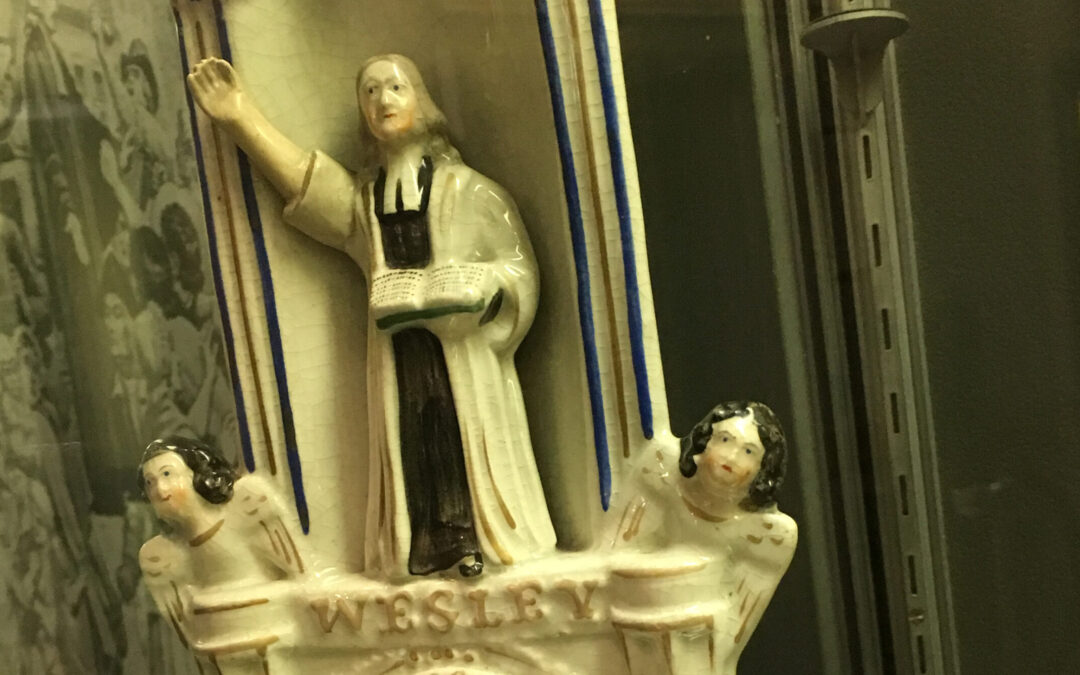
Art: This is a model for a proposed Wesley monument to be built at Epworth in the mid-1800s that never materialized. It was on the display at the World Methodist Museum in Lake Junaluska, North Carolina. Photo by Steve Beard.
by Steve | Jul 24, 2017 | In the News, Perspective E-Newsletter
 Guest Perspective from Dr. William J. Abraham
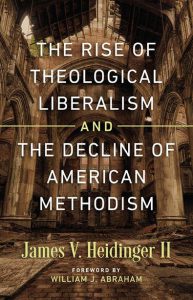
As The United Methodist Church prepares for an unprecedented called General Conference in 2019, Seedbed Publishing recently released an important book to help us understand the deeper theological debates that have led to our present impasse. The Rev. Dr. James Heidinger’s The Rise of Theological Liberalism and the Decline of American Methodism is a masterful history of the subject.
For 26 years Heidinger was the president of Good News. During that time he wrote hundreds of editorials, several books, and spoke at least once in nearly every annual conference in the U.S.
Jim has always been known for his irenic spirit, his commitment to dialogue, and his passion for a church fully committed to Scriptural Christianity.
In The Rise of Theological Liberalism, Jim demonstrates what so many of us have always known about him. He carefully does his research and then, without rancor, tells the story in a fair and clear manner.
We admit we are a bit biased when it comes to Jim’s writings. So don’t just take our word for it, here is an excerpt from the foreword to Jim’s new book.
-Good News
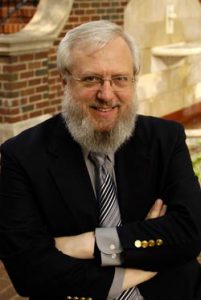
Dr. William J. Abraham
Foreword by Dr. William J. Abraham
This book constitutes a pivotal intervention in the current debates about the nature and future of United Methodism. It should be read and pondered across the denomination. It will be seen by historians as an invaluable source for understanding what has happened over the last generation.
James Heidinger II has been a quiet but extremely influential figure in the recent history of United Methodism. He makes no pretension of being an academic historian. However, this is one reason why this work is so important. He has been deeply involved in the life of the church as an agent who has sought to renew United Methodism across a lifetime of ministry and service. It is not a role that anyone in his position can relish because it entails being a lightning rod for all sorts of fantasies and anxieties about the church. However, he has borne years of criticism with incredible dignity and fortitude, plugging away as a master of ceremonies in both high and low places. The result is a personal take on what has happened from an agent of change and hope. He has operated from the trenches and his analysis must be taken seriously precisely because his observations represent a crucial but neglected stream within United Methodism as a whole. We cannot understand where we have come from or where we are headed without this clearheaded and gracious testimony.
I find it astonishing that so few have devoted attention to providing serious historical narrative of Methodism in the United States across the last generation. Maybe we are still too close to events to venture forth. Maybe the truth about our recent past is too painful to record openly. Maybe we are too confused to know how to orient our narratives. Whatever the case, we have here a hang glider account that provides grist for all future historical mills that may operate. No doubt in time there will be other narratives; however, this narrative must be given a privileged place in the resources that are available. We have here an insider’s account of the first importance.

James Heidinger II
Heidinger’s passion has long been the scriptural and doctrinal reinvigoration of United Methodism. He has, to be sure, also been heavily involved as a key leader of the Good News movement in the ecclesial events of the last half-century. Because of this latter identity it is easy to dismiss his work as that of a political operator. I recently heard of one leading bishop who dismissed the evangelical and orthodox wing of United Methodism as an incarnation of Machiavelli. I doubt if he knows anything of substance about Machiavelli and the recent scholarly revision of his work….
Heidinger has wisely decided to focus on a theological reading of the recent past and how that effects the decline that everyone readily recognizes. The content is decidedly his own. Other evangelicals may want to draw up a different bill of particulars. They may balk at the sharp disjunction between liberal and conservative in play here. However, the great virtue of the approach adopted is that it is clear and substantial. Other narratives will have to reckon with this one if we are to make progress in understanding and action. In fact, this is no mere propaganda piece in favor of Good News and other Renewal movements in the neighborhood. Heidinger has his own searching critique of his own tribe and team. Even so, he has never been a jeremiad; he has been resilient in working for civil dialogue and constructive change.
It is patently clear that we now stand at a crossroads as far as the future of United Methodism is concerned. Folk are moving beyond anxiety toward the development of what Professor David Watson has aptly called “the Next Methodism.” Rest assured there will be a next Methodism and it will have a stormy relationship with the United Methodism put together by a complex hero of many evangelicals, Albert Cook Outler, of blessed memory. Outler shifted his ground in later years, although few know the details as yet. He had a stormy relationship with evangelicals, as he did with everyone. I would dearly love to get his take on where we are. Whatever he might be thinking on the other side, we are headed for a new day. It would be great to sit in on a seminar with Outler and Wesley and other great heroes and heroines of our tradition. The workers die but the work goes on, as Wesley once noted. There are eighty-two million descendants of John Wesley across the globe so Methodism is not going to disappear any day soon. The big question is what place United Methodism will have in that future. This book is a must-read for those pondering that question.
William J. Abraham is the Albert Cook Outler Professor of Wesley Studies at Perkins School of Theology, Southern Methodist University, in Dallas.
This excerpt is taken from Dr. Abraham’s Forward to The Rise of Theological Liberalism and The Decline of American Methodism by James V. Heidinger II (Seedbed, 2017). Heidinger is president emeritus of Good News. This excerpt is reprinted by permission of Seedbed.com. To purchase Heidinger’s book click HERE.
by Steve | Jul 17, 2017 | In the News, Perspective E-Newsletter
 By Walter Fenton-
The Commission for a Way Forward will gather for its fourth meeting in Chicago, July 19-21, as it searches for a way to break the impasse in an increasingly divided church.
According to a press release, the 32-member commission indicated after its early April meeting in Washington D.C. that, “it was leaning toward a simpler structure with clearer processes for decision-making and accountability for The United Methodist Church in its mission to make disciples of Jesus Christ.”

Commission for A Way Forward Members Meet, UMNS
However, the commission will gather for its fourth meeting as United Methodism continues absorbing a number of major developments impacting the 12.7 million member, global denomination.
Since the last time the commission met, the church’s Judicial Council (its “Supreme Court”) handed down a ruling that left Bishop Karen Oliveto, openly lesbian and married, as the leader of the Mountain Sky Episcopal Area. That was in late April.
 However, the Council’s decision made it clear that the consecration of a bishop found to be in a same-sex marriage is a violation of church law. Outstanding complaints were filed against Oliveto in August of 2016, but nearly one year later the Western College of Bishops has offered no word on their disposition. (The Council just recently rejected the Western Jurisdiction College of Bishops’ request to reconsider part of its April decision.)
The Council’s decision and the outstanding complaints have kept Oliveto’s episcopal leadership under a cloud of controversy. Some individuals and congregations have reduced or stopped contributing to the Rocky Mountain and Yellowstone Annual Conferences that she oversees. The latter recently reported it is in the midst of a financial crisis.
In two other cases, the Judicial Council ruled annual conference boards of ordained ministry cannot negate or defy church law when it comes to examining and recommending clergy candidates for commissioning and ordination. Despite the rulings, at least two annual conference boards have said they will not abide by the judiciary’s decisions.
Also, since the commission’s last meeting, two large churches in Mississippi – The Orchard (Tupelo) and Getwell Road (Southaven) – have officially exited the denomination. Their exits come amidst growing reports that some local churches are withholding apportionments from a denominational hierarchy that appears increasingly conflicted and unable to enforce its own standards.
Since the commission’s meeting in D.C. it has solicited and received input from various North American advocacy groups, denominational leaders of boards and agencies, large church pastors, and seminary students. (There is a group on the commission attempting to gather input from United Methodists outside the United States, but that data has not yet been presented to the commission.)
“The United Methodist Church’s decades-long attempt to silence our voices and to destroy our community and culture have proven that LGBTQ lives are not valued in the least,” wrote leaders of Love Prevails, a leading LGBTQ advocacy group. “The only proper and Christian corrective to the unjust and prejudicial treatment our people have received at the hands of the United Methodist Church is the full and complete removal of all language in the Book of Discipline which categorically discriminates against LGBTQ people“(emphasis included in original).
The newly formed Wesleyan Covenant Association wrote to the commission, “We affirm the ways all persons are welcomed into our church in a graceful and biblical way. Our United Methodist Book of Discipline presently affirms LGBTQ+ persons as people of sacred worth, deserving to receive the full life of grace which the church provides.”
The WCA also reaffirmed the UM Church’s sexual ethics , its long held teaching that marriage is between one man and one woman, and it added, “The UM Church today is a deeply divided church where we often use the same words, cite the same Scriptures, quote the same Wesley Sermons, and pledge fidelity to the same Discipline; but we are talking about VERY DIFFERENT expressions of Christian faith. We disagree in basic beliefs and practices, with no real means of accountability, which makes our covenantal relationships untenable. We are no longer one church” (emphasis included in original).
This November the Council of Bishops (COB) will receive an interim report from the commission, and the report will likely include at least the outlines of a plan for the bishops’ preliminary reflections.

Delegate speaks at General Conference, UMNS
The commission is expected to submit its final proposal for a way forward to the COB in April 2018. The COB has the right to modify it, but it must publicly release a proposal no later than July 4, 2018, so the delegates slated to attend the called 2019 General Conference have time to give it their due consideration.
Unless two-thirds of the delegates decide otherwise, the plan, amendments to it, or alternative plans will be the only item of business for consideration. While there is no groundswell of support for any particular plan for breaking the impasse, United Methodists across the theological spectrum do seem to agree that failure is not an option at the called 2019 General Conference.
Walter Fenton is a United Methodist clergy person and an analyst for Good News.
by Steve | Jul 14, 2017 | In the News
Members of the Bishops’ Commission on A Way Forward, my colleagues at Good News and I thank you for your service to the church which is time consuming and, no doubt, emotionally draining. We have been praying for you and will continue to do so.
Bottom line, we pray that you will propose a solution that allows good people to be true to their convictions and that does not create winners and losers. Doing so will require enough structural separation that neither progressives, nor centrists, nor traditionalists must compromise their deeply held beliefs regarding the Scriptures, the work of the Holy Spirit, or sexuality.
Many of us are weary of the destructive battle that has harmed the church and our witness to the world. We are praying that God will grant you the wisdom and the courage to recommend a solution that ends the infighting that has diverted much of the church’s creative and financial resources from our mission of making disciples of Jesus Christ for the transformation of the world. Thank you for this opportunity to share our thoughts and concerns.
We believe:
1. Our differences are irreconcilable. Progressives cannot live in a church that does not marry gay couples and ordain gifted, partnered gay persons. Traditionalists cannot live in a church that does. We can value and welcome all people into our churches. However, we cannot be in a church that promotes what we believe is contrary to God’s Word.
2. We can respect those with whom we disagree. We believe a progressive sexual ethic is contrary to the Scriptures and ultimately detrimental to the church. But we also believe that our progressive brothers and sisters are sincere in their beliefs. We do not want a solution that has winners and losers or where one side is punished or penalized for their convictions. We may not be able to avoid a real structural separation – the other mainline denominations have not been able to do so. But we can do what they have not been able to do – honor each other’s convictions and sincerity by creating a fair, respectful, and amicable parting.
3. The local option is not a viable solution. This option did not receive enough support even to come to the floor in Portland. With most of the same delegates returning, there is no reason to believe it would pass with a majority of the vote in 2019, much less receive the support of two-thirds of the Conference needed for a solution requiring constitutional amendments.
4. Should the local option or some form of the jurisdictional plan pass, the church will come apart. When the jurisdictional plan was seen by some as a viable solution in 2015, Good News held a conference call with nearly 100 pastors of our largest evangelical churches. We expounded on the positive benefits of this plan for traditionalists. In a poll the next day, a majority of the pastors said they could not live with this plan and would do all they could to lead their churches out of the denomination should it pass. The “local option” was even more soundly rejected. It may be hard for progressives and centrists to understand, but many, if not most, traditionalists cannot participate in a church that allows its pastors and bishops to promote something they believe to be sinful even if they themselves are not required to do so.
5. Some form of connection is possible. To receive evangelical support, a plan does not have to remove all ties between the new entities it creates. The pension board, publishing house, UMCOR, and other connections could remain, as well as some kind of Methodist affiliation similar to the World Methodist Council. But most of our pastors cannot remain in a denomination that allows and promotes practices they believe are contrary to the Scriptures.
6. Doing nothing or forming a solution that requires traditionalists or progressives to compromise their beliefs will do great harm. More and more traditional United Methodists are leaving the denomination every day. I receive letters from such people every week. If responses to progressive blogs are to be believed, progressive members are also leaving because they disagree with our present position and they believe the church is harming people. We do not have an easy solution before us. Every possible proposal will create pain. But, the worst solution is to do nothing. In fact, if the commission is not able to propose a way forward that sets both sides free to pursue its vision of God’s will, the present exodus will increase greatly.
Since Good News began in 1967, we have remained at the table in dialogue with those who have different views of Scripture and sexuality. We have been willing to continue the conversation even though our differences have appeared to be irreconcilable. But we are in a different place now. We are no longer a church merely with differing views. We now have differing practices. Annual Conferences, Boards of Ministry, and Jurisdictions have voted to be disobedient to the Book of Discipline, have knowingly acted contrary to our covenant, and have said they will not change in the future. If we are one church, we cannot act as if we are two. If we are two churches, or more, we should no longer pretend to be one.
If you are unable to present a plan that is acceptable to the delegates at General Conference and, later, to the delegates in the Annual Conferences, the church will not separate. It will shatter. The bishops will have failed to fulfill the most important task we have asked them to address in decades. Our leaders, lay, and clergy, will have proven to be ineffective and out of touch. We will leave St. Louis even more hopeless and defeated than we left Tampa in 2012. And the consequences will be devastating. Many traditional churches will immediately stop paying apportionments and many will file law suits to leave the denomination. Whether these churches are successful in leaving with their property and assets or not, the legal fees incurred by the annual conferences will be in the millions of dollars. It will be ugly, expensive, far from amicable, and a terrible witness to the world.
We don’t need winners. And we don’t want losers. But we cannot abide a proposed solution that does not end our fighting. To be adopted it must include sufficient separation that traditionalists in both the United States and the central conferences can affirm it overwhelmingly.
With prayers and gratitude,
Rob Renfroe
President
Good News