by Steve | Dec 4, 2017 | In the News, Perspective E-Newsletter
 By Thomas Lambrecht-
It has been alarming to read and hear the steady drumbeat of new allegations of sexual harassment and inappropriate behavior by leaders and other powerful men in our country. A small ripple has become a tidal wave of reports, swamping even the most powerful who have withstood a winked-at reputation for decades.
What is new at this time is the spotlight being put on women’s stories of abusive behavior. It is one thing to read the statistic that more than 40 percent of American women report having experienced sexual harassment. It is another thing to hear the stories of some of the behavior that women have had to endure.
As a married father of three daughters, these stories are beyond disgusting. As a Christian, they are morally reprehensible. I find it difficult to conceive how some men could act this way, although I know in my head that such behavior has existed since the dawn of time.
We can and should make sure that laws and policies protect women and men from abusive behavior. We can and should provide clear avenues for victims to find redress for the abuses committed against them. But laws alone cannot solve a problem of the human heart. Only Christ can.
God is in the transformation business. He wants to transform our lives into the likeness of Jesus Christ. And he wants to transform our culture through the leavening power of the Holy Spirit expressed in the lives of believers who permeate society like yeast in dough. That transformation is an inner change wrought by the Holy Spirit, as we cooperate and live into the change he is working in us.
There are several images in Scripture that can help us welcome God’s transformation into this area of our lives.
One image has to do with treating women with respect. The Apostle Peter says some pretty revolutionary things in I Peter 3:7, when he commands husbands to “be considerate as you live with your wives, and treat them with respect.” Although specifically addressed to husbands and wives, the points apply to all male-female relationships. Peter wants us to act with consideration and respect. None of the stories of sexual harassment that I have read betray any sense of the perpetrator acting with consideration or respect.
Women are given a status equal to men by the use of the terms “partner” and “heirs with you of the gracious gift of life.” In God’s eyes, women and men are of equal value and worth. We can demonstrate that with numerous examples from the way that Jesus treated women. As such, women are entitled to consideration and respect. Women are not things to be used to satisfy men’s desires, but equally powerful human beings with equal stature and equal moral agency.
In the above cited passage, Peter uses the term “weaker partner” to describe wives. Of course, this is not the kind of phrase one uses in modern day public discourse, but it was a common understanding during biblical days. Throughout history, all kinds of wrong-headed applications have been made from this passage. In fact, scientists have extended great efforts to prove that women are stronger than men in many ways (albeit perhaps not in terms of brute strength). But I think that misses the point.
In Peter’s time, women were in need of protection. Culturally and economically, women were for the most part unable to function as independent people. It was the man’s role to care for and protect women. This role fell naturally to the father and then to the husband, but it was also assumed by the church in the case of widows. I have become much more aware how dangerous it might be to be a woman in our society, based on how pervasive and widespread are the instances of sexual harassment and even rape.
Women today still need our protection. They do not need the stifling kind of controlling “protection” by a male authority figure. They need all of us to watch out for each other, offering strength and encouragement and help in time of need. In short, they need consideration and respect. And in the words of that new ubiquitous saying, “If you see something, say something.” We need to speak up for each other and call out behavior that is inappropriate.
These concepts of equal status and worth and the need for consideration and respect for women in particular were revolutionary in Bible times. Women were not generally regarded in this way. Over time, the Christian gospel changed society, but the transformation has not been complete. There is still work to do.
Another image from Scripture is found in the Golden Rule, to treat others in the way that we would like to be treated. We have to take the time and effort to imagine what it would be like to be in the shoes of the other person and treat them in a way that we would want to be treated. I cannot believe that any of the perpetrators would want to be treated in the way they are treating their victims.
I realize that the predominant motif of sexual harassment or abuse is an issue of power, with a more powerful person (in the world’s eyes) taking advantage of a less powerful one. But I cannot help but wonder if some of the seeming epidemic of sexual abuse is the result of our society having lost a healthy understanding of the purpose of sex. Through the widespread use of birth control, we have fairly effectively separated sex from procreation (which can be a very good thing, but it can also have negative consequences). And in more recent years, changing mores have separated sex from marriage. It is no longer discouraged to live together without being married, and in many instances it is assumed that people should do that. In the attitudes of many, sex has become a recreational activity between consenting adults on par with going to see a great movie or going for a bike ride.
This trivialization of sex has deprived it of the sacred mystery that God intended it to have, serving as part of the glue to hold a lifetime relationship together and symbolizing the uniting of two persons into one intimate relationship. It is no coincidence that the Old Testament euphemism for sexual relations was “to know” a person. Sex is meant to point to the most intimate and knowing of human relationships, and to point toward the ultimate knowing relationship between a person and God. Paul looks forward to a time when “I shall know fully, even as I am fully known” (I Corinthians 13:12). Yet today it is considered normal to hop into bed with a person after the first or second date, when you hardly know the other person’s name!
Part of the antidote to sexual harassment and abuse is to recover God’s purpose and understanding behind sex. When we come to terms with the deep and sacred meaning God intended for a sexual relationship, we will treat sexuality with the seriousness and deference that it deserves.
The bottom line is that this whole area of sexual harassment and abuse is an area where Christians should be leading in a counter-cultural direction, yes in our teaching, but supremely by the way we live and treat others. Where we have failed to live up to God’s ideal, it is disappointing, and we must resolve to live in ongoing repentance and transformation. The good news is that forgiveness and transformation is available to even the most sin-hardened among us. All we need to do is turn and ask.
Although painful in the process, God’s healing is available to victims of sexual harassment and abuse, as well. The Church is positioned to offer the affirmation of women’s worth and equality, as well as the ministry of the Holy Spirit in bringing restoration and healing to those who have suffered. Part of our responsibility is to make it safe to talk about experiences of abuse in a church context in order to open the door to that healing and affirmation. In the Church, we tend to be afraid to talk about sex and power. By the grace of God, we need to overcome that fear.
Thomas Lambrecht is a United Methodist clergyperson and vice president of Good News.
by Steve | Nov 28, 2017 | Magazine, Magazine Articles, Nov-Dec 2017
 By Steve Beard-
For more than 150 years, The Salvation Army has been the most consistent, creative, and trustworthy symbol for a warm-hearted faith and a generous helping hand for those in need. During this year’s treacherous hurricane season, it was a frontline responder – serving 1.3 million meals, offering prayers, and providing supplies to traumatized survivors in the Houston area, Florida, as well as those across the Caribbean, including Puerto Rico and the U.S. Virgin Islands.
With a legacy of rushing into where the need is greatest, The Salvation Army has earned a coveted reputation for integrity and compassion without prejudice or discrimination. Having served survivors of every major national disaster since 1900, its industriousness is a powerful testimony for its purpose and passion. Last year, more than 3 million people received holiday assistance, more than 10 million nights of lodging were provided to those in need, and more than 56 million meals were served to those who were hungry. Nearly 30 million Americans receive assistance through it each year. It is simply indispensable.
The Salvation Army was launched in Victorian London by William and Catherine Booth, a powerhouse Christian couple who were overwhelmed and horrified by the conditions of the poorest of the poor – the “submerged tenth” – who had virtually no escape from the clutches of misery and poverty. Booth’s spirited response was, “Go for souls and go for the worst!”
He was passionate about reaching the people the established church had overlooked or ignored. “While women weep, as they do now, I’ll fight,” Booth proclaimed. “While little children go hungry, I’ll fight; while men go to prison, in and out, in and out, as they do now, I’ll fight — while there is a drunkard left, while there is a poor lost girl upon the streets, where there remains one dark soul without the light of God — I’ll fight! I’ll fight to the very end!”
Today, The Salvation Army – complete with its iconic uniforms and brass bands – operates in 129 nations of the world. Commissioner George Scott Railton and seven “Hallelujah Lassies,” as they were called in those days (Google teenager Eliza Shirley), arrived in New York in 1880. “Salvationists marched up the avenues and down the boulevards – even raiding brothels, saloons, and dance halls – in pursuit of lost souls. Their ‘Cathedral of the Open Air,’ a figurative canopy spread over the city, turned all of New York into sanctified ground,” writes Diane Winston in Red-Hot & Righteous: The Urban Religion of The Salvation Army (Harvard).
Winston reports that the early Salvationists “sent out ice carts in summer, coal wagons in winter, and salvage crews all year round. They established soup kitchens, rescue homes, employment bureaus, hospitals, shelters, and thrift shops.” Their work was tireless and consequential.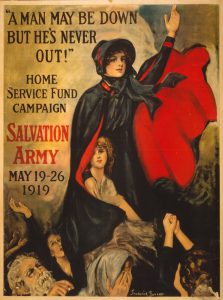
The Salvation Army crowd-gathering techniques were as effective as their innovative social services for the down-and-outers. “In the early days their brass instruments, jingling tambourines, and resonant bass drums clamored over the din of horse-drawn carriages and noisy peddlers,” reports Winston. “Their testimonies, shouted from street corners, captured the curious, while their renditions of popular tunes – ‘Swanee River’ or ‘Tramp, Tramp, Tramp’ rewritten as hymns – roused critics to decry such blasphemous strategems.”
The trailblazing methods – loud music, dancing, posters resembling P. T. Barnum’s advertisements – were not welcomed by respectable religious observers, nor by those outside the fold who were annoyed by their message about a transformed life. The Salvationists were attacked in print and sometimes physically assaulted for their public preaching and worship services. One writer actually had the ugly audacity to group African Americans with “whores” and “bums.” “A more motley, vice-smitten, pestilence-breeding, congregation could seldom be found in a house of worship,” wrote the jaundiced reporter from the New York Herald. “There were Negroes, dancing girls, prostitutes, and station house tramps sandwiched between well-dressed visitors who had sauntered in out of curiosity. The floors were as clean as a deck of a man-of-war, but in a few minutes they were frescoed with tobacco juice, the stench became overpowering, and a yellow-fever pest-house could not have been less attractive.”
Throughout its colorful history, the public mockery and vicious assaults were never able to dim the bright light projected from The Salvation Army. “Whether parading in the streets, singing in the saloons, or appearing on the city’s stages, the Army used the venues and forms of the contemporary culture to promote an alternate, even subversive message,” writes Winston. Booth never wanted to surrender one square inch of life or culture to his spiritual enemy. “Why should the devil have all the dancing?” he asked. “You must sing good tunes … I don’t care much whether you call it secular or sacred. I rather enjoy robbing the devil of his choicest tunes, and, after his subjects themselves, music is about the best commodity he possesses,” he concluded. “It is like taking the enemy’s guns and turning them against him.”
It’s a provocative countercultural message – similar to the Red Kettle in front of a department store at Christmas time. Yes, enjoy Christmas, Booth might say, but please don’t forget the less fortunate. The kettle was first utilized in San Francisco in 1891 when Joseph McFee wanted to raise funds for a free Christmas dinner for the poor. He borrowed a large crab pot and hung it from a tripod on a busy street. With a sign that read, “Fill the Pot for the Poor – Free Dinner on Christmas Day,” he was able to collect enough spare change to feed more than 1,000 hungry men, women, and children.
That’s the creative spirit and spiritual legacy of The Salvation Army. It has earned our support.
Steve Beard is the editor of Good News.
by Steve | Nov 28, 2017 | Magazine, Magazine Articles, Nov-Dec 2017

Rev. Rob Renfroe
By Rob Renfroe-
We all need the same things: air to breathe, food to eat, a place to sleep, a sense of security, a feeling of self-worth. When it comes to needs, we’re all the same. It’s your wants that make you different. It’s your wants that determine who you are and the choices you make. It’s your wants that create the life you live.
What do I want? I want to glorify my Lord and Savior and bless the world he died to save. And there is no greater way of doing that than letting him use me to make passionate and purposeful disciples of Jesus Christ. That is my calling, but more than that, it’s the calling of the church. Our calling is to make disciples of Jesus Christ who will bring salvation to the nations and social holiness to the world. How does the church make disciples? Let me suggest three ways.
1. Truth. We preach the truth. We teach the truth. We live the truth. We do all we can to get our people into the Word and to get the Word into them. Why? “If you continue in my word,” Jesus said in John 8, “you will know the truth and the truth will set you free.”
I was heartbroken to read a prayer that one of our bishops asked his churches to pray for our denomination as we struggle with questions of unity and sexuality. Here’s how it begins: “God help us! Help us … to take the next faithful step forward not based on … doctrine, tradition, or theology.” He goes on: “God help us! Help us … to take the next small faithful step forward that is neither … right or wrong; good or bad; for or against.”
In other words, Help us to be faithful – but faithfulness that is not based on theology or doctrine, faithfulness that is not based on right or wrong, good or bad. Can you imagine the apostle Paul writing to Timothy, “Watch over the church in your care, help them to be faithful, but tell them not to worry about theology or doctrine.”
Can you envision Jesus giving his apostles the Great Commission, “Therefore, go into all the world and make disciples, teaching them … ah, forget that teaching part. All that stuff I told you these past three years isn’t all that important. Just tell them God is nice and they should be, too.”
What is theology? What is doctrine? It’s what we believe about God and how we are to live in light of who God is. The bishop suggests that we act simply out of love. And who can be against that? But how do we know what love is? Do we let our hearts tell us what it means to love? The hearts within us that are fallen and self-serving? Do we let our hedonistic, materialistic culture define love? Of course not. Instead, we go to God’s word which tells us; “By this we know what love is: Jesus Christ laid down his life for us.” Without theology, we wouldn’t know what love is.
What is our hope? That the word of God is living and active, cutting deep within our souls. That the word of God will confront us with our sin in a way that we must be honest with ourselves and with God. As a pastor for 35 years, I have learned that real spiritual and emotional growth is impossible unless we are willing to be honest with God and ourselves about ourselves.
The problem is, as T.S. Eliot wrote, that “humankind cannot bear very much reality.” We don’t want to see the wrong things we do, much less the wrong things we are. We don’t want to be naked before God or others or even ourselves. Like Adam and Eve in the garden, we cover up, hide, and pretend. And when we do, we live lives that are false, stop growing spiritually, and fail to become disciples of Jesus who are growing into the likeness of our master.
That’s why Jesus came with grace and truth. Because we need both. That’s why the first words on his lips in Mark’s Gospel are, “The time is fulfilled; the kingdom of God is at hand; repent and believe the Gospel.” In other words, look at the truth of who you are. And where you’re wrong, get right with God. That’s why Jesus told the woman caught in adultery, “Go and sin no more.” People need the truth about God and the truth about themselves. Change begins when we get into that truth and we get that truth into us. We need to make certain our people know that we do not change the Word of God; it changes us.
2. Time. If we are to make disciples, we must encourage and make opportunities for our people to spend time with Jesus. “Remain in me, and I will remain in you,” said Jesus. “No branch can bear fruit by itself; it must remain in the vine. Neither can you bear fruit unless you remain in me. … Apart from me you can do nothing” (John 15:15).
The first duty and the greatest privilege of a disciple is to spend time with Jesus. Take special notice of this verse: “Jesus appointed twelve as apostles that they might be with him and that he might send them out to preach and to have authority to drive out demons” (Mark 3:14).
These are the big boys. These are the apostles. They are going to take the Gospel to the ends of the earth, heal the sick, raise the dead, and cast out demons. But the first privilege they are given is “that they might be with him.” That’s first. That’s where the power comes from. That’s where lives are changed.
Whenever a kid gets in trouble, the first thing his momma will say is: “He fell in with the wrong crowd. They rubbed off on him.” And if you’ve had trouble with your children, one of the things you pray for over and over is that God will bring someone into his or her life that will be a good influence. Why? Because we know that our relationships change us. We become like those we spend time with.
Just being with someone has an effect on us. Remember when Moses spent time with God on Mt. Sinai and he came down to meet with the Israelites and they were afraid of him. Why? Because his face was glowing. He spent time in the presence of God and he began to reflect the nature and the character of the God he had been with. This won’t sound very theological, but the simple point is that the more time Moses spent with God, the more God rubbed off on him and the more Moses was changed into the image of God.
If we want to make disciples of Jesus, we must teach them to spend time with him. Worship, prayer, reading his word, holy communion, fasting, and meditation – the means of grace, the spiritual disciplines. The Christian life is not something we live for Jesus, it’s the life Jesus lives through us.
3. Terror. By terror I mean we must get our people into situations where they are in over their heads. Where they come to the end of themselves so they have to depend upon God in ways that are new and frightening.
You and I need to be uncomfortable. We need to get into situations that raise questions that don’t allow for easy answers or a shallow spirituality. We need to have experiences where we don’t know what to do and we don’t know what to think.
We need to get out of a world that is isolated and safe and churchy and into a world that is so needy and so full of pain that we feel what we’ve never felt, ask what we’ve never asked, weep like we’ve never wept, pray like we’ve never prayed, and experienced God like we’ve never experienced him before.
We can read about poverty and we can read about a God who loves the poor, but until we have been among the poor, we won’t understand poverty and we won’t really understand God’s heart for the least and the last.
We can read about a Savior who healed the broken and loved the despised, but until we have listened to their stories and cared for them ourselves, we won’t truly understand Jesus or the power of what his love can do in a life.
The same experiences that keep us in our comfortable, predictable worlds where our ideas are safe and unchallenged, where our skills and our knowledge are sufficient, will never produce a life that is adventurous or a heart that is wise.
They only create lives that are complacent and hearts that are small. How do we make disciples? We encourage and make opportunities for our people to care for the sick, the poor, the broken, and the lost. Not just so they will become disciples of Jesus, but so we will.
What do you want? I want my life to count. Eternity is in my heart. God put it there. I want my life to count for eternity. And the best way I know to do that is to make passionate, purposeful disciples of Jesus Christ. If your heart is as my heart, then give me your hand. And let’s change the world together for the glory of our Lord and Savior Jesus Christ.
by Steve | Nov 28, 2017 | Magazine, Magazine Articles, Nov-Dec 2017

After the consecration of the Rev. Dr. Karen Oliveto as bishop by the Western Jurisdiction. UMNS photo.
According to a United Methodist News Service article published on August 23, 2016 – more than one year ago – Bishop Grant Hagiya, president of the Western Jurisdiction’s College of Bishops, said then newly-elected Bishop Karen Oliveto, an open lesbian married to a UM Church deaconess, “faces multiple complaints under church law.”
One full year went by and there never was a peep about the complaints or the status of the process. Good News reached out to Bishop Hagiya and asked him about the complaints and if there was an explanation for the unusually long delay regarding resolution.
Hagiya responded as follows: “Due to Judicial Council Ruling 1341 [April 2017], and under advisement of our legal counsel, we dismissed the original complaint without prejudice, and opened up a new complaint submitted in light of 1341 to deal with any issues pertinent to the new ruling.
“A new complaint supervising committee has been formed and will begin working on this new complaint.”
With all due respect, concerned lay persons and clergy view this as an ecclesiastical three-card monte sleight of hand. Yes, we are aware there is a portion of United Methodism that is downright giddy about Oliveto’s election. And we are well aware that the new caucus group “Uniting Methodists” is at least publicly indifferent – neither heartbroken nor celebratory – about Oliveto’s election, consecration, and episcopal leadership. However, there are the vast majority of United Methodists who believe that this process lacks credibility and transparency. For them, it is about the integrity of the process and the heart of accountability within United Methodism.
According to church law, the status of complaints against a bishop must be reported after 120 days. However, if the parties involved in the matter have not reached a resolution they can request an additional 120 days, and, if necessary, another 120 after that. Apparently, Oliveto’s colleagues in the West are attempting to indefinitely postpone any decision for their colleague. They think the church’s sexual ethics, teachings on marriage, and its ordination standards are wrong. While they are certainly entitled to their opinions, their actions – or lack thereof – are raising serious questions about the possibility for church unity and trust.
What comes of a church when some of its bishops cavalierly decide which laws they will and will not enforce? What comes of church unity when some of its leaders are patronizingly dismissive of values held by the vast majority of United Methodists across a global denomination? And what comes of trust when bishops give the appearance they are protecting one of their own when it comes to legitimate complaints?
Lest we forget, several bishops issued statements lamenting Oliveto’s election as a breach of the church’s covenant and its unity. The Council of Bishops’ Executive Committee, citing “the great importance of the matter,” encouraged the Judicial Council to take up the matter as soon as possible. United Methodists rightly expect a just and timely resolution of this case. At this juncture, the Western Jurisdiction bishops’ failure to push for timely action would be indicative of their arrogance and disdain for the wider church.
–Good New Media Service.
![When God Grieves]()
by Steve | Nov 28, 2017 | Magazine, Magazine Articles, Nov-Dec 2017

Items lay out to dry from flood damage from Hurricane Harvey. Photo by Kathleen Barry, UMNS.
By Elizabeth Glass Turner-
“Creation itself will be set free from its bondage to decay and will obtain the freedom of the glory of the children of God. We know that the whole creation has been groaning in labor pains until now; and not only the creation, but we ourselves, who have the first fruits of the Spirit, groan inwardly while we wait for adoption, the redemption of our bodies. For in hope we were saved. Now hope that is seen is not hope. For who hopes for what is seen? But if we hope for what we do not see, we wait for it with patience.
“Likewise the Spirit helps us in our weakness; for we do not know how to pray as we ought, but that very Spirit intercedes with sighs too deep for words” – St. Paul (Romans 8:21-26).
This tilted rock that we call planet earth has been groaning. You can almost hear the geological grinding of planetary distress; above, in an expensive international tin can, astronauts peered down below at tight eyes of sprawling white storms, islands usually illuminated gone black. While the International Space Station hurtles through orbit with multiple sunrises and sunsets a day, it is emblematic of humanity’s hopes for the best in us: exploration, cooperation, respect, discovery. But astronauts get the news too, and I wonder what continent they were speeding over when word came that an American took bags of weapons into a hotel so that he could harm as many concertgoers as possible before ending his own life.

Water and food were the most pressing needs in the Jayuya area of Puerto Rico. Photo by Gustavo Vasquez, UMNS.
Houston floods, a city soaked, humid, and moldy. Mexico City shakes as tectonic plates grind, turning buildings to rubble. Multiple Caribbean islands brace against wind, power outages, blocked roads. Puerto Rico goes dark, patients stranded in upper-level cardiac units of hospitals where temperatures swell over 105 degrees. Las Vegas crumples, stunned, as the tourist destination known for pleasure, excess, and entertainment weeps while dawn breaks over broken bodies and overwhelmed hospital staff members. The British Isles brace when Ophelia sweeps in from the ocean, knocking trees down on cars with people in them, brushing electricity off for hundreds of thousands of residents. California burns with ferocity, blackened beams angled crookedly where homes once stood. The Rohingya people continue to stream away from genocide in Myanmar with tales of atrocities. Kurdish cities evacuate as Kurdistan and the Iraqi government go toe-to-toe over oil-rich territory now vacated by ISIS. A young man walks into a New Mexico library and shoots employees. Los Angeles comes face to face with its own ugly corruption, power and wealth buckling under the weight of one too many women saying, “me too.”
When Florida prepared for potential catastrophe from Hurricane Irma, I wrote this note to friends on social media:
Dear Floridans:
You are loved, and you’re being prayed for. You’re not alone. But I can’t promise everything will be okay. I’ve seen a lot of kind, inspirational Bible verses suggesting that God has promised that you’ll be safe. The thing is, you might not be. Tragedy happens in this world, like the joyful saint I knew growing up who was killed in a car accident leaving church after volunteering.
Being someone who believes in God doesn’t give you supernatural AAA. It’s not insurance. The Apostle Paul was shipwrecked. Simon Peter was crucified. They had the same Old Testament you do, with scriptures about God’s protection.
Here’s what I can tell you.
1) Loss, death, and grief don’t disprove faith in God. They are equal-opportunity realities that descend on every human. We live in a finite, hurting world. It hurts, and we scream and rage, and that is ok. There’s a whole book in the Old Testament called Lamentations.
2) We pray. I don’t understand why sometimes doctors shake their head and mutter, “I hate this word but it’s a miracle,” and why sometimes, miracles seem to be withheld. Because of this we must be very careful when we claim, “God protected me” while our neighbor’s house was flattened. We pray for protection for ourselves and others; but we also pray for peace, for grace, for other people in the world suffering at the same time. We give thanks for infrastructure and FEMA and aid organizations. We pray for relief workers and hospital staff working long hours. We pray for kids who are scared. We pray for animals.
3) There’s a Bible verse that is descriptive: “The rain falls on the just and on the unjust.” Whether rain is a good thing, for farmers with dry crops, or a bad thing, like floodwaters in Houston, we live in a natural world. Nature is real. Whether you’re a kind person or a jerk, we both experience forces of nature. It might not seem fair – you’ve been law-abiding and your house and belongings are ruined, and your wife-abusing neighbor’s house was spared. If you believe in an all-powerful God, it’s not inconsistent to say both that God controls the universe and that air currents, the slight dip in your street, and the choices of the contractors who built your house are all real factors.
4) Take stock of what really matters. Where in your life have you been coasting? What have you been putting off? Let these experiences drain your fear rather than magnify it.
We are tired of hashtags. #HoustonStrong. #MexicoCityStrong. #PuertoRicoStrong. #VegasStrong. #CaliforniaStrong. Whose city is next? Whose church? In the face of natural evil – catastrophic weather events, earthquakes, wildfires – we also witness human evil: the desire to make other human beings suffer for his own twisted purposes, punishing all who witness it by making certain he died before anyone could ask him why he was doing this. What extraordinary spite.
If hurricanes, earthquakes, and wildfires remind us how relatively powerless we are on this tilted, groaning rock, a man firing out of a hotel window, or brutal soldiers killing children in an ethnic scourge, remind us how evil we are capable of being. We have met the enemy, and he is us.
When we are weary of multiple tragedies unfolding so quickly we cognitively cannot keep up with it, what happens to our hearts? Every time a new tragedy hits the news crawler, does your blood pressure spike? Are you numb? Have you become deaf to groans as a coping mechanism? Do you fatalistically believe it’s God’s mysterious will that children in Myanmar and Mexico City die? Do you turn off the news and read an idyllic book that paints a different picture of reality? Do you leap to activism, collecting water, donating money, lobbying for bump stocks to be banned, shoveling out moldy linoleum from a neighbor’s ruined home?
Every time something bad happens, variations of the same meme appear on social media: a quote from Mr. Rogers, whose mother told him that when something bad happened, to look for the helpers – in other words, to see the goodness of humanity, the kindness and love pouring out for each other. To a degree, it’s a beautiful response. Yet even beautiful responses can lose their power when the same quote is posted a dozen times in a month. We get compassion fatigue; we get news fatigue; we get imagination fatigue. In part, this jaded weariness comes from a very childlike place: “but we had hoped…”
Does that phrase sound familiar? It’s one of the saddest phrases in scripture, coming from a downcast disciple walking with a friend and a stranger on the way to Emmaus.
He said to them, “What are you discussing with each other while you walk along?” They stood still, looking sad. Then one of them, whose name was Cleopas, answered him, “Are you the only stranger in Jerusalem who does not know the things that have taken place there in these days?” He asked them, “What things?” They replied, “The things about Jesus of Nazareth, who was a prophet mighty in deed and word before God and all the people, and how our chief priests and leaders handed him over to be condemned to death and crucified him. But we had hoped that he was the one to redeem Israel” (Luke 24:17-24).
It may have been silly of us, but we had hoped. We were proven wrong, but we had hoped. We knew better, but we had hoped anyway.

Volunteers from Chapelwood United Methodist Church in Houston “embody grace” by volunteering in homes flooded by Hurricane Harvey. Here they pause for prayer. (From left) Helen Crowe, Mary Fuller, Suzanne Musgrove, Daniel Solis and Dennis Crowe. Photo by Kathleen Barry, UMNS.
This unknown stranger asked them questions and let them talk: what is on your mind, and what is your interpretation of the things on your mind? And their grief, disillusionment, and fatigue all come pouring out.
We had hoped faith communities would have the last word, but some of the women saying, “me, too,” were assaulted in churches. We had hoped a political party would help straighten out wrongs, but some evil goes beyond party platform. We had hoped for a safer region to live in after ISIS left, but now old disputes are reemerging about who lays claim to what land. We had hoped for peace in Myanmar, but satellite imagery shows swaths of burned land. We had hoped our cities and bridges and highways were reliable, dependable, and sufficient, but they’re a toy train set ready to be knocked over compared to the phenomenal power of a superstorm. We had hoped for a return of routine, but the power is still out. We had hoped for a nice night of escape at a concert until the gunfire rang out.
When one of Jesus’ best friends, Lazarus, died, before Jesus sobbed at the pain of death and grief that afflicts all humanity, he had to talk to Lazarus’ sisters. Mary wouldn’t come out of the house to see him. Martha did, and was the first to throw out words that stung like vinegar: “Lord, if you had been here, my brother would not have died.”
If you had been here, God, it would have been alright. We had hoped you would come in time. But you show up now?
“Jesus said to her, ‘Your brother will rise again.’ Martha said to him, ‘I know that he will rise again in the resurrection on the last day.’”
If anyone else had said it, it would have been a condescending platitude: you’ll see your brother again. And Martha, with orthodox faith for the future but little hope for the present, responds, knowing it will be alright someday. Not now, but someday. She cannot picture a present where things are made better.
Martha went back to the house and quietly told her sister that Jesus was asking for her. Mary emerged quickly from the house, her friends sitting in grief with her following her, and as Mary approaches Jesus, none of the right Sunday school answers come out. Instead, the words hit him in the face again: “If you had been here, my brother would not have died.”
And when Jesus saw Mary sobbing – Mary, who had neglected kitchen duty with her sister to sit at Jesus’ feet with men and learn – when Jesus saw Mary and her friends sobbing with no right answers, only questions, Jesus was “greatly disturbed in spirit, and deeply moved.” And as he asked where Lazarus was buried, he began to sob.
There are times when arguments about the sovereignty of God won’t cut it. Hope without compassion is a sterile, self-centered escape plan. But compassion without hope is just as fatalistic, drying into weary despair.
Jesus didn’t scold Mary. Jesus looked at her. And when the Word Made Flesh looked at Mary, the tears came and wouldn’t stop. He was disturbed from the inside out, irreversibly moved. There was a shuddering earthquake in the heart of the Trinity. The Word Became Flesh, and sobbed. Not much later, the body of Christ would be broken for Mary, for Lazarus, for Martha, for families in Mexico, for kids in Myanmar, for women shakily calling 911 after assaults, for country music fans helping each other escape over fences, for mass shooters, for me, for you. But when Jesus looked at Mary, the heart of Christ was broken.
Later, Paul would write to early Christians in Italy that the “Spirit intercedes with groans too deep for words.”

The Woodlands (Texas) United Methodist Church operated as a distribution center after Hurricane Harvey. Photo by Steve Beard.
What are you talking about as you walk along? What’s the news? What events are you talking about? These questions from a shared walk along the road echo across the centuries. Is your hope past tense? “We had hoped…” Is your hope only in a distant future? “I know that he will rise again in the resurrection on the last day.”
This tilted rock that we call planet earth has been groaning. You can almost hear the geological grinding of planetary distress. But the heart of the Trinity has been groaning. You can almost hear Jesus’ sobs at humanity’s pain and distress.
Paul asks us to quiet our hearts and listen in hope for the sounds of the Spirit interceding for us with groans too deep for words. It is the sound of the God who grieves. Christ has died; Christ is risen; Christ will come again. These words give order to our own grief. We don’t have a high priest who is unable to sympathize with us: Jesus Christ died. When Christ died, death itself got a final notice. And when Christ comes again, that last enemy, death, will be destroyed.
Meanwhile, we do not weep alone.
Elizabeth Glass Turner, a frequent contributor to Good News, is Associate Director of Community & Creative Development at World Methodist Evangelism.