by Steve | Apr 3, 2017 | In the News, Perspective E-Newsletter
 By Walter Fenton-
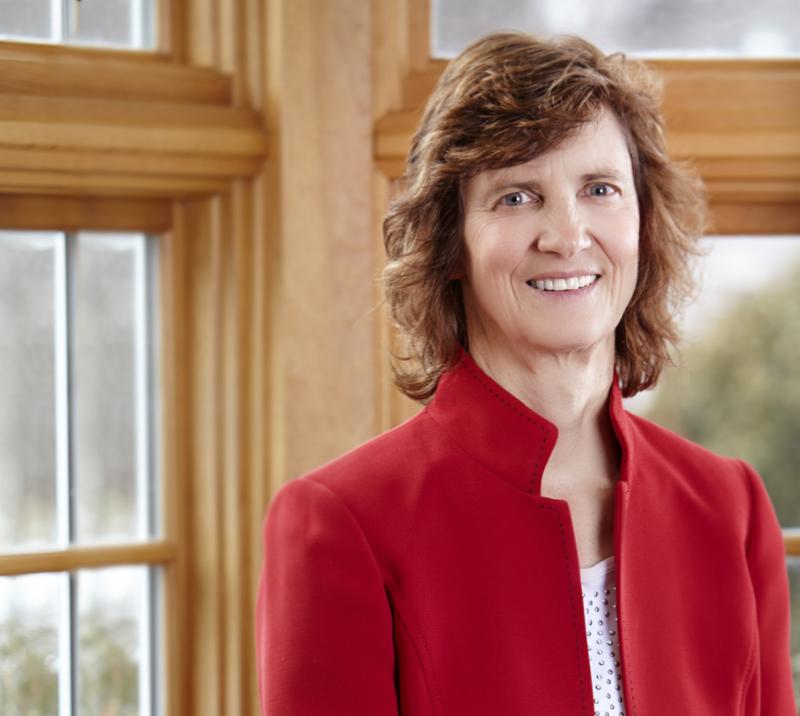
Moderates and conservatives long ago gave up on any hope the UM Church’s General Board of Church and Society (GBCS) would demonstrate any fairness or impartiality when it comes to non-liberal plans for health care, tax policy, education, energy policy, military spending, minimum wage laws, … well, you get the point. So there was little surprise when the Rev. Dr. Susan Henry-Crowe, General Secretary of GBCS, unloaded on a Republican backed bill that would have modified the Affordable Care Act (ACA).
To her credit, Henry-Crowe is not nearly as strident as some of her predecessors, but she can get off some zingers. Not long after a press conference with U.S. Rep. Nancy Pelosi (D-California), we received inquiries wanting to know about “the United Methodist Statement” that said, “people will die” if a Republican backed health care bill passed in Congress (as most know by now, it did not).
We were confident no such statement existed. The UM Church, thankfully, does not make a habit of pontificating on every bill that comes before Congress. Only the General Conference, which meets every four years, can pronounce authoritatively for the UM Church. What we suspected was that Rep. Pelosi had read something a UM bishop or the General Secretary of GBCS had said about the bill. And sure enough, Henry-Crowe had recently opined, “People will die because of efforts like this to roll back health care.” Pelosi gladly took Henry-Crowe’s personal prognostication that “people will die,” as the UM Church’s official word on the bill. It is not.
Henry-Crowe, who holds two degrees in theological studies, and for 22 years served as the dean of the chapel and religious life at Emory University before her role at GBCS, offered no evidence to support her hyperbolic claim. Her remark is particularly interesting in light of a recent column by New York Times columnist Ross Douthat. To be sure, like Henry-Crowe, Douthat is not a health care expert. But unlike her, he actually references reputable studies that find claims about how many lives this or that insurance plan will save to be overblown. As Douthat notes, since the expansion of Medicaid under the ACA, Americans have not become healthier or experienced lower mortality rates (they’re actually higher in some of the states and counties where Medicaid was expanded).
It is hard to understand why, in a church with rank-and-file members from across the political spectrum, GBCS has felt compelled to march almost uniformly to the left on most issues. And it often seems incapable of even acknowledging people of good faith and good will might find alternative prescriptions to be reasonable, responsible, and compassionate. GBCS has a propensity to close off options and stifle conversation before it gets started. So if you don’t stand with Henry-Crowe and GBCS on the recent bill before Congress, you’re evidently comfortable with a plan that will allow “people [to] die.”
After reading a missive from the GBCS team, you cannot help but think they are unaware of people like Arthur Brooks, Robert George, or Michael Gerson, thoughtful Christians who are as faithful and as informed as they, who do offer alternative solutions and valid critiques of progressive proposals. GBCS seems to have no dialogue partners in a church that desperately needs them.
This is odd and even unhelpful coming from an organization appointed to serve and represent the whole church, not just its left wing. True, GBCS can appeal to the UM Church’s Book of Resolutions, a huge compendium full of progressive nostrums written by or sponsored by GBCS and its allies, passed in haste at General Conferences, and then trotted out as necessary when needed. But this is no way to build consensus in a diverse church. Progressives often style themselves as community organizers for social justice, but you seldom get the impression that GBCS folks are actually out organizing among the grassroots. Instead, they are more often found provoking laity and pastors with progressive pronouncements issued from their Capitol Hill offices in Washington D.C.
As for the healthcare debate, we’re happy to leave it to the experts who study these matters to share their findings, make recommendations to our Congressional representatives, and then engage in a civil debate on the matter. In the future, we hope Henry-Crowe can find the good in other proposals and refrain from conversation stoppers like, “people will die.”
Walter Fenton is a United Methodist clergy person and an analyst for Good News.
by Steve | Mar 24, 2017 | In the News, Perspective E-Newsletter
By Walter Fenton-
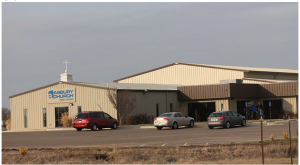
A congregation in Wichita, Kansas, that averages 350 in worship has voted to leave The United Methodist Church. As a satellite campus of Asbury UM Church, the congregation announced its decision on Sunday, March 19.
“Some pastors and people are weary of all the defiance and unaccountability in the denomination,” said the Rev. Rick Just, senior pastor of Asbury UM Church. “While we at the central campus are praying and waiting for the Commission on a Way Forward to provide leadership and guidance during this unsettling time, Pastor Aaron Wallace, the leadership team, and the congregation at our west campus reached the conclusion that the ongoing battles in the denomination are a distraction from the kind of kingdom work they want to do.”
Asbury UM Church planted its west campus site 10 years ago in an effort to reach unchurched people and younger families on Wichita’s growing west side. The satellite congregation grew quickly and attracted its target audience. The west campus is filled with people in their 30s and 40s, and boasts thriving programs for children and youth. The central campus also remains one of the healthiest and most evangelistic churches in the Great Plains Annual Conference.
“We are sad about their departure,” said Just, “but church leaders have been going their separate ways to do ministry since Peter and Paul took different paths. Asbury is proud of what we accomplished with our west campus. We’re not bitter about the situation, and we foresee partnership opportunities with Pastor Wallace and his congregation as we all work to make disciples of Jesus Christ.”
In a media statement shared with Good News, Wallace acknowledged his “struggle with some of the conflict that has been occurring in the life of the denomination.”
According to an article by Todd Seifert, Communication Director for the Great Plains Annual Conference, Bishop Ruben Saenz, Jr., the episcopal leader in the area, said, “Clergy and laity throughout The United Methodist Church are in a season of waiting and discernment as members of the denomination experience varying levels of frustration with the impasse on human sexuality and the unity of the church. The denomination is awaiting a ruling from the Judicial Council on the election of an openly gay bishop serving in the Western Jurisdiction and is following closely the progress of the Commission on a Way Forward, a group appointed by the Council of Bishops to review language related to human sexuality in the Book of Discipline.”
Word of the congregation’s decision comes just weeks after two large UM churches in Mississippi voted to leave the denomination. Both congregations are still in conversations with Mississippi Annual Conference leaders regarding the terms of their exits.
“I fear these departures are just the most visible manifestations of what is going on across the connection,” said the Rev. Rob Renfroe, President of Good News. “People hoped our bishops would stand up and defend our church’s teachings on marriage and its sexual ethics, instead, they’ve witnessed a train of defiance and dysfunction. My guess is many more rank-and-file United Methodists are just simply walking away from local churches. It’s a sad indictment of many of our leaders.”
Walter Fenton is a United Methodist clergy person and an analyst for Good News.
by Steve | Mar 24, 2017 | In the News, Perspective E-Newsletter
 By Walter Fenton-
Methodists down through the decades are famous for being “methodical” and giving attention to detail. From the very beginning, John Wesley baked into the Methodist system a regular accounting of membership and attendance in small groups. In order to participate in a worship service, Methodist members had to regularly attend small groups and receive a ticket for admittance!
Today, church membership is a vital statistic used to track the health of the church. It is often a factor in how much money a local church is asked to pay for denominational missions and administrative expenses. The number of General Conference delegates and the number of bishops are determined by how many members reside in a given area.
But one must ask, given the importance of membership numbers, are they reliable? It is risky to draw detailed conclusions based on numbers that may not be accurate.
In a recent blog post, Dr. David A. Scott, Director of Mission Theology for the General Board on Global Ministries, reports a potentially groundbreaking news story that has eluded the United Methodist media and all other denominational analysts regarding explosive UM Church membership growth among ethnic minority groups in the U.S.
According to Scott, every single ethnic minority group has experienced dramatic growth between 1996 and 2016 (Scott has since informed me that the numbers he provides for 2016, are actually totals for 2014). If these statistics were proven to be solid, this would be a justifiable cause for denomination-wide rejoicing. It would also be one of the most important cultural/ethnic/racial religion stories in the news.
One of the iron-clad rules for journalism, however, is that when statistics look fantastically irregular, they are often worth a second look.
For example, is it possible that overall United Methodist membership and attendance in the United States could be declining at an alarming rate and yet African-American membership within the denomination has skyrocketed 37 percent?
If those statistics were solid, there would be a remarkable story to tell – and church growth leaders would be telling it. After all, the UM Church in the U.S. has not seen an identifiable 37 percent membership increase in years.
The same could be said of the 78 percent increase among United Methodist Hispanics. That would be stunning and a great cause for rejoicing. The same goes for the 106 percent increase of Asian-American United Methodists, the 101 percent increase of Pacific Islanders, and the 23 percent increase among Native American United Methodists.
Based on alleged remarkable gains for minority groups and the drop among Caucasian membership, Scott concludes that Caucasians need to “acknowledge their whiteness and repent of the ways in which their thinking has been shaped by race and not the gospel,” so they can “learn from their sisters and brothers of color.”
Cross-cultural learning is always a worthy task, but Scott’s grounding this insight in the membership numbers he cites is a dubious one. This is true because the UM Church faces a variety of conundrums when it comes to compiling and reporting membership data.
Pastors, who lead its approximately 32,100 local churches in U.S., are ultimately responsible for submitting membership and attendance data to their annual conferences and the denomination’s General Council on Finance and Administration. The ways clergypersons manage local church membership rolls vary dramatically. Some are so fastidious they would warm John Wesley’s heart. Others, as one colleague wryly noted, “Have other fish to fry.” Most fall somewhere in between.
Clergy also vary widely in the way they receive members into the denomination. Some pastors require people to attend anywhere from four to a dozen or more class sessions on doctrine, history, and polity before joining the church. Others are happy to receive people as members at the close of a worship service after they have attended a time or two.
And while pastors do dutifully report membership losses many are loath to do so. They believe it reflects poorly on their leadership and, not without some justification, believe it will impact their next appointment. And of course district superintendents and bishops are not immune to a certain reticence around reporting losses either. On balance, there are many compelling reasons for pastors and church leaders to not be too meticulous when it comes to membership numbers.
Consequently, many local churches carry far more members on their rolls than actually attend their services. For instance, several of the denomination’s 100 largest churches see, on average, just 10 to 15 percent of their members at weekly worship. In 2015, over 60 percent of the UM Church’s 7.1 million members were not in attendance on any given Sunday.
None of this would be particularly disconcerting were it not for the fact that the membership numbers do figure significantly in different ways.
As noted above, the number of General and jurisdictional delegates are apportioned based on church membership. And membership figures are a key factor in determining the viability and number of districts, annual conferences, and episcopal areas in the church. But given all the variability in the ways members are created and membership rolls are maintained, how accurate is the data?
Which brings us back to Scott’s report on the rather dramatic increases he reports for minority groups and the lessons we might draw from their purported growth.
The UM Church is not particularly good at getting the big number right, let alone providing granular figures for distinct groups. Pastors, district superintendents, conference statisticians (typically a humble, hardworking pastor who has volunteered for the thankless post), and bishops are not trained census takers. And to believe that each year most pastors scrub their local church’s membership rolls, and then go on to decipher the racial and ethnic status of every member (a fair number of whom they may have never met) is to expect the unlikely. Some local churches do not ask the ethnic identity of their members and fail to track that characteristic accurately.
A comprehensive 2014 report by Lauren Arieux, a GCFA Research Fellow and Statistician, demonstrates how challenging it is to produce this type of data with consistency and reliability. While all of the minority groups in her report trend upwards from 1989 to 2013, the path is very inconsistent.
For instance, Hispanic membership is pegged at 60,900 in 2004, but one year later is reported to have fallen to 44,951. Four years later it shoots to 68,088.
And Asian membership is reported as 53,302 in 1995, then 44,940 in 1996, and back up to 53,731 in 1997.
African-American membership in 2001 is reported to be 409,432, one year later it has dropped to 371,203, but then rises the following year to 415,072. It is highly unlikely the church lost 38,229 African-American members in one year and then gained back 43,869 just one year later.
(It should be noted the figures for Caucasian membership go up and down as well.)
And none of this data actually comports with a Pew Research Center’s 2014 Religious Landscape Study that Scott links to in his article. According to that report, Latino (or Hispanic) and Mix/Other each account for 2 percent of the UM Church’s membership, and Asian and Black each account for approximately 1 percent. The remaining 94 percent, according to Pew is Caucasian.
What all this likely reveals is not, as Scott would have us believe, dramatic and heretofore uncelebrated growth among minority groups, but a church steadily struggling to get better at something difficult to do under the best of circumstances: decipher with care and consistency the racial and ethnic composition of millions of people. And to complicate matters, the UM Church is trying to do it with people who are neither trained nor equipped for the task.
This is not to say the goal of ascertaining solid macro and micro membership numbers is not a worthy one; it is. Given the importance the church places on membership totals for apportioning representation and determining the viability of annual conferences and episcopal areas, it should strive for more consistent and accurate figures. But until it gets there, granular numbers should be handled with caution, and sweeping lessons drawn from them should be made with care.
Walter Fenton is a United Methodist clergy person and an analyst for Good News.
by Steve | Mar 13, 2017 | In the News, Perspective E-Newsletter
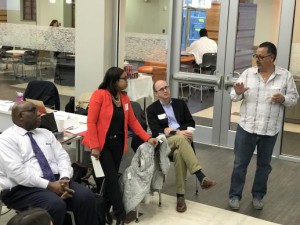
Commission on a Way Forward members: Bishop Gregory Palmer, Jasmine Rose Smothers, Dave Nuckols and Jorge Acevedo, UMNS
By Walter Fenton-
As the Commission on a Way Forward moves beyond preliminaries to the hard task of proposing a plan for the church’s consideration, it is worth trying to clarify what United Methodists in the renewal and reform groups regard as misunderstandings or mischaracterizations of their positions.
Not infrequently, some centrists and progressives claim renewal and reform leaders are unwilling to engage in dialogue. This is demonstrably untrue. Over the years, its leaders and board members have participated in numerous roundtables, open forums, and debates at every level of the church. They have respectfully listened to others, represented their own positions, and have given consideration to proposals to resolve our differences. They remain open to further conversation today. People who claim otherwise are either unfamiliar with the church’s fifty year history or are attempting to characterize them as impediments to unity.
Closely associated with the foregoing is the claim renewal and reform leaders are opposed to any and all attempts to change or modify the Book of Discipline regarding the UM Church’s sexual ethics and teachings on marriage. Again, this is simply not true. They respect the church’s polity and believe all United Methodists have the right to propose changes. For instance, at the 2016 General Conference, it was not renewal and reform leaders who led the effort to table petitions seeking to alter the church’s teachings on these matters. Leaders in the movement have advocated that all petitions, within reason, should be considered and discharged at General Conference.
Having said that, renewal and reform leaders oppose the actions of those who would impose their preferred outcomes on the majority of the church through acts of ecclesiastical disobedience. They reject the claim that widespread and organized defiance of church law is necessary in order to keep faith with other parts of it. This siren song always sounds good to those who believe their cause is just and right. However, following it is an invitation to supplanting the individual conscience over the authority of the church – a community, it should be remembered, of the willing not the compelled.
By way of example, consider the case of female ordination, a vital part of our Wesleyan heritage supported by renewal and reform ministries. Even though it is less so every day, there are some United Methodists who would seek to impede a woman’s path to ordination based on their own Scriptural interpretations and readings of church history. In such a case, renewal and reform leaders expect the church to stand by its well founded conviction that ordination is open to women. In short, United Methodists are entitled to advocate for changing the Discipline, but not to imposing their wills on others.
Too often the above mischaracterizations lead to the more harmful claim that renewal and reform leaders are “schismatics”. This term – often used hyperbolically – simply shuts down conversation rather than fosters it. While it is true that some renewal and reform leaders have discussed “amicable separation,” more often than not it has been offered as sober analysis of the state of the church, not necessarily as a preferred prescription.
Nevertheless, given the deep differences and actions of various parties, separation can no longer be dismissed out of hand. It should be prayerfully and thoughtfully considered. The name calling, on the other hand, is not helpful. Truth be told, leaders across the connection – at every level – are either openly or quietly considering the option.
Finally, it would help dialogue if progressives learned the difference between the biblical hermeneutic of evangelicals and fundamentalists. Too often, progressives point out to conservatives – as if they are unaware – that there are biblical prohibitions (e.g., from body tattoos to dietary laws) the Discipline does not even mention, let alone enforce. It seems as if they are then quick to compare, for example, avoiding shell-fish to the church’s prohibition against the practice of homosexuality – ultimately claiming our view of marriage and sexuality is rooted in homophobia. This is to create a straw man anyone can blow down.
The church’s prohibition, however, is grounded in a nuanced and classical form of biblical interpretation going back to John Wesley and well beyond. It is certainly true that a host of contemporary biblical scholars and theologians have made compelling arguments for change (e.g., James V. Brownson, Victor Paul Furnish, Letha Scanzoni, Virginia Mollenkott,), but it is just as true that others have quite capably defended and reaffirmed the church’s teachings (e.g., William Abraham, Bill Arnold, Richard Hays). We are thankful for their work, believe it to be done in good faith, and deserving of our careful attention. But in the end, the General Conference alone, (and even it, within proscribed limits) is empowered to establish church teaching and order.
At this critical juncture it is important for various parties to deal with one another as they truly are, not as we imagine them to be.
Walter Fenton is a United Methodist clergy person and an analyst for Good News.
by Steve | Feb 24, 2017 | In the News, Perspective E-Newsletter
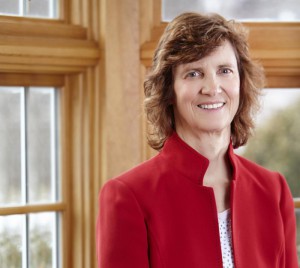
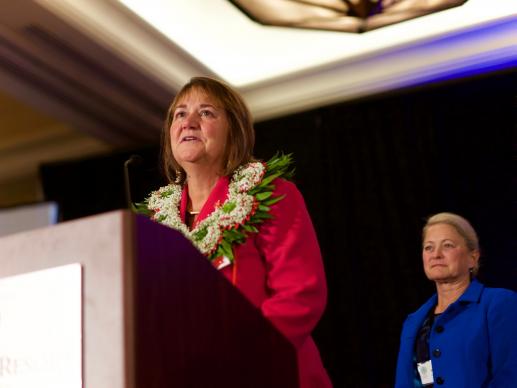
Bishop Laurie Haller, UMNS
By Walter Fenton-
On February 15, Bishop Laurie Haller of the Iowa Episcopal Area confirmed that a church trial had been averted regarding a complaint filed against Bishop Julius Trimble of the Indiana Episcopal Area.
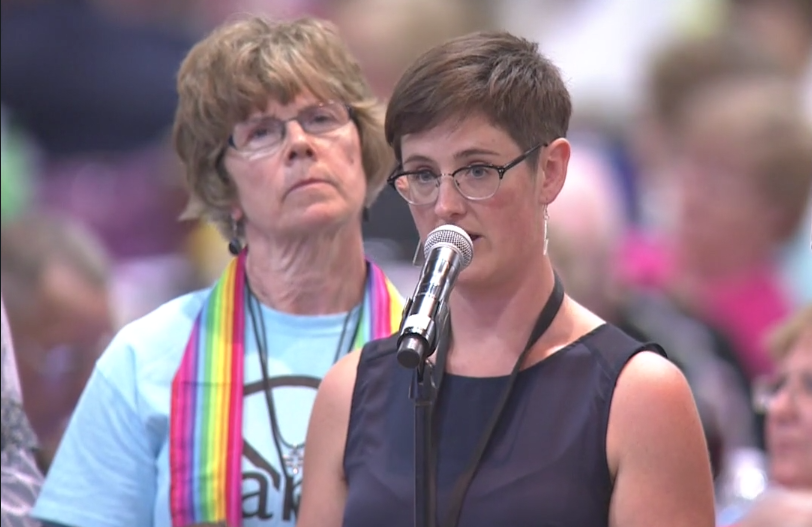
The complaint stemmed from Trimble’s handling of a complaint filed against the Rev. Anna Blaedel, a campus minister at the University of Iowa Wesley Center, who announced on the floor of the 2016 Iowa Annual Conference, “I am a self-avowed practicing homosexual. Or in my language, I am out, queer, partnered, clergy.” Trimble, at the time, was the presiding bishop of the Iowa Episcopal Area and therefore the presiding officer at the time of Blaedel’s announcement.
As intended, Blaedel’s candid announcement stirred controversy. LGBTQ+ advocates were heartened by her willingness to put her clergy credentials at risk. And supporters of the church’s sexual ethics and long held teachings on marriage were stunned by her open admission.
But perhaps as surprising was Trimble’s response, or lack thereof. Having granted Blaedel the moment of personal privilege, he offered no rebuttal to her open admission. Shortly after her address, three clergy members filed a complaint against her.
In the weeks after the conference, Trimble engaged the parties in an attempt to avoid a church trial and reach a just resolution. But given “Blaedel’s open admission of violating church law there were really only two paths to a just resolution: a complete retraction of her statement or her voluntary resignation. Neither materialized.
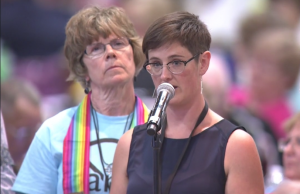
The Rev. Anna Blaedel: “I am a self-avowed practicing homosexual.”
But instead of pursuing the matter, on the second to last day of his tenure, Trimble informed the complainants and Blaedel that he was dismissing the case entirely without comment. In response, 17 lay and clergy members of the Iowa Annual Conference filed a complaint against him for failing to fulfill the duties of his episcopal office.
As part of the just resolution, Trimble has acknowledged in an open letter to Iowa Annual Conference delegates, “that my presiding of Annual Conference in June 2016 could have been more helpful to the body had I made a pastoral statement rather than move on to the next order of business following granting a point of personal privilege to Rev. Anna Blaedel.”
Trimble goes on to write, “I should have articulated a clear process for follow-up regardless of the outcome of the complaint process. For any harm that my leadership may have caused lay and clergy in the Iowa Conference, I ask for your forgiveness.”
As for Blaedel, she continues to preside as the campus minister at the University of Iowa Wesley Center, where the people of the Iowa Annual Conference continue to fund much of her salary.
Iowa United Methodists now wait to see how Bishop Laurie Haller will handle Blaedel’s situation. See the above article for a potential outcome.
Walter Fenton is a United Methodist clergy person and an analyst for Good News.
by Steve | Feb 24, 2017 | In the News, Perspective E-Newsletter
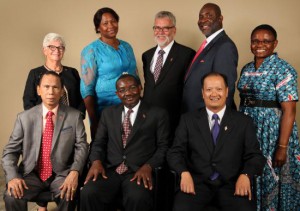
Judicial Council 2016-2020, UMNS
By Walter Fenton-
Most United Methodists have long recognized the debate over the church’s sexual ethics and its teachings on marriage has reached an impasse. However, a legal brief submitted to the UM Church’s Judicial Council (its “Supreme Court”) argues otherwise. It essentially invites the church’s highest court to prolong the legal maneuvering for several more years.
The brief, filed on behalf of the Western Jurisdiction College of Bishops, is in regard to last July’s election and consecration of an openly gay, married bishop. In late April of this year the Judicial Council will consider the legality of the moves. Shortly thereafter it will issue what is sure to be one of the most important judicial decisions in the UM Church’s history.
When the Western Jurisdiction Conference, meeting in Scottsdale, Arizona, elected the Rev. Karen Oliveto as a bishop of the whole church, the South Central Jurisdiction (SCJ), which was meeting concurrently in Wichita, Kansas, voted to ask the Judicial Council to rule whether her nomination, election and consecration were lawful. Parties on both sides have since submitted briefs.
The brief from the Western Jurisdiction (WJ) is a combination of chutzpah and legalistic hairsplitting.
Its first line of defense is to claim the election of an openly gay, married bishop in its jurisdiction has no bearing on the work of the SCJ or, for that matter, any other jurisdiction. Therefore, it argues, the Judicial Council should, in so many words, tell the SCJ to butt out of its business.
Realizing this argument might not fly, the brief goes on to invite the Council to join the WJ in either ignoring or engaging in legalistic hairsplitting when it comes to The Book of Discipline.
At the time of her election, the brief argues, Oliveto was a pastor in good standing so the WJ’s election of her was perfectly legitimate.
True, it acknowledges, most if not all the delegates and bishops at the WJ conference knew she had admitted to the New York Times she had presided at some 50 same-sex weddings during her tenure as a UM pastor. And yes, they were also aware UM pastors are prohibited from presiding at such affairs. And yes, they knew she was married to a deaconess in the UM Church. And true, they were aware the church defines marriage as between one man and one woman. But …
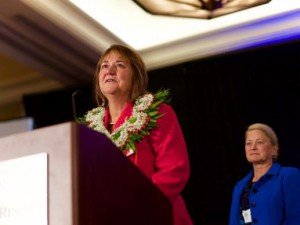
Rev. Karen Oliveto accepting her election, UMNS
No one had ever filed a complaint against Oliveto. She had never been found guilty of violating the Discipline. And besides, while the Discipline clearly defines marriage as between one man and woman, it never explicitly states a pastor or a bishop cannot be married to a person of the same sex. This is akin to the boy caught stealing, responding to his parents’ citation of the commandment, “You shall not steal,” with the retort, “God never specifically said I should not steal.”
Again, sensing the weakness of its argument, the brief reminds the Council a special commission is studying matters germane to this case. Better, it argues, for the Council to stand down for now, and defer to the uncertain outcome of the commission’s work and a special called General Conference that may or may not meet in 2019.
To their credit, the brief’s authors do a passable job of making weak arguments sound the better. But moments of reflection reveal how strained they are.
First, when a bishop is elected, she is elected as a bishop of the whole church, not just the jurisdiction in which she is elected. She will join her colleagues on the Council of Bishops as a chief executive officer for the whole church. She is liable to serve as the presiding officer at General Conferences, she will nominate clergy and lay people to serve on general church boards and agencies, and serve herself as a chairperson of those same boards and agencies. Furthermore, it is not unheard of for bishops to end up serving in jurisdictions other than the one in which they were elected. The SCJ, along with other jurisdictions, clearly has a legitimate interest in the lawfulness of episcopal elections in the separate jurisdictions.
Second, the claim that Oliveto was a clergy member in good standing at the time of her election and consecration is an argument the Judicial Council should thoroughly explore. Why that fiction was true will drive home the necessity of it ruling in favor of the SCJ, and simultaneously reveal the roots of the UM Church’s present crisis.
The only reason Oliveto could be said to be in good standing was because clergy colleagues, district superintendents, and bishops were all complicit in ignoring the plain facts of her situation. Many knew she had presided at same sex weddings. And long before she arrived in Scottsdale last July, most, if not all, the delegates and bishops present knew she was married to another woman. And if they didn’t know when they arrived, they learned of it shortly thereafter. Still, the delegates elected her, and the bishops consecrated her, knowing she had violated church law.
The WJ brief is inviting the Judicial Council to play along with this charade; it should not. When district superintendents, bishops, and an entire jurisdictional conference become complicit in allowing a pastor to flout church law, it becomes imperative for the Judicial Council to act. It is the only body left that can defend the church’s polity and maintain the good order of the church.
Furthermore, there is no reason it should defer to the Commission or a potential called General Conference. When the 2016 General Conference approved of the Commission’s creation, it never even intimated the Judicial Council should suspend the enforcement of church law. It must continue to fulfill its duties regardless of developments that may or may not happen.
Nor should the Council fall for the spurious argument that rendering a decision would usurp the General Conference’s legislative function. The SCJ’s request for a declaratory decision does not request the Council to legislate; it simply asks it to interpret and apply church law. And in this case it is imperative it does so since the Western Jurisdiction delegates and bishops have demonstrated they have no intention of abiding by or enforcing it.
Finally, it is important to note the SCJ’s brief is not asking the Judicial Council to take or suspend Oliveto’s ministerial credentials. In fact, Oliveto is only a party to the case insofar as she made herself complicit in the WJ’s defiance of church law and its willingness to provoke a church crisis. Should the Council rule the WJ’s actions null and void, she will remain a clergy person in good standing and be available for an appointment. And if a complaint is filed against her, she will be entitled to due process. But neither she nor the WJ are entitled to flout church law.
The Judicial Council should call the Western Jurisdiction’s bluff, ignore a brief inviting it to countenance endless church conflict, and end the legal wrangling.
_______________________________________
To read the brief on behalf the Western Jurisdiction College of Bishops click HERE.
To read the brief on behalf of Ms. Dixie Brewster, the South Central Jurisdiction lay delegate who made the motion requesting the declaratory decision, click HERE.
To read a reply to the brief on behalf the Western Jurisdiction College of Bishops click HERE.
Walter Fenton is a United Methodist clergy person and an analyst for Good News.

 By Walter Fenton-