by Steve | Sep 12, 2016 | In the News, Press Releases
 By Walter Fenton-
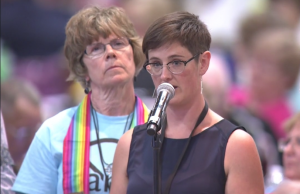
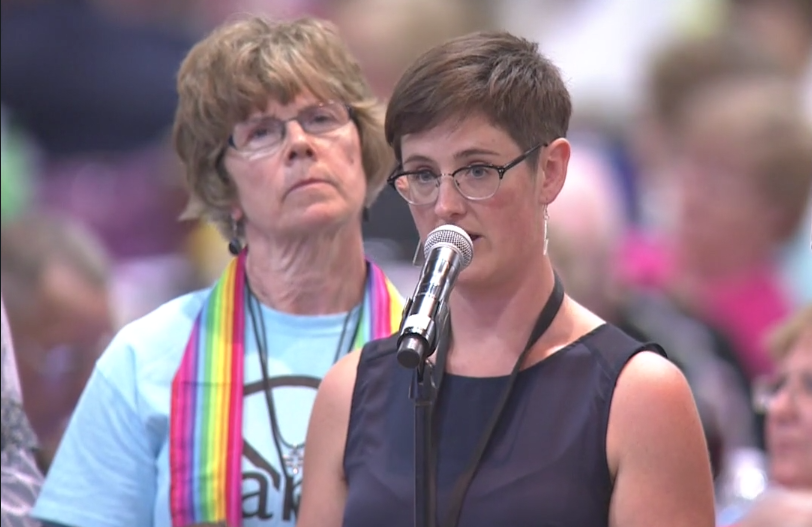
Bishop Julius Trimble has dismissed a complaint filed against a United Methodist clergywoman who announced during a plenary session of the 2016 Iowa Annual Conference, “I am a self-avowed practicing homosexual. Or in my language, I am out, queer, partnered, clergy.”
The Rev. Anna Blaedel, a campus minister at the University of Iowa Wesley Center, made her announcement during a moment of personal privilege during a June 4 plenary session. Shortly after her address, three of her clergy colleagues prepared a complaint against her and submitted it to Trimble.
Trimble informed the complainants on the second to last day of his tenure as bishop of the Iowa Episcopal Area that he was dismissing their charge. As of September 1, Trimble is now the presiding bishop of the Indiana Episcopal Area.
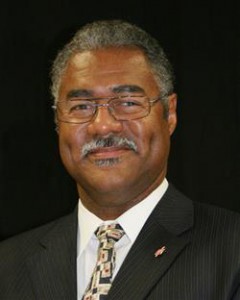
Bishop Julius Trimble
Two of the three complainants in the case, the Revs. Craig Peters and Ben Blanchard, were only mildly surprised by Trimble’s decision. They noted that other bishops are also trying to quietly resolve cases related to the church’s sexual ethics and teachings on marriage, and that the resolutions often allow clergy members to keep their ministerial credentials and remain under appointment with no blemish on their service record.
[In two separate pieces released this week (HERE and HERE), United Methodist News Services’ Heather Hahn reports on two similar cases.]
But Peters and Blanchard also pointed out their laity are mystified by a system that allows clergy to openly defy its standards and then suffer no consequences for their defiance.
In order to dismiss a complaint a bishop needs the consent of his or her cabinet (i.e., the district superintendents serving the annual conference). According to Peters, Trimble told him that he had the “general consent” of his eight cabinet members, but he also said the bishop would not say whether that meant all eight approved his decision or just a simple majority of them.
The Book of Discipline requires a bishop to put in writing for the complainants the reasons why he or she has decided to dismiss a complaint. Both Peters and Blanchard report they have received no such statement from Trimble.
Bishops are also charged with giving “due regard to the interests and needs of the complainants” when deciding to dismiss their complaint. Both Peters and Blanchard said Trimble failed to do so. They believed they were acting as representatives of a larger body of clergy and laity in their annual conference who are concerned about integrity and accountability with respect to the UM Church’s sexual ethics and teachings on same sex marriage.
“I believe the bishop was hoping for a swift and quiet just resolution,” said Blanchard. “But when it became apparent that would not happen he dismissed it as an alternate way of keeping it quiet.” To date, Trimble has not made a public statement regarding his actions, and the Iowa Annual Conference Communications Office is either unaware of Trimble’s decision or has decided not to report on the matter.
In an open letter to “Friends and Colleagues” regarding Trimble’s decision, Peters said he interpreted the bishop’s decision as follows: “We find ourselves in an unprecedented ‘time of transition.’ … We must be willing to offer grace to one another, who for conscience sake can no longer follow the Book of Discipline. This evidently would include those who, for conscience sake, feel they can no longer, with integrity, pay their church apportionments.”
Blaedel remains at her appointment at the University of Iowa Wesley Center, and newly elected Bishop Laurie Haller is now presiding over the Iowa Episcopal Area.
Walter Fenton is a United Methodist clergy person and an analyst for Good News.
by Steve | Sep 7, 2016 | In the News, Perspective E-Newsletter
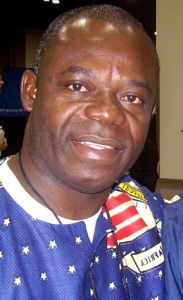 The Rev. Jerry Kulah, West Africa Central Conference Coordinator of the UMC Africa Initiative and the dean of the Gbarnga School of Theology, a United Methodist seminary in Liberia, is set to speak at the WCA launch event Friday, October 7.
Jerry is an ordained United Methodist clergyperson and has served as both a local church pastor as well as the Monrovia District Superintendent overseeing 35 churches. He has represented the Liberia Annual Conference as a delegate to General Conference.
With his miraculous story of escaping death during the Liberian civil war, Jerry has been instrumental in organizing Liberia’s non-denominational National Day of Prayer and is widely regarded as one of its most influential Christian leaders. He was also instrumental in bringing the medical mission Mercy Ships to Liberia that has blessed hundreds in need of medical services that would otherwise be out of reach.
Jerry’s sermon, “Methodists at the Crossroads,” inspired hundreds of people at the first worship service ever hosted by Africans at the 2016 General Conference. We are thrilled to have Jerry join us in Chicago.
To register for the launch event, click HERE.
by Steve | Sep 7, 2016 | In the News, Perspective E-Newsletter
 “During this time of uncertainty and chaos in our church the Wesleyan Covenant Association is a fresh voice of hope,” says the Rev. Jessica LaGrone, Dean of the Chapel at Asbury Theological Seminary in Wilmore, Kentucky. In her invitation to United Methodists to join her for the WCA’s launch event on October 7, she says, “We are covenant keeping people, and we are leaning into the covenant we have with God and with each other.”
An acclaimed pastor, teacher, and writer, Jessica will be one of the main speakers at the WCA launch event. An ordained pastor in the Texas Annual Conference, Jessica previously served for nine years at The Woodlands United Methodist Church near Houston, Texas. She has represented the Texas Annual Conference as a South Central Jurisdiction delegate.
Jessica’s books and studies include Namesake: When God Rewrites Your Story, Under Wraps, Broken and Blessed: How God Used One Imperfect Family to Change the World, and Set Apart: Holy Habits of Prophets and Kings. Jessica also is a video co-host for the new Disciple Bible Study Fast Track, an adaptation of the original, bestselling Disciple Bible Study.
To register for the launch event, click HERE.
by Steve | Aug 31, 2016 | July-Aug2016, Magazine, Magazine Articles
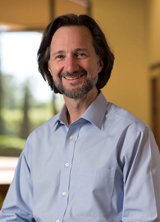
Rev. Rob Renfroe
By Rob Renfroe-
If the Western Jurisdiction wanted to create a schism within The United Methodist Church, its delegates could not have devised a better plan than their recent election of the Rev. Karen Oliveto to serve as a bishop of the UM Church. As is widely publicized, Oliveto is married to another woman and has announced that she has performed over fifty same-gender weddings.
This provocative act is simply the latest indication that the UM Church is coming apart. Nine annual conferences have now voted that they will not comply with the church’s positions regarding sexuality – meaning they will allow partnered gay persons to serve as ordained pastors and they will not hold accountable pastors who marry gay couples.
Unfortunately, the way the UM Church is organized, there is little that can be done to bring these annual conferences into compliance with UM doctrine. And though Rev. Oliveto’s election has been appealed to the Judicial Council, it is unlikely that the Council will rule her election out of order. Any elder “in good standing” may be elected to the episcopacy. At the time of her election, Oliveto was in good standing within her annual conference.
The election of a partnered gay bishop was not a surprise. Good News had been predicting such an event for the past two years. Knowing progressives could not change the church’s official views legislatively at General Conference, they had two options: give up the fight or step up their acts of disobedience, in hopes of demonstrating that there is no real accountability within the UM Church and signaling to others that they may now disobey the church’s instructions regarding sexuality.
The ironic part to this drama is that when orthodox United Methodist leaders have questioned whether, with all of our differences, we could live together as one church, they were condemned as “schismatics” by progressives who said we should all remain at the table and “continue the conversation.”
What’s obvious at this point is that when the conversation is not to the liking of progressives, they feel free to disregard the views of the majority and do what they “know to be best.” And they expect us “to stay at the table and remain in holy conferencing” – not because they are open to change or to honoring the conversation but because they know they can turn over the table and dishonor the practice of holy conferencing without any consequences. And should we even hint that we don’t see the point of continuing in dialogue any longer since it has no bearing on what progressives do, we are made out to be the villains, rather than those progressives who disrespect holy conferencing and the table they claim brings us together.
Question. If I was unfaithful to my marriage covenant and my wife discovered it, and if I responded by saying that I had my reasons and that I intended to be unfaithful in the future and that there was nothing she could do to change my mind, what would you tell her to do? If I told her that to be a good spouse she needed to stay in relationship with me and keep talking about our relationship, not because I’m open to changing but simply because that’s what a good wife should do – how would you advise her?
I’m guessing you would think that I have no right to tell my wife how she should respond. (I have never counseled a couple whose relationship has been shattered by adultery that the cheater should be the one to determine the rules for the faithful spouse.) I’m guessing that if she was willing to put up with such continued abuse, you wouldn’t find her noble and healthy but weak and co-dependent. At some point, you’d tell her “he’s not going to change; it’s unhealthy for you to stay in this relationship; so you can respect yourself, you have to say, ‘enough.’”
That’s where we are. We have an unfaithful spouse. He has his reasons for what he’s doing and he has told us that he is never going to change. And he tells us that we should stay in conversation because that’s what good people do.
This is the situation that the bishops’ commission must address. Trying to create some compromise that allows continued unfaithfulness will not work. Re-writing our marriage vows so that fidelity is no longer required won’t heal our relationship. Attempting to “contextualize” our behavior so that the spouse can cheat in places where cheating is acceptable won’t resolve our differences.
That’s why “A Third Way” failed. That’s why talk of re-writing the Book of Discipline and removing restrictive language about the church’s teaching on sexuality is foolish. And that’s why claiming that churches in more liberal contexts should have a different position than those in more traditional parts of the world is unthinkable. We don’t determine faithfulness based on the sentiments of a fallen culture but on the clear teaching of God’s word.
So we are in a time of crisis and chaos. And the future of the UM Church is in question. Why are we here? There are many reasons but the primary one is this: our bishops have been permissive parents. Many have signaled that pastors are free to be unfaithful to our covenant in their annual conferences. And even the conservative bishops have not unified, organized, spoken out together, or warmly promoted our church’s biblically based sexual ethics. And what permissive parents always discover is that failing to enforce the family’s rules never leads to a healthy, unified family but to a family that is dysfunctional and selfish.
In this vacuum of leadership, many orthodox leaders – lay and clergy – have created the Wesleyan Covenant Association. This network of innovatively traditional Wesleyan churches is coming together to witness and work together for the orthodox faith, to resource each other for effective ministry, and to strategize for the future, regardless of what the commission may recommend. They have decided that it’s time to stop waiting for the progressives to change their stripes (they won’t) or for our bishops to restore integrity to our covenant (they are too divided to do so).
Whatever God has in mind for the people called Methodist, the Wesleyan Covenant Association is prepared to lead the way to a better day for Bible-centered Methodists. It will have no authority to change the church’s teachings and has no desire to do so. But it does have the power to encourage faithful United Methodists to step into the future strong, smart, strategic, and together.
God has the ability to bring order out of chaos, blessing out of brokenness, and life out of death. What he asks of us is faithfulness. And if we do that – if we remain faithful and together – whatever happens, there is a better day coming. God will create it. And honestly, I cannot wait to step into that future with brothers and sisters who long for the world to know Jesus.
Rob Renfroe is the president and publisher of Good News.
by Steve | Aug 31, 2016 | July-Aug2016, Magazine, Magazine Articles
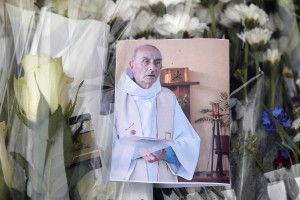
Flowers are left in tribute to Father Jacques Hamel who was murdered during a church service in France. Associated Press.
By Steve Beard-
“Jacques, you were a faithful disciple of Jesus.”
If he were given the opportunity to overhear the proceedings at his own funeral, these are the words that Father Jacques Hamel would have been most pleased to hear. They were said with a mixture of solemnity, sorrow, and triumph by those who knew him best.
In what can only be described as barbaric bloodlust, Father Jacques’ throat was slit by two jihadists in front of the altar of the church at St Étienne-du-Rouvray, near Rouen, nearly 80 miles northwest of Paris. He was 85 years old.
Father Jacques’ death sparked international controversy for politicians and religious leaders in the midst of our current battle against terrorism. Some call his death martyrdom. Others wish we could call it something else so as not to add further tension to an easily flammable international tinderbox. It is pitiable that the ghastly murder of an elderly priest should have very smart observers tiptoeing through a minefield, but such is the world we live in.
Thankfully, from the testimonies given at Father Jacques’ funeral, there are more celebratory observations to be made.
1. Lifelong commitment. One of his ministerial colleagues used to jokingly remind Father Jacques that he was getting up in years and that perhaps it was time to take his pension. The old priest would laugh and say, “Have you ever seen a retired pastor? I will work until my last breath.”
What was said with good humor ended up being manifest in great tragedy. Serving communion would be his final pastoral act. “This is my body given for you,” said Jesus. “This is the new covenant in my blood…”
“When Jesus wanted to explain to his disciples what his death was all about,” writes Anglican scholar N.T. Wright, “he didn’t give them a theory, he gave them a meal.” As the disciples noted, these are very difficult concepts to grasp. When offered, however, we receive the gifts of the sacraments with grateful and childlike faith.
What was intended to be sacrilegious, Father Jacques’ death in the shadow of the altar ended up becoming an amplified witness of lifelong devotion to the incarnate love of a God pierced with bleeding wounds in his hands, feet, and side. Blood remains the key element that binds all of humanity. When pooled in a puddle, it may appear grotesque; but coursing through our veins, blood remains the source of life.
2. Spiritual vision. At his funeral, it was recalled that Father Jacques tried to push away his murderer with his feet, twice saying, “Go away, Satan.” As taught by St. Paul, Father Jacques knew “our struggle is not against flesh and blood but … against the powers of this dark world and against the spiritual forces of evil in the heavenly realms” (Ephesians 6:12).
Father Jacques had seen many horrors during military service as a younger man. His life had been spared when other soldiers lost their lives. His ministry was one way of responding to the mystery of why his life had been spared. His sister Roselyne spoke of his humble spirit: “The God of love and mercy chose you to be at the service of others … until your last breath.”
3. It’s all about Resurrection. “Christ is risen, it is a mystery, a secret, a secret that God gives us to share,” Father Jacques wrote to his parishioners last Easter. Archbishop Dominique Lebrun responded to this message at the funeral: “Perhaps this mystery, this secret you confided was what was winning hearts in our assembly: yes, Christ is risen. The death is not the last word.”
Lebrun continued: “The resurrection of Jesus is not a catechism lesson, it is a reality, a reality for our heart, for the secret of the heart, a reality at the same time to share with others, as a confidence told with trust.”
There were several thousand French men and women in attendance at Father Jacques’ funeral. For a proudly secular society, this was an enormous audience. Each listener was challenged by Archbishop Lebrun’s message: “Brothers and sisters, let us be simple and honest about ourselves. It is in our heart, in the depths of our heart that we have to say ‘yes’ or ‘no’ to Jesus, ‘yes’ or ‘no’ to the path of truth and peace, ‘yes’ or ‘no’ to the victory of love over hatred, ‘yes’ or ‘no’ to his resurrection.”
Lebrun concluded: “God will never force us. God is patient, and God is merciful. Even when I, Dominique, have resisted, and said ‘no’ to love; even when I told God, ‘I will think about it; we will see later,’ even when I have forgotten, God is patient. God expects me because of his infinite mercy.
“But we must uphold with Jesus that every man, every woman, every human person can change his heart with His grace. This is how we make ours the words of Jesus, even as they may seem beyond our strength today, ‘Well! I tell you: Love your enemies and pray for those who persecute you.’”
It is with grace that we remember an elderly French priest, desperately loved by his parishioners. It is with grace that we ask God for the strength to love our enemies and pray for those who persecute us. It is with grace that we receive with open arms the power of the resurrection, the great mystery and the great secret that we are empowered to share.
Steve Beard is the editor of Good News.

 By Walter Fenton-

