by Steve | Apr 27, 2017 | In the News, Perspective E-Newsletter
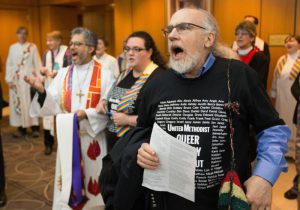
Observers and demonstrators at Judicial Council hearing. Mike DuBose, UMNS
By Walter Fenton-
The Judicial Council of The United Methodist Church heard oral arguments this past Tuesday in the matter of the Western Jurisdictional Conference’s nomination, election, consecration, and assignment of the Rev. Karen Oliveto as a bishop of the church. Oliveto is openly gay and married to Ms. Robin Ridenour, a deaconess in the UM Church.
At a Newark, New Jersey, hotel, over 200 people turned out to witness what many regarded as the most controversial case ever to come before the Council. Typically, Judicial Council meetings are closed, but in rare cases it does grant requests for oral arguments and opens its proceedings to the public. The wide interest in the case required the Council to secure overflow space and request heightened security for its Tuesday morning session.
The vast majority of the observers were LGBTQ+ advocates who were there to support Oliveto and protest the church’s sexual ethics and its teachings on marriage. Some wore clerical robes and rainbow stoles, while others wore black t-shirts emblazoned with the message, “United Methodist QUEER CLERGY #calledOUT.” Their demonstrations were made before and after the oral arguments. There were no disruptions of the proceedings.
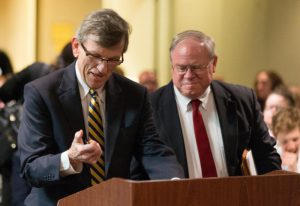
Richard Marsh and the Rev. Keith Boyette presented oral arguments to the Judicial Council. Mike DuBose, UMNS
The Rev. Keith Boyette, a UM clergy member and attorney from Virginia, asked the nine-member Council to rule the Western Jurisdictional Conference’s election of Oliveto null and void. Conversely, Mr. Richard Marsh, the chancellor of the Rocky Mountain Annual Conference, sought to defend the jurisdictional conference’s right to elect her and Oliveto’s right to serve.
The arguments revolved around varying interpretations of the church’s constitution as it pertains to the rights of jurisdictional conferences, a clergy member’s good standing and rights to due process, and when it is appropriate for the Council to exercise judicial review in a given controversy.
According to Marsh, the church’s constitution does not permit the Council to interfere in jurisdictional conferences’ episcopal elections. He argued jurisdictions have sole and unfettered authority to elect and assign whomever they wish. The constitutional grant of jurisdictional autonomy in episcopal elections and assignments is so expansive, he said, that it bars the General Conference or another jurisdictional conference from asking the Council to exercise its power of judicial review.
Boyette countered that the Book of Discipline clearly grants the Judicial Council the right of review and the authority to issue declaratory decisions regarding the actions of jurisdictional conferences. He cited several instances where the Council has asserted its authority in prior instances, and maintained the Western Jurisdictional Conference’s election and assignment of a person clearly in violation of the church’s definition of marriage warrants the Council’s review.
While never yielding the point that the Council did not have jurisdiction in this case, Marsh further argued it would be improper to rule Oliveto’s election null and void. He pointed out that when she was nominated, elected, consecrated, and assigned, she was a clergy member in “good standing,” and therefore an eligible candidate. He maintained any attempt to declare her election null and void would negate her constitutional rights to a fair trial and the appeals process.
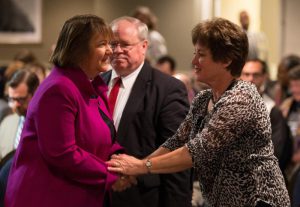
Bishop Karen Oliveto greets Dixie Brewster, the lay woman who petitioned the Judicial Council for a declaratory decision. Mike Dubois, UMNS
Boyette countered the case was not about Oliveto’s standing as a clergy member, but about the legality of the Western Jurisdictional Conference’s election and assignment of her. Her election, he said, would negate, ignore, and violate the Discipline. He noted that in prior decisions the Council has ruled similar actions out of order.
He also argued basic facts in Oliveto’s ministry necessitate judicial review. Although her supervisory authorities (i.e., bishops, district superintendents, and conference boards of ordained ministry) have been aware of her marriage and admission of presiding at approximately 50 same-sex marriages, all failed to hold her accountable to the church’s standards for ordained ministry. Furthermore, the Western Jurisdictional Conference elected and assigned her fully aware of her marital status and her admission of presiding at same-sex marriages. The Judicial Council, Boyette said, is now the only body left to enforce the church’s law.
Council members had sharp questions for both Boyette and Marsh, with most of their inquiries revolving around the autonomy of jurisdictional conferences and whether it was appropriate for the Council to assert its power of judicial review in the case. Marsh steadfastly defended jurisdictional autonomy and claimed the Council would be “legislating from the bench” if it decided to rule Oliveto’s election null and void. Boyette said the details of the case warranted the Council’s review and cited previous decisions indicating its right to rule on its merits.
Last year, delegates to the 2016 General Conference voted to approve a special commission to address the long running debate over the church’s sexual ethics and its teachings on marriage. Many believe that debate has undermined the church’s health and vitality, and now threatens its unity. The delegates granted the Council of Bishops authority to appoint commission members, lead a discernment process, and to convene an unprecedented called General Conference in 2019 to consider any plan or plans proposed by it.
Marsh noted the importance of the commission’s work in his argument, and encouraged the Council to steer clear of issuing a ruling that would likely infringe upon or undermine the commission’s work. In a brief rebuttal, Boyette said the Council should not refrain from fulfilling its duties based on uncertain proposals from the commission and what may or may not happen at a subsequent General Conference. He countered that a decision from the Council would actually bring clarity to the commission’s work.
The Council gave no indication of how it will rule in the case. It is expected to issue a decision within the next few days.
To read Boyette’s oral argument, click HERE.
To read the principal briefs and replies submitted before the hearing, click HERE.
Walter Fenton is a United Methodist clergy person and an analyst for Good News.
by Steve | Apr 27, 2017 | In the News
ORAL ARGUMENT ON BEHALF OF DIXIE BREWSTER
My name is Keith Boyette. I am an elder in the Virginia Conference of The United Methodist Church and an attorney licensed to practice law in the Commonwealths of Virginia and Kentucky. I represent Dixie Brewster, a lay person from the Great Plains Annual Conference who was a delegate to the 2016 General Conference and the 2016 South Central Jurisdictional Conference. Ms. Brewster was the maker of the motion before the 2016 South Central Jurisdictional Conference requesting the declaratory decision which has given rise to this matter.
On July 15, 2016, during the session of the South Central Jurisdictional Conference, Ms. Brewster made the following motion:
Bishop, I move that the South Central Jurisdictional Conference request a declaratory decision from the Judicial Council on the following matter:
Is the nomination, election, consecration, and/or assignment as a bishop of The United Methodist Church of a person who claims to be a “self-avowed practicing homosexual” or is a spouse in a same-sex marriage lawful under The Book of Discipline of The United Methodist Church.
Specifically, What is the application, meaning and effect of ¶304.3, ¶310.2d, ¶341.6, and ¶2702.1 (a), (b), and (d) in regard to the nomination, election, consecration and/or assignment as bishop of a person who claims to be a “self-avowed practicing homosexual” or is a spouse in a same-sex marriage or civil union? Further –
- Does a public record that a nominee for the episcopacy is a spouse in a same-sex marriage disqualify that person from nomination, election, consecration and/or assignment as a bishop in The United Methodist Church?
- If a jurisdictional conference nominates, elects, consecrates, and /or assigns a person who, by virtue of being legally married or in a civil union under civil law to a same-sex partner, would be subject to a chargeable offense, is the action of the jurisdictional conference null and void?
- Is it lawful for one or more of the bishops of a jurisdiction to consecrate a person as bishop when the bishop-elect is known by public record to be a spouse in a same-sex marriage or civil union?
- When a bishop, district superintendent, district committee on ordained ministry, Board of Ordained Ministry, or clergy session becomes aware of or is made aware that a clergy person is a spouse in a same sex marriage or civil union of public record, does such information in effect and in fact amount to a self-avowal of the practice of homosexuality as set forth in ¶304.3, related footnotes and related Judicial council Decisions?
The motion made by Ms. Brewster was seconded and then adopted by the South Central Jurisdictional Conference by a vote of 109 for the motion to 94 against the motion, a 53.6% majority. In our brief, we supplied a link to a video of the floor debate and the taking and announcement of the vote on the motion.
Contemporaneous with the adoption of the motion requesting a declaratory decision by the South Central Jurisdictional Conference, the Western Jurisdictional Conference elected the Rev. Dr. Karen Oliveto as a bishop of The United Methodist Church. Bishop Oliveto, since October 1, 2014, has been and continues to be a spouse in a same-sex marriage according to a public record obtained from the Clerk’s Office in the County and City of San Francisco, California. See Exhibit 1. Bishop Oliveto on numerous occasions and most recently during the 2016 Western Jurisdictional Conference has affirmed that she is a lesbian. Bishop Oliveto has publicly affirmed that she performed more than 50 ceremonies celebrating homosexual unions or marriages, knowing that the performance of such ceremonies violated the provisions of our Book of Discipline and she has acknowledged that she has been able to do so because she had the support of those who had supervisory responsibility over her ministry. (NY Times 2/18/2102 A Quite Struggle Within the Gay Marriage Fight). The 2016 Western Jurisdictional Conference was well aware of this reality as they took time during the Conference for conversation about the impact of electing an openly homosexual person who was in a same-sex marriage to the episcopal office. See Exhibit 2. The questions presented by the South Central Jurisdictional Conference and the decision of the Judicial Council may have an impact on the ability of Bishop Oliveto to continue to serve.
This morning, I urge you to rule:
- That the Judicial Council has jurisdiction over this matter under ¶ 2610 of the 2012 Book of Discipline of The United Methodist Church.
- Jurisdictional conferences may not legally negate, ignore or violate provisions of the Discipline.
- The nomination, election, consecration and/or assignment as a bishop of The United Methodist Church of a person who is a spouse in a same-sex marriage negates, ignores, and violates the provisions of the Discipline and is null, void, and of no effect.
- Likewise, the nomination, election, consecration and/or assignment as a bishop of The United Methodist Church of a person who claims to be a self-avowed practicing homosexual negates, ignores and violates the provisions of the Discipline and is null, void, and of no effect.
- A public record that a nominee for the episcopacy is a spouse in a same-sex marriage disqualifies that person from nomination, election, consecration and/or assignment as a bishop in The United Methodist Church.
- Where a person is known by public record to be a spouse in a same-sex marriage or civil union, the bishops of a jurisdiction cannot lawfully consecrate that person as a bishop and their actions would be null, void and of no effect.
- A public record of a same sex marriage or civil union of a clergy person is a self-of avowal of the practice of homosexuality when brought to the attention of the bishop, district superintendent, district committee on ordained ministry, board of ordained ministry, or clergy session.
JURISDICTION
The Judicial Council has jurisdiction over this matter under ¶ 2610 of the 2012 Book of Discipline of The United Methodist Church. Paragraph 2610 provides, in relevant part:
Declaratory Decisions – 1. The Judicial Council, on petition as hereinafter provided, shall have jurisdiction to make a ruling in the nature of a declaratory decision as to the constitutionality, meaning, application, or effect of the Discipline or any portion thereof or of an act or legislation of a General Conference . . . .
- The following bodies in The United Methodist Church are hereby authorized to make such petitions to the Judicial Council for declaratory decisions: . . . (f) any jurisdictional conference on matters relating to or affecting jurisdictions or jurisdictional conferences or the work therein . . . .
The 2012 Book of Discipline grants jurisdiction to the Judicial Council “to make a ruling in the nature of a declaratory decision as to the . . . meaning, application, or effect of the Discipline or any portion thereof . . . .” Discipline, ¶ 2610.1. The South Central Jurisdiction’s request falls within this jurisdictional grant as it seeks a ruling on the meaning, application, or effect of identified portions of the Discipline to an action of a jurisdictional conference. Thus the request is proper with respect to its subject.
The party requesting this declaratory decision is also proper. Paragraph 2610.2 (f) provides that such a request can be made by “any jurisdictional conference on matters related to or affecting jurisdictions or jurisdictional conferences or the work therein.” Here, the party requesting the declaratory decision is a jurisdictional conference and the subject of the request is on “matters related to or affecting jurisdictions or jurisdictional conferences or the work therein.” The request addresses the nomination, election, consecration and assignment of persons as bishops of The United Methodist Church which is the primary and exclusive work of the jurisdictional conferences in the United States. Discipline, ¶¶ 46, 405. Each jurisdiction has an interest in how other jurisdictions interpret and apply the Discipline in the process of nominating, electing, consecrating and assigning a bishop because a person elected to the office of bishop is a bishop of the entire church and eligible to serve within the confines of any jurisdiction. Discipline, ¶¶ 49, 422.1. When elected a bishop, she joins her colleagues as a CEO of the entire church; she has the opportunity to serve as a president officer at General Conference; she nominates clergy and laity to serve on general church boards and agencies; and she serves as chairperson of boards and agencies.
The Judicial Council decisions and memoranda relied upon by the WJCOB and other amici curiae are all distinguishable from the present matter and do not preclude jurisdiction here. See Brewster Reply Brief at 2-4.
- Decision 255 involved a dispute between a clergyperson and the General Board of Pensions in denying benefits. The Central Kansas Annual Conference sought a declaratory decision but the annual conference had no role in the determination of benefits for the clergyperson and the General Board of Pensions. The subject matter of the request did not relate to the work of any of the annual conferences.
- Decision 301 – SEJ and Florida Annual Conference sought a declaratory decision on a statement adopted by GC. Statement did not direct either conference to take any action and did not require them to do anything. Statement did not relate to the work of either the jurisdictional conferences or the annual conferences.
- Decision 452 – GCOM requested a declaratory decision on the method of election of the Jurisdictional Committee on Episcopacy and the Interjurisdictional Committee on Episcopacy. GCOM had no role in the election of either. Did not relate to the work of GCOM or any general board or agency.
- Memorandum 1114 – Western Ohio Annual Conference sought declaration on the relationship between GC and Interjurisdictional Committee on Episcopacy. Subject matter did not work relate to the work of any annual conference.
- Memorandum 1160 – Northern Illinois Annual Conference sought declaratory decision on whether GC action superseded a Judicial Council decision. GC action did not relate to the work of annual conferences, but rather dealt with church membership – a matter for local churches not annual conferences.
- Memorandum 1329 – decision of law – jurisdictional grant different.
Here, the Judicial Council should adopt the cogent reasoning and declaration of Ruben Reyes in his Dissenting and Concurring Opinion in Memorandum 1200:
[I]n order for an annual conference [here jurisdictional conference] to gain access to the Judicial Council via petition for declaratory decision under ¶ 2610, it is sufficient for jurisdictional purpose that the subject matter relates to the annual conferences or their work, not necessarily limited to the petitioning conference. The matter or matters taken up need not be peculiar, exclusive, or confined to the business, agenda, or work of the petitioner annual conference. It may also relate to or affect other or all annual conferences, especially those similarly situated. The door of the Judicial Council ought to be open to an annual conference initiative concerned not only with their own valid interest and causes but also with those of other annual conferences. Note is to be keenly taken on the plural form of the connected critical terms – annual conferences – in sub-¶ 2(j). The settled pertinent rules of statutory construction mandate that words should be given their ordinary meaning; general words should be understood in their general sense; when the law does not distinguish, courts should not distinguish. Annual Conferences certainly include one, some, or all such level of conference in the church. This construction acquires cogency because a petition by an annual conference for declaratory decision pertains to the constitutionality, meaning, application, or effect of the Discipline or part of it or any act or legislation of the General Conference. In principle, such a decision on constitutional or disciplinary issues raised by a petitioning annual conference has a repercussion on many, or possibly all, annual conferences. Considered with our vital tenet of connectionalism, it is discernible that what affects one annual conference can affect all annual conferences, particularly of the same jurisdiction or region. What is good policy for one conference would likely be good for others in the same situation. What salutary principle applicable to one may apply to all. That, hopefully, would redound to the good order and discipline of the annual conferences of the Church linked together worldwide.
(emphasis in original).
JURISDICTIONAL CONFERENCES MAY NOT LEGALLY NEGATE,
IGNORE, OR VIOLATE PROVISIONS OF THE DISCIPLINE.
In Decision 886, the Judicial Council held:
The Discipline is the law of the Church which regulates every phase of the life and work of the Church. As such, annual conferences may not legally, negate, ignore or violate provisions of the Discipline with which they disagree, even when the disagreements are based upon conscientious objections to those provisions.
The Judicial Council has declared that the holding of Decision 886 is applicable to the jurisdictional conferences in The United Methodist Church. In Decision 1250, the Judicial Council reviewed a resolution adopted by the Western Jurisdictional Conference titled “Sense of the Western Jurisdiction of The United Methodist Church” and which sought to establish by legislative action of the jurisdictional conference the penalty if a bishop was convicted of violating a provision of the Discipline. The resolution provided that in such a case the appropriate penalty would be a suspension of the bishop “from the exercise of the episcopal office for a period of 24 consecutive hours.” See Decision 1237. The Judicial Council stated “a conference – jurisdictional, central, or annual – . . . may not legally negate, ignore or violate provisions of the Discipline . . . .” Decision 1250 (citing Decision 886).
In Decision 886, the Judicial Council observed that such acts negating, ignoring or violating the provisions of the Discipline “would leave the Church, without any enforceable law, which would lead to chaos in the Church.” The principle set forth in Decision 886 has been applied in numerous cases to invalidate actions of annual and jurisdictional conferences. See, e.g., Decisions 911, 1111, 1115, 1120, 1185, and 1250. In each instance, those actions have involved resolutions directing individuals or entities to take actions which would negate, ignore or violate the Discipline. However, the action addressed here is even more pernicious because a jurisdictional conference, if it were permitted to proceed to nominate, elect, consecrate and/or assign a person such as described in the declaratory decision request, would immediately be in violation of the Discipline. In such an event, the Judicial Council is the only body within the polity of The United Methodist Church which would have the ability to rule such an action by a jurisdictional council to be unlawful, null and void.
The words of the Judicial Council in Decision 886 have proven to be prophetic in The United Methodist Church, where the actions of various jurisdictional and annual conferences negating, ignoring and violating the provisions of the Discipline leave the Church without any enforceable law and where the Church is in chaos with its very unity threatened. The only remedy left for those who would uphold the Discipline in the face of such willful disobedience is to seek redress from the Judicial Council.
The circumstance on which a declaratory decision is requested by the petition has in fact now occurred through the actions of the Western Jurisdictional Conference. Representatives of the Western Jurisdictional Conference have been identified as interested parties, including Bishop Oliveto who has been nominated, elected, consecrated and assigned in violation of provisions of the Discipline. Therefore, if the Judicial Council holds as requested, the action of the Western Jurisdictional Conference in nominating, electing, consecrating and assigning Bishop Oliveto would be an action which would negate, ignore and violate the provisions of the Discipline, and would be null, void, and of no effect, resulting in the invalidation of Bishop Oliveto’s election.
THE DISCIPLINE ESTABLISHES WHAT CONSTITUTES A MARRIAGE IN THE UNITED METHODIST CHURCH AND ALL OTHER RELATIONSHIPS WHICH PURPORT TO BE MARRIAGE ARE UNLAWFUL.
The United Methodist Church has positively defined what marriage is for The United Methodist Church. Marriage is explicitly defined as being a relationship between one man and one woman. Paragraph 161B of the Discipline states, “We affirm the sanctity of the marriage covenant that is expressed in love, mutual support, personal commitment, and shared fidelity between a man and a woman. . . . We support laws in civil society that define marriage as the union of one man and one woman.” This definition of marriage excludes all other definitions of marriage and makes such other definitions unlawful in The United Methodist Church.
Thus, when the New York Annual Conference sought by conference policy to permit clergy to enter into same-sex marriages in contravention of the Discipline, the Judicial Council, in Decision 1185, held that the New York Annual Conference had acted in such a way as to negate, ignore or violate the Discipline. In other words, any form of marriage other than that defined by the General Conference in the Discipline was unlawful under our church’s polity.
In Decision 1185, the Judicial Council stated,
The General Conference has legislative authority for all matters that are distinctly connectional and is the only body authorized to define legislatively the words ‘lawful’ and ‘marry.’ The General Conference is the only body empowered to adopt legislation; the General Conference has done so including ¶ 161B in defining marriage by limiting it to ‘the marriage covenant that is expressed in love, mutual support, shared commitment, and fidelity between a man and a woman.’ This definition is within the power and authority of the General Conference to define ‘marriage’ for the entire Church.
The Judicial Council proceeded to note that the New York Annual Conference’s resolution and policy under review in Decision 1185 was aimed at permitting clergy who wish to enter into same sex marriage to do so at their discretion. Paragraph 604.1 provides that an annual conference, ‘for its own government, may adopt rules and regulations not in conflict with the Discipline of The United Methodist Church.” The action of the New York Annual Conference in adopting Resolution 2010-305 is a violation of ¶ 604.1 of the Discipline. This resolution and policy could arguably be advance as some safe have from the complaint process for those clergy who choose to enter into a same sex marriage at their discretion under the auspices of the proposed resolution and policy. An annual conference has no authority to offer clergy immunity from administrative or judicial complaint processes by adopting a resolution and policy that is clearly contrary to the Discipline.
The Judicial Council, in Decision 1185, concluded, “The Church’s definition of marriage as contained in the Discipline is clear and unequivocal and is limited to the union of one man and one woman.” As a consequence, any other form of marriage not limited to the union of one man and one woman is unlawful. As the Judicial Council noted in Decision 1185, ¶ 2702.1(a) defines immorality in part as “not being celibate in singleness or not faithful in a heterosexual marriage.” By explicit action of the General Conference codified in the Discipline clergy in The United Methodist Church, including persons in the office of bishop, may either be single or in a heterosexual marriage. It is unlawful for clergy to be a party to a same-sex marriage. Such a marriage is contrary to the Discipline of The United Methodist Church.
The Western Jurisdiction College of Bishops in its brief cites Decision 833 in arguing that a provision in the Social Principles is not the law of the church. But Decision 833 rules exactly contrary to the WJCOB position. There the Judicial Council recognized that provisions of the Social Principles may have the force of law “notwithstanding its placement in the Discipline” and specifically held that a provision prohibiting the celebration of homosexual union by our ministers or in our buildings had the force of law even thought it was then lodged in the Social Principles. Decision 1185 holds that the definition of marriage contained in the social principles has the force of law.
Our Book of Worship, in its provision of marriage ceremonies, affirms that marriage is the union of one man and one woman. See The United Methodist Book of Worship at 116-133. Paragraph 16.6 of the Discipline states that as part of the full legislative power over all matters distinctively connectional, the General Conference has the authority to “provide and revise the hymnal and ritual of the Church and to regulate all matters relating to the form and mode or worship . . . .” and they have done so through the adoption of the Book of Worship.
The Discipline further declares that an act of immorality by a person who is a bishop or clergy member of an annual conference includes but is not limited to “not being celibate in singleness or not faithful in heterosexual marriage . . . .” ¶ 2702.1a of the Discipline (emphasis added). Paragraph 341.6 of the Discipline further makes clear the understanding of The United Methodist Church that the General Conference has declared marriage to be a covenant between a man and a woman: “Ceremonies that celebrate homosexual unions shall not be conducted by our ministers and shall not be conducted in our churches.”
Several of the briefs filed by amici curiae in this matter assert that it is not unlawful for a pastor in The United Methodist Church to be married to a person of the same gender. Such an argument strains credulity. Despite numerous provisions adopted by the General Conference over the past more than forty years which make clear that marriage is defined in a specific, biblical way, these amici curiae assert that the lack of a prohibition of other forms of relationship as a marriage would mean that the church permits such relationships. Under this reasoning, although our church’s position is that marriage is between two people – one man and one woman, it would be fine for persons in The United Methodist Church to be parties to a polygamous marriage because such a marriage is not explicitly prohibited in the polity of The United Methodist Church. And yet our church does not recognize polygamous marriages as being lawful marriages in which our elders can be participants.
A public record that one person is married to another person conclusively establishes the existence of the marriage addressed therein unless a court order of divorce is produced. The nomination, election, consecration and/or assignment as a bishop of The United Methodist Church of a person who is a spouse in a same-sex marriage would be an act which would legally negate, ignore and violate these provisions of the Discipline and as such would be null, void and of no effect. The Discipline repeatedly makes clear that an ordained person, and thus a bishop, must be celibate in singleness and faithful in marriage (see ¶¶ 304.2, 310.2d, and 2702.1a), and expressly defines marriage as heterosexual marriage between one man and one woman.
Likewise, the nomination, election, consecration and/or assignment as a bishop of The United Methodist Church of a person who claims to be a self-avowed practicing homosexual would manifestly negate, ignore and violate ¶ 304.3 of the Discipline and would as such be null, void and of no effect.
Note that the focus of the Judicial Council in this proceeding is on the ability of a jurisdictional conference to elect a person as a bishop and not on the standing of the person under consideration in his or her ministerial office. The Discipline does not guarantee any ordained person the right to be elected to the episcopacy. However, the Discipline does guarantee ministers in good standing an appointment. Therefore, in Decision 920, the Judicial Council held that a statement made by a clergy woman that she is “living in a partnered, covenanted homosexual relationship with another woman” is a sufficient declaration to subject such person’s membership in her ministerial office to review under ¶ 359.1″ [now ¶ 363.1]. While the review occurred, the person remained a minister in good standing and was guaranteed an appointment under ¶ 334.1 [now ¶ 337.1]. If the Judicial Council determines as contended here that a jurisdictional conference is prohibited from electing to the office of bishop an individual the election of whom would negate, ignore or violate the Discipline and that such an election would be null, void and no effect, such a person would continue to be a member of the order of elders, would continue under appointment as an elder and that person’s membership in his or her ministerial office would be subject to review under the terms of Decision 920. Thus, if as requested, the election of Bishop Oliveto is declared null, void and of no effect, Bishop Oliveto would still remain an elder of The United Methodist Church and be guaranteed an appointment, but the Western Jurisdictional Conference would have been prevented from taking an action which negates, ignores and/or violates the Discipline. All fair process and trial rights which attach to membership in the order of elders are safeguarded.
Complaints are pending against Karen Oliveto placing her membership in her ministerial office as an ordained elder in The United Methodist Church under review. The last statement issued with respect to those complaints has been that they are in supervisory process. See Heather Hahn, “Bishops Respond To Gay Colleague,” UMNS, August 23, 2016, at http://www.umc.org/news-and-media/bishops-respond-to-gay-colleague (accessed on February 9, 2017). The initial 120 day period for the supervisory process has expired with no notification of an extension of the supervisory process or what the disposition of the complaints has been. Oliveto’s right to trial guaranteed by ¶¶ 20 and 58 and fair process protections are ensured as part of the judicial process resulting from the complaints filed against her.
Where a person is known by public record to be a spouse in a same-sex marriage or civil union, the bishops of a jurisdiction cannot lawfully consecrate that person as a bishop and their actions would be null, void and of no effect.
Paragraph 403.1(f) of the Discipline declares:
- Bishops are elected from the elders and set apart for a ministry of servant leadership, general oversight and supervision . . . . The bishop leads therefore through the following disciplines:
. . .
- f) The ministry of administration. The role of the bishop is to uphold the discipline and order of the Church by consecrating . . . persons in ministry of the Church and the world . . . .
Charged with upholding the discipline and order of the Church, the lawful actions of the bishops are defined by the Constitution and Discipline. Just as conferences (jurisdictional, central or annual) cannot negate, ignore and/or violate the Discipline, neither can bishops in the performance of their responsibilities. The General Conference as provided in ¶ 16 of the Constitution is invested with full legislative power over all matters distinctively connectional.
As discussed above, the General Conference has preemptively declared that the only marriage acknowledged and permissible in The United Methodist Church is a marriage between one man and one woman, and that our clergy, and therefore our bishops, are called to celibacy in singleness and fidelity in heterosexual marriage (see ¶ 2702.1a of the Discipline).
Therefore in their role as bishops charged with the ministry of administration, the upholding of the discipline and order of the Church, it would be unlawful for a bishop or a group of bishops to consecrate a person who is known by public record to be a spouse in a same-sex marriage or union. If a bishop or groups of bishops did consecrate such a person, their actions would be null, void, and of no effect.
A PUBLIC RECORD OF A SAME SEX MARRIAGE OR CIVIL UNION OF A CLERGY PERSON IS A SELF-AVOWAL OF THE PRACTICE OF HOMOSEXUALITY WHEN BROUGHT TO THE ATTENTION OF THE BISHOP, DISTRICT SUPERINTENDENT, DISTRICT COMMITTEE ON ORDAINED MINISTRY, BOARD OF ORDAINED MINISTRY, OR CLERGY SESSION.
There are many ways that information can be conveyed to another. Certainly a direct statement, either oral or written, is one way. When such a statement is made in a governmental record signed by a clergy person and made public as an official record, it is sufficient to declare that which is contained in the public record to anyone to whose attention the record is made known. Therefore, if a bishop, district superintendent, district committee on ordained ministry, board of ordained ministry or clergy session becomes aware or is made aware of a public record of a same sex marriage or civil union of a clergy person, the public record is an act of self-avowal of the practice of homosexuality.
CONCLUSION & RELIEF REQUESTED
Dixie Brewster, through her advocate the Rev. Keith D. Boyette, respectfully requests that the Judicial Council issues its declaratory decision on the matters raised in the petition of the South Central Jurisdictional Conference as follows:
- The nomination, election, consecration and/or assignment as a bishop of The United Methodist Church of a person who is a spouse in same-sex marriage negates, ignores and violates the provisions of the Discipline and is null, void, and of no effect.
- The nomination, election, consecration and/or assignment as a bishop of The United Methodist Church of a person who claims to be a self-avowed practicing homosexual negates, ignores and violates the provisions of the Discipline and is null, void, and of no effect.
- A public record that a nominee for the episcopacy is a spouse in a same-sex marriage disqualifies that person from nomination, election, consecration and/or assignment as a Bishop in The United Methodist Church.
- Where a person is known by public record to be a spouse in a same-sex marriage or civil union, the bishops of a jurisdiction cannot lawfully consecrate that person as a bishop and their action would be null, void and of no effect.
- A public record of a same sex marriage or civil union of a clergy person is a self-avowal of the practice of homosexuality when brought to the attention of the bishop, district superintendent, district committee on ordained ministry, board of ordained ministry, or clergy session.
- The election of a person to the office of bishop where such election is null, void and of no effect results in no change in such person’s membership in their ministerial office, but subjects such person’s membership in their ministerial office to review as required by Decision 920.
- For all of the foregoing reasons, the nomination, election, consecration and assignment of Karen Oliveto as a bishop of The United Methodist Church is an action which negates, ignore, and/or violates the Discipline and her nomination, election, consecration and assignment is null, void and of no effect.
by Steve | Apr 27, 2017 | In the News

The Rev. Keith Boyette
The Wesleyan Covenant Association (WCA) has named the Rev. Keith Boyette as their first president. Boyette is a member of the Virginia Annual Conference and founded the Wilderness Community United Methodist Church 19 years ago. For eight years, Boyette served on the Judicial Council, known as the “Supreme Court” of The United Methodist Church, and was elected by his peers to serve as secretary of the Council. Prior to responding to God’s call to ordained ministry in the UM Church, Boyette was a practicing attorney in Virginia and Kentucky.
“We are very pleased to have Keith as our first president,” said Dr. Jeff Greenway, the Chair of the Wesleyan Covenant Association Council and pastor of Reynoldsburg (Ohio) United Methodist Church. “He has been an integral member of the team that cast the vision for the WCA from the very beginning and is committed to the renewal of the church. He has vast experience in our denomination, and has demonstrated an ability to relate to a wide variety of people. He embodies our commitment to vibrant, evangelical, orthodox, Wesleyan Christianity and to renewing the theology and practice of our denomination.”
While his election takes effect immediately, he will not begin devoting his full attention to his new duties until he retires from the Virginia Conference in June.
“I am humbled and excited by the opportunity to begin my service as President of the Wesleyan Covenant Association,” said Boyette at the time of his election. “I have contended for the advancement of evangelical, orthodox, Wesleyan Christianity throughout my adult life. This is a crucial season for those committed to a vibrant expression of the Christian faith that is true to the best of our heritage as we seek the most beneficial outcome for maintaining our beliefs with the approaching Special General Conference in February 2019. I look forward to working with others to ensure that we have deeply committed leadership possessing a fervent passion for the cause of Christ and to connecting churches, clergy, and laity in this endeavor.”
“Building a new organization from the ground up is what Keith does,” said the Rev. Carolyn Moore, the vice-chair of the WCA Council and pastor of Mosaic UM Church in Augusta, Georgia. “He comes to the WCA after nineteen years of successfully planting and developing a healthy, creative expression of ‘church’ in Virginia. Having him in the lead as we craft a net wide enough to hold everyone ready to do a new thing is a real grace. I’m grateful to Keith for his willingness to step up and take us into the next Methodism.”
The Wesleyan Covenant Association was formed and their governing Council was elected at a gathering of 1,800 persons last October in Chicago. In its first seven months of existence it has grown to have membership from every Annual and Central Conference in The United Methodist Church. The all-volunteer Council of 25 persons has cared for the day-to day operations since their election. The naming of Boyette as president is the next step in the development of this growing organization that is committed to the theological and practical renewal of the UM Church.
“I have valued the opportunity to work with Keith over the past few months and have appreciated his humility, good humor, and depth of insight,” said Chris Ritter, pastor of the Geneseo (Illinois) First United Methodist Church and member of the WCA Council. “His work in the church, including eight years on our Judicial Council, has given him the opportunity to work collaboratively with people from a wide range of viewpoints. Keith models civility as he stands firm on his core convictions. He will be a faithful captain for our work in the Wesleyan Covenant Association.”
“Keith’s vast leadership, ministerial, and legal experience, combined with his wisdom and servant’s heart, makes him a solid choice to lead as the WCA’s first President,” said Cara Nicklas, a lay member of the Council and attorney from Oklahoma. “I am thankful for Keith’s willingness to make significant sacrifices in order to step into this important role for such a time as this.”
by Steve | Apr 24, 2017 | In the News, Uncategorized
Key questions in the Oliveto case
On July 15, 2016, during the session of the South Central Jurisdictional Conference, Dixie Brewster, a delegate and lay member of the Great Plains Annual Conference, asked that the delegates to request a declaratory decision from the Judicial Council on the following matter:
“Is the nomination, election, consecration, and/or assignment as a bishop of The United Methodist Church of a person who claims to be a ‘self-avowed practicing homosexual’ or is a spouse in a same-sex marriage lawful under The Book of Discipline of The United Methodist Church?”
Specifically, Brewster wanted to know how United Methodism’s standards on ordination and same-sex marriage applied to the nomination, election, consecration and/or assignment as bishop of a person who claims to be a “self-avowed practicing homosexual” or is a spouse in a same-sex marriage or civil union?
In her motion, Brewster asked some key questions:
• Does a public record that a nominee for the episcopacy is a spouse in a same-sex marriage disqualify that person from nomination, election, consecration and/or assignment as a bishop in The United Methodist Church?
• If a jurisdictional conference nominates, elects, consecrates, and /or assigns a person who, by virtue of being legally married or in a civil union under civil law to a same-sex partner, would be subject to a chargeable offense, is the action of the jurisdictional conference null and void?
• Is it lawful for one or more of the bishops of a jurisdiction to consecrate a person as bishop when the bishop-elect is known by public record to be a spouse in a same-sex marriage or civil union?
• When a bishop, district superintendent, district committee on ordained ministry, Board of Ordained Ministry, or clergy session becomes aware of or is made aware that a clergy person is a spouse in a same sex marriage or civil union of public record, does such information in effect and in fact amount to a self-avowal of the practice of homosexuality as set forth in the Discipline and related Judicial Council decisions?
The motion made by Brewster was seconded and then adopted by the South Central Jurisdictional Conference by a vote of 109 for the motion to 84 against the motion, a 56.48 percent majority.
The United Methodist Judicial Council will hear the oral arguments of the case on April 25, 2017.
To read the brief on behalf the Western Jurisdiction College of Bishops click HERE.
To read the brief on behalf of Ms. Dixie Brewster, the South Central Jurisdiction lay delegate who made the motion requesting the declaratory decision, click HERE.
To read a reply to the brief on behalf the Western Jurisdiction College of Bishops click HERE.