by Steve | Jul 17, 2020 | In the News, Perspective E-Newsletter
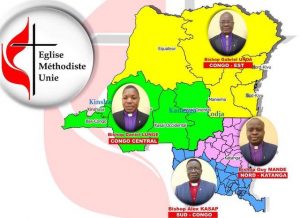
Graphic is a screenshot from the Congo Central Conference Facebook page.
By Thomas Lambrecht –
The polarization of The United Methodist Church in the United States is now unfortunately surfacing in the part of the church located in the Democratic Republic of Congo (DRC) – one of at least 17 countries on the continent of Africa to host United Methodist churches. There are 3 million United Methodists in DRC – the largest contingent of Methodism outside the United States.
At last count, there were roughly 6.6 million United Methodists in North America, 5.9 million in Africa, and 200,000 in the Philippines and Europe.
Actions have been taken by two of the four bishops and annual conference boards in the Congo to penalize pastors and lay leaders who are working to promote faithfulness to traditional doctrines and moral teachings. These penalizing actions were taken contrary to the processes required by our Book of Discipline and violated the rights of the persons penalized. Complaints have been filed against the church authorities for these improper actions, but so far, the complaints have been either ignored or no remedy has been provided.
UM Church in the Congo
The primary languages of United Methodists in Congo are French and Kiswahili, which often presents a challenge in communicating with their English-speaking brothers and sisters. In addition, DRC is the same size as the U.S. east of the Mississippi, but with less than 1,000 miles of paved roads, an indicator of the extreme poverty of the country, which naturally affects the church and its ministry there.
The Congo Central Conference has four bishops: Bishop Gabriel Unda (Eastern Congo), Bishop Kasap Owan (Southern Congo and Zambia), Bishop Daniel Lunge (Central Congo), and Bishop Mande Muyombo (North Katanga). Bishop Unda was elected in 2013 and is the president of the Congo College of Bishops. The other three bishops were elected in 2017.
Bishop Kasap is the only bishop of the four who has declared his strong support for the Wesleyan Covenant Association and for the traditionalist position on church doctrine and teachings on marriage and sexuality. The other three bishops supported the “One Church Plan” at the 2019 General Conference in St. Louis, urging their delegates not to vote for the “Traditional Plan” that eventually passed. Reports from delegates, however, indicate that delegations generally voted contrary to their bishops’ advice, which has engendered conflict both within and between the episcopal areas in the Congo.
This Perspective will address some of the actions occurring in Central Congo under Bishop Lunge.
Nicolas Munongo
Nicolas Munongo is a layperson in the West Congo Annual Conference of the Central Congo Episcopal Area who at one time served as a trusted assistant to Bishop Lunge. Because Munongo became aware of some allegations against Bishop Lunge that cannot be made public at this time, Bishop Lunge suspended Munongo as a church member and removed him from his position as assistant. Munongo had also attended a meeting where he heard about the Traditional Plan and became a supporter of that plan, which further angered Lunge and his supporters.
After the 2019 General Conference, Munongo continued to promote the traditional perspective among clergy and lay leaders in Central Congo. When Bishop Muyombo (North Katanga) visited Central Congo and told one of the pastors, Henriette Okele, not to associate with Bishop Kasap (Southern Congo and Zambia) and the conservatives, Munongo reported that information to Kasap. When Kasap confronted Muyombo, he became angry and complained to his ally, Bishop Lunge. Lunge instituted proceedings against Munongo, a layperson, by the West Congo Annual Conference Board of Ordained Ministry. The Board held a hearing without any notice to Munongo and, in his absence, accused Munongo of making “defamatory, derogatory and insulting remarks” about Bishops Muyombo, Lunge, and Unda, designed to “create an unhealthy climate and lead to the division of the Central Conference of Congo and the College of Bishops.”
The Board of Ordained Ministry removed Munongo from his membership in the church as a layperson and forbade him “from performing any act in the name and on behalf of the East Congo Conference of the United Methodist Community in the Central Congo both inside and outside its bodies” and threatened legal action if Munongo failed to comply.
Apart from whether or not Munongo did anything wrong, there are many problems with how the bishop and annual conference handled this situation. First and foremost, neither the bishop nor the Board of Ordained Ministry has any authority to suspend or remove from membership a layperson. The only way a layperson can be penalized is through the complaint and trial process, which was not followed in this instance and over which the Board of Ordained Ministry has no jurisdiction. No formal complaint was filed against Munongo. No supervisory process was held. No trial was held. There was no attempt at a negotiated resolution of the problem. The bishop and annual conference violated Munongo’s rights as guaranteed by the Book of Discipline to fair process and trial. Instead, an arbitrary and punitive action is attempting to deprive Munongo of his membership in the church in an effort to discredit him due to his difference of opinion with the bishop over the Traditional Plan.
The Rev. Louis Loma Otshudi
The Rev. Louis Loma is a pastor in the West Congo Annual Conference. The Board of Ordained Ministry, without the filing of a written complaint, supervisory process, or trial, suspended him in October 2019. He was accused of “defaming” the bishop on social media (WhatsApp). (Loma had criticized Bishop Lunge for supporting the One Church Plan, advocating instead for the Traditional Plan.) Loma was also accused of being part of a “divisionist” group in Central Congo. (Loma identifies as a “conservative” in line with the current position of the Book of Discipline and spoke out against a group of progressive persons who came from the U.S. to meet with leaders in Central Congo.)
Again, regardless of whether Rev. Loma did anything wrong, the process of the Book of Discipline was not followed. There was no formal complaint filed against Loma. There was no supervisory response by the bishop, only a meeting by the Board of Ordained Ministry, of which no notice was given to Loma and no opportunity provided to Loma to rebut or present evidence. No trial was held. Under the Discipline, the Board of Ordained Ministry could only suspend Loma if a complaint was being processed, and then only for 90 to 120 days with pay. Instead, Loma has been suspended without pay for nearly nine months with no complaint or charges being filed. Loma has no recourse in this situation, since a trial was never held and therefore, he cannot appeal the decision. (Additionally, no appeal would have been possible because the Congo Central Conference has elected no central conference committee on appeals.) The Board of Ordained Ministry has violated Loma’s fair process and constitutional rights guaranteed by the Book of Discipline.
The Rev. Henriette Okele
The Rev. Henriette Okele is a pastor in the East Congo Annual Conference. On April 2, the Board of Ordained Ministry suspended her because she attended a meeting of African leaders in Johannesburg, South Africa. The meeting was sponsored by the Africa Initiative, a group formed by African leaders to equip and promote the voice of African United Methodists within the larger denomination. The purpose of the meeting was to explain the provisions of the “Protocol” and its implementing legislation regarding the possible separation of the church and to hear the feedback from African leaders regarding the “Protocol.” (The African Initiative issued a statement following the meeting endorsing the “Protocol” and urging several amendments to it.)
Because Okele attended the meeting without the permission of her superintendent and bishop, and because the meeting “was accompanied by resolutions tending to the division of the United Methodist Church,” she was suspended. The letter of suspension further said that her suspension was “without appeal.”
There is nothing in the Discipline that allows bishops or superintendents to forbid clergy from attending meetings of church leaders for the purpose of understanding issues and proposals coming before the church. This claim of power by Bishop Lunge and other African bishops is an attempt to keep their people uninformed about what is happening in the church. By controlling all the information that is reaching their people, the bishops hope to control what the African church decides to do in response to the actions of General Conference.
Again, the process with Okele violated every aspect of the Discipline’s requirements. No formal complaint was filed against her. There was no supervisory process or attempt to negotiate a just resolution. No trial was held. The Board of Ordained Ministry did not have the authority to suspend Okele at all, let alone without pay. It cannot deprive her of the right of trial and appeal, which is guaranteed by the Restrictive Rules of our church Constitution.
No Recourse
Because of all the violations of fair process and constitutional rights, Munongo, Loma, and Okele appealed to Bishop Lunge to reverse the decisions and require the Boards of Ordained Ministry to handle the situation according to the requirements of the Discipline. Bishop Lunge ignored their appeal.
Therefore, Munongo filed a complaint against the chair of the Board of Ordained Ministry for disobedience to the order and discipline of the church. Bishop Lunge ignored his complaint and declined to process it, refusing even to meet with him and instructing his aides not to allow him in the conference office or to receive any mail from him.
Finally, Munongo filed a complaint against Bishop Lunge for disobedience to the order and discipline of the church for failing to process his previous complaint. The complaint against Lunge went to Bishop Unda as the president of the Congo College of Bishops. In response to the complaint, Bishop Unda met with Munongo, Loma, and Okele and suggested that they should apologize to Bishop Lunge and ask forgiveness. Since they had done nothing wrong, they declined to apologize. Bishop Unda at that point refused to process the complaint, saying that he could not “interfere” in the affairs of another annual conference.
We have heard this line of reasoning from other bishops, who are unwilling to hold a fellow bishop accountable because it would be considered “interference.” Such reasoning is completely contrary to the Wesleyan and Methodist understanding of mutual accountability. It creates an Anglican or Roman Catholic idea of “diocesan bishops,” where each bishop is essentially a law unto themselves in their own diocese. In contrast, United Methodist bishops are general superintendents, having oversight of the whole church, not just their particular annual conference. In Methodism, bishops, clergy, and laity are supposed to be accountable to each other, for the sake of growing in holiness and for the good of the whole church.
We have also seen other instances where a college of bishops refuses to prosecute a complaint against a fellow bishop. It has happened in Africa before and in the Western Jurisdiction. This failure of accountability gives the appearance of episcopal dictatorship and the variations of practices from one annual conference to another that makes the United Methodist identity virtually meaningless.
The practical result of this lack of accountability is the victimization of pastors and laity who dare to think or speak differently than their bishop in some annual conferences. The heavy-handedness and distortions of the truth end up victimizing the whole church. When the Book of Discipline is no longer followed, we are no longer living in a faithful church, but in a church that is subject to the whims and proclivities of its leaders.
These three individuals in the Central Congo episcopal area have no recourse for the injustice that has been done to them. They are deprived of position and livelihood without due process and in violation of their rights as clergy and lay members of the church. The last hope is that the Council of Bishops would step in and intervene in the complaint against Bishop Lunge. But given the reluctance of bishops to “interfere” with a fellow bishop, that kind of intervention is unlikely.
It is this type of violation of the Discipline and the lack of accountability that is causing the separation of The United Methodist Church. The story told in this Perspective is but one example of the kind of malaise that has afflicted our church. When accountability becomes impossible, the only solution is to start over. A new traditional Methodist church will have a more robust accountability mechanism for bishops at the global level. Bishops will be expected to follow the Discipline or face accountability. Those unwilling to live by the Discipline of the church will be unable to align with that new denomination.
Our denominational identity should mean something. Without accountability, we have no identity as a church. If we stand for anything, we end up standing for nothing. If the plan of separation passes the next General Conference, we will have the opportunity to choose what we will stand for.
Thomas Lambrecht is a United Methodist clergyperson and the vice president of Good News.
by Steve | Jul 13, 2020 | In the News, Perspective E-Newsletter
By Thomas Lambrecht –

Screenshot from the “virtual” annual session of the California-Pacific Conference.
The current focus of our denomination is rightly on how to do effective ministry in the midst of a pandemic and how to understand and address racism in our nation and in our church. For most of our pastors and leaders, there is not much bandwidth left to keep abreast of denominational conflicts.
Unfortunately, the conflicts besetting the denomination have not gone away since the 2020 General Conference was postponed until 2021. Rather than honor a spirit of unity with patience before next year’s gathering in Minneapolis, where a new expression of Methodism can be launched, there are decisions made by progressive leaders that continue to sow division within our denomination regarding marriage and sexuality.
Annual Conferences
For example, at this year’s “virtual” gathering of the California-Pacific Annual Conference, the ordination service was conducted in front of an enormous “Reconciling Ministries Network” banner in the sanctuary of the First United Methodist Church of Pasadena. For those watching online, it gave the appearance that the ordination service was being conducted under the guidance of a singular advocacy caucus rather than a worldwide denomination.
In the Mountain Sky Annual Conference, clergy were invited to a “Zoom” webinar entitled: “Let’s Talk: LGBTQ+ Weddings” set for July 15 by the “United Methodist Association of Retired Clergy & Friends” (UMARC). According to the promotional material, the Rev. Harvey Martz, vice chair of the UMARC, declares, “Perhaps there is no better way to repent for past pastoral malpractice than to intentionally reach out to the LGBTQ community, acknowledging past sins, and instituting inclusive wedding policies in our local churches.”
Rather than respecting the fact that there are deeply held, Scriptural beliefs regarding same-sex unions, which are also enshrined in the Discipline as official church policy, these convictions are dismissed as “pastoral malpractice.”
Church Agencies
The General Commission on Religion and Race (GCORR) celebrated Pride Month in June, calling upon the church to “consider the impact of intersectionality,” a “paradigm that addresses the multiple dimensions of identity and social systems as they intersect with one another and relate to inequality (such as racism, genderism, heterosexism, ageism, and classism).” The principle of intersectionality supposes that all forms of discrimination are related, and one must combat them all in order to make progress against any form of discrimination.
“Genderism” is the belief that there are two genders, male and female, not a range of “gender identities.” “Heterosexism” is the belief that heterosexuality is humankind’s God-given manner of experiencing sexual relations. Rather than being harmful discrimination, these two “isms” have been part of our Judeo-Christian understanding of marriage and sexuality for over 3,500 years. Importantly, neither the Bible nor the Church condemns persons who experience gender dysphoria or non-heterosexual attractions. It is when we act on these feelings, inclinations, or temptations that we contravene God’s will.
The primary task of GCORR is to combat racism. That is a task that all United Methodists should affirm. There is a solid basis in both the Bible and the Book of Discipline for upholding equality and fairness for all persons, regardless of race or ethnicity.
But when the agency tasked primarily with overcoming racism instead celebrates and promotes the affirmation of LGBT behavior, that agency violates church policy and forfeits much of its credibility. Both the Bible and our Book of Discipline are clear: we love and affirm every person as created in the image of God, with infinite value and worth. At the same time, we acknowledge certain behaviors as contrary to God’s will for human flourishing.
To use church funds to “promote the acceptance of homosexuality” is contrary to United Methodist policy. At the same time, it is our policy “not to reject or condemn lesbian and gay members and friends.” This is admittedly a balancing act. But in its celebration of Pride Month, GCORR comes down completely on one side of the balance. When agencies such as GCORR contravene by their actions and words the official stance of The United Methodist Church, it is no wonder that individual members and churches are reluctant to enthusiastically pay funds to support the work of the general church. This is yet another example of the general church structure ignoring the will of the church body and disregarding the authority of General Conference.

Screenshot from GCORR’s Facebook page.
Garrett-Evangelical Theological Seminary
In another example of recent violations of church standards, Garrett-Evangelical Theological Seminary (Evanston, Illinois) recently announced it will bestow one of its distinguished alumni awards upon Sue Laurie. As a self-avowed lesbian, Laurie was ineligible for ordination in the UM Church. However, during the 2016 General Conference in Portland, Oregon, Laurie was “ordained” as clergy by a group of friends and colleagues. Although this “ordination” has no official standing in the church, GETS chose to recognize it in their honoring of Laurie by granting her the title “Rev.”
Since at least the 2000 General Conference, Laurie has been a leader in the disruptive demonstrations that halted the work of every conference before 2016. At the 2008 General Conference in Fort Worth, Texas, as an act of protest following the reaffirmation of the denomination’s current stance on marriage and human sexuality, Laurie and her partner, Julie Bruno, married in a sidewalk service outside the convention center.
GETS prepares dozens of clergy to serve in annual conferences of the upper Midwest. The impact such a seminary has in undermining the church’s teachings for generations cannot be underestimated. With its alumni award, GETS once again affirms its stance in opposition to United Methodist standards and policies, despite the fact that GETS receives hundreds of thousands of apportionment dollars each year from the church. This is another reason why UM members and churches are reluctant to wholeheartedly support giving funds to the general church.
Implications
Boards and agencies of the church have been flaunting the will of General Conference for years. Those of us who deal with such adverse actions day in and day out may become accustomed to this constant drumbeat of disobedience. But many United Methodists have been unaware of the blatant nature and common frequency of such actions over the years. It is the buildup of this repeated pattern of disregard for the teachings of Scripture and the decisions of the General Conference, the only body empowered to speak for the whole church, that illustrate the current impasse in our church.
Regardless of current challenges, that impasse is not going away. We remain two churches pretending to be one. Despite the wishful thinking of a few in our church, hoping this division would go away, it will not. Our deep theological differences cannot be overcome by thoughts of unity or appeals to solidarity.
During this time of waiting for the next General Conference to open a pathway to resolve our impasse, Good News and our coalition partners are diligently preparing for the founding of a new Methodist denomination that will reflect the doctrinal and moral commitments of the church through the ages and specifically our Methodist heritage.
We are part of an eternal Kingdom of God, in which there is one Ruler and Source of truth and righteousness. Earthly kingdoms and nations come and go, but the realm of our heavenly Father persists forever. As we prepare for the next iteration of Methodism, we are conscious of being part of that eternal stream. In our day and time, it is to that eternal Kingdom and its Sovereign that we seek to be faithful. If your heart is as our heart, we invite you to join us in this adventure.
Thomas Lambrecht is a United Methodist clergyperson and the vice president of Good News.
by Steve | Jul 8, 2020 | July-August 2020, Magazine, Magazine Articles
By Rob Renfroe –
 One of the great counterintuitive truths of our faith is that God brings good out of bad. What human beings mean for evil, God often uses to bring about a new and better day. There is no greater example than the cross. Our Lord Jesus – pure, innocent, and compassionate – made to suffer the most painful and shameful death the Roman Empire could devise. And from this terribly heinous act, God brought forth his most gracious gift – salvation for all who will believe.
Our country is reeling from an atrocious, unjust act – the killing of George Floyd, made worse by the fact that it was perpetrated by one, and watched for nearly nine minutes without objection by others, who were sworn to serve and protect their community. For the God who brings good out of evil, this is certainly an opportunity to do something dramatic and powerful that will change our world for the better. And as the people who serve that God, we have an opportunity and a calling to join him in what he is doing.
I do not know all that needs to be done. I do not know what God will call upon you or me or his church to do. And I certainly do not know the depth of pain my African American brothers and sisters have experienced throughout their lifetimes. But there are some things I do know. And so do you. So do all Bible believing followers of Jesus.
We know every human being is made in the image of God. In fact, this is the first truth God’s word tells us about what it means to be human. “So, God created humankind in his own image; in the image of God he created them” (Genesis 1:27). Every human being possesses immense, inherent worth not because of what he or she achieves, how they live, the social status they enjoy, or the race they belong to. Every human life has infinite value because every person bears the image of God.
We know racism is wrong. If every human being is created in God’s image, racism and prejudice are not simply sins against a person or a community, but against God himself. We know as persons who hold the Scriptures to be true, we must condemn however our society promotes racial stereotypes and we must recognize, confess, and repent of whatever prejudice lives within our souls. We cannot be neutral, look the other way, or be satisfied that our nation has made great strides in the past to overcome racism. It still exists, sometimes in ways that are hard for some of us to perceive. So, we must ask God to give us “eyes to see” and the courage to call it out whether we discern it in our institutions or in ourselves.
We know diversity is a blessing from God. The human race that God created is a beautiful tapestry of races, ethnicities, and cultures. Our appreciation of God’s creation, the wonders of his grace, and his calling upon our lives is made richer and more powerful when we embrace this diversity and learn from the experiences and the perspectives of others who are different than we are. When our pride or our need to justify ourselves or our fear keeps us from receiving the stories and the gifts those who are different from ourselves can bring into our lives, we not only impoverish ourselves, we also deny God’s good creation.
This is true for humankind and even more for the church of God. “For we were all baptized by one Spirit so as to form one body – whether Jew or Gentile, slave or free … The body is not made up of one part but many” (1 Corinthians 12:13-14). We need each other. We need poor and wealthy, male and female, young and old, developed world and developing world, “red and yellow, black, brown, and white.” We need everyone in the church. And as individuals we need relationships with people who have different experiences, perspectives, and stories. Without such relationships, we will never see the world or God’s plan for the world rightly and fully. We know this is true because God’s word tells us it is. And we know we must be intentional about creating relationships that cross the lines that too often divide us.
We know our hearts often deceive us. Jeremiah tells us “the heart is deceitful above all things … who can understand its way” (17:9)? It’s possible, no, it’s likely, that we will be blind to what resides within our hearts. We will convince ourselves that our intentions are more righteous and our motives more pure than they truly are. We will be oblivious to the prejudice that dwells within us – and sometimes because we want to be ignorant about who and what we are. Without knowing it, we will try to protect our image of ourselves as good and decent folks by not being willing to look deeply within our own souls and admitting what we find there. This doesn’t make us bad people; it makes us human beings who possess a fallen nature. But we know it’s there, this tendency to hide the truth about ourselves from ourselves. We know this because God’s word tells us so. Consequently, we also know we must examine ourselves and ask the Holy Spirit to reveal to us whatever prejudice lies within us.
I don’t know what God will do with this terrible moment we find ourselves in. But I know what I can do with it. I can look within myself, admit what I find there, confess it, repent of it, and ask God to change me. And so can you. And that will be a start.
We know we are called to be peacemakers. Not peacekeepers, but peacemakers. Making peace in times of turmoil and misunderstanding can be frustrating and even dangerous. But it’s a ministry that we are called to. “Blessed are the peacemakers, for they will be called children of God” (Matthew 5:9). I do not know all that peacemaking will require, but I know that it begins with listening. For me, it means continuing the conversations I have recently had with black friends and colleagues. Listening to black parents and grandparents tell me how worried they are about the safety of their children and grandchildren every time they leave the house. Hearing the fear beneath the words of African American men who have told me they are regularly pulled over by the police for no other reason than they are in “the wrong part of town” – their town, their hometown. Talking with black pastors, as educated, gifted, and committed as I am, who grieve that because of their race they will never be given opportunities to serve many of our great churches that are predominantly white. And hearing the painful truth that many of these pastors are concerned that the same will be true even after we create a new Methodist denomination.
Peacemaking begins with listening, but it doesn’t end there. For true peace to be made, there must be equal opportunity for all people. There must be justice for the victimized. There must be accountability for those who perpetrate violence. There must be an admission on the part of white folks that many of us have chosen to remain ignorant regarding race in our country and the suffering persons of color have endured. We must admit this, confess it, and repent of it and of all the ways we have been complicit. There must be outrage on our part in the face of injustice and racism. And there must be real change in our hearts, in our country, and in our churches
We know we are fighting more than flesh and blood. Paul tells us that our struggle to advance God’s Kingdom and its values is against “the rulers, the authorities, the powers of this dark world and against the spiritual forces of evil in the heavenly realm” (Ephesians 6:12). Paul understood that there was more to the ignorance and the evil we encounter than what dwells in the human heart. There are spiritual forces at work, organizing the systems and the structures of our world in ways that are counter to the will of God and his good design for creation.
We cannot be naïve. If we believe in the Bible as God’s word, we must expect to find sin within the institutions of our fallen society. We cannot minimize the work of “the evil one,” “the prince of this world,” to only individual temptations. His plan is more encompassing and his powers of deceit far greater. His desire is to infiltrate and warp all that influences humankind. Our entertainment. Our government. The media. Education. The Church. We must have “kingdom eyes” to look at society’s institutions. And we must be willing to call out unrighteousness and injustice wherever we see them, and we must work to reclaim these institutions for the glory of God and the good of all humankind.
I do not know how God will use this moment. But I know he will be at work for good. I know that you and I and all who name the name of Jesus must ask for eyes to see and a determination to act in accordance with God’s will. I do not know everything I need to know for this moment. But I know enough to begin to make things better. And so do you.
by Steve | Jul 8, 2020 | July-August 2020, Magazine, Magazine Articles
By Heather Hahn-

An empty collection plate. Photo illustration by Kathleen Barry, UMNS.
The United Methodist Church already is feeling financial fallout from COVID-19’s devastating spread. In a May 29 online meeting that also included prayers for an end to racism, General Council on Finance and Administration board members got a glimpse of some of the financial challenges ahead.
For the first four months of the year, general church apportionment receipts in the U.S. dropped about $3.2 million compared to the same period in 2019. April, so far, saw the steepest decline — with the collection rate down 26 percent compared to last year and 45 percent compared to 2017.
“This indicates the impact that the coronavirus has had so far on general church collections,” Rick King, GCFA’s chief financial officer, told the board.
By April, United Methodist churches around the globe had suspended in-person worship to slow the deadly coronavirus. Congregations are just now slowly returning to their buildings but with a whole checklist of added and potentially expensive precautions.
Funding for the denomination’s seven general church funds comes from conferences, which in turn ask for apportionments – requested giving – from local churches. Typically, more than 85 cents of every dollar in local church revenue remains with that congregation. About 2 cents of each dollar given goes to general church ministries.
General church apportionments support bishops, ministerial education, most general agencies, general administration, and denomination-wide efforts such as the Black College Fund, ecumenical work, and Africa University in Zimbabwe. The U.S. church provides 99 percent of the funding for general church ministries.
For now, many U.S. conferences have allowed churches to hold off on apportionments to bolster their ministries, and at least three of the 54 U.S. conferences have laid off or furloughed staff. An untold number of United Methodist churchgoers also are now out of work, as the U.S. sees its highest unemployment rate since the Great Depression in the 1930s.
Already faced with uncertainty, the denomination’s Episcopal Fund that supports bishops and most United Methodist general agencies had budgeted for 2020 based on a 70 percent apportionment collection rate. At the current giving rate, the General Council on Finance and Administration projects 2020 apportionments could come well below that.
The GCFA board spent part of its meeting hearing an update on the Episcopal Fund, which was in peril of running out of money even before the current crisis. At present, King said, the fund’s revenue is about $422,000 lower than budgeted, but because of reduced spending, the bishops are making up for some of that lost revenue. Still, at a 65 percent annual giving rate, GCFA projects that the fund could be in the red by the end of 2022.
In May, the bishops agreed to form a task force that will look at strategies to move the Episcopal Fund toward financial sustainability. Among the ideas on the table is reducing the number of U.S. bishops. The task force plans to release its recommendations in November.
Over the past three years, the GCFA board each summer has set bishops’ salaries and support for their office staff. However, the board is postponing any action until it receives the task force’s report, said the Rev. Steve Wood, who chairs the board’s committee on general agency and episcopal matters.
Amid the drops in giving, various U.S. United Methodist entities, including churches, conferences, and general agencies, have found some relief from Paycheck Protection Program loans. The U.S. Small Business Administration program, initiated in response to the coronavirus, aims to help small businesses – including nonprofits – keep workers on the payroll.
Most of the 10 general agencies that receive church giving, including GCFA, have applied for and received loans through the program. The one exception is the United Methodist Board of Higher Education and Ministry. All told, the agencies now have nearly $7.9 million in loans. Based on the program’s requirements, the agencies each expect their loan amounts to be forgiven.
“Some agencies have returned funds they deemed to be in excess of the amount that will be forgiven,” King told United Methodist News.
Heather Hahn is a multimedia news reporter for United Methodist News.
by Steve | Jul 8, 2020 | July-August 2020, Magazine, Magazine Articles
By Steve Beard –
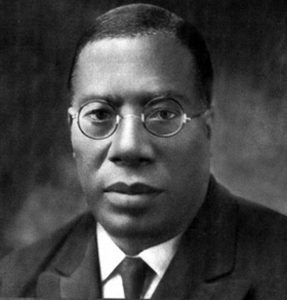
Charles Albert Tindley was one of Methodism’s premier pulpiteers and song writers. Image: Charles L. Blockson Afro-American Collection, Temple University Libraries, Philadelphia.
Charles Albert Tindley arrived for his first pastoral appointment in Cape May, New Jersey, in the middle of a snow storm. With small children to feed, Charles and his wife had only a stale piece of bread. As parents, they dipped the bread in water to soften it for the kids.
Charles asked his wife to set the table as if there was food for breakfast. Swallowing her reluctance, she agreed to do as he asked. As the story has been relayed by his youngest son, the parents got on their knees to thank God for their lives, their health, for the snow storm, and the rising sun in the morning.
“Not once did he complain about the shortage of provisions, but thanked God for what they had,” E.T. Tindley writes. They got up from their knees and sat at the barren table. When they did, there was a loud commotion outside. They heard a man commanding a team of horses.
“Whoa! Whoa!” They then heard loud stomps on the front porch. “Hey! Is anybody alive here?”
Tindley opened the front door and was face to face with a man with a large sack on his shoulder. Dropping it to the floor with a thud, the stranger said: “Knowing you were the new parson here, and not knowing how you were making out in this storm, my wife and I thought you might need some food. I’ve a cartload of wood out here, too. I’ll dump it and be on my way.”
Tears streamed down Tindley’s face. “You are an answer to prayer, for we didn’t have anything to eat except a stale crust of bread … We are not going to worry though, for we know God will provide a way.”
Later that night, Tindley was seated in a rocker thinking over the blessings of the day. In the afterglow of the miracle, he wrote the song, “God Will Provide For Me.”
Here I may be weak and poor,
With afflictions to endure;
All about me not a ray of light to see,
Just as He has often done,
For His helpless trusting ones,
God has promised to provide for me.
Charles Albert Tindley went on to become one of Methodism’s greatest pulpiteers and a pillar of faith. His life was bookended by the Civil War and the Great Depression. Tindley’s father was a slave, but his mother was a free woman of color. Tragically, he lost both his parents at very young age and had to live with strangers who did not permit him to read or go to church.
Seemingly every step of the way, Tindley (1851-1933) faced adversity and challenges. Nevertheless, he showed steadfast determination, ingenuity, and faith. From his Methodist pulpit, he became known as the “Prince of Preachers,” composed dozens of popular gospel songs, launched one of the first soup kitchens in his city, and spurred economic development for African Americans in Philadelphia through a savings and loan that helped secure home ownership. The church he shepherded – now called Tindley Temple – is still a historic and vibrant fixture in its community.
Tindley was filled with intellectual curiosity and passion. As a child he began to learn to read by picking up scraps of newspapers along the roadside. He studied the shape of each letter and attempted to use bits of coal to teach himself to write.
After the Civil War, Tindley and his wife moved to Philadelphia and attended Bainbridge Street Methodist Episcopal Church. He eventually became the janitor at the church. Although he had never been to college, he began studying for the Methodist ministry in order to pass the denominational examination with a high enough score. He learned Greek through a correspondence course offered by Boston Theological School and studied Hebrew with a rabbi at a synagogue in Philadelphia.
At the time of the exam, an arrogant college graduate snidely asked Tindley, “How do you expect to pass this examination? I and the other candidates hold diplomas in our hands. What do you hold?”
“Nothing but a broom,” replied Tindley who had just been sweeping around the church. Tindley passed second among a large class of candidates, all of whom had academic degrees.
When the storms of life are raging, stand by me;
When the storms of life are raging, stand by me;
When the world is tossing me, like a ship upon the sea,
Thou who rulest wind and water, stand by me.
After several different pastoral assignments, Tindley was eventually appointed to the very church he had previously swept as a janitor. As a young boy, he once wallowed in shame because he had no shoes to wear to church and had to sneak up into the balcony and hide behind boxes to attend a worship service. Now, because of a lifetime of walking barefooted in faith, he became the pastor of one of the largest congregations in Methodism and was routinely preaching and breaking into song at “standing room only” Sunday services.
Tindley is rightfully considered the “Grandfather of Gospel Music,” serving as an inspiration to Thomas Dorsey, usually indentified as one of the pivotal founding fathers of gospel music. Tindley’s songs are still found in the United Methodist Hymnal, as well as those of other denominations. His songs were recorded by gospel legends such as Mahalia Jackson (“Beams of Heaven”), the Soul Stirrers (“By and By”), the Ward Singers (“Take Your Burden to the Lord”), Blind Joe Taggart (“The Storm is Passing Over”), Sister Rosetta Tharpe (“What Are They Doing in Heaven”), and Elvis Presley (“Stand By Me”).
So pervasive was his influence that one of his hymns was the inspiration behind the Civil Rights anthem, “We Shall Overcome.”
Tindley had witnessed some of the worst chapters of the unfolding American experiment. He preached faith, protested against injustice, provided food and shelter, and sang from his soul. His artistry dealt honestly with suffering and hardships. At the same time, he lived and saw through the eye and heart of faith. He knew that one day – someday – things would be redeemed and transformed. In “Beams of Heaven,” his vision shines through:
I do not know how long ‘twill be,
Nor what the future holds for me.
But this I know; if Jesus leads me,
I shall get home someday.
Steve Beard is the editor of Good News.