by Steve | Jun 7, 2024 | May-June 2024, Uncategorized
Killing Stone to Baptismal Font
By Steve Beard
Remarkably, after 45 seasons CBS’s “Survivor” is still a certifiable television hit. Millions of viewers tune in to watch the travails of contestants in a Robinson Crusoe-style tropical setting. Coral reefs, whitecapped waves, pristine beaches, and snuffed-out tiki torches.
For the last 12 seasons, the American audience has been savoring the sites and skullduggery from half-a-world away since the show is taped in the South Pacific nation of Fiji – 5,500 miles southwest of Los Angeles, two-thirds of the way from Hawaii to New Zealand, and immediate neighbors with Samoa, Tonga, and Vanuatu. If you spin your globe to examine this area of the world, you’ll discover that Fiji is made up of more than 332 islands, 110 of which are inhabitable.
With its stunning visuals and breathtaking landscape, it is not difficult to see why adventurer Bear Grylls also tapped the Fijian islands for his 10-episode” World’s Toughest Race., in 2019 (currently on Amazon Prime).
“Fiji is such a stunning country and a land of extremes,” Grylls told Lonely Planet. “It has so much incredible natural beauty and diversity, from the crystal blue oceans, to the jungle rivers, to the pristine wilderness and the rolling canyons. But it’s also a tough and dangerous type of terrain, with hundreds of remote miles of swamps, jungle, ravines and high mountains that are among the most intense I have ever been in, ironically.”
Grylls also noted, “We had huge welcomes from the locals wherever the race took us, and they were such a genuinely warm and friendly people.”
The Flying Fijians. The Fijians are not only hospitable, they are fiercely competitive and simultaneously anchored by their Christian faith. The national rugby team made international headlines in the fall of 2023 by defeating powerhouses such as England and Australia in stellar World Cup bouts. Rugby is the king of sports for Fiji.
With great devotion, the players pray and sing hymns before and after their bouts. While first-tier teams travel with sports psychologists, teams from Fiji (population 900,000); Tonga (100,000), and Samoa (200,000) prepare in a different way.
“We are able to bring in a reverend,” Flying Fijian coach Simon Raiwalui told the media. “[O]ur mental well-being is in connection with our religion and people.” The Rev. Joji Rinakama, a Methodist Church minister, serves as the Fijian chaplain. He is a former player and coach. (Tonga and Samoa also have chaplains.)
With its international rugby success and the nation’s name emblazoned on high-end bottled water, Fiji’s star has never shone more brightly on the world stage.
In an earlier era, however, it was a different story. Seafaring explorers such as Captain Cook in the 1770s fastidiously avoided the Fijian islands. In 1789, Captain Bligh noted: “I dare not land [on Fiji] for fear of the natives.” At that time, Fiji was known as the “Cannibal Isles.” The world – and Fiji – was notably different.
Thakombau’s reluctance. The spiritual turnabout of the picturesque island nation did not take place overnight – it took place over decades. The World Council of Churches notes that the first Christian missionaries to Fiji were three Tahitian teachers with the London Missionary Society in 1830. The Wesleyan Missionary Society from Australia began ministry among the islanders five years later. Ultimately, the work was done by Tongan, Tahitian, and British missionaries.
“Your religion is well enough for the white races; but we Fijians are better as we are,” Thakombau (or Ratu Seru Cakobau), the top-ruling chief/warrior during that era, told the missionaries.
With matter-of-fact exhibits in The Fiji Museum in the capital city of Suva, the nation’s cannibal history is neither denied nor celebrated. Instead, it is acknowledged and public apologies have been offered.
Live among the stars. With initial reluctance, Jodi Bulu became a Christian believer in neighboring Tonga in 1833. He would be a key component in the spiritual trajectory of Fiji. In his autobiography, he explains how his mind was changed when he heard there would be a “promised land of the dead,” a “home in the sky for the good.”
Bulu describes an epiphany that shifted his thinking: “It was a fine night; and looking up to the heavens where the stars were shining, this thought suddenly smote me: ‘O the beautiful land! If the words be true which were told us today, then are these lotu [Christian] people happy indeed;’ for I saw that the earth was dark and gloomy, while the heavens were clear, and bright with many stars; and my soul longed with a great longing to reach that beautiful land.”
“I will lotu,” wrote Bulu, “that I may live among the stars.”
Bulu’s cross-cultural ministry began when he heard the call for Christian teachers to go to Fiji. He testified, “my soul burned within me, and a great longing sprang up in my heart to go away to that land and declare the glad tidings of salvation to the people that knew not God.”
After becoming a believer, he relates his spiritual struggle while listening to a message on the love of Christ. Bulu recalled, “my eyes were opened. I saw the way; and I, even I also, believed and loved …. My heart was full of joy and love, and the tears streamed down my cheeks. Often had I wept before: but, not like my former weeping, were the tears I now shed. Then, I wept out of sorrow and fear, but now for very joy and gladness, and because my heart was full of love to him, who had loved me, and given himself for me.”
There are many factors that led to the transformation of Fiji, but there is no doubt that Bulu’s outreach was indispensable.
Bishop Gerald Kennedy. In a 1965 sermon at Asbury Theological Seminary in Wilmore, Kentucky, Bishop Gerald Kennedy of Methodism’s California-Pacific Annual Conference spoke about his visit to Fiji. Prior to his expedition, Kennedy was unaware of the island chain’s history and macabre nickname.
Regaling his experience in the South Pacific, the bishop extolled the missionary work of the Rev. John Hunt who left England in 1838 as a newlywed to share his faith on the other side of the world (more than 15,000 nautical miles). “He wrote one of the best books you’ll ever read on entire sanctification – right among those cannibals,” Kennedy told the clergy and seminarians. “You remember that when you say, I’m going to write a book someday, but I haven’t time.”‘(Kennedy was the prolific author of more than 20 books.)
After months at sea, Hunt and his wife had been given a small dwelling in the village and “often times a horrible stench came into his cottage when they [the Fijian warriors] returned from their raids as they killed and cooked the enemy,” Kennedy said. Through it all, Hunt worked tirelessly in translating the Bible to the Fijian language and attempted to work with the chiefs.
In an almost surreal conversation with Hunt, Thakombau asked: “What will become of the bodies of those who have been eaten, and of those who have been buried? Will they rise again from the dead?”
The Rev. Hunt replied, “Your body, the bodies of all those whom you have eaten, and the bodies of all who are in the graves, will rise again at the day of judgment; and if you and they have not repented, you will all be condemned and cast into hell-fire.”
Thakombau said: “Ah, well! it is a fine thing to have a fire in cold weather.”
Hunt responded: “I shall still pray for you with a good mind, although you treat the subject so lightly.” That was a notable understatement in a truly different and difficult era. When one reads through the blood-curdling missionary reports regarding what they witnessed, it is miraculous that they didn’t all hightail it back to Australia or any of the neighboring islands.
Bishop Kennedy pointed out that Hunt was discouraged and didn’t believe he was making progress with the Fijians. Regrettably, ten years after arriving in Fiji, Hunt would die of dysentery in 1848. From his deathbed, he sent word by a messenger back to Thakombau that he was praying for him. Hunt’s final words were, “Lord, bless Fiji! Save Fiji!”
“Now, here’s a miracle,” Kennedy said. “It didn’t happen right then, but five or six years later, Thakombau was converted.”
In telling his story, Thakombau (1815-1874) attributed his conversion to Hunt’s dying prayers. “I was first favorably impressed towards the Christian religion when I saw it made dying not only easy, but triumphant. John Hunt’s whole concern was about my conversion,” he said. “His wife was soon to be a widow and his children fatherless in a land of savages. He could leave them to the care of his heavenly Father. I barred the way to the spread of Christianity, and had forbidden the people, at the peril of life, to turn away from the gods of Fiji.”
Thakombau continued: “ … He prayed for Fiji, and for me, the chief of sinners. I went to see the body after his death, and Mr. [James] Calvert told me he had left a message of love, and his last prayers were for my conversion. My salvation was the answer to those last prayers.”(Correspondingly, cannibalism was abandoned in 1854.)
Killing Stone. While he was in Fiji, Bishop Kennedy took a boat to a sanctuary on a neighboring island to see a thoroughly unique and provocative symbol of conversion.
“Up at the front of the church was a whole rough stone. It was hollowed out in the top,” Kennedy said. The Fijian Methodists told him that it was their baptismal font. “They said it was originally the killing stone where Thakombau killed his victims,” Kennedy reported. Eventually, the stone was washed, “got the blood off of it, and brought it into that church and made the baptismal font of it.”
A few years ago, the Fiji Times retold a story about the transformation of the stone during the ministry of the Rev. Norman and Mabel Deller (1921-1936). According to Rev. Aubrey Baker, “the stone remained in the village unused, but a constant reminder of the evil of the past and the change made possible by Christ. … Even a stone could be converted. A thing that had been the agent of death became the symbol of new life in Christ.”
In his message nearly 60 years ago, Kennedy reflected on the deep symbolism of the transformed killing stone.” Don’t you like that?” he asked. “I looked at that and said to myself, That’s what the Christian Church is and that’s what the Christian Church ought to be: something to remind people who they were and what they can be without Christ. At the same time, something will say to them but this is what you can be when God finds you – and you give yourself to him.”
Steve Beard is the editor of Good News. This article appeared in the May/June 2024 issue of Good News. PHOTO: Fijian village of Navala in Nausori Highlands. Photo by Anton Leddin (Creative Commons).

by Steve | May 12, 2024 | May-June 2024, Uncategorized
Christ in You, the Hope of Glory
By Oswald Bronson
Good News Archive
1971 Good News Convocation
May/June 20204
Think with me on the topic, “Christ in you, the hope of glory” (Colossians 1:27). Our theme comes from a man physically imprisoned, but liberated in mind and convinced that in his soul lived a universal mystery – the presence of Jesus Christ, who was the ground of his faith and conviction. Any man with a conviction becomes ill at ease when the foundation of that conviction is subjected to misinformation. And so it was with Paul. He had heard that false teachers in Colossae were proclaiming a dangerous and deceptive heresy.
Under the influence of what came to be known as gnosticism, these false teachers sought to syncretize [mix together] the Christian faith with Greek and Oriental religious systems that reduced Jesus Christ to one of many intermediaries between God and man. They instituted complex and secretive initiation rites, paganistic ceremonies that extolled the so-called mysteries of their syncretistic faith. Little did they care that this mixture of religious ideologies was an insult to a prisoner under lock and key in the Roman jail. You see, they had not been with Jesus, not been pricked by his power on the Damascus road.
In the Epistle to the Colossians, Paul speaks to a communal irregularity that threatened to bankrupt the Church’s spiritual treasure, and to immobilize its moral behavior and its Christian witness. Here, my friends, we see one of Paul’s ablest defenses against heresy in the ranks. It is against this background of false teaching – of a divided community, of a church threatened by ethical decadence, and spiritual erosion – that Paul courageously reaffirmed his evangelical faith and pointed to the Mystery hidden for ages and generations. The Mystery is the topic of this address. For Paul says, it is “Christ in you, the hope of glory.”
This theme underscores three basic dimensions of Christology (or the doctrine of Christ), without which our faith is emptied of its pulling power.
1. Jesus Christ, The Image of the Invisible God.
2. Jesus Christ, The Mystery of the Indwelling Presence.
3. Jesus Christ, The Hope of Glory.
In Pauline theology, Christ was not one of a number of equal intermediaries; not simply one of the angels; not a power among other powers, as the heretical teachers at Colossae would have the Christians believe. In Colossians 2:8 Paul warned the church to beware lest any man spoil you through philosophy and vain deceit, after the tradition of men or after the rudiments of the world.
This warning has relevance for modern day Christianity. You and I know that the modern church runs the risk of becoming theologically sterile and spiritually bereft. Many churches have departed from the biblical faith, lost their spiritual magnetism and the fire that burned in the hearts of our fathers. The absence of the Holy Spirit leaves a vacancy open and available to all kinds of heresy, such as the [1970s] God-is-Dead movement. Preachers and laymen quarrel, blaming the other for the church’s predicament.
Some time ago I came across a rating chart that sought to evaluate the pastor’s work. It sought to measure a pastor’s adaptability, effectiveness in pastoral calling, strength of character, spiritual maturity, preaching skills, and communication. Those were the areas of measurement. Across the top of the chart were the degrees of measurement: Far exceeds requirements, exceeds requirements, meets requirements, needs some improvement, does not meet minimum requirements.
The first area of performance is the preacher’s adaptability. Far exceeds requirements: Leaps tall obstacles with a single bound. Exceeds requirements: Must take running start to leap over tall obstacles. Meets requirements: Can leap over small obstacles only. Needs some improvement: Crashes into obstacles. Does not meet minimum requirements: Cannot recognize obstacles at all.
Sadly, we have folk who are not able to recognize sin and its creeping effects.
What about the pastoral calling? Far exceeds requirements: Faster than a speeding bullet. Exceeds requirements: As fast as a speeding bullet. Meets requirements: Not quite as fast as a speeding bullet. Needs some improvement: Would you believe, a slow bullet? Does not meet requirements: Usually wounds self with bullet.
What about preaching? Far exceeds requirements: Enthralls huge throngs. Exceeds requirements: Enthralls the congregation. Meets requirements: Interests the congregation. Needs some improvement: Only spouse listens. Does not meet requirements: Not even spouse listens.
Surely if you’re going to be a real pastor, you need strength of character. Far exceeds requirements: My pastor is stronger than a herd of bulls. Exceeds requirements: Stronger than several bulls. Meets requirements: Stronger than one bull. Needs some improvement: Shoots the bull.
Surely we need someone who can communicate. What about the pastor’s communication if they’re shooting the bull? Communication far exceeds requirements: Talks with God. Exceeds requirements: Talks with the angels (Paul would be concerned). Meets requirements: Well, talks with self. Needs some improvement: Argues with self. Does not meet minimum requirements: Loses argument with self.
If Paul had to rate the heretical teachers and preachers in Colossae, he would simply say that, “You are losing arguments that are vital, the argument that stands tall and places our faith solidly on Jesus Christ.”
Paul teaches not to be misled by any attempt to establish a religious faith on any power except Jesus Christ. Here he underscores the uniqueness and supremacy of Jesus Christ. Jesus Christ is not one of many intermediaries. Christ is the Mediator. He’s not a power among other equals. He is the supreme Savior, the highest expression of God’s love. He is God’s image from all of eternity, before creation was brought forth, before the Spirit moved upon the waters.
As I heard one preacher say over the radio, before there was a “when” or a “where” or a “then” or “there,” or “this” or “that” – before there were plants, animals and human life on the face of the earth – Christ was already in existence. St. Paul, the man of faith, said, “He is the image of the invisible God, the first born of creation, for in him all things were created, in heaven and on earth, visible and invisible, whether thrones or dominions or principalities or authorities, he is before all things, and in him all things hold together” (Colossians 1:15-18).
Not only was Christ with God in the beginning, but on earth he was fully human. Herein lies the great paradox. It is the link between the Jesus of history and the Christ of faith. In his humanity dwelt the fullness of God, in his deity dwelt the fullness of man. This is a paradox that dramatizes God’s extending himself in suffering love. And humanity reaching its highest in obedience, in humility, and in devotion to God’s will. The downward reach of God, and the upward reach of man, had its highest hour and met in Jesus Christ.
In Christ the Son we meet God supremely revealed. On the cross we experience God’s aching heart, his agonizing love, and his forgiving spirit. Often my heart bleeds when I look at my Savior on the cross, and think how he has there, on his shoulder, all my sins. And then I hear him say, “Father, forgive them, for they know not what they do.”
Oh Christ, I love you! Easter brings the Good News that God-in-Christ is victorious over the forces of evil. Pentecost signals through Christ a new baptism, the baptism of the Holy Spirit. Surely, God was in Christ, reconciling the world to himself.
We enjoy singing, “All Hail the Power of Jesus Name.” He is not one among equals – he is superior! He is preexistent! He is God, the image of the invisible God. “Let angels prostrate fall. Bring forth the royal diadem and crown Him lord of all.”
We must crown him Lord of all. Jesus Christ, the image of the invisible God, is also the mystery of the indwelling Presence. Please note that Paul frequently uses the word mystery. It denotes the incomprehensible, an event or an idea that cannot be explained and understood by human faculties. A mystery defies human intellect. The secret of his power is on a level beyond our human understanding.
This universe that God has made is filled with mysteries. It is true, we are extending our explorations to other planets. Yet, with each such exploration, we realize that we are dealing with but an infinitesimal part of this vast universe. The full knowledge of God’s power lies only in his mind. Paul was eminently correct in using the word mystery, for life is a mystery. Nature is a mystery. The human being is a mystery.
Through science and technology, the human mind is grasping facts once thought to be miraculous. We think now that we know the secret of the Universe. We understand how to manipulate certain physical laws to bring about desired results. But how these laws came into existence remains a mystery. There is so much we cannot fully explain.
When I was a lad, I used to like to watch Molly, the cow. And I used to wonder how a brown cow, eating green grass, with a red tongue, could give white milk, churned into yellow butter.
Regardless how much we try to explain many of these things, we come back to the question, “Who did it? Who got it started?” We have to come to grips with this one outstanding fact: “In the beginning God created the heavens and the earth, and everything therein found.”
I heard a radio preacher very eloquently remind his audience that we live in a push-button age today. We can push a button and lift tons of steel. We can push a button and send astronauts throughout space, even to the moon. We can push a button and sail heavy aircraft through the skies. We have come to feel that there is hardly anything that the push-button cannot do.
But, said the preacher, man cannot push a button and cause the sun to shine, or the stars to twinkle, or create mothers and fathers to provide love for their children, or our Savior, who brings healing to our souls.
The push-button is mechanical, cold, and indifferent to the deeper yearnings and needs of the human heart. Only God can push that button! As Isaac Newton stood in the presence of nature’s mysteries, he said “I feel like a child who has picked up a few pebbles on the shore of a boundless ocean.”
I was glad to hear the great scientist Albert Einstein said, “The most beautiful thing we can experience is the mysterious.” Mystery is the source of all true art and science. He to whom this emotion is a stranger, who can no longer pause to wonder and stand rapt in awe, is as good as dead. His eyes are closed.
Yes, we are surrounded by mystery.
Paul’s time was the age of mystery religions and secret initiation rites. The false teachers of Colossae were greatly influenced by these religious practices. Against this background, Paul is saying, “I, too, have a Mystery into which I was initiated. It is a divine secret, which for ages no man guessed. Now it has pleased God to make known the secret. And it is, Christ in you. The innermost dynamics and the very nature of God’s being reaches its apex in Christ. And we know this Christ as the inward presence, making our lives one with his life. Christ is the mystery, because in him lies hidden all the treasures of wisdom and knowledge. Because he represents far more than has yet been disclosed.”
Notice that Paul said Christ in you; not Christ on you, nor merely around you. Not Christ objectified in a philosophical system, or any system locked to a period in history. Not a Christ beautifully painted in a picture, or described in poetry or set to popular music.
Christ on me is not enough! I might change toward him as I changed my clothes, or as I moved from group to group, from city to city, from position to position. Christ around me has great advantages, but he is still external. In theory he is limited to intellectual activities, but our problems are deeper than the intellect.
A Christ arrested in the past is good for the museum; a picture may be good to adorn the walls of our homes and our offices. Jesus Christ in poetry and music is fine, though he runs the risk of becoming a fad rather than the savior.
Instead, Paul sees an urgency in the indwelling Christ. When Christ is truly internalized – permeating every cell, every fiber, thought, utterance, motive, behavior – we become new creatures. We experience unspeakable joy. We have an eternal assurance. We have a new light, a new spirit, a new love, a new heart, a new code of ethics, a new behavior, a new fellowship. With Christ in you and Christ in me, I declare, we’ve got to be together.
On a sign prepared by youth in one of our Atlanta United Methodist congregations are the words, “If you were arrested and charged for being a Christian, and indicted, would there be enough evidence to convict you?”
The indwelling Christ supplies the evidence. It is expressed courageously in a life of love and service, and the record is filled with testimonies across the ages of the transforming power of Jesus Christ as an indwelling presence.
How well do I remember when I was a small child, I heard my father pray, “Lord, I gave Oswald to you before he was born. Help him to be your servant. May you live in his life.”
I heard my Daddy pray that, morning and night. Sometimes I would wake up in the night. I would hear him praying, “God, I gave Oswald to you before he was born ….” I thought about that. At an early age, my Father, not having the kind of theological sophistication that many of us have, but a faith in Jesus Christ, was reminding me of the divine origins of any human being. And that my own existence in the world is the result of God’s creative activity, that in my life was a purpose – a purpose to glorify God.
He surrounded me with the Christian faith. I saw Christ in him. But I needed more than Christ around me, I needed Christ within me. My father’s faith was not enough. As Billy Sunday used to say, “Your wife’s faith cannot save you. You’ve got to be more than a brother-in-law to God.”
When I made my own decision for Christ, God became more than just a distant relative. He became an intimate Savior. The old Gospel hymns took on new meaning. It became a joy to affirm deep within that “I am Thine, oh Lord;” “Have Thine Own Way Lord;” “Blessed Assurance, Jesus is Mine.”
The Christian faith claims that in Christ, God’s nearness becomes a greater reality. He lives within. He becomes the battery that makes a glow radiate from our personality. And when you walk, somebody will say, “There goes a Christian, I see their light.”
Yes, Jesus Christ, the image of the invisible God. Jesus Christ, the mystery of the indwelling presence. Christ, the hope, is a theme that winds its way through the Pauline epistles. The word hope communicates the sense of the possible. It is an attitude towards life affirming that what we really need is possible.
The value of hope is poetically demonstrated by Percy Bysshe Shelley’s drama Prometheus Unbound: “To suffer woes which hope thinks infinite, to forgive wrongs darker than dark of night, to defy powers which seem omnipotent, to love and bear, to hope till hope creates from its own wreck the thing it contemplates.”
Christian hope, however, is more than a general kind of optimism. It is more than hope in hope, or faith in faith. Christian hope is tied to the goal of history, and the purpose of each person’s existence. It is the unshakable confidence in the sovereignty of God, and his eventual triumph over all the forces that stand against truth, justice, righteousness, faithfulness, love, and mercy. In the great contest between good and evil, Christian hope declares God as winner. He is the victory.
For the Christian, in race relations, Christ is the victory. In family crises, Christ is the victory. In marital conflicts, Christ is the victory. Not only is he the hope of victory, he is also the hope of glory. The hope of sharing with God the eternal radiance of his victory.
Today, I have hope. I have hope that through Christ, all men and women will recognize their common bond. I have hope because in everything God works together for the good. Yes, I have hope. It is this hope that sends Christians forth witnessing against wrong, upholding the right, giving God the glory and the praise. It is this hope that brings light and deliverance to the downtrodden, the dejected, the underprivileged, the overprivileged, the “just-right” privileged.
Reverent. A matron in an orphanage whipped little Jimmy E. West, and put him on a bread and water diet. She said he was evading his chores by pretending to be sick. Fortunately a lady who knew Jimmy’s mother before she died, came by to see him. And she asked the matron to let her take the lad to a doctor. The matron agreed. The doctor examined the nine year old lad and sure enough, he had a tuberculous hip. He was laid up for a year on a very hard board. After a year the doctor said, “There’s no hope, so I might as well send him on back.” He called the orphanage, and the matron said she couldn’t take him.
The doctor called the taxi, gave him instructions, and in the gathering darkness he took Jimmy to the orphanage, left him and his crutches on the porch. Little Jimmy was found there by a girl who came to lock up for the evening. She dragged him in. What hope was there for a nine-year-old lad? No mother, sickly, rejected. None, according to the socially accepted opinions of the psychologists and social workers. He was doomed for a miserable life and death.
But a miracle took place. In this orphanage was a Sunday school. And Jimmy’s class was taught by a man who was in charge of the heating plant. He was not a man sophisticated in theology, but he had a faith – a living, vibrant faith, a belief in Jesus Christ that he shared with Jimmy.
Jimmy said later, “I came to believe that my life need not be hopeless wreckage.” And so, he started a life of prayer. He finished high school, worked his way through college and became a lawyer. He was brought to the attention of President Theodore Roosevelt because of his work with underprivileged children. This work was so significant that when the Boy Scouts of America was chartered, Congress elected Jimmy E. West (1876-1948) as its first chief executive.
But the story doesn’t end there. The Boy Scout code of America has one line that the code does not have in England. “A Boy Scout is Reverent.” Who put it there? It was a Sunday school teacher, faith, and spirit, working in the life of Jimmy West. Through Christ, he came to find that God had meaning for him in his time of wreckage. So now, Boy Scouts around the world raise their hand to God and say, “A Boy Scout is Reverent.”
Christ is the hope not only in the world to come, but he’s the hope right now.
In my home community we used to sing a spiritual called “Ain’t That Good News?” The lyrics are: “I’ve got a Savior in the Kingdom, ain’t that good news? He’s the joy of my salvation, ain’t that good news? He’s going to lead us from earth to glory, ain’t that good news?”
Yes, the Christian community has Good News! We have what the world desperately needs. It is Christ within us, the hope of glory. Ain’t that Good News?
When he delivered this address to the 1971 Good News Convocation, Dr. Oswald P. Bronson, Sr., Ph.D., an ordained United Methodist clergyman, was President of Interdenominational Theological Center (ITC) in Atlanta. After completing his time at ITC, in 1975, Dr. Bronson began an appointment as the fourth president of his alma mater, Bethune-Cookman University, a position he held for 29 years. Dr. Bronson passed away on February 2, 2019, at the age of 91 years old. This sermon first appeared in the October/December 1971 issue of Good News. Photo courtesy of Atlanta University Center. Photo: Rio de Janeiro, Brazil (Shutterstock).

by Steve | May 2, 2024 | Uncategorized
Removal of LGBTQ prohibition is cause of rejoicing from some
By Jim Patterson
May 1, 2024 | CHARLOTTE, N.C. (UM News)
Randall Miller sat — looking stunned — a little removed from the impromptu celebration after delegates at General Conference swept away a decades-old policy banning LGBTQ people from serving as pastors in The United Methodist Church.
He was happy, but the change came too late for him personally.
“It doesn’t affect me,” said the reserve delegate from Berkeley, California.
“I made a decision 40 years ago that I would not pursue ordination as long as this policy was in place. … I’m close to 65. But I’m just so glad for others, especially the younger folks who are deeply committed to The United Methodist Church that want to be able to serve.”
The mood was mostly jubilation in the hastily arranged celebration in a courtyard at the Charlotte Convention Center on a sunny and temperate North Carolina afternoon.
“It’s a wonderful step forward about just including folks, taking a step further to the ‘all means all’ idea that we believe in,” said the Rev. Jonathan Campbell, pastor of Lacey United Methodist Church in Forked River, New Jersey.
But some, in and outside the convention center, said there also was sadness in reflecting on people like Miller and all they have lost, all the damage done and the good works that never happened because of the discriminatory rule.
“It’s a day for happy tears,” said the Rev. Jamie Michaels, pastor of First and Summerfield United Methodist Church in New Haven, Connecticut.
“It’s really hard not to be standing next to the people who are missing,” she said. “Folks who have been pushed out of churches, folks who have lost their livelihoods.”
Michaels was thinking of a friend who abandoned the ordination process because he felt unwelcome in The United Methodist Church.
“He discerned that this was no longer his fight,” Michaels said. “God was calling him to something big and beautiful, and he didn’t want to spend his whole career fighting for his very existence.”
Her friend is in a non-Methodist “very fruitful ministry” today, she said.
“But it’s hard to have started this journey next to him and not be here with him.”
The Rev. Deb Stevens, a retired elder in the West Ohio Conference and board member of the advocacy group Reconciling Ministries Network, said she “wonders a lot about grief.”
“Grief for those we’ve lost along the way, the people who had their orders taken away, the people who were brought up on charges, the people who despaired and gave up on United Methodism, the people who were told that they were not loved and appreciated by this church,” Stevens said.
The effort to allow LGBTQ people to be pastors dates back to the inception of the ban in 1984, and not everyone was happy it was being lifted.
“I’m deeply troubled, because the church has deviated from the faith,” said the Rev. Jerry Kulah, a Liberia Conference delegate and coordinator of the traditionalist Africa Initiative, in an interview away from the courtyard celebration. “I’m going to deeply reflect and determine how long I can bear with this.”
The Rev. Chang Min Lee, pastor of Los Angeles Korean United Methodist Church and president of the Korean Association of the United Methodist Church, also expressed concerns about the vote to United Methodist News.
“For most Korean American churches that are traditional, we are concerned about today’s vote, but at the same time, we are pleased to see that the legislation approved this morning also explicitly protects the right of clergy and churches not to officiate at or host same-sex weddings.
“While we recognize that this decision will cause some confusion and difficulty for Korean American churches, we will continue to pray and work to move forward to lead the mission of The United Methodist Church in the providence of God, who is ‘greater than all’ (Ephesians 4:6).”
But for many, the prevailing mood was one of “deep, deep gratitude,” especially for all the activists who kept the faith for years, sometimes decades, said Helen Ryde, a home missioner and a Reconciling Ministries Network coordinator.
“We’re celebrating something that hundreds and hundreds and hundreds of people have worked for in this moment,” Ryde said. “We got here because of the so many people who worked hard. Some of them are not here anymore.”
Many people who wanted to serve God were prevented from doing so because of the ban, said Bishop Ken Carter of the Western North Carolina Conference.
“It was harmful to people,” Carter said. “It was not helpful to the church’s mission, and the body, with an almost unprecedented consensus, removed it.
“It’s like removing something harmful from the body, that frees the body to be healthy.”
The Rev. Adam Hamilton, a Great Plains Conference delegate, mega-church pastor and author of bestselling books on various aspects of Christianity, also welcomed the church’s turn toward full inclusivity for LGBTQ persons.
“In 1972, we singled gay and lesbian people out and created exclusionary language for them, and we’ve been fighting ever since,” he said in an interview in the convention center. “For 52 years, we’ve been a conflict-driven church and today we’ve become once more a mission-driven church and a church that’s saying everyone’s welcome in our congregations.”
Hamilton added, “I’m really proud of The United Methodist Church and I’m proud to be a United Methodist today.”
When the change was acknowledged during the morning plenary, those in favor did not make an immediate big hullabaloo about it, said the Rev. Jennie Edwards-Bertrand, pastor of Hope Church in Bloomington, Illinois.
“We had decided not to celebrate openly, out of respect for all perspectives,” she said. “So people around me were silently weeping, and one of my friends was passing out consent calendar chocolate. The second we got the text to come out by the fountain, everyone just stood up and rushed out (to celebrate).”
The consent calendar is a bundle of legislation that can be quickly passed in one vote. The ban of LGBTQ pastors was removed as part of such a vote.
“We still have more work to do at this General Conference to extract all the pieces of harmful language,” said Bridget Cabrera, executive director of the Methodist Federation for Social Action, an advocacy group social justice. “Yet today the UMC overwhelmingly stated no matter who you are and no matter who you love, God loves you and you are welcome here.
“Thanks be to God.”
Going forward, progressive United Methodists need to “continue to build relationships,” said the Rev. Laura Wittman, pastor of The Mills Church in Rocky Mount, North Carolina.
“We have to learn and help each other live into the values that we are beginning to set for ourselves,” Wittman said. “This is a different set of values, a long-awaited, hard-earned set of values, and it’s going to take time.”
The Rev. H.N. Gibson, associate pastor of East Lake United Methodist Church, concurs with Wittman.
“There’s still work to do, because just because we change legislation doesn’t mean that we change hearts and minds,” Gibson said. “Moving toward a more inclusive church and a church that accepts and affirms all people of all gender identities and sexual identities is going to take a lot longer and a lot more work.
“But I’m committed to that long-term work.”
Patterson is a UM News reporter in Nashville, Tennessee. Heather Hahn, Sam Hodges and the Rev. Thomas Kim contributed to this report. PHOTO: The Rev. Dorlimar Lebrón Malavé (left), Bishop Karen Oliveto (in blue jacket) and her wife, Robin Ridenour (front, center), join in embracing delegates and visitors t the 2024 United Methodist General Conference in Charlotte, N.C., after the conference voted to remove the denomination’s ban on the ordination of clergy who are “self-avowed practicing homosexuals” — a prohibition that dates to 1984. Photo by Mike DuBose, UM News.
by Steve | Apr 19, 2024 | Uncategorized
In Regard to the Dakotas-Minnesota alteration
April 19, 2024
|
|
| It has come to our attention that an anonymous person went on the Dakotas UM Annual Conference website and changed an official document to contain alleged misinformation and divisive rhetoric. (Although we have made a request to Bishop Lanette Plambeck’s office to see the altered document, we have not yet seen it in its altered form. However, we were able to discuss the matter with her office and they walked us through the issues of concern.)
No matter the motive, anonymously altering a document is deceptive and improper for a disciple of Jesus Christ. It goes without saying that Good News and the Wesleyan Covenant Association unequivocally condemn this kind of unethical activity. Both of our ministries have operated within the United Methodist Church over many years. There is no need for us to interfere with saomeone else’s website. Our opinions and viewpoints are well known and public knowledge.
At the same time, we also condemn the precipitous leap by some to unsubstantiated insinuations of guilt in the service of raising funds and promoting a particular agenda for the church.
Even within the context of deeply-held convictions, we encourage persons on all sides of the current debates within Methodism to treat one another with love and respect, honesty and integrity. How we treat one another as Christians is just as important as the substance of our disagreement and constitute our witness to a watching world. |
|
by Steve | Apr 5, 2024 | In the News, Uncategorized
Is a New Disaffiliation Pathway Needed?
By Thomas Lambrecht
Recently, several articles have come out saying that there are already disaffiliation pathways for annual conferences and local churches, so new pathways do not need to be enacted by the 2024 General Conference. For example, Christine Schneider, a reserve delegate from Switzerland and member of the Standing Committee on Central Conference Matters, surprisingly declares: “In the central conferences, we do have functioning procedures for handling the disaffiliation of annual conferences and local churches. Extending disaffiliation options under something like Paragraph 2553 is therefore simply not needed here.” That is her startling opinion.
Of course, Schneider writes from a uniquely European perspective that does not apply in Africa. She gives the example of Estonia, which is leaving the denomination using a process defined by its central conference. She also mentions 14 local churches in France disaffiliating from their Switzerland-France-North Africa Annual Conference. In both cases, these disaffiliation process were negotiated by the entities involved. The admirable goodwill exhibited by church leaders enabled these disaffiliations to be successfully worked out. The same goodwill is not present in all parts of Africa.
My colleague, Simon Mafunda, WCA Vice President for Africa, recently reported to me, “In Africa, several bishops have declared their adamant opposition to allowing any disaffiliation to take place. In some areas, pastors inquiring about disaffiliation have been summarily fired without any due process, depriving them of both house and livelihood. Around September 2022, a majority of African bishops meeting at Africa University took a combative stance and banned activities of both Africa Initiative and Wesleyan Covenant Association known for advocating for justice and fairness with regards to these disaffiliation rights. The prospect of amicable negotiations in these situations is unlikely.”
The only official process for disaffiliation to occur in the central conferences outside the U.S. is Par. 572, which allows an annual conference to become an autonomous Methodist Church. To do so is a long and arduous process that can take up to four years or more, depending upon when the process begins and when the General Conference is held. It requires the departing annual conference to develop its own statement of faith, constitution, and Book of Discipline. It requires the approval of the Standing Committee on Central Conference Matters, the relevant central conference, a two-thirds vote of all the members of the annual conferences in that central conference, and the General Conference. At any point along the way, a negative vote by any one of these entities can derail an annual conference’s disaffiliation. Furthermore, the African annual conferences that could consider disaffiliating are not interested in becoming autonomous Methodist churches. They would want to affiliate with another Methodist denomination, such as the Global Methodist Church, the Free Methodist Church, or the Church of the Nazarene. Why should they have to go through all the work of composing their own Discipline when they would rather just adopt the Discipline of the denomination they are aligning with?
By contrast, a proposed new Par. 576 would allow annual conferences outside the U.S. to disaffiliate in order to align with another Wesleyan denomination simply by adopting that denomination’s Book of Discipline and receiving the affirmative vote of their central conference. It would be a much more straightforward process with only one level of approvals.
The proposed new Par. 576 would apply only to annual conferences outside the U.S. (It is highly unlikely that any annual conferences in the U.S. would want to disaffiliate as an annual conference, given that many traditionalists have left those annual conferences.) So, this disaffiliation pathway would not affect churches in the U.S. at all.
What about local churches?
At this point, the only process in the Discipline left open for local churches to disaffiliate is Par. 2549, which allows an annual conference to close a local church and dispose of its property. Some annual conferences are using this paragraph to “close” a church that wants to disaffiliate and then sell the property to the exiting congregation. In most cases, the cost is similar to what Par. 2553 required: two years of apportionments and a pension liability payment. Any other process would be outside the scope of what the Discipline allows. And in all cases, this process depends upon the goodwill of conference leaders to allow the local church to disaffiliate under this closure paragraph. They can say “no” or jack up the cost to make it prohibitively expensive to disaffiliate.
In a recent blog (under the ominous, misleading, and tabloidish headline: “Good News Issues Threats to Delegates”), the Rev. Mark Holland of Mainstream UMC says, “To be clear, Mainstream UMC believes that churches should be able to leave, but this should be left up to the annual conferences and central (or regional) conferences to handle from this point forward.” It is good to hear Holland endorse the ability of local churches to disaffiliate going forward. However, it is at the point of leaving it to the annual conferences where the process too often breaks down.
Many annual conferences handled Par. 2553 disaffiliations with integrity and cooperation, despite the pain involved for all concerned. Unfortunately, about a dozen annual conferences arbitrarily and capriciously imposed additional requirements or abruptly changed their policies on disaffiliation. At least eight annual conferences required payment of a percentage of the church’s property value, anywhere from 10 to 50 percent. With the high property values on the coasts, that could push the cost of disaffiliation for even a small to medium sized church into the millions of dollars. One church in California figured it would need to pay $60,000 per member to disaffiliate! A few annual conferences imposed other additional costs and fees that further raised the price. In many cases, the financial penalty for disaffiliation made it realistically impossible for local churches to disaffiliate. In those cases, churches faced the choice of staying in the annual conference or walking away from buildings and property they had invested in for decades, depriving them of their ministry base and forcing them to start over as a new church plant.
A few annual conferences arbitrarily changed their disaffiliation process mid-stream. After allowing a first wave of churches to disaffiliate, both North Georgia and Alabama-West Florida changed the rules to halt any further disaffiliations. Peninsula-Delaware allowed a first wave of disaffiliations, but then imposed a 50 percent of property value fee that priced most churches out of the ability to disaffiliate after that. Both West Virginia and South Carolina initially banned all disaffiliations, with South Carolina grudgingly coming to allow them late in the process using Par. 2549. West Virginia allowed only 24 of its 971 churches to disaffiliate, merely one-tenth the national average.
In Africa, the situation is similar, with most bishops opposing any form of local church disaffiliation. As mentioned above, in parts of the Democratic Republic of Congo, pastors whose local churches wanted to disaffiliate were summarily removed as clergy without any charges or due process. This deprived the pastors of their home in some cases and of their livelihood. And the congregation was unable to disaffiliate. The only reason more than 50 local churches disaffiliated in Kenya is that they constituted a majority of the annual conference and were able to vote to allow their own disaffiliation in defiance of the bishop’s opposition (not a healthy dynamic to encourage).
In another recent commentary, Holland says, “It is unacceptable for the General Conference to prescribe another uniform process that will hurt the very annual conferences that have already been hit the hardest by disaffiliation.” It is only by providing a “uniform process” that the arbitrary and capricious actions of a few annual conferences can be corrected. To set the record straight, local churches in those annual conferences never truly had an opportunity to disaffiliate. The annual conferences in the U.S. most affected by extending a uniform process would be those who lost very few congregations due to their draconian requirements. They would NOT be the annual conferences “hit the hardest by disaffiliation.” Those hit the hardest have already lost the vast majority of churches that would want to disaffiliate.
To close out the option of disaffiliation at this point would be unjust. In annual conferences where bishops and conference leaders oppose disaffiliation, they should not be allowed to thwart the intent of General Conference to provide an equal opportunity for all congregations to discern their future. Such an opportunity is even more important now, given the magnitude of the changes envisioned for the UM Church to be enacted at the Charlotte General Conference.
What about fairness?
In some U.S. annual conferences, bishops and other conference leaders lobbied their churches to wait and see what happens at the 2024 General Conference. They made the case that nothing had changed in the Book of Discipline, and that we don’t know what the General Conference will do in terms of the proposed changes coming before it. They told local churches they should wait until after the General Conference acts before making a decision about disaffiliation. Yet very few of these annual conferences made provision for any disaffiliation process after the upcoming General Conference. One that did – Mississippi – reneged on that promise by stipulating that any churches not in the discernment process by the end of March would not be considered for disaffiliation. Thus, through their change of policy, they defeated the very purpose of churches waiting until after the General Conference acts. How is this fair?
Only a uniform process adopted by the General Conference can ensure that annual conferences do not act to block the ability of local congregations to discern their future in light of how the UM Church changes its standards and teachings at the upcoming General Conference. Failing to adopt such a process locks churches into a denomination changing in directions they may not agree with. Such an outcome will hurt those local churches, who will lose members due to the changes, and it will hurt the UM Church, which will still have within it congregations actively opposing the new directions chosen by the General Conference. Allowing a fair and uniform process of disaffiliation is in the best interest of all concerned.
The issue of fairness returns us to where we began this article. UM Churches in the African context need a uniform disaffiliation process. To fail to provide it would mean that churches in the U.S. had rights and privileges that are denied to our brothers and sisters in Africa. It is bad enough that their opportunity to discern their future was put on hold for three years past when U.S. churches could act. To completely cut off the option of disaffiliation through the provisions of the Discipline would reflect unfair and unequal treatment and indicate a disregard for the needs of our global brothers and sisters.
For the sake of justice and fairness, a uniform process of disaffiliation for annual conferences and local churches is needed. Current options do not meet the need. Hopefully, the General Conference will see the need and respond positively to it.
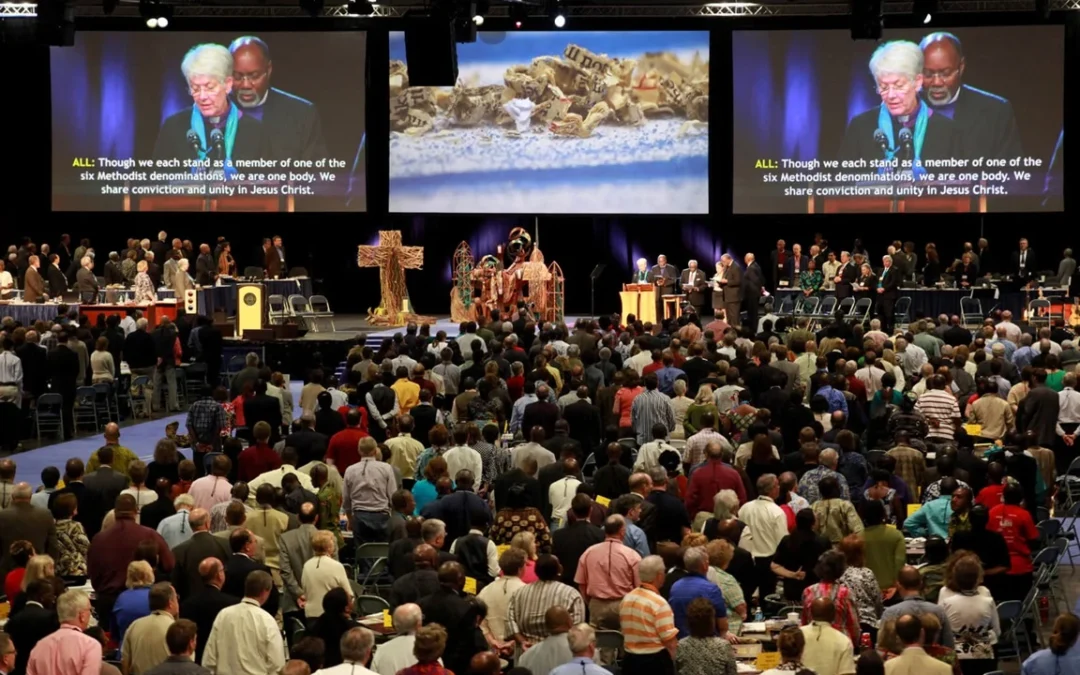
Thomas Lambrecht is a United Methodist clergyperson and vice president of Good News. Photo: Delegates and visitors at the 2012 United Methodist General Conference in Tampa, Fla. On the screen are Bishop Sharon Rader and Bishop John White. A UMNS Photo by Kathleen Barry.
by Steve | Jan 13, 2024 | Jan-Feb 2024, Uncategorized
A Place of Rest
By Jenifer Jones
About 300 miles west of Paris, in the center of the Brittany region of France, stands a three-story stone manor house.
Over the past 410 years it’s been home to lords, ladies, their servants, and in the 1960s and 70s, a famous Breton singer.
Today it’s inhabited by Mike and Valerie Smith and guests who stay at Le Manoir Du Poul Coeur de Bretagne Bed & Breakfast. Some are tourists, others are cross-cultural witnesses (CCWs) who come for rest and rejuvenation.
An answer to prayer. The Smiths have been in Brittany for more than two decades. They had served in France years before and were looking for an opportunity to move back.
“We felt strongly that God spoke to our hearts saying, ‘You will return to France, but next time it will be with a job,’” Mike said.
It was an answer to prayer when friends purchased the manor house and offered the Smiths the role of property managers. That’s how Valerie, an artist, and Mike, a musician who used to work in a bank, found themselves running a bed-and-breakfast.
Learning to serve. The Smiths make the beds in rooms decorated in bright whites, light blues, soft yellows, and neutral tones. In the kitchen, a load of laundry tumbles in the washing machine, while a sink-full of dishes fills with soapy water.
“I even like to wash dishes now,” Mike confesses. “Before moving to France, I just dreaded it. And that was just for our little family. Now we’re doing it for groups, and we love it. We don’t have a dishwasher. It’s all by hand. So it’s funny how we evolve.”
In the dining room, wooden beams run across the ceiling, connecting one stone wall to another. The space is decorated with Valerie’s artwork. Jars of homemade jam sit on the windowsill. A large stone fireplace occupies much of one wall, its mantle reaching nearly to the ceiling.
“I didn’t even know how to set a table properly before we came here,” Valerie said. “In my family, we just put out stuff. It didn’t matter. Just plop it on the table. I had to learn. It always made me nervous at the beginning, but now it just comes naturally.”
When Valerie and Mike lived in the United States, they didn’t have people over often because she was always nervous about what to make, and afraid her guests wouldn’t like it.
“I can’t believe now how many hundreds of people we feed every year now,” she said.
Valerie notes she had to learn to stop being self-conscious and remember that serving is not about her.
“It’s all about meeting their needs and making it wonderful for the guests and just doing my very best to make it as nice and as good as possible for them,” Valerie said. “They’re not there to judge me. That freed me up to serve and concentrate on blessing them. I think that changed me. We love the service.”
Mike adds, “I never thought we were hospitable before, but well, it turns out we are.”
And then there’s the yardwork. The B & B is surrounded by 30 acres of woods. The Smiths maintain the lawn and flower beds. The birds love it here.
“I worship when I’m working in nature,” Valerie said. “It’s the most amazing thing and it makes me feel so good, like we are accomplishing something that God wants us to do. And I think, but it’s just gardening. And yet I feel such a sense of pleasure that God is happy with me for taking care of his ground.”
The Smiths serve people from all over the world who come to the B & B on holiday. But they also serve CCWs who need rest and restoration. “And they love it because it’s so peaceful,” Mike reports.
A light in a dark region of France. He says serving CCWs keeps him encouraged. In this region of France, he says, it’s easy for Christian workers to want to give up. Though each town in Brittany has a Catholic church, many are closed. Protestant Christians are few and far between.
“Most communities don’t have one single Christian living in it,” Mike observed. “But there are communities that might have one or a family, and so they have to search. They’re just scattered.”
The Smiths helped plant a church in their area.
“And once we started that, a few more hidden Christians came out of the woodwork and appeared,” Mike said. “So maybe we’re just trying to establish something there to be a light and draw more people. But it is difficult. A lot of French people prefer to be atheist.”
The Smiths continue to build relationships in their community. Valerie is in an artist group, and Mike plays in a band.
In the daily grind of caring for the manor house, its grounds, and the guests who come to enjoy them, it can be hard to see the fruit of ministry.
Valerie notes, “I often think, what am I really accomplishing when all I’m doing is cleaning rooms and weeding and all of that. You can wonder, am I really doing the right thing, you know? And yet, no, I know I am. God put us here.”
Mike adds, “When we lived in Texas, I worked in a bank with my white shirt and tie. I can’t even picture that now. I’m a completely different person.”
Jenifer Jones is a communicator for TMS Global (tms-global.org).