by Steve | Aug 6, 2021 | In the News, July/August 2021, Perspective E-Newsletter
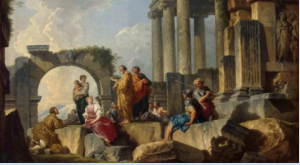
St. Paul preaching among the Roman ruins. Giovanni Paolo Panini /Hermitage Museum via Wikimedia Commons
By Thomas Lambrecht
As a declining denomination in the midst of cultural headwinds becoming increasingly hostile to Christianity, we wonder how to be a growing, vital church. Although I have served as a pastor and have been a member of growing congregations at one time or another, I have never in my church membership life been part of a growing United Methodist denomination. That is true of all active clergy in our church today.
Many programs have been tried and much ink spilled in trying to foster a denominational turnaround. The results, however, have been unsuccessful denomination-wide. Our decline is only accelerating as our church gets older. Certainly, the long-running conflict over theology and moral teaching has not helped.
As we think about a new traditionalist Methodist denomination that will no longer have conflict over doctrine and morals, how can we best approach our new societal situation, where Christianity is no longer privileged and the church as an institution is no longer respected?
In some ways, we are returning to the situation experienced by the early church in the first three centuries. Upon the recommendation of others, I have found the book The Patient Ferment of the Early Church by the late church historian Alan Kreider to be extremely helpful in unpacking the factors that led the early church to grow.
How the Early Church Grew
Growth in the early church after the first apostles’ generation died out was not primarily due to missions or evangelism. The seeds had been planted around the Mediterranean world, and they grew from there. Kreider summarizes, “According to the evidence at our disposal, the expansion of the churches was not organized, the product of a mission program; it simply happened. Further, the growth was not carefully thought through. Early Christian leaders did not engage in debates between rival ‘mission strategies.’ … The Christians … did not write a single treatise on evangelism. … [In] the best surviving summary of catechetical topics, … not one of them admonishes the new believers to share the gospel with the gentiles. Early Christian preachers do not appeal to the ‘Great Commission’ in Matthew 28:19-20 to inspire their members to ‘make disciples of all nations.’ … Most improbable of all, the churches did not use their worship services to attract new people. In the aftermath of the persecution of Nero in A.D. 68, churches around the empire … closed their doors to outsiders.”
In short, many of the strategies and programs we use today to grow the church played no role in the early Christian centuries up until the Emperor Constantine I began promoting Christianity in A.D. 313.
What caused the church to grow? Kreider identifies several factors. The primary factor he identifies is the “patient ferment” of the church – the bubbling up of spiritual life in the lives of believers that over time attracted tens of thousands of individual new believers, a few at a time, into the growing church.
This approach is summed up in a quote from the writer Cyprian (A.D. 256), “We do not speak great things but we live them.” As Kreider explains it, “Christians, said Cyprian, are to be visibly distinctive. They are to live their faith and communicate it in deeds, and their deeds are to embody patience. Patientia: when Christians make this virtue visible and active, they demonstrate the character of God to the world.” And it is this distinctive, lived-out faith that becomes attractive over time to people unfulfilled by the world’s pleasures and possessions.
The key is that “Christians and their communities must live a life of integrity with no discrepancy between words and deeds,” Kreider states. “Outsiders will judge the Christians not so much by what they say (most people won’t listen to them anyway) as by what they are and do.”
Early Church Examples
How did this work out in practice? According to Justin Martyr (about A.D. 150), it meant living out Jesus’ Sermon on the Mount. Be patient with others. Be servants to all. When struck on one cheek, turn to them the other (rather than taking revenge). If compelled to go one mile, go two. Do not be angry. Do not quarrel. As Justin put it, “Let your good works shine before men, that they as they see may wonder at your Father who is in heaven.”
In their business lives, Christians were to act with integrity. They were “to speak the unadorned truth about a product they were selling.” Perhaps it meant refusing to retaliate when mistreated by another businessperson. It could have meant refusing to engage in litigation in the law courts.
In an extremely licentious culture, Christians were committed to sexual purity. Justin “points to Christians in Rome ‘and in every nation’ who have repudiated adulterous glances,” avoided polygamy, and committed themselves to a lifelong Christian understanding of sexual restraint and fidelity. By embracing this new ethic, the early church attracted “to the faith an ‘uncounted multitude of those who have turned away from’” sexual licentiousness.
In a rigidly hierarchical society, Christians created a heterogeneous community of rich and poor, nobles, working class, and laborers, masters and slaves, men and women, older adults as well as children. They formed a new type of family that incorporated all its members, including those most despised by society, on an equal and integral basis.
In a society where 90 percent of the people were powerless, Christians experienced the power of God at work in their lives. Miracles were part of their regular experience through the exorcism of demons and the healing of disease. And the leaders of a church were just as likely to be slaves as to be wealthy.
In a society where “65 percent of the population lived close to or below the subsistence level” and it was often “every man for himself,” Christians were known for caring for their poor. As we see in the book of Acts, churches would collect money and donations to provide food and clothing to those in need.
In a brutal society where life was cheap, Origen (about A.D. 250) stipulated, “refusing to participate in ‘the taking of human life in any form at all’ was a basic Christian commitment.” Christians refused to retaliate. They opposed and undermined the gladiatorial games (one of the primary means of mass entertainment, like today’s football). They “said no to abortion or to putting unwanted infants to death by exposure.” And in the early years, this commitment ruled out Christians serving in the Roman legions.
Under persecution, Christians were often courageous. They were not afraid to suffer or die for their faith because they were assured of a heavenly reality following death. They were conscious that they were imitating Jesus, who also suffered and died. Their calmness in the face of persecution stunned and attracted unbelievers.
This countercultural lifestyle appealed to people who were unsatisfied or unfulfilled by the world’s way of living. It prompted questions and inquiries that led to sharing of “the reason for the hope that is within us” (I Peter 3:15). This led to joining a catechism class for an extended time of learning and preparation before one was baptized and received into the membership of the church. There is much more to Kreider’s thesis than I have been able to share here, but this aspect is instructive for how we can promote a growing and vital church.
The Wesleyan Example
John Wesley knew that lifestyle was as important as doctrine. That is why he put forward the General Rules for those joining the Methodist movement. “There is only one condition previously required of those who desire admission into these [Methodist] societies: ‘a desire to flee from the wrath to come, and to be saved from their sins.’ But wherever this is really fixed in the soul it will be shown by its fruits. It is therefore expected of all who continue [within the Methodist societies] that they should continue to evidence their desire of salvation” by doing no harm, doing good, and attending upon all the ordinances of God (the means of grace).
The General Rules are very specific about the kinds of behaviors that were expected of Methodists.
In a society where alcoholism was rampant, Methodists were expected to avoid “drunkenness: buying or selling spirituous liquors, or drinking them, unless in cases of extreme necessity.”
In a society where slaveholding was common, Methodists were expected to avoid “slaveholding; buying or selling slaves.”
In a society experiencing personal conflict and violence, Methodists were to avoid “fighting, quarreling, brawling, brother going to law with brother; returning evil for evil, or railing for railing.”
In a country where smuggling and the black market were a constant practice, Methodists were to avoid “buying or selling goods that have not paid the duty.”
In a society where ostentatious displays of wealth were expected, Methodists were to avoid “putting on of gold and costly apparel.”
In their personal lives, Methodists were expected to avoid “uncharitable or unprofitable conversation; particularly speaking evil of magistrates [government officials] or of ministers.” They were to avoid “such diversions as cannot be used in the name of the Lord Jesus” and “singing those songs, or reading those books, which do not tend to the knowledge or love of God.” They were to avoid “laying up treasure upon earth” or “borrowing without a probability of paying.”
In a time when Methodists were ridiculed and persecuted, they were expected to “do good, especially to them that are of the household of faith or [striving] to be; employing them preferably to others; buying one of another, helping each other in business, and so much the more because the world will love its own and them only.”
The distinctive lifestyle and countercultural expectations of Methodists was not a deterrent, but a positive factor in the growth of Methodism in its first century. When Methodism began to compromise with the world and try to blend in or “be relevant,” it began to plateau and decline in relation to the size of the population.
Implications for Today
Doctrine, what we believe as Christians, is highly important. But if our lives contradict our beliefs, the world will not be interested in what we say we stand for.
Evangelical Protestantism has become so fixated on the Reformation truth that we are saved by grace through faith, and not by works, that we have forgotten the necessity of living the life of faith. We spend much energy on getting people to say the “sinner’s prayer” or commit their lives to Jesus Christ (which is essential), but neglect to help disciples form their lives to live as Jesus did. We emphasize forgiveness and grace more than holiness. As someone has said, American Christianity is more American than Christian.
Of course, we cannot live the Christian life by human effort alone, and our ability to exhibit a holy character is not what saves us. We come to Jesus as we are, he accepts us as we are, he welcomes us into his family, and he offers us the chance to become like him. We depend upon the power of the Holy Spirit to truly transform our desires and affections, as we nurture our relationship with the Lord through prayer, study of God’s word, worship, spiritual fellowship, and the other means of grace. As we are transformed on the inside, our outward behavior will change. But our outward behavior is an indicator of the extent of our inner transformation.
Our churches will not grow until people see that following Jesus Christ makes a difference in our lives. We must stop trying to blend in to the culture and instead be willing to live counter to the culture as Christians. Authentic Christians down through history have always been thought “strange” by an unbelieving world. We ought not to shy away from high expectations for how we as Christians are to live and act.
Evangelism programs and missional strategies are good and helpful. But people will not buy what we are selling unless they see that it works in making our lives different and more fulfilling than theirs. Otherwise, why make the sacrifices that being a Christian entails?
by Steve | Aug 5, 2021 | July/August 2021, Magazine, Magazine Articles
 By Max Wilkins –
At TMS Global, we talk a lot about “joining Jesus in his mission.” But what, exactly, is that mission? Maybe you’ve wondered that, too. In recent decades, parts of the church in North America have watered down the mission of Jesus until anyone who is doing anything even remotely helpful or is simply being nice to others is thought to be on mission.
From its inception, however, the actual mission of Jesus has been about one thing: making disciples. Jesus spent the entirety of his earthly ministry making disciples. And as he gathered with his disciples on the evening before he was crucified, he prayed to his heavenly Father: “I have brought you glory on earth by finishing the work you gave me to do” (John 17:4).
It is essential to note that Jesus had not yet been to the cross, much less risen from the dead. He had much remaining work to do. But he had made disciples. And it says something about the importance the Lord places on disciple-making that he would indicate that this was the work his Father sent him to do, and that by doing it, he had brought glory to his Father on earth. How remarkable that Jesus would now entrust this God-glorifying mission to us! Yet, that is exactly what he does.
The final words in Matthew’s gospel have come to be widely known as the Great Commission. It is understood by the church that in these words Jesus is giving marching orders to those who would join him in his mission.
“Then Jesus came to them and said, ‘All authority in heaven and on earth has been given to me. Therefore go and make disciples of all nations, baptizing them in the name of the Father and of the Son and of the Holy Spirit, and teaching them to obey everything I have commanded you. And surely I am with you always, to the very end of the age’” (Matthew 28:18–20).
There is a command in these verses, and only one. I have had the opportunity to share with communities of believers in dozens of countries around the world, and I commonly ask them: “What is the command in the Great Commission?” Nearly 100 percent of the time the immediate and enthusiastic answer is: “Go!”
Many years ago, the late Christian singer Keith Green recorded a song entitled “Jesus Commands Us to Go.” It is a beautiful song, and the song’s sentiments are shared by many passionate believers. It is, however, also theologically incorrect. The Great Commission does not command us to go. We know this because the text is handed down to us in Greek, a language in which command verbs have their own form. When looking at this passage in Greek, it becomes clear: the only command in the entire passage is “make disciples.” In fact, Jesus seems to assume that those who follow him would not need to be commanded to go. Movement is more or less implied in the act of following. A better translation of this passage in English would be something like: “As you are going … make disciples!”
The mission of Jesus is to make disciples. Period. And while there are thousands and thousands of ways to make disciples, and we can utilize many platforms to accomplish this vital work, not everything that is nice and helpful is also disciple-making. It is essential that those who would live lives worthy of the calling of Jesus be about the work of making disciples. It is the only mission that ultimately matters, and the one that brings glory to God on the earth.
The good news is that we are not on our own as we live into this mission. Paul reminds the believers in Thessalonica that it is the power of God that makes the mission possible. These outcomes are both accomplished “by his power” (2 Thessalonians 1:11).
At TMS Global our mission statement calls us to join Jesus in his mission, but we understand that mission to be making disciples. Thus, all TMS Global cross-cultural workers are engaged in disciple-making regardless of their platform for ministry.
Max Wilkins is the president and CEO of TMS Global. This column is adapted from his latest book, Focusing My Gaze: Beholding the Upward, Inward, Outward Mission of Jesus. To learn more, visit seedbed.com/focusingmygaze, or inside cover.
by Steve | Jul 28, 2021 | July/August 2021, Magazine, Magazine Articles
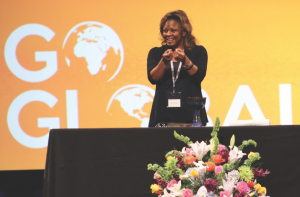
The Rev. Angela Pleasants prepares participants of the WCA Legislative Assembly for communion. WCA photo by Katy Patterson.
By Angela Pleasants –
In addition to being a local pastor, I am also a chaplain for the Charlotte-Mecklenburg Police Department in North Carolina.
A couple of weeks ago, I was in my sergeant’s office watching a video of Mark Gungor, a popular speaker and minister, using two mannequin heads as props in a sermon. One head was male. The other was female. After jokingly doing the sign of the cross, he pointed to the female head and tried to explain how women think. He described the female brain as intricate as an internet expressway. “Women can think of many things at one time,” he said. All of our emotions get involved. We hop from one subject to the next and to the next.
Then he pointed to the male head and said that a man’s brain has little boxes in it. There’s one thing in one box. Men have a box for the spouse. A box for the children. Another for the job. None of the boxes can touch. “Men open one box at a time and that’s what you deal with,” said the minister. You open one, and then the next, and then the next. Jokingly, he said men even have a box in the basement for the mother-in-law.
“Also,” the pastor said, “men have what’s called the Nothing box.” That’s right, the Nothing box and in that box is nothing. That’s why when wives ask husbands what they are thinking about they can so often say, “Nothing.”
The minister’s humorous illustration made me think about the correlation between how men keep track of the boxes in their brains and the way that our society encourages us to put people into boxes. We all are tempted to do it. We want to try to put people in a box, close it up with a nice bow, and put a label on it. Why? Because it makes us feel better when we can put someone in a box and label that person. Therefore, it validates us.
Of course, that is a secular world view that tries to box and label people. The sad part is that it has trickled into the body of Christ. My question is, “Why have we in the body of Christ today permitted the secular worldview to dictate, define, and identify who we are?”
Paul said, “Do not be conformed to the world.” Why? Because the world is not yet redeemed. It is not spiritually discerning. It does not hear from God. Yet we still allow it to dictate how the body of Christ is supposed to think.
When Jesus came up out of the waters at his baptism, the voice of heaven names who he is as the Son of God. “This is my Son, whom I love; with him I am well pleased” (Matthew 3:16). Then Jesus goes into the wilderness and is tempted for 40 days. After that time of temptation, he begins to preach. “Repent! For the kingdom of heaven is at hand!” Then he begins to teach and heal.
The Sermon on the Mount is our defining moment as the body of Christ. It begins, “Blessed are the poor in spirit, for theirs is the kingdom of God” (Matthew 5:3). In other words, blessed are you who know that we are spiritually bankrupt and that we need something outside of ourselves. That is Jesus Christ.
Jesus goes on to teach about salt and light, and how our righteousness should exceed that of the scribes and Pharisees. He teaches us about humility, to seek the kingdom of God, and not to be driven by selfish ambition.
Jesus said, “Anyone who listens to my teaching and follows it is wise, like a person who builds a house on solid rock. Though the rain comes in torrents and the floodwaters rise and the winds beat against that house, it won’t collapse because it is built on bedrock. But anyone who hears my teaching and doesn’t obey it is foolish, like a person who builds a house on sand. When the rains and floods come and the winds beat against that house, it will collapse with a mighty crash.” Matthew reports, “When Jesus had finished saying these things, the crowds were amazed at his teaching, for he taught with real authority – quite unlike their teachers of religious law” (Matthew 7:24-28 NLT).
He was teaching about the foundation. If you did not dig about 10 feet into the bedrock, the storms would come and knock the house over. Storms hit all the houses – those that had foundations at the bedrock and those that were merely on the shallow sand. Which one will be left standing? The one on the solid foundation.
Of course, Jesus was not just talking about the physical building of brick and mortar. He was talking about a spiritual foundation.
To the crowd of his day, Jesus was saying, You have heard the shallow teachings that have been built on the shifting sands of the religious leaders of the day – the scribes and the Pharisees. You can choose the path of the “establishment,” and the path of ease and comfort, and remain on the sinking sand of the religious leaders of your day.
Or, you can follow the path with a solid foundation. It may not be easy. It definitely won’t be comfortable. The way is narrow. There will be persecution. There will be attacks. But the end result will be eternal life.
Jesus gave them a choice. Which way will you choose? The sinking sand or the solid foundation?
That is the choice we have today as we live in the kingdom of God. We can choose the sinking sand of the establishment. We can continue to be comfortable and at ease.
Or we can continue to stand firm in the solid rock of Jesus Christ, standing firm in the gospel truth. I love when Paul said, “I’m not ashamed of the gospel of Jesus Christ.” The choice is ours.
When Jesus spoke those words on the Sermon on the Mount, this was the defining moment for those who made the choice to enter into the kingdom of God through Jesus Christ. What do I mean by defining moment? It was the moment where Jesus set forth the theme and nature of the kingdom. It was also showing God’s grace and showing how Christians are to live.
Saints, we have a defining moment right now. What is going to be our choice? Jesus said that when we choose the way of the kingdom of God, we are blessed. We are blessed when we come to him realizing that we are poor in the spirit. We are blessed when we mourn over our sinful nature, knowing that he is the only one that can heal and forgive us. We are blessed when we are merciful. We are blessed when we serve as peacemakers. We are blessed when they persecute us.
Jesus said we will be lied to, mocked, and persecuted, but rejoice because it happened to the prophets. The kingdom of Heaven will be ours. This is our defining moment. Let us celebrate that together.
Angela Pleasants is a United Methodist clergyperson in the Western North Carolina Annual Conference. She also serves as the chair of the Racial and Ethnic Equality Taskforce of the Wesleyan Covenant Association. This article is adapted from her address to the Wesleyan Covenant Association 2021 Global Gathering.
by Steve | Jul 26, 2021 | July/August 2021, Magazine, Magazine Articles
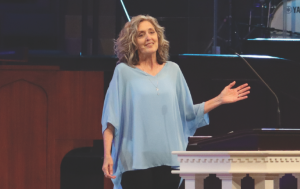
The Rev. Dr. Carolyn Moore addresses the 2021 Global Gathering of the Wesleyan Covenant Association. WCA photo by Katy Patterson.
By Carolyn Moore –
A well-known Reformed pastor and theologian once said, “God is always doing 10,000 things in your life, and you may be aware of three of them.” It’s a good line. It opens up the creative pores and asks what are the 9,997 things God is doing around me right now that I’m not even aware of? What relationship is he repairing? What movement is he birthing? What miracle is already in the works? What if God is doing far more in your life and you’re not even aware of it?
In Acts 16, Paul is sitting in a room in Troas feeling some dejection. Things had not gone so well on this trip. Good ideas were met with contention and doors were closing. It starts with the simple suggestion that they go back and visit the believers in all the towns where they’d started churches and already preached. Then they started to brainstorm who they’d take with them. Barnabas thought they should take John Mark. Paul didn’t. That debate erupted into a huge blow up. We could spend a lot of time psychologizing this scene and deciding who was right and who was being ridiculous but if we go down that road we’ll miss one of those 9,997 things God doesn’t want us to miss: The Holy Spirit directs the mission – not us.
Paul wanted to visit the believers but you don’t get the sense that was the mission in the mind of the Holy Spirit. “Paul and his companions traveled throughout the region of Phrygia and Galatia, having been kept by the Holy Spirit from preaching the word in the province of Asia. When they came to the border of Mysia, they tried to enter Bithynia, but the Spirit of Jesus would not allow them to. So they passed by Mysia and went down to Troas” (Acts 16:6).
For the lack of an open-door, Paul is left to wonder what in the world God is up to. Here’s this go-getter apostle trying to win souls for the kingdom, begging for an opportunity to do what he does best. And there is God slamming every door that distracts Paul. Slowly the Holy Spirit nudges Paul towards the coast where he will finally be able to gaze across the sea towards Macedonia and catch a glimpse of God’s heart for the nations.
Every door has a threshold. That is the point of entry at the bottom of a door that leads us from one room to the next. In spiritual terms thresholds mark progress. They represent forward movement in our spiritual maturity. It would make sense that it would be precisely at the thresholds that we experience the most pressure. When I approach a threshold that takes me from one level of intimacy with Christ to a deeper level, I begin to encounter greater pressure right at the threshold itself, just before the breakthrough.
That pressure can sometimes feel overwhelming. There we are waiting for the threshold of a new spiritual place, hearing God’s invitation to come on in. And meanwhile some devilish force is luring us backwards creating pressure against our progress, thresholds, or doorways. Another biblical word-picture is gate.
“Gates are where we win or lose. That’s why Scripture uses gates as the place to be broken through,” writes Barbara Yoder. “We must break through intimidation, faithlessness, fear, hopelessness, despair or whatever else looms like an unconquerable foe at the gates. The threshold is where we either cross over or hold back, opting to be safe in our homes. Yet once we cross over it is where we meet the incredible supernatural power of God to break through before us, victorious over every obstacle. It is after we leap that we begin to possess our inheritance for the current season.”
Paul was sitting at the coast of Troas, this threshold moment being lured by the Holy Spirit through a doorway into Macedonia where he would begin to possess a revolutionary call to take the gospel beyond Asia and into the world. “During the night Paul had a vision of a man of Macedonia standing and begging him, ‘Come over to Macedonia and help us.’ After Paul had seen the vision, we got ready to go to leave for Macedonia, concluding that God had called us to preach the gospel to them” (Acts 16:9).
That’s so Paul, isn’t it? He is like a spiritual battling ram – breaks down a door, steps over a threshold into a whole new spiritual territory. I don’t know why he didn’t see it coming. I mean he had already preached this moment. In Acts 13, we find him battling the incessant complaints of religious people who are anxious over the mixing of races and evangelization of foreigners. Paul’s response to them draws from Isaiah’s word to the Israelites, reminding them that truth is not a private affair.
Paul quotes from Isaiah 49, “For this is what the Lord has commanded us: ‘I have made you a light for the Gentiles, that you may bring salvation to the ends of the earth.’” This word moves us right up to a threshold, a doorway, because most of us are content to nestle down inside our own salvation and be comfortable. But Paul won’t have it. He needs us to hear the prophet’s word as our call too. ”I will make you as a light to the nations, that my salvation may reach to the ends of the earth” (Isaiah 49:6 ESV).
Dr. Tim Tennent teaches us that the missionary task is bigger than we tend to give it credit for. “When we see the church being planted cross-culturally we begin to see that the gospel is being brought to new people groups, and that is the missionary task,” he writes. God is always stretching us towards the ends of the earth, towards the ones who don’t yet know.
“Even if every Christian in the world became an evangelist and they witness to everybody they knew, and everyone they knew became Christians, and they themselves became evangelists, even after you had a tremendous movement to Christ all over the world, there would still be over a billion people who had never even heard the name of Jesus,” Tennent writes. “Why? Because they had no friends or neighbors to evangelize them, to speak the word of God to them. So however vibrant the church’s life may become in various parts of the world where the church is planted, however vivacious the people’s ministry may be, however mature the church’s growth, the world will not be reached, the Great Commission will not be fulfilled, until people cross cultural barriers and bring the gospel to those who have not heard it.”
That’s why the threshold moment in the life of Paul is so critical. There he stands at the far edge of the movement. Paul, maybe the only follower of Jesus bold enough to do such a thing, opens the door so the world could be introduced to a global Messiah. Why? Because if Jesus is not Christ for the whole world, he’s not Christ for any of it.
In Acts 16:13 we read, “On the Sabbath we went outside the city gate to the river, where we expected to find a place of prayer. We sat down and began to speak to the women who gathered there. One of those listening was a woman named Lydia, a dealer in purple cloth from the city of Thyatira, who was a worshiper of God … When she and the members of her household were baptized, she invited us to her home. ‘If you consider me a believer of the Lord,’ she said, ‘come and stay at my house.’ And she persuaded us.”
What an example of our thesis that God is doing, 10,000 things. Here is Paul opening up the gospel door for Europe and when he gets there, he finds himself evangelizing women. How bold!
Down by that river sharing the gospel with Lydia, Paul crosses yet another threshold and finds himself on the creation side of Genesis 3 and, by that obedience, God opens the door for Lydia to join the fellowship of biblical women who dared to walk back in the Garden of Eden and claim their call to carry the good news to a lost and hurting world. We thank God for Phoebe, Junia, Priscilla, Mary, Tryphena, and all the women that Paul said worked hard for the Lord.
The first century church proved that when men and women worked together to build the kingdom of God, operating in freedom and in the power and giftedness of the Holy Spirit, the effects of the fall are reversed, and the glories of the gospel are exposed. Paul has a word for the future Global Methodist Church: Don’t forget the Macedonians. Don’t forget the ends of the earth.
Hope above the fog. A few weeks ago, I presided over a funeral in Florida and had the chance to walk on the beach at sunrise and was staring at the horizon, waiting for the sun to break through. That morning, the fog created a band above the horizon.
Staring at the fog line, waiting for the sun to show up, I thought about us and waiting for the dawning of the Global Methodist Church. I also thought about that quote, “God is always doing 10,000 things around us and we are aware of three of them.” And I wondered what if we are waiting for something that has already happened? What if God has already placed his stamp on this vision. Has he already sent it forth into the world like a sun that has already risen above the horizon yet hasn’t broken through the fog? And what if while we’re focused on the dawning of something that God has already blessed to happen, he’s off doing 9,997 things we’re not even aware of yet.
Just as I thought about that, I turned around and saw all of these people staring in the direction of the horizon. There was a door. It wasn’t a physical door, but it was definitely an open door. It was actually rows upon rows of hotels and there were people just waiting to see the sun break over the fog.
Those rooms were full of people who must surely be starving, as I once was, for a better answer to life. Some of them were perishing for lack of it. And I can literally hear the cry, “Come over to Macedonia and help us.” So, I stood there looking at the hotels and the fog and wondered and grieved about how much time all of us have spent desperately staring toward a horizon waiting for a sun that has already broken through while a world of lost and hurting people are starving for a better answer.
Be encouraged. Don’t focus on the fog. Focus on the door. Because God is always doing many things in the world and right now, he is inviting us to step through a doorway to become a light to the nations because the world is our parish, and the world is God’s mission.
Carolyn Moore is a United Methodist clergyperson and the founding and lead pastor of Mosaic Church in Evans, Georgia. She also serves as the chairwoman of the Wesleyan Covenant Association Global Council. You can read more of her essays by visiting her webpage (artofholiness.com) and podcast. This article is adapted from her address at the Wesleyan Covenant Association’s Global Gathering in April.
by Steve | Jul 23, 2021 | July/August 2021, Magazine, Magazine Articles
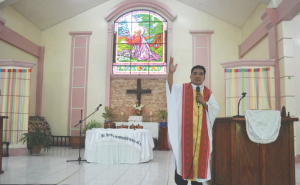
The Rev. Dr. Jonathan Razon addressed the 2021 Global Gathering of the Wesleyan Covenant Association remotely from The Philippines because of travel restrictions due to the pandemic. Photo courtesy of Dr. Razon.
By Jonathan Razon –
Martin Luther changed the course of human history in 1521 when he was twice brought before the Holy Roman Emperor Charles V and was told he must take back all of his teachings. As we all know, Luther refused to recant. “Unless I am convinced by Scripture and plain reason – I do not accept the authority of popes and councils because they have contradicted each other – my conscience is captive to the Word of God. I cannot and I will not recant anything, for to go against conscience is neither right nor safe. So help me God. Amen.”
Regrettably, we all know that throughout church history there have been tyrants and bullies who have abused their powers to manipulate and deceive God’s people. So, what was the source of Luther’s faith and fearlessness to stand up to the Holy Roman Emperor and the power of the papacy, the tyrants and bullies of his day? How was it that an obscure monk from the countryside was able to courageously speak the truth and launch the Reformation?
The source of Luther’s fearlessness was his rediscovery of the primacy of sacred Scripture and the essential truth of the gospel, namely, our justification by grace through faith in Christ alone. The gospel freed him to speak the truth to the political and religious powers of his day.
Luther was convinced that the truths revealed in the Scripture and the Church’s great creeds are timeless. They are truths that inform our moral and ethical teachings, and consequently shape the good ordering of church and society. Luther knew that in order for the church to fulfill its mission, its leaders must teach, defend, and model in their daily lives the lifesaving and life-giving ethical teachings rooted in Scripture and the Church’s creeds.
Without such leadership and fidelity, the church loses its way; leaders and people begin to do “what is right in their own eyes,” and if chaos is not corrected, confusion will reign among the faithful. Unfortunately, we have witnessed this happen in the recent histories of some Christian denominations.
With this in mind let me turn to those once timid, but ultimately fearless, apostles Peter and John who boldly preached the truth of Christ’s resurrection. In Acts 4, we see the high priest, the elders, and the scribes – the religious authorities of their day – question and bully them, treating them like common and ignorant followers of a crucified criminal. However, even though Peter and John were thrown in jail and reviled, they were not intimidated. They were fearless in their defense of the gospel.
Where did Peter and John get their fearlessness? Of course, they had recently seen and spoken with our risen Lord. Yet, they still needed to be filled with power of the Holy Spirit to make their bold defense before the religious authorities.
After the Apostles are questioned about their preaching and the healing of a crippled man, Luke writes, “Then Peter, filled with the Holy Spirit, said … ‘Rulers and elders of the people! … It is by the name of Jesus Christ of Nazareth, whom you crucified but whom God raised from the dead, that this man stands before you healed’” (Acts 4:8, 10).
Christ’s resurrection and the infilling of the Holy Spirit gave Peter and John the courage to bear witness before leaders who could have turned them over, as they did Jesus, to the Roman authorities. But they did not do that. Instead, the Bible says that even though the religious authorities still regarded Peter and John as “unschooled, ordinary men,” they now recognized the two men’s “courage” (Acts 4:13).
How can we be courageous and fearless in the places where God has called us to serve? Surely the experience of having just recently seen our resurrected Lord and talked with him gave them confidence to stand before the religious authorities. But then I think of what Jesus said to doubting Thomas after he had given him the opportunity to touch the scars on his hands and the wound on his side. Our resurrected Lord said to Thomas, “Have you believed because you have seen me? Blessed are those who have not seen and yet believe.” And since all the disciples were in the room when Jesus spoke those words to Thomas, I like to think Jesus’ words were for all of them.
Jesus was also thinking of you and me when he said those words to the disciples. He knew that when it is our time to be fearless, we must do it by faith alone and trusting that the Holy Spirit will fill us with courage and wise words. It is not always an easy thing to do. Writing to the early church, Peter said in his first letter, “though now for a little while you may have to suffer grief in all kinds of trials. … Though you have not seen him, you love [Jesus] and even though you do not see him now, you believe in him and are filled with an inexpressible and glorious joy, for you are receiving the goal of your faith, the salvation of your souls!” (1 Peter 1:6, 8-9).
Wherever we live in the world today, Christians are realizing we must become more courageous and fearless in the face of everything from insults to outright persecution.
Our principal model is of course Jesus himself, who as the Truth always taught it and defended it. He did so with compassion and pity for those who denied the truth. Even from the cross Jesus cried out, “Forgive them for they know not what they do.” Jesus demonstrates for us that our battles are not against people who make fun of us, who revile us, or who may even persecute us, but they are with powers and principalities beyond this world. We must discern and learn what Christ-like courage and fearlessness looks like as we face our circumstances.
Like Peter and John, we must be happy warriors who actually exhibit fearlessness and courage for the sake of our enemies, not simply to defeat them. Because when we read Acts 4, we can tell that Peter and John are first and foremost declaring the truth because they want people to know the truth for their own good. They know it leads to life.
The Rev. Dr. Martin Luther King, Jr. preached and modeled boldness for us in the great Civil Rights movement in America. His witness, and the witness of so many others, was steeped in the courage and fearlessness of Jesus and the Apostles. They stood for the gospel truth in the face of those who not only belittled and slandered them, but they stood for it even in the face of those who beat them and murdered them. By displaying Christ-like characteristics, they not only added people to their ranks; they even won over many of those who had yielded up their hearts and minds to the dark powers and principalities of hell.
Continuing the Wesleyan Vision. We Filipinos, like people all around the world, were inspired by the courage and fearlessness of Dr. King and the many brothers and sisters who followed in the footsteps of Jesus and the Apostles. They demonstrated for us what our Christian courage and fearlessness must look like when people belittle our faith, attack our beliefs and ethical standards, and even persecute us for declaring that Jesus Christ is the way, the truth, and the life.
Recently over three hundred Filipinos (myself included) signed a statement entitled, “Continuing the Wesleyan Vision: A Call to Unity in Holiness and Truth.” Those who signed the statement are clergy and laity from all over the archipelago of the Philippines and even Filipino migrants in diaspora – those living in the Middle East, Europe, and North America, or wherever they can find work to support themselves and their families.
As signatories we are all painfully aware of the decades-long dispute that has undermined the health and vitality of our denomination. As United Methodists who love to share the good news of Jesus Christ in both word and deed, we are very troubled that some clergy and bishops in the United States are unwilling to promote and defend the Holy Bible and our church’s teachings that are grounded in it.
We are very disappointed that, at our special 2019 General Conference in St. Louis, some U.S. clergy and bishops openly said they would defy the will of our global General Conference. Additionally, we are also very disappointed that after that conference some U.S. clergy and bishops took out full page ads in major U.S. newspapers belittling what we Filipinos believe, and the teachings that our UM Church had just reaffirmed. Their willingness to do these things has sown the seeds of confusion in the Philippines and undermined our courageous witness to the teachings of The United Methodist Church.
Therefore, as Filipino United Methodists who hold to the primacy of Scripture, we believed it was necessary for us to boldly say we are committed to our church’s teachings regarding marriage, sexual ethics, and ordination that are rooted in Scripture. These beliefs have been taught by the church universal for almost two thousand years, and they are affirmed by the vast majority of Christians the world over.
We do not want to see these healthy, life giving teachings over-ruled by a small, progressive group of rich, elite U.S. bishops and clergy. We do not want to see these teachings changed by U.S. leaders who appear to be more committed to “virtue signaling” to a progressive and permissive culture in the U.S., than to the time honored teachings of the Christian faith.
Our passion is for spiritual vitality, accountability to the life-giving teachings of our faith, and for doctrinal integrity. We want to continue to reach our young people with the good news of Jesus Christ. We do not want to lose them to other evangelical denominations in our country or, even worse, to a secular culture with permissive and destructive values. We envision the birth of a new Global Methodist Church that is committed to discipling our young people, and dedicated to bringing Filipinos to the saving work of Jesus Christ.
We hope to recapture the Spirit-filled passion of the early Methodist movement in the British Isles, North America, and especially that of our Filipino forebearers. We want to recapture that passion and adapt it to new ways of evangelizing and discipling people towards Christlikeness in the 21st century. We hope and pray for the creation of the new Global Methodist Church – a faithful continuation of the original vision of Methodism to “spread scriptural holiness throughout the land!”
As a small country representing small annual conferences, our challenge will be great as we take our stand for God’s truth as it is revealed in the Holy Bible. But it is not relative truth or subjective truth; we believe it is the Truth! It is always true, no matter the region or place. Despite the challenges, we Filipinos will courageously and fearlessly take our stand with Jesus Christ, who is the Truth for all time.
Jonathan Razon is a United Methodist clergyperson and the senior pastor at The Living Faith United Methodist Church in Murong, Bagabag, Nueva Vizcaya, Philippines. In addition to being a pastor, teacher, and human rights worker, Dr. Razon served as a delegate to the UM Church’s 2016 and 2019 General Conferences. This article is adapted from his address to the Wesleyan Covenant Association’s Global Gathering in April.