by Steve | Jul 8, 2016 | In the News, Uncategorized
 As we mourn this week’s tragic events in Louisiana, Minnesota, and now Dallas, it is evident that we need God now more than ever. My prayer on this day of shock and heartbreak:
God, our heavenly Father, our minds go back to the day when Jesus knelt beside his beloved city and wept, “If you, even you, had only known on this day what would bring you peace — but now it is hidden from your eyes” (Luke 19:42).
We sense so deeply the same reality. We weep for our cities even as we bury our dead. The sound of gunfire is the grim sound of what has already shattered our relationships. We are witnesses of distrust, revenge, and anger. We see no one to lead us and guide us. To whom shall we go?
Our differences seem to lead us even farther apart. Oh, Lord of miracles, do what only you can do to save us from ourselves. Give us men and women who will lead us to reconciliation. Give us leaders who will bind us up to heal our wounds, not those who will only incite more hate.
Give us voices that will bring hope and not despair. Please comfort the bereaved and give humility to the ones who are resistant to your ways. Give us pause so that we might sit back for just a few moments to look to you before we look at our impulsive solutions.
We shed another’s blood when we are without answers. You shed your own blood as our only answer. We kill, buried in despair. You rise, giving us hope.
You told Peter to put back his sword and you restored the one wounded. That’s what we long for. A reprimand to the one who would injure and a healing within the one injured. God of miracles, please do it again. We need you. Our nation needs you. Our leaders need you. Many a home today will not have a loved one returning. Without you we have no hope. With you all things are possible—even for beauty to come out of ashes. We pray for the day of unarmed truth and unconditional love. Please answer our prayer.
In the name of Jesus your Son, our only Savior, we ask this.
Amen.
Ravi Zacharias is a Christian apologist, speaker, and author. You can read this prayer on his website HERE.
by Steve | Jul 7, 2016 | In the News
Nashville, Tenn.: Spiritual growth and genuine community are the top motivators for attending church. That’s according to a new survey of spiritual “seekers” aged 18-34, conducted by Barna Group on behalf of United Methodist Communications.
The top reasons to attend church as cited by survey respondents were:
• Church helps my spiritual development (39 percent)
• Opportunity to find out more about God (38 percent)
• Opportunity to make friends and nurture friendships (38 percent)
• Knowing that anyone will be welcomed into the church community (38 percent)
• Opportunity for support during difficult times (37 percent)
David Kinnaman, president of Barna and director of the study, says the findings point to ways church leaders can offer genuine community for young seekers across a variety of life circumstances, especially looking at the differences between married and single young adults.
“Young adults are connected to social media nearly every waking hour, but four of the top-five reasons they might attend church point to a profound need for community that is deeper than what’s available virtually,” said Kinnaman. “In fact, twice the number of U.S. adults tell us they are lonely compared to 10 years ago—and that relational gap represents a real opportunity for churches that want to reach young seekers.”
According to the survey, feeling welcomed into a community and instilling values in their children are the top motivators for marrieds, while a desire for spiritual growth, support and friendships would more likely drive singles to church.
The survey found that favorable impressions of The United Methodist Church increased from 25 percent in 2011 to 40 percent in 2015. Married respondents were more likely to have a favorable impression of the denomination (51 percent) compared to single respondents (32 percent), and 49 percent of Gen-Xers (ages 32-34) had a favorable view compared to 35 percent of Millennials.
Three-quarters of seekers – especially Gen-Xers, marrieds and women – find the denomination’s tagline (“Open hearts. Open minds. Open doors.”) appealing.
The online survey, conducted from November 26 to December 7, 2015, included 406 adults aged 18-34 who are not attending or committed to a church, but who self-identified with at least four of nine statements regarding spiritual development. The sample was weighted by gender and region to be nationally representative.
Barna conducted an expanded online survey among 500 adults 18 to 49 years old, with no other screening criteria. The goal of the survey was to gain insights about the general population’s attitudes regarding spiritual development, community orientation and motivations related to church.
The survey found that 79 percent valued some sort of spiritual development in their lives and 69 percent believe that church has something to offer them.
The complete survey results are available online.
###
United Methodist Communications
by Steve | Jul 1, 2016 | In the News, Uncategorized
An Open Letter to the People of The United Methodist Church:
 As clergy and lay leaders of healthy, vibrant orthodox United Methodist congregations, and as teachers preparing the future clergy leaders of our denomination, we welcome the creation of the Wesleyan Covenant Association. In these times of great uncertainty about the future of The United Methodist Church, we believe it is important for orthodox congregations, clergy, and laity to work together, to support one another, and to encourage each other. We long for a church committed to sharing the Gospel of Jesus Christ with the last, the least and the lost.
Committed to the Wesleyan expression of orthodox Christianity, we believe the church can and must do better. We are alarmed by the growing loss in average worship attendance in many of our annual conferences. We regret the now numerous instances where colleagues in ministry have broken covenant with the rest of the church and sowed the seeds of schism. We are grieved by the actions of annual conferences that have decided not to conform to our Discipline. And we are disappointed in leaders who have failed to maintain the good order of the church. Consequently, the work of faithful pastors and laity has been undermined, healthy congregations have left the denomination, and thousands of United Methodists have gone in search of other places to worship and serve.
 We believe the Wesleyan Covenant Association will give orthodox United Methodists hope for the future and serve as a source of encouragement as the church works through a critical period of discernment. We want to serve in close partnership with our brothers and sisters in Africa, Europe and the Philippines. And we want to be prepared to act as one in light of the important work and recommendations of the Bishops’ Commission on the Future of the Church. We encourage all orthodox clergy and laity to remain steadfast and faithful in these uncertain times. We believe the Wesleyan Covenant Association will bind us together and make us a strong, united witness for Scriptural Christianity.
We believe that God is “doing a new thing.” We believe a new and better day is coming for the people called Methodist who are committed to the Lordship of Jesus Christ, the authority of the Scriptures, and the church’s being a missional force determined to reach a lost culture. We yearn to step into this new future together with others of like minds and hearts.
Please visit the Wesleyan Covenant Association website (www.wesleyancovenant.org) to learn more about it. We also hope you will plan to join us in Chicago on October 7, 2016, for the first gathering of the association.
We are confident you will be hearing more about the association in the weeks and months ahead, and we trust you will join us as we band together for the sake of a vibrant, Wesleyan expression of orthodox Christianity.
In Christ,
Billy Abraham, Perkins School of Theology, Dallas, Texas
Bill Arnold, Asbury Theological Seminary, Wilmore, Kentucky
Ryan Barnett, Kerrville First UMC, Kerrville, Texas
Keith Boyette, Wilderness Community UMC, Spotsylvania, Virginia
Madeline Carrasco-Henners, Luling First UMC, Luling, Texas
Ferrell Coppedge (lay), Mount Bethel UMC, Marietta, Georgia
Bryan Collier, The Orchard UMC, Tupelo, Mississippi
Jennifer Cowart, Harvest UMC, Byron, Georgia
Jim Cowart, Harvest UMC, Byron, Georgia
Dan Dalton (lay), Dalton & Tomich, Detroit, Michigan
Maxie Dunnam, Christ UMC, Memphis, Tennessee
Walter Fenton, Good News, The Woodlands, Texas
Scott Field, Crystal Lake UMC, Crystal Lake, Illinois
John Gaulke, Altoona UMC, Altoona, Iowa
John Gerlach, Trinity UMC, Windsor, Connecticut
Jeff Greenway, Reynoldsburg UMC, Reynoldsburg, Ohio
Joy Griffin (lay), International Leaders Institute, Carollton, Georgia
Wes Griffin, International Leaders Institute, Carollton, Georgia
Jeff Harper, Evangelical UMC, Greenville, Ohio
Jeff Jernigan (lay), Powder Springs, Georgia
Rick Just, Asbury UMC, Wichita, Kansas
Charles Kyker, Christ UMC, Hickory, North Carolina
Jessica LaGrone, Asbury Theological Seminary, Wilmore, Kentucky
Thomas Lambrecht, Good News, The Woodlands, Texas
Jim Leggett, Grace Fellowship UMC, Katy, Texas
Kenneth Levingston, Jones Memorial UMC, Houston, Texas
Pat Miller, The Confessing Movement, Indianapolis, Indiana
Carolyn Moore, Mosaic UMC, Evans, Georgia
Mike Morgan, Marion First UMC, Marion, Iowa
Norman Neel (lay), San Augustine, Texas
Martin Nicholas, Sugarland UMC, Sugarland, Texas
Craig Peters, Shueyville UMC, Shueyville, Iowa
Rob Renfroe, The Woodlands UMC, The Woodlands, Texas
Chuck Savage, Sardis UMC, Atlanta, Georgia
Branson Sheets, Covenant UMC, Winterville, North Carolina
Stephens Sparks, Indianola UMC, Indianola, Mississippi
Greg Stover (retired elder), West Ohio Annual Conference, Lake Waynoka, Ohio
Andrew Thompson, Springdale First UMC, Springdale, Arkansas
Richard Thompson, First UMC, Bakersfield, California
David Watson, United Theological Seminary, Dayton, Ohio
Max Wilkins, The Mission Society, Norcross, Georgia
###
* Church names provided only for identificational purposes.
by Steve | Apr 23, 2015 | Uncategorized
Remembering Ira Gallaway
By James V. Heidinger II
2015
Dr. Ira L. Gallaway, one of United Methodism’s most influential evangelical leaders over the past four decades, died March 16, 2015, at the age of 91. A memorial service celebrating his life was held Sunday, March 22 in Estes Chapel on the campus of Asbury Theological Seminary (ATS) in Wilmore, Kentucky. The setting was especially appropriate as Ira had served on the ATS board of trustees for more than 40 years, with several of those years as board chairman. Dr. Timothy Tennent, current ATS president, led the service, and Dr. Maxie Dunnam, a former president of the seminary, gave the memorial message for his long-time friend and colleague in ministry. Dr. Steve Martyn, a professor at the seminary and long-time friend of the Gallaway family, also participated in the service, as did I.
It would be difficult to overstate the impact Ira had on The United Methodist Church. He answered the call to ministry in 1956 and went to Perkins School of Theology at Southern Methodist University. After serving at Highland Park (Dallas), Hutchins, Kirkwood (Irving), and Walnut Hill (Dallas) churches, he became district superintendent of the Fort Worth East district. In 1971, he went to Nashville, Tennessee, to serve as General Secretary of the United Methodist Board of Evangelism. While there, he was influential in bringing future leaders to Nashville, including Maxie Dunnam to the Upper Room and Joe Hale, Eddie Fox, and George Morris to the Board of Evangelism.
In late 1972, Ira began a 17-year appointment as senior pastor at First United Methodist Church in Peoria, Illinois, one of the largest UM churches in the North Central Jurisdiction. Biblical preaching and regular Bible study were at the heart of his ministry there. Ira hosted the Upper Room’s first Cursillo spiritual retreat at Peoria First, which would soon become the very successful Walk to Emmaus program. A few years later, Ira joined laity from Peoria First to go to Hong Kong, to lead a Walk to Emmaus, which has grown and moved on into mainland China. One of those Peoria lay persons, Mrs. Joan Krupa, recently completed a three-year term as the first female chairperson of the Asbury Seminary board of trustees.
Ira, helped always by his lovely and gifted wife Sally, was a major leader in the cause of Scriptural Christianity and renewal within the denomination. He was a charter board member of the Institute on Religion and Democracy, founded in 1981 by Dr. Ed Robb and others. Then, he and the late L.D. Thomas were key leaders in the founding of the Mission Society for United Methodists in 1984. Ira had shared with me his sense of God’s providence at work as he contacted his friend H.T. Maclin regarding who might give leadership to a new mission-sending agency. To Ira’s surprise, H.T. had just resigned from his jurisdictional staff position with the General Board of Global Ministries, and he said, “Ira, how about me?” And so it was. Ira served for many years on the Mission Society board, and chaired it for several years.
Ira also played a key role in enlisting six prominent United Methodist leaders to serve on an invitation committee to invite other pastors from the denomination’s largest churches to come to Houston as an expression of concern about the church’s drift from its traditional doctrine. Some 48 leading pastors from 42 churches in 18 states gathered in Houston and signed what became known as “The Houston Declaration.”
Ira was also on the Coordinating Committee for the gathering of United Methodists in January, 1992, hosted by Maxie Dunnam, then senior minister at Christ United Methodist Church in Memphis. That conference resulted in “The Memphis Declaration,” a statement affirming the church’s traditional stance on human sexuality and calling the church to a new emphasis on mission and world-wide evangelism. More than 200,000 United Methodists signed the Declaration.
When the Confessing Movement within the United Methodist Church was launched in April of 1994, Ira helped the new movement on a part-time staff basis as it established its headquarters in Indianapolis.
Ira was much involved in helping the Methodist Church in Costa Rica, traveling there often to speak and teach. And in retirement, he and Sally were involved with the Four Corners Ministry with the Navajo Indians.
All of these ministries speaks much about Ira’s heart and his leadership in renewal efforts within the denomination. Ira was unquestionably a natural leader. He was fearless, and courageous, and a man of deep conviction, and he lived by those convictions. God used Ira to touch countless lives across the years. This was evidenced by the number of families from First Church Peoria who came all the way to Wilmore, Kentucky for his service.
In the final years of his life, Ira lived at the Wesley Village Retirement Community in Wilmore. While there, he continued to serve as a consultant and emeritus member of Asbury’s Board. He was preceded in death by his wife, Sally, his two sons, Jerry and Timothy, and two grandsons, John and Zachary. He is survived by a daughter, Cynthia, and son, Craig (wife Deb), thirteen grandchildren, and five great grandchildren. The theme for his service of celebration was the theme to be inscribed on his grave stone in Glen Cove Cemetery near Coleman, Texas. It is simply: “Thank You, Lord!”
For this good friend, colleague, and bold leader within the United Methodist Church, we also say a heartfelt “Thank You, Lord!”
James V. Heidinger II, editor emeritus of Good News.
by Steve | Jan 1, 2015 | Uncategorized
By Kenneth Tanner
“And the Word became flesh and dwelt among us, and we have seen his glory, glory as of the only Son from the Father, full of grace and truth” (John 1:14 ESV)
“Therefore he had to be made like his brothers in every respect, so that he might become a merciful and faithful high priest in the service of God, to make propitiation for the sins of the people” (Hebrews 2:17 ESV)
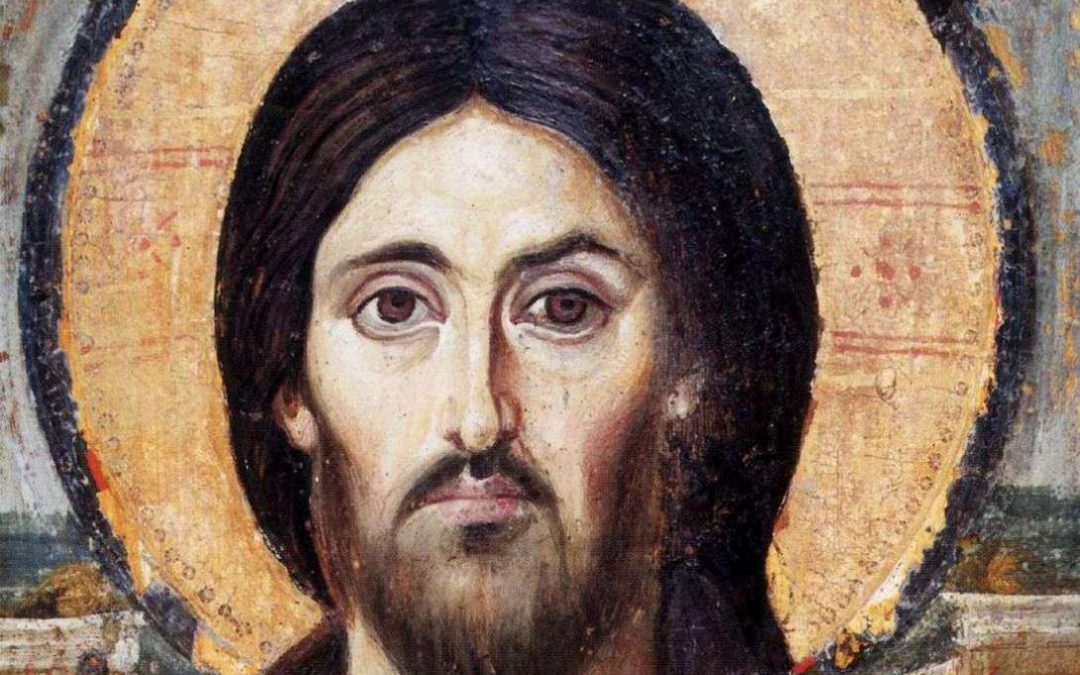
On a wall in the chapel of the Saint Catherine’s Monastery, a remote wilderness abbey at the base of Mount Sinai in Egypt, hangs an icon.
It’s not a poster of Brad Pitt or a reproduction of the Apple or Microsoft logo. This is a religious icon, perhaps the oldest in the world – a special painting the first Christians called a window into heaven.
This figure of Christ Pantocrator, or Christ the Ruler of All, is no ordinary icon. No surviving icon of its era looks anything like it. It seems fresh, as if painted yesterday.
Believed to have been given to the desert monastery in the mid-sixth century by the Byzantine emperor Justinian, it survived a period when icons were destroyed in many urban churches, was preserved against deterioration in the arid climate, and was secured from invaders by an order of protection the prophet Muhammad himself granted after the monks of Saint Catherine’s gave him shelter and hospitality.
The icon shares sixty-three points of precise alignment with the image of Jesus “burned” into the Shroud of Turin, five times the number of alignments needed to match fingerprints.
For many, this is the closest thing we have to a photograph of God.
Note the difference between the left side of the face (in which some see evidence of Christ’s torture and passion) and the right side (in which some discern his transfigured, resurrected radiance).
The icon tells the story of Good Friday and Easter.
The eyes stand out. Something about them is not quite right. For some, they have an unsettling quality. One of my childhood friends had a lazy eye. He was wonderfully unconscious of his difference, but I often was distracted by it. More frequently than I’d like to admit, I caught myself staring.
The more time I spent in prayer looking at this unique image of Jesus – the Pantocrator – the more the asymmetry of the eyes troubled me. I pondered why the artist would paint Jesus with a physical “imperfection.”
Eventually I realized this was not a problem with the artist or the image but rather a limitation of my imagination, a failure to see everything there is to see in Christ. After all, the word became flesh in Jesus (John 1:4) and was made like us in every respect (Hebrews 2:17).
Jesus took on everything it means to be human. One early Christian pastor taught that “what has not been assumed has not been redeemed.” Jesus grew tired, donned a cloak against the piercing cold and burning sun, could catch a virus or suffer a wasting disease, and if all that is true, he might also have borne some physical “defects.” Isaiah’s prophecy of the suffering servant warned us that Jesus had “nothing beautiful or majestic about his appearance, nothing to attract us to him” (53:2b NLT).
Still, I discovered it wasn’t just a matter of accepting that Jesus might have had physical imperfections. I had never absorbed into my heart the reality that the divine became one with matter in Jesus. Real flesh, real bones, real heart.
My encounter with the Sinai Pantocrator helped end my inherited mental image of Jesus as a stick figure in a Bible story – a Sunday school flannelgraph character – and experience the full-blooded actuality of how things are in Jesus Christ; even the possibility that the sinless one’s participation in our nature involved bearing physical infirmities, just as daily he grew thirsty, hungry, and weary.
Icons of Christ help us consider that Jesus is no abstraction – no mere thought, no matter how beautiful; no protagonist in a children’s story told to make us feel better – but the express image of the unseen all-holy God made vulnerable (Colossians 1:15), made like us “in every way.”
We see in Jesus the sacred reality of our humanity as God intended it from the beginning; his was the first human life to fulfill that intention. The Sinai icon helps us comprehend that we become most truly human when we embrace the humanity of God in Jesus Christ.
Embracing the humanity of God, icons help us visualize such an incredible possibility; that we might, by grace, become transfigured partakers of the divine nature in clay (2 Peter 1:4).
I have a sort of odd pastoral practice. I keep small wood-mounted reproductions of this Sinai icon in my backpack to give to strangers and friends. I started this about ten years ago on Chicago’s trains, subways, and buses. My commute was four hours round trip. Eventually folks figured out I was an undercover man of the cloth, commuting and working just as they did every day – someone imperfect enough that they eventually came to share with me their questions about God.
The icon gave me a way to show them the gospel and allowed me to use fewer words when I did so. Fifteen hundred years after its creation, the icon still hangs in the shadows of the mountain on which God forbade the worship of idols.
The reason this isn’t ironic is that icons are not idols. Idols are objects that we make and worship in place of the living God. In Jesus Christ, God has acted to make a perfect image of himself (Hebrews 1:3).
God has made Jesus the “visible image of the invisible God.” When iconographers depict Christ in the icons they write – in their parlance, icons are “written,” not painted – the writers are not fashioning a god for themselves but rendering an image of what the Father, Son, and Spirit have already done in the incarnation of the one God in Jesus Christ.
It is not idolatry that God became flesh in Jesus, and it is not idolatry to depict what God has done and hang these depictions in our homes and houses of worship just like we hang family photos or images of contemporary leaders. We would never think to tear such images up or deface them, because these pictures represent the people we love. Almost no one worships these depictions. Christians do, however, worship a God who clothed himself in clay, in the same material stuff with which he made our ancestors in his image in the Garden of Eden.
Women and men are made in the image of God, female and male together bearing all that is in God, and so it shouldn’t surprise us when our incarnate Lord looks like us. The Sinai icon reminds us that we are one with him and he is one with us.
Ponder with me for a moment the mystery that we’ve entered when we encounter Christ in the Gospels . . .
When Jesus is on the Sea of Galilee with the disciples, and storm winds and waves frighten even seasoned fishermen, we find the God who made the waves, the wind, and the wood the boat is crafted from – who made everything and holds everything together – tired and asleep in the hold of the ship.
God is asleep on a boat, even though our first thought as readers is that, of course, Jesus, a mere human, is napping (and that is true, too).
When the disciples awaken Jesus and he surveys the situation (and their hearts), he rebukes their fear, and then a mere man stands up on two feet in a vessel sloshing with lake water and speaks: “Peace, be still.”
Someone just like the rest of the disciples – with breathing lungs and a beating heart, sleepy and finding his sea legs – makes the wind stop gusting and turns the waves to glass with his words. As readers, we think Jesus is God and this awe-inspiring ability fits his divinity, but Jesus is also merely human, no more special in his biochemistry than anyone else in that boat on a sea gone wild.
When we read every story about Jesus with the sort of contemplation that icons allow – realizing this protagonist is in every moment God “all‑in” and human “all‑in” – we begin to discern that something has happened forever in God and something has happened forever in us, because the Son who breathed the stars into fiery existence and set their courses in the sky, who made the orchid and the hummingbird, humbled himself and was made like us in every way: weary, thirsty, hungry, aching, longing, striving, rejected, fallen, marvelous clay that we are, that we might be as he is, as God from all eternity. World without end.
The Sinai icon reminds us that in Jesus Christ, God leaves fingerprints, leaves DNA , wherever he goes (Jesus is human without measure); that Jesus breathes the spirit of the Father’s loving-kindness on all things (Jesus is divine without qualification).
His blood, his touch, his stops of breath reconcile the creator and the clay that as female and male alone in all creation bears the image of God.
Jesus walks with us, walks as us now, and we participate by our prayers, by our touch, by our faith and compassion – sometimes even by our blood – in the renewal of all things.
We see the likeness of Jesus in every human. Would that they might behold in our faces the icon of his vulnerability, self-sacrificial love, and resurrection in this wild, wonderful world he became human to restore to life without end.
Kenneth Tanner is pastor of Church of the Holy Redeemer in Rochester Hills, Michigan. His writing has appeared in Books & Culture, The Huffington Post, Sojourners, National Review, and Christianity Today. This essay originally appeared in Disquiet Time: Rants and Reflections on the Good Book by the Skeptical, the Faithful, and a Few Scoundrels (Jericho Books). It is reprinted by permission. This article appeared in the January/February 2015 issue of Good News. Artwork is Christ Pantocrator from Saint Catherine’s Monastery in Sinai.

 As we mourn this week’s tragic events in Louisiana, Minnesota, and now Dallas, it is evident that we need God now more than ever. My prayer on this day of shock and heartbreak: