by Steve | Nov 14, 2017 | Front Page News, In the News

Bishop Karen OIiveto during opening service of Council of Bishops. Photo: Council of Bishops.
According to reporting from Heather Hahn (UMNS), United Methodist bishops find themselves “off the map” as they try to navigate a way forward through the church’s impasse over homosexuality, said Bishop Bruce R. Ough of the Dakotas-Minnesota area. “There is currently no larger or intractable barrier to the mission, unity and vitality of The United Methodist Church than the matter of homosexuality,” the Council of Bishops president said November 6, in his fall address to 127 of his episcopal colleagues.
From our vantage point, it is noteworthy, but not surprising, that the Council of Bishops addressed this “intractable barrier” by inviting Bishop Karen Oliveto, the controversial episcopal leader of the Mountain Sky Episcopal Area, to preach one of the opening sermons before their gathering. Oliveto, of course, is married to another woman and has been publicly forthcoming about performing more than 50 same-sex weddings prior to becoming a bishop last year. It remains a mystery how this preaching invitation helps create unity or strengthen the mission, unity and vitality of the denomination.
To read Heather Hahn’s news story about the challenge before the Council of Bishops, click HERE.
by Steve | Nov 6, 2017 | In the News, Perspective E-Newsletter
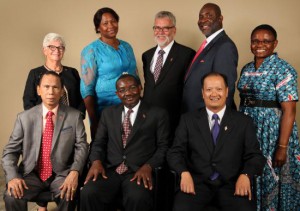
The Judicial Council. Photo by Kathleen Barry, United Methodist Communications.
By Thomas Lambrecht-
The latest rulings by the Judicial Council illustrate that the impasse in our denomination over theological disagreements and the question of LGBTQ inclusion cannot be resolved by the church legal process.
Church’s Teaching Still Constitutional
In the most blatant challenge to The United Methodist Church’s teaching that “the practice of homosexuality is incompatible with Christian teaching,” the Judicial Council declined to rule. That leaves the church’s teaching intact.
Both the Denmark and California-Pacific Annual Conferences had requested declaratory decisions on whether the church’s teaching violates the First Restrictive Rule in our church constitution. That rule states that “The General Conference shall not revoke, alter, or change our Articles of Religion or establish any new standards or rules of doctrine contrary to our present existing and established standards of doctrine” (Discipline ¶ 17). The conferences argued that the church’s teaching on the incompatibility of homosexual practice is a new doctrinal standard, and that it needed a two-thirds vote of the General Conference and a three-fourths majority vote of all the members of the annual conferences in order to adopt such a new standard.
Good News argued in a brief submitted to the Judicial Council that the church’s teaching was not a doctrinal standard on par with the Articles of Religion or Confession of Faith, but simply a moral teaching of the church. Further, we argued that, even if it were a new doctrinal standard, it was not “contrary to our present and existing standards of doctrine” and therefore permissible.
The Judicial Council, however, did not even rule on the issue. It decided that there was no direct connection between the question of the constitutionality of the church’s teaching and the work of the annual conferences. According to ¶ 2610.2j, a request for a declaratory decision coming from an annual conference “must relate to annual conferences or the work therein.” “Our longstanding jurisprudence has interpreted ¶ 2610 to mean that a request for a declaratory decision that comes from an annual conference must be germane to the regular business, consideration, or discussion of the annual conference and must have a direct and tangible effect on the work of the annual conference session.” There was also confusion in the California-Pacific Annual Conference minutes that did not show the motion for declaratory decision received a majority vote.
The bottom line is that the church’s teaching that “the practice of homosexuality is incompatible with Christian teaching” is still valid under our church constitution. Using the legal process to challenge its constitutionality will not work. The issue can only be settled by action of General Conference.
Complaint Against Lesbian Pastor Cannot Be Reactivated
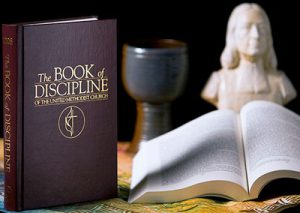
The Book of Discipline. A UMNS photo by Mike DuBose.
In June 2016, the Rev. Anna Blaedel announced during a plenary session of the Iowa Annual Conference that she is a self-avowed practicing homosexual. Such a statement brought her standing into question, since a self-avowed practicing homosexual may not be ordained or appointed as clergy (Discipline ¶ 304.3). A complaint was filed against Blaedel and there was no just resolution of that complaint, but Bishop Julius Trimble (who was the bishop of Iowa at the time) dismissed the complaint without putting Blaedel on trial.
At the 2017 session of the Iowa Annual Conference, a question of law was asked as to whether the dismissal of the complaint by Bishop Trimble was proper under the Discipline and whether the complaint could be reopened in order to start a trial process.
The Judicial Council ruled that, once a complaint has been resolved, whether by a trial, a just resolution, or by being dismissed, it cannot be reopened. A new complaint would have to be filed if the violation were repeated. In this case, the Judicial Council said, there would have to be evidence that Blaedel once again publicly claimed to be a self-avowed practicing homosexual after the dismissal of the previous complaint on September 1, 2016.
In a little-noted passage in the decision, the Judicial Council said, “Clearly if the record in this case alleged a self-avowing statement since that date, the current bishop would have a duty to initiate proceedings under Discipline ¶362 in accordance with JCD 920 and 1341.” In an article posted by Reconciling Ministries Network in response to the decision last week, “Rev. Anna Blaedel reflected on the ruling by saying, ‘I am relieved to have this dehumanizing, disempowering process resolved, for now. However, I proudly remain a ‘self-avowed, practicing homosexual.’ I delight in my queerness, and my relationship with my beloved. I lament the use of loopholes to hide any aspect of queer life and love.'”
Thus, Blaedel is renewing her self-avowal, making her once again subject to a complaint. According to the Judicial Council decision, new Iowa Bishop Laurie Haller “would have a duty to initiate proceedings.” At the very least, someone could file a new complaint against Blaedel for her ongoing violation of the standards for ordained ministry.
Lesbian Candidate for Ministry May Not Be Approved
The Judicial Council ruled that an annual conference board of ordained ministry was not obligated to recommend for commissioning as a provisional member a person that they believed did not meet the qualifications for ordained ministry. The case involved Tara Morrow, who had been turned down for commissioning in 2016 in the Baltimore-Washington Annual Conference due to the fact that she disclosed to the board that she is a lesbian married to another woman.
When the board declined to recommend her for commissioning in 2017, even though she initially received the required three-fourths vote of approval by the board, their failure to do so was challenged by a question of law. Heightening the controversy, the Rev. J. Phillip Wogaman surrendered his clergy credentials in protest on the eve of celebrating 60 years of ordained ministry service.
The Judicial Council asserted that the board was within its rights to rescind its recommendation of Morrow in light of Judicial Council decisions issued in May. “Decisions 1341, 1343 and 1344 prevent a Board of Ordained Ministry from ignoring statements of self-disclosure about any action that violates any portion of church law as is the case of the candidate who acknowledged that she is a lesbian and married to another woman. In JCD 1344 the Judicial Council stated that it is the duty of the Board to conduct a careful and thorough examination and investigation, not only in terms of depth but also breadth of scope to ensure that disciplinary standards are met.”
Again, the attempted exploitation of presumed legal loopholes cannot overturn the settled will of the General Conference in establishing qualifications for ministry.
How to Deal with Parliamentary Rulings
Two other decisions related to resolutions that were declared “out of order” by a bishop. In Western Pennsylvania, a resolution requiring the annual conference to conform to the Book of Discipline on matters of ordination and same-sex marriage was declared out of order by Bishop Cynthia Moore-Koikoi and thus not able to be voted on. In South Carolina, a petition to form a task force to study the possibility of the annual conference disaffiliating from The United Methodist Church was also declared out of order by Bishop L. Jonathan Holston.
The Judicial Council ruled correctly in both cases that it has no jurisdiction to rule on parliamentary questions. A decision by a bishop to declare a particular proposal out of order is a parliamentary decision, and therefore not subject to Judicial Council review.
It is important that annual conference members understand how to handle a parliamentary ruling with which they disagree. The proper response is to appeal the ruling of “out of order” to the “house.” That means that the whole annual conference gets to vote on whether they agree with the bishop’s decision to call something out of order. The annual conference can vote to overrule the bishop, which enables the conference to consider the matter that was ruled out of order. Or the annual conference can vote to sustain the bishop’s ruling that the item is out of order, which ends consideration of that item. Either way, the bishop’s rationale for ruling it out of order would be placed on the record.
If the annual conference votes to sustain the bishop’s ruling of “out of order,” the matter could then be the subject of a question of law that would eventually go to the Judicial Council. Because the annual conference took an action (to sustain the bishop’s ruling), the question of law is no longer about a parliamentary decision, but about the action of the annual conference. A question of law must be about an action taken or proposed to be taken by the annual conference. Thus, this is the way to get that issue before the Judicial Council.
The Way Forward
All of the above cases illustrate that the legal processes of The United Methodist Church cannot resolve the impasse in our church over theology and the moral teachings of the church regarding the extent of LGBTQ inclusion. We are currently in a state of schism, where some parts of the church are following the Book of Discipline and other parts are not conforming. The General Conference is the only body that can resolve the dispute. Our prayer is that the proposals of the Commission on a Way Forward, as submitted by the Council of Bishops, will enable the special session of the General Conference in 2019 to take definitive action to resolve this crisis. The future of our church depends upon it.
Thomas Lambrecht is a United Methodist clergyperson and vice president of Good News.
by Steve | Oct 30, 2017 | Front Page News, In the News
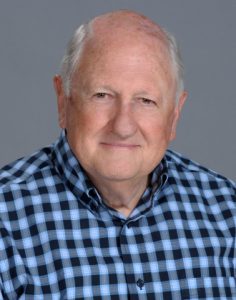 – By Donald W. Haynes
The 21st century infighting about marriage, sexuality, and the Christian faith are obviating the relatively unrelated mistakes of the 20th century. That is the century when we lost membership and attendance inside the institutional church, and muscle at the “table of the public square.” Either cobbling together some modicum of ecclesiastical unity or separating into two denominations will be a sheer travesty. We have been down both roads before — division and unification. Neither option made us stronger in the past nor will it in the future.
Because some spoke German and some spoke English, we divided over language at the inception of “the people called Methodist” in America. We voted to divide over polity in 1792 and 1828, resulting in The Christian Church and The Methodist Protestant Church. We voted to divide over racial issues in 1816, 1820, 1843, and 1867, resulting in the African Methodist Episcopal Church, the African Methodist Episcopal, Zion Church, the Wesleyan Methodist Church, and the Colored Methodist Church (re-named “Christian” in 1954). We split over doctrine in 1894, and around 1900 resulting in the Nazarene Church, the Assemblies of God, and the Church of God of Anderson, Indiana.
The Price of Ecumenism
The magnificent obsession of the 20th century for Methodist was ecumenism. The “evil” of that Christian generation was denominationalism. The mood was “unification or bust”! This tunnel vision either caused or allowed Methodism to ignore the infamous “Fundamentalist-Modernist” controversy that raged in the 1920s. We ignored the rise of the Bible College movement. We had a condescending posture toward Fundamentalism that come home to haunt us when they took the campuses by storm in the late 20th century with the result that we lost thousands of “our children” who went to college and never came “home again.”
Seminary homiletics prior to 1968 taught topical preaching rather than biblical sermons. So much of their content was what Dr. William Abraham has called “doctrinal pablum or moralistic platitudes.” He also coined the term “doctrinal amnesia” which made the Methodist delegation embarrassed at the negotiations for EUB-Methodist merger. We had long ignored Wesley’s sermons and the “consensus Fidelium” of early Methodism. The holiness doctrine and perfecting grace were virtually embarrassing to denominational leadership after the “come out” and “put out” controversies of the late 19th century that resulted in the formation of the Nazarene Church. The Article on “Sanctification” was salvaged only by the Methodist Protestant Church in the unification of 1939. Article XI of the EUB “Confession of Faith” also articulated the “experimental divinity” of sanctification. We even neglected our social justice obligation in the Great Depressions because most of Methodist passion was for unifying three churches to form, in 1939, The Methodist Church.
In late 18th century Pennsylvania an evangelical and Arminian revival was taking place. When Martin Boehm, a Mennonite, heard Philip Otterbein’s testimony, he ran to him, embraced him and said, “Wir sind brudert” (We are brethren). That was 1767. By 1800 they had become The United Brethren in Christ. Meanwhile, by 1816 in central Pennsylvania, Jacob Albright, Lutheran heritage, was starting another church of the German Pietist movement called the Evangelical Association. They were all “one in the Spirit” with the Methodists. In 1884, the United Brethren split over polity. In 1946, the United Brethren and Evangelical Association became the Evangelical United Brethren church (EUB) and had 738,000 members.
In the 1950’s and especially in the turbulent 1960’s the Evangelical United Brethren and The Methodist Church engaged little in the social revolution occurring in United States society. They were deeply involved in merging their churches. This was accomplished in 1968, but with the EUB conferences, the merger was approved with only a 3 percent margin over the required 2/3rds. The Methodists had 10.2 million members, fourteen times more than the EUB’s. With the new name, The United Methodist Church, some towns in Pennsylvania, Ohio, and Indiana had two churches of the same denomination across the street from one another. Some sociological studies have revealed that the driving force behind both religious bodies was the conviction among their leaders that denominationalism was a sin!
There was no discussion of theology in the EUB-Methodist merger! They were obsessed with ecumenism. The EUB people lost the most sense of “brand.” The United Methodist Church has lost members every year of its existence. Some wag has written, rather accurately, that The United Methodist Church is “a mile wide and an inch deep.” The new church has been “vanilla.” By the 21st century, almost no United Methodist could engender in their children what they believed! Therefore history will record that the price of ecumenism was high — the loss of identity.
The Loss of Churches of Small Membership
The genius of Methodism was its following of English speaking people movements. The United Brethren and Evangelicals did much the same as Germans moved west. Rural churches became the center of communities as people named their roads, and often their “one room schoolhouses” or post offices. Many were served by clergy who pastored several churches in different communities, linked only by their denominational names.
Historically, Methodist, United Brethren and Evangelical preachers were appointed to a “territory” to be evangelized rather than a congregation to be belittled. The rural parishes were seen in most seminary classrooms as cultural “back eddys.” By the pre-World War II years, the “Town and Country Movement” recognized the chasm between the seminary classroom and the rural parish. Unfortunately, the result of their prodigious effort was the seminary appointments of faculty whose doctorates were in Rural Sociology. They had keen insights about the plight of rural America, but offered little help in effective evangelism, education, missions, and worship! Rather than identifying with their communities, seminary graduates saw the rural church as a stepping stone to a more theologically sophisticated “city church.”
In 1961, Gibson Winters wrote an important book that suffered benign neglect, The Suburban Captivity of the Church. Not only did we lose our influence in the “country,” but also in the blue collar mill and coal mine villages, but also in the inner cities near the behemoths of industries such as automobiles and steel. Once these were the seedbed communities in the legacy of Wesleyanism, but with every passing decade, our presence and witness dwindled. Our pastors did not stay long enough to effect social justice systemic change.
The Religious Education Curriculum
A book that should be re-read in every generation is Faith and Nurture, written in 1941 by Dr. H. Shelton Smith, Professor of American Protestant Thought at Duke Divinity School. He traces the history of Christian Education as the emergent priority of liberal Christianity, replacing both evangelism per se and missions with any modicum of evangelical content. Smith wrote, “From the standpoint of popular interest, religious education eclipsed every other project of the churches.”
Then, as a voice crying in the wilderness, Smith dismantles the theological premises of what was pointedly called “religious education,” not “Christian education.” A quote from the prestigious and widely read periodical, Religious Education, in a 1928 article was only one of many documentations Smith provided regarding the “takeover” of religious education from previous mainstream Protestant agendas: “Perhaps nowhere else than in religious education can we see more clearly the direction in which religious thinking is moving.”
George A Coe, a Methodist, was a disciple of John Dewey, the father of philosophical progressivism, and the “godfather” of public school education. The emerging professional on large church staffs was not a “D.C.E.” (Director of Christian Education) but a “D.R.E.” (Director of Religious Education). The shapers of the church’s nurturing ministries deliberately removed the word “Christian” from staff titles. All too few people noted the difference as important, but it was! Indeed he, and several generations after him, chucked the term “Sunday School” and created the term, “Church School.” This meant that “Vacation Bible School” became “Vacation Church School” and the “Sunday School Superintendent” became the “Church School Superintendent” and finally, in 1968, was relegated to an optional position and called “Superintendent of Study.” The person who had been the “backbone” of small membership churches on circuits was moved from the “sidlelines to offline.”
Reflecting on the quote, “We are making religion anew … as Jesus made it,” Smith opined, “In this view, the value of the Bible lies chiefly in its power to stimulate a religious quest that will result in the creation of spiritual norms that transcend those embodied in the Bible.” Coe was vehemently opposed to the concept of sudden conversion, the gateway to discipleship that characterized the Second Great Awakening and the phenomenal growth of the United Brethren, the Evangelical Association, and the several branches of Methodism. Dewey made no claim to being a Christian, but Coe, reflecting Dewey’s philosophy, “sharply dissented from traditional theologies of sin and evil” (The Religion of A Mature Mind, by George A. Coe, 1902). He successfully influence editors of Church School literature to deleted any references to the doctrine of original sin, any references to the atonement, and any references, in Sunday School literature, to these basic premises of historic Christian thought.
We cannot devote more space here to the negative effect that “religious education” concepts had on the rise and fall of the Sunday school. George Coe’s philosophy of religion influenced all students majoring in religious education for well over half a century. It was the 1960s before the term “DRE” finally was archived and the term “DCE” came into vogue. As Shailer Matthews put it though, “a faith on the defensive is confessedly senile.” Shelton Smith said it this way: “There is little hope that liberal nurture in its present form can keep religion prophetically alive in our culture.” Using the term “Christian Education,” churches built elaborate and spacious “Educational Buildings” when Sunday school attendance as double that of worship in almost every Protestant Church in America. Culture was a friend of the Sunday school in that most people married young and had three or four children, all of whom were brought to Sunday school every Lord’s Day. As the revival was quietly laid to rest and before confirmation became the norm for joining the church, most churches received most or all sixth or seventh graders into membership. In 1955, seven of eight new members in The Methodist Church came through the Sunday school. Again to quote Smith: “Liberal nurture is feeble because it is rooted in a sub-Christian gospel. Educational evangelism has no adequate evangel.”
A cover story of LOOK magazine in 1957 exposed the faultline of liberal religious nurture in a long story entitled, “Sunday School — most wasted hour of the week?” The Church School editorial boards, literature writers, and most clergy went ballistic! The article, however, was based on the raw data from hundreds of interviews in several mainline denominations. To a simple battery of questions about biblical content or doctrinal beliefs, people who had been to Sunday school for decades were found to be biblically and doctrinally illiterate. Conversations were already underway to merge The Evangelical United Brethren and The Methodist Churches, but the bombshell of the LOOK cover story and its aftermath apparently set off no alarm bells in the merger talks! By 1968, when The United Methodist Church was “born,” the Sunday school decline had become an irreversible trend — a trend that evolved into a virtual stampede. Now thousands of churches have less that 20 percent of the Sunday school attendance they had in the 1950s.
The once popular comic strip “Pogo” had a line whose wisdom could not, and cannot, be denied: “We have met the enemy and he is us.” Or as Shakespeare had Caesar to say, “Men at some time are masters of their fates; the fault, dear Brutus, is not in the stars.” God’s word is clear: “Love thy neighbor as thyself” and the rest is small stuff.
Donald W. Haynes is a retired United Methodist clergyperson from the Western North Carolina Annual Conference, author, and adjunct professor of United Methodist Studies at Hood Theological Seminary.
by Steve | Oct 30, 2017 | In the News, Perspective E-Newsletter
 By Thomas Lambrecht-
That old saying from our parents, “let conscience be your guide,” is foremost in the debate over ministry with LGBTQ persons. Some cannot in good conscience go against what they believe Scripture teaches about the sinfulness of same-sex practices. Others cannot in good conscience go against what they believe Scripture teaches about loving and accepting all people. Others cannot in good conscience go against the requirements of the Book of Discipline, formed as they are out of prayerful discernment by the General Conference (the only group able to speak for global United Methodism), despite the fact that those persons disagree with some of its requirements.
This conflict of consciences has led some to disobey the Book of Discipline. It has led others (laity, clergy, and even congregations) to leave The United Methodist Church. It has led to the filing of complaints, church trials, and the irregular setting aside of church law by church authorities.
What do we do when there is an apparently unresolvable conflict between the consciences of different individuals or groups? How do we resolve the resulting impasse?
One important principle is that people should not be forced to violate their consciences. John Wesley made this point in his sermon, Catholic Spirit. “No man can choose for, or prescribe to, another. But every one must follow the dictates of his own conscience, in simplicity and godly sincerity. He must be fully persuaded in his own mind and then act according to the best light he has. Nor has any creature power to constrain another to walk by his own rule. God has given no right to any of the children of men thus to lord it over the conscience of his brethren; but every man must judge for himself, as every man must give an account of himself to God.”
This principle of not violating conscience guides the work of the Commission on a Way Forward. It is seeking to develop proposals that give freedom to all to engage in ministry according to their conscience.
(It is important to note that, while we ought not to constrain another person’s conscience, that does not mean that we can allow any sincere or conscientious ministry to take place under the umbrella of United Methodism. We cannot allow a United Methodist pastor who conscientiously refuses to baptize infants, for example. It simply means that, if a person conscientiously opposes United Methodist teaching or practice, they should be allowed to find an alternative venue for ministry with dignity and grace. But while they are functioning within United Methodism, Wesley says, they ought not to “mend our rules, but keep them; not for wrath, but for conscience’ sake” (Historical Question 19b).)
A second important principle is that conscience is not the supreme moral authority. We cannot always trust our conscience because it has been corrupted by human sinfulness. Our conscience is sometimes confused or overpowered by our feelings and desires, by our faulty reasoning, or by an unwillingness to do what we know to be right. Paul speaks about persons “whose consciences have been seared as with a hot iron” (I Timothy 4:1-2). Persistent disregard of what we know to be right and instead doing wrong can have the effect of searing the conscience and making it ineffective.
Key to understanding the role of conscience is to realize that it is a secondary authority, and it must always be accountable ultimately to God and God’s Word. It is God through his Word who over time can form our conscience and enable us to discern and resist the ungodly influences that hurt our ability to follow a right conscience. It is God through his Word who can correct our consciences when our judgment is faulty.
Wesley acknowledged this principle in the quote above when he says, “every man must judge for himself, as every man must give an account of himself to God.” Our consciences, too, are accountable to God. Our consciences are correct and to be followed only in so far as they coincide with the will of God.
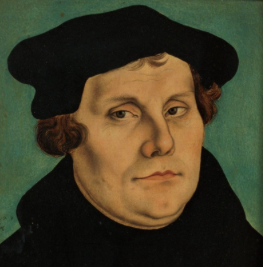
At this 500th anniversary of the Protestant Reformation and Martin Luther’s nailing of the 95 Theses on the Wittenburg cathedral door, we can learn from his understanding of the role of conscience. When he appeared in an ecclesiastical trial before the Diet of Worms, he based his position not solely on conscience, but on conscience as subject to God’s Word. Here is his famous statement:
Unless I am convinced by the testimony of the Scriptures or by clear reason (for I do not trust either in the pope or in councils alone, since it is well known that they have often erred and contradicted themselves), I am bound by the Scriptures I have quoted and my conscience is captive to the Word of God. I cannot and I will not retract anything, since it is neither safe nor right to go against conscience. I cannot do otherwise; here I stand. May God help me.
As the Rev. Dr. John L. Thompson points out in an article published in Theology Matters, “Luther’s declaration wasnot intended … as a defense of his conscience per se, much less a bold claim on behalf of worldly freedom or individualism. On the contrary, Luther was defending the utter priority of the Word of God not only as a guide for what Luther taught and wrote, but also–first and foremost–as the only possible way to know that he, Luther, still confessedly a sinner, was loved and saved by God.” (Thompson’s article on page 9 is an excellent brief overview of a theology of conscience.)
Our current culture exalts the autonomous individual as the sole and final judge of truth and reality. In contrast, Christianity recognizes the fallibility of our consciences and insists that the final moral authority is God alone, as revealed through God’s Word. With the writer to the Hebrews, we must grow in maturity as those “who by constant use [of the teachings of God’s Word] have trained themselves to distinguish good from evil” (Hebrews 5:14).
Thomas Lambrecht is a United Methodist clergyperson and vice president of Good News.
by Steve | Oct 23, 2017 | In the News, Perspective E-Newsletter
 By Thomas Lambrecht-
For United Methodists concerned about the future of our denomination, the current crisis revolves around a critical lack of accountability. For 45 years we have been part of a church where people have a variety of thoughts and opinions about theology and ethics, including whether same-sex marriage or the ordination of LGBT persons is contrary to God’s will. We are willing (even if not always eager) to continue having discussions with people whose viewpoint is different from ours.
But what really spurs distrust and disillusionment with our denomination’s leadership is when those charged with teaching and upholding the beliefs of The United Methodist Church simply ignore that responsibility and do what is “right in their own eyes.” We believe that our doctrines and ethics are arrived at and sustained by a process of holy conferencing, culminating in the decisions of the General Conference, which meets every four years as the only body able to speak for the entire United Methodist Church. To intentionally, knowingly, and publicly disobey or disregard the teachings and requirements thus arrived at, is an affront to who we are as United Methodists.
Such disregard has just happened in the West Ohio Annual Conference, once a bastion of evangelical thought and vital ministry. A committee on investigation has just nullified the most serious charges filed against one of the conference’s clergy, the Rev. David Meredith.
Background
Meredith was under charges because of his being married to another man, a headline-gathering  wedding that took place in his former parish in Cincinnati just three days prior to the 2016 General Conference. He has made no secret of his marriage, in fact publicizing it in hopes of influencing the actions of General Conference. He further used the platform of being a candidate for bishop in 2016 to publicize his disagreement with church teachings.
Accordingly, Meredith was brought up on complaints by a number of clergy in West Ohio. The “just resolution” process was unable to bring a resolution to the complaints. So the evidence was turned over to a counsel for the church, who acts as the church’s prosecuting attorney to bring the complaints to a legal charge that can then form the basis for a trial.
The first step in the trial process is for the counsel for the church to bring the complaints before a committee on investigation, which acts like a grand jury to determine if there is enough evidence to charge the accused person. It is that committee on investigation that has just issued its findings by stripping away most of the charges against Meredith.
Charges
Under church law, Meredith was charged with three offenses:
- “Immorality including but not limited to, not being celibate in singleness or not faithful in a heterosexual marriage”
- “Practices declared by The United Methodist Church to be incompatible with Christian teachings, including but not limited to: being a self-avowed practicing homosexual”
- “Disobedience to the order and discipline of The United Methodist Church”
Meredith never contested the fact that he is in a same-sex marriage. The marriage license is a public record, and Meredith has promoted the fact of his marriage on Facebook and through other avenues. Being in a same-sex marriage is neither being celibate in singleness nor being faithful in a heterosexual marriage, and is thus by definition immorality according to our church law.
Judicial Council decision 1341, which found that Bishop Karen Oliveto had been potentially illegally consecrated as a bishop, found that being in a same-sex marriage constitutes self-avowal of being a practicing homosexual. The decision states, “Being legally married and living in a same-sex relationship is a public declaration containing both personal and objective elements and, therefore, constitutes self-avowal under ¶ 304.3.” Meredith could deny being a self-avowed practicing homosexual by stating such, or by testifying that his marriage does not involve sexual contact. As far as I know, he has done neither.
Yet, the West Ohio Committee on Investigation has thrown out charges one and two. The committee has effectively ignored the Discipline and decided to impose its own standard of morality, essentially declaring that there is nothing wrong with a clergyperson being in a same-sex marriage or being a self-avowed practicing homosexual.
By doing so, the committee has also weakening the third charge. If the church cannot argue that Meredith is guilty of immorality or being a self-avowed practicing homosexual, on what basis can he be accused of disobedience to the order and discipline of the church? It will make for a very weak case.
Implications
Perhaps in the interest of “unity” or to further its own agenda, the committee on investigation has gutted the accountability process in this case. The only way the church has of holding its clergy accountable to the standards they promise to live up to when they are ordained is the complaint process. Complaints can hopefully be resolved in a way that brings about reformation of behavior and the redress of harm done, while protecting the innocent. This committee decision does none of these, in fact encouraging further disobedience by other clergy in West Ohio and across the church.
And when complaints cannot be resolved, the only recourse is a fair and open trial process that allows the evidence to be openly considered and a transparent judgment made, with provision for appropriate consequences. The committee’s decision short-circuits this accountability process by summarily throwing out the very basis for the complaint against Meredith, not due to a lack of evidence, but because the committee evidently disagrees with the church’s standards.
This egregious violation of the church’s law and accountability process can be appealed. Good News hopes that such an appeal would lead to a restored process that demonstrates that the church is able to hold its clergy accountable.
If an appeal fails, this committee’s decision will demonstrate that our church is no longer governable. We will no longer be governed by laws, but by people who reserve the right to undermine or ignore requirements that they disagree with. Such an outcome would demonstrate our ever-deepening schism and could only reinforce the movement toward anarchy and the reliance on raw power in our church-values that hardly comport with being disciples of Jesus Christ, let alone leading to the (positive) transformation of the world.
Thomas Lambrecht is a United Methodist clergyperson and vice president of Good News.