by Steve | Nov 28, 2017 | Magazine, Magazine Articles, Nov-Dec 2017
 By Thomas Lambrecht-
The new group “Uniting Methodists” is in the process of forming to (in their words) give voice to the “broad center” of The United Methodist Church. A recent information session about the group was held at Church of the Resurrection in Leawood, Kansas, led by the Revs. Adam Hamilton, Tom Berlin, and Olu Brown. “We can’t keep doing what we’re doing,” Hamilton is reported to have said. “Who’s going to speak up for that broad, middle in the center?”
It’s a good question. For the last 40 years, the “broad, middle” of global United Methodism was, of course, expressed by the General Conference. The Uniting Methodists position is that there is a “middle ground” that would allow same-sex marriage and ordination in the church, but not require it. This would effectively allow individual pastors to make their own decision about doing weddings and individual annual conferences to decide whether or not to ordain practicing homosexuals. Their hope is to keep much of the church united around this “Third Way” or “local option” approach.
There can be no discussion about the broad center of the church without actively engaging our brothers and sisters in Africa, and other locations outside North America. We are an unmistakably global church connected by a common covenant with 45 percent of United Methodists living outside the U.S. Those members are by and large conservative, and many would not be able to live in a denomination that allows same-sex marriage and ordination. When a caucus groups says it wants to construct a solution for the “80 percent of United Methodists in the middle,” they are excluding the voices of nearly half of the church.
Uniting Methodists portrays itself as a “centrist” group that welcomes people of both progressive and conservative theological perspectives and would allow the practices of both perspectives to coincide without hindrance. There is a group within The UM Church that would respond to such a voice. Given the heavily progressive leanings of the group’s leaders and interested persons, however, that may not be a fully accurate portrayal. The attempt to hold together mutually contradictory theologies may only result in an uneasy truce that invites a return to conflict in the not-too-distant future.
In the final analysis, the church will need to decide: do we perform same-sex weddings or not? Do we ordain practicing homosexuals or not? Will we welcome gay bishops or not? There is not a lot of middle ground in those decisions.
Thomas Lambrecht is a United Methodist clergyperson and the vice president of Good News.
by Steve | Nov 28, 2017 | Magazine, Magazine Articles, Nov-Dec 2017
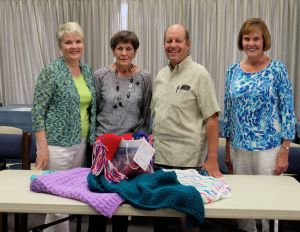
Founders of Knit-A-Prayer from left to right: Karen Wentzel, Sharon Wainwright, Rev. Dr. Richard Thompson, and Joyce Spetz. Photo courtesy of First United Methodist Church in Bakersfield, California.
By Katy Kiser-
Thousands of American service men and women have lost their lives in the on-going battle against terrorism. Since 2009, bodies of fallen soldiers, mostly from the war-torn areas of Afghanistan and Iraq, have been flown into Dover Air Force Base. At Dover, these heroes are given a dignified transfer as they are received by their grieving loved ones. And it is here that those loved ones are comforted by the ministry of the women of the First United Methodist Church in Bakersfield, California. The women call their ministry, Knit-A-Prayer.
The Dignified Transfer program at Dover has become a vital tradition of honor, respect, and a way of acknowledging the sacrifice of the fallen. Early in the Repatriation and Dignified Transfer program, chaplains at Dover asked for prayer shawls and lap blankets. They wanted grieving families to have something tangible to show that they were surrounded by the love of God and the prayers of fellow citizens. They also wanted them to know our country does not take their loved one’s loss of life for granted nor is it unaware of the deep grief the family experiences.
When families receive their fallen soldier at Dover Air Force Base, they are ushered onto the tarmac to witness a solemn ceremony as the casket is brought off a plane. Often the walk from the base to the plane is cold and windy. The shawls the family receives provide comfort both spiritually and physically. Many notes of appreciation have been sent to the Bakersfield women. For example:
“I’m writing to thank you on behalf of my sister. She and her family live in Arkansas. On November 20, her grandson, my great nephew, was killed in Afghanistan. When his dad flew to Dover AFB to receive his body, he was presented with a prayer shawl made by your group. Their hearts were touched by the shawl, the note you included, the words of comfort and the prayers that had gone up in the making of the shawl. I’m amazed at our God and how He works. Words cannot express our appreciation. God is good all the time. Blessings to you.”
Although the number of fatalities has fallen in recent years, the Methodist women in Bakersfield continue to pray and send the love of God to those who grieve.
In May, just before Mother’s Day 2017, Knit-A-Prayer celebrated its 10-year anniversary. It was founded by Sharon Wainwright, Joyce Spetz, and Karen Wetzel. When Sharon closed a needlework store she had operated for 22 years, she knew she must find something productive to do with her creativity and love of knitting. She mentioned this desire to her friends Joyce and Karen. Joyce knew about the prayer shawl ministry and ordered the book, Knitting Into Mystery: A Guide to the Prayer Shawl Ministry, which taught creating shawls as a way of nurturing one’s own and others’ souls through prayer. The three women met several times to pray and seek the Lord’s guidance before going to their pastor, the Rev. Richard Thompson, and receiving his blessing to start a ministry.
The three women were amazed at the interest in their proposed endeavor. Within a short period of time, 25 women signed up and committed to bi-monthly meetings. These women were intergenerational ranging from college-aged to mature women in their nineties. Over the last ten years, these women have sent 2,700 shawls and lap robes to people all over the world.
Sharon and her friends began by contacting another prayer ministry in their church known as Prayers and Squares, whose chapter #317 was started in 2005. This ministry, launched by Isabel Carrera, promotes prayer through the use of quilts. The quilters were happy to see their prayer ministry expand to a group who knitted and crocheted.
The quilting ministry originally began in San Diego at another United Methodist church, that sponsored an informal quilting group. A member’s two-year-old grandson, Kody, ended up in a coma following heart surgery; he had little chance for recovery. As the women worked quickly to make a quilt to cover this critically-ill child, they prayed earnestly for him. Against the odds, Kody came out of the coma. As he recovered, his little hands touched and fingered the knots on his quilt. His doctors wrote into his medical chart that the quilt was not to leave his side! The quilt remained with the child through several surgeries, tests, and treatments. It provided comfort and strength for many years. Other patients began to ask about the ministry and soon it had spread to other churches including Bakersfield First UM Church.
The process of making these quilts is saturated in prayer. When a quilt is requested, it is personalized to the recipient on a label and dated. As the women of the quilting ministry piece their quilts and tie in square knots the thread that holds the layers together, they pray for each recipient. After they finish a quilt, it is displayed so that the congregation may come and say a prayer while tying a knot on the quilt.
The same process is true for knitting and crocheting shawls. From the beginning of the project to its completion, the women bathe their work in prayer. Each shawl begins with a prayer for the recipient and their needs even when those needs are unknown. When they knit at home, they pray over their work. Some use a knitting pattern, a simple knit three, purl three that represents the Trinity.
One knitter shared, “In a sense this ministry is a ‘blind ministry.’ When knitting or crocheting a shawl one doesn’t know where it is going, what will be the effect, who will receive it, but God knows.” Another remarked, “There is joy in selecting the colors of yarn for the next shawl as well as the pattern. One can meditate while knitting. It is peaceful in God’s presence.”
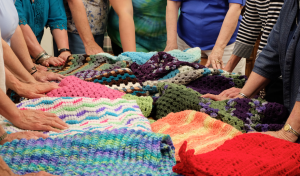
Each shawl and blanket is bathed in prayer. Photo courtesy of First United Methodist Church in Bakersfield, California.
Opportunities to witness and share the love of Christ occur when a knitter has taken her project outside her home and works as she waits for an appointment or meeting. As one knitter explained, “Often an individual will strike up a conversation when they see someone knitting. That opens the door to talk about the prayer shawl ministry and our faith.” When the women gather together at the church, they take time to lay hands on their work and pray out loud in a ritual of prayer. At the completion of each shawl, a card is attached that includes a space for a hand-written prayer.
In their own city of Bakersfield, shawls are sent to several hospice groups and shelters for battered women, abused children, and the homeless. The women provide shawls and support for the Dream Center, a ministry to young adults in foster care who are required to transfer out of the program when they turn eighteen. At the center they are given help finding a permanent place to live, help with writing resumes, and learning how to interview for a job as well as other life skills.
The Knit-A-Prayer ministry steps into action when disasters of all kinds occur. In 2011, a 9.1 magnitude earthquake struck northeast of Tokyo; it was the largest ever to hit Japan. The resulting tsunami compounded the damage. Serving at the time were eight missionaries from the United Methodist General Board of Global Missions. The Bakersfield women sent their prayers and shawls to Japan, which were distributed by the missionaries along with other efforts by the United Methodist Committee On Relief (UMCOR).
GBGM contact, Claudia Genung-Yamamoto wrote, “These shawls have special meaning and we would like to distribute them through partner groups, especially through the Japanese church women with a message of God’s love shared with both Christian and non-Christians in the Tokyo area.”
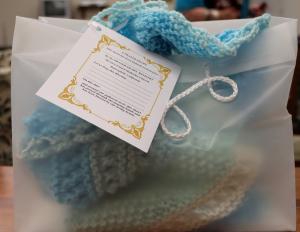
Each package is a blessing to those who receive. Photo courtesy of First United Methodist Church in Bakersfield, California.
Closer to home, last summer these women sent shawls when one of California’s largest fires, the Erskine Fire, killed two people, destroyed 309 homes, and damaged hundreds more. People who lived in the path of the fire were in evacuation centers for weeks. These evacuees were not alone, for the Bakersfield women actively prayed and sent shawls through a long-time member of their church. He just happened to be serving as a local pastor for two of the communities hard hit by the fire.
The women share many stories where they have seen God’s hand on their ministry. One afternoon they received a request for a shawl from a lady in Missouri. She had found Knit-A-Prayer listed on a shawl ministry web site. She requested a shawl for a young adult man, seriously ill in San Diego. The shawl needed to be delivered quickly. Ironically, the daughter of the church’s administrative assistant was returning to San Diego that very afternoon. She took the shawl to the hospital and personally gave it to family members.
Another incident occurred when the women learned of a young girl who had attended VBS at the Bakersfield church. She was seriously ill with cancer. The mother was contacted and said she would appreciate a shawl for her daughter. When it was delivered, the little girl responded by saying, “How did you know that pink was my most favorite color?” She kept the shawl with her constantly through all her treatments until she passed.
Early in the spring of 2017, an adult nephew of a member of the Bakersfield congregation was seriously injured in an automobile accident. He was barely removed from the vehicle before it went up in flames. Doctors were unable to assure the family of his recovery. He was in ICU for a month and had many surgeries. Although he was not a believer in Christ, he kept the prayer lap robe with him constantly. All the prayers that were prayed for his recovery were eventually answered when he walked out of the hospital.
Prayers and Squares and Knit-A-Prayer are not ordinary clubs; they are not an excuse for women to get together for fellowship, although meaningful fellowship occurs; they are not just a creative outlet, although they are that as well. Prayers and Squares and Knit-A-Prayer are two groups of creative, praying Christian women, who like Jesus, are full of compassion; they are women who use their talent to make visible the love of God in the material blessing of a quilt or a shawl. Most of all, they are women who know the power of prayer to love, encourage, honor, heal, and comfort infinitely more than all they ask or imagine.
As Sharon Wainwright attests to the power of God working through the Knit-A-Prayer ministry, “God continues to open doors where we can offer a shawl and prayer. Our original hopes and dreams for this ministry were so small in comparison to where God has directed us. The ‘God winks’ have been many and the blessings numerous beyond measure.”
Katy Kiser is the team leader for the Renew Women’s Network. To learn more about these ministries, contact Isabel Carerra at thimble65@att.net, Sharon Wainwright at sew6439@aol.com or Renew Network at renew@goodnewsmag.org.
by Steve | Nov 28, 2017 | Magazine, Magazine Articles, Nov-Dec 2017
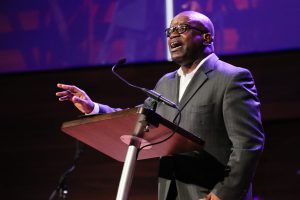
The Rev. Kenneth Levingston of Jones Memorial United Methodist Church in Houston addressed the WCA event. Photo by Steve Beard.
By Sam Hodges-
The Rev. Kenneth Levingston used his pulpit time before the Wesleyan Covenant Association to compare The United Methodist Church to the valley of the dry bones, as described in Ezekiel. Tough talk, but Levingston held out hope.
“If God can move by his spirit, and make dead bones dance, then God can move by the same spirit and call a dead denomination to dance again!” thundered Levingston, pastor of Houston’s Jones Memorial United Methodist Church. “He can make it shake, rattle, and roll again!”
The Wesleyan Covenant Association’s third public gathering, held October 14 at The Woodlands United Methodist Church near Houston, offered lots of stirring preaching and no indication of what the evangelical group’s next move might be in trying to shape the denomination’s future. The Commission on a Way Forward is to issue an interim report to the Council of Bishops in November, suggesting possible structural changes that might allow the denomination to hold together despite deep divisions over how accepting to be of homosexuality.
So, Wesleyan Covenant Association leaders — who issued no statement at this gathering, though they did during their first — admit that in some ways they’re on hold. “We’re like the rest of the church right now,” said the Rev. Jeff Greenway, chair of the association leadership council. “We’re in a place of waiting to see what the commission is going to bring forward.”
The association’s leadership council met at length on October 13, but the association’s president said even that session was void of detailed strategizing. “Depending on what comes out, we will be ready for what unfolds, but we don’t have any specific plans that have been worked on and that are mapped out,” said the Rev. Keith Boyette, the association’s president.
The association formed last year as an organization of United Methodist clergy, laity, and churches committed to what it describes as an orthodox understanding of Wesleyan Christian faith. Unlike some other advocacy groups within the church, it charges membership dues.
The group also holds that marriage should be for “the uniting of one man and one woman in a single, exclusive union,” and has complained that Bishop Karen Oliveto, who is married to another woman, continues to serve despite church law restrictions against gay clergy.
Since its organization after the 2016 General Conference, the association has grown to 2,500 individual, dues-paying members, and about 200 membership churches, representing some 100,000 United Methodists around the world, Boyette said. The meeting at The Woodlands United Methodist attracted a few hundred people, but Boyette said simulcasts to 64 U.S. sites brought total attendance to about 2,300. He added that the association would continue to use technology to reach local churches.
At the October 14 gathering, association leaders introduced a book, A Firm Foundation: Hope and Vision for a New Methodist Future, and an app as resources for small groups. “We want to empower people at the local church level,” Boyette said. “We want (the association) to grow from the bottom up.”
The association also welcomed to its leadership council the first international members, from Africa and the Philippines. One of them, the Rev. Forbes Matonga of Zimbabwe, preached at the gathering.
The Rev. Jerry Kulah of Liberia, another new council member, praised the theological focus of the association and leaders’ embrace of global perspectives. “Africans do not want to be accommodated,” Kulah said in an interview. “Africans want to be part of the solution.”
Among the gathering’s preachers was retired Bishop Robert Hayes Jr., now bishop-in-residence at The Woodlands church. Texas Conference Bishop Scott Jones attended, but did not speak. “My role as bishop is to remain connected to as many different groups as possible, to help improve the quality of conversation about the future of our denomination,” Jones said.
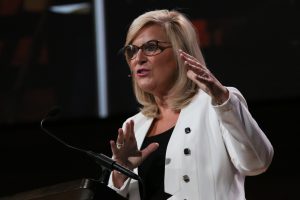
Jennifer Cowart addresses the WCA event in Houston. Photo by Steve Beard.
The day was dominated by preaching, with speaker after speaker calling for a return to an evangelistic focus. “People need to take an unapologetic stand for Christ, for biblical standards, always erring on the side of grace and love,” said Jennifer Cowart, executive pastor of Harvest Church, a United Methodist congregation in Warner Robins, Georgia.
The Rev. Shane Bishop, pastor of Christ (United Methodist) Church in Fairview Heights, Illinois, noted the long decline of membership and attendance in The United Methodist Church in the United States, as well as internal divisions. “I know there’s a lot of denominational uncertainty right now,” he said. “But there’s not one thing happening in The United Methodist Church that can keep you and me from telling people about Jesus Christ.”
Without specific reference to the status of LGBTQ people in the church, speakers emphasized the authority of the Bible over the values of contemporary culture.
The Rev. Rob Renfroe, pastor of discipleship at The Woodlands United Methodist and president of the unofficial evangelical advocacy group Good News, said United Methodists should worry about being “on the right side of eternity” rather than the right side of history.
Greenway described the gathering as “a family reunion for folks who are like-minded and warm-hearted by Jesus in the orthodox Wesleyan tradition.” But the question about how or whether The United Methodist Church can avoid splitting was always in the background, and sometimes came to the fore.
Boyette noted in his remarks the recent formation of two more groups, the “Uniting Methodists” and the “United Methodist Association of Retired Clergy.” Both seek to influence the debate leading up to a special General Conference in 2019. And that’s fine, Boyette asserted. “These are people of good will that have different visions for the church,” he said in an interview. “It helps the church to really have clarity in what we’re facing.”
Sam Hodges, a United Methodist News Service writer, lives in Dallas.
by Steve | Nov 28, 2017 | Magazine, Magazine Articles, Nov-Dec 2017
By Scott McDermott-
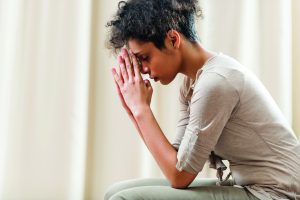
How is your prayer life? Really? I am not referring to how much you pray, or even how long you pray. For all too many of us that seems to be where our minds go when we are asked such a question. So, let me phrase it another way. Do you find your prayer life compelling? Are you drawn to it each day because of the life it brings to you? You see, God never intended our commitment to prayer to be driven by obligation. God intended our commitment to prayer to be driven by something deeper and something richer.
I spent a number of years praying from the place of obligation rather than that richer, more meaningful place. And yes, I was faithful to it. I seldom, if ever, missed my daily prayer time. I even prayed for a couple of hours each day. Now, that’s commitment! If anyone ever asked me if my devotional time was intact, I could answer with a resounding, “Yes!” There was just one thing wrong. My prayer wasn’t compelling and it wasn’t life-giving. But one day that began to change. How? Well that answer is found in the response Jesus gave his disciples when they asked him, “Lord, teach us to pray” (Luke 11:1).
While Jesus’ disciples were undoubtedly looking for a model prayer much like John the Baptist had provided his disciples,
Jesus provided so much more. Sometimes one word can make all the difference in a conversation and that is certainly the case here. From the very first word of his instruction, Jesus interjects an important thought that forever changes how we typically think of prayer. What is that word? “Father.” In other words, prayer is about relationship.
Recognizing that prayer was about relationship opened up a whole new world for me. When prayer is about relationship, then prayer is not just about what I say to God, it is also about what God says to me. Day after day I had gone to God with my list in hand carrying my heavy burdens, asking God to move on my behalf, but not once did I ever pause to listen for a response about my request. That one word made all the difference.
It’s been over 30 years since I made this significant change in my prayer time. Each day I go to my prayer time just as I had done so faithfully years before, but now I begin my time in prayer by focusing on his presence and not problems. As I enter God’s presence each day, I usually begin by saying: “God it’s me. I have just come to be with you.” And I pause. Some days the pause is longer than others, but it doesn’t matter. I am setting my heart on the pursuit of the face of God. Time after time God’s presence never fails to show up in the stillness. It was there that I learned an important lesson about prayer. If prayer is about relationship, then prayer is also about presence. From that place of presence, God began to speak to me gently and powerfully. My prayer life has been transformed. Prayer has become life giving. Prayer is never about how long you pray, it’s about touching God’s presence every day.
So what does that mean for how I pray? Well, over the years I have developed a simple guide to help me practice God’s presence when I pray. I call it, “Fill your Prayer with Praise.” Each letter of Praise stands for something I want to remember when I pray. Praise, Repent, Ask, Intercede, Silence, Expect. Some days I make it through all six categories. Other days I just make it through one. It doesn’t matter. I just allow God’s presence to guide me.
Praise: I usually have a journal in hand during my prayer time (for me it is now all electronic). As I begin my time of prayer, I start by recording three ways I have seen God’s hand at work in my life the day before. I look for the moments I have sensed his presence or experienced his encouragement. I will make note of how God has used me the day before or how I have seen his presence at work in others. I cannot tell you how much I have gained from this. It has proven to be quite an encouragement to have my own written log of God’s faithfulness. If there is one important lesson I have learned from this, it is that God is with me no matter what, and I have proven it. We all have those difficult seasons in our lives, an illness, heartbreak, a sorrow, an unexpected tragedy. But I discovered that even in my darkest days I found his presence at work.
Repent: Here, I ask God to examine my life and to speak to me about the things he wants to change within me. I sometimes pray: “Lord show me where my heart is today?” I pause and listen. Sometimes there are people I need to forgive. Other times God makes me aware of my need for forgiveness. Yes it is convicting, but it is also healing and refreshing. At other times God uses this time simply to speak into the areas of my life he still wants to change. Despite what God does in this time, forgiveness, rebuke, or instruction, I am frequently reminded of God’s holiness and my call to live a holy life before him.
Ask: At this point I spend time praying over my life. God taught me a prayer to pray that he never fails to answer: “God show me how to pray for myself today.” I received so much from that little prayer. When I ask that of my Father, I just pause and wait. I can hardly believe the things that come to my mind in response to that prayer.
Intercede: This is where I pray for others. Here I pray for family, friends, coworkers, and the church God has given me to pastor. I sometimes write down some ongoing concerns so I don’t forget them, but mostly I just ask God to guide me in my prayer. But I pray for others just as I pray for myself. “Lord, show me how to pray for my wife today.” “Lord, show me how to pray for family today.” “Lord show me how to pray over my church today.” Once again, God my Father helps me as I pray.
Silence: As you see, I have already filled much of my prayer time with listening anyway. But at this point, I allow stillness tobe my place of prayer. What happens there? Well that is just it. You never know. There are days when it is just soaking in God’s presence. There aren’t any great visions or revelations. Some days I can’t say I even hear God’s still small voice. But it is okay. I am just here “to be with God.” This moment has become one of my favorite moments in my daily prayer. It is as if everything within me, my successes and my failures, my joys and my sorrows must all pause and bow before the King of Kings. And yes there are times when God clearly speaks to me. When He does, I write down what I am discerning.
Expect: I close my prayer time expecting that God will respond. This becomes my launching out point for my day. How will God answer my prayers? Where will I encounter him?
Scott McDermott is the Lead Pastor at The Crossing in Washington Crossing, Pennsylvania. www.drscottmcdermott.com.
by Steve | Nov 28, 2017 | In the News, Uncategorized

Today is #GivingTuesday. This is a great reminder that we find our most fulfillment in giving to others. Giving is a way to say “Thank you” to the God who gives us all things.
We invite you to remember Good News with a gift today. Click HERE.
For 50 years, Good News Magazine has been the voice from the pews. Independently-supported, Good News has endeavored to be a reliable source for denominational news and opinion from a decidedly evangelical and traditionalist viewpoint. We ask that you continue to help us be a ministry with warm-hearted advocacy and reliable journalism.
We depend upon your support to help lead United Methodists to a faithful future. We are working hard to advocate for scriptural faithfulness in The United Methodist Church. The next four years will be critical for the next era of our denomination.
We very much appreciate your partnership with us in this vital mission. Your investment in the work of Good News will pay dividends for eternity.
Please pray that God would grant us wisdom to navigate in these vital days ahead. Give today as the Lord leads. Thank you for your prayerful consideration and support for Good News!
–Good News