by Steve | Feb 24, 2019 | In the News
By Richard Allen (1760-1830) –
O, my God, in all my dangers, temporal and spiritual, I will hope in thee who art Almighty power, and therefore able to relieve me; who art infinite goodness, and therefore ready and willing to assist me.
O, precious blood of my dear Redeemer! O, gaping wounds of my crucified Saviour! Who can contemplate the sufferings of God incarnate, and not raise his hope, and not put his trust in Him? What, though my body be crumbled into dust, and that dust blown over the face of the earth, yet I undoubtedly know my Redeemer lives, and shall raise me up at the last day; whether I am comforted or left desolate; whether I enjoy peace or am afflicted with temptations; whether I am healthful or sickly, succored or abandoned by the good things of this life, I will always hope in thee, O, my chiefest, infinite good.
Although the fig tree shall not blossom, neither shall fruit be in the vines; although the labor of the olive shall fail, and the fields yield no meat; although the flock shall be cut off from the fold, and there shall be no herd in the stalls, yet I will rejoice in the Lord, I will joy in the God of my salvation.
Richard Allen (1760-1830) was a founder and first bishop of the African Methodist Episcopal Church. From Conversations With God: Two Centuries of Prayers By African Americans (HarperCollins).
by Steve | Feb 24, 2019 | In the News
By Thomas Lambrecht
“I look upon all the world as my parish,” famously said John Wesley. As we gather in St. Louis, The United Methodist Church – one aspect of Wesley’s spiritual legacy – is in ministry in 60 different nations around the globe. Within the last 20 years, a notable shift has occurred from the UM Church being a declining North American-centric denomination (6.9 million members) to one that reflects a growing 40 percent of our membership (5.2 million) found on the continent of Africa. An additional 200,000 members are found in the Philippines, Europe, and Eurasia.
Whatever decision is made in St. Louis regarding United Methodism’s future must be made with these changing realities in mind. The majority of North American bishops have endorsed the One Church Plan. We don’t believe that the OCP will situate United Methodism for a faithful future. Instead, we support the Modified Traditional Plan as the best way to proceed.
First, the MTP is the only plan that maintains the church’s position in line with the clear teaching of Scripture and 2,000 years of church teaching. Since United Methodists claim that Scripture is our primary authority for matters of faith and practice, this is no small consideration.
Second, the Modified Traditional Plan deals with the real cause of division within the church – not different beliefs, but different practices. Proponents of this plan believe that the unity of the church is at stake, and that church unity requires common standards of sexual morality that apply in every time, place, and culture. Yet, at least ten annual conferences and two jurisdictions have voted in one way or another to disobey the Discipline. Bishops have dismissed complaints alleging clear violations of the Discipline. Boards of ordained ministry continue to recommend unqualified candidates.
The only way to restore unity of practice is to have clear accountability processes that do not allow bishops and annual conferences to flaunt the covenant they promised to uphold.
The Modified Traditional Plan puts bishops, annual conferences, and clergy in the position of having to make a clear decision: will I abide by the Discipline and hold those under my supervision accountable to it or not?
Finally, the Modified Traditional Plan (alone among all the plans) provides a gracious exit for those unable to live by our covenant. The MTP gives those who decide they cannot abide by the Discipline the freedom to depart from the UM Church and form a denomination that is more in keeping with their convictions. Annual conferences are free to withdraw. Bishops and clergy may transfer to the new denomination. Congregations can transfer to the new denomination while keeping their property and buildings. Provisions are made for securing the pension program and promises made to our retired clergy.
Why Not the One Church Plan?
Proponents of the One Church Plan claim it can also restore unity by allowing every annual conference, clergy person, and congregation to set their own moral standards when it comes to marriage and human sexuality. While this approach sounds great in theory, this attempt to accommodate all opinions will not work in the real world.
For evangelicals, the primary reason the OCP does not work is that it officially affirms the practice of homosexuality, contrary to Scripture. This action alone will cause many congregations and members to seek to depart from the church, which will in turn greatly weaken the denomination.
The OCP fosters a disconnected solution to the conflict over moral standards. By allowing each entity to make its own determination, the OCP weakens the connection and encourages a centripetal force that could spread to other areas of disagreement in the church. The end result will be a much looser connectionalism that betrays our Wesleyan DNA and heritage.
Far from ending conflict, the OCP will instead spread the conflict that currently happens mainly at the general church level down to the annual conference and local church. Annual conferences will have to decide whether to ordain practicing homosexuals, with all the conflict that decision entails.
Likewise, congregations will be engulfed in conflict. When their pastor performs a same-sex wedding, traditionalist congregants will have no recourse, other than to leave the church. And if a couple requests to be married in the church building, the congregation will have to take a vote in order to allow it. The conflict around that vote will further alienate members of the congregation, causing some to leave.
The One Church Plan ignores the reality that there are two mutually exclusive teachings being promoted in the church. The two teachings cannot coherently live in one denominational body. And the OCP makes no provision for those who by conscience must depart. The One Church Plan fundamentally changes the church’s teaching and identity, while not allowing those who disagree with this new reality to leave in a gracious way.
A healthy and sustainable covenant cannot be obtained by forcing people who disagree with it to stay in it. The Modified Traditional Plan seeks to provide a way to end the conflict with integrity, while restoring the unity that has been torn apart by recent schismatic actions.
Thomas Lambrecht is a United Methodist clergyperson, vice president of Good News, and a member of the Commission on a Way Forward.
by Steve | Feb 20, 2019 | In the News, Perspective E-Newsletter

Dr. Chappell Temple
By Chappell Temple –
I’ve been getting their emails and letters almost every day, so it seems. In preparation for the upcoming General Conference of The United Methodist Church in St. Louis, a group advocating for one of the plans being proposed has been more than “methodical” about getting their message out.
The problem is, however, that “Mainstream UMC” seems to have a more casual relationship with truth than I think is merited. And in terms of respectful dialogue with those who think differently, they’ve exhibited instead a censorious and unkind spirit at best, and a downright slanderous one at worst.
They’ve suggested, for instance, that the advocates of maintaining our current stance on homosexuality have “recreated the climate of 1844” when the Methodist Church split over slavery. But the traditionalists are not proposing a split at all, only a continuation of what the greater church has repeatedly and increasingly believed to be a faithful response to some of these difficult questions.
They’ve claimed that the Commission on the Way Forward (COWF), which created the three plans that will be before the delegates in St. Louis, dåid not introduce the idea of a gracious exit, but that’s simply untrue. It was originally in every one of the three plans that the COWF developed until the bishops took it out when they reviewed those plans.
They’ve said that only a “few rogue bishops” hastily wrote the Traditional Plan. But they neglected to mention that the reason that plan was assembled rather quickly was that the bishops as a group told the Commission not to work on it and then, as the Commission was winding everything up, they changed their minds and reluctantly agreed to include that option after all.
They’ve likewise almost libelously labeled two of our bishops, Scott Jones and Gary Mueller, as “WCA bishops,” referring to the Wesleyan Covenant Association, simply because they accepted the invitation to attend a meeting of that group of United Methodists. Indeed, in contrast to many of his progressive colleagues, Bishop Jones has gone out of his way to remain neutral and not endorse any of the three plans publicly.
They’ve warned that there’s simply not time to carefully craft any exit plans before 2020, despite the fact that numerous folks have been working on them for more than a year and versions have been available for delegates to read since the early fall. And some even falsely accused Maxie Dunnam of promoting the exit plan so that traditional churches can get money from the denomination on their way out, when the truth is that he did so to help progressive congregations who may not wish to stay if the current standards are maintained.
They’ve misrepresented the One Church Plan as not requiring anyone to change their positions if they chose not to do so, when in reality it will change our denomination’s definition of marriage for everyone. And should the plan pass, traditional United Methodists will still be forced to pay into an episcopal fund that underwrites openly partnered gay bishops. What’s more, even many proponents of the One Church Plan have admitted publicly that it’s simply a transitional step towards an eventual mandate for full inclusion by the whole denomination.
Most of all, Mainstream UMC has, in a dazzling display of redirection, argued that traditionalists are simply trying to force the church into schism when in truth it is progressives who have blatantly disobeyed our Discipline that have already done so. For I have heard of no conservatives who have broken their ordination vows, disobeyed church law, ignored our covenant, or blatantly defied the discernment of the whole church in favor of their personal opinions or beliefs regarding this issue.
It’s one thing to argue a position and try to persuade others to adopt it. But in misrepresenting the facts so blatantly, and twisting the position of their opponents so maliciously, so-called “Mainstream” proponents of the One Church Plan have plainly turned from progressives into simply pro-aggressives.
And if that sentiment prevails, I have a feeling that the decline in our worship attendance – already almost one million down from just 18 years ago – will only get worse.
Chappell Temple is the lead pastor of Christ United Methodist Church in Sugar Land, Texas, a southwestern suburb of Houston. He is a General Conference delegate from the Texas Annual Conference. This guest commentary appeared on ChappellTemple.com. It is republished by permission.
by Steve | Feb 15, 2019 | In the News, Perspective E-Newsletter

Dr. Seamands
– By Stephen Seamands
“Sing, O barren one who did not bear; burst into song and shout you who have not been in labor … The children of the desolate woman will be more than the children of her that is married … Enlarge the site of your tent … do not hold back; lengthen your cords and strengthen your stakes.”
Twenty years ago, I found myself drawn to these words in Isaiah 54:1-2 (NRSV) and I wrote an article about these verses for Good News. Strangely, I believed these verses were particularly appropriate for contemporary United Methodism. I still do.
Yes, I know if you look over the landscape of our denomination right now it doesn’t appear that we have much to “burst into song and shout” about. And as far as “enlarging the site of our tent,” we’re a denomination that’s been in decline for more than 45 years. Most of our churches are in a survival mode – just doing their best to hold on to what they’ve got. We are a denomination that for the last 50 years has been unable to reproduce itself or hold on to our youth.
As I’ve reflected on these verses in Isaiah and the ones that immediately follow, I’ve been struck by how apt the prophet Isaiah’s descriptions of the Israelites, after their 70-year exile in Babylon, are of us United Methodists today. He calls Israel a “barren one,” a “desolate woman” (v. 1); one who has suffered “shame” during her youth and “the disgrace of widowhood” (v. 4). She is “like a wife forsaken and grieved in spirit, like the wife of a man’s youth when she is cast off” (v. 6). She has been an “afflicted one, storm-tossed, and not comforted” (v. 11).
Barren, desolate, shamed, disgraced, forsaken, grieved, cast off, afflicted, storm-tossed – that’s Israel and in many ways that’s the people called United Methodists.
Yet it was to Israel in such awful condition, following those 70 years of most shameful, humiliating exile that God said, “Sing, O barren one … burst into song and shout … Enlarge the site of your tent.” And could it be that he is speaking the same words to us United Methodists? I believe the answer is a resounding Yes!
When I made that affirmation 20 years ago, I had just received an email from a United Methodist youth minister who said this: “I guess I need to hear from someone who still believes God is going to use this denomination. It’s hard to be motivated to revive something that many feel is dying or should die.” Those words echoed the way I felt.
At that time, there was a lot of talk of revival and spiritual awakening. My love for my Wesleyan roots was renewed during this time. God gave me a new set of eyes with which to view our church. He showed me things I’d never seen before. And he led me to this passage in Isaiah 54. There were two things in particular that were impressed upon me.
First, I came to realize that all the chaos and craziness in the UM Church, all the turmoil, is not the result of God’s absencefrom us; it is actually the result of his increased presenceand activity in our church. In Scripture, times of greatest redemptive activity are also always times of greatest judgment. For example, when Israel was redeemed from bondage in Egypt, Egypt was devastated by the ten plagues. The Red Sea opened for the Israelites, but closed on Pharoah’s army!
So just as some today are experiencing the increase of God’s presence as a river of redemption and blessing, our church, by and large, is experiencing it as a river of judgment and curse. It’s like being in a canoe. When you are traveling with the current, you experience the current as positive. It helps you along. But when you turn against it, you experience the same current as negative. It slows you down. But it’s the same current either way.
Could it be that given the present condition of our church, we are thus experiencing the present river of renewal as a current of resistance? Thank God that’s not true everywhere in United Methodism – especially for congregations outside the United States. There is much in the UM Church that I believe is under judgment, that needs to die. Before we can experience the renewal as blessing, those things that stand against God must be dealt with.
Understanding this idea has actually caused me to view the current turbulence in the church as a good thing. Even though it’s negative, it’s a sign God is working in our midst. And so I’ve found myself praying, “More, Lord, more! Increase your judgment upon us if necessary. Shake us from top to bottom. Let everything that is not of you be dislodged and blown away.”
However – and this is the second thing I have come to believe – in the midst of all the chaos and craziness, there is a righteous root of Methodism, a remnant which God is calling forth and which is going to participate in the work God is doing right now in bringing about a great worldwide harvest. The shaking and the turbulence is necessary for that righteous root to come forth. It’s like the labor and travail which is necessary in order to give birth.
There is a worship song that says, “Father of creation, reveal your sovereign plan, raise up a chosen generation that will march through the land. All of creation is longing for your unveiling of power. Would you release your anointing? O, Lord, let this be the hour.”
Like Joshua and Caleb in contrast to the others who came out of Egypt, the next generation will possess a “different spirit.” Unlike many of the current generation of United Methodists leaders, who have been caretakers and even undertakers, they will be risk-takers! They will possess the spirit of the early Methodists; the spirit of John Wesley and Francis Asbury and the first generation of circuit-riding Methodist preachers such as Peter Cartwright will be upon them.
I believe God’s word to us United Methodists can be found in Isaiah’s words, “Sing, O barren one who did not bear … Enlarge the site of your tent … do not hold back. Lengthen your cords and strengthen your stakes” (Isaiah 54:1-2, NRSV).
Please don’t take what I am saying as some kind of Methodist triumphalism, as if I believe Methodist glory days are here again. Denominationally, I’m not sure what is going to happen to us.
Think about how God answered this promise to Israel. “The children of the desolate woman will be more than the children of her that is married.” That’s what it says. But did it happen for Israel? Was she ever restored, after the exile, to the glory of her former days? No. In fact this promise really has been fulfilled not through the people or the nation of Israel, but through the church. Paul says in Galatians 3 that “if you belong to Christ, then you are Abraham’s seed, and heirs according to the promise” (v. 29).
But that’s not how the Jews who first heard or read Isaiah’s words would have understood them. They were looking for something for themselves. So what I’m saying is this: God will be true to his promise. You can count on that. He said to Israel through Isaiah and he says to us: “you will spread out to the right and to the left and your descendants will possess the nations” (v. 3, NRSV).
But let’s not assume we know what that means. Ten years from now, the United Methodist Church as we now know it may no longer exist. But God will – and he will be faithful. He will be true to his word even though the fulfillment might look quite different from the one we were expecting. What we’re talking about then is not Methodist triumphalism but Kingdom triumphalism.
Finally, I have been struck by the fact that this passage of the barren woman singing in Isaiah 54 follows the familiar passage of the suffering servant in Isaiah 53, the one who was despised and rejected, a man of sorrows and acquainted with grief. It’s because of what he did that the barren woman can sing. I believe the order is significant.
If the United Methodist barren woman is going to sing, there will need to be some United Methodist suffering servants, those who will bear the burdens of others to make intercession for them. This will be the order. The experience of Isaiah 53 first; then Isaiah 54. There must be those who are willing to lay their lives down – like those early Methodist circuit riders did.
At one point in his Autobiography, Peter Cartwright, one of those early circuit riders, describes that early generation of preachers:
“A Methodist preacher in those days, when he felt that God had called him to preach, instead of hunting up a college or Biblical institute, hunted up a hardy pony or a horse, and some traveling apparatus, and with his library always at hand, namely, Bible, Hymn book, and Discipline, he started, and with a text that never wore out nor grew stale, he cried, ‘Behold the lamb of God, that taketh away the sin of the world.’
“In this way he went through storms of wind, hail, snow, and rain; climbed hills and mountains, traversed valleys, plunged through swamps, swam swollen streams, lay out all night, wet, weary, and hungry, held his horse by the bridle all night, or tied him to a limb, slept with his saddle blanket for a bed, his saddle or saddlebags for his pillow, and his old big coat or blanket, if he had any, for a covering.
“Often he slept in dirty cabins, on earthen floors, before the fire; ate roasting ears for bread, drank buttermilk for coffee, or sage tea for imperial; took, with a hearty zest, deer or bear meat, or wild turkey, for breakfast, dinner, and supper, if he could get it. His text was always read, ‘Behold the lamb of God.’ This was old fashioned Methodist preacher fare and fortune. Under such circumstances who among us would now say, ‘Here am l send me?’“
May the Lord raise up a generation of Methodist leaders like that today. May the spirit of self-sacrifice that moved our Lord Jesus, our suffering servant, and that moved the apostles, and that moved those early Methodists – may it move upon us and our church today.
Stephen Seamands is Emeritus Professor of Christian Doctrine at Asbury Theological Seminary in Wilmore, Kentucky, and the author of numerous books, including Give Them Christ: Preaching His Incarnation, Crucifixion, Resurrection, Ascension and Return(InterVarsity Press, 2012). This article is adapted from “Navigating the River of God” in the July/August 1999 issue of Good News.
by Steve | Feb 15, 2019 | In the News, Perspective E-Newsletter
By Thomas Lambrecht –
 Recent communications from proponents of the One Church Plan have attempted to portray traditionalists and evangelicals as a small group within The United Methodist Church seeking to divide the denomination. In 2016, moderate leaders suggested that maybe 10-20 percent of the church is progressive and 10-20 percent is conservative, but the “broad middle” is 60-80 percent and constitutes the bulk of the denomination. (We are speaking here only of the American part of the church – roughly 60 percent of the global denomination.) In my own thinking, I have often surmised that American Methodism is one-third progressive, one-third moderate, and one-third evangelical.
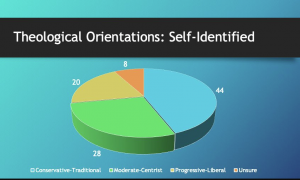
It turns out we are all wrong. A recent survey by United Methodist Communications has found that rank and file laity in the American church self-identify as 44 percent conservative-traditional, 28 percent moderate-centrist, and 20 percent progressive-liberal. (It found 8 percent were unsure.)
One can quibble with the methodology of the survey, how the questions were worded, and the validity of accepting someone’s self-identification. But the fact remains that the largest segment of the church considers itself to be conservative or traditional in their beliefs. And this is at a time when reactions against harsh partisan secular politics are causing some American conservatives to be reluctant to use that term about themselves.
Furthermore, although moderates tended to fall between traditionalists and progressives in their answers, they were often closer to the conservative position. “I don’t think you can add the moderates and progressives and say that’s where the church is,” said Chuck Niedringhaus, who oversees research for UMCom. “Theologically, many (moderates) are more traditional.”
The survey indicates that the center of gravity of American Methodists is on the conservative-traditional end of the spectrum. Delegates to the special General Conference this month will need to take into consideration how rank and file members of our churches think and believe. A way forward that adopts a non-traditional understanding of human sexuality risks alienating a substantial portion of the church.
Niedringhaus suggested that the survey results have implications also for how our general boards and agencies function. “There’s a big theological gap,” he said. “At the very least, boards and agencies should be looking at this data.”
For decades, Good News has challenged our boards and agencies to give greater respect and weight to the thoughts and beliefs of conservatives within the church. Too often, agency leaders are themselves progressive in theology and out of touch with what rank and file members believe. As a result, agencies end up promoting many positions and programs that are at best irrelevant to many members and at worst offensive to them.
According to the survey, conservative-traditional members are more active in the church. Fifty-seven percent of conservatives claim to attend church at least 2-3 times per month, compared with 44 percent for moderates and 39 percent for progressives.
The survey points out how wide the theological gap is between traditionalists and progressives. For conservatives, the top two sources for their personal theology are Scripture (41 percent) and Christian Tradition (30 percent). For progressives, the top two sources are Reason (39 percent) and Personal Experience (33 percent). (Only six percent of progressives view Scripture as their most authoritative source.)
In the secular world, there is a perception that conservatives get their news and information from Fox News, while liberals get theirs from CNN. Having different sources leads to divergent opinions and even worldviews. Similarly, traditionalists and progressives in our denomination derive their personal theology from mutually exclusive sources. This is bound to create highly divergent theological perspectives, and it is probably one reason why the two groups often seem to talk past each other. They are using some of the same words, but with totally different meanings and contextual understandings.
The survey also seems to bear out the contention of evangelicals that the disagreements in our church are over the authority of Scripture. When progressives name Scripture as the least authoritative source for their personal theology, named by only six percent, that is a stance that evangelicals are not able to understand or support.
This theological gap has practical consequences in the life of the church.
What should be the primary focus of The United Methodist Church? Eighty-eight percent of conservatives said “saving souls for Jesus Christ.” Only 32 percent of progressives agreed. Progressives favored “advocating for social justice to transform this world” by 68 percent.
For contemporary evangelicals, this is an old and unfortunate dichotomy. Obviously, we believe in preaching the gospel but we are equally compelled to care for the physical needs of our neighbors and work to right injustice. “For I was hungry and you gave me something to eat, I was thirsty and you gave me something to drink, I was a stranger and you invited me in” (Matthew 25:35).
From an evangelical perspective, both focuses are essential. Our mission statement is “Making disciples of Jesus Christ for the transformation of the world.” Evangelicals, however, tend to emphasize the priority of evangelism and discipleship because it is something only the church can uniquely do. If we do not do this, no one else will.
Furthermore, evangelicals believe that the way to transform the world is through personal transformation. Yes, structures need to be transformed and laws changed. But unless the human heart is transformed, sin and injustice will continue and grow, regardless of one’s commitment to social justice. We all need Jesus, first and foremost.
Given the disconnect in terms of priorities, one can see how the heavy emphasis on advocating for politically liberal agendas for social justice on the part of our general boards and agencies without a corresponding emphasis on evangelism and discipleship can seem irrelevant and at times even offensive to conservatives and traditionalists. They often feel like their tithes and offerings are going toward an agenda that they do not support. This is part of the reason for a reluctance to pay apportionments.
It is important to note that these deep theological differences (we will highlight more of them in a future blog) were not somehow “ginned up” by Good News or other renewal groups. They reflect the deep-seated differences between groups in our church that are playing out now in the conflict over human sexuality and marriage.
Many evangelicals think they can no longer support an agenda at odds with their beliefs. If The United Methodist Church goes forward with a change in the definition of marriage, allowing same-sex weddings and the ordination of practicing homosexuals, most conservatives and traditionalists will feel alienated from their church. If even half of them were to leave, the church would lose one-fifth of its members in the United States. The consequences for the denomination could be devastating.
Thomas Lambrecht is a United Methodist clergyperson and the vice president of Good News. He is a member of the Commission on a Way Forward.