by Steve | May 1, 2019 | Uncategorized
By Kenneth Tanner
I find it amusing, this great befuddlement that befalls some intelligent Christians when it comes to the definition of resurrection. On Holy Saturday the New York Times published an interview with the president of Union Theological Seminary in which she mentioned Christian “obsession” with the physicality of our Lord’s resurrection.
Count me among the obsessed.
There are so many witnesses in the New Testament but John’s testimony that Jesus Christ ate with his disciples, and his words to his disciples in Luke that “a ghost does not have flesh and bones, as you see I have,” takes the guess work out of it. This is someone who remains flesh of our flesh and bone of our bone “beyond” death, the grave, and hell.
Yes, the body of Jesus Christ walks through walls and vanishes and – before resurrection – walks on water. There is great mystery here, no doubt, but we are talking about embodied mystery.
One does not have to be a skeptic or a confused cleric – this is not only about a class of over thinkers – misunderstanding of the resurrection is ubiquitous among a wide variety of believing American Christians, who have a tendency to make a ghost of Jesus, who tend to think of Jesus as disembodied in eternity, a state many American Christians consider superior to embodiment.
Americans in general have a fundamental philosophical misapprehension of human nature that assumes we are mere ghosts in machines, spirits in a material prison. Whereas Christian anthropology trusts – insists – that our created earthiness is essential to our humanity, now and for eternity; that one does not have resurrection without a body, even if that body has a transfigured physics.
As Cyril of Alexandria reminds us, echoing Paul, if Jesus does not rise again in a body of flesh – not only for a moment but forever – then death is not defeated, neither is the sin that bound in the grave and in hell everyone who shares human nature.
Jesus Christ ascends in the flesh, transformed somehow, yes, but still bearing the scars of his torment on the body Mary gave him. This is what makes the Son’s ongoing intercession for humanity so intimate and real.
As a fellow human in eternity Jesus Christ is our mediator and advocate, made like his brothers and sisters in every way so that he might be One who rules and judges those whose existence he understands from the inside, because he lived our human story with us in the most vulnerable, authentic, and beautiful way.
In Jesus Christ, God has a mother and a betrayer. In Jesus Christ, God has scars and God has memories of meals and laughter with his friends, and cold nights huddled in cloaks against the desert air; he recalls storms at sea and a grinding emptiness in his guts, dried tears on his face, at the tomb of his friend. In Jesus Christ, God knows hunger and thirst and loneliness and pain. In Jesus Christ, God knows the human devastation of disease and poverty.
And the first Christians are clear about this: the one human nature we all share has been rescued from death by the death and bodily resurrection of Jesus Christ, not only for a moment but forever. This is not a small matter where different opinions and perspectives are allowed.
You can struggle with its enormity and not comprehend it (who does), and doubting is part of being human – the “ants in the pants” of faith, as Frederick Buechner reminds us – and talking about and debating the mystery of it all is part of having faith in community with other persons, but that resurrection – Christ’s and ours – involves cells and skin and eyes and tongues and hearts and lungs (“he breathed on them”) and empty tombs – because transfigured material bodies have somehow escaped them – is a settled matter for Christians.
Yes, it is spiritual and mysterious and beyond science and nature, yes, he hides the fullness of his resurrected glory from his disciples (who could yet bear it?), and, yes, the physical resurrection of Jesus Christ is an apt metaphor now for existence and nature and our personal struggles – yes, now death is the not the end of anything or anyone, resurrection is – but resurrection as a word has that “power” because death is defeated when this one human is raised bodily and brings all our bodies with him.
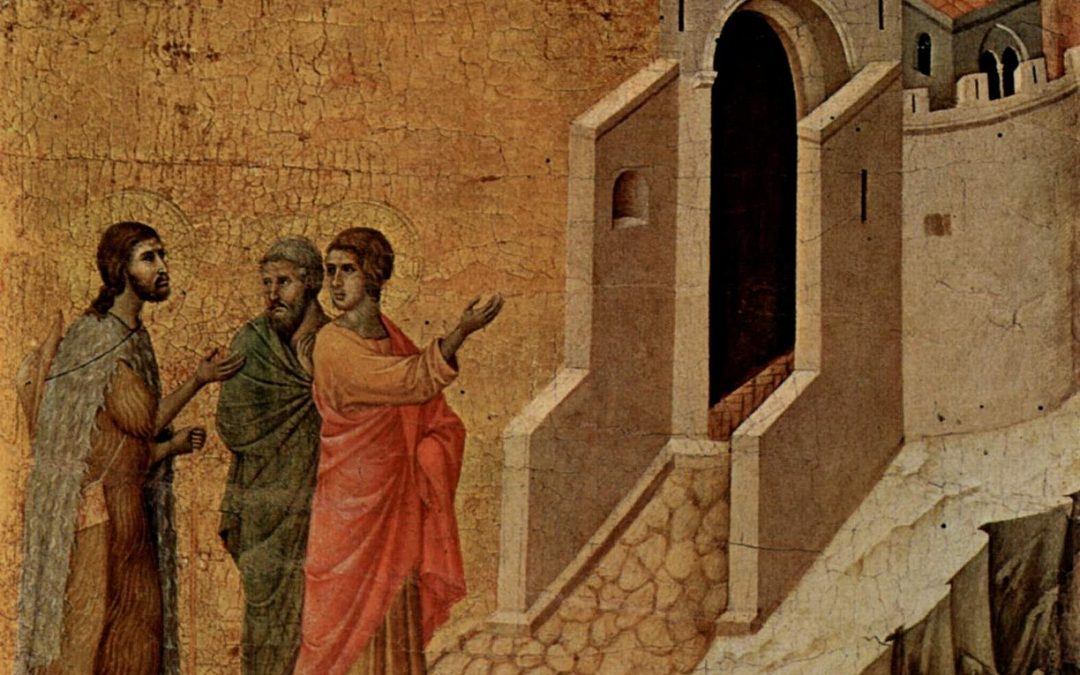
Kenneth Tanner is pastor of Church of the Holy Redeemer in Rochester Hills, Michigan. His writing has appeared in Books & Culture, The Huffington Post, Sojourners, National Review, and Christianity Today. This article appeared in the May/June 2019 issue of Good News. Artwork: Jesus and the two disciples On the Road to Emmaus, by Duccio, 1308–1311, Museo dell’Opera del Duomo, Siena. Public domain.
by Steve | Mar 12, 2019 | Uncategorized
Doing General Conference Math
By Thomas Lambrecht
Supporters of the One Church Plan are considering a number of options in the wake of the decision by the 2019 General Conference to adopt the Traditional Plan. One of those options is to come back in 2020 to the General Conference in Minneapolis and attempt to reverse the result, adopting the One Church Plan in place of the Traditional Plan.
One commonly hears the statement that there were “only” 54 votes separating the two sides in 2019, which means that 28 delegates would need to change their minds and vote for the One Church Plan in order for it to pass. Those 28 delegates would most likely come from the U.S., since it is unlikely that OCP supporters will gain more adherents among the central conferences than what they already received in 2019.
But the task in 2020 for OCP supporters gets more daunting. For starters, there were 31 delegates from Africa who did not obtain a visa to attend the General Conference. If all of them are able to gain visas in 2020 (or there are replacement delegates who can), that will likely add at least 28 votes for the Traditional Plan. OCP supporters would then need to gain 42 new votes in the U.S. (half of 54 plus half of 28).
But the delegate totals will not remain the same in 2020 as they were in 2019. Due to changes in membership, Africa will gain an additional 18 delegates in 2020. That will most likely add at least 16 votes for the Traditional Plan. OCP supporters would then be up to 50 new votes required (half of 54 plus half of 28 plus half of 16).
That is not all. The U.S. delegation will lose 22 delegates. If two-thirds of U.S. delegates generally support the OCP, then the OCP would lose a net total of 8 votes. (7 votes lost would be offset by the 7 votes that the Traditional Plan would also lose in the U.S.) That means OCP supporters would then be up to 54 new votes required (half of 54 plus half of 28 plus half of 16 plus half of 8). This would be offset by potentially 5 new votes from African delegates, bringing the total new votes needed for the OCP from U.S. delegates to 49.
This means that OCP supporters would need to either convince nearly one-third of U.S. Traditional Plan supporters to change their mind, or elect OCP supporting delegates in place of TP supporting delegates. That would be a tremendous swing in votes and highly unlikely to happen.
Another way of doing the math is to look at the various constituencies and estimate what percentage of them would vote for the Traditional Plan. The totals could look something like this:
33 percent of U.S. delegates (482) equals 159.
80 percent of Filipino delegates (52) equals 42.
90 percent of African delegates (278) equals 250.
50 percent of European and Eurasian delegates (40) equals 20.
The Total for the Traditional Plan would then be 471, which would leave 391 delegates supporting the OCP, a difference of 80 votes.
Based on this second method, OCP supporters would need to “flip” 41 delegates in order to gain a bare majority. This represents one-fourth of U.S. Traditional Plan supporters who would have to change their vote. Again, this would be a very significant shift.
There are of course some variables in all these math “problems.” But the bottom line is that a lot of circumstances would have to break one way in order for the OCP to gain the votes needed to reverse the results of the 2019 General Conference.
Of course, the OCP supporters could still try to delay and obstruct the will of the General Conference, as they did in St. Louis. But why? As Africa continues to grow in membership and the U.S. continues to decline, the numbers will only get more daunting for OCP supporters.
And the prospect of another public legislative battle, with all the vitriolic rhetoric that came from the progressive side, would only continue to damage the church. I have read numerous remarks by people on social media saying their relationships with persons on the “other side of the aisle” had been damaged by the process at St. Louis. At least one newspaper described what is happening in The United Methodist Church as a “civil war.” Is that what we want to perpetuate?
Based on the public responses from many on the moderate to progressive side, they cannot continue to serve in a church that does not allow them to perform same-sex weddings and ordain self-avowed practicing homosexuals as clergy. They desired unity in the church, as long as it meant that they could engage in ministry the way they wanted to do so. But faced with a choice between unity and denying their principles, they are choosing to adhere to their principles, even if it means disunity.
So would it not be more productive for persons across the theological spectrum to agree on a way to separate from each other, freeing everyone to engage in ministry the way they believe God is leading them? An equitable way could be found to divide assets and provide for the continuation of vital ministries such as UMCOR, Wespath, GBGM, Communications, and Archives and History.
Freed from the need to continue fighting one another, the resulting new denominations could devote their whole energies to evangelism, church planting, discipleship, missions, and social action – all according to each group’s theological perspective. In areas where there is agreement, the new groups could continue to cooperate on joint projects and mission endeavors.
In the end, The United Methodist Church does not face a math problem, but a spiritual problem. Is it now possible to choose a different path, one that leads to a constructive future, rather than a destructive one for the church? Can we not work toward a different form of unity that allows for both the separation needed and the possibility of cooperation where warranted? The former United Methodist Church is already dead. We are in the birth process of something new. Can we work together to create that new reality in as painless and Christ-like a way as possible?
Thomas Lambrecht is a United Methodist clergyperson and the vice president of Good News. He is a member of the Commission on a Way Forward.
by Steve | Feb 26, 2019 | In the News

Bishop Cynthia Fierro Harvey observes the results from a Feb. 26 vote for the Traditional Plan, which affirms the church’s current bans on ordaining LGBTQ clergy and officiating at or hosting same-sex marriage. The vote came on the last day of the 2019 General Conference in St. Louis. Photo by Paul Jeffrey, UMNS.
By Thomas Lambrecht –
Here is a brief summary of the accomplishments of the special called 2019 General Conference of The United Methodist Church held in St. Louis.
Given the opportunity to support the full court press of the majority of North American bishops in their advocacy of the One Church Plan, a decisive majority of delegates instead chose the Traditional Plan.
- By a vote of 438 to 384 (53.3 percent), adopted the Traditional Plan, parts of which will not be able to go into effect because they are unconstitutional. Parts that willgo into effect are:
- Expanded definition of “self-avowed homosexuals” to include persons living in a same-sex marriage or union or who publicly proclaim themselves to be practicing homosexuals
- Explicitly prohibits bishops from consecrating bishops, ordaining or commissioning clergy who are self-avowed practicing homosexuals
- Requires all persons nominated to serve on the annual conference board of ordained ministry to certify that they will uphold and enforce the Book of Discipline’sstandards for ordained clergy
- Establishes a minimum penalty for clergy convicted of performing a same-sex wedding of a one year suspension (first offense) and loss of credentials (second offense)
- Explicitly prohibits district committee and conference board of ministry from recommending a candidate for ministry who does not meet the standards, and orders the bishop to declare any such unqualified candidate out of order
- Prohibits a bishop from arbitrarily dismissing a complaint against a clergy person
- Requires the involvement of the complainant in all stages of the resolution process and that every effort must be made to have the complainant agree to any just resolution
- Allows the church to appeal the verdict of a trial court in cases of egregious errors of church law or administration
- Petitions defining how clergy pensions are to be handled when a clergy person or congregation leaves the denomination
- An exit path for congregations seeking to leave the denomination with their property, in exchange for one (extra) year’s apportionments and payment of pension liabilities. This legislation will not go into effect because it is believed to be unconstitutional.
- All constitutional defects in the various pieces of legislation could have been fixed with simple amendments. But stalling tactics by proponents of the One Church Plan prevented these important amendments to be enacted. It would be possible to pass them at the 2020 General Conference next year.
- Defeated the One Church Plan by a vote of 374 to 449 (54.6 percent opposed)
- The most vitriolic atmosphere ever at an annual conference, with even leading centrists engaging in hateful rhetoric, lies, and character assassination, casting doubt on their claim to want to live together in one church body.
Thomas Lambrecht is a United Methodist clergy person, the vice president of Good News, and a member of the Commission On A Way Forward.
by Steve | Feb 25, 2019 | In the News, Uncategorized
By Thomas Lambrecht
Whatever the outcome in St. Louis, some congregations and clergy will be unable to live conscientiously within the boundaries established by General Conference. From the beginning, the Commission on a Way Forward (COWF) acknowledged that an exit path for congregations to leave the denomination with their property should be part of any plan submitted to General Conference. All the sketches of the three plans submitted to the Council of Bishops included an exit path. The Council of Bishops acted to take out any exit path from the One Church Plan and the Connectional Conference Plan.
Some claim there is already a way for local congregations to exit the denomination with their property. This is not the case. Under ¶ 2548.2, the annual conference may transfer the deed of a local church to “one of the other denominations represented in the Pan-Methodist Commission or to another evangelical denomination under an allocation, exchange of property, or comity agreement.” This requires the consent of the bishop, cabinet, district board of church building and location, and annual conference, in addition to the request of the local church.
Under ¶ 2549, the annual conference can close a church that “no longer serves the purpose for which it was organized or incorporated” (as a United Methodist congregation). The conference can then sell, lease, or otherwise dispose of the property, including selling it to the exiting congregation. This also requires the consent of the bishop, cabinet, district board of church building and location, and annual conference, in addition to the request of the local church.
Under either scenario, any of the approving persons or bodies can arbitrarily stop the congregation from keeping its property. Annual conference officials can impose whatever payment requirements they want upon the local church, or refuse to allow the local church to keep its property at all.
The current provisions of the Discipline put the local church at the mercy of the bishop and annual conference. There is no certain or consistent process whereby a local church can exit the denomination with its property.
We need a more fair and streamlined exit path for congregations.
It is not a good witness for the church to be involved in hundreds of lawsuits over church property. The Episcopal Church spent over $45 million at the national level (not counting what local churches spent) in order to preserve church property for the denomination.
The General Conference has prioritized two exit proposals: Petition 90059 Disaffiliation – Boyette; and Petition 90066 Disaffiliation – Taylor.
The church would be best served by adopting either the Boyette exit path. However, certain amendments would eliminate most objectionable requirements from the Taylor option.
This is the kind of generous spirit the Renewal and Reform Coalition believes ought to govern our decisions regarding congregations that choose to exit from the denomination. They are our brothers and sisters. There ought not to be quarreling or lawsuits over property. We ought not try to coerce a congregation into a covenant they can no longer support.
Here’s hoping the General Conference delegates will embrace a fair, consistent, and gracious path for congregations to exit with their property. The future peace of the denomination may depend upon it.
Thomas Lambrecht is vice president of Good News and member of the Commission on A Way Forward.
by Steve | Feb 25, 2019 | In the News, Uncategorized
– By E.M. Bounds –
I believe that what the church needs today is not more or better machinery, not new organizations or more novel methods. She needs Christians whom the Holy Spirit can use—Christians of prayer, Christians mighty in prayer. The Holy Spirit does not flow through methods, but through people. He does not come on machinery, but on people. He does not anoint plans, but people—people of prayer!
…Spiritual work is always taxing work, and Christians are loath to do it. True praying involves serious attention and time, which flesh and blood do not relish. Few people have such strong fiber that they will make a costly outlay when inferior work will pass just as well in the market. To be little with God is to be little for God. It takes much time for the fullness of God to flow in the spirit. Short devotions cut the pipe of God’s full flow. We live shabbily because we pray meagerly. This is not a day of prayer. Few Christians pray. In these days of hurry and bustle, of electricity and steam, men will not take time to pray. Prayer is out-of-date, almost a lost art.
Where are the Christ-like leaders who can teach modern saints how to pray and put them at it? Do we know that we are raising up a prayerless set of saints? Only praying leaders have praying followers. We greatly need somebody who can set the saints to this business of praying!
–E.M. Bounds (1835-1913) was a Methodist preacher and editor of the St. Louis Christian Advocate. He is most well-known for his books on prayer such as Power Through Prayer, Prayer and Praying Men, and Purpose In Prayer.