
by Steve | Aug 11, 2023 | In the News, Perspective / News
Defining the Church
— By Thomas Lambrecht —
As folks consider disaffiliation from The United Methodist Church and engage in foundational work to start the Global Methodist Church, it causes one to consider the question, “What is the church?” Is the church merely a local body of believers? Is the church a denomination? What does it take to be a “viable” church? Does disaffiliation mean a congregation is leaving “the church?”
A recent article by Dr. Kenneth J. Collins, Professor of Historical Theology and Wesley Studies at Asbury Theological Seminary, helps flesh out our understanding of the church from a Wesleyan perspective.
Collins points out that John Wesley, Methodism’s founder, “actually employed two basic frameworks, not one,” when attempting to define the church. Those two frameworks help us look at the concept of church from two different angles.
The Institutional Angle
The first framework comes from the Anglican Thirty-Nine Articles, condensed and adapted by Wesley into our current Articles of Religion. Article XIII says, “The visible Church of Christ is a congregation of faithful men in which the pure Word of God is preached, and the Sacraments duly administered according to Christ’s ordinance, in all those things that of necessity are requisite to the same.”
As the article states, this definition focuses on the visible church. It entails things that can be seen and verified. The key marks here are:
- A group of believers in Christ
- The preaching of the pure Word of God – preaching that is based on the Bible, without watering it down or changing it
- The administration of the Sacraments (baptism and Holy Communion) according to the directions given in Scripture
These three marks can apply at any level of the church. A congregation can be “the church.” An annual conference or district can be “the church.” A denomination can be “the church.” All that is necessary is for these three marks to be present.
What is a “congregation of faithful men?” Simply put, it is the presence of believers in Christ in a congregation (male and female). Collins notes, “Later on historians reckoned that this definition of the church, which informed the life of both Anglicanism and Methodism, allowed for the mixed assemblies of sinners and saints, of nominal and real Christians, that Augustine recognized in his own ecclesiology and played out in large national churches such as the Church of England.” In other words, the presence of some unbelievers or nominal Christians in a body does not nullify it being a church. As long as some true believers are present, the body can be considered a church.
Biblical preaching is an essential mark of the church. The preaching of human ideas, however lofty, or teachings that are divorced from Scripture contravene this mark. The consistent lack of biblical preaching in a local body or in a denomination could cause one to suspect it is no longer a Christian church, even if true Christians are present in the congregation.
The proper administration of the Sacraments is also essential. A controversy in 2018 over the worship practices of Glide Memorial Church in San Francisco is one illustration. In an open letter, Bishop Minerva Carcaño states about Glide, “Sunday Celebrations are uplifting concerts, but lack the fundamentals of Christian worship. Baptisms are conducted periodically but in the name of the people rather than from a Christian understanding of Baptism. Holy Communion was done away with some time ago and only introduced back into the life of the congregation this past Spring, but outside of the Celebration gatherings and with much resistance.” The absence of the Sacraments, or the administration of the Sacraments in a faulty manner could cause one to suspect that a body is no longer a Christian church.
The Spiritual Angle
Wesley’s second framework for defining the church is based on the four marks of the church lifted up in the Nicene Creed, articulated by the Second Ecumenical Council in AD 381. It states, “We believe in the one holy catholic and apostolic church.”
These marks are much more subjective and less overtly visible. In fact, Wesley maintains that the invisible universal church consists of all believers in Christ, no matter their denomination or nationality. Baptists, Methodists, Presbyterians, Lutherans, Roman Catholics, Eastern Orthodox, non-denominational, Pentecostals are all part of the universal church.
The “oneness” or unity of the church does not depend upon any kind of institutional unity. If it did, then the church stopped being a true Christian church in 1054 when the Eastern Orthodox and Roman Catholics separated from each other. Christians residing in different denominations are still part of the one universal church. That means United Methodists in the post-separation era are still part of the universal church of Christ. And the Global Methodist Church (and other independent congregations who have disaffiliated) have not left the church but remain part of the universal church of Christ.
Disaffiliating from or leaving a particular denomination does not mean that one has left the church of Jesus Christ. Our unity is spiritual, rather than institutional. One can experience that unity in ecumenical gatherings where the name of Christ is lifted in worship and preaching. There, all serve the same Lord, regardless of what part of the Body of Christ in which they find their home.
Holiness is another essential mark of the invisible, universal church. Wesley helpfully describes it this way:
The Church is called holy, because it is holy, because every member thereof is holy, though in different degrees. … If the Church, as to the very essence of it, is a body of believers, no man that is not a Christian believer can be a member of it. If this whole body be animated by one spirit, and endued with one faith, and one hope of their calling; then he who has not that spirit, and faith, and hope, is no member of this body. It follows, that not only no common swearer, no Sabbath-breaker, no drunkard, no whoremonger, no thief, no liar, none that lives in any outward sin, but none that is under the power of anger or pride, no lover of the world, in a word, none that is dead to God, can be a member of his Church (Works, 3:55)
But who can judge the holiness of individual members? Who knows our hearts but God? We are all sinners and fall short in some aspects of living a Christ-like life. What “degree” of holiness is necessary in order to be part of the church?
The mistake we make here is trying to make the invisible spiritual universal church line up with the institutional church. The institutional church will never be “pure” in the sense that all its members are holy. To attempt to “weed out” any “unholy” or insufficiently holy members only does damage to the church. Jesus taught about this in the parable of the wheat and the weeds (Matthew 13:24-30, 36-43). When the servants wanted to pull up the weeds that were mingled with the wheat, the owner replied, “No, because while you are pulling the weeds, you may root up the wheat with them. Let both grow together until the harvest” (vs. 29-30). It is only at “the end of the age” (vs. 39) when the weeds and wheat will be separated. God, who knows our hearts, is the only one who can separate the wheat from the weeds.
Accountable discipleship is the pathway to holiness, as the Spirit of God works within each one, transforming us into the likeness of Christ. We all ought to be accountable to live up to the ideals set before us in Scripture. Bishops and pastors ought to be accountable for their preaching, teaching, and leadership, as well. But grace and forgiveness are a big part of the discipleship journey. None of us is perfect, nor do we perfectly reflect the image of our Savior in all we do and say. The test of our holiness is our willingness to confess our sins, receive God’s forgiveness, and strive to do better. It is only when we turn our back on God, refusing to acknowledge our sins or receive his forgiveness, that we take the path away from holiness.
Integrating the Two Angles
The key point is that the institutional, visible church is not identical with the invisible, spiritual, universal church. There are members of the institutional church who are not true believers in Christ and are therefore not members of the invisible, universal church. At the same time, the invisible, universal church includes believers from all denominations, nationalities, races, and ethnicities. After all, Jesus was “slaughtered, and [his] blood has ransomed people for God from every tribe and language and people and nation” (Revelation 5:9). All these ransomed people belong to the universal church, no matter which part of the institutional church they are members in.
In a garden, there are certain plants, like tomatoes and peas, that need support in order to grow and bear fruit. So, gardeners set up structures like tomato cages or pea towers for these plants to grow upon in order to maximize their fruitfulness. Without these structures, the plants will not be nearly as fruitful.
In the same way, the institutional church is a visible support structure for the invisible, universal church. Different structures can help different parts of the church grow in that part of the garden in which they are planted. If a particular structure or denomination is not serving the purpose of fruitfulness for which it was intended, it can be modified or even abandoned. Only, whatever structures are used, they must contain the seven essential marks outlined above.
This is why some congregations are disaffiliating from the UM Church. They believe the UM Church is abandoning the pure Word of God by affirming behaviors that Scripture warns against. And they believe the UM Church is described by Collins as having “apparently abandoned the universal call to repentance, and therefore to forgiveness and holiness as well” with regard specifically to same-sex relationships and the church’s understanding of marriage.
When some believe the institutional support structures are not fulfilling their purpose of bringing about spiritual fruitfulness in line with the seven marks of the church, they feel justified in exchanging that support structure for a different one that holds more promise of fruitfulness. In doing so, they may be leaving one institutional church for another, but they are not leaving the invisible, universal church. In fact, they are attempting to be even more faithful to that universal church by disaffiliating. Let us pray that the new structures being built will be faithful to the seven marks of the church and yield even greater fruitfulness for the kingdom of God in the years ahead.
Thomas Lambrecht is a United Methodist clergyperson and vice president of Good News.
by Steve | Aug 4, 2023 | Front Page News, In the News
Centrists Describe Future UMC —
By Thomas Lambrecht —
The last two Perspectives (here and here) extrapolated what the future United Methodist Church might look like on the basis of a foundational article from Mainstream UMC (a centrist advocacy group within The United Methodist Church). A new Mainstream article this week goes further in describing how many centrists see the future of the UM Church.
The article is entitled, “Next Steps (1 of 3): Honesty.” True to its title, the article is honest about where centrists see the church today and where they believe it will go in the near future. This honesty is commendable and helps United Methodists across the spectrum understand what is at stake, as they make decisions about their alignment with the church. It should be remembered that centrists purport to represent the “broad center” of the church and hold most of the power positions in the bureaucracy and the Council of Bishops. Therefore, centrists are a key power bloc in determining the decisions made by the church. Below are some quotes from the article that tell us what we need to know about its vision for the future of the UM Church.
Current U.S. Church Identity
• “Many US and Western European churches and annual conferences are already meeting the ministry needs of their mission field by openly, unapologetically ordaining and marrying LGBTQ persons. … We do not buy into black-and-white dualistic understandings of human sexuality.”
This statement points to the reality that many U.S. annual conferences have moved beyond living by the Book of Discipline. They are disregarding its teachings on marriage and human sexuality. They are ordaining persons regardless of their sexual orientation, gender identity, or partnered status. Clergy who perform same-sex weddings are, for the most part, not experiencing any adverse consequences. Most U.S. and Western European annual conferences have adopted a theology that affirms LGBT relationships and practices.
“There is NO scenario where the US church changes this identity.” Regardless of what the Discipline says, much of the U.S. church has moved on in ignoring it. There will be no going back from this current situation in the U.S. church.
Centrists and the Bible
• “We believe in the primacy of Scriptures and prayerfully explore them through the lenses of Tradition, Reason, and Experience. We believe the Biblical views on slavery, women, polygamy, divorce, and homosexuality are descriptive Biblical truths, that describe what was true for others in another time and place. We believe in the prescriptive Biblical truths of justice, inclusion, and grace.”
Although stating a commitment to the primacy of Scripture, when it comes to issues of marriage and sexuality, many centrists in fact give primacy to experience and reason. There is no real doubt about the clear teaching of Scripture. But many have found a way to say Scriptural teachings don’t apply in this case. They would say, “Because our experience of sexuality and knowledge of sexuality is greater than and different from the biblical authors, we know better what God really wants us to do (namely, affirm same-sex relationships).”
Many centrists use a “canon within the canon” to determine what the Bible teaches. They focus on “justice, inclusion, and grace” (as they define them) to decide whether a particular biblical teaching is in or out. If a particular teaching is not just, inclusive, or gracious (again, as they define them), then that teaching is not applicable in today’s world. (In contrast, traditionalists believe we should strive to understand the “whole counsel of God” (Acts 20:27) with all its nuances, seeing the Bible as a whole and understanding how its various teachings and time periods fit together.)
The effect of this focus on justice and inclusion is a particular social-justice agenda for the church that may or may not reflect the actual teachings of Scripture. More significantly, it takes the church’s focus off of evangelism and discipleship and shifts it to the political sphere. Many centrists believe the church is accomplishing its mission when it advocates for particular political positions. While such advocacy may be needed at times, the overwhelmingly biblical emphasis is on evangelism, discipleship, and lovingly caring for others in practical ways. This has been the hallmark of evangelical and traditionalist Methodist churches for generations.
General Conference 2024
• “We, very likely, have the votes to remove the anti-gay language at General Conference 2024.”
This is a true statement. In the aftermath of the 2019 General Conference in St. Louis, delegate elections in the U.S. annual conference resulted in a more progressive delegation. By our calculations, the delegate count would have been very close in 2020, although still slightly favoring traditionalists. Since that time, however, almost 6,200 U.S. churches have disaffiliated, including a number of traditionalist delegates to General Conference. This year, many U.S. annual conferences elected replacement delegates for those who resigned or died since 2019, meaning the delegation will skew even more toward the progressive end. In addition, some annual conferences in Europe that would normally send traditionalist delegates have withdrawn from the UM Church.
• “If we do have a ‘compatibilist’ majority, there is NO scenario where, after suffering significant membership losses in the US, we do not vote to change the language at this upcoming General Conference.”
Many centrists view changing the church’s position on the marriage and ordination of gays and lesbians as an issue of the church’s survival. The allusion to “significant membership losses” indicates they believe that our current biblical stance on these issues is causing the membership losses. This makes centrists very motivated to change the church’s definition of marriage and allow ordination for partnered gays and lesbians. They think it is the only way the church will survive in the U.S.
This whole line of thinking is questionable. Not one of the other Mainline denominations saw their membership grow as a result of changing their position on marriage and sexuality. In fact, their membership losses (Episcopal, Presbyterian, Lutheran, northern Baptist, and United Church of Christ) only increased.
Regardless of whether centrist theories of church growth are correct, their statements indicate it is a near certainty that the definition of marriage and ordination standards will be changed at the 2024 General Conference in a progressive direction.
• “We do not yet have 2/3 for regionalization.”
This statement recognizes that the African delegates hold the key to whether regionalization takes place. African delegates make up about one-third of the delegates, so they could potentially block regionalization at the General Conference if they are not convinced it is the right thing to do. Even more importantly, African annual conferences make up over half of the annual conference members that need to vote by two-thirds to approve the regionalization constitutional amendments. Even if only two-thirds of African annual conference members vote against regionalization, they can defeat it.
The regionalization proposal is being marketed as coming from the central conferences outside the U.S. because some of the leaders behind the proposal are from the central conferences. However, the grass roots membership of the central conferences is not yet convinced to support regionalization. Therefore, its adoption at the 2024 General Conference (and subsequent ratification by the annual conferences) is questionable.
• “There is NO scenario where Africa would ordain LGBTQ pastors, even if the General Conference told them to. There is NO scenario where the United States will go back to trials and exclusion, even if the General Conference told them to.”
This statement points out the basic irrelevance of the General Conference. No matter what the General Conference decides, people will do what they think is right, even if it contradicts the General Conference.
Some U.S. bishops have been pushing to marginalize the power of the General Conference and weaken its authority. They believe the General Conference is inefficient and causes division in the church. They would rather the Council of Bishops and the general boards and agencies would run the church. Of course, this would disempower the voices of the grass roots of the church who elect the delegates and empower a favored elite to govern the church. It would also turn United Methodist governance on its head, as the General Conference has been given supreme authority over the church by the Book of Discipline. But again, no matter what the Discipline says, certain leaders think they know better how the church should be run than the voice of the people.
This quote also shows how committed to the LGBTQ agenda centrists are. As we saw in the aftermath of the 2019 General Conference, no matter what the General Conference decides, centrists and progressives will persist in their defiant actions. The possibility of any kind of Traditional Plan or maintaining accountability to a traditional, biblical view of marriage and sexuality is out of the question for the U.S. part of the UM Church.
Centrists and Africa
• “We are committed to remaining in relationship with Africa and the Philippines but recognize that they are much more traditional than even the US traditionalists. They may not be willing to stay in relationship with a church that is openly, unapologetically ordaining LGBTQ pastors … We need to be prepared to live with that … The US is ‘compatibilist’ and willing to live with regions that are much more conservative. The most traditional regions, Africa and the Philippines, then get to decide if they are willing to live with the US church. We cannot, however, live together under false pretenses.”
Although centrists say they are willing to live with regions that are much more conservative, there will continue to be efforts to persuade United Methodists outside the U.S. to support the LGBTQ agenda. Just as the U.S. government often lobbies African governments to change their laws about marriage and homosexuality, UM progressives and centrists will continue to lobby the central conferences to accept and eventually affirm LGBTQ persons and relationships.
Centrists represented by Mainstream UMC are prepared to acknowledge that more traditional parts of the church outside the U.S. may decide to separate. That is a significant acknowledgement. Let us hope that, rather than throw up roadblocks to traditionalists outside the U.S., centrists are prepared to allow them to make informed, prayerful discernment and will honor their decisions.
Currently, the Council of Bishops is saying that Par. 2553 does not apply outside the U.S., even though the language adopted by the 2019 General Conference plainly says, “This new paragraph became effective at the close of the 2019 General Conference.” The only other way for churches outside the U.S. to disaffiliate is through becoming an autonomous Methodist Church, a laborious process that requires General Conference and central conference approval.
Some bishops and other leaders have been advocating for churches to postpone their decision about disaffiliation until after the 2024 General Conference. They are saying that one never knows what the General Conference will decide until the votes are taken. While these leaders are technically correct, the Mainstream articles have given us a clearer understanding of what will happen at the General Conference and what the future UM Church will look like. We can predict the outcome with near certainty.
There will be proposals at the 2024 General Conference to allow local churches and annual conferences outside the U.S., as well as local churches in areas where U.S. annual conferences have imposed significant additional costs, to disaffiliate from the UM Church. Centrists can help facilitate their vision of the future UM Church by adopting these new exit paths. Let us put an end to the fighting and allow mature Christian adults to make their own prayerful discernment about their participation in the future UM Church. Mainstream UMC has given us a much clearer picture of what that future church will look like.
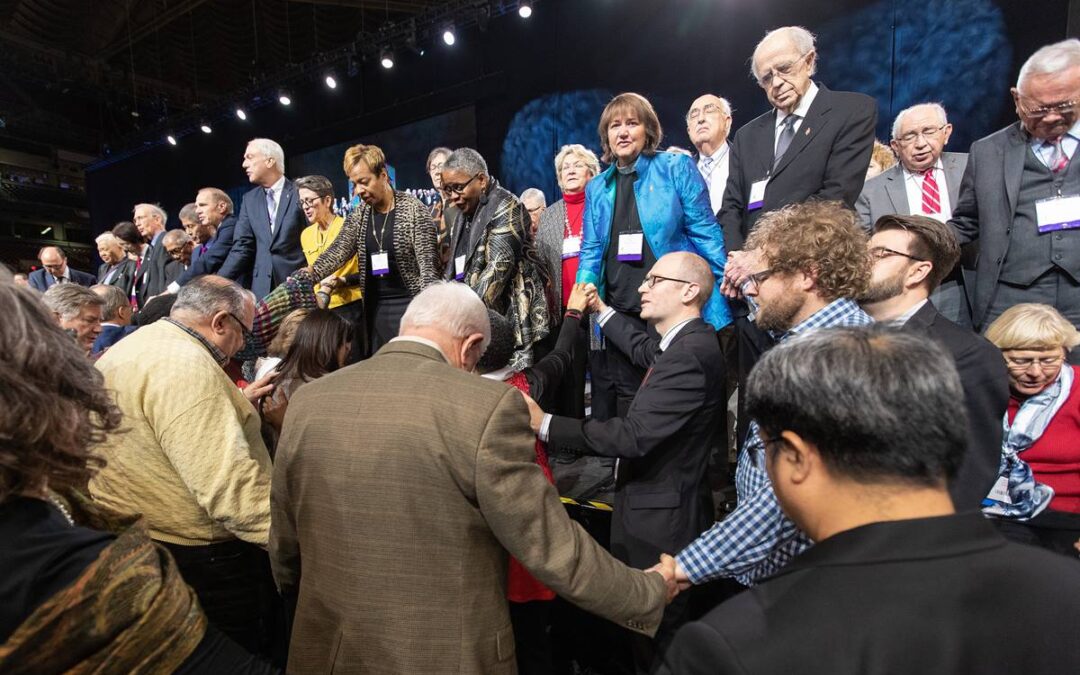
Thomas Lambrecht is United Methodist clergyperson and vice president of Good News. Image: Delegates and bishops join in prayer at the front of the stage before a key vote on church policies about homosexuality during the 2019 United Methodist General Conference in St. Louis. Photo by Mike DuBose, UMNS.
by Steve | Jul 28, 2023 | In the News, Perspective / News
What the Regionalization Agenda Tells Us about the Future of the UMC, Part 2 —
By Thomas Lambrecht —
In last week’s Perspective, I surveyed a recent article by Mainstream UMC (a centrist advocacy group within The United Methodist Church) outlining the case for the regionalization of the church. This important article advocates for a plan that would set the UM Church in the U.S. as its own regional conference, with wide latitude to “adapt” the Book of Discipline according to the views of U.S. delegates and different from how other regions of the church might position themselves.
Continuing our survey in today’s Perspective, the article gives some hints as to the bigger picture implications of moving forward with the regionalization plan and the conception of the UM Church envisioned by many centrists.
Addressing a Global “Divide”
The Mainstream article portrays the 2019 “Traditional Plan” as being “imposed” upon the church, primarily by delegates from outside the U.S. and especially in Africa. It states, “60 percent of the votes to impose the Traditional Plan on the U.S. church were cast by international delegates. In fact, 80 percent of all non-U.S. delegates and 90 percent of all African delegates voted against two-thirds of the U.S. church on a policy that only affects the practice of ministry in the United States.”
The article presumably makes this claim because it was primarily the U.S. delegates who were agitating to change the denomination’s position and institute the “One Church Plan” that would have allowed same-sex weddings and ordaining partnered gays and lesbians. However, even this portrayal is inaccurate because Germany, Denmark, Norway, and some other Europeans, as well as some in the Philippines favored a change in the church’s policies.
More importantly, this characterization misrepresents the church’s decision-making process. While the “Traditional Plan” is congruent with most African culture, not all African countries outlaw homosexuality. Notably, South Africa has adopted a permissive attitude toward LGBT relationships. Some other countries do not have laws criminalizing same-sex relationships. So the “Traditional Plan” applies just as much to the African church as to the U.S. church.
Furthermore, if the UM Church is truly to be a global church, it must respect the voices of all parts of the global church community. If all are not agreed, how can we walk together (Amos 3:3)? Rather than the African delegates seeking to impose the “Traditional Plan” on the U.S., the Council of Bishops and progressive/centrist UM leaders attempted to impose the “One Church Plan” on the African church. African, European, Filipino, and U.S. traditionalists were not willing to agree to the “One Church Plan.” By their words and actions since 2019, most bishops and progressive/centrist UM leaders have continued to try to impose the “One Church Plan” on the church. They would not take “no” for an answer.
There is no question that there is a global “divide” over these questions. The problem is how to resolve that divide. Progressives/centrists are unwilling to accept the “Traditional Plan.” Most traditionalists, including those in Africa, Europe, and the Philippines, are unwilling to accept the “One Church Plan.” The divide is not geographical, but theological.
Given that neither party is willing to accept the other’s way forward, it seemed that separation was the only viable way to resolve the divide. However, most bishops and many other UM leaders have bent over backwards to prevent separation from occurring outside the U.S., as well as in some conferences in the U.S.
They want to impose “unity” and the “One Church Plan” by making it impossible to disaffiliate. Now they want to impose regionalization as the way to implement the “One Church Plan.”
The Mainstream article seems to envision a future UM Church where it is acceptable to impose a solution on parts of the church that disagree with it, as long as it is the “right” solution. Traditionalists have been willing to make substantial sacrifices in order to resolve the divide through separation. Many progressives/centrists have instead imposed barriers outside the U.S. and in some parts of the U.S. in order to impose the “right” (“One Church Plan/Regionalization”) solution to the divide. Which is more respectful of the consciences and voices of church members and leaders?
Is UM Governance “Undemocratic?”
The Mainstream article makes the claim that the United Methodist system is “quirky” and “not very democratic.” Many centrists envision a need to change the system, but are unclear how they would change it.
Complaints center around several points:
- Almost all voting at General Conference is done by secret ballot (electronic voting).
- In some cultures, particularly in Africa, delegates tend to vote as a block, meaning that some annual conferences vote nearly unanimously for or against particular proposals.
- Lobbying by Good News and other traditionalist groups over the years has somehow distorted democracy in an effort to “prop up the views of a shrinking minority of conservative delegates in the United States.”
The article acknowledges that secret ballot voting in the past has been seen as “help[ing] advance social justice issues in the church.” But now that the General Conference has passed legislation objectionable to progressives and centrists, secret ballots are a problem. It seems the only real reason to do away with secret ballots is to open the delegates to being pressured to vote in line with a centrist/progressive agenda.
The theory of electing General Conference delegates is that they are elected to act according to their best prayerful wisdom. They are trusted to be representative of the opinions of their annual conference. But they are delegated authority to act according to their own conscience (which is why they are called “delegates”). Doing away with secret ballot voting would open a can of worms allowing the kind of pressure politics seen in the secular world to invade the church. It would also favor the promotion of a politically correct agenda via shame and intimidation. That is not how our church should conduct its business.
It is true that some cultures, particularly in Africa, value community solidarity higher than individual opinions. At times, this can result in unhealthy block voting. But on the issues that the Mainstream article focuses on, African delegates are nearly unanimous in their opposition to allowing same-sex marriage and ordination in the church. To decry block voting is to deny that Africans can agree on a particular topic and all vote with a similar mind. It is also to disrespect a culture that manifests different values and priorities than American ones. The article gives no mechanism for doing away with block voting. Again, it seems to want to resort to shame and intimidation to force delegates not to vote in the same way with each other.
Lobbying by caucuses and interest groups within the UM Church is not a new phenomenon. Even the official boards and agencies of the church lobby the delegates. They host meals and briefings to persuade delegates to support agency initiatives and budgets. The Methodist Federation for Social Action has been around since 1907 lobbying for liberal and progressive causes within the church. Lobbying and persuasion are part of the very fabric of democracy. Just because some progressives and centrists do not like the causes that traditionalists lobby for does not mean that all lobbying ought to be ended. Nor is it justification for excluding only traditionalist lobbying, while allowing centrist and progressive lobbying. It is those actions that would be antidemocratic, not lobbying itself.
Follow the Money
Lastly, the Mainstream article critiques the fact that the U.S. part of the church contributes 99 percent of the money to support the functioning of the denomination, but it may in the future have less than 50 percent of the votes. The article asks, “the U.S. church is willing to fund mission and ministry around the world, but why should it fund a governance structure that is actively harming the remaining 80 percent of U.S. churches?”
This is a real issue that any global denomination needs to address. There is financial power for those who have resources. There is political power for those who have votes. But when the financial and political power do not line up, it can cause division in the body.
Part of the solution is for the churches in Africa and the Philippines to become less financially dependent upon the U.S. and Europe. Long-term, the goal needs to be for each part of the church to become financially self-sufficient or self-supporting in its own context. The sharing of financial resources from the U.S. and Europe ought to be tailored to empowering churches in less developed countries, rather than on keeping them dependent.
But it would be unfortunate for the U.S. church to use its financial resources to leverage political power away from the churches outside the U.S. The fact that the U.S. possesses the bulk of the financial resources of the denomination should not give the U.S. the ability to do whatever it wants without the input and agreement of the rest of the church. Otherwise, the church would return to seeing itself with a colonial mentality of a U.S. church with mission outposts overseas.
In a healthy marriage the husband and wife may contribute unequally to the financial resources of the family, but the couple still sees their financial resources as belonging to the couple, rather than to each individually. The same should be true in the church. The financial and non-financial resources of each part of a global church belong to the whole church, not each part separately.
At the same time, the churches outside the U.S. will need to face the reality that the U.S. church will have diminished financial resources to share with the rest of the world. While the U.S. church may have lost over 20 percent of its congregations, the General Council on Finance and Administration believes ultimately the church will see a 40 percent drop in income for the general church. That is reflected in the budget proposed to the 2024 General Conference. After the cash windfall of disaffiliation fees is expended, the U.S. church will not be able to support churches outside the U.S. at the same level as before.
The shifting availability of financial resources and the shift in membership will cause change to happen in the UM denomination. That change could bring about a healthier relationship between financial power and political power, or it could cause a deepening divide between the U.S. church and the financially poorer parts of the church outside the U.S. Using the shift in financial resources as a reason to adopt regionalization could lead to a deepening divide.
Where will this lead?
The Mainstream article states, “Our entire global governance/administrative/ financial structure must change. … the current apparatus is an outdated relic of Western colonialism and is irreparably broken.” The question is what kind of change will happen.
The proposed answer of regionalization only tends to cause further separation between the UM churches in the various parts of the globe. It continues to reflect and enable a U.S. church mainly interested in preserving its own autonomy and self-governance, at the expense of global connection and interrelatedness. The mindset behind many progressive and centrist proponents of regionalization is to create a system where they can ensure that the church makes the “right” decisions and adopts the “right” positions, even if that means disregarding the voices of those outside the U.S. who might disagree. Such an approach would unfortunately trade one sort of colonialism for another.
One wonders why, if having churches outside the U.S. with enough power to thwart the wishes of American progressives and centrists is such a problem, would not the church be better off going the whole way and allowing separation for those who desire it outside the U.S.? Why the intense desire to hang on to churches outside the U.S. that pose such a threat to the U.S. that they must be disenfranchised through a regionalized governance? Let those who agree walk together, and those who disagree walk separately. Anything else ends up being an attempt to impose the will of one part of the church on another part. We have seen how that movie ends.
Thomas Lambrecht is a United Methodist clergyperson and vice president of Good News.

by Steve | Jul 28, 2023 | Home Page Hero Slider, Jul-Aug 2023, Magazine Articles
Our Side of the Street —
Editorial by Rob Renfroe —
I often read that we traditionalists are guilty of giving out misinformation about the United Methodist Church – its beliefs, practices, and future. It would be understandable for traditionalists to respond with a litany of falsities that have been stated by UM bishops and centrist leaders about our beliefs and our practices. Honestly, I’ve done my fair share of that. People need to hear the truth.
But we also have a responsibility to “take care of our side of the street.” We need to make sure we do not propagate untruths or write in such a way that we are easily misunderstood. If we have ever done so, we need to do our best to make it right.
One charge against traditionalists is we are telling people “the UM Church is going to change the Articles of Religion” which go back to the time of John Wesley. Along with a few other foundational documents, the Articles of Religion define what United Methodists believe about the Trinity, the person and work of Jesus, justification by faith, the sacraments, and many other important topics.
I can honestly state that I have never heard a traditionalist leader make this claim. I haven’t read everything my colleagues have written, but I’ve read a great deal. Over the past three decades, I have been in scores of discussions with other traditionalist leaders. Never in public or in private, never in writing or in conversation, has anyone stated that once we conservatives are gone, the UM Church will change its foundational beliefs.
What we have said is that the UM Church does not hold accountable bishops, pastors, and seminary professors who teach contrary to our doctrines and the Articles. You don’t need to change the rules if no one is enforcing them. Teach that Jesus is just one of many ways to salvation. Preach that he did not die for our sins. Declare that it is not important whether Jesus was raised from the dead. Undercut what the Articles of Religion (and the orthodox Christian faith) state, and you can remain in your pulpit or continue to teach in a UM seminary. Teach that Jesus was prejudiced and bigoted and you can be a UM bishop.
So, to clear up the misinformation, will the UM Church change the Articles of Religion any time soon? No. Will the UM Church and its bishops who are charged with upholding our doctrines enforce the Articles of Religion in the future? If they didn’t do so before the traditionalists left, it’s hard to believe they will do so in the future when most of us are gone.
Another accusation is we have portrayed everyone who is staying within the UM Church as theological liberals and cultural progressives. If we have, we were wrong to do so. I have close friends whom I respect and admire who are “staying UMC.” These are pastors who have a high Christology and who believe the Bible is God’s inspired word. Some of them even possess the same view I hold that marriage is the sacred union of one man and one woman and that sexual relations outside of marriage are contrary to God’s will.
Staying or leaving is a complex matter. Individual life circumstances come into play. Frankly, I have been baffled by some who are remaining. But we who are leaders within the traditionalist camp are grown-ups. We know the world and the human heart are complicated realities, and good people can differ on whether and when to leave. I am sure many centrist leaders love Jesus as much as I do and have devotional lives far superior to mine. I know that in the process and the politics of disaffiliation harmful things are said and there is a tendency to paint with an overly broad brush. If I have done that, I apologize. If laypersons on the way out have unfairly maligned the faith or the character of their pastor, they, also, need to ask forgiveness.
I have also been told that a common bit of misinformation is the conservative talking point that churches remaining in the UM Church will one day be forced to accept a partnered gay person or a theological progressive as their pastor. I don’t think we’ve ever put it that way, but this one is difficult to get just right. Churches that have been told they will never have to accept a pastor whose theology is progressive need to think carefully about that promise. By the end of this year most strongly traditionalist UM pastors will have left. A good number of those who stay will be nearing retirement age and will soon be gone. Very few young traditionalists will enter the UM pastorate in the future. So, in a very short time there will not be many conservative pastors to appoint to UM churches.
As for being forced to receive a practicing gay pastor, I don’t think anyone can guarantee that won’t happen. The definition of marriage and the requirements for ordination will change within the UM Church. There will be many more openly gay UM clergy and leaders. Most bishops and pastors who remain in the UM Church will see “full inclusion” as a matter of justice. Can you imagine a bishop promising a church that it will never have to accept a female or a black pastor? No, if the bishop thought such an appointment was best for that church, he or she would make that appointment, even if the church was resistant. To discriminate based on gender or ethnicity would be unjust.
In a similar way, it’s very likely there will come a time when giving in to a church’s desire to have only straight pastors will also be considered unjust. And bishops will decide to do what’s necessary to help a congregation grow, overcome its bigotry, and become “a real United Methodist Church.” Will it happen right away? Probably not. But will it one day happen? I can’t tell you for sure it will. But no one can tell you for sure it won’t.
I have assumed above that the UM Church will change its position on sexuality, marriage, and ordination. I have been told – and in the official UM series “Is the UMC Really …” it is stated – that no one truly knows where the UM Church is headed regarding sexuality. There are some proposals, we’re told, but no one is certain where the UM Church will come down, and it’s misinformation to say we know that the church will liberalize its position.
Ok, in the interest of full disclosure, I do not have a crystal ball, the gift of prophecy, or “a word from the Lord.” But it’s not disinformation to say that progressives and more recently centrists have for many years argued and fought for a more liberalized sexual ethic. Votes to uphold traditionalist views at General Conference have recently prevailed by only a few percentage points. It’s not “fearmongering” (as we are sometimes charged with) to conclude that once most of the traditionalists have left, the centrist-progressive coalition will constitute the majority and will be able to legislate what they have long wanted to be the UM position on sexuality.
The only question is “how far will they go?” As the culture becomes more and more progressive and begins to approve of loving sexual relationships beyond two adult persons, what will a denomination committed to full inclusivity and diversity not accept? If love is love, what love will be intolerable in the future UM Church? I don’t know. But have you heard any centrist leaders state they recognize this will be an issue for the UM Church in days to come? Have you read any bishop or denominational leader crafting a sexual ethic that states, “this we will accept, but this we cannot?” Have you seen anything that gives you confidence that the leadership of the UM Church is prepared for, or even aware of, the progressive wave that is coming its way regarding sexual ethics?
So, no, I don’t know where the UM Church will end up when it comes to marriage and sexual relationships. But it is not misinformation to say it will be more liberal than it is now. Possibly much more liberal.
We traditionalists need to be very careful when it comes to misinformation. We need to focus on issues, not attack people. We need to apologize and make amends where we have stepped over the line. But having a difference of opinion is not misinformation. Good people can differ. Grown-ups can talk about those differences. Christians can discuss those differences in a respectful way. That should be our goal and our commitment.
Rob Renfroe is the president and publisher of Good News. Photo: Shutterstock.
by Steve | Jul 28, 2023 | Jul-Aug 2023, Magazine Articles
When Jesus Prays for Unity —
By Carolyn Moore —
“My prayer is not for them alone. I pray also for those who will believe in me through their message, that all of them may be one, Father, just as you are in me and I am in you. May they also be in us so that the world may believe that you have sent me. I have given them the glory that you gave me, that they may be one as we are one – I in them and you in me – so that they may be brought to complete unity. Then the world will know that you sent me and have loved them even as you have loved me.” – John 17:20-23
This prayer is the last thing to happen in the book of John before the writer begins to share the story of Jesus getting arrested, crucified and resurrected. There is a locker-room feel to this scene. Jesus and his followers are in a room together and this is the last conversation they’ll have before he is arrested. This is like the huddle before the fourth quarter, and Jesus is giving his team that talk you give when you want the team to stop playing “old man football” and start playing for real.
He tells them that from this point forward, they are to live by a new rule: Love one another, in the same gracious, generous, unselfish, mature way he has loved them. He beseeches them to love one another and then he prays for them. He prays lavishly and deeply, from the heart. If you want to learn how to pray like Jesus, study this prayer in John 17.
Jesus not only prayed for his followers but also for all those who would believe in him in the future. Jesus prayed for the ones who haven’t heard but eventually would hear. He prayed for all who would believe, in every age. Which means that Jesus prayed for us. And he also prayed for the people of Haiti. And for the people of India, for the people of Brazil and Venezuela and China and Pakistan. Jesus prayed for us!
I’ve been reading a little book called The Hidden Life, written in 1895 by J.R. Miller. One of the chapters has this title: “The Sin of Not Praying for Others.” It picks up on the story of Samuel, a priest in the Old Testament who had poured his life out for the Israelites, only to be basically fired by them in his old age. Miller says that our natural tendency when we are rejected like this is to do immature things. We get all emotional. We get bitter. We get vindictive. We don’t think to pray for people who hurt us or frustrate us or reject us, even though that lesson is all over the Bible. Unless we’re asking God to rain fire down on their heads, we don’t tend to pray for people who aggravate us.
But Samuel was a man of God, and these were his people and even when they rejected him, he said he would keep praying for them because it would be a sin to stop praying. Given their choices, Samuel believed prayer was the only sane thing to do.
He is right. Prayer is the only sane thing to do. When Jesus prayed for the ones in front of him and also for the ones who didn’t yet know him, and also for the ones who would not know for centuries to come, he was doing the most sane thing. Even while his detractors were breathing down his neck, he prayed for them. And he prayed that those who belong to him would be protected from the evil one, while he also prayed that they would learn to love one another. He prayed that all of us would be one, as he is one with his Father.
Yes, Jesus prayed for unity – “that they may be one as we are one, I in them and you in me.” This teaches us something important about unity in the Kingdom. As it turns out, the nature of Christian unity is not agreement on a set of issues. It is not everyone getting along, no matter what differences we must ignore in the process. That isn’t unity. That is tolerance, and the Bible never commands us toward tolerance. To tolerate someone is not the same as loving them. In fact, tolerance can sometimes be the opposite of loving someone well.
The nature of spiritual unity is agreement in Christ. Christian unity is rooted in Jesus. In other words, Jesus teaches us that the way to true spiritual unity is to gather at the foot of the cross and find our unity in all that Jesus died for. And in our prayers, unity means bringing those who are on the heart of Christ to the foot of the cross and agreeing in Christ over their lives.
Lord, hear our prayer, not that we will learn to tolerate each other, but that we will learn to love even those with whom we disagree. And give us grace to pray in Christ over the lives of those you have given us to shepherd and love into the Kingdom.
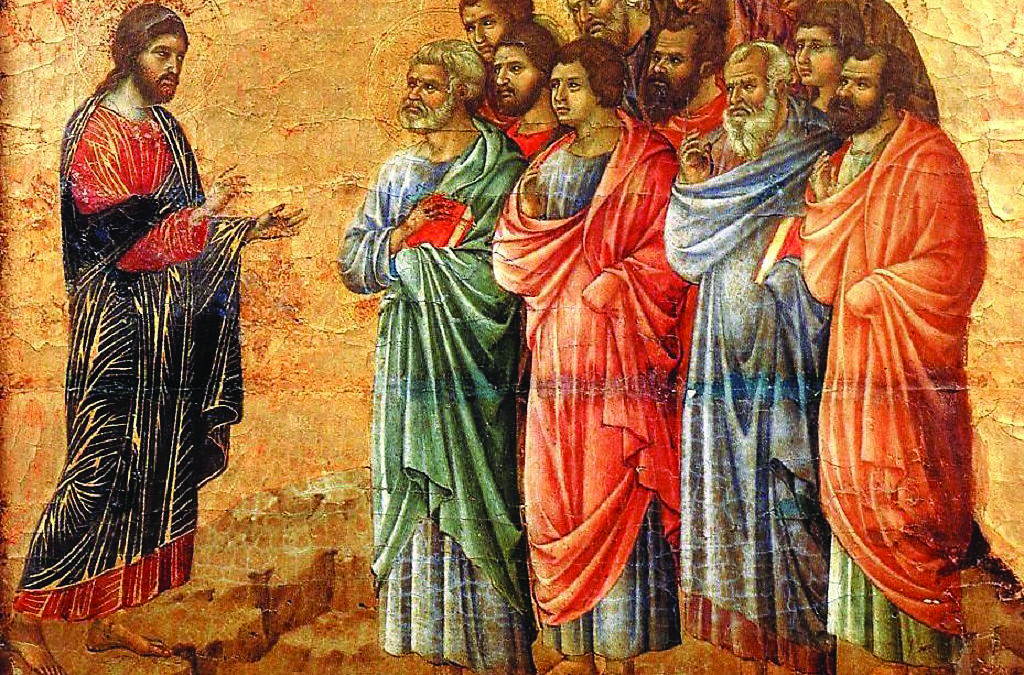
Carolyn Moore is the founding pastor of Mosaic Church in Evans, Georgia, and the author of When Women Lead (Zondervan). Her MDiv and Doctor of Ministry degrees are from Asbury Theological Seminary. She co-hosts a podcast and writes at artofholiness.com – where this article originally appeared. It is reprinted by permission. She is the chairperson of the Wesleyan Covenant Association. Art: Duccio di Buoninsegna (1255-1319): Christ Appears to the Disciples on the Mountain in Galilee. Public domain.