by Steve | Jan 23, 2017 | In the News, Perspective E-Newsletter

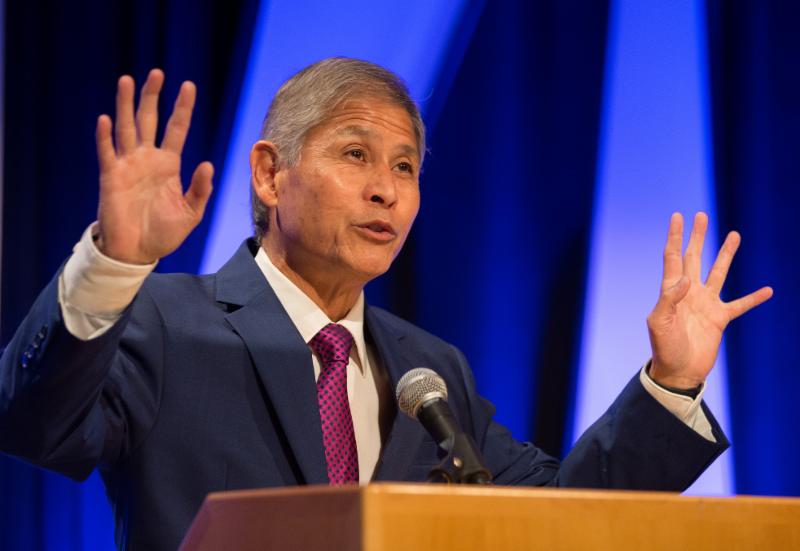
Bishop Grant Hagiya, UMNS
By Walter Fenton-
According to a United Methodist News Service article dated August 23, 2016, Bishop Grant Hagiya, president of the Western Jurisdiction’s College of Bishops, said newly elected Bishop Karen Oliveto, an open lesbian married to a deaconess in The United Methodist Church, “faces multiple complaints under church law … [and] that he has initiated the church’s supervisory process that seeks to reach a resolution without trial.”
No one has heard anything since.
Oliveto’s election came after General Conference had agreed to table all petitions to change the church’s sexual ethics, and after it had authorized the Council of Bishops to appoint a commission to study the matter and present a definitive plan for resolving the long running debate at an unprecedented, called General Conference. Delegates, church leaders, and bishops left the conference with an understanding the church’s teachings on marriage and sexuality remained fully in force while also allowing time for the commission to do its work.
Oliveto’s election also came amid heightened acts of defiance and votes by progressive annual conferences to reject the will of the church’s governance structure and its good order. When the Western Jurisdiction announced her election it rocked a church already reeling from the long and acrimonious debate, and a massive drop in worship attendance over the past 10 years.
In response, a number of active bishops issued statements lamenting her election as a breach of the church’s teachings and covenant. The South Central

Bishop Elaine Stanovsky receives Holy Communion from protesters, UMNS
Jurisdictional Conference immediately petitioned the denomination’s Judicial Council (its “Supreme Court”) regarding the legality of the Western Jurisdiction’s action. The executive committee of the Council of Bishops, citing “the great importance of the matter,” asked the Judicial Council to expedite its hearing of the case. And of course many United Methodists regarded her election as an event likely to tip the church towards separation or dissolution.
In short, Oliveto’s election has pushed the church to the brink of division, and its ramifications are almost certainly taking a toll on worship attendance and giving across the connection. But despite all of the turmoil, the Western Jurisdiction’s College of Bishops has said nothing about its disposition of the “multiple complaints” filed against her.
Its dithering should surprise no one. In October 2013, shortly after retired Bishop Melvin Talbert presided at a same-sex service in Birmingham, Alabama, the Council of Bishops, in closed-door sessions at its November 2013 meetings, directed two of its colleagues to file a complaint against him. The complaint was finally filed in March 2014, and the Western Jurisdiction College of Bishops took another nine months for investigation, conversation and deliberation. It finally announced a trivial resolution of the matter on December 30 of the same year.
Talbert’s case was not a complicated one, nor is Oliveto’s. There was no ambiguity about Talbert’s participation in a same-sex wedding in Birmingham. He participated with the express aim of drawing attention to his act of defiance. In the same way, Oliveto has never attempted to conceal she is married to her female partner, and in the past she has boasted that she has presided at over 50 same-sex weddings.
Given the liberal tilt of her four episcopal colleagues in the Western Jurisdiction, few people believe the panel handling the complaint will do anything more than announce a “just resolution” that leaves Oliveto in place. But that decision would be clarifying for the whole church, and it would inform the work of the special commission as it ponders the realistic options before it.
Whether one agrees or disagrees with Oliveto’s presiding at same-sex services or her own marriage, fair-minded people can and should expect a just and timely resolution of a case with implications for the entire connection. At a minimum, the Western Jurisdiction College of Bishops owes the church some report on the status of the complaints filed against her.
Its failure to act or to even report on the matters is indicative of either arrogance or disdain for the wider church.
Walter Fenton is a United Methodist clergy person and an analyst for Good News.

by Steve | Jan 12, 2017 | In the News, Perspective E-Newsletter
Archive: Methodism’s Silent Minority
The following article by the Rev. Dr. Charles W. Keysor was published in the Christian Advocate, July 14, 1966. Keysor’s essay galvanized evangelicals in the then Methodist Church. Within months of its publication the Good News movement was launched in 1967.
Within The Methodist Church in the United States is a silent minority group. It is not represented in the higher councils of the church. Its members seem to have little influence in Nashville, Evanston, or on Riverside Drive. Its concepts are often abhorrent to Methodist officialdom at annual conference and national levels.
I speak of those Methodists who are variously called “evangelicals” or “conservatives” or “fundamentalists.” A more accurate description is “orthodox,” for these brethren hold a traditional understanding of the Christian faith.
Orthodox Methodists come in theologically assorted shapes, sizes, and colors. But, unfortunately, the richness and subtlety of orthodox thought are often overlooked and/or misunderstood. There lurks in many a Methodist mind a deep intolerance toward the silent minority who are orthodox. This is something of a paradox, because this unbrotherly spirit abounds at a time when Methodism is talking much about ecumenicity-which means openness toward those whose beliefs and traditions may differ.
Yet it seems almost an intellectual reflex action to regard the orthodox brother as one who is ipso facto, narrow-minded, naive, contentious, and potentially schismatic.
This familiar stereotype contains only a shadow of truth. Orthodoxy is more complex and more profound than its many critics seem to realize. Intellectual honesty-let alone Christian charity-demands more objectivity than the church now accords to its silent minority.
Webster’s Dictionary tells us that orthodox means “conforming to the Christian faith as formulated in the church creeds and confessions.” These are Catholic, Lutheran, Reformed, and Anabaptist, which means that orthodoxy is the ultimate in ecumenicity. But what is orthodoxy?
Actually, there is no mystique. We who are orthodox believe that the Christian faith is comprehensively declared in Holy Scripture and is succinctly summarized in the Apostle’s Creed. Here, we feel, is faith’s essence, doctrinally speaking.
Orthodoxy in America has developed a theological epicenter known as the “five fundamentals.” These are by no means the whole of orthodox doctrine, as many people mistakenly suppose. Instead, these five points constitute a common ground for all who are truly orthodox. But beyond this common ground lies an enormous area of Christian truth where orthodox Christians disagree vigorously.
Despite the broadness of orthodoxy’s doctrinal scope, one must examine the five fundamentals in order to understand orthodoxy’s point of view.
1. Inspiration of Scripture. Orthodoxy believes with a passion that the whole Bible is God’s eternal, unfailing truth. Some portions of this truth are more important than others (Isaiah 5 towers above Esther, for example), but everything in the Scriptures has sacred significance. A thing is not true because it happens to be included in the Bible; we believe it is in the Bible because the thing itself is true. Orthodoxy believes that God has expressed scriptural truth through human personality, by the agency of God’s Holy Spirit. Perverted orthodoxy limits inspiration to the King James Version, as though God had somehow lowered it from heaven on a string back in 1611. Another unfortunate mutation of orthodox doctrine is the idea of mechanic dictation: that human beings were nothing more than stenographers, recording mechanically every jot and tittle that was dictated from above.
True orthodoxy shuns these mistaken views of inspiration. Instead, historic orthodoxy regards inspiration of Scripture as a dynamic, continuing activity of the Holy Spirit:
First,God’s Spirit inspired the original authors, causing them to perceive and record God’s truth in their own God-given literary styles. (Hence the difference between James and Ezekiel.)
Second, acting through translators, redactors, and canonizing bodies, the Spirit has preserved Scripture from significant effort during the long and torturous process of transmission, right down to the present moment.
Third, the Spirit enables believers to get God’s intended meaning from Scripture. To properly understand Scripture without the Spirit’s illuminating inspiration is no more possible than for an airplane to fly without wings and engine! This is why pure orthodoxy considers invalid any hermeneutic which disregards or minimizes the Spirit’s threefold work of dynamic inspiration.
2. The virgin birth of Christ. We believe that our Lord was, literally, “conceived by the Holy Spirit, born of the virgin Mary.” This must be true, or it would not have been written and transmitted in Holy Scripture. Naive? If so, we who are orthodox accept the label-along with such naive men of faith as the authors of Matthew and Luke, St. Augustine, Martin Luther, John Calvin, and our own John Wesley.
We do not believe in Jesus because of the unusual circumstances surrounding his entry into the world via Incarnation. On the contrary, our experience of Christ’s lordship teaches us empirically what Scripture tells – that the entire realm of nature is subject to His sovereign authority. Therefore, Christ is not subject to known limitations of “natural law.” Order and unity and coherence for the entire cosmos center in Christ. Believing this about him, we logically believe that our Lord could be virgin born – just as the Bible reports.
3. The substitutionary Atonement of Christ. What happened on Calvary is a mystery which can never be adequately explained by theories and/or analogies. Scripture seems to justify several explanations of the Atonement. In trying to fathom this mystery of mysteries, the theologian is something like an engineer trying to locate the main channel of the Mississippi River at flood stage. The river is two miles wide, but careful examination reveals what undoubtedly is the main channel of the river.
Orthodoxy believes that the main channel of Atonement truth lies in the area of substitution: that somehow Christ on the cross paid the price of transgression which a righteous and holy God properly requires. We do recognize certain validity in “moral influence” and other such theories. But orthodoxy believes it is more correct to say that our Lord, “for a world of lost sinners was slain.”
4. The physical Resurrection of Christ. We think that Christianity is a hoax unless Christ rose bodily from the grave – as the Scriptures report. We do not believe that the Bible would make such a central emphasis on His being raised from death bodily if this were not true. Frankly, we are tired of ingenious theories which charge the Resurrection up to the wishful thinking of primitive Christians. More convincing to us is the Spirit of our risen Lord, bearing witness with our spirits that “He lives!”
5. The return of Christ. Orthodox Christians hold various views of the Parousia’s place in the order of last things. But all truly orthodox believers agree that Jesus Christ will return physically to “judge the (living) and the dead.” We do not regard the Great Assize passage (Matthew 25: 31-46) as parabolic teaching; instead, we believe it is a literal foretelling of the future judgment which Christ will execute when He comes again.
Perverted orthodoxy has made an illusory religion out of millennial speculation. This clearly ignores Jesus’ teaching that the time of His appearing is known only to the mind of God. Jesus did not intend for His disciples to dawdle with date-setting. We are not to waste time peering into the sky waiting for a homecoming Hero to solve the world’s problems!
Instead we are to let our Christian light shine in a dark world. Our calling is to be redeeming the time for the days are evil. This precludes two extremes: (1) setting dates for His return; (2) Pointing negatively to the fact that early Christian expectations have not been fulfilled according to man’s time scale. To both, orthodoxy says, “Be ready! But as you wait in confidence, be a Christ to your neighbor.”
Orthodoxy clings with joy to the “blessed hope” of Christ’s physical return. This expectation strengthens us for the living of these days. One of the most pronounced characteristics about authentic orthodoxy is its vibrant sense of eschatological expectancy. This is God’s gift to those, who cling to the “blessed hope” as we live in the eschatological twilight zone, between promise and fulfillment.
How many orthodox believers are there among the people called Methodist?
Probably there are quite a few. The evidence is elusive, but several clues bear examination. For one thing, more than 10,000 Methodist churches are using some Christian education materials based on orthodox theology. These materials do not come out of Nashville but from Elgin and Wheaton, Ill., and Glendale, Calif.
Theology is not the only reason why the wide-scale defection exists (price, service rendered by the publishers, and educational methodology are all significant factors). But theology cannot be dismissed by thoughtful Methodists who ponder the matter. The tenacity with which so many Methodists cling to non-Methodist literature strongly suggests the existence of an orthodox stratum down at Methodism’s grass roots.
Another clue was unearthed during preparations for our new Methodist Hymnal. Surveys of musical tastes showed a powerful desire for those “good old” gospel songs. Of course there are various reasons for this. One of the most important is that gospel music emphasizes strongly the five fundamentals, which the Gospel likewise emphasizes. One reason for the persistence of gospel music is the people’s persistent interest in the Gospel.
What is orthodoxy’s future within The Methodist Church? Persecution is not impossible, for just recently a high official in Nashville was heard to declare, “We are going to stamp out the last vestiges of fundamentalism from The Methodist Church!” Within the author’s lifetime, a Methodist bishop threatened to drive from his conference any man who affirmed from the pulpit Christ’s Second Coming.
More likely, however, is the objective prediction made by Dr. Paul Hessert, professor of historical theology at Garrett Theological Seminary. He foresees a continuing eclipse of orthodox influence within the seminary trained Methodist ministry. He also predicts that orthodoxy will continue among the laity – and, therefore, will remain strong among supply preachers.
As to the hierarchy of the church, Dr. Hessert believes that the present liberal influence will gradually give way to the newer theologies, which represent an evolution of old-fashioned liberalism. Neo-orthodoxy will have a lessening influence, be believes. The reason is that neo-orthodoxy is essentially a compromise position, and its adherents tend to slide away-mostly toward the newer liberalism.
Orthodoxy seems destined to remain as Methodism’s silent minority. Here lies the challenge: We who are orthodox must become the un-silent minority! Orthodoxy must shed its “poor cousin” inferiority complex and enter forthrightly into the current theological debate. We who are orthodox must boldly declare our understanding of Christian truth, as God has given these convictions to us. We must speak in love and with prophetic fearlessness, and must be prepared to suffer.
But regardless of the consequences, we must be heard in Nashville, in Evanston, and on Riverside Drive. Most of all, we must be heard in thousands of pulpits, for the people called Methodist will not cease to hunger for the good news of Jesus Christ, incarnate, crucified, risen, and coming again.
We must not speak as right-wing fanatics, intending to subvert the “establishment” and remake it in our own orthodox age. Instead, we must speak to our Christian brothers as Christian brothers, trusting that God will direct and prosper our witness to the truth as we see it in Christ Jesus our Lord.
____________________________________________________
+The Rev. Charles Keysor passed away on October 22, 1985. He became the founding editor of Good News. Photo: Good News archives.
Reprinted from Christian Advocate, July 14, 1966. Copyright (C) 1966 by The Methodist Publishing House.
by Steve | Jan 9, 2017 | In the News, Perspective E-Newsletter
 By Walter Fenton-
Shortly before Christmas, local churches in the Mountain Sky Episcopal Area of The United Methodist Church received a letter requesting monetary gifts for a “Vital Congregations Sustentation Fund.”
The letter, signed by the 16 jurisdictional delegates from the area’s two annual conferences (Rocky Mountain and Yellowstone), explained that since the election and appointment of the Rev. Karen Oliveto as the area’s bishop, “there has been stress in some of our most theologically diverse congregations. Some have lost members. Others have had members withdraw their financial support.”
The communiqué goes on to state that the fund is being created, “to provide churches with short-term financial assistance … where a pastor’s compensation is at risk.”
In short, some of the very Western Jurisdictional delegates who ignored the church’s teachings on marriage and rejected its sexual ethics by voting for Oliveto, are now asking laypeople and clergy, many of whom respect the will of General Conference, affirm the church’s governance structure, and believe its teachings on these matters are grounded in Scripture, to fund the consequences of their defiance.
For years some progressives and institutionalists have claimed the church’s plunging worship attendance could be traced to its archaic sexual ethics and its failure to affirm same-sex marriage. And in fact, the letter implies the need for financial assistance is just a “short-term” fix, presumably to be rectified when secular liberals and millennials begin pouring into local churches prepared to tithe and lend a hand repairing the church’s roof.
But before anyone buys into this dreamy scenario they might want to see how things are going for old-line denominations like the Presbyterian Church USA (PC-USA), the Episcopal Church, and the United Church of Christ (UCC), denominations that have been running this experiment for the past decade or two.
In early 2016 PC-USA officials projected the denomination would shed 400,000 members from 2015-2020. This is on top of a whopping 28% plunge in membership between 2005 and 2015. The denomination raises funds for the general church by assessing a per member amount that each congregation is expected to pay. That figure is set to rise 12.5 percent over the next five years, even as the church plans to cut outlays by 12 percent from 2017-2020. Perversely, even increasing the per-capita member amount fails to generate the necessary funds for growing the church when membership falls so precipitously. UM Church officials should take note.
Since the consecration of an openly gay bishop in 2003 and the liberalizing of its sexual ethics and teachings on marriage, the Episcopal Church has watched its worship attendance drop by an astounding 26 percent from 2005 to 2015. It is in the process of closing seminaries and has even contemplated selling its church headquarters building in New York City.
And finally, the UCC, which was the earliest adopter of a liberalizing strategy, is now in free fall. It has laid-off numerous church officials, watched hundreds of churches exit the denomination, and seen the vast majority of the remaining ones shrink in size. Membership plunged by 28 percent between 2005 and 2015, and church officials warned earlier this year that on its current trajectory the denomination would essentially collapse by 2045.
To be sure, some will respond that church is about more than seeing how many people you can pack into your pews. But by the same token, church leaders, like the 16 delegates who signed the request for “financial assistance,” need to candidly state the likely long-term cost their agenda will require of people in the Rocky Mountain and Yellowstone annual conferences.
Here’s betting it will be very steep.
Walter Fenton is a United Methodist clergy person and an analyst for Good News.
by Steve | Dec 30, 2016 | In the News, Perspective E-Newsletter
 There is still time to make a 2019 gift to Good News. Please remember:
1. All gifts mailed to Good News that are postmarked on or before December 31, 2016 are considered charitable gifts for the 2016 tax year.
2. Any credit or debit card transaction completed online before January 1, 2017 is considered a charitable gift for the 2016 tax year. Make an online gift to Good News today by clicking HERE.
3. If you call the Good News office (832-813-8327) on Friday, December 30, 2016 between 8 a.m. and 12 p.m. Central Time, we will process a credit or debit card gift before the close of the business day.
 Faithful clergy, laity, and local churches in every annual conference support Good News. Gifts to Good News support the publication of our widely respected magazine, our website, our work with clergy and laity in annual conference renewal groups, and our strong witness at General Conference where we champion conservative-evangelical, orthodox, Wesleyan Christianity.
Your gifts to Good News enable us to inform, inspire and bring hope to those who long for a faithful church. Individuals making gifts of $25 or more will receive the next 12 issues of Good News magazine. Join us today!
The Good News staff and board of directors warmly and sincerely thank all of its friends for their faithful and generous financial support in 2016!