by Steve | Mar 20, 2017 | Magazine, Magazine Articles, March-April 2017
 By Duane Brown-
The apostle Peter says we must always be ready to explain our Christian hope (I Peter 3:15, NLT). “Always” probably seems like an impossible goal for most of us. Too often that’s true for me.
Several months ago, while I was talking to the woman next to me on the plane, she discovered I did leadership coaching and requested a session. I happily complied. After about an hour of her answering questions and my coaching, we had devised a workable plan for her to take with her.
In the course of our conversation, we learned that we had grown up in the same denomination. She told me, though, that she had since quit on God and church. I realize now that that would have been a perfect opportunity to talk more with her about that. Why didn’t I do it? We briefly talked through her faith journey, but I regret at the end I didn’t go far enough in the conversation to maybe explore the root of her feeling alienated from God. We can be afraid of witnessing. The apostle Paul and John Wesley might have something to say to us about this.
When Paul experienced God’s transforming power, he became, as you know, an unstoppable force for the gospel’s expansion throughout the Mediterranean. During one of his journeys, as he addressed Athenians who had a shrine to an “Unknown God,” this versatile evangelist proclaimed: “This God, whom you worship without knowing, is the one I’m telling you about.” Then he went on, not mincing words: “God overlooked people’s ignorance about these things in earlier times, but now he commands everyone, everywhere to repent of their sins and turn to him. For he has set a day for judging the world with justice by the man he has appointed, and he proved to everyone who this is by raising him from the dead” (Acts 17:30-31, NIV).
Founder of the Methodist movement, John Wesley, once said to his church leaders, “You have one business on earth – to save souls.” Wesley expected Christ followers to serve the socio-economic needs of others, but that could never take the lead; evangelism should.
In his book, Growing God’s Church, Gary McIntosh offers a helpful perspective on the church’s evangelistic priority. McIntosh cautions the church against adopting a “holistic view” of mission. In this view God has only has one mission, which may include everything from caring for the environment to preaching the gospel. He argues that when everything is missional, nothing is missional. That ends up meaning that evangelism and soul-winning will never take the lead as the church’s missional priority. Like my experience with the woman on the plane, we help people yet we don’t get to the heart of the matter.
McIntosh believes there is another way besides a holistic view. The church may have numerous and interrelated tasks of missional ministry, but these tasks do not have the same priority. The church’s priority is to reach, baptize, and teach others the way of Jesus. McIntosh supports a church’s involvement in ministries of community transformation, as exemplified by the early church. However, he writes, “While they served the common good, the early church placed a priority on the greater good¸ that of saving souls.”
A way forward is for each person to discern one’s gifts and passions as members of Christ’s body. Then we must accept the tensions and struggles of prioritizing evangelism through creative expressions of our witness in the near, far, and in the hard places of this world.
Duane Brown is a missiologist and serves as senior director of church ministry at TMS Global – www.tmsglobal.org, formerly known as The Mission Society. He is happily married to Patty, and is proud father to Eric, Kathryn, and Elizabeth.
by Steve | Mar 20, 2017 | Magazine, Magazine Articles, March-April 2017
 Perhaps grace has been treated unfairly by the church. A powerful word with eternal truths, grace often slips through the cracks when we offer Christian encouragement. We don’t really know how to explain it. Offering grace sounds too simplistic, too incomplete. We want more.
When Paul pleaded for his thorn to be removed (2 Corinthians 12:7-10), he had a genuine need. In Paul’s opinion, removing the thorn would help him serve the Lord more completely. Jesus’ decision to offer grace rather than removal of the thorn is puzzling. Our Lord healed others. Why not Paul?
Grace is the undeserved favor of God. In our very limited understanding of spiritual truths, we think, “I’m all for your favor, Lord. I accept your unconditional love. But, I can’t feel it, see it or taste it, and I’m hurting. I need tangible evidence.” God says, “My grace is sufficient.”
We are left on our own to decipher meaning from these four words, knowing that God never owes us an explanation. Jesus reserves the right not to tell us why he says what he says. When Paul walked away from this conversation with no answer, Jesus was totally and genuinely at peace with his answer.
It was as if Jesus said, “Look Paul, what I give you through my grace is all you will ever need. My grace saves you and keeps you from an onslaught of sin. It helps you get past the mundane of life and live inside of my victory. Isn’t that all you really need?” In the grand scheme of things, Jesus has a point.
What Jesus could have said was, “Paul, get a grip! Man up! Grow up!” Instead, Jesus offered grace, and in that same verse he offers his strength. Jesus not only said his grace was sufficient, but also “my strength will be made perfect in weakness.” It was a grace-filled answer bursting with possibilities for humans who know all too well about our weaknesses.
Paul likely left this conversation with huge question marks all over his heart, thinking, “That all sounds well and good, but if grace is so sufficient, why am I still hurting?”
Maybe our problem is that we see grace from an earthly view while Jesus sees grace from a heavenly view. Jesus is overjoyed to give us grace because he knows we are getting his very best! If, when he hands out grace, we could see the grin of God, we would better understand that we are receiving a gift that makes him smile! If we were allowed into the Throne Room just as he dispenses his grace, we would likely see angels dancing while applauding. We would hear beautiful singing about grace from those who knew grace was amazing before the song was ever written.
Into your personal situation of heartache and pain, Jesus whispers, “Trust me. Grace is the better answer, your very best healing.” Into that relationship that is broken and bruised, Jesus whispers, “Trust me. Grace is the anchor you need to carry you above your pain, not just to help you tolerate your heartache, but to help you gain the victory.”
Into those deep wounds that want to control your thoughts and keep you in the clutches of an unforgiving attitude toward another, Jesus whispers, “Trust me. Grace will be your calm in the midst of your storms. It will come to mean so much more to you than what you think you need.”
As far as we know, Paul’s thorn was never removed. He lived, preached, taught, and healed with the thorn still in his life. He learned first-hand what it meant to have grace as his sufficiency, with strength bursting forth on waves of endurance for the rest of his life.
It is believed, but perhaps not proven, that Paul was beheaded under the rule of Nero, the Emperor. I’m sure he went to his death bravely, still carrying that thorn and thanking God for it. His thorn helped him understand God’s grace, the grace that would now carry him through death. By the time Paul wrote Second Corinthians, he had figured it out. He explained that because he had received an abundance of revelations, he had been given a thorn to prevent him from self-exaltation. In the grand scheme of things, Paul had a point.
It’s all about grace and will forever be about grace. Even when we’re still hurting.
by Steve | Mar 13, 2017 | In the News, Perspective E-Newsletter
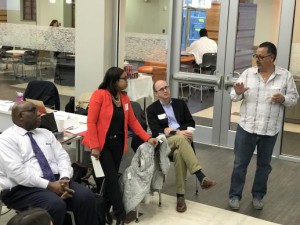
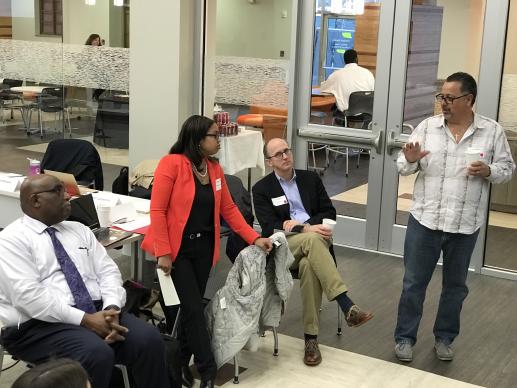
Commission on a Way Forward members: Bishop Gregory Palmer, Jasmine Rose Smothers, Dave Nuckols and Jorge Acevedo, UMNS
By Walter Fenton-
As the Commission on a Way Forward moves beyond preliminaries to the hard task of proposing a plan for the church’s consideration, it is worth trying to clarify what United Methodists in the renewal and reform groups regard as misunderstandings or mischaracterizations of their positions.
Not infrequently, some centrists and progressives claim renewal and reform leaders are unwilling to engage in dialogue. This is demonstrably untrue. Over the years, its leaders and board members have participated in numerous roundtables, open forums, and debates at every level of the church. They have respectfully listened to others, represented their own positions, and have given consideration to proposals to resolve our differences. They remain open to further conversation today. People who claim otherwise are either unfamiliar with the church’s fifty year history or are attempting to characterize them as impediments to unity.
Closely associated with the foregoing is the claim renewal and reform leaders are opposed to any and all attempts to change or modify the Book of Discipline regarding the UM Church’s sexual ethics and teachings on marriage. Again, this is simply not true. They respect the church’s polity and believe all United Methodists have the right to propose changes. For instance, at the 2016 General Conference, it was not renewal and reform leaders who led the effort to table petitions seeking to alter the church’s teachings on these matters. Leaders in the movement have advocated that all petitions, within reason, should be considered and discharged at General Conference.
Having said that, renewal and reform leaders oppose the actions of those who would impose their preferred outcomes on the majority of the church through acts of ecclesiastical disobedience. They reject the claim that widespread and organized defiance of church law is necessary in order to keep faith with other parts of it. This siren song always sounds good to those who believe their cause is just and right. However, following it is an invitation to supplanting the individual conscience over the authority of the church – a community, it should be remembered, of the willing not the compelled.
By way of example, consider the case of female ordination, a vital part of our Wesleyan heritage supported by renewal and reform ministries. Even though it is less so every day, there are some United Methodists who would seek to impede a woman’s path to ordination based on their own Scriptural interpretations and readings of church history. In such a case, renewal and reform leaders expect the church to stand by its well founded conviction that ordination is open to women. In short, United Methodists are entitled to advocate for changing the Discipline, but not to imposing their wills on others.
Too often the above mischaracterizations lead to the more harmful claim that renewal and reform leaders are “schismatics”. This term – often used hyperbolically – simply shuts down conversation rather than fosters it. While it is true that some renewal and reform leaders have discussed “amicable separation,” more often than not it has been offered as sober analysis of the state of the church, not necessarily as a preferred prescription.
Nevertheless, given the deep differences and actions of various parties, separation can no longer be dismissed out of hand. It should be prayerfully and thoughtfully considered. The name calling, on the other hand, is not helpful. Truth be told, leaders across the connection – at every level – are either openly or quietly considering the option.
Finally, it would help dialogue if progressives learned the difference between the biblical hermeneutic of evangelicals and fundamentalists. Too often, progressives point out to conservatives – as if they are unaware – that there are biblical prohibitions (e.g., from body tattoos to dietary laws) the Discipline does not even mention, let alone enforce. It seems as if they are then quick to compare, for example, avoiding shell-fish to the church’s prohibition against the practice of homosexuality – ultimately claiming our view of marriage and sexuality is rooted in homophobia. This is to create a straw man anyone can blow down.
The church’s prohibition, however, is grounded in a nuanced and classical form of biblical interpretation going back to John Wesley and well beyond. It is certainly true that a host of contemporary biblical scholars and theologians have made compelling arguments for change (e.g., James V. Brownson, Victor Paul Furnish, Letha Scanzoni, Virginia Mollenkott,), but it is just as true that others have quite capably defended and reaffirmed the church’s teachings (e.g., William Abraham, Bill Arnold, Richard Hays). We are thankful for their work, believe it to be done in good faith, and deserving of our careful attention. But in the end, the General Conference alone, (and even it, within proscribed limits) is empowered to establish church teaching and order.
At this critical juncture it is important for various parties to deal with one another as they truly are, not as we imagine them to be.
Walter Fenton is a United Methodist clergy person and an analyst for Good News.
by Steve | Mar 3, 2017 | In the News
March 2, 2017
Atlanta, Ga.: Meeting in Atlanta, Georgia this week, the Commission on a Way Forward continued to make progress towards completing the groundwork for their task, building relationships, engaging in learning, information gathering, working and worshiping together.
On Wednesday, the Rev. Donna Pritchard led a morning Bible study of Galatians 2. Later, Commission members joined the staff of the General Board of Global Ministries in the stained-glass sanctuary of Grace United Methodist Church for an Ash Wednesday service.
The day concluded with Bishop David Yemba reminding the Commission that people across the Connection are praying for the Commission. He shared a meditation about Ephesians 1:15-23, noting that Paul is sharing through prayer the things believers have in common, not only what is dividing them. “Above all is that you have the Lord Jesus Christ in common and then you have in common faith in him and you have common hope in him and you have God’s promises in him,” said Bishop Yemba.
Team reports
In January, the Commission formed learning teams to take on various aspects of their work and the teams have been diligently pursuing their assignments. The work of some teams will take longer than others, but the following generally summarizes work to date.
• Initial research has involved interviewing bishops, pastors and laypersons from other denominations and gathering data and resources to report to the Commission. Denominations are unique in terms of polity and experience, and none is a perfect match with The United Methodist Church.
• One team shared information with the group about the power of language and culture, sexual orientation and gender identity. Conversations have taken place with reconciling congregations and research gathered on experiences and perspectives from Africa.
• There is ongoing research seeking clarification about the rules, petitions, logistics, and the roles of the Council of Bishops and the Commission on the General Conference.
• One team led a learning session describing the current landscape and the different strategies at work of the Confessing Movement and other renewal groups, Reconciling Ministries and progressive strategies, the Wesleyan Covenant Association, and groups in the Central Conferences with general discussion and questions.
• There was a report on a plan for gathering information within the Central Conferences related to the diversity of attitudes regarding LGBTQ issues and the different social, cultural and religious contexts. There was a strong recommendation to explore the subject of unity with the Central Conferences.
A tale of two centuries
Dr. Russ Richey of Candler School of Theology says the unity and disunity of the church has been, in a sense, his life’s work. He shared insights about how Methodism has historically dealt with disagreement and the different ways the church dealt with conflict over two centuries.
The 19th century saw separation and organizational division among American Methodists every decade. The century following brought unity, even amidst divisions that were more internal than structural. “By and large we stayed united, but there were serious divisions and controversies.”
Richey said there was “separation between” in the former and “separation within” in the latter.
The earliest disputes were over a variety of causes, sometimes over big issues such as slavery. “We were a very popular movement. In some ways for the 19th century, we were the most popular and dynamic movement, so the big issues the country wrestled with were ones we as Methodists took on.”
The result was division, and those divisions had costs, he says. “We didn’t speak with a common voice, but churches competed with one another and reached out and evangelized.”
“Beginning in the very late 19th century and continuing in the 20th, there was a sense that these denominational divisions tore apart the cloak of Christ, that we were dividing Christ’s gift to us,” he said. “There was really a Biblical mandate and Christ’s injunction to bring us together and so a lot of energy was put into unitive efforts,” said Dr. Richey in an interview.
Following the presentation was a discussion about takeaways that might be important to the Commission’s process and what other historic perspectives or information might be needed, including learning more about our history globally.
Gathering additional input
The Commission also continued discussion both in small groups and as a body regarding the input they need from other groups and individuals, including:
• Conversations with caucus groups
• Conversations with strategic denominational leadership groups at meetings that are already a part of their schedule and at which the commission might ask for time
• Conversations with seminary students
• Engaging bishops and annual conferences in supporting the work of the commission
• Engaging annual conferences to develop their own strategies by which they can offer feedback and information to the Commission so that local church members, participants and clergy have a voice
The group worked together on beginning to compile a comprehensive list.
The Commission began its last day with a Bible study on Galatians 3 led by the Rev. Helen Cunanan of the Philippines. There was also a discussion of a timeline for their work ahead. The Commission’s next meeting will be April 6-8 in Washington, DC.
More information on the Commission is available on their website at UMC.org/wayforward.
###
About the Commission on a Way Forward
The 32-member Commission on a Way Forward was appointed by the Council of Bishops to assist the bishops in their charge from the 2016 General Conference to lead the church forward amid the present impasse related to human sexuality and resulting questions about the unity of the church.
by Steve | Mar 1, 2017 | In the News

Photo by Phileas Jusu, UMNS
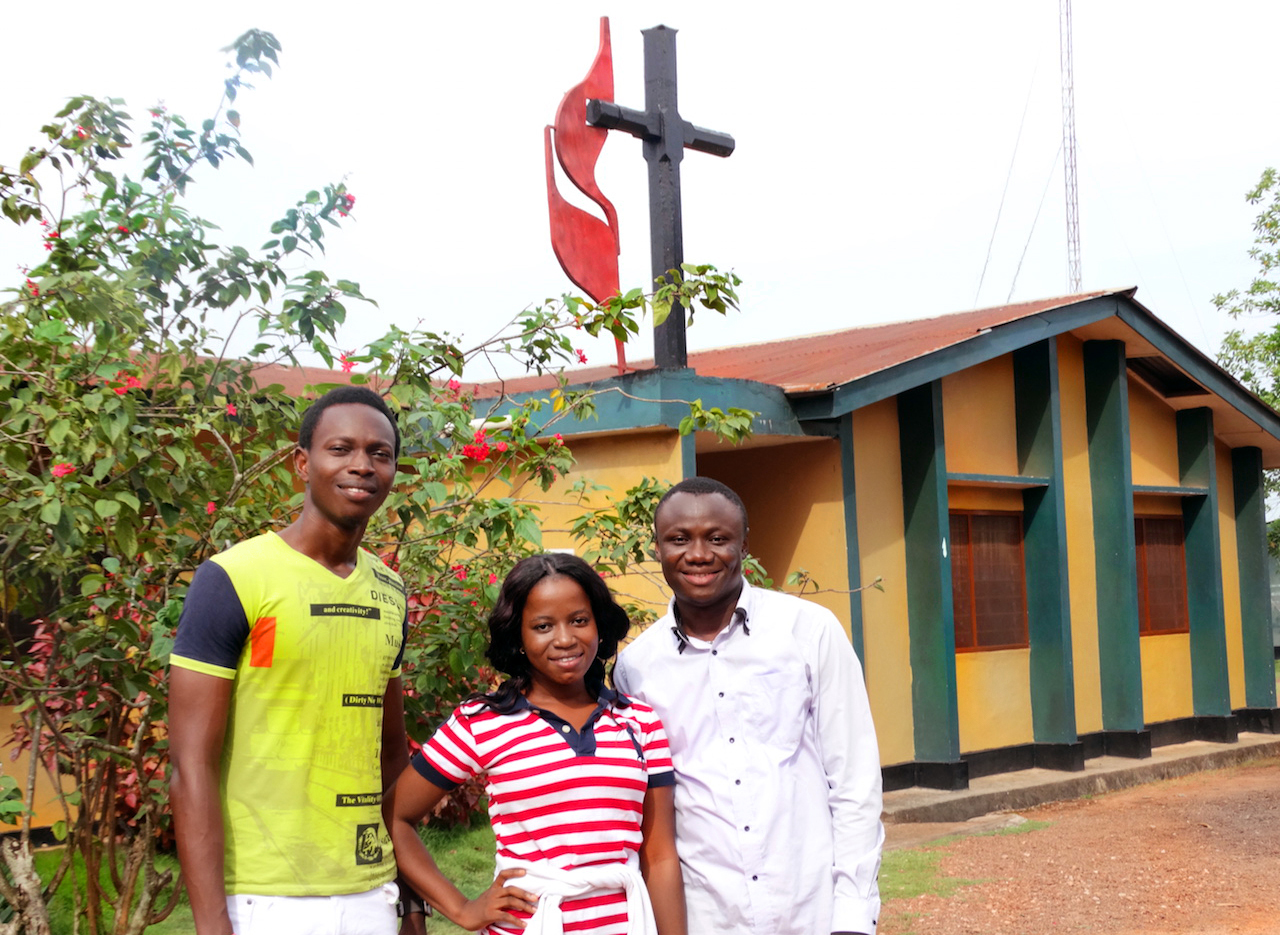
Johannes Baun (from left), Rose Saffa and Mohamed Nabieu, who were helped at the Child Rescue Center, are giving back the help they received by working at the center. The rescue center was founded to care for children impoverished by the 1991-2002 Sierra Leone civil war.
By Phileas Jusu-
Mohamed Emmanuel Nabieu was 8 years old when his father was shot during a rebel attack and he was separated from his mother during the Sierra Leone civil war.
After living on the streets for four months, workers from the United Methodist Child Rescue Center found him and offered help. Now, as program director of the center, he works to pay back the help he received to other orphaned and abandoned children.
“My father was shot right in front of me. In the confusion of fleeing from my village… I lost contact with my mother. My mum went away in a different direction with a different group of people while I headed for Bo City,” Nabieu recalls of the turbulent times during the 1991-2002 war.
When the rescue center workers asked why he was sleeping on the streets, he was frightened.
“I attempted to explain but I was very nervous because I saw strange people in the company of white people. And I had never seen white people before,” he said. Eventually, the workers convinced him to follow them to the center at Mahei Boima Road.
More than a decade after the war, five staff members at the center are all alumni of the program.
To read the rest of the article, click here.

 By Duane Brown-