by Steve | Sep 18, 2017 | In the News, Perspective E-Newsletter
 By Walter Fenton-
In his recent respectful, but critical appraisal of so-called United Methodist “centrism,” Dr. Kevin Watson, Assistant Professor of Wesleyan and Methodist Studies at Candler School of Theology, says he has “no idea to what extent [the Rev. Adam] Hamilton desires to be seen as a leader of… the United Methodist Centrist Movement.”
Question asked, question answered. Hamilton has quickly responded with an essay of his own entitled “In Support of United Methodist Centrists.”
Watson’s critique and Hamilton’s response are well worth reading, particularly with the launch of a new caucus group called “Uniting Methodists” (Hamilton has openly identified with it).
But here, we want to consider whether self-identified “centrists” are actually at the center of the worldwide United Methodist Church.
For Hamilton, a centrist is a compassionate, faithful United Methodist who recognizes that other compassionate, faithful United Methodists “disagree on how to interpret the Scriptures cited as relevant to the questions of same-sex marriage.”
The centrist caucus appears to promote a new UM infrastructure where some pastors preside at same-sex weddings and where some annual conferences ordain openly gay clergy, and, at the same time, some pastors only miles away decline to preside at same-sex weddings and some annual conferences refuse to ordain openly gay clergy.
Presumably, the centrist caucus would also promote legislation where some annual conferences could discipline a pastor who declined to receive an openly gay person as a church member, and, at the same time, would defend a pastor’s right to decline administering the membership vows in a different annual conference.
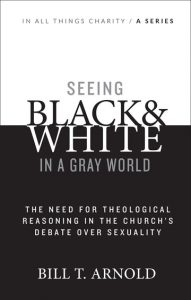
For a moment we will set aside this rather novel approach to a Christian church’s sexual ethics, teachings on marriage, ordination standards, 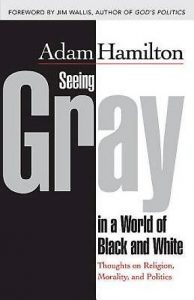 and even its membership vows to consider how Hamilton arrives at his definition of a centrist. For him, if two Christ loving, warm hearted, passionate United Methodists reach different conclusions regarding a given ethical issue, it most likely means the issue in question requires us to see gray even if what we want is a clear cut answer (see his book Seeing Gray in a World of Black and White and also Dr. Bill Arnold’s Seeing Black and White in a Gray World). This philosophy comes to the conclusion that the ethical issue is gray. In response, the best approach appears to be to sit loosely on the matter, allowing plenty of room for faithful people who have legitimate differences.
This is often a fair-minded, generous, and practical approach to some thorny ethical issues, and the church has decided to handle some of them in just this fashion. However, as Hamilton himself acknowledges, there are some ethical issues that cannot be handled this way. And that is the crux of the matter when it comes to the church’s sexual ethics, teachings on marriage, and its ordination standards.
Both LGBTQ advocates and the UM Church (through the General Conference) do not think we can sit loosely on these matters. The former believe justice is at stake and therefore there is no room for compromise. They are so fervent in their convictions that they have defied the church of which they are members.
 The UM Church believes its standards are firmly rooted in Christian teaching and are reflective of what the church universal has taught at all times and in all places. With compassion and grace, it calls on Christ followers to do the hard work of warmly and compassionately engaging with people who feel – often justifiably – marginalized and mistreated. However, it maintains it cannot yield on an issue that has paramount ramifications for the community of faith, for some of its core theological and ethical convictions, and for families and society in general. As challenging as it can be, the church believes it must speak the truth with grace and charity. And it believes this is done most effectively at the most basic level, where pastors and lay people open their doors, befriend others, listen, and speak kindly and warmly at the right time.
Judging from the declarations on the new centrist website, it seems as if it is advocating that the theological and ethical issues surrounding same-sex marriage, ordination, and church membership are not of paramount importance and that global United Methodism can move forward where some pastors joyfully preside at same-sex weddings, and others are firmly convinced such weddings are contrary to Christian teaching. This version of centrism appears to neither warmly promote the church’s teachings, nor will it wholeheartedly advocate for the full and unfettered inclusion of LGBTQ people. While no one would question the sincerity of their beliefs, the centrist caucus errs in believing that this puts them at anything approximating the center of the church. It does not; it puts it at odds with the church.
Wittingly or unwittingly, the centrist caucus is attempting to usurp the center of the church from the duly elected delegates who are sent to represent United Methodists at its General Conferences. This global body – representing people from Africa, Europe, The Philippines, and the U.S. – either reaffirms or modifies our Book of Discipline, and it alone constitutes the actual center of the church. Those who want the church to adopt a novel, laissez faire approach to its sexual ethics, its teachings on marriage, and its ordination standards may well be sincere, good-hearted people, but it’s a stretch to call this centrism.
To be fair, the new centrist caucus – complete with high-profile clergy as well as the past and present top executive from the United Methodist Publishing House – are not completely indifferent to the teachings of the church or the demands of LGBTQ advocates, but they are apparently willing to champion an exotic approach that is almost certainly a recipe for disaster.
For example, the centrist caucus would have us believe the UM Church could function as a healthy and vibrant denomination where two ministers, in the same community, teach diametrically opposite things about marriage and sexual intimacy. One teaches same-sex marriage is morally unacceptable, while another maintains LGBTQ marriages are to be celebrated. One teaches sexual intimacy is meant to be monogamous, heterosexual, and expressed in the confines of a marriage; the other warmly approves of LGBTQ understandings of sexual intimacy and marriage. This is not a credible way forward.
Practically speaking, particularly for bishops and district superintendents who have to appoint pastors to local churches, it’s a train wreck in the making. But even more importantly, their exotic plan of accommodation will solve little or nothing.
Previous versions of this “local option” plan were met with contempt by some ardent LGBTQ advocates. It was seen as an unacceptable vision of “gradualism” or “accommodationalism” – institutional leaders willing to sell them out whenever this or that annual conference has the votes to deny them full inclusion.
To those who find themselves in the center of the global United Methodist Church – those who actually support the church’s teachings, abide by its polity, and respect the will of the General Conference – the centrist caucus looks like it is willing to perpetuate an on-going division because they continue to see only gray.
Both sides – LGBTQ advocates and the UM Church – want the centrist caucus to take a stand on an issue where the church cannot have it both ways. Do they support LGBTQ advocates’ cry for full inclusion? Or do they stand with the center of The United Methodist Church, which believes what Christians at all times and in all places have taught regarding our sexual ethics and teachings on marriage.
Seeing only gray is no longer a luxury LGBTQ advocates or the UM Church can afford.
Walter Fenton is a United Methodist clergyperson and an analyst at Good News.
by Steve | Sep 15, 2017 | Magazine, Magazine Articles, September/October 2017

Rev. Rob Renfroe
By Rob Renfroe-
If you were to summarize one rather stark section of the Apostle Paul’s message to the Corinthians, it might be: God loves you and has a dangerous plan for your life.
He reminds the congregation that he has “been in prison more frequently, been flogged more severely, and been exposed to death again and again.” Five times he was whipped severely, three times he was beaten with rods, once he was pelted with rocks, shipwrecked three times, and spent a night and day drifting in the open sea. “I have been in danger from rivers, in danger from bandits, in danger from my fellow Jews, in danger from Gentiles; in danger in the city, in danger in the country, in danger at sea; and in danger from false believers,” Paul reminds them. “I have known hunger and thirst and have often gone without food; I have been cold and naked” (2 Corinthians 11:23-27). Not exactly a sales pitch for church work or following Jesus.
Two thousand years later, however, we have churches and pastors, liberal and conservative, whose primary message is “God wants to make you happy.” They might not put it in so many words, but they rarely speak of sin and repentance, or counting the cost of discipleship, or crucifying our desires so we can live fully for Christ. Instead, they talk about a God who wants to bless us and favor us – and very often the signs of his favor are presented as material prosperity and professional success. They preach that God wants to give us the desires of our hearts but they fail to mention that first God wants to change the desires of our hearts.
Years ago I read these lines: “In the beginning God made man in his own image. And, ever since, we’ve tried to return the favor.”
Every one of us has this tendency. Often without being aware of what we are doing, we create for ourselves a god who wants for us exactly what we want for us; who proclaims what’s right and moral is exactly what we think is right and moral; whose main goal for our lives is that we be happy and content.
We live in an era of designer jeans, designer drugs, and designer gods. We decide the kind of god we are comfortable with and we feel free to re-create the God of the Bible into our own image.
You’ve heard people say, “The God I believe in would never…” and they complete the sentence with what they would never do. Or “the God I worship is…” and they list the traits they would like to see in a deity. Maybe you’ve even said such things yourself. Our sinful, egocentric natures will always tempt us to remake God so that he is no longer above us, challenging our beliefs, our morals, or our actions. Instead, he becomes one of us, only kinder, more compassionate, and more forgiving.
Instead of challenging our tendency to idolatry, much of present day American Christianity promotes it. Here’s a quote from one of the best-selling Christian books of all time, written by one of the best known TV pastors in the world just a few years ago.
“God wants to make your life easier. He wants to assist you, to promote you, to give you advantages. He wants you to have preferential treatment. Consequently, I’ve come to expect to be treated differently. God has crowned me with favor, therefore, I can expect preferential treatment.”
How do you extract that message from a first-century itinerant preacher who had nowhere to lay his head, who was persecuted throughout his ministry, and was scourged with 39 lashes and then crucified? How do you turn “the man of sorrows” into a 21st century prophet of easy living, preferential treatment, and material gain?
Jesus said, “If anyone would come after me, let him take up his cross and deny himself.” How do you turn him into someone whose main goal is to make your life easier and give you advantages that others don’t enjoy?
You begin with a theology which is so shallow, so worldly, and so self-centered that you believe God’s great goal for you is to be happy in this world. You define the good life, the blessed life, in the same way as does our culture – material abundance, physical comforts, and preferential treatment.
Do that and you have transformed the God you were created to worship into a god who worships you. That god may not be graven out of stone or wood or metal. But that god is not the God of the Bible. That god is an idol.
The Bible is clear that God’s primary goal for us is that we become like Jesus, “conformed to his image.” That’s simply another way of saying that God’s will for us is that we become holy because there is no better example of holiness than the character and the life of Jesus.
Becoming like Jesus means we must put the Father’s will above our own even if the Father’s will troubles our souls and causes us to sweat blood. It means that we must forgive those who crucify us and be patient with those who fail us. Rather than expecting preferential treatment, being like Jesus requires that we humble ourselves, give up places of honor and lift others up. Being like Jesus is not a call to a life that is easy but to a life that is difficult and self-denying.
Two gospels – one promises happiness, the other calls us to holiness. Can’t you have both happiness and holiness? No, at least not all the time. Taking up a cross, dying to self, loving difficult people, putting others ahead of ourselves – in the moment none of those endeavors will make us happy. But they will make us like Jesus. And over time, that will bring us joy.
The gospel of happiness sells much better than the gospel of holiness. It allows egocentric, materialistic people to stay the way they are as long as they will say, “I accept Jesus.” It doesn’t require that we give generously to the poor or confront our prejudices. It doesn’t produce feelings of conviction, much less guilt, when we sin. It doesn’t demand that we change our priorities or live differently from the world as long as we remember to thank God for our blessings. It doesn’t necessitate that we do what’s hard or costly.
You’ll find this gospel of happiness proclaimed in progressive and traditional churches. In both, you’ll hear the message, “God loves you. Stay the way you are; no need to change your lifestyle or be challenged by the radical claims of Christ.” It’s a great way to keep the customers happy. But it’s a terrible way to make disciples.
Rob Renfroe is the president and publisher of Good News.
by Steve | Sep 15, 2017 | Magazine, Magazine Articles, Perspective E-Newsletter
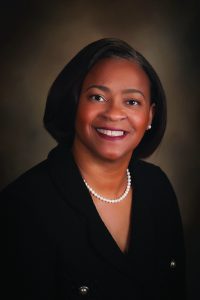
Bishop Sharma Lewis
By Bishop Sharma Lewis-
Brothers & Sisters:
As we continue to process the disturbing events from Charlottesville, Virginia, we need to turn to God for understanding, guidance, and strength in our next steps.
As Christians and United Methodists, we are to act. Hatred of any kind, including racism, is intolerable. As faithful people, we are commanded to address it by being witnesses and advocates for the marginalized.
Racism remains in the world. While progress has been made, particularly since the days of the Rev. Martin Luther King Jr., we must eliminate racism and not stop until it is fully and irrevocably gone. As such, I ask that you do the following.
Pray. Let us pray for the families of Heather Heyer, Lt. H. Jay Cullen, and Trooper Berke M.M. Bates. Let us pray for the injured, especially those still hospitalized. Whether we come together for prayer vigils or rallies, for Charlottesville, the Commonwealth, and even our country, let the foundation of these be rooted in love and concern.
Witness. We need to stand together as the people of God and have our voices heard. Our witness is lost when we as Christians do not stand up and advocate, especially in times like this.
We need to denounce white supremacy, neo-Nazis, and the KKK. No race is superior to any other; as Christians we know that all persons are created equal in the image of God.
Our baptismal vows remind us “to renounce the spiritual forces of wickedness, reject the evil powers of this world, and repent of your sin. Do you accept the freedom and power God gives you to resist evil, injustice, and oppression in whatever forms they present themselves?”
Preach. Many pastors have already been addressing the events in Charlottesville. We must continue to prophetically speak the truth and address the sin of racism. In our teaching and preaching, we must not browbeat, but rather show the light of Christ.
Combating Racism. While our physical presence is important to our roles as witnesses and advocates at rallies, we have work to do beyond these rallies in our Conference and in our local churches.
I have found in my ministry that racism is rooted in ignorance. In addressing racism, we must be intentional in getting to know our brothers and sisters and address the sin of racism, hate, and violence. This is important work for our local churches.
In the days ahead, we know that God, love, peace, and prayer will overcome all of this hatred and fear. We must be vigilant in our witness and peaceful in our advocacy.
I pray for you and our nation as we seek to do this hard work ahead. Peace and Blessings,
Sharma Lewis is the United Methodist episcopal leader of the Virginia Annual Conference. Reprinted by permission.
![Is There a Way Forward?]()
by Steve | Sep 15, 2017 | Magazine, Magazine Articles, September/October 2017
 By Walter Fenton-
For nearly nine months now the Commission on a Way Forward has been meeting behind closed doors in an attempt to fulfill two almost impossible tasks: producing a plan to definitively resolve the deep disagreement over The United Methodist Church’s sexual ethics and maintain some semblance of church unity.
The idea of a commission was proposed and approved at the May 2016 General Conference in an effort to avoid chaos. The church’s highest administrative body, the Connectional Table, had come to the quadrennial gathering with a plan to liberalize the church’s teachings on marriage and to allow annual conferences to decide whether to ordain openly gay clergy. However, it quickly became apparent that even though the plan had significant support it would still be defeated, just as all previous attempts to change the church’s teachings had been rejected at previous General Conferences.
The Council of Bishops (COB) knew another vote rebuffing efforts to liberalize the church’s teachings would ignite waves of protest by allies of the LGBTQ+ movement. Some feared the conference would spin out of control and prove to be a public relations disaster for the UM Church. The Commission on the General Conference had contracted for heightened security and police presence at the Portland, Oregon Convention Center. All delegates and visitors had to pass through security checkpoints, and for the first several days of the conference the Portland Police Department maintained a pronounced presence in and around the convention center.
Given the dynamics of the situation, the COB seized on a proposal to table all legislation having to do with the church’s sexual ethics and teachings on marriage, and in turn create a commission to study the controversy and propose a definitive plan for resolving the long debate. The proposal narrowly passed 428 to 405. It gave the COB the authority to select the commission members and to convene an unprecedented called General Conference to consider a forthcoming proposal.
While the maneuver averted chaos at the General Conference, it did not cool passions at the annual and jurisdictional conference levels in the U.S. Within weeks of General Conference, several annual conferences voted to defy church law when it came to examining clergy candidates for commissioning and ordaining. Bishop Jane Middleton, on the recommendation of the New York Annual Conference’s Board of Ordained Ministry, ordained and commissioned openly gay candidates.
Matters took a turn for the worse when the five U.S. jurisdictional conferences convened in July. Delegates at the Northeastern Jurisdictional Conference in Lancaster, Pennsylvania, passed several measures calling for ecclesial disobedience regarding the church’s sexual ethics and ordination standards. And then, on July 15, 2016, in Scottsdale, Arizona, the Western Jurisdiction elected as a bishop of the whole church, the Rev. Karen Oliveto, an openly lesbian pastor. It was widely known at the time of her election, consecration, and assignment that Oliveto had presided at dozens of same-sex marriages, and was herself married to Ms. Robin Ridenour, a United Methodist deaconess. The votes for defiance of church law and Oliveto’s election jolted the denomination.
Initially, many United Methodists, bishops included, believed these developments plunged the church into a crisis and warranted standing-up the commission as quickly as possible. However, it took the COB five months to announce the names of the 32 commission members and its three episcopal moderators. Before the year was over, the commission had met just once for an introductory conference call, and original plans for a called General Conference in 2018 were eventually pushed back to February 23-26, 2019, to be held in St. Louis.
In the meantime the church continues to confront growing challenges. Acts of ecclesial defiance have continued. Two large and growing conservative churches in Mississippi have left the denomination with all their property and assets, and other local churches are exploring their options. Several annual conferences are experiencing severe financial strains, with one characterizing its situation as a “crisis.” Some rank-and-file United Methodists have curtailed their giving, or requested that no portion of their tithes and gifts be forwarded to the annual conference or general church. And some local churches have decided to withhold their apportionments entirely.
Since the beginning of 2017, the commission has met four times, twice in Atlanta, once in Washington D.C., and recently in Chicago. The church is slated to spend $1.5 million on the commission, and another $4 million for the called 2019 General Conference. It is no exaggeration to say the fate of the denomination hinges on the plan the commission submits to the COB, and that it in turn presents to the delegates in St. Louis.
My Good News colleague, the Rev. Thomas Lambrecht, serves on the commission that has been meeting behind closed doors and has pledged itself to not divulging information of their proceedings. This article is based on several plans that had been floated prior to the creation of the Commission as well as the public comments made by Commission members and others that characterize their discussion of “simpler” and “looser” connections, as well as “new forms and structures.”
What follows is a portrayal of the groups involved in the debate, and descriptions and critiques of some potential plans the commission may propose.
Reconcilers, Liberalizers, Conservatives
One group might best be called reconcilers. For the sake of church unity reconcilers can live in a church where others think and act differently about the church’s sexual ethics, same-sex marriage, and ordination standards.
They could make room for pastors who could not, in good conscience, preside at same-sex weddings and for pastors who would joyfully preside at them. And if an annual conference voted to ordain openly gay clergy, reconcilers would welcome them just as long as other annual conferences were free to maintain the UM Church’s current position forbidding such ordinations.
Even more fundamentally, reconcilers would make room for people who believe “the practice of homosexuality is incompatible with Christian teaching,” and for those United Methodists who believe such a statement is unbiblical, harmful, and an incitement to violence against LGBTQ+ people.
In their defense, reconcilers are not without convictions regarding these matters. They have them, and, when necessary, will act upon them. However, they believe the church is big enough and that unity is precious enough to accommodate people with diametrically opposing views.
A second group might be called liberalizers. Their ultimate goal is to dramatically liberalize the church’s sexual ethics, its understanding of gender, and its teachings on marriage. Liberalizers, leaning into the Bible’s demand for justice, particularly for those who have been marginalized and persecuted, maintain the church’s present teachings are, at best, based on outdated biblical scholarship, and at worst, grounded in homophobia. They are committed to creating a church where LGBTQ+ people are fully included in every facet of the church’s structure, and where their relationships are blessed and celebrated by the church.
They could tolerate people who think differently than they do, but not at the price of limiting in any way the full rights and responsibilities of church membership to their LGBTQ+ brothers and sisters. Local UM congregations must be prepared to receive an openly gay pastor, and UM pastors must not refuse to preside at same-sex weddings solely on their belief that such weddings are contrary to Scripture and the traditions of the church catholic.
The third group can justifiably be called conservatives. They want to conserve the church’s present standards because they believe they are rooted in Scripture, confirmed by centuries of church teaching, and are widely held by the majority of Christians around the world. They are happy to live in a church where all people are welcome to attend, but conservatives cannot endorse practices they deem incompatible with Christian teaching.
Hope for Unity
The COB’s fondest hope for the commission is for it to propose a plan that definitively resolves the acrimonious debate over the church’s sexual ethics and keeps the church united. Many United Methodists across the theological spectrum share the COB’s hope. However, most acknowledge it is a very tall charge, some think it an impossible one.
Prior to the 2016 General Conference most reconcilers believed the “Third Way Plan,” proposed by the Connectional Table, fit the bill. It seemed to them practical and fair, requiring compromise from both liberalizers and conservatives. For liberalizers, it made room, where possible, for same-sex marriage and the ordination of openly LGBTQ+ people. And for conservative clergy and annual conferences it did not force them to violate their principles when it came to same-sex marriage and the ordination of openly gay candidates.
Now, many reconcilers have reached the conclusion the plan is no longer viable. Most recognize that liberalizers regarded it as an insult to the LGBTQ+ community. The plan, according to them, essentially said LGBTQ+ people would only be tolerated where others in the church are willing to accept them. For LGBTQ+ advocates, the Connectional Table’s plan simply replaced one discriminatory regimen with another. At best, liberalizers regarded “A Third Way” as a step toward, but certainly not a plan that would solve their fight for full inclusion.
Conservatives, too, regarded the plan as a non-starter. It called for redefining marriage in a way that undercut Scriptural authority (the plan called for inserting the phrase “marriage is between two people” into the church’s Book of Discipline), and required them to be part of a church that allowed for practices the vast majority of global Christianity has and continues to proscribe.
Some chastened proponents of the Connectional Table’s “A Third Way” plan now acknowledge some kind of separation is necessary, but perhaps a kind of separation that would still allow for some form of overarching unity covering those with irreconcilable differences. Therefore, it is not uncommon now to hear talk of a “big tent,” an “umbrella,” or a “structural solution” as a possible way forward.
A potential plan, under such a scenario, would call for the creation of two or three autonomous entities, one each for reconcilers, liberalizers, and conservatives. In practice, the three entities would be required to choose new names and they would function as three separate denominations, but they would all exist under something that might be called The United Methodist Communion of Churches.
Under this proposal, the entities would work together in areas where there was clear and broad agreement – for example, on certain mission
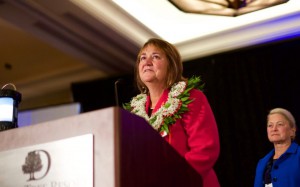
Bishop Karen Oliveto. Photo by Patrick Scriven, Pacific Northwest Conference.
initiatives and in response to natural disasters. And, where willing, they would share and contribute to critical agencies like Wespath (the UM Church’s pension and health benefits service). From time-to-time, perhaps once every four or five years, the leadership of the various entities would, in a way similar to the present World Methodist Council, meet together to make decisions regarding those ministries and agencies they shared in common.
Such a plan would, at least in some sense, accomplish the COB’s two major goals: it would definitively resolve the debate over the church’s sexual ethics, and also maintain unity. The subsidiary entities would be autonomous, each with their own names, and the right to make their own decisions regarding doctrine, polity, and social issues, but all would operate under and partake in a United Methodist “communion.”
The plan would have the added benefit of liberating three distinct bodies to engage in creative forms of ministry without the constraints of a current institutional structure that people across the connection believe is too costly and bureaucratic for the severe demographic challenges the church will be forced to confront in the 2020s.
However, such a plan faces serious, and perhaps even insurmountable problems. First, the very aspects that make the plan commendable could lead to its undoing. To create such a communion would almost certainly require constitutional amendments for its creation. That means over two-thirds of the delegates at the 2019 General Conference would need to approve of it, and then it would need to garner two thirds of all the votes in all the annual conferences for ratification. Not only would that process be time consuming, delaying any implementation for one to two years, it would give opponents ample opportunity to rally just thirty-four percent of United Methodist annual conference delegates to defeat it.
Second, people would justifiably question the utility of creating an umbrella organization like a United Methodist Communion if, in fact, such a communion would not be substantially different from the existing World Methodist Council. Would it not be easier, critics might ask, to simply spin off organizations like UMCOR, GBGM, and Wespath, and just allow the three new entities or denominations to use or participate as they wish? A United Methodist Communion would provide only a patina of unity, seem superfluous to many, and so, in time, it would be short lived.
Third, many reconcilers affirm the UM Church’s doctrines, polity, and its stands on various social issues, they just don’t want to fight over them. They are inclined to give people wide latitude to believe and do as they please as long as they do not embarrass the church in the public square or the wider culture. In fact, they are so contented with the name United Methodist that they would be reluctant to yield it up to a supra-organization as the price for a semblance of unity.
Where the debate over the church’s sexual ethics is not raging – in places like Africa and The Philippines – the United Methodist name is widely respected. Many members in these regions would chafe at being asked to align with one of the three entities and thereby accept a new name when they are happy with the present one. They believe U.S. liberalizers are largely responsible for driving the battle over the church’s sexual ethics. They would prefer the liberalizers simply exit the church if they cannot live by its standards.
Liberalizers, however, have no interest in creating their own entity or denomination. Their stated goal has always been to redeem the one they are presently a part of. They too would resist giving up the name United Methodist. To be sure, they wouldn’t be satisfied with a church still short of fully including LGBTQ+ people, but they have fought long and hard for full inclusion, and would feel confident reconcilers would eventually see the light. So for a time, the liberalizers and reconcilers would remain united and continue to debate the church’s sexual ethics and teachings on marriage. Liberalizers would constantly be pushing for full inclusion and full participation. Left leaning reconcilers would show signs of yielding. And right leaning reconcilers would grow frustrated, discovering that the unity and peace they thought they had won was only fleeting, forcing them once again to make a definitive decision they hoped to avoid.
Conservatives too would likely have serious reservations. So much water has gone over the dam since the 2016 General Conference that they have little appetite for remaining yoked to liberalizers. The heightened acts of ecclesial defiance and Oliveto’s election have soured conservatives on the idea that unity can be preserved. Many would balk at finding themselves under an umbrella or big tent with the liberalizers who defied the church’s teachings or even the reconcilers who countenanced the defiance. And they would certainly be opposed to any configuration that forced them to acknowledge an openly gay person as their bishop.
Furthermore, a growing number of conservatives find no great benefit in the name “United Methodist,” indeed, some consider it a hindrance. Many of the denomination’s largest and fastest growing congregations do not feature the name on their signs or other forms of publicity. For instance, the two large congregations who exited from the Mississippi Annual Conference were simply known as Getwell Road Church and The Orchard. At this juncture some conservatives would regard a United Methodist Communion as a fiction at best, and at worst, a supra-organization that would continue to entangle them in unwanted alliances and continued fighting with liberalizers and reconcilers.
So, if a “big tent” or “umbrella” faces such daunting challenges what are other viable options?
Liberalizers Should Leave
A significant number of global conservatives believe they know the best way forward: liberalizers should simply leave the church. After all, the denomination has repeatedly rebuffed their attempts to liberalize its teachings, and it is likely to do so for the foreseeable future. Conservatives in this camp think this way forward can be implemented in one or two ways – amicably or legislatively and litigiously.
Under the much preferred amicable plan, the UM Church would graciously allow all liberalizer congregations and even annual and jurisdictional conferences to exit the denomination with all their property and assets, and they would apply no penalty for unpaid apportionments.
Under the more onerous legislative and litigious plan, the UM Church would close the legislative loopholes liberalizers have exploited in the past, and begin strictly enforcing church law with stiff sentences for all those who defied it. In short, the litigious plan calls for forcing liberalizers out of the denomination and any reconcilers who would abet or countenance their defiance.
These plans are siren songs for conservatives across the global connection. They are, by far and away, their preferred way forward. However, neither is likely to come to pass.
First, the idea that liberalizers will amicably leave the church is naïve at best, and delusional at worst. The plan fails to take liberalizers seriously. As stated above, they are not interested in creating a new denomination; they want to redeem the one they are a part of. They find offers to leave, even offers to leave with all their property and assets, to be insulting, as if they are fighting for their “piece of the pie.” Some conservatives like to tell themselves liberalizers do not want to leave because they know they do not have the financial resources to create their own church. This may or may not be true, but it’s beside the point. When you believe you are fighting for justice, you don’t surrender for property and assets. People who do that are called “sell-outs,” and that term is anathema to social justice advocates.
 Second, the idea that liberalizers can be forced from the church is almost as far fetched as them voluntarily leaving. If the events of the past two or three years have definitively demonstrated anything, it is the truism that all the right laws in the church are of little avail if bishops and annual conferences are unwilling to enforce them. That is surely the case in the United States, and it will continue to be the case for years to come. The vast majority of U.S. bishops simply have no stomach for all the bad press that would surround church trials and the eviction of clergy and their colleagues from the denomination.
Given the structural shape of the church in the U.S., these dynamics are unlikely to change any time soon. Conservatives have to work mightily just to defend the church’s current sexual ethics and ordination standards. Closing loopholes and passing more robust legislation is possible, but it will take time and it is by no means inevitable. To be sure, conservative U.S. jurisdictional conferences will elect some conservative bishops who might strictly enforce the Discipline. However, reconcilers and liberalizers will elect far more of their own kind. Just as their predecessors found ways to thwart the will of General Conference, they will do the same, and they will do so even if future General Conferences manage to tighten church law and close loopholes.
Finally, it would seem reasonable for the Commission to reject these plans; they are simply non-starters. In that event, conservatives invested in them would need to acknowledge that they are on their own, and are likely in for a fight that will last for at least another decade or two.
Conservatives Should Leave
Another option would be for conservatives to leave the church. In the U.S., this is unfortunately happening every day, individual by individual, family by family, and in some cases, whole congregations. Many conservatives are as frustrated as reconcilers and liberalizers with the current state of affairs. They believe the church has reached an impasse, the differences are irreconcilable, and therefore further debate is only destructive. Some are clearly ready to leave the denomination – if the terms are acceptable.
But only some conservatives think this way. It is now likely that the majority of U.S. conservatives are in this camp, but the majority of conservatives in Africa, Europe, and The Philippines are not.
Furthermore, for many U.S. conservatives general church matters are not a high priority. They see little benefit in supporting several of the denomination’s general boards and agencies, particularly those they regard as hostile to the church’s sexual ethics, its teachings on marriage, and its ordination standards. In truth, many conservative pastors do what they can to shelter their people from the doings of U.S. bishops and many of the UM Church’s general boards and agencies. As the 2010 Call to Action Report revealed, United Methodists, not just conservatives, have little confidence in U.S. bishops, and believe the church’s bureaucracy is a drag on the denomination.
Therefore, at least some conservative pastors and congregations would leave under the following conditions: they are given title to all their property and assets, and they are immediately free of sending apportionment dollars to their annual conference and the general church.
But there are problems with this way forward too.
First, the majority of conservatives are not invested in this option. Indeed, where conservatives are at their strongest – in Africa and The Philippines – there is little or no interest in this plan.
Second, even in the U.S., a determined minority would reject, out of hand, any offer to leave. Why, they would justifiably ask, should we leave when we represent the majority of the global church, and when the church continues, at least on paper, to support sexual ethics, teachings on marriage, and ordination standards rooted in Scripture and the traditions of the church catholic? They would continue to ally with their global brothers and sisters to fight for what they think is right.
To be sure, a generous exit offer would bleed off some conservatives, but not all of them. Reconcilers and liberalizers would likely find themselves still locked in a church with no interest in reconciliation or liberalization when it came to the presenting issues. In short, there would be no definitive resolution to the matters that exercise us, and therefore precious little unity.
The Messy and Realistic Way Forward
Given this appraisal, it is no wonder the Council of Bishops seized on the creation of a commission. It allowed them to pass along the task of resolving the greatest challenge the UM Church has confronted in its nearly 50 year history. A task many believe they could have resolved by fulfilling their duty to promote the church’s teachings and seeing that its teachings and standards were followed.
Obviously, the commission needs our prayers, patience, and perhaps most importantly, our pragmatism. United Methodists need to disabuse themselves of the idea that the Commission on a Way Forward is going to produce a plan that definitively solves the debate over our sexual ethics and keeps the church united; it’s not. Given all that has happened in just the past year, the divisions are now too deep, and therefore, some are bound to find any plan of unity to be a fiction at best.
Realistically speaking, for those who support unity at any price, they will have to accept, at least in the short term, further battles over the church’s sexual ethics, teachings on marriage, and its ordination standards. Reconcilers, most liberalizers, and many conservatives all say they want unity, but they all still want it on their own terms. That’s undoubtedly a recipe for more church skirmishes.
And for conservatives who just want to be free of the fractious debate, they will have to accept that the way out could come at a steep price. It is possible the Council of Bishops will balk at any proposal allowing conservatives to leave with all their property and assets and the immediate cessation of apportionment payments. Such a stiff response would force those conservative congregations that wanted to leave into potentially protracted, costly, and uncertain legal battles over their property and assets. Other mainline denominations, particularly the Episcopal Church, have demonstrated how costly and bitter that path can be. And even if they were able to break free of the UM Church, they would face the challenge of either going independent or joining a new connection of like minded local churches. Either option would come with its own set of challenges.
It is likely, indeed probable, a mix of much of the above will come to pass no matter what the commission recommends, the COB proposes, and the called General Conference approves come February 2019. There are no good options, only less bad ones. And whatever option is proposed, some will not like it. Still, the number one priority should be ending the conflict definitively, so the church can focus on the mission of incarnating the ministry of Christ and making disciples.
The Commission on a Way Forward is likely to submit its recommendation no later than the COB’s April 2018 meeting. And the COB must publicly release a final proposal 230 days before the called 2019 General Conference, which means the proposal will be available for all to review no later than July 4, 2018.
For now, wise and faithful pastors and lay leaders will spend the interim providing their local churches with as much information as possible, and carefully preparing their local congregations to respond accordingly.
Walter Fenton is a United Methodist clergyperson and an analyst for Good News.