by Steve | Jan 12, 2018 | January-February 2018, Magazine, Magazine Articles
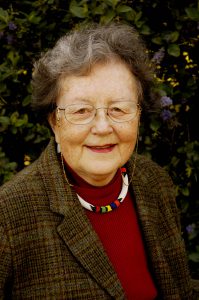 The Rev. Jeanne Audrey Powers died while traveling in Switzerland on September 29, 2017. She was 85. The obituary from the Minnesota Annual Conference was on target: “Always on the leading edge of historical shifts in culture, Rev. Powers was a global-level advocate for a more progressive, inclusive faith, focused on inclusive language, relevant liturgies, LGBTQ struggles, and opening leadership opportunities to women, young people, and people of many cultures.”
Let us mark her passing by expressing heartfelt respect for Powers – even though Good News was on the opposite side of key issues within United Methodism. Over the years she served in various capacities, most notably with the General Commission on Christian Unity and Interreligious Concerns, and the World and National Councils of Churches. Her obituary properly notes,“Until her death, she was a driving force in the Reconciling Ministries Movement and she came out as a lesbian during her sermon at its national gathering in 1995.” She was 63 years old at the time.
While she was widely praised throughout the UM Church for the courage of her decision, the Good News board of directors stated its belief that her public declaration was “openly defying the witness of the United Methodist Church” and “raising the challenge as to whether United Methodism can and will effectively enforce its own Discipline.”
Despite Good News’ opposition to her announcement, the Rev. Powers was a faithful paying Good News subscriber until her death. Last year, she called our offices to check on her subscription and kindly reminded us that she was on “the other side” but also said she loved our magazine because she felt we did a good job of explaining difficult issues. For the editorial team, this was a treasured comment.
Powers was an unapologetically liberal lioness, but she was also gracious, fair-minded, and intellectually curious. During her twilight years, we were able to let her know our appreciation of her consistent readership. In this day and age, we are gratified when progressives like Powers are willing to read publications outside their echo chamber. Conservative evangelicals are best served when they do the same.
Recently, we were startled and disappointed to read one of our leading United Methodist bishops publicly admitting “having given up Christian Century (too predictably liberal), Christianity Today (too Calvinist) and First Things (too predictably conservative) long ago” and only subscribing to a Quaker publication. We have no need to criticize this leader’s desire to winnow down his reading list. We trust that he is a vigorous thinker and lifelong learner. We would simply ask that the subscription decisions be reconsidered. Of course, this is an important issue to us. We gain a lot from journals of opinion – as would UM clergy and laity. Although we are an independently-supported magazine with a decidedly evangelical and traditionalist viewpoint, we put a premium value on fairness, charity, and reliable journalism. We welcome readers – the ones who agree and the loyal opposition.
“I have chosen to swim against the stream in many areas of controversy [in the church] because I truly believe that the Church is the Body of Christ, called to share its message of healing, reconciliation, and yes, salvation,” said Rev. Powers. “I do not choose the Church simply because I want to belong, but because I believe in its transforming Spirit.”
We did not agree upon many things, but we share a belief in her words above. Despite our differences, we will always be grateful for her graciousness and eager willingness to read broadly. Jeanne Audrey Powers, RIP.
– Good News.
by Steve | Jan 12, 2018 | January-February 2018, Magazine, Magazine Articles
 By Steve Beard
For three years, they were ultimately voyaging back home. Along the way, they circumnavigated the globe – without so much as a compass. The crew of the Hokule’a, a 62-foot-long Polynesian sailing canoe, traversed more than 40,000 nautical miles in its epic journey with no engine or modern navigational instruments. Having set sail in 2014, the crew returned to Hawaii in July 2017. Guided only by their assessment of the sun, moon, stars, wind, swells, and sea life patterns, the Polynesian Voyaging Society accomplished a global trek that most people thought was impossible.
In an era enamored by technological pinnacles, chalk this extraordinary triumph up to the ancient South Pacific ways.
In order to grab hold of the wow-factor behind this feat, forget about touristy ocean cruising. On the Hokule’a (ho-koo-lay-ah, “Star of Gladness” in Hawaiian), there was no midnight buffet, ice sculptures, or cocktails on the lido deck. There was no refrigeration, restroom stalls, or internet café on the catamaran-style vessel. The showers were buckets of seawater and the canvas-covered sleeping quarters were 6 foot segments marked out in the hulls where the 12-member crew slept head-to-foot. Spartan conditions. Spectacular adventure.
Participating in month-long shifts, there were more than 250 different volunteer sailors. “They strapped on safety harnesses to change sails and tighten lines; hauled heavy anchors out of the water; loaded bulky supplies; cooked hearty meals for a dozen people using a camping stove,” Marcel Honoré reported in the Honolulu Star Advertiser. (more…)
![Unleashed for Ministry]()
by Steve | Jan 12, 2018 | January-February 2018, Magazine
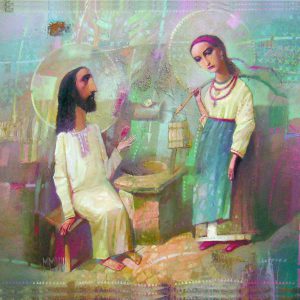
Jesus and the woman at the well by Ukrainian artist Oleksandr Antonyuk. Used by permission of the artist.
By Cara Nicklas-
I want to see revival in our church. I want to be part of a movement of God. And the church as an institution excites me only in so far as that institution is willing to submit itself to that larger movement of God.
Our church is at a crossroads. Some would even say we are in crisis. And there is plenty of blame to go around. We can blame the bishops, General Conference, and our pastors who have ignored the issues that have resulted in this defining moment for our church.
Speaking as a lay person, however, it is important for laity to share the blame as well. If we earnestly long for a vibrant renewal of the Wesleyan movement, we lay folks must seriously examine ourselves and our personal responsibilities in an honest and fair manner.
As a way of making that examination, I’d like to briefly reconsider why the Wesleyan expression of Christianity inspired so many of us in the first place.
We Methodists have a long rich history of leading people to Christ and then helping them grow as disciples who are passionate about sharing the Gospel with others, in both word and deed. Our roots are grounded in a Wesleyan theology that strikes the perfect balance between truth and grace, head and heart, personal piety and social holiness.
I love the richness that comes from our global denomination, one that is committed to the great teachings of the Christian faith that reach all the way back to the early church. The Apostles’ and Nicene Creeds remind me that I am joining with that great cloud of witnesses that preceded us, and with brothers and sisters around the world. The church’s historical and global context keeps me from making a mistake we are prone to make: interpreting Scripture and the great confessions of our faith solely within the context of our own culture. Our Wesleyan expression of the faith is truly global in its appeal.
In 2016, I was a delegate to General Conference in Portland, Oregon. Overall, it was a discouraging and frustrating experience. But there was a moment that profoundly moved me. The worldwide nature of our church was evident during the opening worship service when we sang the hymn “Holy, Holy, Holy” in various languages. I stood in the conference center surrounded by my brothers and sisters from Africa, the Philippines, Russia, and other parts of the world, as we sang this familiar hymn together. We sang each stanza in a different language. The last stanza was in English and the swell of voices unified in our praise to God moved me to tears. One African delegate later commented to me that it was an image of heaven. And it was. We don’t want to lose that connection – we want to restore it and build on it.
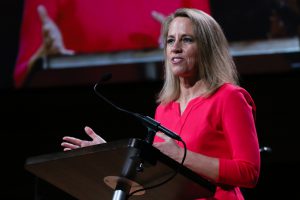
Cara Nicklas speaking at the Wesleyan Covenant Association gathering in Houston. Photo by Steve Beard.
But, juxtaposed with the encouragement I felt singing “Holy, Holy, Holy” was the realization that more often than not our church bears the marks of a stagnated, inward looking institution, rather than the marks of a passionate, outward looking movement. Our denomination has increasingly come to depend on professional clergy for the work of the church. We might talk about how we are partners in ministry – clergy and laity – but in practice, we laity are not equipped, empowered, or released to do ministry both within and outside the walls of the church. Sure, we might be asked to round up volunteers for the nursery or head up the local canned food drive. But too often, we lay folks have been content to leave evangelism and discipleship to our pastors. And I think we all know deep down that’s not how Jesus envisioned the Great Commission.
The mission statement for The United Methodist Church is: “Making Disciples of Jesus Christ for the Transformation of the World.” It’s an admirable and good mission statement. But within our denomination I think there is a philosophical difference about whether transforming the world leads to making disciples of Jesus Christ or whether making disciples of Jesus Christ leads to the transformation of this world.
Some United Methodists emphasize transforming the world first, so they choose to pour significant resources into lobbying efforts for social justice issues. They place a lower emphasis on literally sharing the Gospel story with others. They seem to believe that by demonstrating our passion for a wide array of social justice issues, people will come to know Christ, if not as their Savior, then at least as a historical figure worthy of their emulation. The church, they argue, will attract new adherents by being on the right side of this or that social, economic, or political issue.
I don’t believe the data supports that approach. And even if it did, I’m convinced it’s the wrong way forward.
Please do not misunderstand me; I am not trying to downplay the importance of our social witness. I just don’t believe we will ever be good and discerning advocates of social issues without the saving knowledge of Jesus Christ as our Lord and Savior. If we are to become, once again, the movement our founder intended us to be, then lay people must recapture our passion for telling others about Jesus.
Since the creation of The United Methodist Church in 1968, membership has declined every year in the U.S. And over the past 10 years, average worship attendance has fallen dramatically. So at General Conference I found it baffling that we never addressed two critical questions: Why are we not a growing church? And what must we do to become a growing church?
At General Conference, we spent an inordinate amount of time debating social and political issues: divestment from Israel, climate change, a single payer healthcare system, and so on. But little or no time was given to how we might more effectively share the Gospel with the lost and hurting in our societies who are in need of a saving relationship with our risen Lord. We spent more time attending to the institution’s needs and what the institution should say about this or that issue, rather than how the institution can become a growing movement committed to making disciples for Jesus Christ.
To my fellow lay persons, it is up to us to have that discussion even if our leadership fails to have it. It is time for us to initiate that discussion in our local church.
And if we are going to do that we have to ask ourselves some challenging questions:
• Am I becoming a spiritually mature Christian?
• Am I intentional about cultivating those disciplines that lead to a life that honors God?
• Am I regularly reading Scripture with others?
• Earnestly praying with others?
• Confessing my sins to close friends in the faith so they might challenge me and help me to grow?
• Am I joining with them to tell others about Jesus?
• Am I serving people who are lost and lonely and need to hear the Good News?
• In short, am I living the Wesleyan expression of the Christian faith?
I know many of us readily volunteer to fill various roles in the church. We sing in the choir, serve as ushers, chair a committee, or even lead a local mission project. Those roles are needed. But those are not substitutes for participation in small groups where we read and study God’s word together, where we are willing to humble ourselves for our own good, and where we challenge one another to grow deeper in our faith in Christ.
We need ushers, and we need someone to chair the finance committee, but more than anything, we need people fully invested in becoming mature Christians who know how to, and passionately want to, share the Gospel of Jesus Christ with others.
What I am describing here is in large part the genius of the Wesleyan expression of the Christian faith: the emphasis John Wesley gave to small, accountability groups. If we are to grow again as a church, we laity will have to rededicate ourselves to becoming mature Christians who are equipped to share the Good News. (See The Band Meeting: Rediscovering Relationship Discipleship in Transformational Community (Seedbed) by Professors Scott Kisker and Kevin Watson.)
That means we need more laity to claim ownership of a small group. Pastors cannot do everything in our churches. They, of course, have an important role to play in equipping lay leaders so they can effectively lead small groups with sound teaching and a good understanding of the Wesleyan approach to Scripture.
At the same time, laity must step up and ensure that our congregations have small groups where men and women read Scripture together and so are challenged and transformed by it.
I have been in plenty of small groups where leaders use curriculum that references Scripture in passing. Teachers show up with a short list of questions to toss out to the group for discussion without the group having studied or prepared in advance. I mean no offense, but too often this results in a group of nice people sitting around sharing their feelings. And this frequently includes misguided theology that goes unchallenged. Someone says something like, “I think as long as a person is sincere in what he or she believes about God, that’s good enough.” Or they say, “Everyone’s interpretation of Scripture is equally valid.” And the rest of us politely nod our heads in agreement.
There must be someone in every small group who gently pushes back on such statements. Spiritual maturity only occurs when we dig deeper into what Scripture and our timeless confessions of faith have to teach us about spiritual maturity.
I know what some of you are thinking. We know from Scripture that God gives each of us certain gifts. And you are thinking, I’m not really a teacher. I don’t have the spiritual gifts of evangelism or shepherding. We have a tendency to claim not to be gifted in an area that is hard – that stretches us – that is time consuming, or that we just don’t want to do.
Friends, God is forever asking us to do things outside our comfort zones. The Bible is filled with leaders who tried to tell God they could not do this or that, or that he’d be better off choosing someone else. God wasn’t interested in their excuses, and I doubt he’s interested in ours.
I have two sons, Connor, my older son, and Evan, my younger one. When they were growing up, we’d be at McDonald’s and I’d instruct Evan to go ask one of the employees for some ketchup. He’d immediately turn to Connor and beg him to go instead. The thought of actually talking to a stranger made him genuinely anxious. Connor didn’t know a stranger, so he’d happily oblige. And at church youth group meetings, Evan rarely if ever shared his thoughts or contributed to the discussion. He did not feel equipped or knowledgeable enough to speak up.
So, you can imagine my husband’s and my surprise when during his freshman year of college, Evan was asked to teach and lead the youth group for our church’s new satellite campus. Admittedly, my first thought was, “That’s not his gift? Why would our pastors ask Evan to teach when they must know how uncomfortable he is speaking to others?”
Evan could have replied, “Teaching and leading are not my gifts.” Or, as a busy biology major with a rigorous course load, he could have said, “I don’t have the time.” But to my surprise he said, “Yes.” Evan demonstrated a sense of spiritual maturity I admire, and over the last few years, I can see incredible growth in his life because he had the courage to say, “Yes.” True, it takes him twice as long as it would take his brother to prepare a lesson because he feels the need to over prepare. But he willingly does it because he wants these kids to know Jesus.
Are you doing something in the way of discipleship or evangelism that is outside your comfort zone? Maybe you really don’t have a gift of teaching or even talking in a group of people. You might ask yourself what you can do to help someone who has agreed to lead a small group. And you might figure out how you can help lead at least one person in your church who needs their heart strangely warmed or who needs nudged to grow deeper in the faith. If you are in a small group, do you study and prepare before you gather so that you are a contributor to the discussion? Bible study is meant to be done in community. If you aren’t leading, are you at least preparing so you can genuinely participate?
And pastors, I assure you Evan would not have emerged as a leader and used his gifts if a pastor had not reached out to him and made the ask. A pastor saw something in Evan that his parents and he himself didn’t see. Please don’t overlook the quiet person, the introvert in your church, who might be willing to step outside his or her comfort zone. Instead, help that lay person hear God’s call. Equip that person and give that person authority to be a minister of the Good News of Jesus in the world.
Recently I was reading the familiar story in the Gospel of John of the Samaritan woman at the well. You know the story. Jesus is in Samaria and stops at Jacob’s well in the heat of the day. The Samaritan woman comes to draw water. Jesus asks her for a drink; she is shocked. He’s a Jew; she’s a Samaritan. He’s a man, she’s a woman. Jesus reveals he knows her, warts and all. And yet he offers the woman living water and declares he is the Messiah. That’s the most familiar part of the story.
But I want to focus on the rest of the story, on that Samaritan woman. She leaves her water jar, goes back to town and tells the people, “Come, see a man who told me everything I ever did. Could this be the Christ?” And Scripture says, many of the Samaritans from that town believed in him because of the woman’s testimony.
Many Samaritans believed! Why? Because a woman who was an outcast in that town experienced the love of Christ in such a profound way that she couldn’t keep the news to herself.
• The Samaritan woman didn’t return to town and think to herself, “I must find the religious leader in my community and ask him to tell the people in town about the Messiah.”
• She didn’t return to town and think, “I must organize a food bank because if I make sure the poor are fed, then people will figure out by my example of generosity that this man Jesus is the Savior of the world.”
• The Samaritan woman didn’t think to herself after meeting Jesus that she wished she had the gift of evangelism or apostleship, because if she did, she’d be able tell others about Jesus.
No. The Samaritan woman, the outcast, the sinner, the woman who came to draw water from the well at high noon to avoid socializing with others – she told the whole town about Jesus!
Friends, I know the excuses for not telling others about Christ because I’ve used them myself. I don’t want to offend someone by imposing my beliefs on them. So, I’ll just be nice to them and hope they become a believer based on my kindness. We Methodists even boast about how we don’t try to impose our faith on others.
If I think someone might be open to coming to church or hearing about Jesus, I much prefer telling my pastor, “Hey, I know this person you should talk to who needs to know Jesus.”
Or, I will pour all my energy into a worthy ministry: the after school program at my church, helping build homes for the poor, or organizing others to buy Christmas gifts for needy children. These are wonderful things to do, but when I’m honest with myself, I have to admit I sometimes do them to justify not actually using words to tell others about Jesus. Ironically, my good deeds in Jesus’ name are actually my cover for not telling people about Jesus.
The Samaritan woman shows us these excuses don’t exempt us from proclaiming the Good News. If we have a deep relationship with Christ that causes us to marvel every day at how God’s grace is even sufficient for us, how can we not share our story with others?
My hope for the next Methodism does not lie with the Commission on a Way Forward, our Council of Bishops, or even our General Conference. My hope lies with my fellow lay persons. Or to put it more correctly, my hope is in Christ working through laity who long to become spiritually mature Christians, and so in turn feel a burning desire to tell others about the overwhelming joy of knowing Jesus as their Lord and Savior.
Cara Nicklas is an attorney in Oklahoma City, a General Conference delegate from the Oklahoma Annual Conference, and a council member of the Wesleyan Covenant Association. This essay is adapted from her October 2017 address to the Wesleyan Covenant Association gathering in Houston.
by Steve | Jan 12, 2018 | January-February 2018, Magazine, Magazine Articles
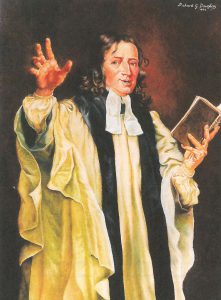
Dr. Richard Douglas painted this portrait of John Wesley in 2003. According to the late Dr. Kenneth Kinghorn, the portrait shows “Wesley preaching without notes, while holding his famous field Bible….He wears no wig, and his natural hair had a slight auburn tint” (John Wesley: An Album of Portraits and Engravings, Empethpress.com). This portrait hangs at Asbury Theological Seminary.
By Donald Haynes-
For the first time since the young United Methodist Church struggled with our theology in 1968 and again in 1988, we are once again asking, “What do the spiritual progeny of John Wesley believe?” Just as importantly, however, is the unusual linkage that Wesley (1703-1791) made between what we believe and how we live. Wesley’s disagreement with Lutheran and Calvinist theology was that while we are saved by our faith in God’s grace, we are saved to “faithfulness.” He called it “holiness of heart and life.”
In the coming months of 2018-2020, United Methodism must examine our roots of what we believe and how that belief affects our morals and ethics. Whether we are “progressive” or “traditional” in our theological bent, our present way forward must be done in the context of historic Wesleyanism. To use seminary terminology, what is our Wesleyan relationship between orthodoxy and orthopraxy? We must be true to who we are. So what is our “consensus of faith” rooted in the Methodist movement within the Church of England and, even more importantly, what is our evangelical heritage in American Methodism, United Brethren, and the Evangelical Association?
In the important but often overlooked book, John Wesley’s Experimental Divinity by Dr. Robert Cushman of Duke Divinity School, we see early Methodists finding common affirmation to the Latin term “consensus Fidelium” or “consensus of faith.” That is, “what do we children of Wesley hold in common; on what can we agree to be our theological heritage?” This will never mean that every United Methodist has the same conscience regarding what is right and what is wrong in the sight of God. Truly, we are called to Wesley’s insistence that we “love alike” even when we do not “think alike.” But that “catholic spirit” does not give us the freedom to “love God and do what we please.” That is called “antinomianism” (anti means “against” and nomos means “the law”). Antinomianism disengages doctrine from a disciplined life.
Holy living was a dimension of being a Christian that Wesley retained from his own journey that began in his college days at Oxford in 1725 and continued until the marvelous night of Aldersgate on May 24, 1738 when he “felt his heart strangely warmed.” While it was not until that night that he felt the inner peace that comes with knowing our sins forgiven, Wesley had practiced Christian discipline (“holy living”). He calls it “the habitual disposition of the soul which in the Sacred Writings is called ‘holiness,’ and which directly implies the being cleansed from sin, ‘from all filthiness both of flesh and spirit,’ … being so ‘renewed in the image of our mind’ as to be ‘perfect as our Father in heaven is perfect’” (Matthew 5:48).
As Dr. Randy Maddox of Duke Divinity School has so clearly outlined for us, Wesley’s grace theology was not totally the divinely initiated grace that the Calvinists believe in. Rather it was what Maddox calls in his book by the same title, “responsible grace.” That is, Wesley insisted that God first loves us as we see in John 3:16: “God so loved … that God gave … that we might have eternal life.” However, we are free to accept or reject God’s love and, if we accept God’s initiating love, we are required to practice a disciplined response, just as any responsible relationship does.
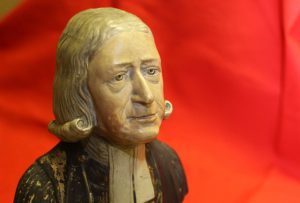
Bust of John Wesley from the famous English artisan Enoch Wood (1759-1840). A UMNS photo by Kathleen Barry.
John Calvin (1509-1564) believed that grace is irresistible; Wesley believed that we have the free will to resist or reject God’s love. Maddox calls this “synergism.” In accepting God’s grace, we must live “in sync” with Jesus. John the Elder wrote in his second epistle, “This is love: that we walk in obedience to his commands. As you have heard from the beginning, his command is that you walk in love” (II John vs. 6). In his third epistle, John wrote to Gaius, “I have no greater joy than to hear that my children are walking in the Truth” (vs. 4). All these and many more scriptural references document Wesley’s insistence that God’s initiating grace is to be met with our responsive faith; so it is that we are saved by God’s grace through our responsive faith.
The “consensus of faith” that Cushman delineated correctly identifies three “faces of grace.” First of all is God’s preparing grace that in older language was called “prevenient grace.” Prevenient grace is indeed at God’s initiative. Then, if we might be colloquial, “the ball comes to our court.” If we respond affirmatively, we reach what Wesley called the “porch of salvation” and we repent of our sins. But repentance is not remorse; it is an active work of the Holy Spirit witnessing with our spirit that our confessional repentance is met with what Jesus illustrated as the “waiting father” in the Parable of the Prodigal Son. We are changed. That is, God meets our response to his love with what Wesley experienced at Aldersgate — a strangely warmed heart. It is the second dimension of what Wesley called the “scriptural way of salvation.” The revival movement of the 19th century codified this as “being saved.” Paul describes it in Romans 8 as “His Spirit witnessing with our spirit that we are children of God, and if children, then heirs, heirs of God and joint heirs with Christ.”
Our consensus of faith for Wesley and for early Methodism was that we are called by God’s initiating, preparing grace, we respond with repentance that is met with our heavenly Father’s love. Then, our doctrine moves to a life of discipline and obedience to the leading of the Holy Spirit for changed lives. Wesley here taps into his Anglo-Catholic heritage of what he called “inner and outward holiness of heart and life.” This dimension of our Christian journey lasts the rest of our life with its several seasons and many twists and turns. For a century we called it “sanctification.” Then, for a century, we dropped it from our teachings. More recently, we call it “perfecting grace.” Walking with Jesus, we grow in grace. Wesley called it “grace upon grace.” He even defined the discipline by which we walk this journey as a “means of grace.”
Wesley’s list of the “means of grace” varied from time to time, but always included prayer, searching the scriptures, frequent communion, and regular church attendance. Along the way, we are either dramatically or quietly filled with the Spirit, becoming what Paul called “in Christ.” Wesley preferred clinical language over courtroom or juridical language. He called Jesus “the great physician of souls” and called being saved, “taking the cure.” Faith was not a set of beliefs, but for Wesley it was “a living, saving faith,” adaptable to our life seasons and circumstances. Clearly, our common faith heritage is that we must forever keep linked the beliefs of the head with the confirming testimony of the heart. Orthodoxy must be linked with living a life that “becomes the Gospel.” This means self discipline – and as Wesley reminded his followers, being a Christian means “denying ourselves (certain liberties of indulgence) and taking up our cross daily.”
Dr. Cushman died in 1989 with a posthumously published warning: “Wesley’s ‘experimental divinity’ had lost currency and by the latter part of the 20th century was not regarded as essential, and affirming it was often received as controversial. Meanwhile the spectacular decline of the past decade and more may suggest that many have wearied beyond endurance with a church that manages mainly ‘the form of godliness that is doctrinally shapeless.’”
Frighteningly, many United Methodists today are not comfortable with being called “evangelical.” However, the “consensus of faith” in our heritage is unequivocally evangelical. Immediately following the Christmas Conference in 1784, these words were printed in the prototype of our Book of Discipline: “Far from wishing you to be ignorant of any of our doctrines, or any part of our discipline, we desire you to read, mark, learn, and inwardly digest the whole….”
The “consensus Fidelium” was, and should still be, our consensus of faith and faithfulness, our common consent to what the early preachers called “Wesley’s little body of divinity” or his “Scriptural Way of Salvation.”
Donald W. Haynes is a retired United Methodist clergyperson from the Western North Carolina Annual Conference, author, and adjunct professor of United Methodist Studies at Hood Theological Seminary.
by Steve | Jan 12, 2018 | January-February 2018, Magazine, Magazine Articles
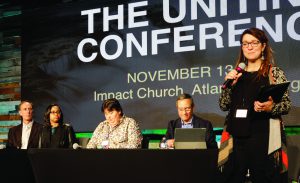
Panelists addressed attendees at the Uniting Methodist Conference. The panelists (from left) are: The Revs. Tom Berlin and Jasmine Smothers, Helen Ryde, Neil Alexander and the Rev. Rachel Baughman. Photo by Kathy L. Gilbert, UMNS.
By Kathy Gilbert-
As The United Methodist Church faces a decision on how to include LGBTQ people, those attending a conference grappled with the issue by asking themselves: What would Jesus and John Wesley do?
The Uniting Methodists Conference was held November 13-14 at Impact Church in Atlanta, a United Methodist multicultural congregation led by the Rev. Olu Brown. Approximately 300 people sat in round tables inside the sanctuary while another 100 joined online from 50 locations across the U.S. and the globe.
“Our stance is Jesus; everything else is conversation,” said the Rev. Mike Slaughter, retired pastor of Ginghamsburg United Methodist Church, in one of three worship services held during the gathering.
Uniting Methodists was formed in 2017 from what organizers termed the “vibrant” center of the denomination. The group advocates for the church to stay united by changing church policies to “allow but not compel” pastors to officiate at same-gender weddings and let conferences decide whether or not to ordain LGBTQ clergy.
Since 1972, The Book of Discipline, the denomination’s lawbook, lists both the blessing of same-gender unions and being a “self-avowed practicing” gay clergy member as violations of church law.
The Uniting Methodists Conference states, “We’re a church that holds together both an evangelical desire to lead people to Christ and a passion for justice. We hold together an emphasis on both grace and sanctification. Our church includes moderates, conservatives, and liberals, and we know that we are stronger because of it.”
David Field, author, theologian and a member of the Commission on a Way Forward, presented two lectures that focused on the theology of the denomination’s founder, Wesley. “It takes courage to love every soul God has created,” Field said, explaining what Wesley preached. “We are to support each other’s ministry, pray for each other and view each other in the best positive light,” he said. Rather than judging others, Wesley said, “Judge yourself harshly,” Field said.
The gathering also heard from two other members of the Commission on a Way Forward, the bishop-appointed group charged with recommending ways to move The United Methodist Church beyond its impasse on homosexuality.
The Rev. Tom Berlin, lead pastor of Floris United Methodist Church in Herndon, Virginia, and the Rev. Jasmine Smothers, lead pastor of Atlanta First United Methodist Church, reflected on the work of the commission and the special General Conference 2019. Another member of the Commission on a Way Forward, Dave Nuckols, was also in attendance but did not speak from the podium.
“There is no magic wand,” Berlin told the gathering. “You have to be self-feeders. We are in hard times. The key issue of The United Methodist Church is vitality. The LGBTQ issue is an important issue, but the bishops have told us everything is on the table.”
Smothers preached on Mark 2:1-12 about the four friends who pushed through a large rowdy crowd to bring their paralyzed friend to Jesus. They ended up carrying him on a mat to the roof and digging a hole to lower him in front of Jesus. As those four men were pushing through the crowd they couldn’t have been too nice or they never would have made it, Smothers said. “The world needs to know people love them,” she said. “Stop worrying about your pension. Get a mat and carry them to Jesus!”
Helen Ryde, who called herself a queer person and is the Southeastern regional organizer for Reconciling Ministries Network, said it is time for bravery. “I really believe there is a person in every church who is having inclusive thoughts, but they are terrified they are the only one,” she said. “We have to get brave enough to turn to the person next to us and say that. The majority of United Methodists long for space for all of us.”
Ryde, who said she was only speaking for herself and not Reconciling Ministries Network, told United Methodist News Service she wants the church to roll everything back to pre-1972. That’s when the language around homosexuality being incompatible with Christian teaching was introduced into the denomination’s Book of Discipline.
She said putting people in a position to disagree about including LGBTQ people by allowing individual churches or conferences to decide these issues would be more harmful than the way things are now. “It wouldn’t allow for the thriving of LGBTQ people,” she said.
In a panel discussion called, “Here I Stand,” the Rev. Stan Copeland said he is a traditional compatibilist, and he said many of the people in his congregation at Lovers Lane United Methodist Church in Dallas are from both traditional and progressive sides. He said for the last five years, 68 to 70 percent of new members in his church are coming by profession of faith and baptism. The United Methodist Church has a wide table where all are welcome, he said.
“We must not be brought to our knees by a culture bent toward divisiveness, nor bow at the altar of division and separation. We are called to transform this culture and our warring madness. We make a stronger statement for unity through our rich diversity,” Copeland said.
In her closing sermon, the Rev. Ginger Gaines-Cerilli, lead pastor of Foundry United Methodist Church in Washington, talked about the epidemic of the “UVT” virus, Us vs. Them. “We are called to the difficult and prophetic task of countering status quo—us versus them is not the only way to live.”
Many attendees said they found the conference hopeful and welcoming. “I’m deeply grateful that queer voices were welcomed at the Uniting Methodists Conference, and while it remains to be seen if we will be intentionally factored in, I remain hopeful that the center will be moved closer to the marginalized so marginalization is no more,” said the Rev. Alex Souto, a member of the United Methodist Queer Clergy Caucus.
Kathy L. Gilbert is a multimedia reporter for United Methodist News Service.