by Steve | Mar 20, 2020 | In the News, Perspective E-Newsletter
By Tom Lambrecht –
 We have a new phrase in our vocabulary: “social distancing.” In this time of the novel coronavirus, keeping a distance from other people can help stop the spread of the disease.
It is ironic to me that this virus has caused an extreme form of what our society has already been doing. In 2000, sociologist Robert D. Putnam wrote the book Bowling Alone: The Collapse and Revival of American Community. Based on over 500,000 interviews, Putnam demonstrated that “we sign fewer petitions, belong to fewer organizations that meet, know our neighbors less, meet with friends less frequently, and even socialize with our families less often.”
Our society has become less socially engaged. I think the supreme example for me was watching a young couple eat dinner at a restaurant, each one buried in his or her own smart phone and not talking with each other. Even the things we do together, we no longer do “together.” It has been said that, in order to communicate with a teenager, you do not talk to them or call them on their phone, you text them (or is it message them on Facebook, or contact through Instagram, or …).
Now we are being forced into even greater “social distancing” from each other due to the coronavirus. Sporting events, school classes, and even church services are being cancelled across the country. We are no longer supposed to be in any gathering of ten or more people. And some parts of the country are telling their residents to “shelter in place” — that is, stay home except for essential errands.
Joni Mitchell captured what I am feeling with her 1969 song, “Big Yellow Taxi.” The refrain contains the line, “Don’t it always seem to go, that you don’t know what you’ve got ’til it’s gone?” We often don’t appreciate something we have until we don’t have it anymore.
I wonder if one way God might use the current crisis is to help us refocus on the value of human connection. The coronavirus is taking us to the extreme of what we have been doing as a society — distancing ourselves from each other. By taking away for a time all the opportunities for fellowship in person, perhaps we will become aware of what we are missing in our lives. Humans are made for personal connection. Some thrive on more connection, while others on less, but we all need it.
Maybe when this crisis is over, we will seek to rekindle the human connections that we have been missing. Worshiping together will be important. If we have to miss worship for a month, it may remind us how important corporate worship is for us, and we may be less inclined to “take a Sunday off.”
Prior to the virus outbreak, traditionalist Methodists had been brainstorming about the kind of characteristics that they were looking for in an emerging new denomination. One essential element is that we go deep in our connectional life, looking for ways to connect with others about what God is doing in our spiritual lives. John Wesley’s “class meetings” formed the basis of Methodism for over 100 years. It was where people talked about “how it is with your soul.” (When was the last time you had that kind of conversation?) Where people shared their struggles and triumphs, receiving the support, encouragement, and prayers of the others in the group.
This kind of “social engagement” is life-giving. It is essential to our spiritual growth in maturity. It is what Wesley meant by “social holiness.” There is no such thing as a “solitary Christian.”
Of course, there is another kind of “engagement” that can be prompted by this unique time in our lives. Not only are humans made for personal connection with each other, we are also made for connection with God. God himself is a “social connection” — Father, Son, and Holy Spirit in eternal fellowship with each other. But God made us in his image, to be relational with each other and most importantly with him.
Now that there is no football, basketball, or baseball (or maybe even golf!) to watch on TV, perhaps we can take this opportunity to refocus on our connection with God. Maybe we can slow our lives down enough to spend more time with the creator of our lives, the one who brought us into this world and is preparing us for the next.
Thomas Paine began his 1776 essay “The Crisis” with the famous words, “These are the times that try men’s souls.” Times of adversity and challenge are a test. They test what we are made of, what we really believe, and what our life is built upon. These times are an opportunity to refocus on what is most important, to recheck and strengthen our foundation. What will these times demonstrate about our lives?
I worked with a youth leader who used to say, “These are the times when good testimonies are made.” What will be our testimony that comes out of this time of trial? Will we testify to the faithfulness of our loving Father, to a closer walk with our Savior? Will we testify to a rekindled desire to connect with others, to build deeper relationships with family and friends, to a renewed desire to go deeper in the faith with our brothers and sisters in Christ? Will “social distancing” become the new normal, or will we rebound to a deeper “social engagement?” Time will tell.
Thomas Lambrecht is a United Methodist clergyperson and the vice president of Good News.
by Steve | Mar 17, 2020 | Magazine, Magazine Articles, March/April 2020
 Responses to the proposed plan for separation could hardly be more divergent. Some are shouting “hallelujah” and others are feeling dismissed, even sold out. We need to remember that nothing is final until General Conference has voted.
There are several components of the plan I do not like. In particular, I don’t like the perception it creates. When I was first told about it, I said, “It looks like we’re being paid off to walk away.” It doesn’t look like a separation or two new denominations being birthed. It looks like traditionalists lost, and now we’re leaving.
Having said that, I am in favor of the proposal. Let me tell you why I and most traditionalist leaders favor its passage.
First, I ask myself what’s our goal? What has been our goal for at least the past 20 years?
For me, it was never about winning or taking over the UM Church. It has been to create a vibrant evangelical Wesleyan church that is fully focused on mission and ministry – a church that is not mired in a dysfunctional and divisive struggle over sexuality.
For me the goal has never been about keeping a name – a name that in many parts of the country is a negative because it has become connected with progressive theology and non-biblical practices.
And it has not been about getting our fair share of the assets. I want that. We deserve that. But that wasn’t the goal. I was not desirous of continuing this ugly, destructive battle so we could receive additional funds. As a matter of fact, in the Yambasu negotiations that brought about the protocol, our (traditionalists’) primary concern was about funding for the Central Conferences, not ourselves.
Most of the leaders in the evangelical renewal groups have long ago accepted that we need separation. That is the result we worked for at GC 2016 and GC 2019. However, when we realized separation was off the table, the only option was an enhanced traditional plan – but that was not our first option, mainly because we knew it would not provide a long-term solution. It would prevent the church from adopting a non-biblical sexual ethic, but it would not end our struggle.
Liberal areas of the church would ignore it, progressive bishops would not enforce it, and we would remain where we were before the Traditional Plan was passed. This is exactly what has happened.
Then, new elections were held for GC 2020 delegates. And we suffered real losses. Plus, we continued to hear that some of the African bishops were willing to adopt – and they were encouraging their delegates to support – a regional conference plan that would allow the UM Church in the United States to have its own Book of Discipline and its own sexual ethics.
So, even though we “won” in 2019, there was no guarantee we would win in 2020. And even if we did, the disobedience and the division would continue.
Looking at who was elected as jurisdictional delegates, it is unlikely we will elect a single bishop in 2020 who would be committed to the full enforcement of the Discipline. And our church structure and constitution have made it nearly impossible to remove a bishop who refuses to uphold the Discipline.
So, the question is: After 47 years, how much longer do we continue to fight the same battle with the same results – good legislation that doesn’t change the reality of the church? How many more years should we spend precious financial, emotional, and spiritual resources on this same issue?
The decision was made that what was most important was allowing churches and annual conferences to vote to step into a vibrant Wesleyan connection with all their properties and with no payments required to the UM Church or to their annual conferences. In other words, it was time to move forward in a positive way for the sake of mission and witness.
In all honesty, I fully understand those who are upset about our not keeping the name “United Methodist.” I realize the name is important to many, but others view our brand as having been so tarnished that keeping it is not a long-term benefit.
I understand people who say, “The progressives and centrists want to change the UM Church – they should leave, not those of us who want to be who we have always been.” I get it when people say, “GC 2019 was called to resolve this matter and it did. Traditionalists won. Those who want to change the Book of Discipline should leave, not us.” People who say those things are right. That’s the way it should be.
by Steve | Mar 17, 2020 | Magazine, Magazine Articles, March/April 2020
By Frank H. Billman –
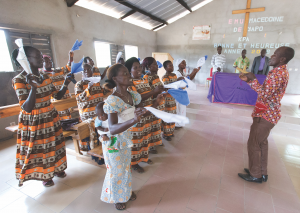
Martin Edi Ori (right) conducts the choir at Macedonia United Methodist Church in Yapo-Kpa, Côte d’Ivoire. Photo by Mike
DuBose, UMNS.
What date would you choose for the birthdate of Methodism? The General Conference of the Methodist Church of England met in 1837 and a committee of preachers and laymen was assembled to put together a celebration of the Centennial, the first hundred years of Methodism. But the first question that they had to settle was what date should they use for the beginning of Methodism? Someone suggested that they use the date of Wesley’s ordination, but that was not supported.
Do you know what other famous date was not supported? May 24, 1738, Wesley’s Aldersgate Street experience. That was an obviously famous and important date in Wesley’s life. Although it was a pivotal milestone, the Holy Spirit had been moving in his life before that time. Dr. Scott Kisker, Associate Professor of Church History at United Theological Seminary, has commented that if Aldersgate was all that Wesley had, he would have probably retired as an Anglican priest at Epworth with his heart strangely warmed and we would never have heard of him or Methodism.
The fact of the matter is, Charles Wesley had his heart warming experience two days before John’s. And George Whitefield had one even before that. And there were others at the time, Anglicans and non-Anglicans, who were having heart-warming experiences.
The Rev. Doug Fox, senior pastor of First United Methodist Church of Irving, Texas, and a DMin student in Supernatural Ministry at United Theological Seminary, read through Wesley’s Journal from May 24, 1738 through the end of that year, a seven-month period. He was especially looking for changes in Wesley’s life and ministry as a result of his Aldersgate experience. Fox found that there was little positive change. Wesley’s Journal entries in those seven months were filled with doubt and questions. He wrote of periods of spiritual exaltation and acute spiritual depression equal in severity to anything preceding the Aldersgate experience. There are at least eleven depression entries, starting the day after the Aldersgate experience. And there are only two clear supernatural occurrences that he records during that time.
Wesley was still restricting his preaching to inside church buildings and there were no huge crowds. He made a pilgrimage to Hernhutt for an extended visit at the Moravian headquarters, but nothing spiritually earth shattering happened in Wesley’s life or ministry during those seven months after Aldersgate.
So, what date did the General Conference of 1837 come up with as the date for the start of Methodism? In his Journal, John Wesley writes on Monday, January 1, 1739, the New Year’s Day after his Aldersgate Street experience with the Moravians, John and Charles Wesley and George Whitefield and about 60 others gathered at a Watchnight meeting at Fetter Lane. Wesley wrote, “about three in the morning, as we were continuing instant in prayer, the power of God came mightily upon us insomuch that many cried out for exceeding joy, and many fell to the ground.”
Twenty-four year old George Whitefield, who was present at this meeting wrote, “It was a Pentecostal season indeed … we were filled as with new wine … overwhelmed with the Divine Presence….” Writing in 1861, Methodist historian Abel Stevens referred to this incident as their baptism in the Holy Spirit. It is clear that this was an infusion of spiriutal power within Methodism and this was the date that General Conference of 1837 used to date the beginning of Methodism.
Four days later George Whitefield met with seven other despised Methodists who left the meeting with a full conviction that God was about to do great things among them. It was in that year that Whitefield “broke the ice,” as he says, by beginning outdoor preaching in England. He then led Wesley to do the same thing.
In his research, Fox also read through Wesley’s Journal for the seven months after Fetter Lane. He found one entry about spiritual depression on January 4, 1739 and then no others. Furthermore, in the seven months following Fetter Lane, Wesley records in his Journal no less than 31 supernatural occurrences involving whole crowds of people.
It is “safer” for us to look back at Wesley’s Aldersgate experience as the beginning of Methodism. It was a private experience. It was a salvation experience or at least an assurance of salvation experience. Even non-Methodists have no problem with someone having a “heart-warming experience.” But the Methodists at the one hundred year mark were still greatly in touch with the fact that Methodism began with a “messy” outpouring of the Holy Spirit where over sixty Anglicans were all over the floor crying out due to the tangible presence of God in the room with them.
Methodism began with what Abel Stevens referred to as a baptism of the Holy Spirit experience that a group of people shared together like on the day of Pentecost. After this powerful experience at Fetter Lane, the lives and ministries of those people changed dramatically.
Perhaps we should ask God for a fresh infilling of the Holy Spirit like the Wesleys and their friends experienced that New Year’s Day in 1739.
Frank Billman is a United Methodist clergyperson, the DMin Mentor in Supernatural Ministry at United Theological Seminary in Dayton, Ohio, and an adjunct Faculty Member at the Bishop John G. Innis Graduate School of Theology at the United Methodist University in Monrovia, Liberia.
![The Cross]()
by Steve | Mar 17, 2020 | Magazine, Magazine Articles, March/April 2020
By Steve Beard –
 I was in elementary school when I first grasped that the death of Jesus was a big deal. On Good Friday, my mom and dad signed me out of class in time for the noon church service. It was somber and stiff and formal – but I was out of school for the rest of the day. It got my attention.
“On a hill far away, stood an old rugged cross,” we sang. “The emblem of suffering and shame / And I love that old cross where the Dearest and Best / For a world of lost sinners was slain.”
Modern day hipsters may roll their eyes at the sentimental lyrics, but they stuck with me. It was a sing-a-long song about the most brutal injustice in human history and it became a well-known gospel chorus for an entire generation. Johnny Cash recorded four different versions. It was also recorded by Al Green, Ella Fitzgerald, Merle Haggard, Mahalia Jackson, Patsy Cline, Willie Nelson, and Loretta Lynn.
“The Old Rugged Cross” was written in 1913 by a Methodist preacher named George Bennard (1873-1958) who was converted to faith as a young man after walking five miles to a Salvation Army meeting. At age 15, he had lost his father in a mining accident. Bennard found new life and inspiration in giving his heart to a Savior riddled with nail scars who had conquered death.
“The crucifixion is the touchstone of Christian authenticity, the unique feature by which everything else, including the resurrection, is given its true significance,” writes the Rev. Fleming Rutledge in her magisterial book, The Crucifixion. “Without the cross at the center of the Christian proclamation, the Jesus story can be treated as just another story about a charismatic spiritual figure. It is the crucifixion that marks out Christianity as something definitively different in the history of religion. It is in the crucifixion that the nature of God is truly revealed. Since the resurrection is God’s mighty transhistorical Yes to the historically crucified Son, we can assert that the crucifixion is the most important historical event that has ever happened.”
When my father would serve communion at our United Methodist church, he said: “The body of Christ, broken for you. Feed on him in your heart by faith with thanksgiving.” Those words can still bring tears to my eyes. Sundays come and Sundays go, but those words stick in my soul. The Lamb of God was betrayed by a sleazy friend, ambushed by a well-armed battalion, falsely accused by conniving religious leaders, condemned by a spineless politician, and publicly executed before his weeping mother as cries of ridicule filled the air and birds of prey circled overhead.
To the abused who feels shame, this Crucified Christ stands with empathy. To the wrongly accused, this Crucified Christ stands with the truth. To all those victimized by injustice, this Crucified Christ stands with the innocent. “Come to me, all you who are weary … and I will give you rest,” Jesus said.
There are countless examples of contemporary Christian leaders who fail to live up to the Jesus ideal. Unfortunately, that has been the failed track record of Church history. But the Christ who was humiliated and shivved in the side on Golgatha is the genuine article. I try to keep my eyes on him. In every conceivable way, Jesus is counterintuitive. Who would have ever come up with a game plan of forgiving your enemies, turning the other cheek, and loving those who plot your demise?
“Even the excruciating pain could not silence his repeated entreaties: ‘Father, forgive them, for they do not know what they are doing.’ The soldiers gambled for his clothes,” wrote the late Anglican scholar, the Rev. Dr. John R.W. Stott. “Meanwhile, the rulers sneered at him, shouting: ‘He saved others, but he can’t save himself!’ Their words, spoken as an insult, were the literal truth. He could not save himself and others simultaneously. He chose to sacrifice himself in order to save the world.”
I understand the reluctance to spend inordinate time dwelling on the sufferings of Christ. It’s macabre and grotesque. It is the stigma of the story, the stain, the moment you turn your head away. But it is an inescapable part of redemption’s drama.
For those in the modern era, it is hard to imagine a time when crosses weren’t sold as bedazzled necklaces, home décor accessories, or garish t-shirt designs (“Body Piercing Saved My Life”). The cross was not always viewed as an icon for a faith dedicated to a kingdom that was not of this world. “To the early Christians it was a symbol of disgrace. They could not look upon it as an object of reverence,” wrote historian George Willard Benson. “Death by crucifixion was the most shameful and ignominious that could be devised. That Christ should have been put to death, as were debased and despised criminals, was bitterly humiliating to his followers.”
Over the centuries since Christ’s blood-soaked public execution, the cross was slowly transformed from a symbol of shame and humiliation to one of victory and triumph for all of us who have been shamed and humiliated.
In his critically acclaimed book, Dominion: How The Christian Revolution Remade the World, British scholar Tom Holland points out that the tales of a human-divine hybrid were not unfamiliar in ancient history. Mythology from Egypt and Greece and Rome featured heroic monster-slayers and a pantheon of warlords that claimed to be empowered from the heavens.
“Divinity, then, was for the very greatest of the great: for victors, and heroes, and kings,” writes Holland. “Its measure was the power to torture one’s enemies, not to suffer it oneself: to nail them to the rocks of a mountain, or to turn them into spiders, or to blind and crucify them after conquering the world. That a man who had himself been crucified might be hailed as a god could not help but be seen by people everywhere across the Roman world as scandalous, obscene, grotesque.”
The gospel is upside-down storytelling. Perhaps it helps explain the inexplicable allure of Jesus. The story does not end on a towering cross on the edge of town where the dying moan and mothers weep. More was to unfold.
Osiris, Zeus, and Odin are worshipped no longer. The Savior of the widow and orphan and tax collector is still worshipped around the globe. That is not chest-puffing triumphalism; it is simple reality. “The crucifixion of Jesus, to all those many millions who worship him as the Son of the Lord God, the Creator of heaven and earth, was not merely an event in history, but the very pivot around which the cosmos turns,” writes Holland.
Holland only returned to the church of his childhood while writing his book. His thinking was dramatically affected while filming near a battlefront in an Iraqi town where Islamic State fighters had previously used crucifixion as a means of terror. “For the first time, I was facing the reality of crucifixion as it had been practiced by the Romans, face to face,” he told the Church Times. “It was physical in the air … people had been crucified by people who wanted the effect of crucifixions to be that which the Romans had wanted. They wanted to generate the sense of dread and terror and intimidation deep in the gut, and I felt that….
“I realized how important it was to me to believe that, in some way, someone being tortured on the cross illustrated the truth of the possibility that power might be vanquished by powerlessness, and that the weak might vanquish the strong, and that … hope might be found in the teeth of life in despair.”
Perhaps the hope found in the horror of the cross of Christ is the “assertion that the same God who made the world lived in the world and passed through the grave and gate of death,” wrote novelist Dorothy Sayers. Explain that to an unbeliever, and “they may not believe it; but at least they may realize that here is something that a man might be glad to believe.”
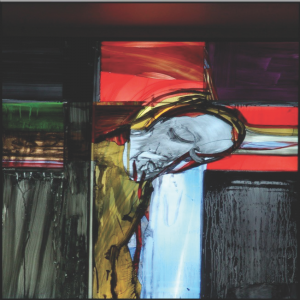
Steve Beard is the editor of Good News. Opposite page art work is a section of the stained glass work in the chapel of the Orange County Rescue Mission designed by Peter Brandes.
by Steve | Mar 17, 2020 | Magazine, Magazine Articles, March/April 2020
By Thomas Lambrecht –

The recently announced separation plan called the “Protocol of Reconciliation and Grace Through Separation” has aroused many reactions in and beyond the church. Some are satisfied and even hopeful that the long-running conflict in our church can finally be over and traditional and evangelical United Methodists will be free to pursue ministry without being hampered by discord or a dysfunctional denominational structure. Local churches will get to keep their buildings, property, and assets and will need to make no extra payments to move into the new traditionalist Methodist denomination.
Others are upset and angry over provisions of the agreement they believe are unfair. We have heard the criticisms of the plan. We understand them. Many of them are legitimate. Clearly, there are several unfair provisions.
The most common criticism I have heard of the agreement is that traditionalists are leaving The United Methodist Church, rather than it being an equal separation. The follow-up comment is that since traditionalists “won” the vote in the St. Louis special General Conference in 2019, it should be those who want to change the church who have to leave and start a new denomination, not those who want to maintain the current doctrine and discipline of the church.
This is a perfectly valid point. In an ideal and just world, those who want to change the church’s understanding of marriage and ordination would leave and those who want to keep the church’s long-standing teachings could remain. Unfortunately, we do not live in a perfect or just world.
This agreement did not come down from God on Mt. Sinai like the Ten Commandments. It is a negotiated agreement worked out between factions in the church that deeply disagree with one another and do not trust one another. Separation within The United Methodist Church has taken place over the last several decades; it has been brewing under the surface. The fact that there is an agreement at all is astounding and a testament to the dedication of the participants and the perseverance of the mediator.
In negotiated settlements, it is not what is right or fair that determines the outcome, but what is possible. This agreement is the best possible agreement that could be reached and is preferable to all other likely alternatives.
What happened in 2019? At the 2019 General Conference, traditionalists made a good-faith effort to bring about unity in the church through compliance with the Book of Discipline, the governing document of the church. It maintained the current teaching and standards of the church, while attempting to increase accountability of bishops and clergy to live by those standards.
Since February 2019, it has become readily apparent that this attempt at unity through compliance did not work. More than half the annual conferences in the U.S. declared their opposition to the provisions enacted in the Traditional Plan. A number of annual conferences and bishops have declared that they will not abide by the provisions of the Discipline. The Greater New Jersey Annual Conference is even trying to write its own Book of Discipline!
This widespread disarray indicates that the church cannot achieve unity through compliance. The gate-keepers on enforcing the Discipline are the bishops. If some bishops are unwilling to enforce the Discipline and plan to simply ignore its requirements, there is nothing the larger church can do about it. The accountability process for bishops envisioned in the Traditional Plan was ruled unconstitutional by the Judicial Council. The accountability process proposed by Bishop Scott Jones and others that relies upon the Council of Bishops to hold other bishops accountable depends upon having a majority of the Council willing to exercise that accountability. At this point, and into the foreseeable future, the majority of the Council favors changing the church’s requirements and will decline to hold colleague bishops accountable.
Since unity through compliance is not possible, and unity through allowing for “local option” (each annual conference and local church making its own rules about marriage and ordination) does not have the votes to pass General Conference, the only apparent way to resolve the conflict is some form of separation. The recent agreement recognizes this fact and provides a way for the church to go in two different directions. We should not discount the fact that, for the first time, some of our leading bishops and other church leaders have finally acknowledged that separation is the only viable way forward for the church.
How to Separate. The fairest way to separate would be to dissolve The United Methodist Church and create two or more new denominations with new names. Such an approach is unworkable because it requires changes to the constitution, which needs a two-thirds vote at General Conference and a two-thirds vote of all the annual conference members (which could take up to two years). Most self-described centrists and progressives are against dissolving the church, as are many Africans and Europeans. Dissolving the church and starting over would most likely not reach even a majority vote, let alone the two-thirds vote required.
So any form of separation that General Conference adopts will have to have a continuing United Methodist Church and a group or groups that form something new. The closest to an equal plan of separation under this precondition is the Indianapolis Plan. However, that plan did not resolve the contentious issue of a division of assets. Furthermore, it encountered fierce opposition from key leaders in the centrist camp, who believe it comes too close to dissolving the denomination. To pass the Indianapolis Plan would require a major fight at General Conference, which could degenerate into a repeat of the vitriol of St. Louis. And its passage is by no means certain, as the margin for traditionalists is projected to be very slim.
The leaders of the Renewal and Reform Coalition decided that it would be better to support a plan that is less fair, but promised a definitive end to the conflict, was much more certain to pass, and would give traditionalists a way to separate while keeping their buildings and property.
Throughout the last year, many progressives and centrists have vowed not to leave the church, but to stay and continue to fight to change the church’s teachings and standards. It is true that a few very progressive annual conferences and a few high-profile progressive leaders have announced plans to prepare to possibly leave the denomination. But the vast majority would stay, and the fight would continue. It is therefore unrealistic to hope that most centrists and progressives would voluntarily leave the church. No matter what good legislation General Conference adopts, if there is no way to obtain compliance, the Discipline is not worth the paper it is written on. Any attempt on traditionalists’ part to keep on fighting for the current teachings of the church would entail another 20 years of conflict, rebellion, disobedience, and vitriol that would destroy the church.
If we were to fight to hang on to The United Methodist Church, traditionalists would also be saddled with trying to either maintain or reform an intractable bureaucracy that is often counterproductive to local church ministry. Every single general board or agency except United Methodist Communications endorsed the One Church Plan. Most of those boards and agencies are staffed by people who want to change the church’s teachings and do not share our traditional theological perspective. To reform and reclaim these agencies would be a monumental task that would again drain valuable resources from actual ministry. If we can drastically lower overhead in a new denomination, we can pour more resources into supporting our central conferences outside the U.S. and engaging in innovative, effective ministry to the unchurched and marginalized people in our world.
What about the money? Faced with the possibility of an impending split in the denomination, United Methodists are rightly worried about the financial impact of the separation plan. Giving to the denomination’s general apportionments fell immediately after the special St. Louis General Conference last February. A number of annual conferences are struggling to meet their budgets. The General Council on Finance and Administration has proposed an 18 percent cut to the quadrennial budget for 2021-24.
Many clergy, particularly retired clergy, are worried about their pension. The good news is that all the proposed plans of separation have made provision for continuing clergy pensions at the current level. Wespath has developed plans and legislative language that would allow clergy in any new Methodist denomination to continue participating in the clergy pension program. Earned benefits would continue at the same level as previously expected. Unfunded pension liabilities would be allocated between the post-separation United Methodist Church and the new Methodist denomination(s), with no payments for these liabilities required. The only exception to the continuation of pensions at the current level would be for congregations and clergy who go independent and do not align with a new Methodist denomination.
Financial Support for New Methodist Denominations
One of the aspects of the newly proposed Protocol agreement for separation that appears unfair is the allocation of $25 million to a new traditionalist Methodist denomination that forms and $2 million to any other new Methodist denominations that might form. Progressives complain that a denomination they believe unjustly discriminates against LGBTQ people should not receive any money upon separation. Traditionalists believe that the amount of money is just a drop in the bucket compared to the total assets of the general church.
It is important to note that the Protocol agreement is the only proposal that came to any agreement about the amount of funding for the new Methodist denomination(s). Where did the $25 million come from? Here is how that calculation was arrived at. According to the General Council on Finance and Administration, total assets held by the general church and its agencies amounts to over $1.536 billion dollars. But about half of that amount, over $753 million, is owed to others as liabilities. That leaves net assets of about $783 million. Of that amount, about $204 million is in buildings, property, and other fixed assets. Donor restricted assets total about $460 million. That leaves about $120 million in unrestricted assets that would be available for any kind of division of assets. (It proved unrealistic to expect to share in the proceeds of any buildings or property that might never be sold, and the mediation group did not want to cause the sale of buildings or properties. The legal complications that would be involved in trying to divide restricted assets proved to be too much to overcome, taking those assets off the table.)
The negotiation resulted in one-third of the $120 million being allocated for the new Methodist denomination(s), about $40 million. $2 million was set aside for potential other denominations that might form, while $38 million was set aside for a traditionalist denomination. Traditionalists agreed to forego one-third of their share ($13 million) to give it to fund ethnic ministry plans and Africa University. (The post-separation United Methodist Church agreed to set aside double that amount for the same purpose, $26 million, leading to a total of $39 million for ethnic ministry and Africa University. This represents continuing the current level of funding over the next eight years.) The goal with the ethnic minority funding is to ensure that some of the most vulnerable populations in our church are not harmed by the separation.
The $25 million that is left will be paid to the new traditionalist Methodist denomination over the four years 2021-24 in equal installments.
Apportionments. The General Council on Finance and Administration is looking at the possible impact on apportionments of a separation. It is undeniable that a significant loss of members and churches from the post-separation United Methodist Church would cause a decline in funding available to the general church agencies and programs. Since it is hard to forecast how many churches might separate, it is difficult for GCFA to budget for apportionments for the next quadrennium. The post-separation United Methodist Church will need to make adjustments to programs and denominational structure in order to account for reduced financial resources available.
By contrast, the new Methodist denomination(s) forming from this separation will be able to start with low overhead. For example, in its draft Book of Doctrines and Discipline, The Wesleyan Covenant Association envisions fewer and smaller agencies, capitalizing on partnerships with existing ministries. This would allow the denomination to care for essential functions, while preserving the ability to respond nimbly to changing needs of congregations and cultural circumstances.
A new future. Talking about money is difficult. Money is often a symbol of our values, hopes, dreams, beliefs, and power. Many traditionalist observers have voiced concerns that the amount of funding given to the new denomination upon separation is not commensurate with the resources that contemporary traditionalists and prior generations have contributed to the church over the decades. As legitimate as these concerns may be, the negotiated settlement was conceived in good faith based on the calculations and limitations shared above.
It is understandable for some to see it as though traditionalists will be “leaving” The United Methodist Church. A better way of describing it is that traditionalists will be separating from a denomination that has left them theologically and seizing this opportunity to create a new traditionalist Methodist movement. No, this agreement is not as fair to traditionalists as we hoped it would be. But it promises a definitive end to the conflict in our denomination and provides an unparalleled opportunity for a fresh start that can create a new denomination that can go forward in unity of belief, vision, and mission.
Thomas Lambrecht is a United Methodist clergyperson and the vice president of Good News.