by Jonathan Powers | Nov 17, 2026 | Uncategorized
The Scandal of the Incarnation
by David F. Watson
This article originally appeared in the November 2022 edition of Good News Magazine.
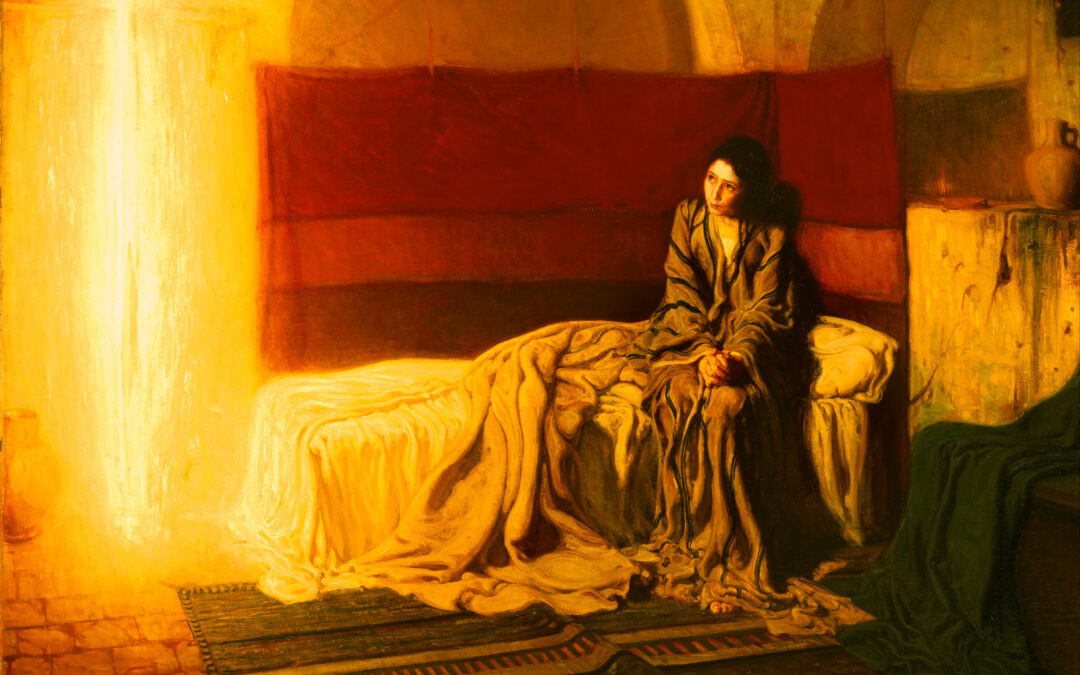
In Nazareth, there is a large church built over the traditional site of Mary’s house. It is called the Church of the Annunciation. Tradition holds that the angel Gabriel spoke to Mary here: “Do not be afraid, Mary, for you have found favor with God. And now, you will conceive in your womb and bear a son, and you will name him Jesus. He will be great, and will be called the Son of the Most High, and the Lord God will give to him the throne of his ancestor David. He will reign over the house of Jacob forever, and of his kingdom there will be no end” (Luke 1:30-33).
Mary, of course, wishes to know how this will happen since she is a virgin. Gabriel responds, “The Holy Spirit will come upon you, and the power of the Most High will overshadow you; therefore the child to be born will be holy; he will be called Son of God” (1:35). Mary responds, “Here am I, the servant of the Lord; let it be with me according to your word” (1:38).
The Word Became Flesh Here. Within the Church of the Annunciation there is an altar that sits atop the site where this event is thought to have taken place. It bears a remarkable inscription: Verbum caro hic factum est, or, in English, “The Word became flesh here.” There is a stunning particularity to this claim. The Word became flesh here – amidst the stone, wood, smoke, fire, and flesh of an ancient village. God is the God of all times and places, but his redemptive work began at a particular time and in a particular place, through the obedience of a particular young woman who responded in faith over fear.
This very claim has so vexed Christianity’s cultured despisers that it has come to be called the “scandal of particularity.” In the midst of so many claims to truth and revelation in our world, how dare we say that the perfect union of God and humanity by which the redemption of all creation took place happened here, and nowhere else? But there it is, carved in stone: Verbum caro hic factum est. It happened, Christians insist. It happened here.
The particularity of this event matters. Today, Nazareth is a busy city of over 75,000 people, but in the first century it was an obscure village with a population of probably less than 500. Nathaniel asks Philip, “Can anything good come out of Nazareth?” (John 1:46). God did not choose Rome or Alexandria or Athens, these cities of renown and high culture, in which to become flesh. God chose a backwater village on the eastern frontier of the Roman Empire as the staging ground for the redemption of the world. He did not need the power of Rome, the literary culture of Alexandria, the philosophy of Athens. “God chose what is foolish in the world to shame the wise; God chose what is weak in the world to shame the strong; God chose what is low and despised in the world, things that are not, to reduce to nothing things that are” (1 Corinthians 1:27).
God does not see as humans see (1 Samuel 16:7). Our vision is obscured by sin in its various manifestations: pride, selfish ambition, the elevation of sensory pleasure, and greed, to name a few. Perhaps this is why we humans have such a hard time accepting this Jesus, born of a virgin, hailing from Nazareth, a carpenter raised by a carpenter, a wandering preacher who had no place to lay his head, loved, hated, worshiped, and betrayed. He did not provide a form of government or a manifesto but spoke in pictures about the kingdom of God. He told his followers they must take up the cross, that they would be hated on his account, and he himself was executed upon the cross, the “slave’s punishment.” After he rose from the dead, he entrusted the news of his resurrection to two women, one of whom he had freed from seven demons. He went back to those obscure few who followed him in his ministry and then left his mission in the hands of fishermen, tax collectors, and zealots.
It is unsurprising that so many have rejected this Jesus. God’s thoughts are not our thoughts, nor are his ways our ways (Isaiah 55:8). Within the last three centuries, many have tried to tell us that the significance of Jesus is not that God became human, that within Jesus is a union of divine and human, or that through his death and resurrection we are forgiven and free from sin. Rather, they have said, Jesus was a supremely wise person, along the lines of Socrates or Confucius. They might suggest that Jesus had an acute “God consciousness.” His spiritual sensitivity and perceptiveness toward the will of God gave him insights much like those wise sages who have existed across the centuries. We should listen to what he taught and live accordingly, rather than focusing on these ancient myths of incarnation, atonement, and resurrection.
This purveyor of wisdom, a sage among sages, even a politically radical Jesus, is a safe, manageable, comprehensible figure. He is here to make us wiser people, to improve our lives, to reform society. If his words seem strange to us, don’t worry. It is easy enough to shape his teachings into the values we already affirm, and myriad authors stand at the ready to help us do so.
Such a Jesus is simply too weak, too cerebral, too bound by the narrowness of modernity to do us any good. Jesus did not come first and foremost to teach us. He came to save us, and his teaching serves the end of salvation. Flannery O’Connor once said of the resurrection of Christ, “If it’s just a symbol, to hell with it.” I would say the same thing of the incarnation. If it’s just a symbol, metaphor, or myth, then so was my baptism. A wise sage cannot save us from sin and death. Only the incarnate God can do that. The real Jesus does not simply want to make us wise, but holy. The real Jesus will not simply reform society, but renew all of creation. The real Jesus offers us not just a better life, but new life.
The Incarnate God and New Life. Perhaps part of the problem is that we do not accurately perceive the need for new life in Christ. According to Ligonier Ministries’ recent report called “The State of Theology,” 43 percent of evangelical Christians in the U.S. agree with the statement, “Jesus was a great teacher, but he was not God.” Put differently, almost half of all evangelicals reject the doctrine of the incarnation. Equally significant, however, is that 65 percent of evangelicals believe that everyone is born innocent in the eyes of God. In other words, they reject the doctrine of original sin.
If we drill down into the doctrines of the incarnation and original sin very far, it becomes apparent that they are closely connected. Let’s start with Paul in 2 Corinthians 5:21: “For our sake he made him to be sin who knew no sin, so that in him we might become the righteousness of God.” Another way of putting this is to say that, even though Christ did not sin, he took on full humanity, which means he took on sinful human nature. Because he did this, we can take on righteousness, which is an aspect of God’s nature. Put still another way, in Christ, God took on what is evil in us so that we might take on what is perfect in him.
As Gregory of Nazianzus wrote, “What is not assumed is not healed.” God has redeemed us – healed us from the corruption of sin and death – by uniting fallen humanity and perfect deity in one person, Jesus Christ. Christ did not sin, but was perfectly obedient to the Father, and he took upon himself what we deserve (death) so that we might receive what only he deserves (righteousness and eternal life). If there is some aspect of human life that God did not take on in Jesus Christ, that aspect of our life is still fallen. But Christ was truly and fully human, even while he was truly and fully divine. We can thus experience full salvation, both forgiveness of our sins and freedom from the power of sin.
One might ask why the all-powerful God could not simply wave away our sin and its consequences, rather than actually becoming human, living a perfect life, dying on the cross, and then rising from the dead. Such a scenario would involve what Bonhoeffer called “cheap grace.” If God were simply to dispense with sin as if blowing on a dandelion, the unavoidable conclusion would be that sin really doesn’t matter. But you and I know that isn’t true. Sin has consequences. We see and feel them every day. Lies, violence, exploitation, betrayal – these kinds of actions cause us pain because they are violations of creation’s moral order. They are the opposite of love, and to say that God has wrath in the face of these sins is another way of saying that God is love. The destruction of his beloved creatures through the corruption of sin and its consequences is intolerable. Were it tolerable, if God simply did not care, it would mean that God does not love us.
Yet God does love us, and so he must deal with sin and its consequences. There are many ways in which God could have dealt with sin. He could simply have willed us out of existence. He could have consigned us wholesale to eternal punishment. The wrath of God is nothing with which to be trifled. But God is love – pure, unselfish, eternal love. So rather than imposing upon us the just consequences of our sin, God took these consequences upon himself, and in so doing, he set us free.
Creation and New Creation. John’s gospel teaches us, “In the beginning was the Word, and the Word was with God, and the Word was God. He was in the beginning with God. All things came into being through him, and without him not one thing came into being. What has come into being in him was life, and the life was the light of all people. … And the Word became flesh and lived among us, and we have seen his glory, the glory as of a father’s only son, full of grace and truth” (John 1:1-4, 14).
Everything was created through the Word. Life and light came into being through the Word. And this very Word, the source of all things, also became the source of redemption for us. As Athanasius put it, “[T]he renewal of creation has been wrought by the Self-same Word Who made it in the beginning. There is thus no inconsistency between creation and salvation for the One Father has employed the same Agent for both works, effecting the salvation of the world through the same Word Who made it in the beginning.” The creative Word of God is the agent of the new creation.
What is not assumed is not healed, but God assumed our full humanity so that we can be healed fully of sin and death. It is the greatest act of love imaginable, given by a perfect God to the broken, the undeserving, the sinful, the selfish – in other words, to all of us. If we but say yes to God, we can be healed. And God wants to heal us. God wants us in the new creation. That is why he became one of us.
David F. Watson is the President of Asbury Theological Seminary in Wilmore, KY. He is the author of several books, including Scripture and the Life of God (Seedbed) and lead editor of Firebrand (firebrandmag.com).

by Jonathan Powers | Oct 21, 2026 | Uncategorized
Pilgrimage as a Spiritual Possibility
By James R. Thobaben
This article first appeared in the March 2022 edition of Good News.
In 1864, as the American Civil War turned toward its inevitable (and proper) conclusion, Methodists in North Carolina published The Southern Zion’s Songster. Included in the work, albeit uncredited, was “I’m a Pilgrim and I’m a Stranger,” a poem written by Mary S. B. Dana Shindler and composed in the midst of war, as well as her own significant personal tragedies. Perhaps she was influenced by Methodist Mary Hamlin Maxwell’s 1849, and similarly named hymn, “I’m a Pilgrim and a Stranger.”
With slightly different words, but quite common sentiments, the two women drew from pilgrim imagery to describe their own revivalist spirituality. They were not alone. Highly influential 19th century hymnals, such as The Sacred Harp and The Southern Harmony, are filled with songs of pilgrimage. Life is a journey, and an uncertain one at that. Yet, it is not random, nor a matter of achieving a self-constructed purpose: there is an end, a telos, that draws one through a process toward a goal.
The song “I am a Pilgrim” – as it is generally known today – is a mixture of lyrics from the work of those two women and anonymous contributors along the way. It has been sung as an African-American gospel song (perhaps most wonderfully performed by the Soul Stirrers in 1965), as a Bluegrass / Appalachian music standard (memorably, by Doc Watson, drawing on the shapenote tradition), and by innumerable small country and inner-city church congregations.
But why? Why sing songs of pilgrimage? Why use the imagery? Did not Protestants give up on ‘pilgrimage’ as a spiritual discipline? Both the Anglican and Methodist Articles of Religion include a rejection of “Purgatory, Pardons, Worshipping and Adoration … of Images as of Relics, and also Invocation of Saints, [with any such action being but a] fond thing, vainly invented…”
The Protestant Reformers questioned the value of physical pilgrimage, with more than a few condemning the practice. They were picking up on suspicions that had begun to appear several centuries earlier, in the late Middle Ages. Some had been arguing that pilgrimages simply provided an opportunity for sin, as Geoffrey Chaucer described throughout Canterbury Tales. Others asserted they were spiritually insufficient – not worth the trouble – as seems to be the argument in William Langland’s Piers Plowman.
Looking back, it may be that a turning point was reached when pilgrimages to sites associated with Christ in Israel and places where martyrs had been killed or buried (such as Saint Paul’s Outside the Walls in Rome) were forced just prior to 1100 AD to compete with new sites associated with the Virgin (e.g. Walsingham in England, 1061 AD) and, then, eventually those places with “remaining relics of heaven” (e.g. remnants of the body of Jesus, like his umbilical cord, and pieces of the eucharistic bread, such as at Wilsnack in Germany, 1383 AD).
The proto-Protestants (that is, reformers before the Reformation) began openly challenging the value of such journeys. The true pilgrimage, they strongly argued, is the sojourn of the soul toward heaven. Therefore, physical pilgrimage is, at best, a distraction and, at worst, a corruption.
• For instance, around 1400 AD, reportedly Master William Thorpe told the Archbishop of Canterbury, “I call them true pilgrims travelling towards the bliss of heaven.” These will not “waste God’s goods in the vain pilgrimages, spending their goods upon vicious hostelars…”
• Similarly, church reformer Jan Hus condemned the Wilsnack pilgrimage site and comparables in no uncertain terms; it was one factor leading to his martyrdom. In 1403, he proclaimed: “True Christians should rather remember Christ’s words spoken to the doubting Thomas: ‘Blessed are they that have not seen, and yet have believed.’ Instead of running after false miracles they should turn to the resurrected Christ who is existent in the Holy Sacrament…”
Rejection of physical pilgrimage was all but required during the Reformation. For instance, the site of Archbishop Thomas Becket’s death in Canterbury likely had in excess of 100,000 visitors annually before the shrine was destroyed in 1538. The site of the supposedly inflammable, blood-stained eucharistic wafers at Wilsnack had drawn its own huge crowds, but suddenly closed down when a reforming priest demonstrated they would burn after all in 1558.
Within 50 years of Luther, the “de-physicalizing” of pilgrimage was generally accepted in Protestant regions. By the time Bunyan released The Pilgrim’s Progress in 1678, the single most important devotional work written in the English language, few English-speaking Protestants would have considered the behavior anything but blasphemous.
Does not “earning grace by a work-of-walking” create a sort of spiritual elitism? Yes. Does not required adoration of an object deny the ever-presence of God? Yes. When taken to an extreme, does it not seem more magical than spiritual? Indeed, yes. Could any earthly object or place act as an intermediary when God is directly accessible? No. And, hence the Anglicans and Methodists included that above cited article of religion. Reform was necessary.
Still, as tends to happen, there was an overcorrection. Might not physical pilgrimage, properly conducted, be an instrument, a tool, a means of grace? Yes, it might. Analogically, even if the sacramental bread and wine is not “transubstantiated” into actual body and blood, is it not still the “real Presence”? Yes, it is. Can it not serve instrumentally as what is called a “means of grace”? It can. So, too, can physical pilgrimage.
It certainly seems that humans find instrumental spiritual value in journeying. Sometimes it is to a local church for prayer, sitting in the same pew one has used for years. Sometimes it is proclaiming the Gospel from the top of one’s own father’s grave, as John Wesley did when he returned to his home church in 1742. Sometimes it is journeying to early Methodist sites in Britain in what is called a “Wesleyan pilgrimage.” And, sometimes it is something almost identical to a practice of the Middle Ages, such as a journey to Jerusalem to walk in the steps of Jesus Christ on the Via Dolorosa.
Some 20 years ago, while coincidentally (or providentially) re-reading John Bunyan’s A Pilgrim’s Progress (1678) and using William Langland’s 14th century poem in a course I teach, I decided I really should walk a pilgrimage route. I chose the Camino de Santiago in Spain. Since then I have walked the Camino a second time (along a different route). In Ireland, I trudged up and down Crough Patrick and fasted three days and stayed awake through the night on the island of Lough Derg. My pilgrimage experience has included walking up a dusty road (with cars driving too fast) to reach Chimayo, New Mexico. In England, I’ve journeyed from Rochester to Canterbury (along the path walked by Chaucer’s pilgrims) and waded the tidal pool to Lindisfarne. Mostly out of academic interest, I’ve walked from just north of Berlin to Wilsnack. I am scheduled to go to Israel this summer, and some day – God willing – hope to visit Ethiopia, Armenia, and maybe Rome.
What have I gained? Nothing I might not have obtained through another means of grace. That, though, is true about all the spiritual instruments we use – none are necessary, for Christ alone saves. Walking toward a Christian destination, then, can be a means of grace, but is never a garnering of “spiritual credit” nor proof of spiritual heroism. Rather, physical pilgrimage makes known to us at the deepest level, that our true selves are not disembodied spirits (even in heaven according to I John) and that our Lord assumed this same corporeality.
Physicality matters spiritually. We all recognize that in a hospital room or at the quickening of a baby or when we see cruel injustice. Similarly, the palpable nature of physical pilgrimage reminds one with every step of the tangible nature of the Incarnation and of our journey to be like Him. Pilgrimage is just a tool for focusing one’s mind and will on what the heart should be, but it is a useful tool.
Here, then, are my five suggestions for Protestants interested in using this means of grace:
• The pilgrimage routes one chooses should be focused on Jesus Christ, the Incarnate God. Christian pilgrimage is not a trip to an interesting place, though it may be interesting to take the trip. The final purpose is not exercise, weight loss, seeing new places, wondering at beautiful art or architecture, or enjoying nature – it is Christ. Those other things may and will happen, but only properly if Christ is the focus – ideally of each step, but at least of the last few as the end is reached.
• A pilgrimage should be costly, but reasonably so. It may or may not cost money, but it must cost time and effort. This is not tourism. It is a spiritual discipline. Select a journey that is manageable, but requires effort – significant enough that one moves through discomfort to the recognition of both the cost of discipleship and the joy of walking with Christ toward heaven. By the way, this requires a balance of “means of grace,” so one should commit to the same cost in effort and money for “works of mercy” – some significant service to others – upon return.
• Follow a route that has a history – going where others have gone to worship our Lord. Even if their theology was not always perfect, it is essential to recognize and be part of the community of faith through time and space. Acknowledge one walks in the company of the cloud of witnesses, and seek out places where people knelt, where they gathered, where they stayed.
• The best way to keep that disciplinary focus is to simultaneously use other disciplines – especially, daily Scripture reading and focused prayer (remember, intentionally, those you meet who need Christ and those at home who miss you). Multiple times through the day, journal both as a diary of travel and as a record of spiritual struggle and of the felt presence of the Lord. Take communion. Serve others along the way. Be intentionally polite in accepting the gift of hospitality.
• And, enter into mutual accountability. Recognize that you, as a pilgrim, need the earthy community of saints. Seriously consider whose company you keep while walking. The criticisms in the late Middle Ages still have some validity – too many walking near you recognize they have a spiritual need, but are too ready to seek gratification in pleasures that are not true joy, but worldly and fleeting. Still, you will certainly have the opportunity to tell some confused and lost seekers why you walk and, thereby, speak the Good News. And, you thankfully will meet faithful others on the Way (just as did the character “Christian” in The Pilgrim’s Progress).
One final suggestion: do not listen to people who say “all that matters is the journey.” That simply is not true. You must want to “get there.” That is true about the physical peregrination and true about life’s sojourn to heaven. If this, or any supposed “means of grace” does not further your journey with Jesus Christ toward the goal of the kingdom of God, then abandon it and use something else.
As that old revival hymn “I am a Pilgrim” says, “rough and thorny is the road … but it leads to God.” While that song refers to the pilgrimage to heaven, physical pilgrimage is a foreshadowing that can be a useful tool toward reaching the goal of the upward calling, but it is nothing more.
James R. Thobaben is the Dean of the School of Theology and Formation, and professor of Bioethics and Social Ethics at Asbury Theological Seminary in Wilmore, Kentucky. He is author of Healthcare Ethics: A Comprehensive Christian Resource. In addition to his work at the seminary, Dr. Thobaben is co-pastor at Mt. Zion United Methodist Church in Mercer County, Kentucky.