
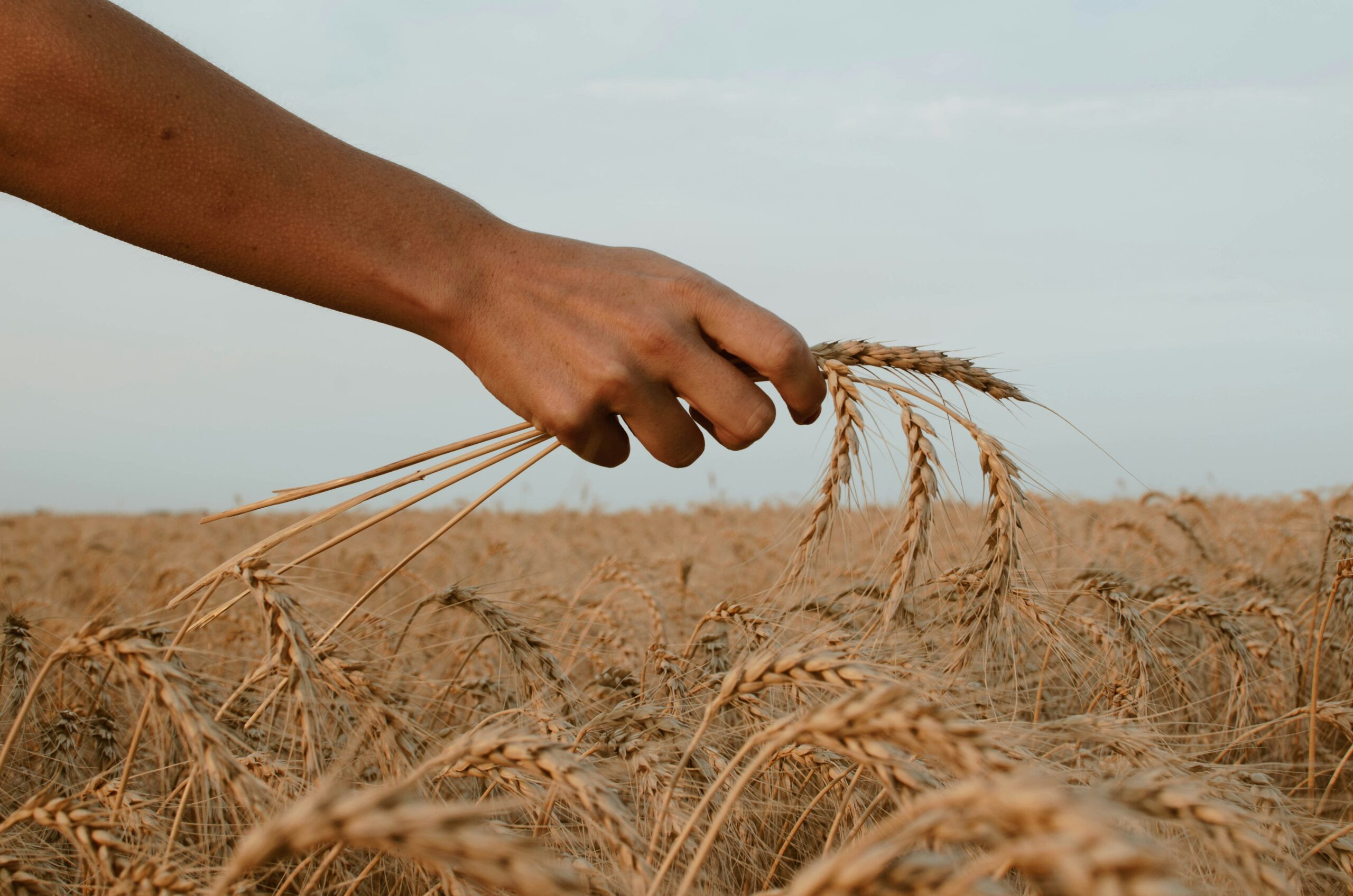
The Law of the Harvest
by Mike Powers
I grew up in Stanford, Kentucky, the county seat of Lincoln County. Lincoln County, like much of Kentucky, is primarily known for its farming. Although I spent the first 17 years of my life right there in that farming community, I knew very little about farming. In fact, I could have been called a “city-slicker” if you would dare call anyone from Stanford such a name. I visited with my friends on their farms a few times in those 17 years, but that was about the extent of my farming experience.
I have always felt a real disadvantage at not having grown up on a farm or at least not having a better knowledge of farming. I don’t think I ever fully appreciated the culture in which I was raised. The older I get, and hopefully the wiser, the more I realize how important that is.
Perhaps the greatest disadvantage in not having a better understanding of farming is the fact that the Bible is loaded with images from agriculture. When I read these passages, I realize that the average farmer in the congregation has a much better insight into what these passages mean than I ever will. Farmers live close to the earth. They know about nature and how things work. I don’t appreciate that as much as they do.
Think about some of the pictures we have in the Bible straight out of everyday farming experiences with which those from rural settings, whether they live in Lincoln County or Palestine, can identify. Isaiah sought to clarify the relationship of God to his people Israel, so he spoke of a farmer tending to his vineyard. To speak of the way God’s Word comes to us, he wrote of rain nourishing the earth, “making it bring forth and sprout” (Isaiah 55:10).
Jesus frequently turned to illustrations from the farming community, such as the parable of the sower, scattering the seed which we understand as the Word of God. He referred to himself as the “true vine” and to his disciples as the “branches.” In various ways, Jesus pointed out that the quality of a tree is known by its fruit (John 15). He looked upon those who sought him out as “fields white unto harvest” and the people as “sheep” in need of a shepherd (Matthew 9:36).
The apostle Paul knew his listeners were familiar with farming terms. He referred to the variety of ministries involved in the lives of the Corinthian Church as the variety of efforts needed in producing a crop: “I planted, Apollos watered, but God gave the increase” (I Corinthians 3:6). To the Galatians he took a cue from nature to illustrate a fundamental principle of life: “Do not be deceived; God is not mocked. For whatever a man sows that shall he also reap” (Galatians 6:7).
Those first recipients of the Biblical message knew that God was the God of all gods, and that He was above all of life and all the processes of nature. The Scriptures are full of references which communicate the deeper biblical truths that can especially be appreciated by those who live close to the earth…the farmers.
Psalm 126 is the seventh “song of ascent.” The Psalmist wrote these words remembering God’s faithfulness to Israel. They had sown their tears in exile; they waited, prayed and dreamed of the day the Lord would act, when he would make it possible for them to return home to Zion, and finally he delivered them. Their dreams had come true. God brought them home with shouts of joy. Laughter had filled their mouths. Their tongues cried out for joy. They were glad and testified, “The Lord has done great things for us!”
Yet, their joy was not complete. All was not well in Zion. Yes, they were home, but their future looked as arid as the Negeb, the region south of Judea that receives so little rainfall and has so few water resources. So now, the psalmist prays that the Lord would bless them again “like streams” in the Negeb.
Verses 5-6 reveal a picture that anyone who knows anything about farming, and even those of us who know little about farming, can easily imagine:
“May those who sow in tears reap with shouts of joy;
Those who go out weeping, bearing the seed for sowing,
shall come home with shouts of joy, carrying their sheaves.”
These two verses describe what we might call “the law of the harvest.” Farmers know all about that law. We city slickers don’t appreciate it like we should. I grew up thinking that bread is something in a cellophane wrapper that you buy in the store. When a farmer sees a loaf of bread, he sees much, much more. He sees the result of the law of the harvest.
Whether you know a lot about farming or, like me, you can’t tell the difference between a bale of straw or hay, let me share a few basic assumptions about the law of the harvest that will help us all better understand what these verses mean:
(1) The farmer lives for the harvest. He believes in the law of the harvest. It is a natural law written into all of life that he depends on with every effort at farming. In fact, farmers stake their entire livelihoods on the fact of the law of the harvest. You cannot harvest a crop until you plant it. The entirety of a farmer’s work in the spring and summer months is based on his conviction that there is a law of the harvest, and it works. He totally depends on that being true.
(2) This harvest will come not at the whim and wishes of the farmer, but at the convenience of the crop. The farmer will faithfully do all he can to prepare for the harvest, but he cannot force at to come one day earlier than it is supposed to come. There must be a lot of patience and diligence in farming. There are very few immediate rewards in farming. He must keep plowing, keep watering, keep working the crops even when that harvest is long in coming.
(3) Regardless of all the planning and hard work by the farmer, his harvest is at the mercy of forces beyond his control. The course of nature ultimately decides the extent of his harvest. He can do the planting and nurturing, but something beyond himself and his control must give the growth. He cannot force a harvest. After he has done everything he can to prepare a good harvest, he must relinquish it to that which he cannot see or hear or control.
So, the farmer (1) believes in the law of the harvest, (2) must wait for the harvest, and (3) must trust beyond his own ability for the harvest to come.
“Those who sow with tears will reap with songs of joy.
He who goes out weeping, carrying seeds to sow, will return with songs of joy,
carrying sheaves with him.”
A story from West Africa is told by a missionary named Del Tarr that will help us better understand and appreciate what farmers already know to be true about these verses.
The Sahel is a vast land stretching for 4000 miles just under the Sahara Desert. Its climate is much like that in the Bible lands. All moisture comes in a 4-month period: May, June, July, and August. After that, not a drop of rain falls for 8 months. The year’s food, of course, must be grown during those 4 months. People grow sorghum or milo in fields about the size of this sanctuary. Their tools are the strength of their backs and short-handled hoes. The annual income is between 85 and 100 dollars/person/year.
October and November are the beautiful months. The granaries are full, the harvest has come. People sing and dance. They eat two meals a day. The sorghum and milo are mixed into a mush that is rolled into a ball that when eaten stays with them so they can work and sleep.


0 Comments