Vision for United Methodist renewal and reform

Vision for United Methodist renewal and reform

THE HISTORY OF GOOD NEWS

By James V. Heidinger II (2013)

The first issue of Good News magazine was published in 1967. Charles W. Keysor, a Methodist pastor in Elgin, Illinois, published the first issue of the digest-size magazine for Methodist evangelicals out of the basement of his parsonage. At the suggestion of his wife, Marge, he called it Good News.

It had all begun a year earlier when James Wall, then editor of the Methodist minister’s magazine New Christian Advocate, asked Chuck, “Why don’t you write an article for us describing the central beliefs and convictions of this part [evangelical wing] of our church?”

Chuck’s article, “Methodism’s Silent Minority” was published in the July 14, 1966 issue of the New Christian Advocate, where he identified the major evangelical convictions (see original article on p. 14).

To his amazement Keysor received over 200 letters and phone calls in response to his article, most of them coming from Methodist pastors! Two themes surfaced in the responses: first, “I thought I was the only one left in the church who believes these things,” and second, “I feel so alone—so cut off from the leadership of my church.”

As he prayed about the letters and phone calls, Chuck felt he must do something. Having been a journalist prior to entering the ministry, he decided to launch a magazine which affirmed the evangelical message of the Wesleys and Francis Asbury. Good News magazine was born.

Responses to the first issue were much like today. One disgruntled Methodist in Alabama wrote, “Your magazine is JUNK!” But Carl F. H. Henry, then editor of the new evangelical journal Christianity Today, wrote, “A mighty fine beginning—congratulations!”

Rallying renewal groups: Seeing the immediate surge of interest in his magazine, Keysor chose 12 Methodists to serve as board members, and the Good News effort became incorporated as “A Forum for Scriptural Christianity.” The board’s first meeting was in May of 1967, only two months after the appearance of the first issue of the magazine.

Good News was a breath of fresh air for Methodists seeking spiritual renewal, quickly becoming their rallying point. Pastors and laity began organizing clusters of like-minded Methodists who came out of a felt need for fellowship, support, encouragement, and prayer. Soon, they began to map strategies for increasing evangelicalism within their annual conferences.

Today renewal groups exist in more than 40 of our United Methodist annual conferences, forming an extensive grassroots network for evangelical advocacy, fellowship, and prayer support. In my annual conference, the East Ohio Evangelical Fellowship—just one of such renewal groups—began in 1969 and has made an invaluable contribution in strengthening the evangelical witness in the conference, especially in youth camping programs and ministries.

Convo fellowship: The Good News board soon felt a need to sponsor some kind of national gathering to help unify Methodist evangelicals. Texas pastor Mike Walker, the youngest member of the fledgling board, headed up plans for the first national convocation held in Dallas in August of 1970. To everyone’s amazement, a whopping 1,600 United Methodists registered, coming from coast to coast! The Holy Spirit drew people together in a remarkable way.

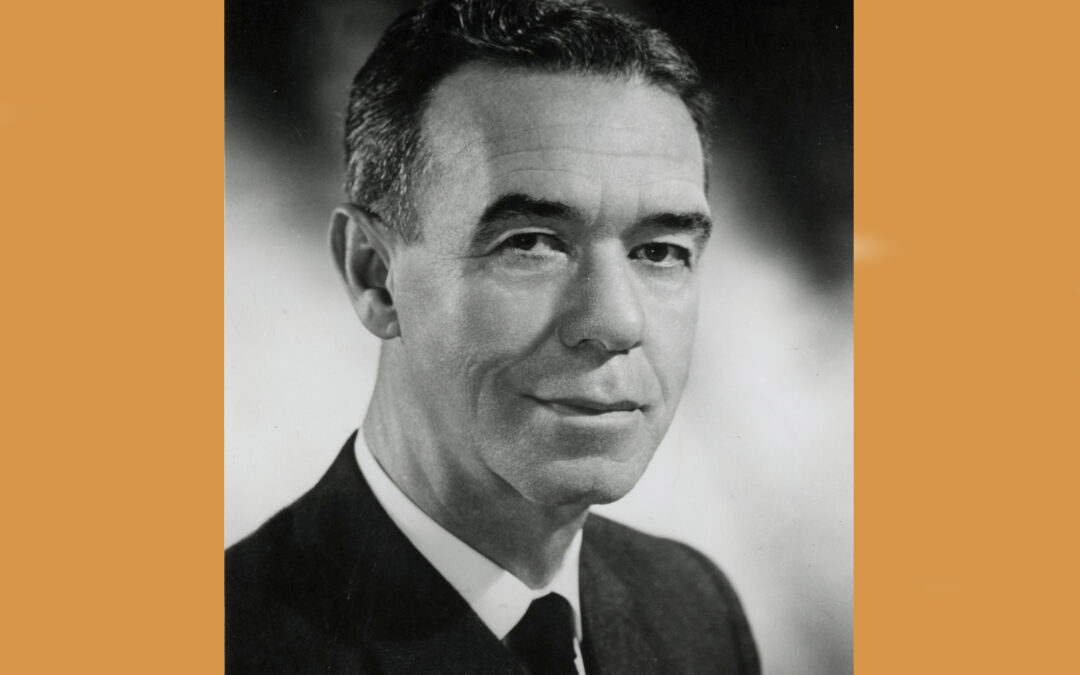
Emotion and excitement filled the air as participants discovered other like-minded Methodists. Tears streamed down the faces of worshippers as they saw the evening crowds swell to nearly 3,000 persons jammed into the Adolphus Hotel ballroom. Folks heard luminaries such as missionary statesman E. Stanley Jones, Bishop Gerald Kennedy, Frank B. Stanger, Dennis F. Kinlaw, K. Morgan Edwards, Claude Thompson, evangelist Tom Skinner, Howard Ball, Billy Graham Association evangelist Akbar Abdul-Haqq, Ira Gallaway, C. Philip Hinerman, and Les Woodson.

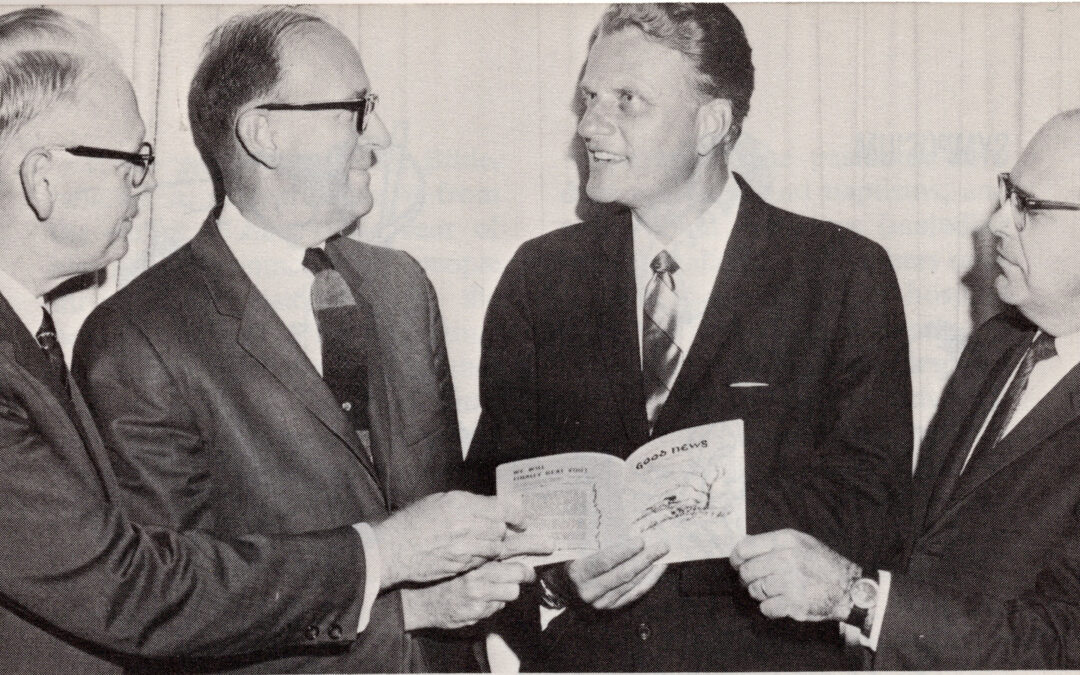
In bringing greetings to the assembly, a message from evangelist Billy Graham stated: “Wish I could be with you for this momentous and historic conference. Methodism was born and it grew through revival and evangelism. It is my prayer that the United Methodist Church will have a spiritual renewal and help lead our nation in the spiritual revival that we do desperately need. May God bless you all.”

Twentieth century United Methodism was marked for renewal. Discouraged United Methodists received hope that they weren’t alone in their evangelical concerns. And most importantly, they began to dream of a new day of revival and renewal in their church.

For 30 years following the Dallas Convocation, Good News sponsored a national convocation nearly every summer. United Methodists came for fellowship, inspiration, and instruction. One couple remarked at our Washington, D.C. convo in the early 1990s, “Jim, when we came here we were so discouraged, we were considering leaving the church. But our hearts have been renewed, and we’re going back to our home church with new hope.” And return they have, by the hundreds, with programs and ideas for their local churches like Marriage Enrichment, Trinity Bible Studies, Faith Promise missions giving, Disciple Bible Study, Discover God’s Call, and Walk to Emmaus.

Improving Sunday school literature: One of the earliest concerns of the fledgling Good News movement was the need to improve dismal denominational Sunday school literature. Evangelicals were frustrated, but hardly knew where to begin to bring about change.

In 1968 Good News carried a stinging evaluation of Methodism’s new adult curriculum. One reviewer wrote, “What is missing here…is a particular and sustained biblical theology.” This reviewer looked in vain for any word about “salvation, any good news about the atonement of Jesus Christ, or any hint about the possibility of spiritual new birth….”

The next year a Good News team met for the first of many dialogues with the church’s curriculum editors and officials. The denominational leaders responded with obvious impatience and condescension toward evangelical concerns. One bishop informed the Good News delegation that they must realize that all contemporary scholars supported the Bultmannian notion that much of the Bible is myth. That was indicative of the gulf that existed between grassroots members and many in positions of national leadership.

Nevertheless, dialogue had begun. The United Methodist Publishing House gradually became more aware of its responsibility to serve the whole church, including the evangelicals. In 1975, Good News published its first edition of We Believe, a confirmation series for junior high youth. Pastors dissatisfied with United Methodist materials received it enthusiastically. It remains a widely-used confirmation curriculum yet today.

A 1985 evaluation of denominational curriculum revealed improvement in our church school literature. In addition, the Disciple Bible Study program has found a warm welcome in the church, as has more recently Christian Believer, a similarly-packaged in-depth study of Christian doctrine, a resource from the United Methodist Publishing House (UMPH) which is doctrinally sound.

The problem evangelicals have now with church school curriculum is its lack of consistency. For adults especially, one quarter’s materials might be sound while the next are disappointingly weak, which is the problem with materials that are published for a broad sweep of theological positions. This inconsistency, among other things, was the impetus that led Good News to begin publishing its  Wesleyan and evangelical Bristol Bible Curriculum.

Both the We Believe confirmation materials and the Bristol Bible Curriculum are published today by the independent, for-profit publisher, Bristol House, Ltd., headquartered in Anderson, Indiana. (Good News had begun publishing books and study materials in 1989, but sold its publishing ministry in 1991 to a small group of Good News supporters who formed Bristol House, Ltd.)

In what was viewed as a sign of increasing openness to the evangelical constituency in the denomination, a few years ago the United Methodist Publishing House (UMPH) and Bristol House, Ltd. joined in a cooperative project to produce Sunday school and small group curriculum for children and adults. This joint venture was welcomed by evangelicals as a new sign of openness on the part of the UMPH.

Doctrinal doldrums: From the start, Good News’ primary concern has been theological. Born in an era when church radicals were demanding “Let the world set the agenda for the church,” we were convinced that the biblical agenda was languishing from both neglect and from theological revisionism.

Adding to United Methodism’s already-existing theological malaise, the 1972 General Conference adopted a new doctrinal statement of “theological pluralism.” While pluralism may have been included to express some of the legitimate diversity found within the parameters of historic Christianity, it was interpreted by many to mean United Methodism offered members a proliferation of theological views, many of which far exceeded the boundaries of sound biblical doctrine. I remember a young pastor friend who was distressed because a United Methodist seminary professor had denied the bodily resurrection of our Lord. He expressed his concern about the matter in his church newsletter. His district superintendent admonished him, saying, “Ed, you must remember that you are in a church that embraces theological pluralism.” For that superintendent, theological pluralism meant that some may affirm the bodily resurrection of Christ and some may not.

In 1974, Good News authorized a “Theology and Doctrine Task Force,” headed by Paul Mickey, associate professor of pastoral theology at Duke University’s Divinity School. The task force was charged with preparing a fresh, new statement of “Scriptural Christianity” which would remain faithful to both the Methodist and Evangelical United Brethren traditions. In addition to Mickey, the committee included Charles Keysor, Frank B. Stanger, Dennis F. Kinlaw, Robert Stamps, Lawrence Souder, and this writer.

In 1975, the Task Force presented its statement to the Good News board and it was adopted at its summer meeting at Lake Junaluska. It thus became known as “The Junaluska Affirmation.” Albert Outler praised Good News at the time for being perhaps the only group within the church to respond to his challenge for United Methodists to “do theology.”

Theological issues were always top drawer for Good News. Our questions and frequent criticism of theological pluralism played a major role in the 1984 General Conference decision to develop a new doctrinal statement for the church. The theological commission, authorized by that General Conference and chaired by Bishop Earl G. Hunt Jr., brought a new and much improved theological statement which was adopted overwhelmingly by the 1988 General Conference. It cited “the primacy of Scripture” as the new guiding principle for doing theology. The term “theological pluralism” was purposefully and conspicuously omitted from the new statement. Some today still try to resuscitate “theological pluralism” under the guise of diversity. However, United Methodism has its clearly articulated doctrinal standards which are protected by Restrictive Rule in the Book of Discipline (Par. 17. Article I).

The seminary challenge: Good News has long been troubled over the liberal domination of theological education. Across the years, evangelicals at our United Methodist seminaries have consistently reported unfair caricaturing, ridicule, and intolerance toward their orthodox, biblical beliefs. They also have cited a troubling dearth of evangelical faculty at our seminaries.

In 1975, United Methodist evangelist Ed Robb Jr., in a fiery address at Good News’ summer convocation, called upon the church to restore Wesleyan doctrine to our United Methodist seminaries. Institutional leaders fumed and seminary professors fussed about his challenge. One could hear the murmurs echoing from their hallowed halls: “How dare he be so critical!”

However, Robb’s hard-hitting address led to a new friendship with Albert C. Outler, United Methodism’s eminent Wesleyan scholar, who taught at Perkins School of Theology in Dallas. Together, with help from others, they formed A Foundation for Theological Education (AFTE). To date, more than 110 evangelical scholars, called John Wesley Fellows, have participated in the scholarship program, receiving grants to seek their PhDs with plans to return to teach at our United Methodist colleges and seminaries.

In 1976, Good News also began publishing Catalyst, the newsletter sent free to all United Methodist seminarians, with the goal of making them aware of evangelical scholarly resources which they did not always have in their liberal seminary setting. The Rev. Mike Walker, the board member who organized the first Good News convocation, has coordinated the editing and mailing of Catalyst from its inception. (It continues today under the auspices of AFTE, which is now chaired by Dr. Ed Robb III, senior minister at The Woodlands UM Church in Texas.)

In 1977, Good News sent teams to nearly all United Methodist-related seminaries, engaging them in dialogue and urging them toward greater openness to evangelical faculty, course materials, and library resources.

Missions derailed: In 1974, United Methodist evangelicals from 23 states gathered in Dallas to discuss their concerns with the church’s world missions program. Those gathered criticized the declining number of overseas missionaries, the mission board’s preoccupation with social and political matters, and its lack of concern for matters of faith—including conversion and the planting of new churches.

The group formed the Evangelical Missions Council (EMC) which several years later would become an arm of Good News. David A. Seamands, Good News board member and former missionary to India, was named EMC’s first chairman. Conversations with the General Board of Global Ministries (GBGM) continued. However, after no less than 22 “dialogues” over an 11-year period between Good News and GBGM, Seamands and others learned that “the unfortunate gulf separating us from the GBGM policymakers was wide and deep.”

For eight years, the Rev. Virgil Maybray, a highly-respected clergy member of the Western Pennsylvania Annual Conference, served as full-time executive secretary of Good News’ EMC effort, spending most of his time speaking in, and consulting with, local churches about expanding their missions programs. During that time, Virgil ministered in more than 350 UM churches in 35 states, raising millions of dollars for missions, with more than $1 million channeled directly through GBGM’s Advance Special Programs.

In 1983, when evangelical discontent peaked upon learning about the proposed new leadership of the World Division of GBGM, 29 large-church pastors and 4 missions professors (all United Methodist) met in St. Louis to form a “supplemental” missions sending agency. It was to be called The Mission Society for United Methodists. It opened its doors for ministry in February of 1984 and began helping United Methodists get to the mission field. Today, with headquarters in Norcross, Georgia, and now known as simply The Mission Society, the young sending agency now has 224 persons in ministry (full-time, standard support) in 31 countries. (This compares, interestingly, with recent numbers from GBGM which report just 247 full-time, standard support missionaries.)

Legislative landmarks: United Methodist evangelicals and traditionalists have struggled with how to respond to the church’s liberal theologies and programs. They could ignore them, find another church, or use their influence for positive change. Good News opted for the latter.

At the 1972 General Conference in Atlanta, Good News launched its first involvement in the legislative process. Board members Bob Sprinkle and Helen Rhea Stumbo prepared and distributed ten petitions and four resolutions. They also cranked out occasional newsletters. Although the 1972 conference was a disaster, approving abortion and adopting the statement on theological pluralism, Good News had thrown its hat in the ring.

The 1976 General Conference brought a stronger Good News showing with the additional help of Robert Snyder and John Grenfell. By 1980, Good News had launched its first full-orbed effort, led by Don and Virginia Shell. They continued leading Good News’ legislative strategy program until 1992, when they turned the leadership over to Lynda and Scott Field, a former Good News board chair and senior pastor of the Wheatland-Salem United Methodist Church in Naperville, Illinois. They gave extraordinary leadership to the Good News General Conference effort from 1996 through 2004.

Whether Indianapolis in 1980, St. Louis in 1988, or Pittsburgh in 2004, the Good News effort has worked behind the scenes in annual conferences to get evangelical and traditional delegates elected, well-crafted petitions channeled properly, and a series of position papers published which articulate our stand on major issues.

The nearly two weeks we spend on site at General Conference with our 40-person team is the culmination of more than two years of careful preparation. As a result of Good News’ field work and legislative training efforts, more United Methodist evangelicals have decided to get involved in the legislative process. Good News, along with other members of the 2008 Evangelical Renewal and Reform Coalition, will once again have a team on site at the 2008 General Conference in Ft. Worth, Texas.

United Methodist evangelicals were encouraged by the efforts of concerned denominational leaders to formulate pre-General Conference activity such as the 1988 “Houston Declaration” and the 1992 “Memphis Declaration.” Both of these initiatives were spearheaded by the leadership of what is now known as the Confessing Movement within the United Methodist Church—which includes prominent leaders such as James B. Buskirk, Maxie D. Dunnam, Ira Gallaway, John Ed Mathison, William Bouknight, and the late William H. Hinson. The grassroots efforts noted above reflected the growing conviction that evangelicals must engage in the legislative process to make their voices heard if the church is ever to experience renewal and reform.

Proliferation of evangelical voices: I am still amazed to think that at one time there were no groups or publications that spoke on behalf of United Methodism’s evangelical or conservative constituency. That, no doubt, helps explain the immediate flood of responses to Chuck Keysor’s inaugural article, “Methodism’s Silent Minority.”

It’s a different world today and the United Methodist Church is not the same church. Think of the organizations that didn’t exist 40 years ago: Good News, The Institute on Religion and Democracy, United Methodist Action, A Foundation for Theological Education, The Mission Society, Transforming Congregations, Lifewatch (the Taskforce of United Methodists on Abortion and Sexuality), the Renew Network, Concerned Methodists, the American Family Association, and the Confessing Movement Within the United Methodist Church.

We should also note the important contribution of several groups affiliated with the General Board of Discipleship, including the Council on Evangelism, the Foundation for Evangelism, the National Association of United Methodist Evangelists, and Aldersgate Renewal Ministries. The above groups have been faithful voices on behalf of our Wesleyan theological heritage.

All of these groups, of course, have their own histories and purposes. They do not walk in lockstep, to be sure. But let’s not miss the significance of their existence. The voices of United Methodist evangelicals and traditionalists are finally being heard. Channels now exist to guarantee this will happen. Thousands of United Methodists have found avenues for evangelical ministry as well as ways to address effectively the spiritual, moral, theological, and social issues that exist in our church.

Emerging new spirit: The various evangelical groups noted above are a part of something new that is emerging within the United Methodist Church. I would call this new surge a growing expectation that the church be faithful to its historic message. I was visiting an annual conference last June and a clergy member, noting the large number of evangelicals elected to his General Conference delegation, said to me almost matter-of-factly, “We expect our delegates in this conference to affirm the evangelical faith.” I was encouraged to hear that. It was another sign that more and more United Methodists have grown weary of theological revisionism and doctrinal fads; weary of those who would use the church in order to advance an ideological agenda. It is time for all of our United Methodist leaders to embrace, believe, and teach the historic doctrines of our Wesleyan tradition.

Many of us have been encouraged by Tom Oden’s The Rebirth of Orthodoxy, published in 2003. After observing the evangelical gains at the 2000 General Conference in Cleveland, Oden says those gains are an indication that the United Methodist Church is re-centering itself around the Apostolic Faith. He wrote, “These gains came largely as a result of a preceding and continuing network of prayer, a coalition of numerous renewing and confessing movements working closely together, and widespread demoralization among the old-guard liberals.”

The 2004 General Conference in Pittsburgh saw further gains that would indicate that the evangelical presence at United Methodist General Conferences continues to grow with each quadrennial gathering. On some 15 votes on issues of human sexuality, delegates affirmed more strongly than ever the church’s long-standing, scriptural position. A motion to allow homosexual unions or marriages was defeated by an 83 percent vote. Surprisingly, delegates by a 77 percent vote went on record to “support laws in civil society that define marriage as the union of one man and one woman.” We are the first and only mainline denomination to be on record on this issue.

As we move toward the 2008 General Conference in Fort Worth, Good News will enthusiastically support the four emphases coming from the Council of Bishops. We are especially excited about the proposal for starting new congregations all across the country. Evangelism has always been a passion for the Good News constituency. For seven years, we have been a promotional partner with The Alpha Course through Good News magazine. By their account, this has been a major factor in the Alpha Course being used in more United Methodist churches than any other denomination in America.

The story of the past decade of Good News’ ministry cannot be told without mentioning the unusual advocacy ministry of the Rev. John Grenfell, a retired member of the Detroit Annual Conference. A former district superintendent, John was tutored well by the late Bishop Dwight Loder that the administration of the church should be done justly and with integrity. John has participated in more than 50 supervisory response sessions, helping pastors who are in need of good and godly counsel, and who often need the help of an advocate. John brings to these sessions a profound understanding of the Book of Discipline and our administrative processes, always urging pastors and laity to be sure they understand due process and the rights provided them in the Discipline.

Even though Good News has sold Bristol House, we continue to publish books for our constituency on themes such as prayer, evangelism, and renewal. One of our newest is Beyond the Badge, by our board member, the Rev. Dr. Chuck Ferrara, a clergy member of the New York Annual Conference. This outstanding book, aimed at bringing police officers to faith in Christ, is already in its 6th printing, even though it has been out less than two years. Churches have been buying the book in quantities to give as a ministry outreach to local law enforcement personnel. The book has great credibility because Chuck, himself, served for 16 years as a member of the New York Police Department (NYPD). Now a pastor, he also ministers as a police chaplain in New Fairfield, Connecticut.

Cry for leadership: When United Methodists feel compelled to form alternative groups within the church and gather at their own expense to issue declarations to the church, as they did at Houston and Memphis, what you have is a plea for godly leadership. We look hopefully to our bishops who are charged with the teaching and overseeing function in the church. Our bishops, according to Paul, “must hold firmly to the trustworthy message as it has been taught,” so they can “encourage others by sound doctrine and refute those who oppose it” (Titus 1:9).

It is easy for evangelicals to grow weary in the struggle for renewal. Some who do will often say, “Jim, the struggle is a distraction from the real ministry of the church.” But Presbyterian clergywoman, the Rev. Sue Cyre, editor of the journal Theology Matters, has written an apt reply to that sentiment, saying that this is not a distraction from real ministry. She writes, “The battle over truth and falsehood is the real ministry of the church. Everywhere the church goes, it is to proclaim the truth of the Gospel, but it is always against a backdrop of some false beliefs.” What a timely word. And those who hold false beliefs do not let go of them easily—Scripture attests to that. So, “Let us not grow weary in well-doing, for at the proper time we will reap a harvest, if we don’t give up” (Galatians 6:9).

New day for United Methodism? So perhaps a new atmosphere is emerging within the church. Granted, we still face serious problems, but there is much reason for hope.

At an earlier anniversary observance, I wrote words that I believe are still relevant today. I will close with them. “Evangelicals today believe the church has been entrusted with a divinely-revealed plan of redemption. This message is set forth clearly in the Word of God. This fact automatically establishes the relevance of the Christian message. We must resist attempts to impose other standards of relevance upon it. And even the slightest mishandling of that biblical message must be ruled out of order. The biblical message, proclaimed in the power of the Holy Spirit, will still bear fruit today. This trustworthy message will revitalize and renew United Methodism and enable us to share in the evangelical awakening that already is moving across our land and world. When our pulpits are alive again with the faithful proclamation of the Word of God, we can be sure the Lord will once again add daily to the United Methodist Church ‘those who are being saved.’”

James V. Heidinger II is the president emeritus of Good News.
Letters to the Editor

Letters to the Editor

On target
Rob Renfroe’s editorial in the September/October issue (“Tone Deafness and the Call to Action”) is on target and very encouraging. As a person in the pew, let me also ask a question.

Why should I distrust a Board that continually labels conservative Americans in favor of a smaller government and less debt as racists? I was at the August 28th Restoring Honor rally in Washington, D.C. and I was humbled by the presence of such a large crowd gathered peacefully with no political signs to hear Dr. Alveda King (Martin Luther King’s niece) speak of her uncle’s “dream”; which gathered to honor everyday Americans for their bravery and generosity and stood with over 200 clergy of all faiths (Christian, Jews, and Muslims) in proclaiming the greatness of this country and praying for a return to God as our savior and leader, and for a renewal of our faith and a return to the founding principles of this nation.

Yes, I too hope and pray that the Call to Action Committee will take its charter seriously. Leadership must be trusted to carry out its role and responsibilities based on biblical foundations and not some political agenda.

Dave Dyer
Spotsylvania, Virginia

Pushed buttons
It might be my own middle-age crisis, but September/October’s “West Coast Lament” pushed several of my buttons. My call to ministry was shortly after the apex of Methodist membership (unification in 1968) and it’s been all downhill since. Like Bishop Swenson, I came west to serve, convinced the world would very soon be transformed for Christ; but as retirement comes onto my horizon, I sometimes wonder what has happened.

Andrew Miller’s analysis and Steve Beard’s story tag some of the probable factors, and George Mitrovich asks directly what might be the other causes for our decline than a failure to honor our Wesleyan heritage. The author asserts that the liberalism that characterizes the West has undermined the Wesleyan witness out here. I would suggest some other factors.

First, I’d like to know why there can’t also be a Christian, Wesleyan church for liberals? Aren’t we eligible for the good news too? Just because there’s not a lot of us doesn’t mean we’re not faithful. Miller’s analysis skips over these facts, culled from the same sources:

• Attendance per member in Cal-Pac is 57.44 percent, while attendance per member in North Georgia is 39.2 percent.

• Despite Cal-Pac’s 16.5 percent decline over the past ten years, giving per member increased 45 percent. In fact, for 2009, per capita giving to the Advance in the Western Jurisdiction is $6.38, with Cal-Pac giving at an even higher rate of $7.37. In contrast, the per member rate for the Southeastern Jurisdiction is $2.74, and specifically for North Georgia, $1.86. If you’re going to compare apples to apples, compare all the apples.

• The article notes the need for a dedicated staff person for church planting. Also reported was the impact of the Pacific-Homes crisis in Cal-Pac—care to guess one of the many places where staffing was cut? Update: since the late 1990s, Cal-Pac has rebuilt its new ministries staff to include an executive director, and directors in both Hispanic and Urban ministries. We’re going in the right direction.

• But wait, there’s more: even though we are committed to planting new congregations by all viable means, Cal-Pac ranks first in the denomination for cost per member to operate a church: $1,297. This indicates the cost of real estate and infrastructure in the second largest metro area in the country. Plainly, this impacts both the vitality of existing congregations, and establishing new ministries, for new people, in new places.

It is interesting to play with numbers and statistics, but personally, I think the reasons for decline are much more personal. The Rev. Adam Hamilton talks about the traditional equation for discipling as “believe, behave, belong.” First, profess faith, as I did in my call experience at senior high church camp. Then learn how to be or “behave” as a Christian and in community and service. The fruit of this for me has become a deep-rooted belonging in the United Methodist fellowship of faith across my life and several western states.

That priority sequence is also at the heart of the accusation that the liberal West has lost its Wesleyan fire and thus its market, its ministry, its witness. But the West is too small to account for the loss of millions of members in the total denomination, and what really drives that loss across much (not all) of our church is not about belief, but how we have behaved. If we take seriously what surveys of those outside the church say, especially those who have actually visited, then the other end of the sequence comes to the front: today, young people in particular come seeking a sense of community and belonging. Hamilton has built his successful ministry by flipping the sequence to begin with belonging, then learning the behaviors (“discipling”), the fruit of which is ultimately profession of faith.

This locates the breakdown at our doorstep. Belonging never gets started because we have not only forgotten true hospitality, we’ve twisted our need for belonging into a cold shoulder. Our need to greet our friends, to sit in our pew, to have only people who look, act, and speak like ourselves to bolster our sense of belonging has effectively closed many of our doors. The root cause is not in our heads, what we believe, but what is in our hearts.

California and the West are booming. It is the mission frontier of our time on this continent. It is packed with folks of all sorts, including more than enough spiritually-rooted, God-seeking persons who are also, by the way, liberal and would welcome Wesley’s open hand, and the idea that Kennedy’s one hundred churches of a thousand members is entirely possible. We will have to deal with the high cost of land and buildings, with multiple languages and colors, and real competition from other faith traditions; but first we will have to open our hearts and minds, and only then should we open our doors. We will have to re-learn and learn anew the ways that match this population—not Georgia’s or anyone else’s. Those who wish to join us in doing so are welcome to go west.

Gary M. Keene
Executive Director
Connectional Ministries
California-Pacific Annual Conference

More needs to be said
Thank you for the very fine article regarding the decline of United Methodism in Southern California and its growth in North Georgia. I appreciate the fact that you were more than fair to Bishop Swenson. But more needs to be said.

The bishop states one reason for Methodism’s decline in the Cal-Pac Annual Conference is its diversity. But the truth is Bishop Swenson has no truly large churches or rapidly growing churches of any ethnic group under her charge. The problem in that conference is not that they have learned how to do “Anglo church” or “Hispanic church” well, but haven’t learned how to do church well for other ethnic groups. Reality is that they aren’t meeting the spiritual needs of any ethnic group sufficiently to make large numbers of disciples—and this in an area where some of the nation’s largest churches of all ethnic groups exist, only they are not United Methodist. A diverse population is not the reason Cal-Pac is failing. There is something systemic that needs to be addressed.

The fact that the bishop points to a financial and public relations problem (the Pacific Homes debacle), which occurred roughly 30 years ago as a reason for a lack of growth today, is both sad and deflective. It is indicative of a mindset that is content with a lack of growth and that is more comfortable with excusing present-day failure than expecting churches to be growing centers of Wesleyan spirituality.

In the past 40 years, the Western Jurisdiction has lost 45 percent of its membership, far more than any other jurisdiction. The reason is not diversity or problems with retirement homes. The reason is systemic. Thus, systemic failure is at hand with the absence of any passion for saving souls; an ambivalence to the poor historical performance; and, as it is with any failing organization, a leadership deflective and blaming like Adam did with Eve. If we mirror contemporary culture, we will be conformed to the world and the world will not need us.

Stew Grant
Texas Annual Conference

Remembering Arminius
I was blessed to read “Celebrating James Arminius” by George Mitrovich in the May/June 2010 issue of Good News. It sounded themes of which we United Methodists need to be reminded. As the recent anniversary celebration of Calvin’s birth showed, certain debates are still very much with us. Lesser debates have often consumed more energy than the Calvinism-“liberty of the will” issue. Mitrovich points out that our beliefs have consequences; therefore, the debate must still be joined. Also, unwarranted suffering can result from falsified doctrine.

Methodism came into being for many reasons; one of the most important was recovery of nearly-forgotten traditions. For us, tradition was a positive force, at least potentially. More than a reaction to Calvinism or Lutheranism, tradition was at stake. The Wesleys looked farther back than these Reformations. We sometimes forget that Arminius and all were preceded by at least a thousand years of living doctrine. A bearer of this continuity was the Eastern Orthodox Church, which continues to this day.

The tradition from which Orthodoxy draws includes the Cappadocian (4th Century) theologians. Their message, as I understand it, was a both/and approach. Both God and humans are somehow involved in what we call salvation. It is about synergy, if you will, more than energy. The alternative to “total depravity” is “energy together” (syn-ergy), a potent force indeed. It does not have to be explained to be true. It has been courageously upheld by Wesleyans and Disciplinary statements through the years.

Your magazine is to be commended for its coverage of both the Early (pre-Schism) Church and the Eastern Orthodox Church (e.g. Archpriest Hardun, p. 8 in September/October 2010 issue). This provided many connections for us to explore.

Joe Beardsley
Retired Elder

Servant leadership
I enjoyed Rob Renfroe’s challenge (“calling out”) for integrity from the top in “Tone Deafness and the Call to Action” in the September/October 2010 issue of Good News. Robert Greenleaf, known as the father of the modern day servant leadership model in the education sector, admonished boards and ad councils of organizations across our society to do their job—hold leadership accountable, thus being good stewards (Servant Leadership: A Journey into the Nature of Legitimate Power and Greatness, Paulist Press, 1977). Those in any field, not just the church, who push their own agenda at the expense of the common good, assist in the erosion of the core values of the organization. Your article explains this well.

Thank you for reminding us of what is at stake. Those at the top of the chain seem to have so little of an idea of what the grassroots of Methodism really think, and are so thirsting for from the bureaucracy. Simply, the grassroots so thirst for true, ethical, transparent leadership that is not aligned with a political party, or the whims of special interests groups, but aligned with Christ, and the biblical principles Wesley assumed we would know how to cling to.

Joseph “Rocky” Wallace,
Doctor of Strategic Leadership
Foundational and Graduate
Studies in Education
Morehead State University
Morehead, Kentucky

Accountability
Thank you for your editorial about accountability and autonomous organizational structure (“Tone Deafness and the Call to Action” in the September/October 2010 issue of Good News).

I am a fairly recent graduate from one of our United Methodist seminaries, and during my four years there, I found myself asking a question over and over: How did it (and how could it) come about that the UM seminaries are not accountable in any truly meaningful way to the UM Church? Sure, we have our six hours of United Methodist classes. But the other 84 hours required for a Masters of Divinity degree will not have much if any focus on Methodist doctrine and beliefs, (and lots of times not even just basic Christian beliefs), unless the student specifically seeks it out.

How did we ever get to this point in the theological education of Methodists? And how can we ever get out if it?

What hope is there for our seminaries becoming accountable, and actually emphasizing and believing Methodist doctrinal beliefs? This would be a major joy and opportunity for renewal.

Thanks so much for all your efforts! Thanks also for not getting all political about everything. No political party is ever going to be our Savior, and I thank you and praise God that Good News magazine does not fall into that trap, but continues to focus on Jesus Christ!

Paul Stephens
Sedgwick and Bentley UM Churches
Kansas West Conference

Excerpt: Three crucial demands

Excerpt: Three crucial demands


Three Crucial Demands

What follows is excerpted from Bishop Gerald Kennedy’s Episcopal Address to the 1964 General Conference of The Methodist Church.

As Methodists, we are now confronted by three crucial demands.

First: the coming of the Holy Spirit in power demands human preparation. To say that we cannot save the world by organization is not to say that we can save it without organization. As a man’s body is to his soul, so is the visible Church to the spirit of Christ. We must use our polity with all the intelligent skill we can muster, remembering that our organization is the means by which we combine our strength, focus our power, and overcome our weakness. In our Methodist polity, we have a mighty weapon to present to our Lord for his use and direction.

Second: the time has come for us to ask ourselves what precisely we believe. We have drifted too long in the shadowy world of obscure theological generalities and we have taken refuge in our vaunted heritage of freedom from creeds. There is spiritual power only in theological conviction. Do we believe that the Gospel is God’s Word to this generation? Do we believe that Christians are commissioned to bring salvation to society? Do we believe that God, through a preacher’s preaching or a layman’s witnessing, can restore a lost soul now? Do we believe that all power has been given unto us? Will we wait together in this General Conference for the rush of the mighty wind and the appearance of the tongues of fire? If we do not leave this place with a new dedication to the all-sufficiency of Jesus Christ for our living and our work, most of what we do here will be of little value. O God, help our unbelief! We do believe that God is able and He has chosen us to bring salvation to each man and His saving health to every nation.

Third: the spirit of expectancy must possess us anew. When men come seeking, they always find. So much of this depends on the preacher that it is hardly too much to say that a worship service is a reflection of his spirit. But the layman has a responsibility too, and if he enters God’s house expectantly, he will hardly ever be disappointed. Methodist churches must be centers of spiritual excitement and hope. We must be rescued from our dullness. We need to learn to sing again the great Wesley hymns and meet together to study the Bible. We need to testify to what God in Christ has done for us and tell our neighbors how Christ has changed our lives and given them eternal meaning.

God called the Wesleys and now He calls their spiritual sons and daughters to a world-wide evangelistic crusade. This evangelism must have the two authentic marks of our tradition, which are the experience of the heart strangely warmed and a deep social concern. It must be broad enough to include all Christians who will join hands with us. Let the Methodist Church around the world unite its power in faith and claim every part of every society for Christ. Let us offer God our organization in the spirit of that ancient cry: “I would fain be to the Eternal Goodness what his own hand is to a man” (Theologia Germanica). We can save our life as a Church only by losing it. Let the Methodists of this world plan a mighty mission to the nations so splendid that future generations will marvel at our courage. Let us pray for a new expectancy that we shall behold God’s mighty acts now.

On February 26, 1791, four days before he died, John Wesley in his last letter to William Wilberforce, the great crusader against slavery, wrote: “Unless God has raised you up for this very thing, you will be worn out by the opposition of men and devils. But, ‘If God be for you, who can be against you’?” On March 2, 1791, Wesley died after speaking his last words in a clear voice: “The best of all is, God is with us.” After lying in state while some ten thousand people passed by him weeping, he was buried at 5 a.m. to escape the confusion of a huge crowd. According to his instructions, he was carried to his grave by six poor men, who were to receive one pound each. All he left behind him, as someone has said, were a badly abused reputation, a worn-out pulpit gown, and the Methodist Church.

We are that Methodist Church, claiming its heritage proudly and facing its future confidently through faith in Jesus Christ our Lord and our Redeemer.

A west coast lament

A west coast lament

A West Coast Lament

By Steve Beard, 2010 —

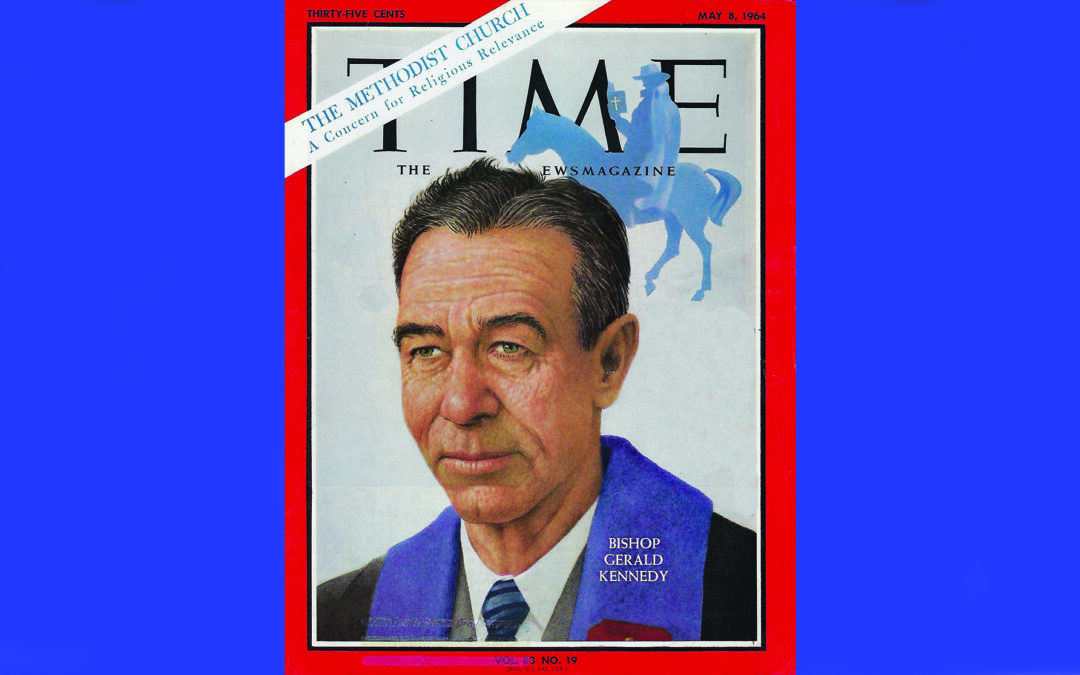
There was good reason that Bishop Gerald Kennedy of Los Angeles presented the Episcopal Address at the 1964 General Conference of the Methodist Church. “Kennedy is unquestionably among the four or five most dazzling preachers in the U.S. today—an oratorical genius with a commanding baritone, and the pace and timing of a Broadway pro,” wrote Time magazine in a cover story on Methodism’s identity crisis a week after the General Conference.

“This year many of the 858 Methodist delegates arrived at their conference with the deep conviction that their church had reached a turning point in history,” reported Time, “and with a scarcely concealed fear that the vitality that once burned in Methodism was lost when fiery evangelism gave way to today’s organized, institutional church.”

In his address, Kennedy told the delegates that the Christian task is “to pursue our ancient course of attacking our own imperfections, keeping our life open to God, and perfecting our society. We are not trying to sell a system, but to demonstrate a Way which is incomparably better than all others, and shines with the promise of a more abundant life for all men.”

Incomparably better than all others. Now that took some chutzpah back in the 1960s. But that was Kennedy. Elegant, gracious, confident, and firm. He was appreciated by conservatives and liberals alike. Although not narrowly categorized as an evangelical, he was the chair of the Billy Graham crusade in Los Angeles in 1963. A prolific preacher and author, Kennedy was independent, smart, urbane, accessible, and spellbinding. When it was time for his sermon at annual conference, preachers literally ran across campus to grab a seat.

Kennedy had a distinct understanding of Southern California culture. He drove around in a convertible Karmann Ghia Volkswagen sports car and preached a trademark sermon called, “A Little Old Lady from Pasadena,” a pop culture nod to the Beach Boys. When his fellow bishop Fred P. Corson of Philadelphia complained about the difficulty of getting his clergy to wear clerical collars in the 1960s, Kennedy used to jokingly respond, “I have a hard time getting my clergy to wear shoes!”

Time observed that Kennedy “best seems to express the peculiar quality of his church’s active, outgoing faith: pragmatic but perfection-aimed, equally concerned with personal morality and social order, loving discipline yet cherishing freedom.” Kennedy called it “sanctified common sense.”

At that time, Kennedy was spearheading the fastest-growing area of the Methodist Church. It was a golden era of buying property, building churches, and extending the tent pegs of Wesleyan Christianity on the West Coast.

A tale of two conferences
Not long ago, Andrew Miller, president of Providence Publishing House, was shocked by the decline of what he considered his home congregation, First United Methodist Church of Riverside, California. When his father was appointed there in 1967, there were more than 2,700 members. Currently, that congregation reports only 346 members.

“It has an enormous physical plant, expansive parking lot, and is in an area of well-populated family homes. There is nothing visible to the eye to explain its decline,” writes Miller in his analysis, A Tale of Two Conferences.

Utilizing the General Minutes of the United Methodist Church, Miller diligently studied the growth and decline of half-a-dozen annual conferences within the denomination. His study ended up comparing the California-Pacific Annual Conference and the North Georgia Annual Conference since they had similar memberships in 1965.

At that time, California-Pacific’s membership stood at 218,352 (92,692 attendance); North Georgia’s membership was at 211,794 (attendance 85,838).

Today, California-Pacific’s membership in 2010 is 81,194 (48,584 attendance). North Georgia, on the other hand, has a current membership of 356,279 (127,486 attendance).

For those doing the sobering mathematics, North Georgia’s membership has swelled by 144,485 since 1965, while California-Pacific’s membership has diminished by 137,158.

Since 1950, North Georgia has had 99 churches that at some point had more than 1000 members. There are currently 72 congregations at that level.

During that same period of time, California-Pacific has had 82 churches with more than 1000 members. Currently, there are only five.

Miller was stunned by the stark data.

So was I. Both of us were raised in Southern California as United Methodist preacher’s kids. I remember skateboarding up and down the sidewalks of the University of Redlands during annual conference as a teenager and growing up within the small but potent subculture of evangelical United Methodism on the West Coast—a unique minority status.

(Editor’s note: In 1985, the Arizona/Southern Nevada portion of the California-Pacific Annual Conference became the Desert Southwest Annual Conference. For the purposes of his study, Miller eliminated those congregations from the statistics.)

A different place
Miller’s study can be used as an illustrative example of two areas of the church pursuing diametrically different spiritual worldviews. Over the years, Cal-Pac has embraced the prevailing theological liberalism and gay activism of the Western Jurisdiction—a section of the UM Church that has lost 45 percent of its members in the last 40 years. For example, during the 2010 annual conference, seven different presentations were given at Cal-Pac to highlight gay, lesbian, and transgender concerns.

North Georgia, on the other hand, has maintained and promoted an overall orthodox theology and upheld traditional United Methodist sexual ethics. This is not to say that there are no liberals or progressives in North Georgia any more than it is to say that there are no evangelicals or traditionalists in Cal-Pac. It is, however, to say that each annual conference has a prevailing theological and ethical outlook.

It is understandable that when most analysts look at the data of the two conferences, they first note the obvious distinction between the perceived “Bible Belt” culture of Georgia, and the “happy pagan” vibe that permeates California.

“The leading difference is diversity,” responded Bishop Mary Ann Swenson when I corresponded with her about the comparison. And she has a point. In addition to Southern California, her area encompasses Hawaii, Guam and Saipan. Almost 60 percent of families in Los Angeles have a language other than English spoken at home. As I grew up in the parsonage, my dad’s ministry included helping launch a Spanish-speaking congregation, as well as Vietnamese, Tongan, and Korean congregations.

When Bishop Swenson’s pastor in Mississippi called her forward to the altar 41 years ago and laid his hands on her head, he prayed for her to be an evangelist and missionary to the “wild West.”

“I have learned that, compared to my home in the South, the West is not so much ‘wild’ as it is profoundly different in religious and cultural terms: this is the context for my ministry—our ministry,” she responds.

Not long ago, Los Angeles surpassed New York and London as the most religiously pluralist metropolitan region. There are more than 600 separate faiths with religious centers in the area.

At the same time, Los Angeles is overwhelmingly Roman Catholic—3.6 million strong. Of those, 70 percent are Latino. The second largest religious representation is Judaism, followed by the Southern Baptist Church, Mormonism, and Islam—the third largest concentration in the United States. Of course, there are cults and pseudo-religions on every corner.

Protestantism in Los Angeles is overwhelmingly evangelical, Pentecostal, or charismatic. Today, the mainline denominations represent a very small segment.

By way of comparison, Atlanta is overwhelming Southern Baptist, followed by United Methodists and Roman Catholics.

Pacific Homes
In our exchange, Bishop Swenson mentioned the Pacific Homes litigation from the late 1970s to the early 1980s as a “difficult time in this region and accounts for some of the decline in those decades.” Once again, she has a point. It was a public relations disaster for United Methodism in Southern California. These church-related retirement homes in California, Arizona, and Hawaii ran into catastrophic financial problems and subsequent legal issues. I remember the talk around the parsonage of lawsuits, liability, bankruptcy, and families leaving our congregation.

Bishop Charles F. Golden (who followed Kennedy) appeared before “60 Minutes” cameras and front page stories appeared in the newspapers. This was a denominational earthquake that threatened to burst the Richter scale. Providentially, Bishop Jack Tuell, a former attorney who followed Bishop Golden, helped guide Cal-Pac through the rigorous and tedious legal and financial issues that threatened the annual conference.

In the painful process, Cal-Pac had to slash its budget and move the conference headquarters into the Pasadena First United Methodist Church. The repercussions of the Pacific Homes debacle would be felt for many years.

Measuring vitality
“Focusing exclusively on congregational membership isolates the question of vitality from the context of mission,” Swenson believes. She points out that membership statistics are not the sole measuring stick to test vitality. Although the membership in Cal-Pac has declined 16.5 percent over the past ten years, attendance increased over 2 percent during the same period. Furthermore, Swenson notes that despite Cal-Pac’s decline in membership over the last 10 years, giving per member increased 45 percent.

“Yet the more fundamental constraint is not visible in numbers and dollars,” Swenson continued. “As much as I love our United Methodist Church, I am convinced that we are attempting to operate out of one size fits all model of evangelism, combined with an assumption of homogenous contexts for ministry. That homogeneity does not exist, and to ignore it is to attempt a ministry that is disconnected from reality. Measurement of ministry based on that assumption is equally disconnected from reality.”

While no one wants to measure ministry on assumptions that are disconnected from reality, it would be worth having a denomination-wide discussion about whether United Methodism actually has a serious “model of evangelism” at all.

The numerical loss of members carries significance because individual souls matter. Perhaps United Methodism has lost sight of the great weight of one lost soul looking for redemption. Are we convinced that the lost even need to be found?

In the beginning of August, evangelist Greg Laurie held his 21st Harvest Crusade at Angel Stadium in Anaheim. Over three nights, more than 118,000 men, women, and children attended the event. How many United Methodist congregations officially partnered with the crusade? Zero.

Stadium crusades are not everyone’s cup of tea, nor are they the normative model of United Methodist evangelism. Nevertheless, would we not benefit by occasionally venturing outside the confines of our denominational family to see what is working and what is making a difference?

Hispanic influx
The Immigration Act of 1965 would prove to transform the ethnic make-up of Southern California. For example, the Hispanic population of Los Angeles is nearly 50 percent. Spanish services are held in two-thirds of the Catholic parishes.

In all honesty, United Methodism is not the only group to have lost a tremendous opportunity with Hispanics. All of the mainline denominations have failed. “The most interesting thing about the Latino population in Southern California is that they have their own churches, some imported here from other countries, some growing up here,” observes sociology professor Richard Flory, senior research associate at the Center for Religion and Civic Culture at the University of Southern California. “But, they do seem to be either Catholic or some version of evangelical, Pentecostal, or charismatic.”

In my conversations with Cal-Pac clergy, I asked why United Methodism never gelled with the Hispanic population. “We viewed them as a social justice project instead of an opportunity to share our faith,” said one pastor. This sentiment was expressed repeatedly. It seems as though we have been held captive by a false dichotomy of social justice vs. outreach. The Roman Catholics and Pentecostals embrace a both/and approach instead of an either/or model. United Methodism would have been wise to have done the same.

If United Methodism intends on making any inroads with Hispanics, we must be intentional about having pastors, evangelists, and teachers speak Spanish and be willing to Pentecostalize some of our services. Furthermore, our annual conferences must attempt to have a greater understanding of Latino culture.

Many years ago, I was a guest preacher at a Methodist annual conference in Mexico. Over meals, many of the pastors asked me about the preoccupation with homosexuality within the UM Church in the United States. One by one they recounted the public disgrace they faced as Methodists when the Rev. Ignacio Castuera, a prominent UM clergyman in Cal-Pac, appeared on the “Cristina” television show to perform several same-sex marriages in 1995. Cristina was the Oprah of the entire Spanish-speaking world.

Castuera was decked out in a clerical collar and a colorful stole draping his robe as he smiled with glee as the male couple and the female couple kissed on television. These pastors in Mexico received the brunt of the ramifications of his actions. Their parishioners were disillusioned and angry. As in the United States, many left the Methodist church for other denominations where this was viewed as unscriptural. These pastors bore an undeserved stigma among the people in their towns just for being Methodists.

Although the bishops of Mexico sent letters of protest and concern, there never came a satisfactory response. This is the kind of situation that guarantees United Methodism could remain an alien faith among Hispanics.

Missing the youth culture
Some of United Methodism’s diminished effectiveness in Southern California had to do with an “inability or unwillingness to adapt to the emerging youth culture starting in the 1960s, and probably just in general being considered too ‘establishment,’” sociologist Richard Flory told Good News. “I think as well that theology also played a role in that in general, the message from mainline denominations was more social gospel oriented than what evangelical and Pentecostal/charismatic churches offered, which in one way or another has always focused on…a personal religious experience, journey, quest, or worship experience.” Wesley would have referred to it as having his heart “strangely warmed.”

Southern California was an epicenter for an enormous religious revival among the counter-culture in the 1960s and ’70s. “Jesus is alive and well and living in the radical spiritual fervor of a growing number of young Americans who have proclaimed an extraordinary religious revolution in his name,” reported Time in 1971 in a cover story on the Jesus People. “Their message: the Bible is true, miracles happen, God really did so love the world that he gave it his only begotten son.”

The church in Santa Ana pastored by my dad that I grew up in had a barefooted Jesus People youth pastor. My dad knew the intense cost—and paid the price—of attempting to merge the countercultural with the “establishment,” but he had a heartfelt commitment to the next generation. Unfortunately, not enough of our mainline clergy had the same passion for evangelism and belief in the transforming power of God to find a way to welcome the John-the-Baptist hippies to a coat-and-tie Sunday morning service.

The spiritual vacuum, however, was filled with entirely new and dynamic denominations. The flagship congregations for such movements as Calvary Chapel, The Vineyard, and Hope Chapels exploded with growth all over the west coast.

Let’s be very honest about the fact that there never has been a problem with growing a large church in Southern California. Rick Warren’s Saddleback Church is just one example of vibrant evangelism, passionate worship, and meaningful social action.

Liberal fundamentalism
As Cal-Pac’s primary seminary, the Claremont School of Theology establishes the theological tone of many pulpits throughout the Western Jurisdiction. Claremont’s decision to become an interfaith graduate school of religion that trains Muslims, Christians, and Jews under the same roof was not terribly surprising to those familiar with its theological underpinnings.

In making his pitch for the seminary’s new vision, Claremont President Jerry Campbell told the United Methodist Reporter that Christians who feel they need to evangelize persons of other faiths have “an incorrect perception of what it means to follow Jesus.”

Huh?

“I think the correct perception is much more on the side of learning to express love for God and love for your neighbor as yourself,” Campbell said. “Those are the fundamentals for me.” The wording was very clever, but ultimately intellectually and theologically confusing and inadequate. Our love for our neighbors is at some point most potently expressed by sharing with them the life-changing power and love of Jesus Christ. To withhold that winsome message does no honor to God nor our neighbor. As Wesley said, “Offer them Christ.”

We are not talking about beating anyone over the head with the Bible, but we are talking about being serious about the message of Jesus: “Therefore go and make disciples of all nations, baptizing them in the name of the Father and of the Son and of the Holy Spirit, and teaching them to obey everything I have commanded you.”

“We have lost the idea of the uniqueness of Jesus Christ,” said one young Cal-Pac pastor. “The gospel has been reduced to doing good things—kind of a religious version of the Lion’s Club. People are looking for much more than that.”

Church planting
“As new areas develop, new congregations must be organized,” observes Miller in “A Tale of Two Conferences.” “North Georgia has dedicated staff working full time on new congregational development. Several other conferences showing growth have such staff assigned as well. Cal-Pac has no large membership category churches that have been founded since 1975. In the same time period, North Georgia established fourteen of its large membership churches, as well as a number of others approaching this level.”

“There is an expectation that every local church can grow and there is a commitment within the annual conference to begin new missions, ministries, and congregations every year,” says Bishop Mike Watson of the North Georgia Annual Conference.

“There is a place for many diverse people including Anglos, African-Americans, Hispanics, Koreans, Kenyans, Vietnamese, Brazilians, Haitians, and others,” Watson told Good News. “We have every size congregation from the tiny to the extremely large. We have inner city, urban, suburban, county seat, small town, and open country congregations….There seems to be a welcoming place for everyone.”
Lyle Schaller, the prolific church growth guru, believes that there should be a “chief strategist in every annual conference (this could be a person or a task force) with the competence plus the responsibility and authority to fill that role.”

After surveying the comparative data, Schaller told Good News, “The North Georgia Conference has been organized for at least four decades with someone, or some group, filling the role of chief strategist and the strategy affirms that larger congregations are more likely able to mobilize the resources required to produce the relevance, quality, and choices younger generations seek as they search for a church home than are small churches.”

Kennedy’s call
As they gathered in Pittsburgh for the 1964 General Conference, delegates believed that their church had reached a “turning point in history,” as Time reported. Many were fearful that the “vitality that once burned in Methodism was lost when fiery evangelism gave way to today’s organized, institutional church.”

To refocus the passions, structures, and vision of the church that he loved so much, Bishop Kennedy reminded the delegates in his Episcopal Address of the evangelical roots of their heritage and the divine calling of the Methodist Church.

“The Wesleyan revival was, among other things, a demonstration that when plain men could say in the words of the founder, ‘We have felt our hearts strangely warmed,’ thousands were converted,” Bishop Kennedy said. “While our fathers were good organizers, they regarded organization as a means to fulfill the evangelistic purpose. Their success was a testimony to the power of witnessing to Christian experience and another example of how the preaching of the Word of God saves men by faith.”

In times like these, we all need to be reminded of that.

Steve Beard is the editor of Good News.

Excerpt: Three crucial demands

Methodist Heritage: Belonging to the Church in Crisis

Methodist Heritage: Belonging to the Church in Crisis

By Bishop Gerald Kennedy
Dallas 1970
Good News Convocation

It’s a very great honor and a great delight for me to be here today. I had the privilege of writing an article the first time Good News magazine came out. I have felt that this is one group that ought to have some representation, and probably one group that has been much neglected.

I brought my Bible because I want a text. And it always makes a great impression on the brethren when a fellow has his Bible instead of his date book. From the 11th chapter of St. Matthew, beginning with verse 16: “But to what shall I compare this generation? It is like children sitting in the marketplaces and calling to their playmates, ‘We piped to you and you did not dance; we wailed and you did not mourn.’ For John came neither eating nor drinking, and they say, He has a demon; the Son of man came eating and drinking, and they say, ‘Behold, a glutton and a drunkard, a friend of tax collectors and sinners!’”

Jesus took his sermons and his insights into the meaning of God, God’s Law and God’s will out of the things he observed. You never catch him quoting a theologian. He never goes back to something that he heard in school. He just looks out over the crowd and he uses the experiences they’ve had. And he says you are like children playing.

The youngsters of that time had two favorite games. One was called funerals. They liked to take off on an oriental funeral. Death didn’t mean much to these youngsters.  They played weddings too. A different mood – rejoicing.

Jesus, looking upon this changing crowd, realized what they wanted now and he knew they’d want something different tomorrow. So he said, you are like the children playing these games, and their whole attitude toward religion was as a game.

I do not know how to speak of our attitude toward religion, toward the Gospel, toward the Church, in any better way than to say we think of it as a game.

When World War II came along, we suddenly got religious. We had a rebirth of religion, or we thought it was. I can still recall what a great thrill it was to start a new church. We built 10 or 12 a year. We opened them up, people came, and there were crowds.

But the mood has changed. It isn’t so easy now. The theologians are predicting now it’s the end of the Gospel, the end of religion. Oh, we are just like those children – we go by moods. Now everything is all well … now everything is all wrong.

When somebody goes to a new community today, he will join any church that seems to be to his liking. Now the ecumenical boys – the COCU propagandists – are telling us that this is a new ecumenical spirit. It’s nothing of the kind. It just means that we don’t take church very seriously one way or the other. If we are going to any church, it doesn’t matter much which one. Wherever it is a little more convenient, or wherever the preacher is a little more pleasant or where we are likely to hear more of the things we like to hear – we’ll go there. It just shows that we treat the whole business as a game.

In a certain Sunday school class, the teacher wanted to inquire about what the children believed. The minister’s son was in that class, and she said to him, ‘‘tell us why you believe in God.” The boy was a little confused and he said, “Well, I don’t know. Somehow it just runs in our family.” And that’s the attitude we’ve taken toward this church membership, and our relationship to the Gospel. If it runs in our family, we have grown used to it, but there’s nothing very deep in it.

Jesus was talking to us. Like the children of the marketplace, we mourn. We laugh and we expect others to join us. What game can we play that will please you? Tell us and we will choose it.

We think that the only purpose of the Church is to make us feel good. We think that the only purpose of the Gospel is to say the thing that we want to hear.

I don’t know anything about music, and sometimes I’m glad I don’t. I know more preachers who get so upset when the music is a little off but I have not a good enough ear to know it. So I just enjoy it. But I do have a conclusion about the hymns we sing. You may be very sure that a subjective hymn is no good for Christians. The hymn which we ought to sing, the hymn which is real, is the objective hymn. It tells us something about the Laws of God and what it means to be in God’s presence.

We have in Southern California more nuts about religion than anywhere else in the world. If you get a funny idea, come out there and start a new church, and people will come.

A former friend of mine came to Southern California and started a church in a theater. He advertises in the Los Angeles Times every Saturday, and the headline of his ad is, “Let’s Talk About You.”

No talking about Christ, or the will of God. Let’s talk about you! Our approach to our religion and our approach to our Church is this: Does it make me feel good? Does it say the thing I want to hear? Will it please me? Does the preacher reflect my economic and political ideas? If not, I’ll go somewhere else. It’s a game.

This is one of the reasons why our Protestant churches have had such a hard time in integrating. The reason is, we just want everybody to be our kind of folks. We like a church where we’re at home with one another. And even our denominations have come to be marked by economics. If a Methodist becomes too successful, he’ll almost certainly become an Episcopalian.

Social classes who have the same sense of values and the same prejudices we want in our churches.

Now so far as the preacher is concerned, he’s in a bad way. What do they want from preachers? They want something interesting, and I’m in favor of that. (I don’t know how anybody can preach the Gospel without being interesting. But preachers can do it. It almost takes a supernatural power to be dull when you are preaching the Gospel. Preachers need some divine aid. You cannot do it on your own.)

And they want the preacher who has some status in the community. They want somebody who amounts to something, who has some brains, who knows which fork to use and so on. He has to be socially acceptable. They want that kind of a fellow, of course, but they also want the kind of man who says the thing they want to hear. And if they don’t hear it on this corner, they’ll go down to the next corner and try him. It does not make any difference about the denomination. They will shop around. Sermon tasters are no good to the Church. No loyalty to the church. They have not joined anything and they are just playing a game. If the mood changes, they must go elsewhere.

If I were a layman, and I went to a church Sunday after Sunday, and heard exactly the thing that I expected to hear, I think I would go to the Pastor-Parish Relations Committee, and say, “See the superintendent, and if necessary see the bishop, but in God’s name, let us have somebody here that will confront us with God’s Law.”

I could not stand the constant hearing of the kind of thing that I want to hear. The Gospel, to me, is that thing which probes down into my life. It becomes as a bright light down in the darkness. Sometimes I feel so ashamed of myself I cannot stand it. And sometimes I feel so guilty I cannot escape. Now the Gospel is not just sweetness and light.

At the root of the whole thing, we have misunderstood what church membership means. We join a church; we really ought to enlist in a cause. When a man joins a church he ought not to be saying by his action I’m going to be here as long as I am happy, and as long as I agree.

“I’m here for the duration!” is what church membership ought to mean.

I went to Russia a few years ago, and I was never received with such cordiality and friendship in my life. Those fellows took me in like I was one of them. They were so desperately anxious to meet somebody from outside. They took me out to the seminary. I met some of the young men who were training for the ministry. Think of that! In Russia!

And I shall never forget a Communion service. I watched those people come down to take Communion, older people some of them, most of them, I suppose. Toil was written on their faces and suffering. And I thought to myself that they’re not here because this is the thing to do. This is a great handicap for them to come here and they know it. One of the greatest spiritual experiences I’ve had was in that church that day.

I got away from my guide one afternoon during the week and went over to the Baptist Church in Moscow. The church was packed. I could not understand a word and I did not understand the hymns. I did not understand what the preacher was saying. But there was something in the atmosphere that I have not felt in an American church in a long, long time. People were there and they hung on those words. This was life and death to them.

I went to Poland. Those folks had been under persecution for years. They were under the Catholics for a long time. (That was before they ever heard of the Vatican Council.) Life was not easy for the Methodists. Then came the communists. And all their lifetime, their Methodist witness has been in the midst of suffering and pain and danger. But you ought to be with one of those Methodist congregations when they worship! Something happens!

Now I have to say this to you and to myself. We are not going to have the same kind of preacher for all the churches. We have to know that there are going to be very many different interpretations. And this we must welcome. Our unity is not going to be found in an orthodoxy of theology. It is going to be found in a loyalty to Christ through the Church of Christ, which is, in our case, The United Methodist Church. We are enlisted in The United Methodist Church and we are there for the duration whether everything pleases us or not.

This Convocation represents to me great hope, and great danger. If it becomes merely another negative group attacking this or that. I’m up to here in caucuses already. The Church doesn’t need us if that is all we are.

But if we can hold up this witness of evangelical preaching and living without narrowing it down too much, and rejoicing in evangelical Christianity The Church has been waiting for this and needs it.

It is a thin line we walk. O God, help us to walk it properly and not go over one way too far or the other.

I have been reading a book about the Queen of England. She is quite a gal. She has dignity, and she’s brought up her family pretty well And she has courage. A few years ago she was going to Ghana, and the communists started stirring things up over there. The government got a little worried and did not think she ought to go. They tried to tell her but she didn’t pay any attention. Finally the prime minister said, to her, “You better not go. It’s too dangerous.”

She said, “Danger is a part of the job,” and she went.

Danger is a part of the job of church membership. It is not going to be a safe time, in these days ahead. I think we are in for tough times.

The first great conference of the Methodist Church in America was the Christmas Conference of 1784. The question was asked of those brethren, ‘‘What is God’s design in raising up the people called Methodist?” The answer they gave was the same answer which John Wesley gave in 1744: “To reform the continent and spread scriptural holiness across the land.”

Now if they’d been modern fellows they’d just sat down and talked about all their problems and how tough it was.

But not being modern, they just said, “What does God want us to do?” Reform the continent! That is a big enough idea for you. And spread scriptural holiness across the land. That’s a pretty good answer. For us too.

I went to Africa a few years ago and saw Albert Schweitzer. I spent two or three days with him. Now he was a tough old boy. Before I left he gave me his picture and autograph. That is one of my most precious possessions.

The other day, when I was thinking about this speech, I glanced up at that picture. And underneath it there is written a wonderful thing Schweitzer said about Jesus: “He comes to us as One unknown. Without a name. As of old by the lakeside He came to those men who knew Him not. He speaks to us the same words, ‘follow thou me.’ And sets us to the task which he has to fulfill for our time. He commands. And to those who obey him, whether they be wise or simple, he will reveal himself in the toils, the conflicts, the sufferings which they shall pass through in his fellowship. And as an ineffable mystery they shall learn in their own experience who he is.”

And I said to myself, that’s it! That is Church membership in a time of crisis. That is what I’m groping for and what I have been trying to say. We find him, and he reveals himself to us, in the task he has given to us to perform and in the sufferings. And that, my brothers and sisters, seems to me to be the very heart of what it means to belong to a church in crisis. To be enlisted in his cause, and to follow him in that spirit. Let us pray.

Our Father, we love The United Methodist Church. Because we love it we know there are times we must be critical of it. And we thank thee that those of us who believe this, also believe that we must not divide ourselves. We pray that out of this great meeting here thou wouldst be pleased to put a new Spirit in our Church, and redeem us from playing with the faith. Through this meeting may there come into all our churches and our lives, great rebirth of power. Amen.

This sermon appeared in the October-December 1970 issue of Good News.