by Steve | Mar 12, 2018 | Magazine, Magazine Articles, March-April 2018

Frederick Douglass, ca. 1879. George K. Warren. (National Archives Gift Collection)
Liberty’s Hero: Frederick Douglass
By Steve Beard –
Frederick Douglass grew up under the perverse shackles of slavery on a plantation in Maryland 200 years ago. He never knew the identity of his father, barely saw his mother, and witnessed unspeakable violence and bloodshed before he turned 10 years old. He was proselytized under a warped version of Christianity that had a Bible in one hand and a bullwhip in the other. It was piety unrecognizable to the Prince of Peace.
As one who escaped the bonds of slavery, Douglass (1818-1895) would become the most eloquent abolitionist orator and the most steadfast defender of liberty, equality, and justice. “Douglass spoke as a man born into bondage in America more than forty years after the Declaration of Independence had proclaimed that all men were equal and endowed by God with liberty,” historian D. H. Dilbeck reports in Frederick Douglass: American Prophet, a new spiritual autobiography.
At eight years old, Douglass was sent to live with a Methodist family in Baltimore. The wife, Sophia, was kind and devout and treated Frederick with the love that children deserve. Bible reading, hymn singing, and prayers were commonplace. One night, he heard Sophia reading the Old Testament story of Job aloud. The desolation of Job’s life was spelled out: death, poverty, and relentless calamity.
“Naked came I out of my mother’s womb, and naked shall I return thither: the Lord gave, and the Lord hath taken away; blessed be the name of the Lord. In all this Job sinned not, nor charged God foolishly.”
“How could this be?” young Frederick asked himself. Why are the righteous stricken with destruction while the evil count their fortune? Where is God? Was this all part of a divine plan? When he should have been identifying with a Sunday school story such as young David slaying the belligerent bully Goliath, instead he connected with the stark horror story of a man whose entire family is decimated.
When asked about their captivity, some fellow slaves repeated the slaveholder’s propaganda that God made white people to be masters and black people to be slaves. Others told him that it was God’s predestined plan for the planet. Douglass rejected these false precepts. “It was not color, but crime, not God, but man, that afforded the true explanation of the existence of slavery,” Douglass concluded. Judging from the biblical messages of the prophets and the King of Kings, it was greed and spiteful hearts of humans that stole liberty and equality from those who were born free.
Wanting to learn more about Job, Frederick asked Sophia to teach him to read. He soon mastered the alphabet and began to spell. Sophia was overjoyed – until she announced the progress to her husband. Horrified, he demanded that the lessons end immediately. “Learning would spoil the best n***er in the world,” he said, because slaves who knew how to read – especially the Bible – became “disconsolate and unhappy.” One can only imagine the fear that would run through a slaveholder’s blood as those kept in chains read about Moses telling Pharaoh, “Let my people go!” Sophia promptly ended the lessons.
Douglass recalled her transformation as proof that “slavery can change a saint into a sinner, and an angel into a demon.” At the same time that young Fredrick’s heart was searching for a relationship with God, he witnessed firsthand the way that the prevailing slaveholding culture blinded the churchgoers to biblical justice and the gospel of love.
Hidden away at night, Frederick taught himself to read using old copies of Webster’s spelling book and Methodist hymnals. The saga of Job launched Douglass into mastering the language – the written words that held power to unchain the heart – that could literally help free men, women, and children. “Devout masters did all they could to keep the sacred truth of the Gospel from their slaves,” Dilbert wrote. “Yet the confounding experience of Job, who heard God in the whirlwind, proved far too compelling to a young boy who had wrestled with the problem of evil. Nothing could keep Frederick from the Bible and from learning to read.”
Remarkably, Douglass scoured the streets looking for passages of Scripture to piece together. “I have gathered scattered pages from this holy book, from the filthy street gutters of Baltimore, and washed and dried them, that in the moments of my leisure, I might get a word or two of wisdom from them,” he wrote.
Douglass would eventually write three best-selling autobiographies. “I was not more than thirteen years old, when I felt the need of God, as a father and protector,” he wrote in My Bondage and My Freedom. “My religious nature was awakened by the preaching of a white Methodist minister named Hanson. He thought that all men, great and small, bond and free, were sinners in the sight of God … and that they must repent of their sins, and be reconciled to God, through Christ.”
Douglass was also befriended by Charles Johnson, a black lay preacher, who told him to pray. “I was, for weeks, a poor, brokenhearted mourner, traveling through the darkness and misery of doubts and fears. I finally found that change of heart which comes by ‘casting all one’s care’ upon God, and by having faith in Jesus Christ, as the Redeemer, Friend, and Savior of those who diligently seek Him.”
Douglass testifies that seeking after God transformed his life. “After this, I saw the world in a new light. I seemed to live in a new world, surrounded by new objects, and to be animated by new hopes and desires,” he claimed. “I loved all mankind – slaveholders not excepted; though I abhorred slavery more than ever. My great concern was, now, to have the world converted.”
Douglass spent the rest of his life battling for the rights of those left out and forgotten: women, Native Americans, and immigrants. He preached and published with the intensity of an Old Testament prophet and the grace of a nail-scarred savior. He had a lifelong “lover’s quarrel” with the Christian church in America that defended or looked the other way while men, women, and children were sold on auction blocks. The complicit preachers armed with a false gospel “have shamelessly given the sanction of religion and the Bible to the whole slave system,” Douglass said.
The message and struggle of Old Testament prophets helped Douglass make sense of the prevailing worldview that devalued and degraded an entire race of people. He “aspired to speak to America as Isaiah and Christ once spoke,” observed Dilbeck, “with words of rebuke and warning, exhortation and encouragement, grace and liberty, hope and truth.” The voice of Christ and the prophets “provided a radical, contrarian vision of righteousness: to care for the marginalized, oppressed, widowed, and orphaned; to heal the brokenhearted; to set free the captives.”
Douglass’s faith was his anchor of hope throughout his life. Preaching in a Methodist church in Washington D.C. near the end of his life, Douglass confessed that when he faced despair about the future of his race and nation, he reminded himself, “God reigns in eternity, and that whatever delays, whatever disappointments and discouragements may come, truth, justice, liberty, and humanity will ultimately prevail.”
Steve Beard is the editor of Good News.
by Steve | Mar 12, 2018 | Magazine, Magazine Articles, March-April 2018
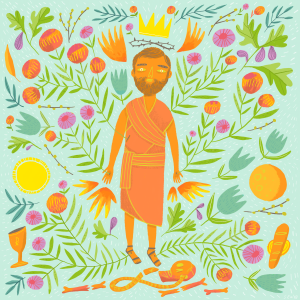
Original Easter art by Sam Wedelich (www.samwedelich.com).
By Stephen A. Seamands –
“Easter was when Hope in person surprised the whole world by coming forward from the future into the present.”
— N.T. Wright
It makes all the difference in the world whether someone is dead or alive. That’s why, according to New Testament scholar, Luke Timothy Johnson, the most important question about Jesus is whether he is dead or alive. If he is dead, the memory of his life and accomplishments may still exert a significant influence, but his words and actions have ended. His life is over. Finished. Complete. The dead lie still.
But if he is alive, then everything is radically different. He can show up on our doorstep. Do new things. Surprise, confront, encourage, instruct us. Encounter us as one living person encounters another.
To be a Christian is to believe and confess that Jesus is alive. For everyone else, no matter how much he is admired, Jesus is still a dead man. For Christians he is the Living One. On this point, there can be no equivocating. It’s either one or the other. “There is no middle ground between dead and alive,” Johnson insists in his book Living Jesus. “If Jesus is dead, then his story is completed. If he is alive, then his story continues.”
Every New Testament writer is firmly convinced that the story of Jesus continues. And they stake this cardinal conviction on the resurrection of Jesus. He is alive because God raised him from the dead. That’s why the resurrection is front and center in the earliest apostolic preaching (check Acts chapters 2, 3, 5, 10, 13, and 17). Instead of following the logical order of the Christian year (Advent, Lent, Easter), they insist on preaching the gospel backwards by beginning with Easter. Only then do they proceed to Christ’s life, ministry, and death, interpreting them in the light of his resurrection.
For the apostles, then, everything hinged upon Christ’s resurrection. It was the first article of Christian faith and the foundation of all the rest. As Paul contends, take away this cornerstone and the whole building collapses. Everything we’ve based our lives upon – our present faith in God, the forgiveness of sins past, our future hope – is an empty sham, nothing but smoke and mirrors, and we are “more to be pitied than anyone in the world” (1 Corinthians 15: 19).
Most Christ-followers and churchgoers today understand that the resurrection of Jesus matters. When they sing “Christ the Lord is Risen Today,” “Lord, I lift your name on high,” or “Christ is Risen from the Dead” on Easter Sunday, like Americans in general, they mean it. According to a 2016 Rasmussen poll, three-quarters of Americans believe in the resurrection. But if you were to ask them why it matters and what it means, their answers would generally have little to do with the teaching of the New Testament.
In The Lion, the Witch and the Wardrobe, when Aslan comes back to life after being killed by the White Witch, Susan and Lucy, aren’t sure at first if he’s really alive: Like the early disciples (Luke 24:36-37) when the risen Christ stood in their midst on the first Easter, they wonder if he is a ghost:
“You’re not—not a —?” asked Susan in a shaky voice. She couldn’t bring herself to say the word “ghost.” Then Aslan licked her on the forehead and when Susan felt the warmth of his breath and smelled his hair, her doubts vanished. Immediately “both girls flung themselves upon him and covered him with kisses.” His unmistakable presence quickly dispelled their doubts and what a joyful reunion it was! Yet when they had calmed down, Susan, like a good theologian, wondered, “But what does it all mean?”
Confronted by scientists and philosophers outside the church who vehemently deny the resurrection, along with theologians within the church who reinterpret or demythologize it, we have spent so much time and effort defending the resurrection we’ve hardly done anything else. To be sure, given the critics without and revisionists within the church, the apologetic task of making the case for the resurrection is something we have to do. Moreover, we owe a great debt to those biblical scholars, philosophers, and theologians who have felt particularly called to do it.
But in the face of its negative critics – ancient and modern, our preaching and teaching can get so caught up in defending the resurrection, making the case for the what, that we fail to adequately proclaim the so what, its positive meaning and significance for Christian faith today.
We also need to be careful not to fall for the common cultural understanding that the resurrection is merely proclaimed as a timeless symbol for life and the triumph of life over death. Indeed, ask the average Christian to tell you what Jesus’ resurrection means and he or she will probably say, “Because Jesus died and rose, we know we will live after we die too.” Easter thus becomes a spring festival associated bunnies and eggs, with the leaves breaking forth after the dead of winter, butterflies emerging from chrysalis’, or tadpoles from dormant eggs. As a result, the resurrection is no longer seen as a unique and singular event on a par with the event of original creation itself, but is viewed as another instance and piece of evidence for what has always been — that our souls are immortal so we live on after we die.
According to the New Testament, however, if there is one thing Christ’s resurrection does not signify, it is that. “But there is not in Scripture the faintest suggestion that the resurrection was new evidence for something that had in fact been always happening,” writes C.S. Lewis in Miracles. “The New Testament writers speak as if Christ’s achievement in rising from the dead was the first event of its kind in the whole history of the universe…. He has forced open a door that has been locked since the death of the first man. He has met, fought and beaten the King of Death. Everything is different because He has done so. This is the beginning of the New Creation: a new chapter in cosmic history has opened.”
Of course, we shouldn’t be shocked or surprised that many Christians are unaware of this. Nature abhors a vacuum. So when we fail to communicate the meaning and significance the New Testament attaches to Easter, soon other meanings, some cultural, others common to religion in general, will get attached to it.
Resurrection and New Creation
When the apostles proclaimed that Jesus was raised from the dead, it was not to announce there was a heavenly hereafter or a life beyond. After all, they were devout Jews and like most devout Jews in their day, they already believed that. At death, they had been taught, that the human soul was separated from the body and went to a shadowy world of the afterlife called Sheol.
When they did talk of “heaven” in terms of the particular place in Sheol where the souls of the righteous (as opposed to the unrighteous) lived on, it was never understood as their final destination or resting place. Instead, according to N.T. Wright in Surprised by Heaven, it was understood “as a temporary stage on the way to the eventual resurrection of the body.” Consider, for example, when Jesus assures the thief on the cross that he will be with him in paradise (Luke 23:43), or when he declares to his disciples that there are many rooms in his Father’s house (John 14:2), or when Paul expresses his desire to depart and be with the Lord (Philippians 1:23). In each case, they are referring to that blissful place of life with the Lord beyond death. But they never associated or equated it with the resurrection of the dead. In their minds, this place was only a prelude to it.
In keeping, then, with the commonly held Jewish belief of their day, the early Christians adhered to “a two-step belief about the future.” First, life after death; then the resurrection of the body and the renewal of all creation (what Wright likes to call “life after life after death”). Furthermore, they certainly never mixed up these two steps or equated them with each other.
Thus before Jesus’ resurrection, they already adhered to a firm belief in the resurrection of the dead. However, it had little to do with the realm of the dead and the transitional place where the souls of the righteous go after they die. Rather, they associated resurrection of the dead with the Day of the Lord, the Last Day, the age to come, and the final restoration of all things. When Jesus, for example, assures Martha that her brother, Lazarus will rise again, her initial response reflects the typical Jewish view: “Yes…he will rise when everyone else rises, at the last day” (John 11:24).
What, then, was so stunning to the early Christians about the resurrection of Jesus was not that God could raise the dead. Like Martha, they already believed in a general resurrection when God would raise the righteous at the last day. What stunned them and sent them reeling was the timing of it. In the case of Jesus, the general resurrection, which was supposed to happen on the last day, had moved forward from the end into the present. What was supposed to happen on the final day had happened now. In other words, tomorrow had happened today!
God’s new world, the new heavens and new earth, had come into being through the resurrection of Jesus of Nazareth. The promise of a renewed covenant, which Jeremiah (Ch. 31) and Ezekiel (Ch. 36) described, where sins would be forgiven and death would be no more, had actually begun. The transformation of the whole cosmos, the new creation, foretold by the prophet Isaiah (cf. Isaiah 60-66) to happen at the end of time, had already started. The resurrection of Jesus was therefore not only one miracle – extraordinary no doubt – among others. Nor was it simply the final guarantee of life after death. Rather, it was the decisive start of the general resurrection, God’s final redemption of all things!
Those who belong to Christ live between the beginning and the end of the end times, between the already future and the not yet future. Because Jesus has been raised, the future, the life of the age to come, has already dawned. Through the certainty of sins forgiven, the presence of the Holy Spirit, the joy of life in Christ and fellowship in his body, we have been given a foretaste of that future now.
But we also live in hope and anticipation of the not yet future. Jesus has not yet returned or descended from heaven with a shout (1 Thessalonians 4:16). Suffering, evil, death, and decay are still all around. As Paul expresses it, “While we are in these earthly bodies, we groan and sigh…” (1 Corinthians 5:4). The enemies of Christ rage against us and refuse to acknowledge he is Lord. They have not yet been made into a footstool for his feet. So we long for the completion of final resurrection, the redemption of our bodies, the fullness of new creation, the subjugation of all Christ’s enemies, the restoration of all things. And our hearts cry, “Maranatha, Come Lord Jesus” (Revelation 22: 20).
At the same time, God’s plan of redemption in Christ is not primarily about you and me and our personal redemption. It’s about the redemption of all creation. Our individual future, as significant as that is, must be understood in the context of the whole creation’s future, not the other way around. Understanding this, in turn, has profound implications for our present lives. Our purpose is not only to live righteously so we can attain our personal heavenly reward in the afterlife. Our purpose is to be engaged in preparing ourselves, yes, but also our community and our world – indeed, the whole world for its destined future.
Jesus is Lord and God
The early Christians boldly proclaimed that “Jesus is Lord.” Through these simple, straightforward words, a group of devout, fiercely monotheistic Jews dared to transfer to Jesus of Nazareth the divine name and title, “Lord,” previously reserved exclusively for Yahweh, the God of Israel. This was the earliest, most primitive, Christian confession, and what distinguished a believer from an unbeliever. A Christian was one who had called upon the name of the Lord (Romans 10:13; 1 Corinthians 1:2; 6:11) and confessed “Jesus is Lord” (Romans 10:9).
From the very beginning, they staked their belief in Christ’s Lordship on his resurrection from the dead. As Peter declares in his Pentecost day sermon, “God raised Jesus from the dead and we are all witnesses of this. Now he is exalted to the place of highest honor in heaven, at God’s right hand…So let everyone in Israel know for certain that God has made this Jesus, whom you crucified, to be both Lord and Messiah!” (Acts 2: 32-3,36).
Paul makes the same point throughout his letters. In Philippians, citing what many believe was an early Christian hymn, he declares that “God elevated him to the place of highest honor and gave him the name above all names, that at the name of Jesus every knee should bow, in heaven and on earth and under the earth, and every tongue confess that Jesus Christ is Lord, to the glory of God the Father” (Philippians 2:10-11).
Notice too, in his letter to the Romans, how he makes the connection between Christ’s Lordship and his Resurrection: “If you confess with your mouth that Jesus is Lord and believe in your heart that God raised him from the dead, you will be saved” (10:9).
In many different languages, Christians throughout the world today sing a simple little chorus: “He is Lord, He is Lord! He has risen from the dead, and he Jesus is Lord. Every knee shall bow, every tongue confess, That Jesus Christ is Lord.” Whenever they do, whether they realize it or not, they are making the connection too.
Lordship not only signifies God’s unconditional claim but also God’s absolute claim on us. He is Lord in all things and in every situation. Lordship and divinity, like two columns of a magnificent arch, are therefore inseparable and dependent upon each other. And the keystone of the arch is the resurrection of Christ. Take that away and both columns, in fact, the entire structure tumbles down.
How fitting it is, then, on Easter and the Sundays that follow, to proclaim the Lordship and Divinity of Christ. What better time then, to raise the all-important question, Who do you say that I am? (Mark 8:27-30). And to let the empty tomb, the reality of the resurrection, provide the indisputable answer: He is Lord and God.
The resurrection of Jesus Christ “assures us that God will win in the end and that accordingly the world is not mad,” writes philosopher Stephen Davis in Risen Indeed. “Events do happen that we cannot explain. Irrational tragedies and horrible outrages do occur. But because God raised Jesus from the dead after the catastrophe of the cross, we can be sure that God will one day overcome all catastrophes… The resurrection is proof that no matter how bad things get, we can trust in God. God loves us. God has our interests at heart. God works to achieve what is beneficial to us. And in the end God will win.”
Stephen A. Seamands is Professor of Christian Doctrine at Asbury Theological Seminary in Wilmore, Kentucky. He is the author of numerous books, including Give Them Christ: Preaching His Incarnation, Crucifixion, Resurrection, Ascension and Return (IVP). Taken from Give Them Christ by Stephen Seamands. ©2012 by Stephen Seamands. Used by permission of InterVarsity Press, P.O. Box 1400, Downers Grove, IL 60515-1426. www.ivpress.com.
by Steve | Mar 12, 2018 | Magazine, Magazine Articles, March-April 2018
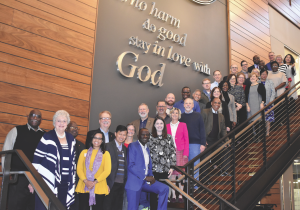
The Commission on a Way Forward convened in Nashville, Tennessee, October 30 – November 1, 2017. Photo by the Rev. Maidstone Mulenga.
By Heather Hahn –
The Commission on a Way Forward is fleshing out the details of three possible models for how the denomination treats LGBTQ inclusion. The multinational group, appointed by United Methodist bishops, held its seventh meeting behind closed doors January 18-20 in Dallas. Each model has its supporters among the 32 commission members with no single plan having a clear majority, commission members told United Methodist News Service.
“Some commission members prefer one sketch; others prefer a different sketch,” the Rev. Tom Lambrecht said. “There’s no one sketch that predominates how we think is the best way to go forward.”
Dave Nuckols, another commission member, said that it’s less relevant which model commission members prefer than that they provide the bishops what they need. The bishops also have asked the commission to draft a theological statement that both informs the three models and creates a compelling narrative for them. “Ultimately, the final report of our work is really not going to be our final report,” Nuckols said. “It’s going to be what the bishops make of our work because we are supporting them.” The three options, in no particular order, are:
• Affirm the current Book of Discipline language and place a high value on accountability. The church policy book says the practice of homosexuality “is incompatible with Christian teaching” and lists officiating at a same-gender union or being a “self-avowed practicing” gay clergy member as chargeable offenses under church law.
• Remove restrictive language and place a high value on contextualization. This sketch also specifically protects the rights of those whose conscience will not allow them to perform same-gender weddings or ordain LGBTQ persons.
• Create multiple branches that have clearly defined values such as accountability, contextualization, and justice. This model would maintain shared doctrine and services and one Council of Bishops.
All three models come with a way for churches to exit the denomination.
While United Methodists have bandied about the first two options in earlier church discussions, the third is different from what comes before. “The multi-branch option is intended to provide a space within the overall church where different groups could operate according to their conscientious beliefs,” Lambrecht said. “Structurally, that’s still under development as how that would look. But I think the intent is that it would abide by one of the principles we operate under, which is that there would be no winners or losers in this scenario.”
However, Nuckols — a Minnesota Conference lay leader and treasurer of the Connectional Table — sees the first and third options as ultimately untenable. He favors something along the lines of the second option, which offers more local decision-making. “Our bishops requested ‘contextual differentiation,’” he said. “That means allowing more space so that we can each succeed in varied mission fields and so that we no longer litigate a single uniform church law treating married homosexuals differently than married heterosexuals.”
Nuckols said the second option offers space within one church, while the third offers space between different branches. “The simpler Space Within approach cultivates greater tolerance as a sustainable path to unity, discipleship and mission,” he said. “The well-intentioned but complex Space Between approach offers structural co-existence, but in my opinion, its long-term consequences will be instability and schism.” [Nuckols is a member of the board of directors of the Reconciling Ministries Network – an advocacy group that wants to change the Book of Discipline regarding marriage and sexuality.]
Lambrecht is a leader in the advocacy groups Good News and the Wesleyan Covenant Association — both of which advocate for maintaining the church’s restrictions. “I think it’s fair to say most evangelicals would prefer to see an option similar to option one — whether that’s realistic at this point is up for grabs,” he said.
The bishops will use the commission’s work to develop legislation that will go before the 864 lay and clergy delegates of a special General Conference on February 23-26, 2019, in St. Louis, Missouri. At the beginning of the recent commission meeting, Council of Bishops President Bishop Bruce R. Ough offered some advice to the commission members. “Time is running short and we need to focus,” he said, according to a commission press release. “Simple is better than complex. Reasonable detail is better than ambiguity. Fewer disciplinary changes is better than more. Honor the parameters and values of the ‘mission, vision, and scope’ document — unity, contextualization, and enhanced mission.”
Retired Bishop David Yemba of the Democratic Republic of Congo also urged the commission to keep the denomination’s global nature in mind. Yemba is one of three bishops serving as commission moderators. “Many United Methodists outside of the United States would like to see the context be taken into consideration seriously,” he said, according to the press release. “Whatever models the Council of Bishops will come up with and recommend to General Conference as a way forward, it is expected that such a recommendation will provide space to focus on what unites us and not what separates us as well as what we can say together as basic principles on human sexuality in the light of the Gospel.”
The commission has two more meetings scheduled this spring. The bishops have a deadline of July 8 to submit their petitions to the special General Conference.
Heather Hahn is a multimedia news reporter for United Methodist News Service.
by Steve | Mar 12, 2018 | Magazine, Magazine Articles, March-April 2018

“Pentecost” by Ed De Guzman from Cubao, Quezon City, Philippines.
By David F. Watson –
“Okay,” I thought. “I can do this.” A crying woman and her young son stood in front of me. With my limited Spanish, I could make out that she had pain in her head, neck, and chest. He had a problem with his throat. They had come for healing during a worship service at a small church on a farm outside of Havana. When I say we were at a church, I don’t mean to imply there was a building. Instead, there was a group of worshippers gathered on a concrete floor under a roof supported by poles. There was no steeple. There were no stained-glass windows. For that matter, there weren’t even walls. But this group of forty or so believers had come together with a sense of expectation. They believed that God was going to show up.
They believed it, and I hoped it. Prayers for healing weren’t in my repertoire of ministerial skills. It seems odd writing this today. So much has changed in my understanding of the work of God and the life of faith. At the time, however, I felt I was in way over my head.
I prayed, earnestly, with all the faith I could muster. The mom smiled at me. The boy looked at me as you would expect a young kid to look at a strange man praying over him in a strange language. The service concluded with punch and cookies. The worshippers dispersed into the night and our team got on the bus. I had no idea whether or not God had healed the woman and her son. I had my doubts, and a bit of faith – maybe as much as a mustard seed. What I did know was that I could learn a great deal about faith and hope from the Christians who had gathered on the farm that evening.
There is More
I’ve long thought that the title of Randy Clark’s There is More! (Chosen Books, 2013) captures succinctly what many Christians I encounter seem to be missing: there is more to the life of faith than we have been taught to believe. There is more power, more peace, more strength, more purpose, more goodness, more abundance, more wisdom. There is more than all we can ask or imagine through the living presence of Christ in our lives, mediated to us by the work of the Holy Spirit.
Clark is the founder of Global Awakening, a transdenominational ministry, and his book is about the ministry of impartation – the work of God to impart gifts of the Spirit through the laying on of hands. Remember, it was the Apostle Paul who told Timothy to “stir up the gift of God which is in you through the laying on of my hands. For God has not given us a spirit of fear, but of power and of love and of a sound mind” (2 Timothy 1:6-7). Clark’s larger point in the book is that there is more to the life of faith than most of us have ever dared to hope.
I’ve known Dr. Clark for several years now, and last October I had the privilege of traveling with him on a ministry trip to Brazil. He certainly has a gift of healing, and simply by watching him you can see the joy it brings him to pray for healing. He will pray over people until he is utterly exhausted, catch a few hours of sleep, and begin again the next day. Randy is also a teacher, though, and the core of the message that I have heard from him time and again could be summarized thusly: expect more of God. The God revealed to us in Scripture is not an absentee landlord. Rather, this God is present, powerful, and loving. The God of Scripture is “able to accomplish abundantly far more than all we can ask or imagine” (Ephesians 3:20, NRSV). He has gifted each of us for the work of the kingdom, and that includes the manifestation of signs and wonders.
The Recovery of Wonder
Preaching this message in North America, however, can be an uphill battle. In the 19th and 20th centuries it became popular to attempt to reinterpret the Christian faith according to principles of modernity. We have progressed, so this line of reasoning went, beyond our forebears, who had to rely on myth and superstition to explain the world around them. We now understand the world according to rational, scientific principles, which have liberated us from the shackles of superstition and given us reliable principles according to which we may interpret our experiences. The “miracles” we see in the Bible are the products of an ancient worldview, and we now know that the world simply doesn’t operate in that way. We can no longer take literally many ancient Christian beliefs such as the virginal conception, the divinity of Christ, the atonement effected by his sacrificial death on the cross, and his resurrection from the dead.
This perspective is best summarized in the words Rudolf Bultmann, who exerted colossal influence upon biblical studies and Christian theology in the twentieth century: “We cannot use electric lights and radios and, in the event of illness, avail ourselves of modern medical and clinical means and at the same time believe in the spirit and wonder world of the New Testament.” Christianity, it was thought, needed to reinvent itself. It needed a new understanding of salvation, the person and work of Jesus Christ, and the work of the Holy Spirit. All of the basic concepts that had sustained the church through the centuries were now up for reinterpretation. The “miraculous” was now superfluous. It was time for a new way of being Christian.
As James Heidinger points out in his book The Rise of Theological Liberalism and the Decline of American Methodism (Seedbed, 2017), such reinterpretation of Christian faith was far more widespread among clergy than laity. Mainline Protestantism produced generations of clergy who had been taught to reject traditional Christian doctrine in favor of modernist revisions of it. Thus Christian preaching began to focus on the human work of building the kingdom of God on earth, and the notion of God’s direct work in this world faded into the background. What has tended to develop in the pews over time is not so much active disbelief in the miraculous, but a simple lack of expectation that God is going to show up in powerful, undeniable, life-changing ways. In Scripture and the Life of God (Seedbed, 2017), I call this “passive disbelief.” It is the domestication of the biblical God by expecting little more of him than the guidance of our consciences and perhaps a secure place in the afterlife.
I have to confess my own passive disbelief for much of my life. Had you asked me if I believed that Jesus had been born of a virgin, healed the sick, and was raised from the dead, I could have readily answered in the affirmative. I was, and continue to be, committed to the orthodox faith once and for all delivered to the saints. Had you asked me what I expected God to do in the here and now, however, I’m not sure how I would have responded. My friends at Aldersgate Renewal Ministries, my engagement with Christians in the developing world, and my affiliation with Randy Clark’s Global Awakening have changed the ways I think about divine action. They have changed my expectations. I have seen things I never thought I would see. I have experienced things that even today are difficult to name. I have recovered a sense of wonder that has been all but lost in my own United Methodist tradition.
A Hunger for More
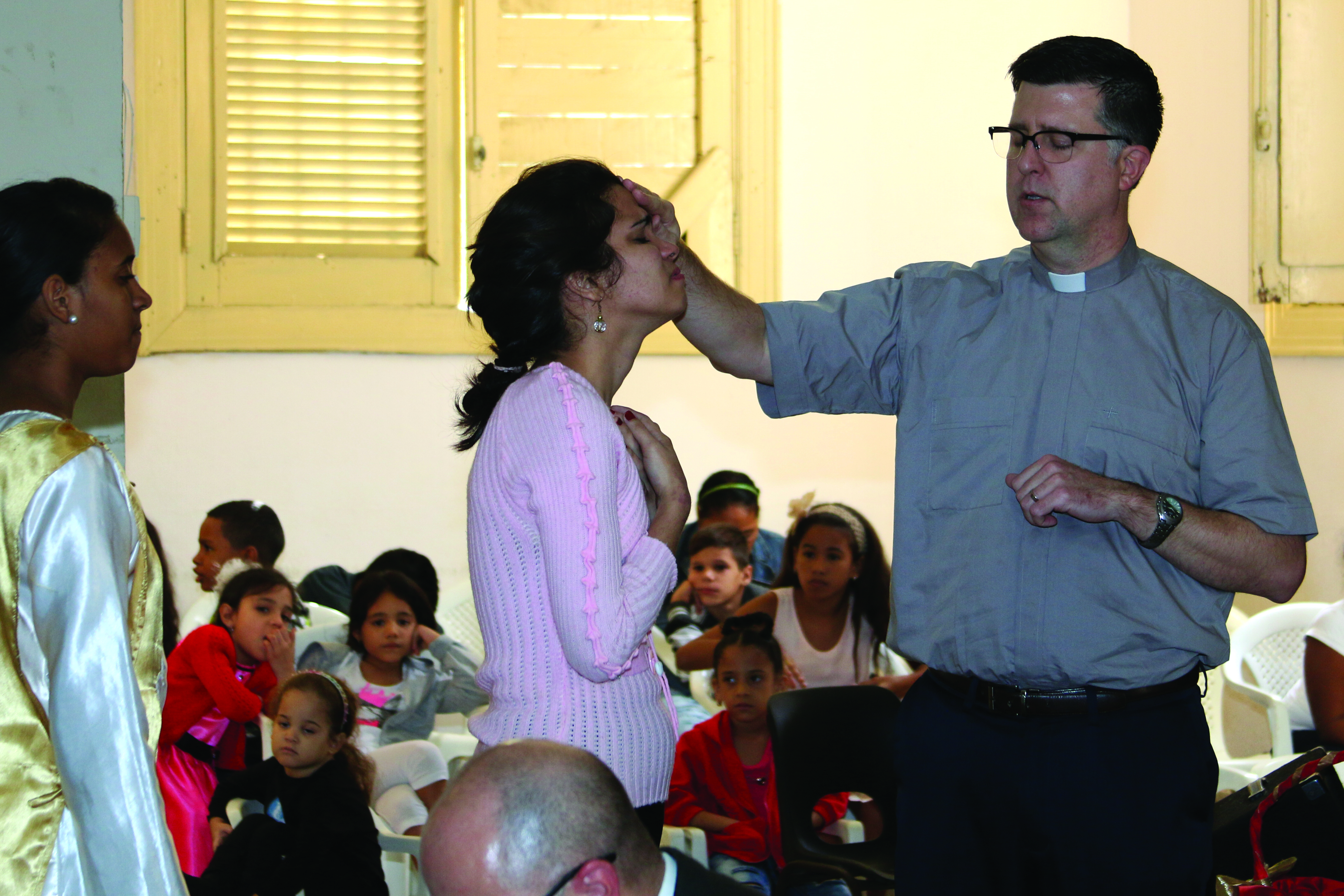
Dr. David Watson prays with a young woman at the Central Havana Methodist Church. Receiving prayer is part of the spiritual culture for Methodists in Cuba. Their pastors and leaders cultivate a faith-oriented anticipation and expectancy. Photo: Steve Beard.
Believe it or not, I recovered this sense of wonder while working in a seminary. I’m blessed to have colleagues from whom I continually learn more about the life of faith. A few years ago one of my professors, Peter Bellini, came to me with an idea for an event he wanted to call the Holy Spirit Seminar. We could partner, he said, with Aldersgate Renewal Ministries to offer an event where people could learn about topics that are generally ignored, or even scoffed at, in mainline theological education. Sure, I replied. Why not? If it makes budget and fits within the mission of the school, I’m all for it.
When the day of the event finally arrived, we completely filled the largest meeting space at the seminary. People were lined up along the walls to the back of the room. In subsequent years we would hold this event at nearby Ginghamsburg Church because we could not accommodate on our campus all the people who wanted to attend. What Dr. Bellini saw, which at the time I did not, was the deep hunger that people in our churches have for something more. I learned that first year how deep the yearning is among both clergy and laity, not just to know about God, but to know God personally and intimately.
When we come to know God, to know Jesus Christ as a personal savior as well as the savior of all creation, we are changed by the encounter. I believe that is the only way in which we find true satisfaction. As Augustine wrote at the outset of his Confessions: “You have made us for yourself, O Lord, and our heart is restless until it rests in you.”
Theological education as we have traditionally conceived it – biblical exegesis, church history, systematic theology, Christian ethics, and the practical disciplines – is exceedingly important in the preparation of clergy. These same disciplines are often of interest to Christian laity. I have become increasingly aware, however, of the imperative to teach both clergy and laity about the workings of the Spirit of God through the people of God. The laying on of hands, prophecy, healing, words of knowledge, wisdom, and other practices and gifts of the Spirit have a crucial place in the life of the church. To ignore these is to impoverish the body of Christ. The implication is that, within our seminaries, we need to talk about what it means to minister with expectation. If the power of God really is available to us in the ways in which Scripture teaches us in passages such as 1 Corinthians 12:8-10, it is imperative that we educate our clergy about the ministries available through these gifts.
Hung up on Labels
As a graduate student I served on the staff of a church in Dallas. One evening I was leading a study group, and together we were reading selections from the fourteenth-century mystic Julian of Norwich. As we began to talk about Julian’s experiences of God, some of the group members were emboldened to talk about their own encounters with the divine. In fact, the majority of the people there spoke of mystical experiences they could not understand, but which they knew were of God. Some of them had not felt comfortable revealing these before, but there is safety in numbers, and one by one they began to disclose these profound mystical experiences. Why, I asked myself, were they so reticent to talk about these experiences in other contexts? Why were these conversations not part and parcel of the everyday life of the church?
The reason, I think, is that they believed that other people would think them fanatical or weird if they disclosed these experiences. In mainline Protestantism, we have become embarrassed by the work of God. We relegate experiences of direct divine action to the “charismatic” world, which we do not understand and often look at as overly emotive and theologically unsophisticated. Unfortunately we often characterize charismatic Christians by their most flamboyant public figures and gross representatives of the “prosperity gospel.” It is unfair, however, to characterize any movement by its most problematic representatives. (After all, every tradition has them.) I know many Christians who would self-identify as charismatic who possess profound theological sophistication and sensitivity. Some of them are on my faculty at United.
I know many people I might call “quiet charismatics” as well. They may seem subdued in public worship, but their experience of God is no less profound than the most elated among the worshipping community. They may have gifts such as prophecy, healing, and tongues, but unless you are close to them you would never know it. Their experiences of God are more contemplative than outwardly expressive. I suspect there are many people in the pews of our churches who fit this description. They do not fit the stereotypes of charismatic Christians, but they are in no way lacking in the profundity of their religious experience.
What is at stake here is not what label we place on ourselves, but our understanding of divine action. What kind of God is our God? Is God distant or intimately present? Does God actively guide the church through prophets and teachers, or are we left to our own devices? Is Christ really present in the Eucharist? Do we really receive Christ spiritually in our bodies? Do we really expect to be changed when we receive the bread and the cup? Does God heal the sick today? If so, how and when should we pray for the sick?
Here’s another way of putting it. For many Christians, it seems that God is simply a construct, an idea that gives heft to the set of claims we want to make about matters of ethics and social justice. God cares about the poor, so we should care about the poor. God cares about racial justice, so we should care about racial justice. These kinds of claims are often true. God does care about the poor – profoundly. God does care about racial justice – profoundly. But there is more to the life of faith than ethical imperatives. There is the life-changing, empowering presence of the living God, who transforms our hearts. This God forms us into the kind of people whose thoughts, words, and deeds are consistent with his will.
Back on the Farm, One Year Later
A year later I was back at the same church outside Havana. It was raining heavily that night, and because the church was out in the country it was difficult for some people to get to worship. I looked for the woman and her son for whom I had prayed, but they weren’t there. After the service I described them to the pastors and asked how they were doing. The pastors knew exactly whom I was talking about and added, “Oh, and they gave a testimony of healing.”
There is more. And my hope is that the people called Methodist will once again know the power of God sweeping through our movement, a power that characterized early Methodism, and which is known by Christians throughout the globe today. Come, Holy Spirit!
David F. Watson is Academic Dean and Professor of New Testament at United Theological Seminary. His latest book is Scripture and the Life of God: Why the Bible Matters Today More than Ever (Seedbed). He blogs at www.davidfwatson.me and is one of the hosts of “Plain Truth: A Holy-Spirited Podcast.”
by Steve | Mar 12, 2018 | Magazine, Magazine Articles, March-April 2018

Photo of book cover by Mike DuBois, UMNS. Photo of Margie Briggs courtesy of Cass Community Publishing House.
By Kathy L. Gilbert –
The tale begins with suicide, mixes in a few miracles, but has no ending because one woman and two small United Methodist churches believe faith can’t be measured by the number of people planted in the pews. Can You Just Get Them Through Until Christmas? is lovingly written by Margie Briggs who chronicles the ups and downs of her more than 10 years as a lay minister to Calhoun and Drake’s Chapel — two small rural churches in Missouri.
The book begins with a shocker when a seemingly happy pastor is late for Sunday service. Worried parishioners go to his house and find him dead on his couch with a 12-gauge shotgun between his legs and a copy of his will next to his body. Briggs was a certified lay speaker at the time and a member of another United Methodist church in nearby Creighton, Missouri. The Rev. Cody Collier, district superintendent, asked her to step in temporarily until a pastor could be assigned to the stunned churches.
“For two months, I preached about God’s love and grace. I listened to anyone who was ready to talk,” she writes. After those few months, the churches were assigned a licensed local pastor and Briggs thought her time as a preacher was done. But the new pastor’s ministry abruptly ended when police came looking for him one Sunday morning. He left his stint as a bell ringer for the Salvation Army on Saturday night and took the collection bucket home with him.
Collier called again. “Can you just get them through until Christmas?” he asked Briggs. She said yes and has been preaching most every Sunday since.
Lay ministers are not ordained and cannot baptize or consecrate the elements for Communion, but throughout the book, Briggs talks about how many times God helped her navigate her ministry despite those restrictions. “My only degree is in life,” she states with candor. Briggs follows her faith and her churches trust her.
One of her favorite chapters in the book is about God placing her in a man’s life as he was dying. He had asked her to baptize him and she knew that during the final hours of a person’s life, anyone is able to baptize. “That day I received the firm affirmation I was doing what I was called to do, being in a small community sharing the Gospel wherever, whenever, however it needs to happen. What happened that day will live forever in my heart,” she said, in an interview with United Methodist News Service.
Briggs believes the denomination urgently needs small churches throughout the denomination in both rural and metropolitan areas. Over the years the two churches have renovated their buildings, started a food pantry, begun hosting yearly Christmas and Easter parties for the community, started holding luncheons for school teachers and first responders — and they’ve grown.
When Briggs first started, the combined worship attendance had dropped to 14. “In the 10 years since 2006, the Calhoun church has celebrated 60 baptisms, 16 re-affirmations of faith and 30 letters of transfer. Drake’s Chapel has had eight baptisms and 15 transfers during that same time,” Briggs writes. “To God be the glory.”
Each of the chapters of the book are short but powerful moments in time. Included at the end is a study guide written by Kay Kotan, a credentialed coach, church consultant, speaker, and author.
In a funny twist of fate, Briggs and her husband were once Sunday school teachers and youth sponsors for a troublemaking little boy named “Bobby.” “Bobby was the prime example of a boy who challenged us. Every time I turned around, he was up to no good,” she writes. She marvels at the boy who later became her boss, Bishop Robert Farr.
Farr wrote an epilogue for her book. “This book is full of ideas on how to reach people through small congregations and examples of how lives can be changed and transformed,” he wrote. “Every small congregation could benefit from using Kay Kotan’s study guide, at the back of the book, to explore some of the questions posed about ministry, mission, and outreach.”
Cass Community Publishing House published the book and the Rev. Faith Fowler, pastor of United Methodist Cass Community Church in Detroit, is publisher. “Cass Community Publishing House has the mission of providing a megaphone to under-represented voices, and Margie’s book fit both because we don’t hear enough from people in rural settings and because very few books are authored by lay people,” said Fowler.
“Her story is compelling and important for rural pastors and small congregations searching for inspiration. Margie has walked the talk. Now she has shared what she tested and tried without filtering her description or hiding her mistakes,” Fowler said.
In the introduction, Briggs states her hope that the book will rekindle people’s faith in churches that have fewer than 100 members. “There is an urgent need for small churches both in declining rural areas and in impersonal metropolitan areas where many struggle with isolation and loneliness.”
Kathy L. Gilbert is a multimedia reporter for United Methodist News Service.
by Steve | Mar 12, 2018 | Magazine, Magazine Articles, March-April 2018

The 45th March for Life Rally in Washington D.C. on Friday, January 19, 2018. Photo by Elvert Barnes.
By Courtney Lott-
When David Watson looks at his 11-year-old son, he sees someone created a little lower than God – a treasured fellow human bearing the divine image. When the rest of the world looks at his son, we might mistakenly only see a young man with Down syndrome. If private thoughts were made public, there are even those that believe he shouldn’t have been born. Convinced his life, and the lives of his parents, will be weighed down by unnecessary hardship, these individuals feel that the most compassionate choice would have been to end his existence while still in the womb.
Technology and scientific progress make this decision a possibility. Now a mother and father can discover genetic disorders like Down syndrome. Armed with this information, proponents of abortion urge the termination of such pregnancies, a practice Dr. David Watson, academic dean of United Theological Seminary, recently called “eugenics.”
Defending the sanctity of all human life at the United Methodist worship service on the day before the March for Life in Washington D.C., Watson discussed the dangers of considering “intellect and rationality as markers of the divine image.” With due respect to Augustine and Aquinas, two theologians who originally identified this as a sign of humanity, such an attitude lends itself to a potentially dangerous thought process.
“The equating of humanity and intellect… seems to have permeated Western thinking very deeply,” Watson warned from the pulpit of the chapel of The United Methodist Building next door to the Supreme Court of the United States. “Perhaps that is one reason that 80-90 percent of pregnancies in which Down syndrome is detected are terminated, often at the urging of medical practitioners. In fact, in Iceland, people with Down syndrome have been almost entirely eliminated as a people group by means of prenatal testing and abortion. Why is this allowed? Why are we not calling this what it is: eugenics? Perhaps the reason is that people with diminished intellectual capacities are somehow seen as ‘less than’ – less than the rest of us, less than human.”
Advancement in neonatal science is changing the conversation around abortion. While new technology can determine if a baby has a genetic disorder, it also allows parents to see very human gestures in the womb. Many consider this technology the reason the millennial generation is now polling more pro-life than their parents.
Because of this, the pro-life movement has heavily relied on science to promote their cause in recent years. This represents a shift in the debate over abortion, as pro-choice activists have long claimed to have science on their side.
While this might be considered a great victory, some pro-lifers worry about the consequences of relying too much on science to promote their cause. Whether an embryo or fetus is a person cannot be answered by science, they argue. Instead, it’s a question of philosophy, theology, and human ethics. If these aspects are removed, it can all come down to a mere medical procedure completely devoid of moral argument.
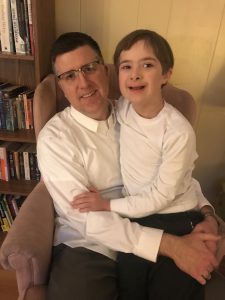
David and Sean Watson.
According to Dr. Watson it all boils down to whose image we are created in. “Not all human beings can think,” he said to the pro-life assembly. “But all human beings can be in relationship to God and other people. Not all people can love, but all people can be loved – loved uniquely by God, and loved by one another.”
Watson furthered his point by proclaiming that our main reasoning behind abortion, particularly the termination of pregnancies in which the child tests positive for “diminished intellectual capacities,” is a desire for individual freedom.
“We have freedom, and freedom – choice – has become a value above all other values. We want freedom to do what we want, to shape our identity and destiny,” Watson said. “People with diminished intellectual capacities don’t fit the template of human beings as entirely free and rational subjects, and therefore they are viewed as aberrations.”
Appealing to morality that comes from God, Watson points to the New Testament book of Hebrews. The writer proclaims that God created humanity a “little lower than the angels” and “crowned them with glory and honor” (Hebrews 2:7). This is true, Watson said, even of those who are inconvenient for us and those that are different than us.
“Human beings have achieved feats of genius in our attempts to dehumanize the other, to make ourselves more and others less, and most often with tragic and lethal consequences,” he said. “History is rife with examples of how we make our tribe, our race, our people, our nation somehow more human than those unlike us.”
We use language to dehumanize the unborn, people with severe brain injuries, and people of other cultures, Watson said. This is a rebellion not only against our creator, but also against the way we are created. If the church does not stand up for the value of all human life, he said, then there is no hope.
Watson ended his address by reflecting on the beauty and joy his son’s life has brought to their family. “I have no ambiguity about his value as a human being. He is created a little lower than God, crowned with glory and honor. He bears the divine image. He is fearfully and wonderfully made. And he is a baptized Christian. I know who he is, and I know whose he is. Much of the world does not. Much of the world would suggest that it would be better had he never been born. But they are wrong.”
Courtney Lott is the editorial assistant at Good News.