by Steve | Mar 14, 2022 | Front Page News, Home Page Hero Slider
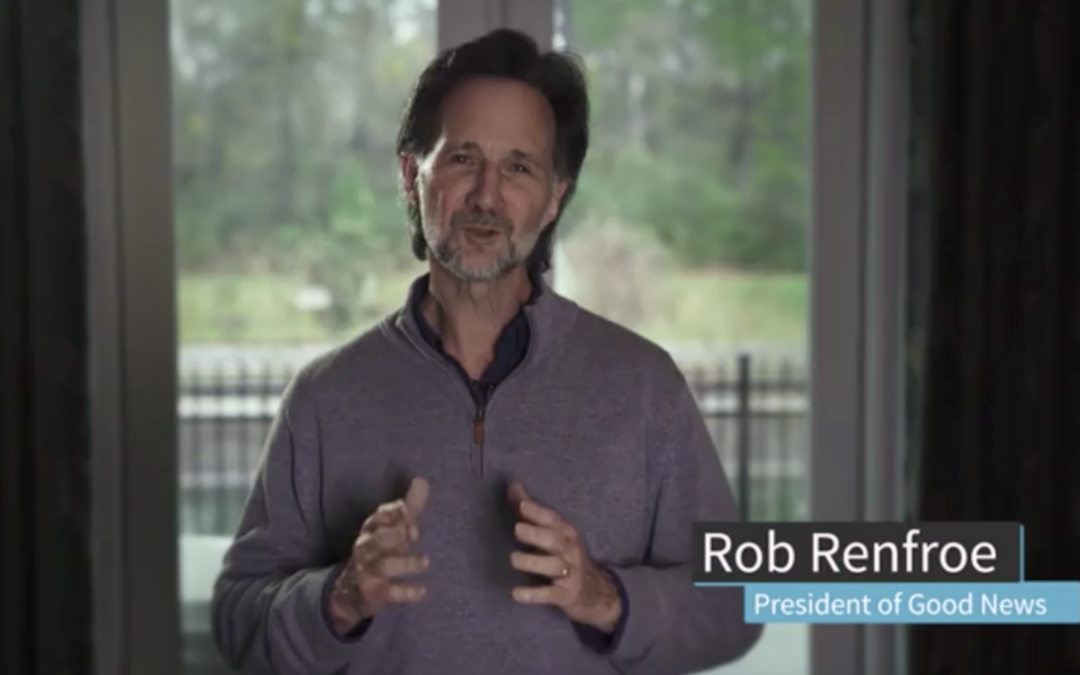
The Rev. Rob Renfroe, president of Good News, discusses the further postponement of General Conference and the launching of the Global Methodist Church. To watch his video, click HERE.
*****
GOOD NEWS BOARD ENDORSES LAUNCH OF GLOBAL METHODIST CHURCH
The Good News board of directors fully endorses the formation of the Global Methodist Church and is encouraged by its announced launch date of May 1. We are grateful for the work of hundreds of lay and clergy leaders who have worked to create the framework for a new Wesleyan movement that will be centered on Christ, founded upon the Scriptures, and empowered by the Holy Spirit.
We regret that such a step is necessary. The theological divide in The United Methodist Church has grown so deep and acrimonious that continuing together will only multiply the harm done to people and congregations on all sides. We affirm the decision to move ahead with separation now, given the lack of urgency by church leaders to resolve the crisis and the evident dysfunction of our denominational governance processes.
Many United Methodist members, pastors, and congregations will move to the GM Church immediately. Others will need more time to negotiate a fair exit from their annual conferences. Some may pursue other faithful options for moving into the future. But the birth of the Global Methodist Church gives hope to all orthodox Methodists that a new and better day is dawning.
We express our deepest gratitude to those who have made the launch of the GM Church possible. We pray for the new church’s success in making disciples of Jesus Christ and spreading Scriptural holiness across the land. And we commend the Global Methodist Church to all Wesleyans who believe that Jesus Christ is the way, the truth and the life.

by Steve | Mar 12, 2022 | March/April 2022
I have made a wonderful, new discovery in my prayer life. It is best defined by one of the many injunctions given in the Bible, “Blessed are those who listen to me, watching daily at my doors, waiting at my doorway. For those who find me find life and receive favor from the Lord” (Proverbs 8:34-35).
Though rarely spoken of today and yet so desperately needed in our stress-torn society, this life-giving reality is the ancient experience of waiting on God. It seems as though there is so little time put aside for such waiting in our slick, fast-moving world. The difficult, yet so rewarding, experience of coming into God’s presence, and by the grace and empowerment of the Holy Spirit becoming calm, quiet, and receptive to his presence and voice is the essence of all growth in grace. Is not the result of spiritual growth a growing awareness of God’s presence and hearing his voice?
The life of prayer has so many marvelous facets and different methods, according to our need at the time. “Trust in him at all times, you people; pour out your hearts to him, for God is our refuge” (Psalm 62:8). The pouring out of our soul to God is because of agitation, turmoil, and unrest. We have to get things off our chest, and tell him exactly how we feel. There certainly can be no calm, quiet receptiveness until we communicate our needs or those of others.
The power of intercession, pouring out our anguish over a situation or person is part of the asking and seeking of Mathew 7:7, “Ask and it will be given to you; seek and you will find; knock and the door will be opened to you.” Tragically, however, we often fail then to wait on God. We do not allow him time to speak to us, to comfort us, to correct us, or to be present to us. We often fail to hear his response to our cries. Waiting allows God the opening or opportunity to manifest his wondrous presence.
Our fast-moving schedules keep us so nervous and overloaded that we find it difficult to sit down and relax and let go, to sit quietly and focus on one thing. We are accustomed to doing ten things at once!
Yet I believe a new dimension of spiritual reality is released if we will wait on the Lord. The psalmist David said it so well, “One thing I ask from the Lord, this only do I seek: that I may dwell in the house of the Lord all the days of my life, to gaze on the beauty of the Lord and to seek him in his temple” (Psalm 27:4).
Waiting on God is not natural for us; it is not easy for us; it isn’t always “fun” for us, but it is a profoundly transforming experience of spiritual growth. It is not for people of casual Christian living. It is for struggling, yearning Christians who want to be more like Jesus, and for those who want to be more fit channels through whom God can flow out to others in love and power.
Our guide is Jesus. He knew to the core of his being the absolute necessity of waiting on God. In his classic book called Waiting on God, Andrew Murray says about Jesus, “He had such a consciousness of God’s presence that no matter who came to him the presence of Father was with and upon him.” Jesus’ own night-long waiting on the Father as recorded in Luke teaches us how important the waiting was, because it allowed the Father to be totally dominant and in total control of him, to the extent that God the Father was the most real presence in Jesus’ life.
The first account of Jesus waiting on the Father, in Luke 4, is followed by testing. Each time we wait on God, no matter how long or short the period, Satan will be present to pull us away. He does not want our physical needs met in a godly way, but in our own way. Satan does not want us feeding on God. Waiting on the Lord allows the Holy Spirit to feed the inner man, and strengthen him (Ephesians 3:16). As we wait, we partake of the Divine nature, and are sustained, changed, and healed.
A second hindrance that comes as we wait is to let something else or someone else be our center instead of our Lord. It could be career, children, education, money, or pleasure. Waiting on God allows the Holy Spirit to teach us how to worship and love only him with all our heart, soul, and mind, and others as ourselves.
Yet a third hindrance is to use God’s power in foolish ways, to take what we get from God and use it for our advantage. Waiting on God daily allows him to cleanse our self-will and self-seeking. He develops a reverence in us for his holiness and power. We tremble before him and honor him as we wait.
Jesus waited on God to bring him forth from the grave (the seed falling into the ground as John 12:23-32 teaches). Waiting produces great confidence in God. It is a form of dying to self, and out of death comes God’s life.
But perhaps the greatest example of Jesus’ waiting is what he is doing now. As Hebrews 7:25 says, “ … he always lives to intercede for them.” As Jesus intercedes, he awaits his return to the earth as Lord where he will receive his bride – the Church. In other words waiting is a part of divine providence and therefore it must be a part of our lives.
If Jesus is waiting on God the Father to bring forth the ultimate will of God, how much more do you and I need periods of quiet waiting and listening.
I can remember as a high school student often talking with my father, a United Methodist minister, about wanting to know how to grow in grace. I knew that I had my part and God had his, and that the basic ingredients of prayer, Bible reading, and obedience were essential to growth. However, I kept feeling there was an added dimension of spiritual understanding involving responsiveness to his presence that would greatly enhance my growth. I did not understand at that time that this involved protracted periods of waiting on God. This waiting included listening to God, a calming of the inner person, and an altering of the capacity to be aware of God.
Waiting on God should teach us a more reverent receptivity; a quieter, less self-willed listening; a calmer repose and collectedness which opens the door to knowing God better, because we can hear him speak and respond to him in conversation and in our will.
Our difficulty lies basically in the feverish, frantic way we have with very little time spent in God’s presence. Our dilemma centers around not knowing the value of spending time in the presence of God nor really understanding how it is done. Waiting is a totalitarian experience of body, mind, and spirit. This includes relaxing the body when it has been agitated and tense, focusing the mind on God when it has been scattered over many interests, and getting in touch with the inner spirit when we have lived externally rather than internally.
The Scriptures are full of invitations to come into his living presence. Matthew 11:28-30, Isaiah 40:29-31, and Proverbs 8:34-36 are just a few.
There are several principles to follow in order to enter into the presence of God. These are not difficult but require time and patience to experience the actuality of them. The lives of Christians throughout history, regardless of their station in life, have involved these great principles.
1. Find a quiet place in your home that will be without outside distractions, noise, phone, TV, and music. You will quickly discover that it is not nearly as difficult to eliminate the exterior noises as it is to eliminate the interior noises. These distractions hinder our ability to focus due to darkness and the unknown within us. This takes courage to persist, but it is not impossible.
2. It is important to ask the Holy Spirit to guide and teach us (John 14:26). We must refer to him!
3. Return daily to this same place, which the Old Testament refers to as the tent of meeting and the New Testament refers to as the place of abiding in Jesus. Regularity aids us in accustoming ourselves to coming into the quiet. We may begin to enjoy it!
4. Sit in a comfortable chair poised, alert, respectful, and anticipating an encounter with God.
5. Relax your body and mind. Avoid trying too hard, or trying to do it perfectly. Relax, let go, this is your time to cast your burden on him.
6. Waiting on God involves the whole person, spirit, soul, and body. Give him your mind that you might receive from his mind. Give him your body, its energies to be refreshed by his life. Give him your emotions, all your feelings, to be cleansed by his love. Give him your will that you might know and love the will of God. Give him your human spirit so that he might reign as Lord of your spirit.
7. There are two ways to realize God’s presence. First through the Word of God, such as taking a single thought as Psalm 46:10, “Be still, and know that I am God,” and meditating on each word. The second way is through using our minds and imaginations. In your mind’s eye see yourself talking with Jesus, look at him face to face, and listen to his response to you (2 Corinthians 3: 18).
8. Know that you will experience mental distractions and be prepared to wait even though your mind is unruly. Speak gently but firmly to your mind and bring it back to Jesus.
9. Use the name of Jesus often, repeated softly; or use the “Jesus prayer” to keep yourself collected and focused. A form of the Jesus prayer is, “Lord Jesus Christ, Son of the living God, have mercy on me.”
10. Keep reaffirming during this time that you are there to know the Lord better and to wait on him.
11. Take 10 to 15 minutes at the end of your devotional time and listen for his voice and presence.
In Waiting on God, Andrew Murray says to stay positive and believe you can and will wait and that God will draw you into his presence.
There are several crucial aspects of the Holy Spirit’s ministry that become ours as we spend time in his presence. In evangelical circles we tend to mention, almost exclusively, only one side of the Holy Spirit’s marvelous work – the miraculous and instantaneous – as in our rebirth and the subsequent infilling of the Holy Spirit. Ultimately, these two supernatural landmark experiences radically change our perspective and inner attitudes. Though we may have sought God for days, months or years, the actual spiritual transaction frequently happens in a matter of minutes – even seconds!
I believe a grave danger lurks here, a misconception that is foreboding in its consequences. We are apt to think it is God’s only way of handling important, life-changing events. We begin to rely too much on our big experiences, neglecting to give him time each day to perform miracles equally powerful and exciting. Let me share with you just a few of the benefits the Holy Spirit continues to provide as we learn to wait on God.
• The miracle of becoming like God, being transformed into his image. For us today this means a growing dependency upon the Father, even as Jesus experienced when he says in John 5:19 “… the Son can do nothing by himself.” This means that we do not take the initiative to run ahead of him in any area of our life (Romans 8:29 and 1 John 3:2). . .
• The miracle of cultivating with God a friendship so real and so satisfying that, of all our friends, we know him best (John 15:14).
• The miracle of a growing helplessness and dependency on God so we live not out of the flesh, but by his power and strength. He flows out from us to others, yet we come more and more into who we are in him. As we wait on God he will reveal to us his direction for our lives. For each of us, the uniqueness of our individuality in him will begin to come forth (Galatians 2:20).
• The joy of learning to listen to God’s voice to recognize when he is speaking to us. Because his voice is so real we can truly converse with one another. God guides us and gives us his wisdom in all of our interactions (John 10:4-5, 14, 27).
• A growing humility as he reveals our true self to us. As we see how desperately we need God in all areas of our life, the experience of waiting on him helps us to face ourselves under the loving gaze of Jesus (Psalm 51:6).
• A daily conviction of our sin, bringing us to repentance and confession. This is important so there are no barriers of sinful pride before him. Sin is dealt with honestly each day (1 John 4:9 and John 16:7-13).
• A marvelous peace as we allow God to take more and more dominion over our thoughts and our emotional life. The fruits and gifts of the Spirit begin to express themselves through us (Isaiah 26:2).
• A greater ability to pray in line with the Father’s will because, as we wait on him, the Holy Spirit searches out the deep things of God, and prays the will of God in life’s challenges. To find his will takes time, and waiting on God affords that leisurely relationship with the Holy Spirit from which he is able to manifest God’s will (1 Corinthians 2:6-16).
• A glorious comprehension of just how real and eternally precious the Father, Son, and Holy Spirit are to me. For many people, the Father God is detached and impersonal, but as we wait on him we begin to experientially know him as our heavenly Father (John 14:20, 21, 23). Our rebirth and indwelling by the Holy Spirit are more sweetly and fully realized and lived out in our daily life. God goes about changing and renewing our inner spirit as we submit to his day by day ministrations to us. While we draw nigh to him he draws nigh to us.
If you have never experienced the joy of waiting on God, I pray you will be strongly impressed by the Holy Spirit to begin that great journey of deepening your receptivity to him. You may find it to be the hardest part of your quiet time, because it requires stillness and quietness, a collecting of every thought around Jesus as preparation for hearing his voice, but it will be the most rewarding of your prayer habits.
“Yet the Lord longs to be gracious to you; he rises to show you compassion. For the Lord is a God of justice. Blessed are all who wait for him” (Isaiah 30:18).
Margaret Therkelsen (1934-2014) was a teacher, counselor, and author of The Love Exchange and other books. For many years she was a treasured devotionalist for Good News. This article originally appeared in the July/August 1992 issue of Good News
by Steve | Mar 8, 2022 | Front Page News, Home Page Hero Slider
By Joseph F. DiPaolo –
President Abraham Lincoln was once taken to task by a congressional ally for changing a policy position. “Mr. President, you have changed your mind entirely within a short time.” Convinced that recent events and new information required a change of heart, Lincoln replied, “Yes, I have, and I don’t think much of a man who isn’t wiser today than he was yesterday.”
Perhaps I’ve been wizened, or maybe I just woke up, but I have changed my mind about The United Methodist Church’s Commission on General Conference (COGC). Last September, Outlook published my reassurances that the members and staff of the COGC were doing all they could to ensure the postponed General Conference would be held as scheduled this summer.
I no longer believe that to have been true.
I am grieved and heartbroken over what I have experienced in the last two months as a member of the Commission, and on Monday (March 7), I resigned from that body in protest over the decision to postpone again. I cited as a primary reason for resigning that I had lost trust in the integrity of the process. The Commission deliberated in closed sessions which, we were told, were necessary to protect sensitive contract negotiations (with vendors and venues) which could be jeopardized if the internal debate were made public. Now that the news is out, the church at large deserves to know what happened.
At our January meeting, a surprise motion was made to postpone General Conference due to the ongoing pandemic, and the challenges faced by many non-U.S. delegates to obtain vaccinations. This was unexpected since we thought we were to receive status reports and facts, and then make a final decision at one of two subsequent meetings scheduled for February and March. It was also odd, since many organizations were then moving full-steam ahead with plans for international conferences in 2022. Some members frankly seemed a little too eager to cancel. Fortunately, a majority decided such a move was premature and we voted to delay a final decision to February or March.
At that same meeting, Commission members asked how many non-U.S. delegates were vaccinated – a requirement to obtain entry visas to the U.S. Apparently, no effort had been made to track that information, since the initial reaction from staff was that we could not ask such private medical information. I pointed out that we were not interested in delegates’ medical histories, only if they had been vaccinated, which would have to be disclosed to get visas. We asked for a report on visas and vaccination rates to be prepared prior to our February 24 meeting.
Two days before that meeting, I sent a letter to all commission members, which, among other things, reminded them that we were to receive that report. My email was sent out at 11:28 AM (EST) on Tuesday, February 22. Just a few hours later, beginning around 2:15 PM (as indicated from emails forwarded to me from delegates), General Conference General Secretary Gary Graves began sending emails to all General Conference delegates asking for their vaccination status, with a response deadline of the next day at 5 PM (EST).
It is hard not to conclude that the staff never took the request seriously and were scrambling at the last minute to cover themselves. Despite the short notice, however, Graves reported that he had received about 500 responses, with more than 90 percent indicating they had received at least one vaccination (the others either refused to answer on privacy grounds or were unvaccinated).
With that data, as well as general knowledge of falling infection rates and the relaxation of many restrictions on travel and large gatherings, COVID could no longer be an excuse to cancel. The discussion then turned to how hard it would be for non-U.S. delegates to schedule interviews for entry visas. To obtain visa interviews at U.S. embassies, the COGC staff must send an official letter of invitation to delegates. But none had been sent – which seems doubly suspicious in light of another document sent to Commission members less than two days before our meeting. This document listed all the wait times for US embassies for delegates to obtain visa interviews. In some countries, the wait time was well beyond the August 29, 2022, opening day of General Conference. In some cases, it was over a year! The date and place of the 2022 GC had been known since March 2021 – yet the staff had never sent out any letters of invitation to get on the schedules as soon as possible. Had they not been tracking the wait times during that period? If not, why not? If so, why were letters not sent to get ahead of the deadlines?
Interestingly, the staff said delegates in some countries might have 10-year visas; and it was learned that others had found ways to obtain visas from embassies in neighboring countries where wait times were shorter. But there was no detailed analysis of all these variables. When asked what percentage of delegates typically have not been seated in past General Conferences for whatever reasons, we were told it has approached as high as 10 percent. This time we were warned, it could 20 to 30 percent – yet again, with no supporting analysis or documentation.
And it was also clear that no serious attempt was made to revisit the possibility of a having an off-site gathering of delegates in Africa or elsewhere for virtual participation. I later learned that Dr. Kent Millard, President of United Theological Seminary had offered information about a hybrid process used for the General Conferences of the African Methodist Episcopal and African Methodist Episcopal Zion Churches, but this information was never seriously studied or even reported to the Commission.
All this raises the legitimate question whether some members, leaders and staff of the COGC ever intended to hold the General Conference in 2022 and were simply leading other Commission members on to achieve a pre-arranged outcome. Nonetheless, a lengthy and robust debate went on during the 3.5-hour meeting on February 24, 2022, and the final vote to postpone was deeply divided, at 14 in favor and 9 opposed (with 1 abstention). Another suspicious feature was that the African members of the Commission argued that we should hold the 2022 conference as scheduled, while white U.S. members argued it would be a kind of “colonialism” to do so if it meant risking a higher number of Africans being absent!
It could have been done. By the way, we were told that the UM Church may lose as much as $3 million in forfeiture fees and penalties for cancelling the General Conference in Minneapolis, Minnesota. That money could have been used to purchase tech support, equipment, or even additional staff to make a hybrid international conference happen – which many organizations have already done.
Because of this unwise and unnecessary decision to postpone, the highest governing body of the UM Church will not be able to meet to address the crisis that is fracturing our denomination or deliberate on the various plans which were proposed to address it. I fear we will shortly see renewed and intensified internal conflict across our connection. The experience of other mainline denominations that have divided without an amicable plan of separation suggests that many millions of dollars will now be wasted in legal battles over property.
None of this was necessary. The people of The United Methodist Church deserved better from the Commission. And you deserved better from me. Please accept my apology for deceiving myself – and misleading you – into believing that this process had integrity and honesty. I no longer believe that it did.
Hopefully, all of us are wiser today than we were yesterday.
The Rev. Joseph F. DiPaolo is Lead Pastor at Lancaster First United Methodist Church in Lancaster, Pennsylvania. He is also a member of the Wesleyan Covenant Association’s Global Council. This article originally appeared via the Wesleyan Covenant Association’s Outlook and is reprinted by permission.
by Steve | Mar 4, 2022 | Front Page News, Home Page Hero Slider
By Thomas Lambrecht –
Good News joins the many United Methodists who are deeply disappointed in the Commission on the General Conference’s decision to postpone/cancel the 2020 General Conference and instead hold the General Conference in May 2024. The reason given was “COVID-related and governmental policies/constraints,” relating to “the wait time for visas … in some countries.” That decision was announced in a press release yesterday.
We are grateful a decision has been made in order to end the uncertainty, but we profoundly disagree with that decision.
As reported by the Rev. Keith Boyette, president of the Wesleyan Covenant Association, in a podcast, “the vote in the COGC was deeply divided and those who identified as theological conservatives and those who live outside the United States overwhelmingly voted in favor of General Conference being held as scheduled in 2022.” If that is the case, it seems that once again, some American members disregarded the input of the very people they claim to be trying to protect – international delegates. If the non-U.S. members of the Commission overwhelmingly believe that General Conference should go forward, and that non-U.S. delegates could safely and effectively participate, why would the institutionalist majority on the Commission block the conference from being held?
It appears as if a majority on the Commission focused more on what the church cannot do than on what the church can do. Good News and our Renewal and Reform partners (Wesleyan Covenant Association, Confessing Movement, and UM Action), working with the Africa Initiative, did everything possible to assure that a safe and fair General Conference could take place. We enabled non-U.S. delegates to receive freely accessible Covid vaccines so they could gain entry into the U.S. for the conference. We were working with contacts in Congress and the State Department to assure that non-U.S. delegates could get interviews to obtain their visas for travel. We were willing to provide Covid testing for non-U.S. delegates, if needed, so those delegates could get on an airplane to come to the U.S.
To concerned observers, it appeared as though the Commission and its staff did very little to ensure that non-U.S. delegates could participate. Boyette reports in the same podcast that cancellation of General Conference in Minneapolis could cost as much as $3 million. Yet the Commission was unwilling to spend money to ensure delegates could obtain vaccines, nor did the Commission appear to be willing to take extraordinary steps to assist delegates to obtain visas. Then, the Commission turned around and used the perceived inability of non-U.S. delegates to participate as the reason for cancelling the conference. (It is interesting to note that only two days before their meeting the Commission emailed all General Conference delegates inquiring about their vaccination status. This after Commission leaders publicly criticized efforts to vaccinate non-U.S. delegates. Such behavior gives the appearance of attempts to cover for their own inaction, rather than legitimately gain information, especially since an email with a 24-hour deadline for response meant that many African and Filipino delegates would not be able to respond to the email survey.)
The health and safety of delegates and their ability to participate is of high importance. However, no activity is completely risk-free. According to the science, vaccination provides substantial protection against severe illness and death. Delegates with underlying health conditions and feeling unsafe to travel could excuse themselves in favor of an alternate. There are delegates at every General Conference who are unable to obtain visas to attend. Alternates can often obtain those visas and participate in their place. In 2019, there were more than 30 empty seats due to visa issues. This is not a new problem, and workarounds have been successful in the past.
The inability of United Methodist leaders to do what it takes to hold a General Conference demonstrates once again the dysfunction and incompetence of the church’s governing structure. This is especially true when tens of thousands of people are gathering across the country for sporting events, concerts, international trade shows, international conventions (including United Methodist Women), and even the Houston Livestock Show and Rodeo!
Many observers are left wondering if the motivation for continuing to resist holding General Conference was to defeat the Protocol for Reconciliation and Grace through Separation and make separation more difficult and costly for churches. The information cited above about the Commission’s inaction, as well as our previous experience with duplicitous institutional leaders, gives us reason to believe that elements of this decision were made in bad faith. Those who control the levers of church power do not represent the majority of the church, yet they continue to believe they know best how the church ought to function, and they do not hesitate to impose their plans onto the church.
The United Methodist Church has once again shown itself to be no longer capable of governing itself. For example, bishops and annual conferences are able to disregard the actions of General Conference and the decisions of Judicial Council. Furthermore, bishops are unaccountable to the larger church. Again, we have been repeatedly told that jurisdictional and central conferences could not meet to elect new bishops and advance the work of the church through the general agencies. Now, the one body authorized to speak for the whole church and potentially resolve the crisis of division is not permitted to meet.
Therefore, Good News wholeheartedly supports the launching of the Global Methodist Church, effective May 1, 2022, as announced by the Transitional Leadership Council. We believe now is the time for annual conferences and local churches to move forward into a new reality, free of the burdens of conflict and liberated to focus solely on the ministry of the Gospel of Jesus Christ for the transformation of the world through the Holy Spirit.
With the launch of the GM Church, the way is now open for local churches and annual conferences to align with the GM Church via ¶ 2548.2 in the Book of Discipline, allowing transfer into “another evangelical denomination,” rather than the ¶ 2553 Disaffiliation process. The parameters of such transfer are determined by each annual conference. Bishops and annual conferences can implement the principles of the Protocol on an individual basis. ¶ 2548.2 does not require payment of extra apportionments or the value of church property in order to transfer with buildings and assets. It allows pension liabilities to be transferred to the local church or to the other evangelical denomination. It allows local churches to choose whether their vote to transfer to the new denomination requires a simple majority or two-thirds vote. All that is required is the approval of the bishop, cabinet, district board of building and location, and the annual conference.
We are appealing to bishops and cabinets of good will to work cooperatively with local churches to allow for a peaceful and reasonable transfer to the Global Methodist Church, based on the principles of the Protocol.
Bishops and annual conferences have a choice. They can respond to this difficult time with a heart of peace (which they have repeatedly extolled) and allow for an amicable separation of congregations that desire to transfer by following as much as possible the principles of the Protocol. Or they can take a punitive approach and demand heavy payments from churches seeking to transfer. A vindictive spirit does not serve the church or its witness for Jesus Christ well. We had hoped to demonstrate to the world that it is possible to resolve deeply felt differences in a gracious and amicable way. Though continued delay calls the eventual passage of the Protocol into doubt, we call upon bishops and annual conferences to adopt a gracious attitude that can pave the way for future reconciliation, rather than seeking to extract heavy penalties or coerce churches into remaining United Methodist.
Many churches will move forward immediately to withdraw from the UM Church and align with the Global Methodist Church. Others will explore their options and educate their members before making a decision. Many other churches will feel trapped in a hostile annual conference that refuses gracious departure. Many will find The United Methodist Church no longer deserving of financial support, while others will resort to the necessity of filing lawsuits to challenge the Trust Clause. All of this rancor could have been avoided, had our leaders worked to support an amicable solution that helped the church move forward in a healthy way. Instead, they chose to perpetuate conflict.
We foresee different waves of churches joining the Global Methodist Church, as conditions change and local churches and annual conferences make decisions at different times. Good News will support churches seeking to realign with the GM Church, as well as traditionalist churches that remain in The UM Church. In both denominations, we will continue to advocate for Scriptural Christianity, as we have for 55 years.
While the pathway before us is not the one we would have chosen, it is the pathway we have been given. And we know that the Lord is with us on this journey into a new, more faithful future. With his guidance, and empowered by his Spirit, we will walk this pathway together with you, seeking always to become the church that God intends us to be.
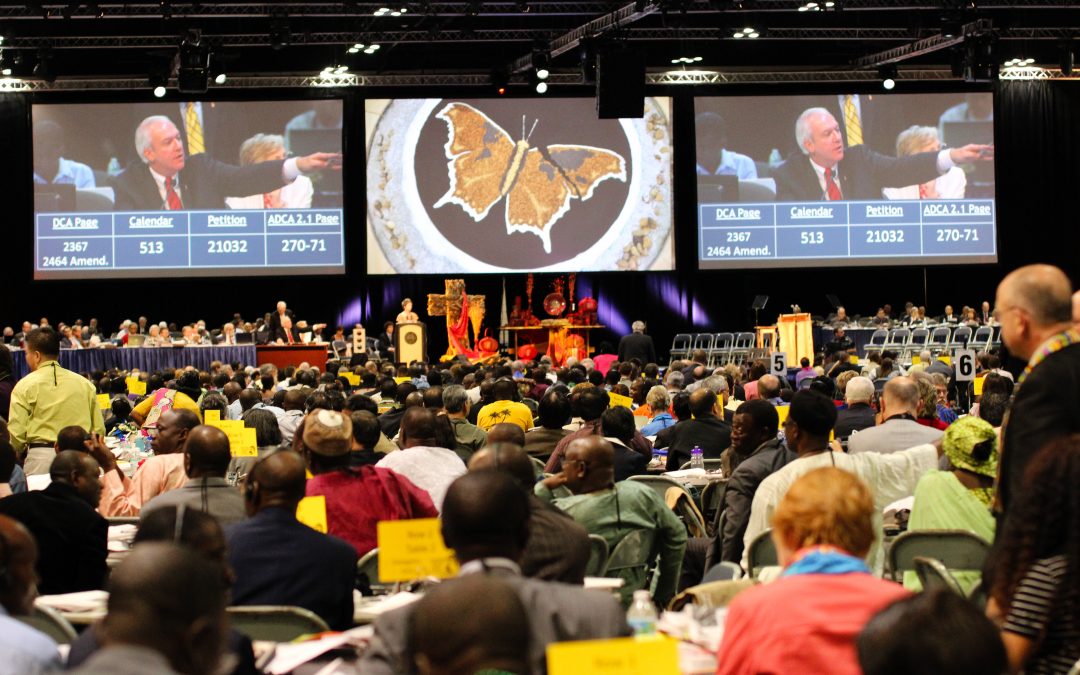
Thomas Lambrect is a United Methodist clergyperson and the vice president of Good News. Photo: General Conference 2012 by Steve Beard.
by Steve | Mar 4, 2022 | Front Page News, Home Page Hero Slider
Global Methodist Church
March 3, 2022
With humility, hope and joy, a 17 member body of theologically conservative Methodist clergy and laity, known as the Transitional Leadership Council, is pleased to announce the Global Methodist Church will officially launch on May 1, 2022.
Supported by fervent prayers, faithful discernment, and a sure hope for the future, the Global Methodist Church is a Holy Spirit inspired movement committed to making disciples of Jesus Christ who worship passionately, love extravagantly, and witness boldly to the ends of the earth.
Thousands of Methodist clergy and laity from around the world have worked together for over three years to lay the groundwork for a new, theologically conservative Methodist denomination steeped in the great ecumenical and evangelical confessions of the Christian faith. They envision a church fired by a warm hearted, Wesleyan expression of that faith that is dedicated to sharing the Good News of Jesus Christ in word and deed.
“The Global Methodist Church will warmly welcome people eager to join others in fulfilling its mission,” said the Rev. Keith Boyette, Chairman of the Transitional Leadership Council and President of the Wesleyan Covenant Association. “We have heard the truth of Jesus Christ, experienced the forgiveness of his grace and love, and so bear witness to his transforming power. We long to take our place alongside brothers and sisters in the church universal who seek to live out their faith everyday so that others might come to know Jesus Christ as their Lord and Savior.”
After having worked for years to renew and reform The United Methodist Church, in late 2019, theological conservatives faithfully joined leading UM Church bishops, and leaders of centrist and progressive advocacy groups to hammer out an amicable and orderly plan to divide the UM denomination.
That plan, known as the Protocol of Reconciliation and Grace through Separation, rapidly gained the support of people across the UM connection, and it appeared headed for approval at the denomination’s May 2020 General Conference. Unfortunately, after two previous postponements, UM Church officials have announced that they are postponing the conference for a third time. Their inability to find ways to help international delegates gain access to Covid-19 vaccinations and secure U.S. entry visas led to the cancellation.
Consequently, the Protocol cannot be adopted this year, so faithful and patient United Methodists will not be afforded the opportunity to part ways with the UM Church according to the Protocol’s terms. Under its provisions, every theologically conservative local church and annual conference would be allowed to join the Global Methodist Church with clear title to all of their property and assets in perpetuity.
“Many United Methodists have grown impatient with a denomination clearly struggling to function effectively at the general church level,” said Boyette. “Theologically conservative local churches and annual conferences want to be free of divisive and destructive debates, and to have the freedom to move forward together. We are confident many existing congregations will join the new Global Methodist Church in waves over the next few years, and new church plants will sprout up as faithful members exit the UM Church and coalesce into new congregations.”
It is anticipated that some theologically conservative local churches will find annual conferences willing to negotiate fair and just exit provisions, while others will unfortunately face obstacles placed in their paths. The Transitional Leadership Council decided it was time to launch the Global Methodist Church, so those who can leave early will have a place to land, to begin building and growing, and making room for others to join later.
Boyette said, “For theologically conservative local churches deciding to remain in the UM Church for a time, we are confident Africa Initiative, Good News, the Confessing Movement, UMAction, and the Wesleyan Covenant Association will continue to vociferously advocate for the ultimate passage of the Protocol. Every theologically conservative local congregation and annual conference should have the right to join the Global Methodist Church with all of their property and assets intact.”
Over the past two years the Transitional Leadership Council has met on almost a weekly basis to create a Global Methodist Church in formation. Informed by the work of the Wesleyan Covenant Association’s Global Council, Legislative Assembly, and dozens of task force teams that prepared white papers covering a host of issues, the members prepared a Transitional Book of Doctrines and Discipline. The book will govern the church during a transitional period prior to a convening General Conference to be held in the next 12 to 18 months. The Transitional Book of Doctrines and Discipline and much of the Transitional Leadership Council’s work can be found on the new church’s website and in Crossroads, the weekly e-newsletter it publishes. Persons and churches interested in aligning with the Global Methodist Church may express their interest through the new church’s website.
“As we embark on this great venture, we know we will stumble and fall at times,” said Boyette. “But with the great prophet Isaiah, we also firmly believe we will, in God’s good time, ‘run and not be weary,’ and ‘walk [in the way of the Lord] and not faint!’”