by Steve | Sep 30, 1986 | Archive - 1986
Archive: Costa Rica The Holy Spirit Moves
A UM mission team sees a spiritual
by Mark Rutland
The Methodist bishop, his arms in the air, tears streaming down his face, stood praising God in the Spirit. A young Methodist pastor told of his commitment to see a true outpouring of the Holy Spirit. Laymen from three or four other Methodist churches in the area testified to having received salvation, baptism in the Spirit and miraculous healings. A prophetic utterance spoke of the beginning of revival in the Methodist church across the nation.
A dream, perhaps? Or maybe the fanciful wish of a hopeless romantic? Or could it be the description of some 19th-century frontier revival? None of the above.
Not only is this scene real, but it is also as contemporary as 1986, and as Methodist as John Wesley. I witnessed events in Costa Rica which may well signal the beginning of an historic reversal of Methodism’s posture in that country.
In recent years the Methodist Church in Costa Rica, as in much of Latin America, gradually began to slide into the darkness of liberation theology. Wherever Biblical Christianity is replaced with pop theology and Marxist political activism, the result will be spiritual decline. And Costa Rican Methodism’s vital signs were growing fainter. With membership declining and lay resentment toward a lethargic clergy rising, the results were predictable. Bitterness among the clergy began to increase. Scandal haunted several pastors, and increasingly angry political maneuvering threatened to swamp the boat. Evangelicals frantically bailed and nervously watched the water rise.
Finally, Bishop Don Roberto Diaz said, “Enough!” In accordance with the prophet Joel’s admonition to “Blow a trumpet in Zion, call a solemn assembly,” Diaz rallied the troops and decreed December a month of prayer and fasting across the country. The spirit began to move, and Diaz sensed revival was on the way.
The bishop drew up a plan including a pastors’ conference for spiritual renewal and an intensive program of evangelism. His idea was simple—renew the clergy, stir the laity, win the lost!
Following the month of spiritual preparation, the bishop scheduled a week-long, nation-wide pastors’ conference in San Jose. These all-day meetings were to be combined with evangelistic services in Methodist churches in and around the capital city. The hope was that if the meetings gave any sign of substantial success, the evangelistic part of the plan would be repeated in other regions. No one had any idea how successful it would be!
Former bishop Don Fernando Palomo, currently an Asbury Theological Seminary doctoral student, was invited to return to help advise and coordinate the event. Through the council of Dr. Paul Morrell (pastor of the Carrollton, Texas First UMC and board member of the Mission Society for United Methodists) several speakers were invited for the conference. Rev. Ted Grout, the senior member of the Rio Grande Conference came from New Mexico. Dr. Ray Hundley, an OMS missionary, came from Colombia where he teaches in the seminary at Medellin. Rev. Hundley, whose credentials include current studies for a Ph. D. from Cambridge in liberation theology, is perhaps one of the most highly qualified teachers on this topic.
The fire fell first among the pastors. Near the end of my second morning’s teaching I felt led to give an invitation. I wondered what the response might be among pastors, many of whom I knew to be experienced and dedicated men of God. I was hardly prepared for the sudden rush to the altar. Weeping, broken, hungry men filled first the altar, then the whole front of the church. Heart-rending cries of uninhibited passion came from men no longer content to live without the Holy Ghost. On their knees, on their faces, on the floor they literally cried out to God to send the power of Pentecost! He did, and soon petition gave way to praise.
Confession, repentance and the healing of relationships are some of the surest signs of revival. I watched for signals that the pyrotechnics were more than skin deep.
“I want everyone to forgive me for what I have done,” said one of the older pastors. “I have said things, terrible things, behind the bishop’s back.”
Before the pastors’ startled eyes, Bishop Diaz and the older pastor joined in a tearful embrace. Quickly they were surrounded by others. More confessions and evidences of revival followed.
A middle-aged pastor confessed that liberation theology and angry activism had nearly “possessed” him. “Pray for me,” he sobbed, his outstretched hands before him. “Pray that God will set me free to preach the true Gospel again.”
Later, his face aglow, he testified to the whole conference, ”I’m free! I’m free to preach again. Today I have received the Holy Spirit. Today my ministry starts.”
After a truly powerful message by Dr. Hundley, the younger men headed to the altar seeking the anointing of God on their ministries. I especially remember a young student pastor who was involved in immorality. I will never forget the look in his eyes when he really faced the gravity of his sin and the joy in his countenance when he found grace.
Several of the “liberation” pastors had opposed Bishop Diaz at first. One man refused to come until the last day of the conference, but on that day he was baptized in the Holy Spirit. Another pastor had steadfastly forbidden any of the visiting evangelists from visiting his church. After attending the conference, he insisted the bishop allow him to host the closing rally.
My most unforgettable moment occurred on my last night there. At the Methodist church in Guadalupe, one of San Jose’s suburbs, I saw the most immediate, manifest orthopedic healing miracle I have ever witnessed.
Among those drawn in from the streets by the sounds of praise was a ragged young woman with a crippled child. As an infant, the little boy named Pablo was involved in a serious auto accident which left one leg twisted, malformed and much shorter than the other. His lurching gait was testimony to the fruitlessness of a lifetime spent with doctors and in hospitals. He wore a brace.
His mother, though probably only in her twenties, looked old and tired. She had never before attended a Protestant service and she warily watched the joyful proceedings. Yet, when I gave the invitation to pray with the sick, she was the first person in the aisle, carrying her sleeping child straight toward the front.
Ted Grout, Bishop Diaz, Fernando Palomo and Nathan Dickerson, a visiting layman from Carrollton First UMC in Texas, joined me to lay hands on the boy. I held his ankles in my hands with the soles of his shoes flat against my chest. Only seconds into the prayer I sensed movement. The child’s leg suddenly turned in my hand and surged slightly against my chest. I could actually feel it move!
Rev. Grout helped me measure the boy’s legs and we found definite, obvious progress. After a second prayer the leg moved again. We removed his brace and both of his shoes and socks. The boy stood and walked as balanced as an athlete. His mother’s praises electrified the congregation. Spontaneous shouts, weeping and singing filled the room. God continued to move as still others were healed.
Later, at an invitation to receive Christ, the front of the church filled. Among them stood Pablo’s mother. “Do you want to repent of your sins,” I asked her, “and accept salvation by faith alone? Will you give your life to Jesus?”
Her answer in Spanish was unclear to me.
“Do you understand what she said?” Rev. Grout asked me. “She said, ‘How can I not? Tonight I have seen Him!’ ”
I have thought about that moment often. I have studied the whole situation—the pastors’ conference, the service, the signs of revival. I usually tend to think in terms of the “greater issues,” like revival in an annual conference, or the confirmation of God on the work of the Mission Society for United Methodists as they helped plan and finance the meetings. Those things are important. I long to see such happenings in my own conference.
Yet I suspect that none of those thoughts are in the mind and heart of Pablo’s mother.
Jesus has healed her son and come to live in her heart. That is all she knows of the revival in Costa Rica. “I have seen Him.” she said.
So have I.
Mark Rutland, a member of the North Georgia Annual Conference, is an approved UM evangelist.
A United Methodist Evangelist Talks About His Church
Evangelist Mark Rutland has preached before thousands of people around the world. His prescription for UM renewal: “What is needed more than anything else is for the clergy to be filled with the Holy Spirit.”
Good News: Mark, you’re traveling and doing evangelistic work in the United Methodist Church. What are you seeing in United Methodism in terms of signs of renewal. Are you encouraged?
Rutland: I’m especially encouraged about the laity. I see a tremendous openness to the fullest implications of the gospel. People are tired of the worn-out liberalism of the 60s and early 70s. They’ve confronted the bankruptcy of that whole way of thinking, and they’re not as patient with the shallow superficialities of that kind of preaching as they were. This is putting added pressure on the clergy, and yet it’s a sign of renewal, not a threat—if we in the clergy will only receive it that way. I see a good sign of renewal among Methodist men. I see that many Methodist Men’s conferences are ready to hear the Gospel.
Good News: This is a concern, especially in the light of membership loss. Are you concerned about these denominational loyalties?
Rutland: In my generation and in the following generation, that denominational loyalty has completely disintegrated. Methodism, per se, only means anything to anybody now as it presents a dynamic Gospel and the power of God. In 1966, when I graduated from high school, if you had attended the First Methodist Church in Sacramento and then moved to Atlanta, you joined the First Methodist church in Atlanta, no questions asked. That’s what everybody did. Now, that is simply not being done. People want to find a church where something is happening.
Good News: They’re more likely to shop around and look for a church that really speaks to them?
Rutland: Exactly, and I think that we’re going to have to face that, or we’re just going to gradually sink into the swamp. People want liberty in the Spirit, they want joy, they want the power and they want preaching that is substantial. Hints for happy living are just not going to cut it with the young, upwardly mobile, thoughtful business executive whose computer thinks faster than he does. He wants something that’s going to challenge him, gut-level Christianity.
Good News: How do you feel about the new strategy and the concern the bishops have in trying to reverse our membership loss? Do you envision this happening?
Rutland: I’m excited over the turn on the problem of membership loss. If we can get two million members in the next 10, 20, 30 years, I’d be thrilled with that, I’d thank God for it. My concern is that we concentrate on church growth techniques that will address the superficialities: having the choir sing Bill Gaither anthems, painting the sanctuary a more appealing pastel color and getting people who will hand out evangelism awards to the churches who have the most members. This only adds dead wood to dead wood. And gradually that will eat the heart out of the church. I’m hoping that we won’t just settle on a passion to make the church grow, but that there will be a genuine return to the power of the Holy Spirit, that we’ll grow in revival power.
Good News: What would you say the clergy needs to do to begin to see and experience renewal?
Rutland: What is needed more than anything else is for the clergy to be filled with the Holy Spirit. I think we are so rooted into climbing the corporate ladder of ecclesiastical success, of getting so involved in the church routine, that we have simply programmed power out of our own clergy. Ten years ago I was sinking, going under as a Methodist pastor-involved in sin. My ministry was going bankrupt. My marriage was on the rocks. Through the ministry of David Seamands from Wilmore, Ky. and Ralph Wilkerson from California I received the Holy Spirit, and that completely revolutionized my life.
My dream is to see conferences on the Holy Spirit for clergy in every annual conference. And I don’t mean just to come together and dissect dried up bones of theology; I’m talking about a place where clergy can come into dynamic, personal experiences of the Holy Spirit.

by Steve | Sep 18, 1986 | Archive - 1986
Challenging a church out of focus
By Bishop Richard Wilke
September/October 1986
In his new best seller, And Are We Yet Alive?, Bishop Richard B. Wilke calls the UMC a “church out of focus.” Following are excerpts from the book featuring both his stinging analysis and his creative suggestions for renewal.
The church that carries the day in the years ahead will not be a disjointed religious group, not a “people’s church,’’ not a bunch of cultists who rewrite their own philosophies. It will be a church of Jesus Christ marching to the historic messages of Scripture.
We have taken so seriously scientific analysis of the Scriptures, using higher and lower criticism, historical and contextual understanding, that we have often forgotten to hear what God is trying to say to us. We must take the Bible seriously. It is the sufficient rule both of faith and of practice. We listen to God speak to us as we read, pray, and think about the Scriptures. Without the authority of the Bible, we have no authority at all.
Those who want to rewrite the Bible using their current philosophical or sociological perspectives do us a great disservice. If the God of the Bible is not able to lead us to wholeness and justice and freedom, then we are indeed lost.
A friend of mine, pastor of a large metropolitan church, shared with me, with some chagrin, this insightful personal experience. When he was pastor of First United Methodist Church in Dallas, he decided to have Lenten Bible studies in the homes. He taught a class, and so did his associate pastor. Because he was the senior minister, the pastor’s home was filled to capacity the first night. The associate’s was about half filled. Week after week, however, like the disciples of John the Baptist, the pastor’s group diminished. The associate pastor’s study group grew each week. Discouraged and somewhat disappointed, my friend asked his associate what he was doing wrong. He had gone to his seminary notes and was discussing the authorship, the design of the book and the historical context, and he thought people would be very much interested in “studying the Bible.” The associate said in response, “Oh, we’re just reading the Scriptures and asking what God is saying to us that would be helpful in our daily lives.” The difference in approach is the difference between listening for God’s present voice and engaging in an academic exercise. One has spiritual power; the other has intellectual curiosity.
On the Missing Gospel Link.
Elton Trueblood used to say that we are a “cut-flower culture, drawing on the spiritual resources of earlier roots.” The image is appropriate for our church, for we are a cut-flower church, showing certain manifestations of the Gospel, but separated from our nourishment. Trueblood observes that we “cannot reasonably expect to erect a constantly expanding structure of social activism upon a constantly diminishing foundation of faith.”
John Wesley feared that something like this might happen. He wrote in 1786, “I am not afraid that the people called Methodists should ever cease to exist either in Europe or America. But I am afraid, lest they should only exist as a dead sect, having the form of religion without power.”
If I were to attend 50 United Methodist churches next Sunday morning, what would I hear? Mostly, sermons would expound ethical implications of the Gospel.
The sermons would be good for me, for they would urge me to be kinder to my immediate associates, and I need that. They would insist that I care more about God’s children who are dying of famine, and, after a plethora of covered-dish dinners, I need that.
However, the sermon, in all likelihood, would not tell me what God is doing to me, in me, through me. The preacher would not tell me how God changes the sinful heart into a heart of faith and love.
We are like cut flowers, no longer nourished by the amazing grace that caused us to blossom in the first place. We act theologically, as if everyone were a child of the kingdom. Yet, Christ has forcefully proclaimed that except we become converted and become as little children, we shall not enter the kingdom of God.
We have become preoccupied with politics. We are energized by economic leverages. We are consumed in cultural realignments. But we have forgotten how to mediate the change which God works in the heart through faith in Christ. We have forgotten how to do it with the poor, the dispossessed, the ethnic minorities, the people with handicapping conditions right in our own home towns. We pass resolutions about the poor, but we do not invite them into our churches. We give bread. but we do not break bread with them.
The theological crisis is precisely whether we are Wesleyans or not. Historians say that in John and Charles Wesley’s experiences, and in the sermons and music that flowed forth, the birthday of a Christian shifted from the time of his baptism to that of conversion, and in that change the dividing line of two great systems was crossed. We will have to decide whether a Christian is someone born in America and baptized by water or a person who knows the gracious work or Christ in his or her heart.
On Runaway Church Machinery.
Originally, we were called Methodists because we had a plan, an organization, a method. But now our methodology approaches madness. our organizational genius consumes our most sophisticated talent. Our structure has become an end in itself, not a means of saving the world.
I became intensely aware or this myopia when I was a pastor. The evangelism committee met, but did not make any calls. The social concerns commission gathered, but did not write any letters. The educational leaders complained about Scriptural illiteracy, but did not read from the Bible. The Council on Ministries assembled to hear reports from the committees, but took little action. The Administrative Board sat in session to approve the budget, but no one was saved. We went home tired, thinking we had done our church work.
Annual conferences are plagued by housekeeping chores. Years ago, conferences would sponsor great missionary rallies, intensive youth programs or significant evangelistic thrusts. Now, in most conferences, committees set philosophical objectives, prepare budgets. interact with other committees and achieve very little. Most of the money is spent on mileage and meals. In times past, conference committees guided hospitals, camps and colleges. Now, high-powered administrators and strong boards of trustees do that work. Yet the committees still meet. Earlier, conference boards of education nourished thousands of volunteer teachers with workshops, teacher training events and lab schools. Now, with a de-emphasis on Christian education and with subcommittees reporting to other committees who report to the Conference Council on Ministries, not much happens.
I was intrigued by Bishop Underwood of Louisiana simply asking his cabinet to set a goal of 150 new adult classes. The cabinet argued it couldn’t be done. The bishop urged them to try.
The result was almost a doubling of the 150 class goal. There was more action than if a hundred committees had met.
The General Church is caught up in its own machinery. It is so complicated and so irrelevant to the local church that most pastors ignore it.
The organizational wheels keep turning, budgets are prepared, personnel are employed. Administrative turf is protected. To those in the local church, it doesn’t matter much; it’s like the committees of Congress – interesting, but a long way off. However, the local church, like the taxpayer, pays the bills.
On Small Group Nurture.
How many people can you love at any one time? Some psychologists say about 12; that is, to be personally concerned, dedicated enough to help, willing to make regular inquiry and eager to pray for each one daily, about 12 is all anyone can handle. No pastor can pray hard enough, run fast enough or love deeply enough to hold hundreds of people in significant Christian fellowship by his or her own efforts. In the church of the future, the pastor will be training lay leaders, class leaders and spiritual leaders who in turn will have ministries to all kinds of covenant groups in the life of the church. It will be the only way to penetrate the urban sprawl.
When Dr. William Hinson was appointed to The First Methodist Church in Houston, Texas, a church of 13 or 14 thousand members, he immediately began to meet with 25 key men at seven o’clock every Thursday morning, and with 25 key women at two-thirty in the afternoon. Almost all of these persons were under 40 years of age. Dr. Hinson disciples these people. He taught them. They talked about what it means to be a Christian in a large city. They talked about Christian stewardship. They prayed. They studied the Bible. They talked about family life and about the pressures of our society. Sometimes someone would say. “I don’t know whether I’m really a Christian or not,” so they talked about that. Someone else would ask for prayer in a business or a family matter. Together they deepened their spiritual lives. Then, Dr. Hinson began to use these people in places of key leadership everywhere in the life of the church. They became lay ministers in training. Last year those key people were so energized that they provided 10 percent of the budget support in that great church.
On Resistance to Evangelism.
Our momentum for conversion and compassion for people has been hindered by a spirit of negativism that has swept through the church, particularly through the ministry. We have become experts at being critical of all forms of outreach and evangelization. Hindu theologians and teachers sometimes define God by saying what He is not. That is, they say, “God is not this. God is not this. God is not this.” It has now become popular for us, particularly for professional minister, to ridicule every form of disciple-making by saying, “Real evangelism isn’t this.” “You must be born again? – Baptist theology: Too dramatic. A bus ministry? – We don’t want just kids. we want the whole family. Raise a hand and sing Praise the Lord? – Too emotional. Call house-to-house in teams of two like the Mormons? – That’s proselytizing. TV evangelism? – They are always asking for money. The Four Spiritual Laws? –-simplistic and presumptuous. A two-year confirmation class like the Lutherans? – Too organized; lacks the reality of conversion.” The disclaimers go on and on. It is as if we wanted to do away with procreation because sex is involved. In church growth, neither I nor any of us want hucksters. No United Methodist wants to prostitute the Gospel. I remember a story told about William Booth, that Methodist preacher who wanted to do evangelism among the “bob-tag and rag-tail” of London. To the woman who criticized his methods of evangelism, he replied. “Madam, I like my way of doing it better than your way of not doing it.”
On Sunday School Decline.
Years ago, one of our most able administrators, Bishop William C. Martin, accurately observed that there were many signs of alive congregations, but the one uniform signal, across the board. of a consistently alive, vibrant and growing church was the strength of its church school attendance. During one period of great growth, the 1880s, 1890s, and early 1900s, the denomination had twice as many people attending the church schools as were members of the church. Children, youth, adults – visitors, friends, relatives – became a part of the church school and later made commitments to the church.
Even as late as the 1950s and ‘60s the church school. by then less than the membership, was still the foundation for new members. Generally, about 70 to 80 percent of all persons received by profession of faith have come out of the church school. Church school attendance has been for us the gateway to Christ and the church.
The decline in our church school began in 1960 and has continued precipitously ever since.
In 1960-1964 – 4.2 million
In 1980-1984 – 2.1 million
Half of our church school is gone! Over two million people are no longer with us. Those classes were. to use Lyle Schaller’s phrase, “ports of entry” for our churches. Those people had “church growth eyes.” They invited friends and neighbors to come with them to attend their classes. Eventually many experienced the living Christ in their lives and joined the church.
On Inverted Evangelism.
Centripetal witnessing means to invite people into the fellowship and to help them grow toward the center of axis, which is in fact Christ himself; we are talking about inverted evangelism, witnessing turned inside out. Instead of inviting people to accept Christ, then join the church, then become a part of the body – life of the church. The strategy is 180 degrees in the opposite direction. Bring people into the corporate life; that is, toward the center. Let them experience the joy, the music, the Scriptures, the prayers, the love of the people. As they sing “Amazing Grace,” they may find it. As a person experiences the acceptance of the fellowship, he or she may find the love that will not let go. Then, in the koinonia, as the people grow closer to the axis, their lives will become integrated, whole, and in harmony with God, neighbor and themselves.
This inverted evangelism has a Wesleyan heritage. We preachers tend to idolize the Wesleys and George Whitefield for their preaching; indeed they were centrifugal and did go out into the open fields where the people were. But historians tell us that more conversions took place in the class meetings than ever occurred under the preaching of those noted evangelists. They stirred people up with their preaching, but then invited them to come to the group meetings. When Wesley was preaching. he would invite people to join a class and would sometimes form a new class that very evening. He would explain that the one condition for class membership was simply “the desire to flee the wrath to come,” know the acceptance of God and live a higher life.’’
On Accountability.
Immediately after I was consecrated a bishop, a friend came by to see me. He was president and chief executive officer of a major corporation, a marvelous Christian and a great churchman. He went right to the point; he said, “Dick, any large company that has a track record like the United Methodist Church, whose charts show steady decline, would have been called on the carpet long ago. The board of directors would have demanded emergency meetings, and the corporate executives would have been held accountable. Consultants would have been brought in. Heads would roll. It would not be business as usual.”
Those of us in places of leadership in the United Methodist Church must assume a great deal of responsibility for the decline of our denomination. Bishops, members of general boards, key laypersons, district superintendents and pastors have focused on many matters, but not on the health and well-being of the local church.
Ineffective ministers will have to be weeded out, using leave of absence, disability leave and administrative location. Churches do not exist to serve ministers. No pastor can be permitted to destroy half-a-dozen churches as he or she flounders in personal confusion or professional ineptitude. No longer should a pastor be guaranteed a job for life. It is not good enough to send a grossly ineffective pastor to the boondocks. The small church deserves a “workman who needeth not to be ashamed.” A seminary degree is not a work permit.
Currently. we don’t have money for missionaries. We don’t have money for new churches. We are fat where we should be lean and lean where we should be fat. Something is wrong with a church that has larger boards of directors than it has staff for those boards. Something is askew with a church with more administrative staff than missionaries.
During the annual conference, when the statistician finished reading the negative report to the conference, one bishop got up from his chair and stepped to the floor of the conference. He then led the entire body in a service of contrition. With dignity and power, he guided a confession of sins for failing to lead men and women, girls and boys into a saving relationship with God and into a fellowship experience in the Church of Jesus Christ.
On Being a Burning Church.
Many people believe that our business is to run the church. That’s why we’re in trouble. Our job is not to run the church; our job is to save the world. “For God did not send his Son into the world to be its judge, but to be its Savior” (John 3:17, TEV). Oh, let us pray that our young men and women will have visions of a world transformed, that our old men and old women will dream of a church on fire.
I remember a young woman who was burning –- burning up inside with guilt, loneliness and sexual cravings. She is an illustration of our world aflame. I’ll call her Jeanette. She walked into my study complaining that she was overeating and gaining weight.
As we talked. she mentioned growing up in a small town. attending UMYF, going to the university, living with a fellow for a couple of years, preparing for a wedding that never happened. When the man walked out, she began to work hard, weep a lot and eat. Dates were one night stands –- in the sack and out.
“Dear God,” I prayed, “if only the fire of the Spirit could be ignited within her so she could be at peace.” But I needed help. I needed the apostolic word. the supportive community, the prayers of the faithful, the incisive skill of the Great Physician.
Then I remembered. On Wednesdays, a Christian psychologist came to our church to serve as a trained therapist for anyone in need. He served as a pastoral associate from a local community mental health center.
I thought of our new young adult church school class that had grown out of a Thursday night group.
As Jeanette continued to talk, across my mind flashed the little prayer group of young women from that class and of the young adults who sat together in worship. Suddenly I blurted out, “Jeanette. here’s what I want you to do: I am going to make an appointment with our therapist. Will you see him?
“Yes,” she answered.
“You need Christian friends who will treat you as a human being, not as a disposable object. Will you come to our young adult class?”
She nodded.
“I’m going to have a fine young woman call and invite you to the prayer group. Okay? And come to worship if you can.”
I never said much about Jesus. But the counselor called me and said that after several interviews he and Jeanette concluded their final session with prayer. He literally saw her straighten up her shoulders, dry her eyes and beam with a new joy in her heart. Later when I saw her, she was trim, laughing, surrounded by new-found friends.
Her mother wrote me, “Jeanette has come ‘home.’” She didn’t mean back to her hometown, but home to God, home to her family relationships, home to her true self, home to the church. The fires of guilt, loneliness and sexual cravings had been quenched. A new fire burned within her.
The United Methodist Church can burn again with the fires of Pentecost. The Holy Spirit can empower us to speak in all the languages of the world, can enable all women and men, old and young, of every race and nation to be inviting witnesses of peace, and can get aflame the mission of Jesus Christ to save a lost and lonely world.
From 1984-1996, Richard B. Wilke was Bishop of the Arkansas area of the United Methodist Church. These excerpts from his book. And Are We Yet Alive © 1986 by Abingdon Press are used by permission.
Sidebar: Conversation with Bishop Wilke.
Bishop Dick Wilke is afraid people will get the wrong idea about And Are We Yet Alive? “One of the things I fear about my book is that people will say, ‘Well, he’s down on the church.’ I’m hoping they’ll see the great hope and optimism.”
But as Wilke, who presides over United Methodism in Arkansas, begins to tell visitors to his office how the book is being received, his anxiety is replaced by excitement and pleasure.
“How many times have you ever written a two-page, single-spaced letter to any book author?” Bishop Wilke asks the interviewer. Upon receiving a negative reply, he says, “I never have. I never have in my whole life.” Wilke has written three other books and felt lucky to get 20 letters on a book before.
And Are We Yet Alive? is a different story. The bishop estimates he has received between 200 and 250 letters as of mid-July. “It’s just been unbelievable,” he says.
The book has been selling, too. Published in hardcover, more than 35,000 copies have been printed so far. Book tables at last summer’s annual conferences couldn’t keep it in stock. Church publications are writing articles. Speaking invitations are rolling in. And that’s on top of the splash Wilke has already made as chairman of the committee trying to turn our membership loss around.
No doubt about it. Bishop Wilke is the talk of the church right now. Still, he’s frustrated over his limited tools for implementing change.
“As a person there’s so little I can do,” he states. “I have no staff. I have no power.”
“My book is a scream in the night. Hopefully, others will hear it and respond to it.” One thing he can do, he asserts, is concentrate on bringing church growth to his own area.
Arkansas’ two annual conferences have adopted a “five star plan,” which includes asking each church to: (1) receive one person on profession of faith for every 75 members; (2) increase Sunday school attendance by five percent; (3) start a new adult Sunday school class within a year; (4) hold a confirmation or membership training class; and (5) pay apportionments. Last year 85-90 of the state’s 842 United Methodist churches made the grade.
If anything, Dick Wilke is a man of action. There’s nothing of the politician or the bureaucrat about him. Mincing words and skirting issues are foreign to him. Another thing – the bishop isn’t holding back his influence for future use like many other leaders. Like the young Patrick Henry, who made his “Give me liberty or give me death” speech very early in his career, Wilke feels he must speak up now or never.
Only elected bishop in 1984, he had been the pastor of a Wichita, Kansas congregation. Wilke is still very much in touch with the local church, and doubts whether big national schemes will turn the church around. Neither is he convinced that retooling our theology is the key.
“It isn’t so much that we don’t believe in conversion,” says Wilke, “we just haven’t been preaching it. It’s not that we don’t believe in the atoning work of God in Christ [but that] we haven’t been saying much about it.”
The bishop believes the church’s enthusiasm for social issues and preaching on ethics has blurred the fact that many of our members are not even converted. Nor, he believes, are we reaching outside our contented little fellowships to bring in nonbelievers, especially young people.
“We’re talking about a field white unto the harvest,” he states. “And whether you’re talking about hell as an experience after death, whether you’re talking about the hell of being a 13-year-old prostitute in San Francisco or whether you’re talking about any of the tornness of life between 11 and 17, the need for Christ and faith is just overwhelming.
“So whether or not it’s a matter of theology, I would call it more a matter of will and spirit and intensity. More a matter of driveness. Our church must become driven.
Referring to his book, Bishop Wilke knows words won’t be enough.
“My great fear is that we will talk about theology or sociology, or continuously diagnose the ailing church, that there will be books and pamphlets and speeches made by the thousands on what’s wrong with the church – and nobody will be doing anything.
“My great hope is that in local church after local church, people will start reaching out to their neighbors and helping to include them in the life of the fellowship.”
-James S. Robb
by Steve | Sep 11, 1986 | Uncategorized
Challenging a church out of focus
By Bishop Richard Wilke
September/October 1986
In his new best seller, And Are We Yet Alive?, Bishop Richard B. Wilke calls the UMC a “church out of focus.” Following are excerpts from the book featuring both his stinging analysis and his creative suggestions for renewal.
The church that carries the day in the years ahead will not be a disjointed religious group, not a “people’s church.” not a bunch of cultists who rewrite their own philosophies. It will be a church of Jesus Christ marching to the historic messages of Scripture.
We have taken so seriously scientific analysis of the Scriptures. using higher and lower criticism. historical and contextual understanding. that we have often forgotten to hear what God is trying to say to us. We must take the Bible seriously. It is the sufficient rule both of faith and of practice.
We listen to God speak to us as we read. pray and think about the Scriptures. Without the authority of the Bible. we have no authority at all.
Those who want to rewrite the Bible using their current philosophical or sociological perspectives do us a great disservice. If the God of the Bible is not able to lead us to wholeness and justice and freedom. then we are indeed lost.
A friend of mine, pastor of a large metropolitan church, shared with me, with some chagrin. this insightful personal experience. When he was pastor of First United Methodist Church in Dallas. he decided to have Lenten Bible studies in the homes. He taught a class, and so did his associate pastor. Because he was the senior minister. the pastor’s home was filled to capacity the first night. The associate’s was about half filled. Week after week, however, like the disciples of John the Baptist, the pastor’s group diminished. The associate pastor’s study group grew each week. Discouraged and somewhat disappointed. my friend asked his associate what he was doing wrong. He had gone to his seminary notes and was discussing the authorship. the design of the book and the historical context, and he thought people would be very much interested in “studying the Bible.” The associate said in response, “Oh. we’re just reading the Scriptures and asking what God is saying to us that would be helpful in our daily lives.” The difference in approach is the difference between listening for God’s present voice and engaging in an academic exercise. One has spiritual power; the other has intellectual curiosity.
On the Missing Gospel Link
Elton Trueblood used to say that we are a “cut-flower culture, drawing on the spiritual resources of earlier roots.” The image is appropriate for our church. for we are a cut-flower church. showing certain manifestations of the Gospel, but separated from our nourishment. Trueblood observes that we “cannot reasonably expect to erect a constantly expanding structure of social activism upon a constantly diminishing foundation of faith.”
John Wesley feared that something like this might happen. He wrote in 1786, “I am not afraid that the people called Methodists should ever cease to exist either in Europe or America. But I am afraid. Lest they should only exist as a dead sect, having the form of religion without power.”
If I were to attend 50 United Methodist churches next Sunday morning. what would I hear? Mostly. sermons would expound ethical implications of the Gospel.
The sermons would be good for me. for they would urge me to be kinder to my immediate associates. and I need that. They would insist that I care more about God’s children who are dying of famine. John Wesley wrote in 1786, “I am not afraid that the people called Methodists should ever cease to exist either in Europe or America. But I am afraid lest they should only exist as a dead sect having the form of religion without the power.” and. after a plethora of covered-dish dinners, I need that.
However, the sermon. in all likelihood, would not tell me what God is doing to me. in me. Through me. The preacher would not tell me how God changes the sinful heart into a heart of faith and love.
We are like cut flowers, no longer nourished by the amazing grace that caused us to blossom in the first place. We act theologically. as if everyone were a child of the kingdom. Yet. Christ has forcefully proclaimed that except we become converted and become as little children. we shall not enter the kingdom of God.
We have become preoccupied with politics. We are energized by economic leverages. We are consumed in cultural realignments. But we have forgotten how to mediate the change which God works in the heart through faith in Christ. We have forgotten how to do it with the poor, the dispossessed, the ethnic minorities, the people with handicapping conditions right in our own home towns. We pass resolutions about the poor. but we do not invite them into our churches. We give bread. but we do not break bread with them.
The theological crisis is precisely whether we are Wesleyans or not. Historians say that in John and Charles Wesley’s experiences, and in the sermons and music that flowed forth. the birthday of a Christian shifted from the time of his baptism to that of conversion. and in that change the dividing line of two great systems was crossed. We will have to decide whether a Christian is someone born in America and baptized by water or a person who knows the gracious work or Christ in his or her heart.
On Runaway Church Machinery
Originally, we were called Methodists because we had a plan, an organization. a method. But now our methodology approaches madness. our organizational genius consumes our most sophisticated talent. Our structure has become an end in itself. not a means of saving the world.
I became intensely aware or this myopia when I was a pastor. The evangelism committee met, but did not make any calls. The social concerns commission gathered, but did not write any letters. The educational leaders complained about Scriptural illiteracy, but did not read from the Bible. The Council on Ministries assembled to hear reports from the committees, but took little action. The Administrative Board sat in session to approve the budget, but no one was saved. We went home tired, thinking we had done our church work.
Annual conferences are plagued by housekeeping chores. Years ago, conferences would sponsor great missionary rallies, intensive youth programs or significant evangelistic thrusts. Now, in most conferences, committees set philosophical objectives. prepare budgets. interact with other committees and achieve very little. Most of the money is spent on mileage and meals. In times past, conference committees guided hospitals. camps and colleges. Now, high-powered administrators and strong boards of trustees do that work. Yet the committees still meet. Earlier, conference boards or education nourished thousands of volunteer teachers with workshops. Teacher training events and lab schools. Now, with a de-emphasis on Christian education and with subcommittees reporting to other committees who report to the Conference Council on Ministries, not much happens.
I was intrigued by Bishop Underwood of Louisiana simply asking his cabinet to set a goal of 150 new adult classes. The cabinet argued it couldn’t be done. The bishop urged them to try.
The result was almost a doubling of the 150 class goal. There was more action than if a hundred committees had met.
The General Church is caught up in its own machinery. It is so complicated and so irrelevant to the local church that most pastors ignore it.
The organizational wheels keep turning. budgets are prepared. personnel are employed. Administrative turf is protected. To those in the local church. it doesn’t matter much; it’s Tike the committees of Congress- interesting. but a long way off. However. the local church, like the taxpayer, pays the bills.
On Small Group Nurture
How many people can you love at any one time? Some psychologists say about 12; that is, to be personally concerned, dedicated enough to help. willing to make regular inquiry and eager to pray for each one daily, about 12 is all anyone can handle. No pastor can pray hard enough, run fast enough or love deeply enough to hold hundreds of people in significant Christian fellowship by his or her own efforts. In the church of the future. the pastor will be training lay leaders, class leaders and spiritual leaders who in turn will have ministries to all kinds of covenant groups in the life of the church. It will be the only way to penetrate he urban sprawl.
When Dr. William Hinson was appointed to The First Methodist Church in Houston, Texas, a church of 13 or 14 thousand members. he immediately began to meet with 25 key men at seven o’clock every Thursday morning. and with 25 key women at two-thirty in the afternoon. Almost all of these persons were under 40 years of age. Dr. Hinson disciples these people. He taught them. They talked about what it means to be a Christian in a large city. They talked about Christian stewardship. They prayed. They studied the Bible. They talked about family life and about the pressures of our society. Sometimes someone would say. “I don’t know whether I’m really a Christian or not.” so they talked about that. Someone else would ask for prayer in a business or a family matter. Together they deepened their spiritual lives. Then, Dr. Hinson began to use these people in places of key leadership everywhere in the life of the church. They became lay ministers in training. Last year those key people were so energized that they provided 10 percent of the budget support in that great church.
On Resistance to Evangelism
Our momentum for conversion and compassion for people has been hindered by a spirit of negativism that has swept through the church, particularly through the ministry. We have become experts at being critical of all forms of outreach and evangelization. Hindu theologians and teachers sometimes define God by saying what He is not. That is. they say. “God is not this. God is ministry?– We don’t want just kids. we want the whole family. Raise a hand and sing Praise the Lord? – Too emotional. Call house-to-house in teams of two like the Mormons? – That’s proselytizing. TV evangelism? – They are always asking for money. The Four Spiritual Laws’! – simplistic and presumptuous. A two-year confirmation class like the Lutherans’! – Too organized; lacks the reality of conversion.” The disclaimers go on and on.
It is as if we wanted to do away with the procreation because sex is involved. In church growth, neither I nor any of us want hucksters. No United Methodist wants to prostitute the Gospel. I remember a story that a story told about William Booth, that Methodist preacher who wanted to do evangelism among the “bob-tag and rag-tail” of London. To the woman who criticized his methods of evangelism, he replied, “Madam I like my way of doing it better than your way of not doing it.”
On Sunday School Decline
Years ago, one of our most able administrators. Bishop William C. Martin, accurately observed that there were many signs of alive congregations. but the one uniform signal, across the board. of a consistently alive, vibrant and growing church was the strength of its church school attendance. During one period of great growth, the 1880s. 1890s and early 1900s. the denomination had twice as many people attending the church schools as were members of the church. Children. youth. adults-visitors. friends. relatives-became a part of the church school and later made commitments to the church.
Even as late as the 1950s and ’60s the church school. by then less than 14 he membership. was still the foundation for new members. Generally. about 70 to 80 percent of all persons received by profession of faith have come out of the church school. Church school attendance has been for us the gateway to Christ and the church.
The decline in our church school began in 1960 and has continued precipitously ever since.
In 1960-1964-4.2 million
In l980-1984-2.1 million
Half of our church school is gone! Over two million people are no longer with us. Those classes were. to use Lyle Schaller’s phrase. “ports of entry” for our churches. Those people had “church growth eyes.” They invited friends and neighbors to come with them to attend their classes. Eventually many experienced the living Christ in their lives and joined the church.
On Inverted Evangelism
Centripetal witnessing means to invite people into the fellowship and to help them grow toward the center of axis, which is in fact Christ himself: we are talking about inverted evangelism. Witnessing turned inside out. Instead of inviting people to accept Christ, then join the church, then become a part of the body-life of the church. The strategy is 180 degrees in the opposite direction. Bring people into the corporate life; that is. toward the center. Let them experience the joy, the music. the Scriptures. The prayers, the love of the people. As they sing “Amazing Grace,” they may find it. As a person experiences the acceptance of the fellowship, he or she may find the love that will not let go. Then. in the koinonia. As the people grow closer to the axis. their lives will become integrated, whole. and in harmony with God. neighbor and themselves.
This inverted evangelism has a Wesleyan heritage. We preachers tend to idolize the Wesleys and George Whitefield for their preaching; indeed they were centrifugal and did go out into the open fields where the people were. But historians tell us that more conversions took place in the class meetings than ever occurred under the preaching of those noted evangelists. They stirred people up with their preaching. But then invited them to come to the group meetings. When Wesley was preaching. he would invite people to join a class and would sometimes form a new class that very evening. He would explain that the one condition for class membership was simply “the desire to 0ee the wrath to come. know the acceptance of God and live a higher life.”
On Accountability
Immediately after I was consecrated a bishop, a friend came by to see me. He was president and chief executive officer of a major corporation. a marvelous Christian and a great churchman. He went right to the point; he said, “Dick. any large company that has a track record like the United Methodist Church, whose charts show steady decline, would have been called on the carpet long ago. The board of directors would have demanded emergency meetings, and the corporate executives would have been held accountable. Consultants would have been brought in. Heads would roll. It would not be business as usual.”
Those of us in places of leadership in the United Methodist Church must assume a great deal of responsibility for the decline of our denomination. Bishops. members of general boards, key laypersons, district superintendents and pastors have focused on many matters, but not on the health and well-being of the local church.
Ineffective ministers will have to be weeded out, using leave of absence. disability leave and administrative location. Churches do not exist to serve ministers. No pastor can be permitted to destroy half-a-dozen churches as he or she flounders in personal confusion or professional ineptitude. No longer should a pastor be guaranteed a job for life. It is not good enough to send a grossly ineffective pastor to the boondocks. The small church deserves a “workman who needeth not to be ashamed.” A seminary degree is not a work permit.
Currently. we don’t have money for missionaries. We don’t have money for new churches. We are fat where we should be lean and lean where we should be fat. Something is wrong with a church that has larger boards of directors than it has staff for those boards. Something is askew with a church with more administrative staff than missionaries.
During the annual conference, when the statistician finished reading the negative report to the conference. one bishop got up from his chair and stepped to the floor of the 16 conference. He then led the entire body in a service of contrition. With dignity and power, he guided a confession of sins for failing to lead men and women, girls and boys into a saving relationship with God and into a fellowship experience in the Church of Jesus Christ.
On Being a Burning Church
Many people believe that our business is to run the church. That’s why we’re in trouble. Our job is not to run the church; our job is to save the world. “For God did not send his Son into the world to be its judge, but to be its Savior” (John 3:17, TEV). Oh, let us pray that our young men and women will have visions of a world transformed, that our old men and old women will dream of a church on fire.
I remember a young woman who was burning-burning up inside with guilt, loneliness and sexual cravings. She is an illustration of our world aflame. I’ll call her Jeanette. She walked into my study complaining that she was overeating and gaining weight.
As we talked. she mentioned growing up in a small town. attending UMYF, going to the university, living with a fellow for a couple of years, preparing for a wedding that never happened. When the man walked out, she began to work hard. weep a lot and eat. Dates were one night stands-in the sack and out.
“Dear God,” I prayed, “if only the fire of the Spirit could be ignited within her so she could be at peace.” But I needed help. I needed the apostolic word. the supportive community, the prayers of the faithful, the incisive skill of the Great Physician.
Then I remembered. On Wednesdays. a Christian psychologist came to our church to serve as a trained therapist for anyone in need. He served as a pastoral associate from a local community mental health center.
I thought of our new young adult church school class that had grown out of a Thursday night group.
As Jeanette continued to talk, across my mind flashed the little prayer group of young women from that class and of the young adults who sat together in worship. Suddenly I blurted out, “Jeanette. here’s what I want you to do: I am going to make an appointment with our therapist. Will you see him?
“Yes,” she answered.
“You need Christian friends who will treat you as a human being, not as a disposable object. Will you come to our young adult class?”
She nodded.
“I’m going to have a line young woman call and invite you to the prayer group. Okay? And come to worship if you can.”
l never said much about Jesus. But the counselor called me and said that after several interviews he and Jeanette concluded their final session with prayer. He literally saw her straighten up her shoulders. dry her eyes and beam with a new joy in her heart. Later when I saw her, she was trim, laughing, surrounded by new-found friends.
Her mother wrote me, “Jeanette has come ‘home.'” She didn’t mean back to her hometown. but home to God, home to her family relationships, home to her true self, home to the church. The fires of guilt, loneliness and sexual cravings had been quenched. A new ire burned within her.
The United Methodist Church can burn again with the fires of Pentecost. The Holy Spirit can empower us to speak in all the languages of the world. can enable ll women and men, old and young, of every race and nation to be inviting witnesses of peace, and can set aflame the mission of Jesus Christ to save a lost and lonely world. fl
Richard B. Wilke is Bishop of the Arkansas area of the United Methodist Church. These excerpts from his book, And Are We Yet Alive? © 1986 by Abingdon Press are used by permission.
A Conversation with Bishop Wilke
Bishop Dick Wilke is afraid people will get the wrong Idea about And Are We Yet Alive? “One of the things I fear about my book is that people will say, ‘Well, he’s down on the church.’ I’m hoping they’ll see the great hope and optimism.”
But as Wilke, who presides over United Methodism in Arkansas, begins to tell visitors to his office how the book is being received, his anxiety is replaced by excitement and pleasure.
“How many times have you ever written a two-page, single-spaced letter to any book author?” Bishop Wilke asks the interviewer. Upon receiving a negative reply, he says, “I never have. I never have in my whole life.” Wilke has written three other books and felt lucky to get 20 letters on a book before.
And Are We Yet Alive? Is a different story. The bishop estimates he has received between in the toning work of God in Christ, [but that) 200 and 250 letters as of mid-July. “It’s just been unbelievable,” he says.
The book has been selling, too. Published in hardcover, more than 35,000 copies have been printed so far. Book tables at last summer’s annual conferences couldn’t keep It in stock. Church publications are writing articles. Speaking invitations are rolling in. And that’s n top of the splash Wilke has already made as chairman of the committee trying to turn our membership loss around.
No doubt about it. Bishop Wilke is the talk of the church right now. Still, he’s frustrated over his limited tools for implementing change.
“As a person there’s so little I can do,” he states. “I have no staff. I have no power.”
“My book is a scream in the night. Hopefully, others will hear it and respond to it.” One thing he can do, he asserts, is concentrate on bringing church growth to his own area.
Arkansas’ two annual conferences have adopted a “five star plan,” which includes asking each church to: (1) receive one person on profession of faith for every 75 members; (2) increase Sunday school attendance by five percent; (3) start a new adult Sunday school class within a year; (4) hold a confirmation or membership training class; and {5) pay apportionments. Last year 85- 90 of the state’s 842 United Methodist churches made the grade.
If anything, Dick Wilke is a man of action. There’s nothing of the politician or the bureaucrat about him. Mincing words and skirting issues are foreign to him. Another thing-the bishop isn’t holding back his influence for future use like many other leaders. Like the young Patrick Henry, who made his “Give me liberty or give me death” speech very early in his career, Wilke feels he must speak up now or never.
Only elected bishop in 1984, he had been the pastor of a Wichita, Kansas congregation. Wilke is still very much in touch with the local church, and doubts whether big national schemes will turn the church around. Neither is he convinced that retooling our theology is the key.
“It isn’t so much that we don’t believe in conversion,” says Wilke, “we just haven’t been preaching it. It’s not that we don’t believe in the atoning work of God in Christ [but that] we haven’t been saying much about it.”
The bishop believes the church’s enthusiasm for social issues and preaching on ethics has blurred the fact that many of our members are not even converted. Nor, he believes, are we reaching outside our contented little fellowships to bring in nonbelievers, especially young people.
“We’re talking about a field white unto the harvest,” he states. “And whether you’re talking about hell as an experience after death, whether you’re talking about the hell of being a 13-year-old prostitute in San Francisco or whether you’re talking about any of the tornness of life between 11 and 17, the need for Christ and faith is just overwhelming.
“So whether or not it’s a matter of theology, I would call it more a matter of will and spirit and intensity. More a matter of driveness. Our church must become driven.
Referring to his book, Bishop Wilke knows words won’t be enough.
“My great fear is that we will talk about theology or sociology, or continuously diagnose the ailing church, that there will be books and pamphlets and speeches made by the thousands on what’s wrong with the church-and nobody will be doing anything. “My great hope is that in local church after local church, people will start reaching out to their neighbors and helping to include them in the life of the fellowship.”
– James S. Robb
by Steve | Jul 12, 1986 | Archive - 1986
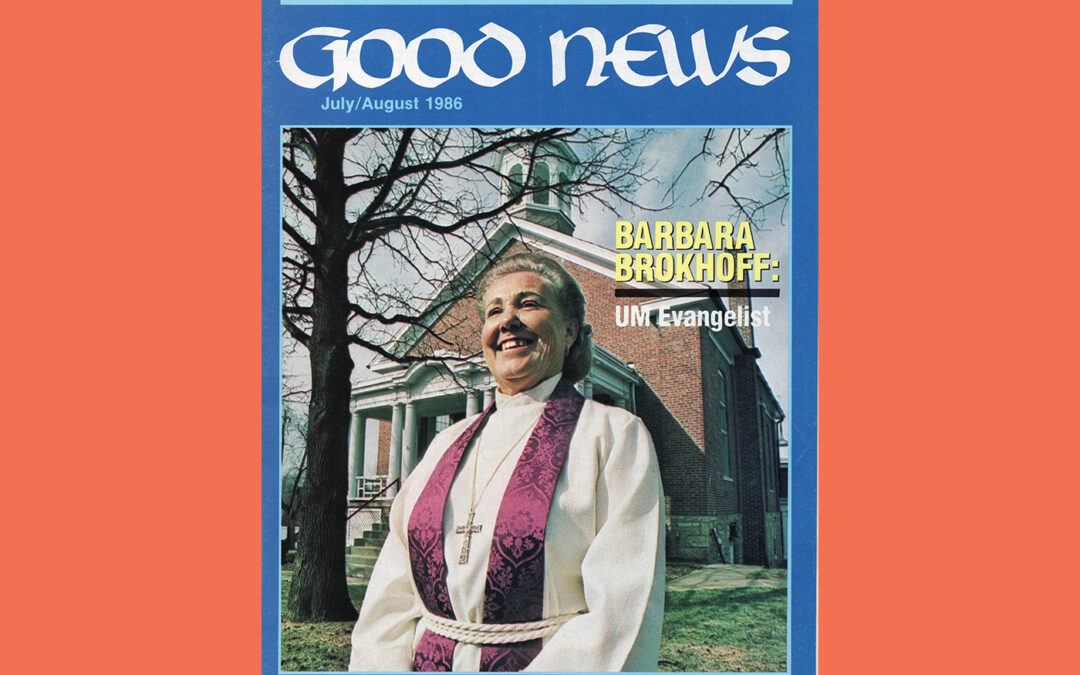
Archive: Barbara Brokhoff: UM Evangelist
“The Gospel is larger than any one issue,” says Barbara. “It’s larger than race; it’s larger than male-female.”
By Sara L. Anderson
Good News, July/August 1986
A young visiting evangelist and the local pastor walked up and down the streets of a small town inviting people to services. “We came to a house, the dirtiest house I had ever seen in my life,” recalled Barbara Brokhoff, the evangelist. When a man answered the door they invited him to church. He refused, saying, “I’m not coming to your revival because preachers will never eat with me.” But he amended that statement with, “Young lady, if you’ll come and eat with my family tonight, I’ll come to your revival.”
“So, I did that,” Barbara said, “and I’m not even able to tell you how filthy that home was. We ate skunk and boiled potatoes.”
Whatever abuse such cuisine inflicted upon her digestive tract, she saw rewards from that visit. The family came to church that night, and when the invitation to trust Christ as Savior was given, the couple and four of their six children came forward.
“A year later I was back in that church,” Barbara continues. “I didn’t even recognize them as being the same people. The pastor said that they had cleaned up their home, themselves – everything. It was amazing to me, just a nineteen-year-old preacher, how God could do something like that by such a simple act as sharing a meal.”
The Mexico, Missouri, daughter of a Methodist pastor, Barbara had heard the call to preach more than two years before, but resisted. “This was less than a hundred years ago [actually more like the early 1940s],” she recalled, “but I had never heard of a woman preacher.”
Finally 17-year-old Barbara McFarland gave in. “I said, OK, God, if you want me to preach. I’ll preach, but you have to open the doors.’ I thought, ‘That’ll fix God,’ because no doors would be open to a woman preacher.”
But that first week she received several invitations to preach, and when her pastor heard of her call, he told her she could preach at the county jail the next Sunday. After a few rounds of “No, I can’t,’’ and “Yes, you can,’’ Barbara left thinking she’d won the argument. But that Sunday she found 30 or 40 inmates expecting a sermon – from her. She opened her Bible to Isaiah, talked about Jesus as the prophesied Messiah and told what Christ had done for her. That impromptu message christened her a genuine preacher.
After attending North Central College in Minneapolis, Barbara sought advice from her district superintendent. He hadn’t heard of a woman preacher either and didn’t recommend seminary. So she completed her education by correspondence and seminars. Finally in 1956, women were admitted to full clergy status in the Methodist church, and Barbara achieved elder status in 1958.
Remarkably, since that first invitation, Barbara has never requested an opportunity to grace the pulpit. “The doors have just been opened, and God has always given me more places to preach than I can possibly fill,” she said. “It’s as if all my life he’s said, ‘I’ll show you how I can open doors.’”
Those doors opened into homes, hospital rooms, small country churches, and large urban worship centers during her early preaching days, her 15 years as a pastor in the Missouri East Conference, and her current tenure as conference evangelist for Florida. They’ve also opened to a number of “firsts”: First woman to preach at the Missouri East Annual Conference, at the North Georgia Annual Conference, at the Florida Annual Conference, the Lenten Series at Chicago Temple, and at the Missouri Conference Ministers’ Week. And everywhere she goes, the warmth of her personality and truth of her message indicate why the “firsts” have not also become “lasts.”
“My main message is Christ, that he absolutely is the hope of the world, and that God can be trusted in all of life,” explained the 58-year-old evangelist. “That means on a national basis, on a world basis, and on an individual, nitty-gritty problems-of-life basis.”
Yet husband John Brokhoff, Professor Emeritus of Preaching at UM-related Candler School of Theology, is quick to point out that the medium can be significant in how the hearer receives the message. “I think one of the reasons for Barbara’s effectiveness is that her personality is so vibrant, and she is so excited about the Gospel that the enthusiasm and the joy of [being] a Christian come through in a powerful way.”
But the medium, however enthusiastic, is unmistakably female, and there are still churchgoers who, unlike Barbara 40 years ago, have heard of women preachers but have never heard one preach.
“Most people are more prepared to hear a male – they’re just traditionally geared to that,” Barbara said. “I have found, though, that God has opened doors so that when people hear the truth of the Word, they don’t care whether it’s a man or a woman speaking, just as long as they hear from God.” For emphasis, she adds, “It’s the Word that’s the healing, saving, helping factor. It’s like going to the doctor. If you’re bleeding to death, you really don’t care if it’s a male or female who stops the bleeding.”
John agrees emphatically with that observation. “When Barbara starts out in a new place, there’s always a question as to whether or not the people want a woman preacher,” he said. “But after she builds a rapport with them, through her introduction – which is somewhat personal – and starts preaching, the Word becomes so predominant that it doesn’t matter whether it’s a male or female who is speaking.”
The key word here is “Word.” That has much more significance to the Rev. Brokhoff than adding more “firsts” to her list. “The gospel is the cause for which she lives and works,” John observed. “Many of the women I know in the ministry have made the women’s movement the cause of their lives. I think [they] are making a very bad mistake. The gospel has to come first and the person is only an instrument in proclaiming the gospel.”
While acknowledging the need to address issues that face women in the church, Barbara clarifies “the Gospel is larger than any one issue. It’s larger than race, it’s larger than male-female, because when the Gospel is truly preached, then Paul’s word [“in Christ there is no male or female”] comes true; then equality is found.”
But John also notes that women often bring different gifts to preaching than men. “I think women preachers are a little more sensitive to the human situation,” he said. “They have more emphasis on feelings, whereas male preachers are more doctrinal and theological and probably more abstract in their presentation.”
While delivering the gospel to people involves sensitivity to their circumstances, Barbara would be the first to admit that the Word is also incisive. Her nonthreatening, almost maternal demeanor might lead one to believe that she could not speak with firmness about the consequences of sin. But that is a significant part of her presentation. “I’m under the conviction that you can tell people almost anything, however difficult it is, if you do not become strident and angry and critical in doing so,” Barbara said. “People hear your spirit. Someone said they didn’t mind their pastor telling them they were going to hell, [but he didn’t have to] seem so glad about it.”
The turning point between pastor/part-time evangelist and full-time evangelist altered Barbara’s message. This change came about after she attended a preaching seminar taught by Dr. John Brokhoff, a Lutheran scholar teaching at Candler. She may not have been the first woman to attend one of his seminars, but she was the only one enrolled in that session. And Barbara’s preaching style was undoubtedly influenced by the eminent Dr. Brokhoff, but that was not the major change wrought by her presence. In the interests of ecumenical understanding, not to mention other considerations, the Rev. McFarland became the Rev. Brokhoff 14 years ago. Barbara joined John in Georgia and requested appointment as conference evangelist for North Georgia. “That meant that we could be on the road for preaching together when John was not teaching,” she said. “It also meant that when he was teaching, I could be somewhere else preaching revivals and missions and seminars.”
That arrangement worked well and it was made even better when John retired seven years ago. Then team preaching became their ministry. Now the Brokhoffs live in Clearwater, Florida, and travel together three-quarters of the time, offering churches a unique program. John teaches for an hour, usually on fundamentals of the Christian faith, and Barbara follows with an hour of preaching. In churches where members have little biblical or doctrinal knowledge this is an important emphasis.
“I think we do need exhortation,” John emphasizes. “But we also need understanding of the Word. Exhortation leaves you with a good feeling, and you’re inspired to make decisions. But feelings come and go. If you get rooted and grounded in the faith and biblical doctrine, you have a chance for permanent understanding.”
Along with teaching the Word and leading people to Christ, the Brokhoffs consider encouraging local pastors a significant part of their ministry. “They are good pastors, they’re just discouraged and are carrying a lot of loads alone,” Barbara said. She recalls a presentation she and John did on the “forgetfulness of God, that he simply does not remember our sins against us. He blots them out – even from his own mind.
“When we gave the invitation that night,” she recalled, “a district superintendent came forward with tears rolling down his face and knelt at the altar. When he stood up his whole face was illumined and he said, ‘All my life I thought that everything I’d ever done wrong would be read out for all to hear on the last day. I had not been fully aware of the forgiveness of God.’”
The Brokhoffs’ stories could go on for pages, and they love to tell them in that way that married couples and good teams do – with interjections reminding each other of some salient detail – and with affirmation for one another. This is noteworthy, considering the fact that a Lutheran Church of America preaching professor and a United Methodist evangelist could find some fertile ground for argument. “We have some wonderful theological discussions,” John said. And Barbara added, “I tell John that whenever Lutherans get a bad pastor they can’t get rid of him, since they call him. [He is not appointed by church hierarchy.] And John tells me that when Methodists get a good pastor they can’t keep him,” she continues, laughing. “Polity is the only thing we have any real difference of opinion on.”
The couple also appears to be unthreatened by each other’s ministry or popularity with a particular congregation. “Our common goal is to be what God had called us to be, so we’re not in competition with each other,” Barbara said, and adds that since they understand each other’s need for solitude when studying or preparing a sermon, that decreases the chances for tension. “Sometimes we even say that we feel sorry for people that are not in the same work, because we understand each other’s problems and needs,” Barbara said. “We just enjoy working together,” John added.
And, as long as the doors keep opening, as long as the Brokhoffs receive more invitations to preach than they can possibly accept, this ecumenical couple will continue to add to their “firsts” list. But, of utmost importance to them, they will be pursuing that common goal or helping people come to Christ and become rooted and grounded in the faith.
Sara L. Anderson was the associate editor of Good News when this article was published in 1986.
Editor’s note: Dr. John Brokhoff died in 2003; the Rev. Barbara Brokhoff died in 2023. Photos by Ed Sedej.
Q&A: The Church We See Today
Barbara and John Brokhoff have brought their two-pronged method of evangelism – teaching followed by preaching – to hundreds of churches. Good News asked them about the needs they’ve observed In United Methodist churches.
 Good News: What, in your opinion, is the greatest need of the average United Methodist lay person?
Barbara Brokoff: I believe the most urgent need is to come into some kind of relationship with Christ, and then, born out of that relationship, a sense of responsibility for evangelism of the non-Christian [is necessary]. The biggest need of our church is for people to know Christ better and then to make him known. I know that’s simplistic, but I really think everything else revolves around that.
John Brokoff: As I get around to the various churches, I find there is an abominable lack of knowledge and understanding of the Scripture. People do not read the Bible, they do not know how to understand or interpret the Bible. And, as a result, they do not know what it is to be a Christian. They have no roots that hold them fast, to give them a sense of certainty in regard to the Christian faith (What is sin, what is salvation, what does it mean to be in Christ, how do you get right with God?). They’re living on a level of works-righteousness. They think Christianity is being nice to your neighbor or doing a little good turn for somebody. A majority of people in a recent poll – I think it’s around 70 percent – indicate that they think God will accept them if they try to do what is right.
BB: We’re amazed at how many people in the teaching sessions, particularly the one that John does on fundamentals of the faith, say, “Oh I’ve been in the church all my life and never did know that.”
GN: Isn’t it rather odd that Methodists who were in the Reformation tradition of salvation by grace and salvation by faith would drift into works-righteousness?
JB: Much of our preaching today, I think, is ethical, moralistic, rather than being Gospel, Christ-centered. And this leads people to think in terms of works-righteousness for salvation. These moral pep talks are not helping people.
BB: I preached at Chicago Temple with Dr. William White this year. I remember one thing he said relative to that. He said, “There is nothing that is so terrible as being told you’re all right when you know that you’re all wrong,” and when we tell people, “Oh, you’re OK,” and do not give them a way out of their dilemma, It’s terrible.
JB: Today there is a minimization of sin and a maximization of the human with our human rights, civil rights, and the glory of being human. When you get God-centered, you have an overwhelming sense of sin, which leads you to Christ as the Savior.
BB: And then, having known that you’re accepted by Christ, you understand human worth in the light of his sacrifice and his acceptance, but not through ourselves.
JB: We emphasize in our teaching that we’re saved by grace alone, and that when you receive this grace through faith, out of faith comas good works, but they’re only a by-product of the previous grace that we experience.
GN: Do you find that Methodist are generally open to hearing a conversion message?
BB: I think people are very hungry to hear that message. People are looking for solutions and answers. People that know they are Christians and have been for years love to hear again the old story of Christ and his coming to save. And people that have not come into a vital relationship are exposed to it. One day the Holy Spirit takes [that message] and makes It vital for them.
by Steve | Jul 9, 1986 | Archive - 1986
Archive: A Call to A Spiritual and Holy Life
By Bishop Ole E. Borgen
adapted by the Councel of Bishops of the United Methodist Church (abridged version)
July/August 1986
The time in which we live appears more and more complex, constantly changing and utterly confusing. There emerges as a consequence a deep longing for a basic, unchanging foundation for all of life, something to build on, something that will last through all changes.
But even Christianity seems to flounder, being subject to the changing aspects of the day, giving birth to a massive conglomeration of views, interpretations, assertions, demands – even convicts – fragmentation, and uncertainty.
I believe that a major cause of this confusion and uncertainty is that too much of the Christian life today may be characterized as “secondary-level Christianity.” A person may express this level of Christianity in various ways. One may focus on reflection upon God, faith, and the life of faith. True doctrine becomes essential.
Or a person may focus upon the faith once established, that is, upon its form and structure. Church organization becomes essential, and, as a consequence, church politics become the dominant way of operating, even to the point of succumbing to the means of politics: power, manipulation and compromise. Business management style of operating more and more dominates the picture. The lifestyle of revival and piety may lose its dynamic and become petrified.
Or ethics and social action dominate, and “we must,” “we should,” “we ought to,” develop into legalism or works-righteousness. Common to all of these understandings is that they are good and in some way belong to the Christian life. However, these understandings all have supplanted what is essential: the dynamic power of God\ life in human life. “Secondary-level Christianity” has usurped the place of what should always be primary and essential. What is good becomes the worst enemy of the best and stands. therefore, in danger of becoming demonic and ultimately destructive or deadening.
John Wesley claimed that “love is religion itself’ and that God raised up the people called Methodists to “reform the nation, particularly the Church, and to spread scriptural holiness over the land.”
What does this mean and what does it mean for us today in our confusion, lack of clarity and spiritual power? It is, of course, impossible even to attempt a complete answer to all questions involved here. But we may peruse the landscape of faith and sec if we can gain a deeper understanding of the essence of Christianity, the Christian life, the Church and, consequently, of our own personal life of faith and holiness.
On this background, I will remind myself and all United Methodists of some things we may have forgotten. Historically, Methodism has held a high and strong doctrine of the Holy Spirit. The Holy Spirit was seen and experienced as the dynamic force in all stages of a person’s journey on the way of salvation. For without this work of the Holy Spirit, there is no life.
A clear tendency among people in our modern age (especially in the West) is a growing sense of meaninglessness. hopelessness. lostness. and alienation. The work of the Holy Spirit in convicting of sin, earlier expressed in fear of hell and sermons on fire and brimstone, appears not to be experienced in such ways in our time. The doomsday prophets of today are not the hellfire preachers, but the secular novelists, dramatists and artists.
But the Holy Spirit still changes hopeless despair into holy despair, which leads to a search for Him who is life, Jesus Christ. Therefore, the living church must offer not only religion, fellowship or teachings. But also Christ. The members of Christ’s Body are called to be “fishers of men:” Providing opportunities for conversion, for commitment to Christ is the primary task for the church in all its ministry.
As the Holy Spirit convicts of sin and creates the need for Christ,[1] so the Holy Spirit is also the agent in changing a person’s total life: Everyone who confesses his or her sins will be justified, will have the sins forgiven and find favor with God.[2] God counts such a person righteous for the sake of Jesus Christ. One is judged and found guilty but finds mercy in Christ.
Legal relationship
God has reconciled the world with Himself in Him. But each person must let himself or herself be reconciled to God.[3] Thus, justification establishes anew the formal, legal relationship with God. But there is another, personal and more wonderful relationship involved.
John Wesley writes:
Justification implies only a relative, the new birth a real, change. God in justifying us does something for us; in begetting us again. He does the work in us. The former changes our outward relation to God, so that of enemies we become children; by the latter our inmost souls are changed, so that of sinners we become saints. The one restores us to the favour, the other to the image, of God. The one is the taking away the guilt, the other the taking away the power of sin: so that. although they are joined together in point of time, yet are they of wholly distinct natures.[4]
The traditional biblical concept of “being born again” (John 3:3) is perhaps one of the most misused and misunderstood phrases in the Bible. But its real meaning is to convey an essential truth about God’s saving work: All persons who commit themselves to Christ are forgiven. find favor with Him. But at the same time the Holy Spirit takes His dwelling in their hearts and through the Spirit also Christ (Romans 8:9).
Thus, it becomes very clear that the Christian life is not primarily believing an idea or a system of thought, nor ethical systems or behavior, nor form or beauty, nor just belonging to a Christian church or fellowship, nor remembering a historical person who lived almost 2,000 years ago, although these aspects, and even more, are connected with it. No, the Christian life is essentially and primarily a person: the crucified and risen Jesus Christ dwelling, and being the Lord ‘in the lives of men and women.[5] Since God not only loves. but is love, when God thus dwells in our lives, then that love which is God himself is “poured into our hearts by the Holy Spirit.” The new life is love, or as John Wesley used to put it: Love is religion itself …
“Spiritual babies”
However, just as a little baby already has everything needed to become an adult, so it is also with the newborn “spiritual baby.”[6] To grow, it needs care, love, nourishment, protection, and guidance. If it does not grow, it will most likely wither away and die. So it is also with the new life in God. In John Wesley’s own words:
When we are born again, then our sanctification, our inward and outward holiness begins: and thenceforward we are gradually to “grow up into Him who is our Head.” … a child is born of God in a short time, if not in a moment. But it is by slow degrees that he afterwards grows up to the measure of the full stature of Christ. The same relation, therefore, which there is between our natural birth and our growth, there is also between our new birth and our sanctification.[7]
As we are justified by grace through faith, in the same way we are made holy (sanctified) through faith.[8] The Holy Spirit is the sanctifying Spirit, forming the believers into Christ’s image, to become like Him.[9] That is, a change from only being counted righteous for Christ’s sake to actually being made holy.
Thus the love of God (which is God) in our lives grows and gains more and more power over us. Actually, this love is experienced in three ways: First, “God’s love has been poured into our hearts through the Holy Spirit which has been given to us.” Second, our selfish being is gradually changed into becoming more and more a loving being; and, finally, into doing the works or love. One of Wesley’s favorite expressions was “faith working through love,” producing both inward and outward holiness. To be loved is a necessary presupposition for being able to love.
There is, therefore, a gradual sanctification, a growing in grace and in the love of God. Nevertheless, at a time that pleases God, another instantaneous change may take place. Negatively, it means being delivered from the power or sin; positively, to be filled with the love or God.
Christian perfection
Wesley calls this instantaneous experience “Christian perfection,” “entire sanctification,” “full salvation.” Later, it was often called “the second blessing,” and more recently, “baptism in the Spirit.”
Whatever term is used, it means being filled with the Holy Spirit, that is “to know the love or Christ which surpasses knowledge, that you may be filled with all the fullness or God.”[10] This means that love reigns and becomes the decisive motivating force in our lives; “love is the highest gift of God, humble, gentle, patient love; that all visions, revelations, manifestations whatever, are little things compared to love.”[11] The Wesleyan (and Biblical) sense or the word perfection does not imply an exemption from ignorance, mistakes, infirmities, shortcomings or temptations. Perfection must not be confused with perfectionism. It is “perfect love.”[12] Those who are thus “perfected in love” may still grow in grace. It is possible they may even fall out or grace, but it is never necessary.
From the beginning of the Wesleyan revival, the doctrine of sanctification (together with Christian perfection) played a central role in preaching, teaching, and life. John Wesley clearly asserted that God raised up the people called Methodists with a call to “spread scriptural holiness over the land.”
As the revival spread throughout the world, this remained central. But then something happened. Without going into any detailed and comprehensive analysis, a few things may be pointed out.
Holiness and sanctification, understood as including both inward and outward holiness, followed Methodism. But comfortable Christianity appeared little by little to take the place of total commitment and the search for a holy and sacrificial life. Several reactions followed.
For the majority of Methodists, the whole question became more and more obscure and irrelevant. Others, strongly feeling the loss of this teaching and experience, even left the Methodist Church and organized their own churches. However, in their zeal not to lose anything. they often ended up making holiness and sanctification into a system or structure, thus losing the living dynamic of the Holy Spirit.
Others sensed that the whole problem really had its root in the loss of personal commitment to Jesus Christ and the Spirit-filled life. As a result, the whole attention was focused on the area of inward holiness alone. Others again, under the pressure of the demands of the day. turned their attention in the opposite direction, focusing on the needs of the neighbor and other social problems. In both cases, one part of holiness usurped the place of the whole, resulting in the strange and unbiblical dichotomy between “the spiritual” and “the social” which so long has prevailed in the church.
Faith and works
For John Wesley the issue was clear. Faith produces necessarily all good works and all holiness: “So that if good works do not follow our faith, even all inward and outward holiness, it is plain our faith is nothing worth; we are yet in our sins.”[13]
For Christians, it is not only important what they do, but also why and how it is done. Good works, social concerns and service toward the neighbor which do not spring out of, and have their basic motivation in, a Spirit-filled life of faith are no longer fruits of faith and holiness, but have become a substitute for them. The compelling motivating force is then no longer faith working through love.
On the other hand, those who take the scriptural exhortation seriously, “be filled with the Spirit,” and earnestly strive to live a holy life have sensed the seriousness in losing the very root of living faith. They are very much aware of the immensity of God’s grace and love, are very much conscious of the scriptural proclamation, that without holiness no one shall see God.[14] They follow the exhortation: “If we live by the Spirit, let us also walk by the Spirit.”
A social religion
But the apostle Paul continues: “Bear one another’s burdens, and so fulfill the law of Christ.” Or, in the Book of Hebrews: “Do not neglect to do good and to share what you have, for such sacrifices are pleasing to God.”[15] Holiness was for Wesley always the Biblical “faith working through love,” that is, through active love. Faith without works is dead. He asserts: “Christianity is essentially a social religion; and to turn it into a solitary religion, is indeed to destroy it.”
And John Wesley states:
Thus should he [the Christian] show his zeal for works of piety; but much more for works of mercy; seeing “God will have mercy and not sacrifice”; that is, rather than sacrifice. Whenever, therefore, one interferes with the other, works of mercy are to be preferred. Even reading, hearing, prayer, are to be omitted, or to be postponed, “at charity’s mighty call”; when we are called to relieve the distress of our neighbor, whether in body or soul.[16]
The United Methodist Church has had, and still has, a strong witness in the arena or justice, civil rights, and social needs, usually with a strong sociopolitical motivation. And still, there is a growing sense that everything is not right.
First, there is among a majority of United Methodists a growing sense of alienation with regard to all social concerns. They seem to find little or no motivation in their life of faith for such activities. Second, the constant decline in membership indicates a growing spiritual anemia within large segments of the church. And both appear to have the same cause: the too widely spread lack of a living faith and a sanctified holy life.
Spiritual power and a holy life or love are absolutely necessary for the individual person as well as for the church. A renewed emphasis on a deepened spiritual life, where the gifts of the Holy Spirit are functioning and the fruits or the Spirit are made visible, is essential for the strengthening and growth or the church. Renewal is basically a spiritual matter.
Likewise, a renewed emphasis upon a deepened spiritual life is a necessary prerequisite for genuine social engagement and service. The way, is of course, as always, using regularly the means of grace: prayer, the Word of God, the Christian fellowship, and the Lord’s Supper. We are all invited to rededicate ourselves to Jesus Christ and search for the fullness of the Holy Spirit and a holy life. We’re invited to be active participants in realizing the Wesleyan goal: to spread scriptural holiness over the land and reform the continent.
It may disturb our comfortableness and demand personal sacrifice or life, time, and money. But being filled with the gift of God’s love, that is, with God, in a living relationship with him is the only way of fulfilling God’s purpose for the church and her members.
Saint Paul puts the whole thing in focus when he writes:
If I speak in the tongues of men [great oratory preaching], and of angels [speaking in tongues], but have not love, I am a noisy gong or a clanging cymbal. And if I have prophetic powers, and understand all mysteries and knowledge, and if I have all faith, so as to remove mountains [various charismatic gifts], but have not love, I am nothing. If I give away all I have, and if I deliver my body to be burned [sacrifice everything in social action and service], but have not love, I gain nothing.[17]
And with John Wesley we will say:
If you seek it [sanctification] by faith, you may expect it as you are: and if as you are, then expect it now. It is of importance to observe, that there is an inseparable connexion between these three points, —expect it by faith: expect it as you are; and expect it now. To deny one of them, is to deny them all; to allow one, is to allow them all. Do you believe we are sanctified by faith? Be true then to your principle; and look for this blessing just as you are, neither better nor worse; as a poor sinner that has still nothing to pay, nothing to plead, but “Christ died.” And if you look for it as you are, then expect it now. Stay for nothing; why should you? Christ is ready; and He is all you want. He is waiting for you; He is at the door.[18]
[1] John 16:8-11
[2] Wesley’s Standard Sermons, ed., E. H. Sugden, vol. II, pp. 445-446.
[3] 2 Corinthians 5: 18-21.
[4] Sermons, vol. I. pp. 299-300.
[5] John Wesley, Explanatory Notes upon the New Testament, Romans 8:9.
[6] I Corinthians 3: I; Hebrews 5: 13-14.
[7] Sermons, vol. II, p. 240. Also The Works of John Wesley, ed,, Thomns Jackson, Zondervan, reprint. vol. VIII. p. 279.
[8] Sermons. vol. I. p. 81.
[9] Sermons, vol. II, p. 240.
[10] Ephesians 3: 19. The term “second blessing”. although indicating the possibility or further blessings after becoming a believer, nevertheless, may also be: understood ns limiting the infilling of the Holy Spirit to two times, The: Book of Acts mentions this as occurring several times. (Acts 2:4; 4:31; 9:17; 13:52; also Ephesians S:18).
[11] Works, vol. XI. p. 430.
[12] I John 4:18. Works. vol. XI. p. 442. Sermons, vol, II, p. 156.
[13] Sermons, vol. II, p, 66. The Journal of the Rev. John Wesley, ed., N. Curnock, vol. II. p, 265.
[14] Ephesians 5:18; Hebrews 12:14.
[15] Galatians 5:25; 6:2; Hebrews 13: 16.
[16] Sermons, vol. I, pp. 381·382; Works, vol. VII, p. 61. Also Sermons, vol. II. pp. 455-456.
[17] I Corinthians 13:1-3.
[18] Sermons, vol. II, p. 460.