
by Steve | Nov 17, 2023 | In the News, Perspective / News
The Marks of a Methodist 4: Mission –
By Thomas Lambrecht –
We have been examining what it means to be a Methodist in honor of John Wesley’s tract, The Character of a Methodist, but following a modern version of those ideas in Bishop Gerald Kennedy’s 1960 book, The Marks of a Methodist. We have seen that the marks of a Methodist include Experience (a personal experience of a relationship with God through Jesus Christ that transforms all of life) and the desire to Make a Difference in this world as an expression of God’s love. In the previous article, we noted the mark of Discipline, a focused and structured effort toward the goal of making disciples of Jesus Christ.
Today we consider the fourth mark, Mission. It could be said of Methodism in general what our pastors say of the local church I attend: “Missions is the heartbeat of our church.” Mission has an outward focus, without which the church turns inward and begins to die.
Kennedy quotes Wesley: “God, in Scripture, commands me, according to my power, to instruct the ignorant, reform the wicked, confirm the virtuous. Man forbids me to do this in another’s parish; that is, in effect, to do it not at all, seeing I have now no parish of my own, nor probably ever shall. Whom then shall I hear? God or man? … I look upon all the world as my parish.”
Methodists throughout our history have admitted no limit to where we should go to proclaim the Gospel and minister to the needs of people.
Go
Kennedy writes, “Sometimes I think the Great Commission was given with the Methodists in mind. For if there has ever been a Church with the word ‘go’ at the center of its life, it is The Methodist Church.”
The need to go sent John Wesley an estimated 250,000 miles by horseback throughout his life and ministry, mostly in the British Isles. That same motivation led Francis Asbury, the founder of Methodism in America, to travel an estimated 270,000 miles by horseback in this country. Asbury was so insistent upon traveling to preach the Gospel and oversee the clergy and churches that historian John Wigger has written, “more people would recognize Asbury on the street than Thomas Jefferson or George Washington,” the famous leaders who lived during the same time.
It was the call to go where the people were that led Methodists to adopt the ministry model of itinerant evangelists and preachers called “circuit riders.” Every six months (and then later, every year) the circuit rider was appointed to a new circuit, or route of towns and churches, on which he rode, preaching and baptizing, performing weddings and funerals. Wherever he went, the circuit rider was establishing new churches. As the frontier in America moved west, the circuit riders moved along with it, always staying on the cutting edge of the country’s growth.
This impetus to go into all the world and preach the Gospel motivated Methodists to be some of the staunchest supporters and participants in the modern missionary movement. Beginning in the early 1800s, thousands of missionaries went to all the continents and countries of the world, establishing schools, hospitals, orphanages, and planting churches.
Today, one can get a sense of going into mission by taking a short-term mission trip, serving on mission projects in the U.S. and other parts of the world. While short-term mission trips bring help and encouragement to the mission field, they more profoundly impact the missioner with the life-changing awareness that God is at work in all places and all cultures. Taking such a trip opens one up to being used by the Lord in new ways to serve others. For many, this experience is transformative.
The need to go where the people are and where the needs are can mean local church members getting outside the walls of the church to serve. It might mean going to the other side of town or into neighborhoods that are different from one’s own. Taking risks and carrying the ministry of the Gospel out to the people of the community is the essence of mission, exemplified by the Apostle Paul and millions of other Christians ever since.
Social Concerns
Mission is born of love – love for God played out in love for others, in response to God’s love for us. That love extends not only to the heart and soul of a person, but to the body, mind, family, and every other part of the person. Kennedy reminds us, “There has never been any willingness to believe that any part of life is beyond the reach of our faith. From the beginning we have had a concern for the physical conditions of life. … The Gospel deals with all of life because it comes to heal the whole [person]. The Bible knows nothing about partial religion, and it has no tendency to divide life into compartments. The goal is a Kingdom in which [each person] will be a citizen under the government of God. So, we may begin where we will and go in any direction, but if Jesus Christ is Lord of our lives, we will travel straight toward human need. We will soon be involved in solving human problems and making life better for all.”
Our goal as Methodist Christians is to seek the welfare of all people in the name of Christ. That is why Methodists have been in the forefront of establishing schools, hospitals, clinics, orphanages, farms, and other social service agencies. That is why Methodists have felt called to advocate for policy changes like the abolition of slavery in the 19th century and the ending of child labor in the 20th century.
Where Methodists have often agreed on the “what” of human need, we have sometimes disagreed on the “how” to meet that need. It is important to acknowledge the validity of different strategies to combat social ills like prostitution, drug addiction, human trafficking, world peace, and crime. When the church limits itself to one approach, it runs the risk of being wedded to an ideology, whether liberal or conservative, rather than focusing on the Gospel and practical love of neighbor. The church is at its best when it goes out to meet the needs of people directly. It is less effective and sometimes harms itself when it ventures into the political arena and begins playing by the rules of advocacy and activism.
Even worse is when the church comes to believe that passing resolutions or governmental laws is the sum total of social concern. Kennedy warns, “The world must be changed, but in the hearts of [people]. There is no system that can do it and laws are poor weak things when you are trying to change society. Wars can stop some things from happening, but they cannot build the new life. What a limited thing is force and how inadequate is money! But God has entrusted to us His love and power to conquer our sin and redeem our wills.”
The transformation of the world comes through the transformation of individual lives by the power of the Holy Spirit, not by the power of political rallies or governmental edicts. But much of that individual transformation happens when people see the love of God in Christ displayed in our loving outreach to minister to human needs. That is the essence of mission.
Evangelism
Individual transformation comes through a personal relationship with Jesus Christ as Savior and Lord. That requires evangelism to be a central part of missions. Kennedy states, “When the Gospel is a living experience, there is no need to talk about evangelism. For to share that experience both consciously and unconsciously is inescapable.”
Living a life of love and caring for others opens the door to relationship. In the context of that relationship, one can then share “the reason for the hope that [we] have” (I Peter 3:15). And certainly, we can use the relationship to invite people to accompany us to church, where they can experience the Gospel in that setting.
Foremost on our minds should be our striving to live a life that is congruent with our message. A life that does not display the grace of God and his love for all the world will not be a great advertisement for the truth of our message of redemption through Jesus Christ. It has been said that you and I may be the only Bible a non-Christian will ever read (at least until they get interested in finding out more about Jesus). On the other hand, Kennedy cites a story about a meeting of college students where one student asked, “What is Christianity anyway?” The response was, “Why Christianity is Oscar Westover” – the name of a Christian believer known to the group. “I love those quiet Christians who move among their friends like a judgment and a benediction,” observed Kennedy. “They are witnesses and evangelists.” Our lives can embody the message we proclaim and be the walking definition of what it means to be a Christian.
Kennedy writes, “There is no joy to compare with bringing Christ to another. The Church has bestowed on me many honors, but nothing compares with the privilege it gives me to call [people] into its saving fellowship.”
Kennedy concludes, “Any church must be missionary in spirit, or it dies. But this is particularly true for Methodism because its whole spirit and polity are not proper for a finished institution. We must march or lose our life.” I wonder if modern Methodism has domesticated the spirit of early Methodism and created that “finished institution” that Kennedy thought we had not attained. That “finished institution” can become a museum piece to be preserved and admired, rather than a vehicle for mission. That way lies the death of the church. May we recover the missionary spirit of early Christianity and of early Methodism. For this God has raised us up!
Thomas Lambrecht is a United Methodist clergyperson and vice president of Good News. A woman has her eyes examined by a medical attendant while other patients sit waiting in line at Gwandum Clinc in Nigeria. Photo by the Rev. Ande I. Emmanuel, UMNS.
by Steve | Nov 15, 2023 | Front Page News
Methodist Heritage: World Methodist Council 1961 –
Address by Bishop Gerald Kennedy –
Tenth World Methodist Conference
Oslo, Norway
August 19, 1961
In the nineteenth century, the English theologian Frederick Dennison Maurice wrote: “I cannot but think that the reformation in our day, which I expect to be more deep and searching than that of the sixteenth century, will turn upon the Spirit’s presence and life, as that did upon the justification by the Son.” That expectation, while as yet unfulfilled, was a confident hope that God through his Holy Spirit would again act mightily in the Church. This expectation was based on previous experiences in the first century and again in the eighteenth century.
The Book of Acts is really the Book of the Holy Spirit. The clue to the meaning of Pentecost is in the words: “And they were all filled with the Holy Spirit and began to speak in other tongues, as the Spirit gave them utterance” (Acts 2). There is a mighty assurance in those early Christians and they acted as if it were only natural to heal and convert. They were filled with a power that made their witness sharp and clear. They lived in the constant awareness of the reality of the Holy Spirit ever present with them for guidance, comfort, and courage.
The end of World War II was a terrible time for the Christians of Germany. The country was ruined, defeated, disgraced, and there was no hope in the future. Germany was divided, with much of Protestantism under the communists. The churches were particularly hard hit, for they had lost their buildings and many of their leaders. Some of the church leaders had to cross back and forth between East and West Zones and suffered harassments from the authorities. Yet listen to this testimony from Bishop Otto Dibelius: “We are living in the Book of Acts, and, oh, it is glorious.” He was speaking of the recovery of the sense of the Holy Spirit’s presence.
Our fathers knew this experience. Indeed, to read John Wesley’s Journal is to be transported back into the atmosphere of Acts. There are the same great expectations, the same inspiring hopes, the same signs. The Evangelical Revival was, among other things, a rediscovery of the truth of the doctrine of the Holy Spirit. I cannot escape the conviction that the Wesleys were raised up by God for this witness and that the people called Methodists have been chosen to continue it.
Now the scandal of revelation for many is its particularity. Why should God reveal Himself in one man, one tribe, one event, one place? Why does God so seldom if ever use an entire generation, a continent, a general infiltration of a whole period as the means of making Himself known? Why is it that He speaks through minorities and fellowships rather than through majorities and institutions? Perhaps it is because He chooses to use the foolish things with which to confound the wise. But I believe He will use some particular instrument for the new reformation.
It could be Methodism. At least we have the tradition and the theology for it. We may have been raised up for such a time and we have the advantage of having been born out of a revival of the Holy Spirit, nurtured by its doctrine, and commanded by its sense of urgency. Let us examine briefly four aspects of our belief in the witness of the Spirit.
In the first place, we believe in Experience. We may argue as to the particulars of John Wesley’s heart-warming event at Aldersgate Street in 1738, but it seems inescapable that it was a personal turning-point and the spring of the Methodist flood. It was an inward witness that brought personal knowledge of God and assurance of the availability of God’s power. It was a baptism of the Holy Spirit.
This was a part of the worship experience of early Methodism. You may remember how Francis Asbury attended a Methodist meeting in Wednesbury and said: “I soon found this was not the Church – but it was better.” He found there no cold formalism and no lifeless ritual, but the sense of the immediate presence of God. The dour and dark dread which seems to dominate so much modern theology, is not the prevailing atmosphere where the presence of the Spirit is expected and recognized. So Wesley could say of a man who has this experience, “He is therefore happy in God.”
I attended a church service a few years ago in a mood of prejudice, which is not the proper way to enter God’s house. I did not like the sermon subject and I was sure that the whole approach was not for me. But from the first hymn, I was captured and lifted. The pastoral prayer began: “O God, when Thy Son walked the earth, men felt that if they could but touch the hem of His robe, they could be healed. We believe He is here with us this day in this place, and with our arms of faith we may touch Him and be healed. Help us to claim Thy promises.” The sermon was a testimony of how men find Christ the answer to their needs and the goal of their search. I left the church helped and strengthened, which is too seldom the experience of people who sit through our chilled formalities.
One of the main problems for modern Methodists is how to create an attitude of expectancy in our ‘cathedrals’ with our choirs and dignified services. Our preaching can so easily become like the heavy lecture at the 1954 World Council Meeting, after which the late Bishop Berggrav of Oslo murmured, “The word became theology and did not dwell among us.” Methodists should sing their theology, which is a better way to proclaim it than reciting a creed or constructing a dogma. Charles Wesley’s hymns are full of personal experiences, and they abound in personal pronouns. I have noticed that Methodist theologians, particularly in England, often quote a hymn when they are discussing a doctrine. They have the sense of these expressions of Charles and John Wesley’s poetry as descriptions of religious experience. And that is theology!
The sign of the living God is communication and revelation. This means experience, and we are committed to the belief that His Spirit witnesses with our spirit. Preachers without the experience of the Holy Spirit are smoking fires with hardly any flame of light. Laymen who have not been baptized with the Spirit, are merely salesmen for an institution with little joy and hardly any power. We cannot give what we do not have any more than we can go back to where we have not been. We believe in the experience of the Holy Spirit.
In the second place, the Holy Spirit’s witness makes us believe in Results. To connect anything pragmatic with the spiritual, will seem to some a contradiction. I am convinced, however, that quite the opposite is true. The spiritual affairs which produce no ascertainable results are to be considered with suspicion. The practical affairs which have no spiritual implications are to be regarded as of questionable importance. This is true of religion in general, but it is the very center of Christianity’s truth.
I have been impressed with the way Wesley met his critics and how in the midst of controversy he kept his eye on the main issue. He seldom argued generalities, but went straight to the particular point. How often he replied to his opponents by referring to the change in environment the Methodists had wrought. He talked about changed personal lives as the answer to Methodism’s critics. John Wesley seems to have thought that the results produced by conversion were the answers to the opposition.
The modern split is reflected in the conversation between two students attending a theological seminary. Both of them served student churches, and one of them was complaining about the condition of his church. The finances were in bad shape, the organizations were feeble, and the attendance was small. But the other one was not disturbed. ‘What do you expect ?’ he asked. “Results?” Or we see it in the superior attitude some times exhibited by other churchmen toward our “activism.” I have seen these communions with their empty sanctuaries and their lack of life. I prefer a Church committed to the idea that the living Spirit of God will produce observable results from its labors, if it is doing God’s will.
We may disagree about methods of evangelism, but we cannot disagree about evangelism itself and remain Christians, to say nothing about remaining Methodists. Evangelism is not just one interest of the Church, for there simply is no Church if evangelism is not present. Let us be critical of all methods and never think that a single method is holy. But that we should ever think that our Methodism can be excused from winning people to Christ would be a confession of death. Every minister and layman in our fellowship must be under the constant question: When was the last time you won somebody to Christ?
We are heavily organized and this causes some of the brethren to chafe. Organization as an end in itself is of the devil, but waste and inefficiency are neither pious nor pleasing to our Lord. All we are trying to do is to conserve the benefits of our faith and exert our maximum power. John Wesley said that he would not strike a blow unless it could be followed up and sustained. I think history says clearly that, for the long pull, Wesley’s way was right. Let us not assume that if we believe in the witness of the Spirit, we must be opposed to machinery in the Church. For it too is a part of God’s plan for the evangelization of the world. It helps us maintain the fruits which God gives from our labors.
A third aspect of this subject is Discipline. This is more important than we think, for only within the framework of a strict discipline can the free Spirit work constructively. Since the days of St Paul, there have been those who would turn the Christian’s freedom into license.
Precisely because he was dealing with tremendous spiritual power, John Wesley insisted on discipline in his services and in the lives of his followers. The early Church found that same necessity and so shall we. In Wesley’s Journal for 17th August 1750 there is this entry: “I preached at Ludgvan at noon, and at Newlyn in the evening. Through all Cornwall I find the societies have suffered great loss from want of discipline. Wisely said the ancients, ‘The soul and body make a man; the Spirit and discipline make a Christian.’” All one or the other can only create half-Christians.
I marvel yet at the Methodist tradition of time and rules. We are to consider time the great gift and the heavy responsibility. We have our General Rules and our Discipline. Our ministers carry heavy burdens and take responsibility for their conferences as well as for their churches. They are to serve where they are appointed without spending time candidating for pulpits. They are subject to the modern tensions and strains which are destroying so many of our contemporaries. I do not know a more difficult or demanding job in our modern world than to be a Methodist minister. This situation will not get better, for we are not about to become pietistic fellowships or passive, waiting servants of Christ. Ours is the marching tradition and we are a travelling ministry. We can only do our work by being the most disciplined of men.
Billy Sunday said one time that he had been accused of rubbing the fur the wrong way. “Well,” he replied, “let the cat turn around.” Perhaps God is saying to us that we must turn around – that we are on the wrong path going in the wrong direction. With all the material advantages we enjoy, we are often frustrated and unhappy people. To be an instrument of the Spirit’s power, we must accept spiritual discipline. The path to freedom is both straight and demanding.
Finally, let us see the witness of the spirit in the light of our doctrine of Christian Perfection. This is a difficult matter for us to understand and explain. There is a very close connection between the doctrines of the Holy Spirit and Christian Perfection. Both stem from the experience of being found by God in Christ. Both are based on a faith that God is involved in all of man’s life. Both believe that the Spirit of God can capture a man and transform his desires. Both will destroy our carefulness and timidity with an assurance that “all things are possible with God.”
When I was a young preacher, I studied John Wesley’s doctrine of Christian Perfection, which may be the only unique doctrine Methodism has preached. I found him spending about as much time explaining what he did not mean as what he did mean. It seemed to me too troublesome, and I spent little time on it in the following years of my ministry. But John Wesley held it and preached it in spite of its difficulty, and I have become convinced that he was right.
A young candidate for Conference membership objected to saying “Yes” to the question: “Are you going on to perfection?” An old bishop asked quietly, “Well son, what are you going on to?” The whole idea of perfection is foreign to us, and we prefer to just do the best we can and not expect unreasonable attainment. But Jesus said, “You, therefore, must be perfect, as your heavenly father is perfect” (Matthew 5).
It is time that we tried to recapture the mood of a man and a people who would declare their intention of aiming at nothing less than being perfect in love. They were not saying that they expected to become sinless – or perfect in judgment. But they were willing to be content with nothing less than giving themselves completely and unreservedly to the service of Jesus Christ. It was an affirmation of the kind of faith we find in the Book of Acts when the experience of the Holy Spirit was so real.
That New Testament enthusiasm is lacking in our time. The American comedian Mort Sahl said that he wished he could find a cause, because he had a lot of enthusiasm. Our problem is just the reverse, for while we have a cause, we seem curiously lacking in enthusiasm, either in the pulpit or in the pews. If in the midst of this compromising, vacillating, mediocrity ridden world the Methodists should proclaim again that they were committed to being made perfect in love, it might start a new revival. In the midst of all the bad news which reaches us daily, this would be good news indeed.
God gives much or little according to our asking. If all we want is the righteousness of the Scribes and the Pharisees, that is all we shall receive. But if we dare to reaffirm our faith in the doctrine of Christian Perfection and pray for the glorious experience of the witness of the Holy Spirit, God wih use us mightily again. And who knows whether we have not come to the kingdom for such a time as this?
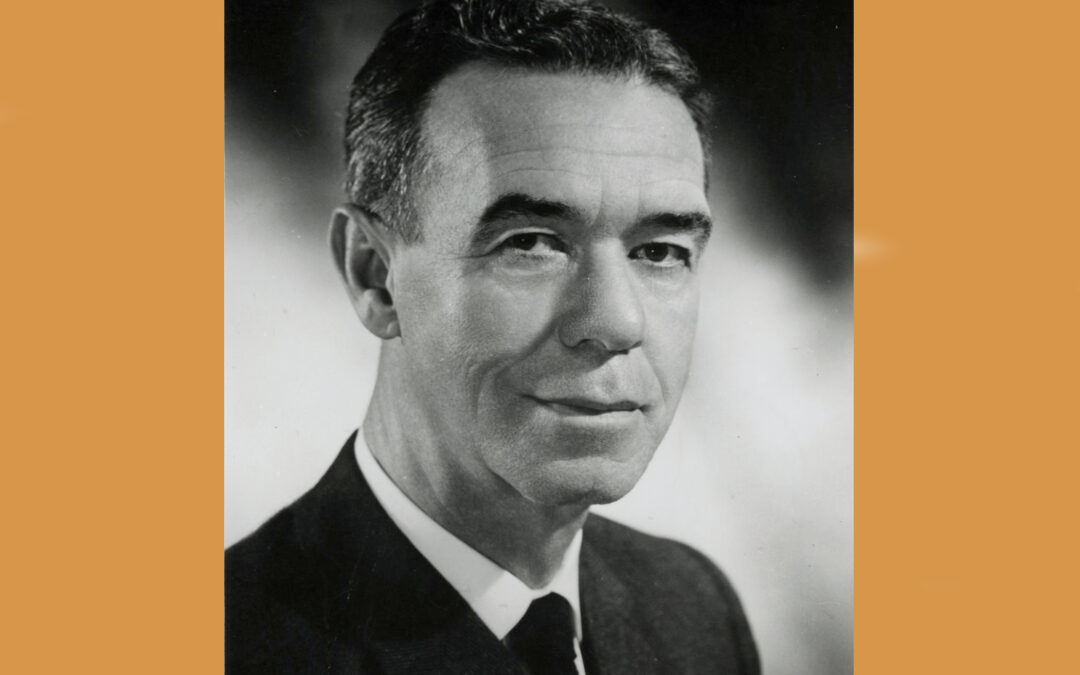
Gerald Kennedy (1907-1980) was a bishop of the United Methodist Church (Los Angeles). Excerpted from the Proceedings of the Tenth World Methodist Conference in Oslo, Norway, August 17-25, 1961.

by Steve | Nov 10, 2023 | In the News, Perspective / News
Judicial Council (Partly) Faces Reality –
By Thomas Lambrecht –
In a recent decision, the Judicial Council has partly walked back their earlier resolution that the 2020 General Conference was not cancelled, only postponed. Unfortunately, this walk-back comes too late to remedy the unfair treatment it extended to our African brothers and sisters.
Postponed or Cancelled?
In Decision 1451, issued last December, the Judicial Council declared, “No provision in [t]he Discipline authorizes the cancellation of a regular session of General Conference or the annulment of elections properly conducted by an annual conference. The next meeting scheduled for 2024 is designated as the postponed 2020 General Conference.” This decision was prompted by requests for declaratory decision by Kenya-Ethiopia, Western Pennsylvania, and Alaska Annual Conferences.
This decision repeated the language of postponement adopted by the Commission on the General Conference and in Judicial Council decisions 1409, 1410, and 1429. In stating that the Discipline did not provide for the cancellation of a General Conference, the Judicial Council ignored the fact that the Discipline does not provide for the postponement of a General Conference, either.
In addition, the Council misidentified the years of a quadrennium. The UM quadrennium begins the year after the General Conference session. So, the General Conference met in regular session in 2016, and the ensuing quadrennium was from 2017-2020. The next regular General Conference was to meet in 2020, with the ensuing quadrennium running from 2021-2024. Instead, the Council referred to “the delegates duly elected to the 2020 General Conference for the 2020-2024 Quadrennium.” That is actually a five-year period, not a quadrennium. The Council correctly identified the quadrennium in their Decision 1409, when they ruled, “The General Conference has full legislative authority in matters of quadrennial budgets and apportionment formulas and acted accordingly in 2016 by adopting the 2017-2020 budget.” The same year (2020) cannot be part of two different quadrennia!
By postponing the 2020 General Conference, there was actually no regular General Conference session during the 2017-2020 quadrennium, only the special session of 2019. The requirement that the General Conference meet “once in four years” was already violated by that first postponement. It will in fact be eight years between sessions of the General Conference, which is certainly a violation of the Discipline.
There is no question that the General Conference could not meet as scheduled in 2020, or even in 2021. There was great controversy over the postponement of the General Conference from 2022 until 2024. That did not need to happen and appeared to be driven by concerns other than logistical ones. By that time, centrists and progressives were having second thoughts about the Protocol, and they wanted to keep the more progressive delegation that was elected for the 2020 General Conference. The third postponement killed the Protocol, launched the Global Methodist Church, facilitated wholesale disaffiliations in the U.S., and cleared the way for a progressive agenda for the UM Church.
Unfair to Africa
By calling it a “postponed” session of General Conference, rather than a “cancelled” session, the same delegates elected for 2020 would be able to serve in 2024. It would also mean that there would be no reallocation of delegates, as there would normally have been for the 2024 conference. Delegates were allocated on the basis of 2016 membership numbers, instead of using the 2020 membership numbers. This resulted in an underrepresentation of African members by fifteen percent of their delegation. Where they should have had at least 320 delegates in 2024, they remain at the previous 278. Most of those 42 delegates now represent the U.S., rather than being reallocated to Africa. One could construe this decision as reflecting a U.S.-centric mindset.
An Extra General Conference Session
The Judicial Council compounded its misinterpretation in Decision 1472. In response to a series of questions from the Council of Bishops, the Judicial Council ruled, “The Commission on the General Conference is required to schedule and plan for a regular session of General Conference to be convened after the adjournment of the postponed 2020 General Conference, between January 1, 2025 and December 31, 2027.”
Given that a regular General Conference costs around $10 million, and even a shorter session would cost at least $7 million, the requirement of an extra General Conference was a huge unfunded mandate by the Judicial Council. It is worth noting that four of the nine Council members dissented publicly from this decision.
Reconsideration
With those financial considerations in mind, the General Council on Finance and Administration requested the Judicial Council to reconsider its decision to mandate an extra General Conference session.
Now in the just released Decision 1485, the Judicial Council has rescinded its requirement for an extra session of the General Conference. The next “regular session of the General Conference that is to be convened following the upcoming 2024 regular session, would be held four years thereafter, in 2028” (emphasis original).
In making this change, the Council adopted some of the language and logic of the dissenting opinion in Decision 1472.
Delegate Elections Remain Unchanged
Predictably, the Council left intact its ruling that the delegates elected in 2019 to the 2020 General Conference remain the delegates to serve for the 2024 session of the General Conference. However, in this recent decision, they appear to have changed their reasons for doing so.
Decision 1451 states, “Cancelling or skipping the 2020 General Conference and requiring new elections to be held would be tantamount to overturning the results of the 2019 elections and disenfranchising the clergy and lay members of an annual conference who voted in good faith. It would also deprive delegates of their right to be seated and serve at the session of General Conference for which they were duly elected. There is no basis in Church law for such course of action.”
Of course, there is no basis in Church law for any of the other actions the Judicial Council took to deal with the pandemic emergency. They chose which emergency actions to sanction, such as allowing the postponement of the 2020 General Conference, and which ones to deny, such as cancelling the 2020 General Conference and requiring new elections.
Their rationale in Decision 1451 appears to be, that for the sake of democracy and honoring the elections that took place in 2019, those delegates must be enabled to serve. Again, many of these delegates will not be serving four years later due to death, change of status from lay to clergy, or withdrawal from the denomination (among other reasons). It seems fruitless to preserve the sacredness of the 2019 elections, when many annual conferences needed to hold supplemental elections this year to fill vacancies in the delegation.
Now in Decision 1485, the rationale for maintaining the 2020 delegates appears to have changed. The decision states, “The reason for this determination … is that the names of all those persons who were elected to serve as General Conference delegates in 2020 were duly submitted in a certified report, by their Annual Conference Secretary, to the General Conference Secretary who was then prepared to issue the credentials for said persons. … the names of all of the duly elected delegates had been certified and submitted to the General Conference Secretary” (emphasis original).
In other words, the reason for keeping the 2020 delegates is “paperwork.” The names had already been submitted and certified. Therefore, we must keep those names. Again, most delegations will have experienced a significant turnover of delegates since 2020 and new lists of delegates will need to be submitted by the annual conferences.
There is no reason why new elections could not be held, since supplemental elections were indeed held this year. There is no reason why new delegates could not be certified, since in many cases new delegates are being certified this year. The only reason for keeping the 2020 delegates was because the Judicial Council declared that it must be so.
At Last – Cancellation
Hidden in the rationale for keeping the 2020 delegates, the Judicial Council has finally admitted that the 2020 General Conference was cancelled, not postponed. “… the global pandemic triggered travel bans and international restrictions and thereby necessitated the cancellation of the regular session of the General Conference that was scheduled to convene in Minneapolis, Minnesota in 2020.” It would have been much simpler had the Judicial Council faced this reality in 2021, when it first issued rulings on the fact that the 2020 General Conference could not be held. Unfortunately, this belated acknowledgement of reality comes too late to rectify the injustice done to the African part of the denomination.
This decision by judicial fiat deprived the African part of the church from its fair representation. It also deprived the whole church of having delegates who reflect the current thinking and desires of annual conferences. A lot has changed in the past four years. Yet the delegates serving at the 2024 General Conference will have been elected under the conditions of 2019 (before the pandemic, before postponement, before disaffiliation) and may not reflect the best current views of the annual conferences.
It is unfortunate that, over the past several years, the Judicial Council has become a legislative body making decisions on behalf of the whole church that only the General Conference can make. At the same time, the Council of Bishops has assumed similar powers to stand in for the General Conference that was not allowed to meet, making such decisions as deciding Par. 2553 did not apply outside the U.S.
This troubling trend establishes precedents that do not bode well for the future of United Methodism. For non-representative bodies to assume powers that are not theirs will diminish the power of the General Conference and of the annual conferences to act in the future. Coupled with the willingness of some bishops and annual conferences to outright ignore or defy the Discipline, these developments spell the potential for chaos in the future governing of the denomination.
Thomas Lambrecht is a United Methodist clergyperson and vice president of Good News. Good News graphic.
by Steve | Nov 9, 2023 | Front Page News, In the News
Methodist Heritage: New York’s John Street –
By Edmund Robb III –
Good News, January-February 1977 –
What do a one-eyed army captain, an Irish immigrant, and a distraught woman have in common? They were all part of launching Methodism in New York City. Here’s how it all began.
In the early 1760s a group of closely-knit, evangelical Irish emigrated to New York. In a few years, with the social and religious restraints of the old country gone, these new Irish-Americans began slipping away from their warmhearted Christian faith. (These Irish were actually Germans who had been driven out of their Fatherland by the advance of French armies under Louis XIV. These Protestant Germans were never happy in Ireland, so they joined that great migration to the New World.)
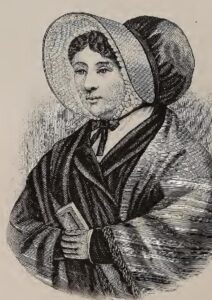
Barbara Heck
It took Barbara Heck to wake things up. One night – five years after landing in the city – she discovered her husband, brother, and close friends gambling with cards in her kitchen.
She was outraged! Quickly she swept the playing cards off the table and cast them into the fireplace. Then she firmly rebuked the gamblers. But she knew this wasn’t enough. Something more had to be done!
Still red with anger, Barbara Heck rushed over to her cousin’s house and cried, “Philip, you must preach to us or we shall all go to hell together – and God will require our blood at your hands!”
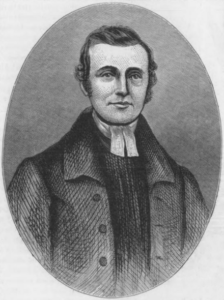
Philip Embury
But Philip Embury, a 38-year-old carpenter, school teacher, and local Wesleyan preacher, wasn’t so easily convinced. After all, for five years since coming to America he had done nothing to advance Christ’s kingdom.
“Where shall I preach?” he asked timidly. “And how can I preach, for I have neither a house nor a congregation.”
But Barbara Heck was stubborn. “Preach in your own house,” she retorted.
“And who will come to hear me?”
“I will come to hear you,” she insisted.
And she did come – along with four others to Philip Embury’s cottage in September 1766. It was Methodism’s first regular preaching service in America.
Over the winter, the humble Methodist society began growing. Soon Embury’s cottage living room became too crowded and they had to move to new quarters.
After scouting the city they found a rigging loft on Barracks Street. It was an unlikely place for preaching and worship! All around were saloons and military barracks.
But there, on the roughest street in town, these early Methodists set up shop. They built a pulpit, erected benches, and held regular preaching services. On Sunday mornings they gathered at six o’clock to hear Philip Embury preach about Jesus. And they usually met several evenings each week, too. Despite this, these “peculiar” Methodists went regularly to the English Episcopal Church to receive Holy Communion. (Until 1784 Methodists in America were official members of the Anglican Church. John Wesley did allow his local preachers to administer the sacraments of Holy Communion or Baptism. This did not change in England until he died in 1791.)
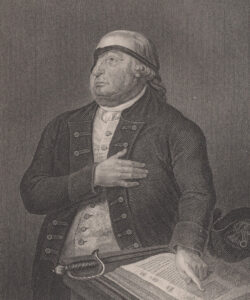
Captain Thomas Webb
Captain Thomas Webb. One day the Methodists received an unusual boost. A stranger, dressed in the full regalia of an officer in His Majesty’s Army, entered the rigging loft. Tension filled the air. The Methodists’ experience with the British Army had not been good. Had not soldiers tried to break up several societies in England? Perhaps this soldier was about to make trouble here, too. But as soon as the meeting closed, the one-eyed army captain marched to the front and introduced himself as “Captain Thomas Webb, of the king’s service, and also a soldier of the Cross and a spiritual son of John Wesley.”
Captain Webb, as New Yorkers learned to call him, had lost his right eye while commanding troops at the Siege of Quebec in the French-Indian War. As a result he was retired early from active duty and sent home to England to recuperate.
It was during this time that Captain Webb came under the influence of John Wesley’s preaching – and was soundly converted.
Since Captain Webb had been given a preacher’s license by Wesley himself, he was soon invited to begin preaching regularly at the society, alternating with Philip Embury.
Now, many more New Yorkers began attending Wesley’s Chapel. John Wesley must have been right. He said of Webb: “The Captain is all life and fire. Therefore, although he is not deep and regular, many who would not hear a better preacher, flock to hear him. And many are convinced under his preaching.”
The sheer novelty of hearing a well-known army officer preach, “You must repent or be forever damned!” packed people in.
One contemporary wrote, “His figure was portly, his countenance commanding, and he usually wore across his forehead a black ribbon with a blind attached, to cover his wounded eye.”
John Adams, who later became President of the United States, heard Webb preach, and described him as “One of the most eloquent men I ever heard; he reaches the imagination and touches the passions very well, and expresses himself with great propriety.”
Another early writer described the scene this way: “To behold in the pulpit a preacher arrayed in a scarlet coat with splendid facings, having a sword, with the Bible before him, was one of those anomalies which the world, while it ridicules the person, cannot help admiring the boldness of the act.”
Webb declared point-blank to his enthralled listeners that all knowledge and religion were not worth a rush unless their sins were forgiven and they had the witness of God’s Spirit with theirs that they were the children of God.
New Yorkers did admire “the act.” But it was Captain Webb’s warm personality, unusual oratorical abilities, and strong faith which kept them coming back. As a result, within another year, Wesley’s Chapel had to look for larger quarters – again!
John Street. This time the Methodists moved to John Street and built a new chapel. But they had one problem. A law of the colony did not permit dissenters to worship in a church building. So to elude this law, the Methodists built a fireplace in their new chapel, which gave it the official rank of a dwelling.
Methodists have been good fundraisers from the beginning. This first society, for instance, appealed successfully to New Yorkers for financial help. Over 250 responded, from the mayor all the way to a number of slaves.
The new building was opened in October 1768. Philip Embury preached that day from a pulpit he made for the society. He, like Jesus, was a carpenter.
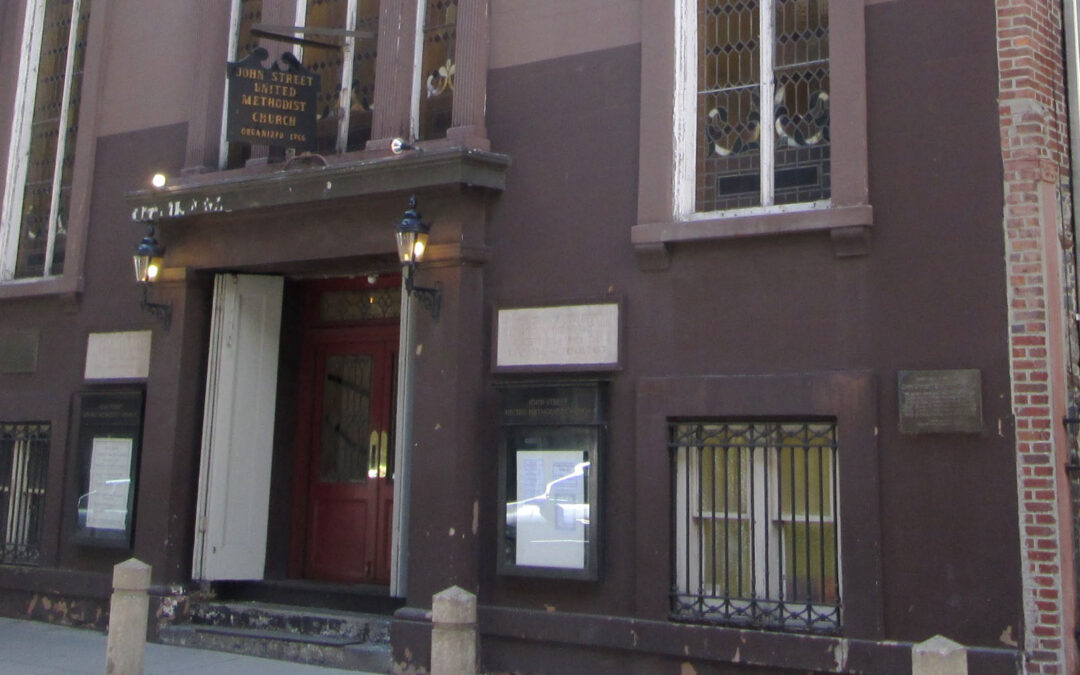
Today, over 200 years later, Philip Embury’s seminal society still stands in the heart of New York City, situated midway between City Hall and Wall Street.
John Street United Methodist Church, as it is now called, is the one church we all own. Because of General Conference action over a century ago, John Street is the only United Methodist Church owned directly by the entire denomination.
As a result, every succeeding General Conference since 1868 has stopped its hectic agenda to receive a formal report from John Street’s trustees, and to elect the local church’s board members for the ensuing quadrennium. (Imagine a General Conference electing your local church’s board members!)
John Street Church continues to minister to people’s needs as it has since 1766. Conditions have changed radically, of course. What was a bustling English port of 18,000 inhabitants, is now the largest city in the United States. Droves of people each day work within walking distance of the church, including employees from international banks, corporate insurance offices, stock and commodity exchanges, and law and government offices.
Each working day many of these people escape from the noisy confusion of the inner city to the sanctuary of John Street United Methodist Church. Here they find solitude and a place to pray.
Captain Thomas Webb is not bellowing vehemently from the pulpit now, but people are still able to respond to the heart-warming Gospel of Jesus Christ, just as they did when Philip Embury and Thomas Webb preached there in 1766!
That’s why John Street is the little church that lasted.
Edmund Robb III was the contributing editor to Good News at the time of this article’s publication. This article appeared in the January-February 1977 issue. Dr. Robb went on to be the founding pastor of The Woodlands United Methodist Church in The Woodlands, Texas. Main photo: Creative Commons.
by Steve | Nov 3, 2023 | In the News, Perspective / News
The Marks of a Methodist 3: Discipline –
By Thomas Lambrecht –
This series of articles has been looking at the marks of a Methodist, as expounded by Bishop Gerald Kennedy in 1960. How has the expression of Methodism changed or remained the same in the last 60 years? We have seen that the marks of a Methodist include Experience (a personal experience of a relationship with God through Jesus Christ that transforms all of life) and the desire to Make a Difference in this world as an expression of God’s love.
The third mark Kennedy points to is Discipline. He quotes John Wesley’s Journal from August 17, 1750: “Through all Cornwall I find the societies have suffered great loss from want of discipline. Wisely said the ancients, ‘The soul and body make a man; the Spirit and discipline make a Christian.’”
Discipline might be defined as focused and structured effort toward a goal. For a Christian, the goal is both personal holiness (experience) and pursuing the mission of God in the world (making a difference). In the mind of Wesley and Kennedy, the means to reach that goal is through discipline. Kennedy quotes Methodist Bishop Edwin D. Mouzon as saying, “Methodist discipline is as much a part of Methodism as Methodist doctrine.”
Disciplined Time
Kennedy illustrates this focused effort by how we spend our time. He quotes one of Wesley’s “Historic Questions” that have been propounded to every aspiring Methodist preacher since the 1750’s. “Be diligent. Never be unemployed. Never be triflingly employed. Never trifle away time. Neither spend any more time at any one place than is strictly necessary.”
These instructions strike us as somewhat obsessive. One wonders if Wesley ever took a vacation! Unrelenting effort is a recipe for burnout. There are occasions when it is appropriate to waste time. Certainly, the Sabbath principle points to the need for rest and restoration, both physically and spiritually.
On the other hand, many today lack focus and purpose in their lives. When we understand what we are to do with our lives, there needs to be focused time and effort to be faithful to that understanding. We will not accomplish what God has for us to do by sitting on a couch and playing video games. Part of making a difference is devoting our time and energy to those things that will result in making a difference. The more we can give that focused effort, the more we are able to accomplish.
Kennedy sums up his viewpoint, “One of the most serious sins is to waste time. God does not give us a more precious gift than the years of life which are made up of hours and minutes. I find myself more and more in harmony with Wesley’s acute sense of the importance of using every minute of every day with ‘sixty seconds’ worth of distance run,’ as Kipling said.”
Wesley’s General Rules
A primary way that discipline was manifested in the Methodist movement from its earliest days was through Wesley’s three General Rules. Kennedy reminds us that Wesley welcomed anyone with “a desire to flee from the wrath to come, and to be saved from their sins” to be admitted to a Methodist society, “but once admitted, members either followed the rules or they were dismissed.”
The first rule states that Methodists will evidence their desire of salvation “by doing no harm, by avoiding evil of every kind.” The examples given in the original rule include “profanity, breaking the Sabbath, drunkenness, fighting and quarreling, dishonesty, buying or selling without paying the tax, usury, speaking evil, doing anything that is not to God’s glory, self-indulgence, borrowing without the probability of repaying.” As Kennedy put it, “great living often begins with a resolution not to do some things which other people are doing. Many people have lost their moral standards because they have accepted the silly idea that a ‘thou shalt not’ is always wrong. Life is made noble by the people who dare to say No.”
The second rule is the flip side of the first. Methodists are to evidence their desire of salvation “by doing good in every possible way, and as far as possible to all.” We are to do good “to their bodies” by relieving physical needs of people and providing food, shelter, clothing, and companionship. We are to do good “to their souls” by engaging them spiritually, instructing and encouraging them to grow in faith. We are to do good “especially to them that are of the household of faith,” our brothers and sisters in Christ, favoring them in business and taking special care to minister to the needs of fellow Christians. Most importantly, we are to do good whether we feel like it or not!
Finally, the third rule is to evidence our desire for salvation “by attending upon all the ordinances of God.” These are: public worship, the ministry of the Word, the Lord’s Supper, family and private prayer, studying the Scriptures, and fasting or abstinence. Kennedy affirms Wesley’s promotion of “holy habits” that build our spiritual lives. “[Wesley] was careful to dismiss those who fell away from their obligations, for he knew that such carelessness could destroy the societies. We are not a people under law but under grace. Still, we will lose our way unless we have guideposts and regulations.”
What strikes one is the systematic way that Wesley and Methodism pursues salvation and holiness. This important pursuit is not left to chance, but is carried out in intentional, methodical ways. Just as discipline focuses our use of time, it also focuses our efforts on doing good, avoiding evil, and engaging the spiritual disciplines, the means by which God has ordained for us to grow in likeness to Christ.
High Expectations
Methodism was characterized by the expectation that God would grow the Christian into spiritual perfection. As Jesus said, “Be perfect, therefore, as your heavenly Father is perfect” (Matthew 5:48). As Wesley understood it, this does not mean perfect in the sense that we never make a mistake. Rather, it is a level of spiritual maturity whereby we are so filled with the love of God that we do not commit any intentional sin. A familiar saying among Methodists is that we are “going on to perfection.”
Most of us may never reach that goal in this life. Wesley himself never professed to have reached perfection. But if we stop striving toward it, we will settle for being much less than we could be.
These high expectations were manifested in an approach to church membership that was characterized by discipline. Kennedy states that of all the thousands of people who professed conversion in the great revivals on the American frontier, “probably not more than a fourth ended up as members [in the Methodist Church]. Candidates for church membership were carefully examined, taught, sifted. They had to attend classes and testify as to the condition of their souls. Nor was it unusual to have members dismissed for failing to live up the rules of the Methodist Church.”
This high expectation has been lost in many churches today, Methodist and otherwise. Studies in church growth over the years have shown that “high-expectation churches” tend to experience greater numerical growth, as well as (hopefully) greater spiritual maturity. The 1950’s before Kennedy wrote his book was a period of some of the highest church attendance in U.S. history. He alludes to the fact, however, that such a “return to church” had not had the equivalent expected impact on the culture of the time. “If the return to religion in our day has not resulted in the moral and spiritual renewal of our society, it is the fault of the churches. If we fail to make clear what Christianity demands, we need not be surprised if our members take the whole affair lightly. The Church only cheapens itself when it fails to make demands and hold up standards.”
Kennedy particularly singles out ministers for needing discipline in their lives. “True it is that our society has no more difficult profession than the ministry. Indeed, it is an impossible task as can be proved easily if you analyze what is expected from the minister by the congregation. No [one] is up to it. But it has always been true that no [one] can carry this load without divine help. The minister is driven back upon God if he [or she] is to ‘walk and not faint.’”
Indeed, this is true in a larger sense of all Christians. We are not able to live up to the high expectations God has for us. That is why we learn to depend upon God to grow us into that spiritual maturity, rather than thinking we can do it all on our own effort. Kennedy reminds us, “we never discover what God can do until our weakness drives us to Him.”
“The time has come when we must hold up The Methodist Church as something that demands the best and insists on discipline. … The Methodist Church has had its great periods of power and influence which were always times of witnessing. We still worship the same Lord, and we believe the same doctrines. If we would accept the same discipline, we could expect the same mighty results. The essential mark of our Church is a disciplined, witnessing fellowship.”
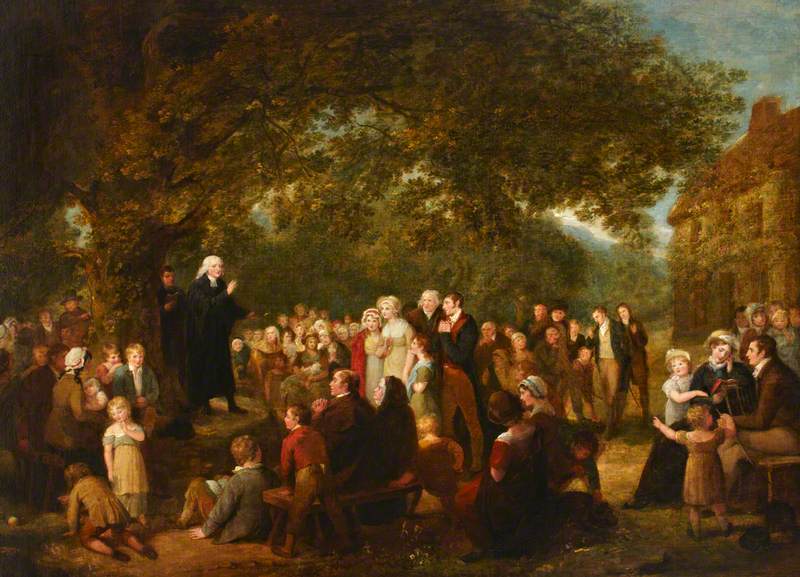
Thomas Lambrecht is a United Methodist clergyperson and vice president of Good News. Art credit: John Wesley preaching in Ireland, 1789. Maria Spilsbury (1777-1820). John Wesley’s House & The Museum of Methodism.