by Steve | Feb 16, 2024 | Front Page News
The UM Church Adjusts to Fewer Bishops
By Thomas Lambrecht
In the aftermath of losing one-fourth of its congregations and members in the U.S., The United Methodist Church anticipates a number of adjustments to its ministry and structure. For example, UM News Service has reported that since 2016, general agencies have cut about 40 percent of their staff. This is in line with the proposed budget coming to the April General Conference in Charlotte, North Carolina, that calls for a 40 percent reduction in the quadrennial budget, making it the smallest budget proposed since 1984.
Adjustments are driven substantially by an anticipated drop in financial resources, and also by a drop in the number of churches and members. This second factor is an important driver in the number of U.S. bishops, which will be reduced by jurisdictional conference action this year.
Number of Bishops Set by Formula
The number of bishops to which each jurisdiction is entitled is based on a formula found in the Book of Discipline, Par. 404.2. Each jurisdiction is entitled to a base number of five bishops. The jurisdiction is then entitled to an additional bishop for every 300,000 members (or major fraction thereof) over the base number of 300,000. So, at 450,000 members, a jurisdiction would be entitled to six bishops, rather than five. At 750,000 members, the number would move to seven bishops, and so on.
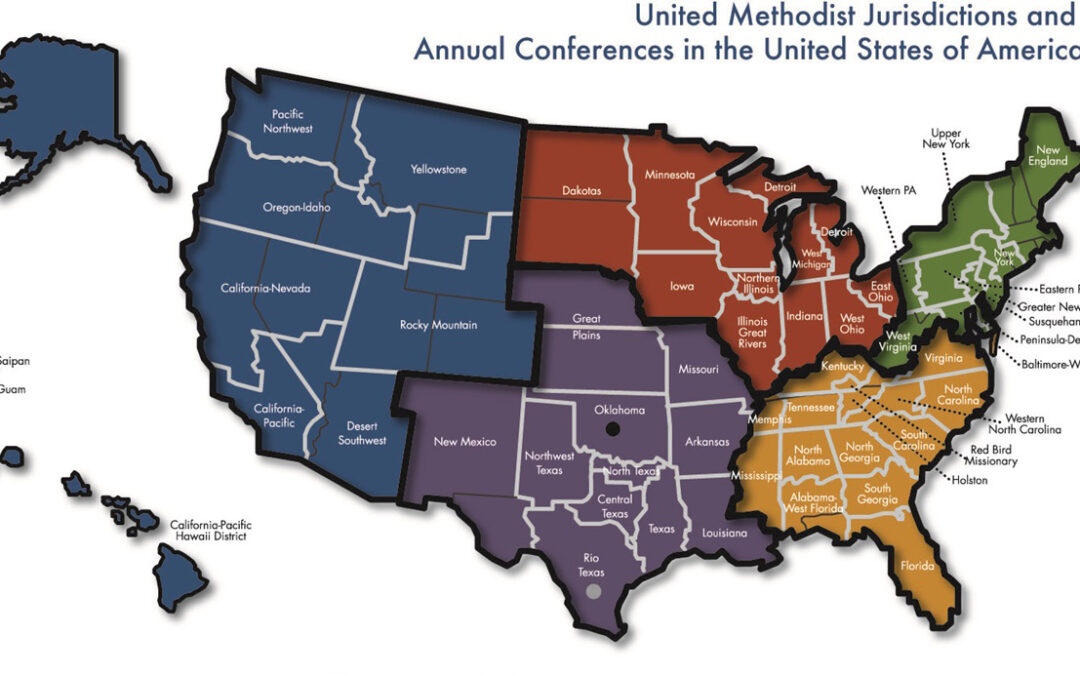
Based on the formula and 2016 membership numbers, this is the number of bishops each jurisdiction had before disaffiliation began:
|
Members |
Eligible Bishops |
2016 Actual Bishops |
| North Central |
1,270,000 |
8 |
9 |
| Northeastern |
1,257,500 |
8 |
9 |
| South Central |
1,707,500 |
10 |
10 |
| Southeastern |
2,818,000 |
13 |
13 |
| Western |
340,500 |
5 |
5 |
| Total |
|
44 |
46 |
As the above chart demonstrates, both the North Central and Northeastern Jurisdictions were set to possibly lose a bishop in 2020, due to a decline in membership in those jurisdictions below the number set by the formula.
However, the number of bishops is not automatically set by the formula. Instead, the Interjurisdictional Committee on the Episcopacy (ICE) is tasked with recommending the number of bishops to be approved by the General Conference “on the basis of missional needs” (Par. 404.2b). The ICE can recommend retaining a higher number of bishops than the formula would allow. It recommended in 2019 that the number of bishops be retained as is for the 2020 General Conference, so that the denomination could see the results of the 2019 General Conference before deciding on any reductions.
Number of Bishops Reduced in 2023
In the aftermath of three postponements of the 2020 General Conference, the jurisdictions held special jurisdictional conferences in 2023 to allow bishops to retire who were mandated to do so by the mandatory age limits in the Discipline. Some of the jurisdictions voluntarily decided to elect fewer new bishops than they were otherwise entitled to elect. That way, if disaffiliation meant further reductions were necessary, some active bishops would not have to be forced out of office. It would give time to see how many churches disaffiliated and the impact on various annual conferences.
This is the result of that first “downsizing”:
|
2016 Bishops |
2023 Bishops |
| North Central |
9 |
9 |
| Northeastern |
9 |
6 |
| South Central |
10 |
8 |
| Southeastern |
13 |
11 |
| Western |
5 |
5 |
| Total |
46 |
39 |
This 15 percent reduction in the number of bishops was actually only an 11 percent reduction from the number that jurisdictions were entitled to in 2020. But it showed church leaders grappling with the potential of drastic changes coming in the wake of disaffiliation. The North Central Jurisdiction anticipated retirements in 2024 that would allow them to reduce their number of bishops as needed.
Number of Bishops Post-2024
Jurisdictions are still making plans regarding the election of bishops this summer in the wake of the 2024 General Conference. There are also several proposals to the General Conference to eliminate the above formula for setting the number of bishops. One of those proposals would have the general church pay for the initial five bishops, and then have each jurisdiction pay for any bishops it elects over that base five. None of the proposals would reduce or eliminate the requirement for a base of five bishops. Thus, they fail to address the greatest inequity, which is the Western Jurisdiction maintaining a full five bishops while other jurisdictions would have two to three times the number of members per bishop.
Based on 2019 membership numbers with an estimated adjustment of how many members were lost through disaffiliation, this is how many bishops would be allocated by formula in 2024, along with how many bishops each jurisdiction plans to allocate:
|
Post-Disaffiliation Members |
Eligible Bishops |
Current Bishops |
Projected 2024 Bishops |
| North Central |
745,000 |
7 |
9 |
7 |
| Northeastern |
864,000 |
7 |
6 |
7? |
| South Central |
950,500 |
7 |
8 |
7 |
| Southeastern |
1,500,000 |
9 |
11 |
10 |
| Western |
277,500 |
5 |
5 |
5 |
| Total |
|
35 |
39 |
36 |
If these projections hold, the number of U.S. bishops will have been reduced by 22 percent, from 46 to 36. That is in line with the General Council on Finance and Administration’s budget for a 23 percent reduction in the Episcopacy Fund for the 2025-28 quadrennium. At this time, it is unknown whether there will be money available for additional bishops in Africa, which were promised in 2016.
Under these projections, neither the North Central, the South Central, nor the Southeast would elect any new bishops in 2024. Depending on whether or not any currently active bishops retire, it is possible the Western Jurisdiction would not elect any new bishops, either. Some jurisdictions have yet to decide what their episcopal numbers will be, and that could also be influenced by actions taken at the General Conference.
Most of the reductions are the result of annual conferences moving to share a bishop.
- In the North Central Jurisdiction, Wisconsin and Northern Illinois will share a bishop, as will East Ohio and West Ohio.
- In the Southeastern Jurisdiction, North Alabama, Alabama-West Florida, and South Georgia will all share one bishop.
- In the South Central Jurisdiction, Northwest Texas, North Texas, and Central Texas will share a bishop, Oklahoma and Arkansas will share one bishop, and New Mexico and Rio Texas will share one bishop.
- In the Northeast Jurisdiction, Baltimore-Washington and Peninsula-Delaware are sharing a bishop, as are Eastern Pennsylvania and Greater New Jersey. New England and Susquehanna are both being covered by multiple bishops. It is very possible one more bishop will be elected in this jurisdiction and/or that annual conference borders will be realigned to provide more equitable episcopal areas.
All of this ferment illustrates the point that Good News has been making for several years. The UM Church following disaffiliation will be a different church than it was, both structurally and in its beliefs and teachings. Those who thought that by remaining United Methodist, everything would stay the same, are finding out that change was inevitable for all of us. The key will be to grasp this opportunity to make the churches of whatever denomination the most effective in their mission and ministry for the sake of Jesus Christ. It will be a challenging task for all, demanding patience, prayer, and sacrificial commitment to the greater mission.
Thomas Lambrecht is a United Methodist clergyperson and the vice president of Good News. Jurisdictional map created by United Methodist Communications.

by Steve | Feb 14, 2024 | Front Page News
Love and Lent
By Shannon Vowell
A strange day today.
Much of the Christian world will begin a season of fasting and prayer by receiving ashes and the somber injunction to “remember you are dust, and to dust you shall return.”
Simultaneously, much of the secular world will exchange over-priced roses, cards, and literally tons of chocolate in ritual celebration of “romantic love.”
(Some of the secular world will watch and wonder whether they will ever be on the receiving end of such love / such stuff; according to the culture, it’s the only route to Real Happiness.)
What to make of these apparent contradictions?
Acknowledging that romantic love has dominated human imagination since humans began recording their imaginings provides context, as does perceiving that the whole-body / whole-mind intensity of romantic love has compelled comparisons to death from time immemorial.
Homer, Dante, Shakespeare – romantic love powers the centripetal force for their writings. Love sends ancient nations to war, sends a medieval pilgrim through Hell and back again, sends young lovers of Verona to their voluntary deaths. Romantic love is the consuming passion – the irresistible force – the flame that even death cannot extinguish.
Modern Valentine’s Day conventions constitute a kitsch continuation of such assumptions. Hallmark may not have Homer on their writing staff, but the end goal remains the same: how to describe an emotion so vast that it could “launch a thousand ships” on behalf of the beloved?
There is a sense in which Ash Wednesday provides the only possible lens through which Valentine’s Day makes sense. Human longing for love that overwhelms, dazzles, and delights even beyond the grave appears sadly futile on its own. Seen from the vantage point of creatures crafted from dust by a Creator whose love literally spans eternity, the fundamental logic of that longing emerges. We are made in the image of the One Who loves us first – the One whose love literally gives us life and the capacity for love, ourselves.
Human nature, imago dei, derives from love and inclines toward love.
In the absence of knowing the One whose love makes us lovers, romantic love offers the only outlet option for emotions too strong to constrain. We were made for love; we will love, inevitably. We will pretend that the unkeepable purple prose promises of Hallmark (and Homer – and Dante – and Shakespeare) satisfy, because we cannot deny the craving for love that animates us.
Ash Wednesday reminds us: there IS a love that is stronger than death, and there IS a Lover who has conquered death on our behalf. Whether we are on the receiving end of roses on Valentine’s Day or not makes no difference to the passion that sent Jesus to the Cross on our behalf. We are loved. We are loved for this lifetime, and we are loved for the lifetime to come.
Chocolates, roses, and cards convey sentiments which, at their best, reflect the true love that begat the universe. At their worst, they distract from the fact that only God can keep a promise to love beyond the grave. Ash Wednesday points us to that promise by reintroducing us to the Promise Keeper, in all his glorious affection and power.
Shannon Vowell, a frequent contributor to Good News, blogs at ShannonVowell.com. She is the author of Beginning … Again: Discovering and Delighting in God’s Plan for your Future, available on Amazon. Photo: Shutterstock.

by Steve | Feb 9, 2024 | Front Page News, In the News, Perspective / News
Extending Disaffiliation Options
By Thomas Lambrecht
The main agenda items for the Renewal and Reform Coalition at the 2024 General Conference meeting in Charlotte, NC, April 23-May 3 relate to providing new disaffiliation pathways for churches and annual conferences that have not been offered a fair opportunity to disaffiliate so far. This will be an uphill battle. United Methodist bishops and other leaders want to turn the page on disaffiliation and put it behind them. UM leaders are aghast at the high number of congregations that have disaffiliated in the U.S., particularly in the South and Midwest. They do not want to lose any more.
So, the UM establishment is putting on a full-court press to prevent any more disaffiliation pathways from being enacted at the 2024 General Conference. It is important to understand why these pathways are needed and what the two pathways submitted by African delegates are designed to accomplish.
Why New Disaffiliation Pathways?
United Methodists outside the U.S. have not been allowed to consider disaffiliation under the Par. 2553 pathway provided by the 2019 General Conference. This arbitrary decision by bishops without obtaining a ruling from the Judicial Council has disenfranchised the majority of the church that lives outside the U.S.
Some congregations and one annual conference outside the U.S. have been able to disaffiliate. They did so either by ignoring the requirements of the Discipline or by a negotiated pathway with their particular central conference. Such a negotiated pathway is not realistically available in all the central conferences, and it is never a good idea to foster ignoring of the church’s Discipline.
The Judicial Council has ruled that annual conferences may not disaffiliate unless the General Conference provides a process for them to do so. Several annual conferences in Africa or elsewhere may desire to disaffiliate. Therefore, it is necessary for the General Conference to provide a way for annual conferences to do so.
In the U.S., nearly a dozen annual conferences (out of 53) imposed extra financial and other costs on churches desiring to disaffiliate. These costs ranged up to 50 percent of the congregation’s property value, additional financial fees, and in some cases an outright ban on traditional congregations disaffiliating. Whereas, denomination-wide about 26 percent of congregations disaffiliated, in these conferences requiring extra costs only about 13 percent of congregations disaffiliated. And in the most extreme examples, less than five percent of congregations disaffiliated because the cost for doing so was nearly impossible for most churches.
At least two bishops and several district superintendents that we know of lobbied their churches not to disaffiliate in 2023. They said that the General Conference had not yet met, and that one could not be certain what actions it would take. They assured their congregations there would be a way to disaffiliate after the 2024 General Conference, if it took actions they disagreed with. In order to make good on those promises, the General Conference needs to enact a disaffiliation pathway for local churches that want to respond to the likelihood that the 2024 Conference will allow same-sex weddings, the ordination of non-celibate LGBT persons, and repeal the Traditional Plan.
Simple fairness and justice demand that the General Conference provide a realistic disaffiliation option for those outside the U.S., as well as those few congregations in the U.S., that have not had that realistic opportunity.
Annual Conference Disaffiliation
Right now, there is in the Discipline a way for an annual conference outside the U.S. to become an autonomous Methodist Church (Par. 572). It requires that the conference write its own new Book of Discipline and obtain approval from the Standing Committee on Central Conference Matters, from the central conference in which the annual conference is located, from two-thirds of all the other annual conference members in that central conference, and from the General Conference. Due to the lengthy process and all the approvals required, the process can take years and is not certain to succeed.
In addition, the process requires the annual conference to become autonomous. But those annual conferences that might seek disaffiliation in response to General Conference action desire to join another Wesleyan denomination, not become autonomous. They should not be forced to go through the process of becoming autonomous in order to move to another denomination.
The Renewal and Reform Coalition is supporting a proposed new Par. 576 that would allow an annual conference outside the U.S. to transfer to another Wesleyan denomination. They could adopt the Discipline of that other denomination, rather than having to write their own. It would require only a two-thirds vote by the disaffiliating annual conference and the majority approval of its central conference. Local churches and clergy in that annual conference desiring to remain United Methodist could do so, with provision made by the central conference for a continuing UM presence where desired.
This much shorter and less laborious process would allow annual conferences outside the U.S. to determine where their most faithful future of ministry lies. They would not be forced to remain in a denomination that has changed its teachings in ways they cannot support. And they would not be subject to the uncertainty of a years-long process that may or may not bring about their disaffiliation.
Local Church Disaffiliation
The Coalition is supporting a proposed new Par. 2553 to allow local churches to disaffiliate, both outside and in the U.S. It would maintain the current requirements of Par. 2553 for two years’ apportionments and payment of pension liabilities. But it would prevent annual conferences from imposing additional financial costs on the disaffiliating church. It would also clarify the timelines for churches to disaffiliate, so that annual conferences cannot impose lengthy disaffiliation processes designed to discourage disaffiliation.
This new Par. 2553 would provide a realistic possibility for local churches to disaffiliate where they have not had the opportunity to do so. It would allow local churches outside the U.S. whose annual conference does not disaffiliate to make the decision that over 7,500 local churches in the U.S. have made.
In a recent fundraising piece for “Mainstream UMC,” the Rev. Mark Holland – self-proclaimed centrist – writes, “Seriously, in this day and age, what organization stays together through coercion?” We agree. Churches should not be forced to remain United Methodist if they do not want to do so. The failure to allow non-U.S. churches to disaffiliate and the imposition of draconian costs on churches in the U.S. amounts to coercion. A coerced covenant is no real covenant at all. A coerced and unfair remainder of churches in the UM denomination is not healthy or good for a denomination that wants to move in a different direction. Hopefully, the 2024 General Conference delegates will consider fairness and provide the needed opportunities for realistic disaffiliation that have been lacking outside the U.S. and in some conferences in the U.S. Future historians and a watching world will see if they do the right thing.
Thomas Lambrecht is a United Methodist clergyperson and vice president of Good News. Photo by Pexels.
by Steve | Feb 2, 2024 | Front Page News, In the News, Perspective / News
“Mainstream UMC” Condemns Nigerian Bishop
By Thomas Lambrecht
In a recent fundraising piece, the self-identified centrist caucus group “Mainstream UMC” condemned the United Methodist bishop of Nigeria, Bishop John Wesley Yohanna. Its principal accusation was that Bishop Yohanna made a public statement on TV in which he “lied about the African delegates who gathered recently in Tanzania, saying they support gay marriage.” It alleges he did so “in an effort to intimidate his delegates” and by doing so “putting people’s well-being at risk to support his political agenda of taking the Nigerian church out of the UMC and into the GMC.”
A recent meeting of some African General Conference delegates and other members issued a statement supporting regionalization and opposing disaffiliation for the church in Africa. Bishop Yohanna apparently made his public statement in response to reports about that meeting, reassuring the Nigerian church and public that the church in Nigeria opposes both regionalization and same-sex marriage.
Mainstream UMC leads the story by asking its readers to “please forward this email to your Bishop and demand that the Council of Bishops take immediate action against Bishop Yohanna.” This is plainly an attempt to support Mainstream UMC’s allies in Nigeria who are actively working against Bishop Yohanna’s authority as bishop (see more details below). It is also highly ironic that Mainstream UMC is attacking a traditionalist bishop in Nigeria who has not violated the Discipline, while previously defending two bishops in the Western Jurisdiction that are ineligible (according to the Book of Discipline and a Judicial Council decision) to serve as bishops due to being in same-sex marriages.
Inaccurate Allegations
Anyone who watches the TV clip of Bishop Yohanna’s statement can clearly see that Yohanna never said that the Tanzania delegates support gay marriage. In Yohanna’s words, “Some years back, some groups within the church have been advocating same-sex marriage. For some of us, this is unbiblical and also is incompatible with church teaching according to our Book of Discipline, which is the laws [sic] of the church.” He went on to state that the United Methodist Church in Nigeria says no to same-sex marriage.
It was actually the news reporters – not Bishop Yohanna – who stated that the delegates in Tanzania were supporters of same-sex marriage. We should all be able to agree that Bishop Yohanna cannot be held responsible for what they said.
Further, it should be clarified that while a previous meeting of the United Methodist Africa Forum in Johannesburg, South Africa, supported changing the definition of marriage to allow for same-sex marriage, the delegates and members meeting in Tanzania voted to retain the current definition of marriage between one man and one woman. That is an important distinction.
The only mention Yohanna made of the delegates in Tanzania was to allege that they were taught at the meeting by caucus groups supporting regionalization how to vote at the 2024 General Conference. He emphatically stated that the Nigerian United Methodist Church “says ‘no’ to regionalization.” The truth of the bishop’s statement was confirmed earlier this week when nearly 1,000 delegates at a special session of the Nigerian annual conferences unanimously voted to oppose regionalization.
There is no doubt there were presentations made by representatives of the caucus groups in Tanzania advocating for the church to adopt regionalization. According to the announced results of the meeting, those Africans present agreed with the caucus groups in favor of regionalization. Undoubtedly, the caucus groups explained that if the African delegates present wanted to support regionalization, there were certain petitions they would need to support. That is a legitimate lobbying activity.
But it is important to note that not all those present were General Conference delegates, nor did the delegates present represent a majority of all African General Conference delegates. One cannot therefore take the Tanzania statement as representative of all African delegates. It is certainly the prerogative of the Nigerian bishop to argue publicly against regionalization as a counter to that meeting.
Certainly, nothing that Bishop Yohanna stated was of a nature to “put people’s well-being at risk.” He did not name personally any of the delegates who attended the Tanzania meeting. He did not call for any form of action or retribution against those delegates. Mainstream UMC’s urgent tone and strident call for Council of Bishops action against Bishop Yohanna is an uncalled for attempt to undermine the bishop, his ministry, and his authority.
Other False Allegations
The Mainstream UMC fundraiser also alleges that the Rev. Keith Boyette, president of the Global Methodist Church, is portrayed in video footage during the newscast because he was in Nigeria to “actively work with Bishop Yohanna for the church in Nigeria to leave the UMC.” The news footage was actually taken during the recent centennial celebration of United Methodism in Nigeria – a full month prior to the meeting in Tanzania. This was Boyette’s first and only trip to Nigeria, and he was there as an invited guest to help celebrate the centennial, along with many United Methodist officials, political dignitaries, and representatives of other denominations. He was not there to lobby the Nigerian church to join the GMC.
Long ago, Bishop Yohanna made it clear that, if the Book of Discipline changed to allow same-sex marriage and the ordination of non-celibate LGBT persons, he would withdraw from the UM Church, and he believed that most of the Nigerian church would withdraw, as well. It did not take Boyette’s presence at a centennial celebration to prompt such a course of action on Yohanna’s part.
The Mainstream UMC piece casts other aspersions on Yohanna meant to undermine him.
It refers to the fact that Bishop Yohanna’s election was challenged in 2012 by some Nigerians before the Judicial Council. The Judicial Council declined to rule because no official body of the church had requested a declaratory decision. The Council of Bishops argued in its brief that “John Wesley Yohanna was ‘validly nominated and elected as a bishop of the West Africa Central Conference.’” Yohanna was elected unanimously out of three candidates by the 57 delegates who cast ballots at the central conference meeting. Thirteen delegates who believed Yohanna was improperly nominated boycotted the meeting. The Council of Bishops stated, “While the resulting boycott by 13 delegates from two annual conferences may have had some impact on the eventual vote totals distributed among the three candidates, there is nothing decisively evident that the outcome of the balloting would have changed the results of the election. Nor is there evidence that any attempt was made during the balloting process to challenge the legitimacy of the election by the West Africa Central Conference.”
The group of challengers was led by the Rev. Philip Micah Dopah, who eventually led a breakaway movement in southern Nigeria that is no longer part of The United Methodist Church, despite many efforts by Bishop Yohanna to resolve the split. One of the issues in the election was tribal identity and the unwillingness to accept a bishop of another tribe. There is no question that Bishop Yohanna was fairly nominated and fairly elected as bishop.
Mainstream UMC also alleges that Bishop Yohanna “worked with the civil authorities in 2021 in Nigeria to jail four members of his clergy.” This is not true.
From a Nigerian clergyperson, Good News received an article from WAX-FAITH Magazine that extensively quotes DSP David Misal, Deputy Superintendent of Police and the Police Public Relations Officer in Jalingo – the capital city of Taraba State in north-eastern Nigeria. In the article, Misal states the four were invited to the police station as part of an investigation into complaints that they were “instigating members of the Church against others, setting division, causing violence among members of the Church and training others to cause violence.” The four came voluntarily and peacefully for police interviews. The article states that, unfortunately, “at the arrival at the Police Headquarters they secretly took photographs of the Police Headquarters gate … and other sensitive locations within the Police Headquarters and attached it with a written complaint and forwarded it to United Methodist Council of Bishops alleging that the police is [sic] been used and paid by Bishop John Wesley Yohanna to harass and torture them.” The four were then charged with spying because taking the photographs was illegal.
According to the article, the police spokesperson stated that, “the Police Command consider the complaints of the clergymen as false misleading and a deliberate attempt to portray the image of the Police in a bad light, as such the Police were professional courteous and civil in handling the case.” The spokesperson “further debunked claims making the rounds that Bishop John Wesley Yohanna was responsible for the trial of the accused persons.”
Missing Context
It is important to note that the group raising concerns in Nigeria is led by the Rev. Ande I. Emmanuel, who was once the secretary of the conference and a trusted aide of Bishop Yohanna. Emmanuel turned against Yohanna and for the last three years has refused an appointment by the bishop. He and his group have been recruiting churches and pastors to defy Bishop Yohanna’s leadership. Those churches have refused to pay their conference apportionments and clergy have refused appointments from the bishop. Emmanuel has announced his own intention to run for bishop, if the General Conference grants an additional bishop to Nigeria, as proposed.
This group has also been holding alternative annual conference meetings with their own delegates, claiming to be the rightful United Methodist Church of Nigeria. As noted in the above article reporting from the police, the group has been accused of fomenting violence. In one incident, a gang of “thugs” invaded a conference youth event and attacked participants, inflicting injuries. Police responded and arrested twelve suspects and recovered weapons. The suspects are being prosecuted for assault.
Complaints were filed by conference leaders against Emmanuel and his group, who in turn filed complaints against Bishop Yohanna. There was a just resolution of the dueling complaints in 2023, but it is apparent that Emmanuel and his group are still not willing to accept the authority of Bishop Yohanna, in accordance with the just resolution. The fundraiser from Mainstream UMC can be seen as part of an ongoing attempt by this group to undermine Bishop Yohanna’s ministry and ruin his reputation. Readers should not accept unchallenged the inaccurate and false allegations that the Mainstream UMC piece makes against Bishop Yohanna.
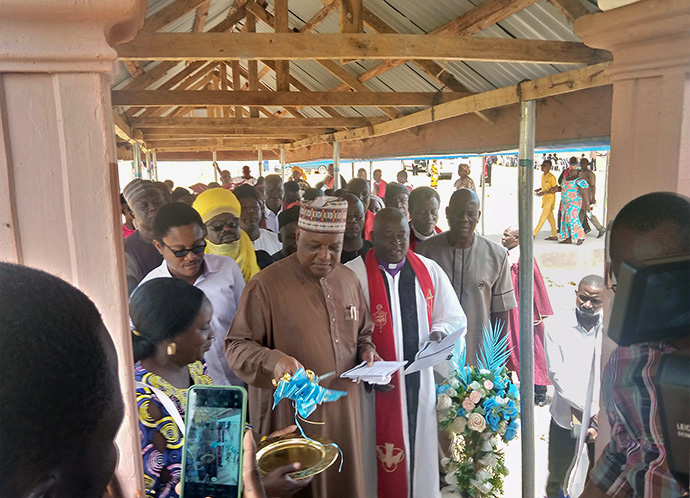
Thomas Lambrecht is a United Methodist clergyperson and vice president of Good News. Photo: Nigeria Area Bishop John Wesley Yohanna is joined by the Rev. Jolly T. Nyame, former governor of Taraba state and onetime director of connectional ministries for The United Methodist Church in Nigeria, during a commissioning service for a new emergency ward at Jalingo United Methodist Hospital in Jalingo, Nigeria. Photo by Ezekiel Ibrahim, UM News.
by Steve | Jan 26, 2024 | In the News, Perspective / News
Downsides of Regionalization
By Thomas Lambrecht
The last Perspective spoke about the unfairness of “regionalization” in its treatment of Africa and other parts of the church outside the U.S. As I wrote, “The top agenda item for the 2024 General Conference in April for most progressives is to adopt ‘regionalization’ as the new mode of United Methodist governance. This proposal would be a dramatic shift in how the UM Church functions. …”
Once again, the regionalization proposal is similar to the U.S. central conference proposal that passed General Conference in 2008 but was overwhelmingly defeated by annual conferences in 2009. It would set up the U.S. as its own regional conference, along with three regional conferences in Europe, three in Africa, and one in the Philippines.
There are other downsides to consider.
Regionalization Rationale
The rationale for regionalization is to allow each geographic region of the church to adapt specified provisions of the Discipline to fit the missional needs of its region. There is also the argument that many of the resolutions on social issues that General Conference addresses relate mainly to the United States and are not of interest to the rest of the global church. Creating a U.S. regional conference would allow the U.S. delegates to issue specific resolutions or take positions on issues that are U.S.-centric without the need for other delegates to participate in discussions that do not concern them.
On the surface, it may seem like the regionalization idea makes sense. Greater flexibility to adapt the rules of the church to meet the needs of each region could make the church’s mission more effective. It seems that the Discipline has moved in the direction of micro-managing the life and work of the church over the past 20 years, not just in the area of sexual morality, but in many other ways, as well. Do we really need 850 pages of rules to run the church by?
One approach to this problem would be to make the rules in the Discipline more general and flexible, so that different cultural contexts could function equally well within the same framework without needing to adapt any of the provisions. This is the approach taken by the new Global Methodist Church Transitional Book of Doctrines and Discipline.
The other approach is to have a general Book of Discipline that governs some of the functions of the church, while then allowing each region to pass its own Discipline to govern the functions of the church in that region. However, there are some philosophical problems with that approach, as well as some practical problems.
Weakening the Connection
Methodism has always understood itself to be governed by a unique form of polity called “connectionalism.” It started with John Wesley, Methodism’s founder, who oversaw the growing Methodist movement through all the preachers who were “in connection” with him. There was the emphasis on personal relationship, along with accountability, as the preachers met annually to determine “what to teach, how to teach, and what to do.” Decisions were made corporately (although heavily influenced by Wesley during his lifetime) and governed the actions of all the Methodist societies in connection with Wesley.
Following the regionalization approach runs the risk of beginning to undo the connection that binds all United Methodists together. Wesley identified that Methodists share a common doctrine, a common discipline, and a common spirit that binds us together. Theoretically, visiting a Methodist church anywhere one would find the same doctrines being preached, and same method of operating as a church, and the same spirit bringing unity to the body.
Importantly, the regionalization proposal keeps doctrine and the Social Principles as part of the general Discipline that applies to all United Methodists. However, the proposal also opens the various regions to have different levels of accountability for our common doctrine, codifying what exists today in a rather lax approach toward doctrinal accountability in some parts of the church.
Other aspects of the church’s life and ministry that really are of significance for our connection are also given adaptability. This includes clergy standards, qualifications for lay membership and leadership, and worship rituals. When these connectional items begin diverging from one region to another, it weakens the connection we have as United Methodists. Important areas of church life that were once decided by General Conference for all United Methodists would now be decided differently for each region of the church.
The ultimate end of such a process of disconnection could be that United Methodism becomes an association of regional or national churches, each one different from the other and having its own way of doing church. We could end up as more of a communion than a denomination. It could be similar to the Anglican Communion that has an Anglican denomination in each country overseen by an archbishop, but where the various national churches function quite differently from each other and have different standards, rules, and even beliefs.
Practical Challenges
Some of the practical consequences of regionalization could include:
-
- Clergy may not be able to easily transfer from one region to another if the qualifications and standards for ordination are different. Currently there are many African clergy serving in the U.S. That ability might be limited in the future if the qualifications for being ordained in an African conference differ significantly from those in the U.S.
-
- Local church membership could mean different things in different regions. Some regions could require extensive probationary periods before becoming a member and exhibit strict accountability to behavior standards for members, compared to other regions that have a “y’all come” approach to membership.
-
- Each region would have its own accountability process. We have seen, especially in Africa, how the current accountability process is not being followed properly. A few bishops are excommunicating lay members and defrocking clergy without any due process, completely contrary to the Discipline. If the accountability process (including investigations and trials) is removed from the general Discipline, one can imagine how the rule of law would go out the window in certain areas and bishops would become dictators, to the detriment of the church’s life and ministry.
-
- The current practice of holding bishops accountable only within their region has not worked. Regionalization would codify that practice and make it even more difficult to ensure that bishops behave with integrity, respecting due process and the rights of clergy.
-
- With the ability to have different chargeable offenses in different regions, clergy will be held accountable to different standards. What is not allowed in one region could be perfectly legal in another. These unequal standards not only create inconsistency as to what is expected of clergy across the church, but they could occasion resentment between clergy of different regions who are treated differently. Again, it undermines the connection.
-
- United Methodist bishops are bishops of the whole church, not just their episcopal area. But opening the legal possibility of having openly gay bishops means they could participate in meetings and events in countries where homosexuality is against the law. Will bishops be redefined as only regional bishops, able to serve only within their region? Regionalization raises problems with having a general episcopacy.
Inconsistent Identity
What does it mean to be United Methodist? Already, there is confusion and inconsistency between different local churches who claim the same name but teach a different theology and practice Methodism differently. Regionalization will only accelerate the inconsistency of identity. The United Methodist “brand” will suffer a loss of identity.
For traditionalists in Africa and elsewhere, the worst consequence is that they will be tagged for being part of a denomination that performs same-sex weddings and has openly gay clergy and bishops, even if that does not happen in their particular region. This poses a grave threat to the mission of the church where the practice of homosexuality is illegal or where the church is under pressure from a militant Islam seeking to discredit Christianity. What affects United Methodist identity in one region affects that identity in all regions. And each region affected is powerless to change that reality.
Regionalization sounds good until one begins to unpack the intended and unintended consequences. At the very least, it would mark a dramatic shift in how The United Methodist Church functions as a denomination. It is being done at the behest of promoting LGBTQ equality and cementing control by the American part of the church of its own affairs. Delegates should think long and hard before taking such a drastic step.
Thomas Lambrecht is a United Methodist clergyperson and vice president of Good News. Photo: Shutterstock.