by Steve | May 24, 2024 | In the News, Perspective / News
What Would Regionalization Look Like?
By Thomas Lambrecht
Before pivoting to today’s topic examining the likely evolution of regionalization, it is important to note some significant developments in the aftermath of the 2024 UMC General Conference. Anxious congregations have been inquiring from renewal group leaders how to move forward in disaffiliating from the UM Church in light of the changes made at the General Conference.
Local church disaffiliation at the denominational level was shot down and removed from the Discipline by the General Conference. The argument was that annual conferences can provide their own mechanisms for congregational disaffiliation. The question is: would they? We are beginning to see mixed answers to that question.
A few annual conferences have already announced that they are working on disaffiliation processes that can be used by local congregations – some based on the Par. 2549 closure process. Some of those may come up for a vote at next month’s annual conferences or at least be announced as in process.
On the other hand, at least one annual conference has come out with a resounding “no” to the question of disaffiliation. The Susquehanna Annual Conference leaders have announced, “In the Susquehanna Conference there is no longer a process in which a local church may leave the United Methodist Church with their facilities.”
This is a doubly disappointing answer because Susquehanna was one place where leaders on the ground report that conference leaders promised there would be such a disaffiliation process available after the General Conference meeting. According to renewal leaders, churches were encouraged to “wait and see” the results of GC rather than disaffiliate because things “might not change.” Many of those same churches were told that it would be “likely” that disaffiliation would be renewed as another reason for waiting. This was shared not only by the disaffiliation team sent out by the bishops but also by other district superintendents.
Over the years, renewal leaders have become accustomed to some centrist and progressive leaders honoring their commitments only as long as it was convenient for them to do so. As long ago as 2004, some institutional leaders violated a pledge of confidentiality to share information about closed-door discussions about separation ideas. And it did not take long for the “changed circumstances” of the Covid pandemic to give cover for all the centrist and progressive signatories to the Protocol to renounce their support.
It is particularly disturbing that conference leaders promoted the idea that disaffiliation would be possible after the General Conference and then did not lift a finger to keep that promise. Not one centrist or progressive delegate at the General Conference spoke in favor of any of the various proposed disaffiliation pathways. Now that the ball has returned to the annual conference court, it remains to be seen how many annual conference leaders across the U.S. will honor their word.
History may harshly judge those who exhibit a coercive, authoritarian treatment of their local churches. United Methodist members are not children, nor are they stupid. One way or another, they will not be coerced to violate their consciences. By trying, some UM leaders are only portraying the denomination as devious and heavy-handed – a church few will want to belong to. It is up to other UM leaders to demonstrate that the UM Church believes and practices grace and respect, even toward those who disagree with its new direction. The greatest exhibition of respect is to honor conscience-driven decisions without exacting a heavy penalty. One hopes that common sense and Christian charity will win out.
Whither Regionalization?
At the 2024 General Conference, all the components of regionalization were adopted by nearly three-fourths votes or greater. Those enactments do not take effect immediately, however. What happens next?
The next step in the process is for the General Conference secretary to prepare the constitutional amendments for ratification votes in every annual conference. In order for regionalization to take effect, a series of constitutional amendments needs to be ratified by a two-thirds vote of all the annual conference members in aggregate. The legislation required that the amendments be prepared for ratification within 30 days of the adjournment of the General Conference. But the first ratification votes are unlikely to take place until this fall, with some annual conferences outside the U.S. being the first to vote.
Most U.S. annual conferences will vote on ratification in 2025. The Council of Bishops is responsible for collecting the results from each annual conference, tabulating them, and then announcing whether the amendments were ratified or not. (It is ironic in this era of doubts about election integrity and pushes for greater transparency that some or even most annual conferences decline to announce the results of their individual annual conference vote. One must trust that the votes are being fairly tabulated and accurately transmitted to the Council of Bishops, but there is no public transparency of the results.)
The earliest the ratification results could be announced is probably at the Council of Bishops meeting in the fall of 2025. It is more likely it will be announced at their spring, 2026, meeting, just before the special General Conference is supposed to meet. It all depends upon when bishops decide to hold the ratification vote in their annual conferences. In the last cycle, some non-U.S. bishops postponed ratification for a year beyond when they could have voted, which delays the ability of the Council of Bishops to tabulate the full results and announce the outcome.
A Regional Reality
It is likely that, if the amendments are ratified, they would go into effect at the 2026 General Conference. However, there would not have been time to plan that conference in light of the regional reality. Practically speaking, then, the first General Conference to be significantly affected would be the 2028 General Conference.
At that conference, there would probably be a shorter meeting with fewer days devoted only to issues of global relevance (in the mind of the organizers). The U.S. Regional Conference would then meet following the General Conference to act on matters relevant to the U.S. and adapt any provisions of the Discipline to fit the U.S. “context.” The outcome would be a U.S. Book of Discipline that contains the general Discipline binding the whole denomination as determined by the General Conference, plus all the provisions adopted by the U.S. Regional Conference that would govern the church in the U.S.
The Central Conferences outside the U.S. will have a bigger task in 2028. They would share the same general Discipline adopted by the General Conference, but they would also have the task of coming up with their own rules and policies related to all the parts of the Discipline that are adaptable to regional context. Since they have not had to do this before, it will be an intimidating task. Since the Central Conference meeting is where they also elect bishops, they will need to add days to their meetings at U.S. expense (for Africa and the Philippines) in order to have time to accomplish all they need to do. The U.S. will also need to pay for the printing of all these Central Conference Books of Discipline, so that church leaders have copies to work from.
For most matters, the newly adapted Disciplines for each region will go into effect on January 1, 2029.
Regionalization Lite
What if the ratification of amendments fails? Does that mean regionalization is dead? Not entirely.
First, the 2026 General Conference could try to pass the regionalization amendments again, for ratification in 2027. This would be especially likely if African votes sink regionalization in 2024-2025 but then significant portions of Africa disaffiliate from United Methodism. With those opposition votes gone, regionalization would stand a much better chance at passing on a second attempt. It would be similar to this year’s General Conference where, in the absence of a significant number of traditionalist delegates, the progressive agenda sailed through with supermajority margins. (Of course, it is also possible that some parts of Africa will disaffiliate before even taking a ratification vote. That would make it more likely that ratification would pass on the first attempt.)
Second, the last regionalization petition passed by the plenary session in Charlotte set up a Standing Committee on U.S. Matters to deal with U.S. concerns. This is parallel to the Standing Committee on Central Conference Matters that deals with issues relevant to areas outside the U.S. However, the Central Conference Committee only has about 35 members, while the U.S. Standing Committee would have all 500-odd U.S. delegates.
The U.S. Standing Committee would meet prior to the 2026 General Conference and also future General Conferences, if ratification fails. They would weigh in on any petitions or resolutions that uniquely affect the U.S. Since U.S. delegates are likely to still have a built-in majority at the General Conference, decisions made by the U.S. Standing Committee will likely be rubber stamped by the General Conference plenary. Judging by recent experience with the Central Conference Standing Committee, the U.S. Committee is likely to be more effective at killing legislation that it does not like, rather than promoting positive legislation for the General Conference to adopt. However, it is a new situation, and it will be interesting to see how these structures are used and evolved.
So, if ratification fails, the U.S. Standing Committee would still meet to care for U.S. interests. They would not be able to adapt the Discipline, however. As was seen at the Charlotte General Conference, it is likely that U.S. delegates will continue to dominate the agenda and votes in the next few General Conferences, making adaptations unnecessary.
One way or another, then, regionalization will go forward. The interim structure of the U.S. Standing Committee provides “regionalization lite.” Once the constitutional amendments are ratified, on the first or second attempt, the U.S. Standing Committee goes away, and full-blown regionalization and adaptation takes its place. It will be instructive to follow the evolution of this new form of “connectionalism” in the years ahead to measure its impact on the church’s ability to make disciples of Jesus Christ for the transformation of the world.
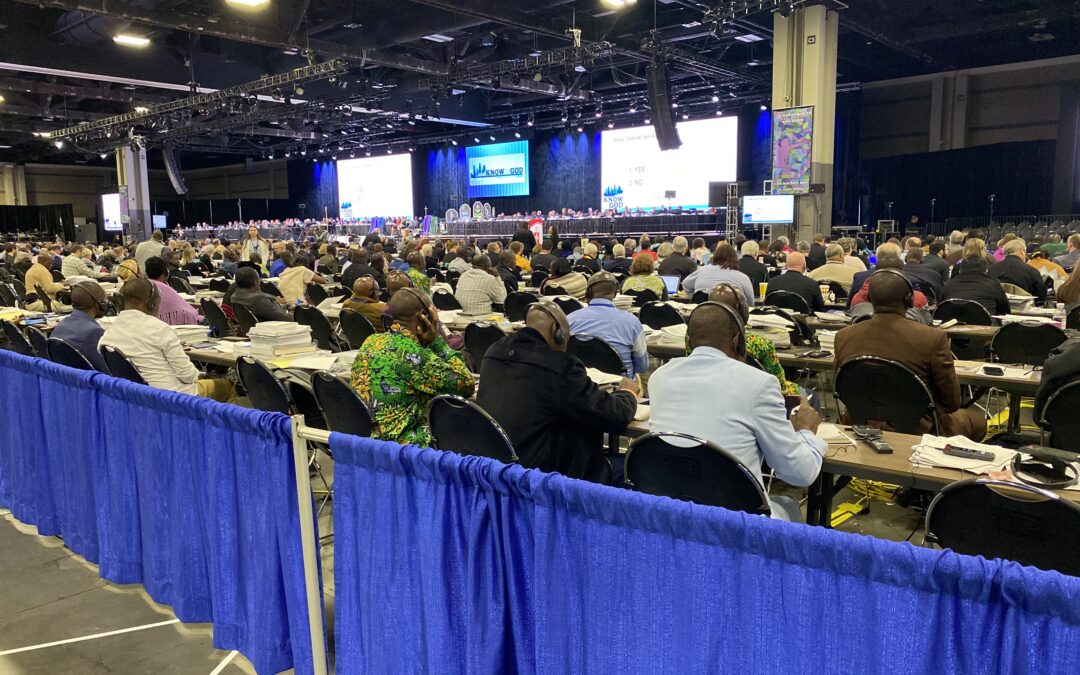
Thomas Lambrecht is a United Methodist clergyperson and the vice president of Good News. Photo: Delegates from the 2024 General Conference of the United Methodist Church in Charlotte, N.C. Photo by Steve Beard.

by Steve | May 23, 2024 | In the News, Perspective / News
The Myth of Neutrality
By Thomas Lambrecht
As observers continue to unpack the significance of actions taken by the United Methodist General Conference in Charlotte, one myth continues to float around the blogosphere: the General Conference merely returned the UM Church to a “neutral position” on issues of marriage and sexuality. The language is back to what it was before 1972, when homosexuality wasn’t mentioned at all. This means liberals and traditionalists can live together in harmony under this “neutral” umbrella that gives space for all perspectives.
Taking a closer look at what was actually enacted in Charlotte, one can see that the UM Church is not neutral on marriage and sexuality. Instead, there is a definite tilt toward the affirmation of same-sex relationships, transgenderism, and a major shift in moral standards.
Same-Sex Marriage
The most neutral aspect of what took place in Charlotte was the reversal of the church’s long-standing prohibition on performing gay weddings. No longer are pastors prohibited from performing such weddings. At the same time, most pastors are not forced to perform them. The decision is up to the pastor’s conscience.
Explicit language was added to protect clergy conscience. “No clergy at any time may be required or compelled to perform, or prohibited from performing, any marriage, union, or blessing of any couple, including same-sex couples. All clergy have the right to exercise and preserve their conscience when requested to perform any marriage, union, or blessing of any couple.”
This language is to be applauded. However, it may have limited impact when it comes to clergy serving as military chaplains or in some other roles outside the local church. Previously, chaplains could point to the prohibition against performing same-sex weddings as the reason why they could not perform them in the military. Now that the prohibition is gone, military chaplains may be expected to perform same-sex weddings without the ability to fall back on conscience objections. Given the current progressive climate, the military may well demand all chaplains to offer equal services regardless of the sexual orientation of the service members they minister to. This non-discrimination policy can trump the conscience of the chaplain, putting them in the position of being required to perform same-sex weddings even if they oppose them. Since this provision took effect immediately on May 4, there has been no time for chaplains to sort out the implications of this change.
Definition of Marriage
The new definition of marriage found in the Social Principles is the most confusing change made by the General Conference. The new definition reads, “Within the church, we affirm marriage as a sacred lifelong covenant that brings two people of faith, an adult man and woman of consenting age, or two adult persons of consenting age into union with one another.” According to this definition, marriage can be between a man and a woman or between two adult persons, presumably of the same or non-binary gender.
It is unmistakable that this definition delineates the union of two people of the same gender as a sacred marriage. Very few delegates in 1968 would have endorsed such a definition, even though the church did not formally define marriage until 1972. This new definition is not a return to neutrality but a definite step to accommodate a progressive understanding of marriage.
What complicates this definition is that it is part of the Social Principles, which are set for the whole denomination, not able to be adapted by different regions. Although not binding, the Social Principles state the church’s consensus teaching on social issues, upon which the church bases its policies. The change in the definition of marriage is the root of why all the other prohibitions related to homosexuality became untenable. If same-sex marriage is now considered Christian marriage, there is no basis for preventing people in such relationships from full participation in all levels of the life of the church.
Another newly adopted provision gives regions the ability “to set the standards and policy for rites and ceremonies for the solemnization of marriage, taking into consideration the laws of the country or countries within its jurisdiction.” Even so, under the Social Principles, those regions that define marriage differently are still part of a denomination that explicitly affirms same-gender marriage. This is not “neutral,” nor does it restore the situation of 1968.
Funding Issues
Previously, both the general church and the annual conference were prohibited from spending apportionment money “to promote the acceptance of homosexuality.” While sometimes ignored, this provision prevented the church from promoting a position contrary to its stated teachings.
Now, that prohibition is removed. Since the church’s teaching has changed, it can now spend church money to promote that teaching, namely “the acceptance of homosexuality.” At the General Conference it was announced that the General Commission on Archives and History intends to establish a “Center for LGBTQ+ United Methodist Heritage” at Drew University.
In addition, the General Board of Global Ministries (GBGM) was given the new responsibility to “Provide training, resources, and consultation for and with all levels of the global church to actively resist intersecting structures of white supremacy, heterosexism, sexism, patriarchy, transphobia, xenophobia, ableism, colonialism and classism” (emphasis added). This means that GBGM will be promoting the acceptance of homosexuality (resisting heterosexism) and transgenderism (resisting transphobia), in addition to a number of other far left causes at all levels of the global church. This is not restricted to those countries whose laws allow the practice of homosexuality but includes even Africa and the Philippines. This is not neutrality, but advocacy for a progressive agenda.
Using apportionment dollars to promote the acceptance of homosexuality is not “neutral.” One should not imagine that apportionment dollars will also be spent to promote a traditional position that the practice of homosexuality is contrary to biblical teaching.
African and Filipino apportionments will be used to promote the acceptance of homosexuality, despite their opposition to the practice. Central conferences outside the U.S. pay apportionments to the General Administration Fund, which supports the Commission on Archives and History and its future LGBTQ+ Center. This is not “neutral” and may well represent a violation of the consciences of United Methodist members that makes them less willing to pay apportionments.
Receiving a Gay Pastor
Bishops are going out of their way to reassure congregations that a gay or lesbian pastor will not be appointed to their congregation unless it is willing to receive such a pastor. This may well be true in the short run. The supply of gay and lesbian pastors is not expected to surpass the demand of congregations open to such a pastor in the near future.
However, a new requirement adds “sexual orientation” to the list of qualities that may NOT be considered by bishops when making pastoral appointments. “Open itineracy means appointments are made without regard to race, ethnicity, gender, color, disability, marital status, sexual orientation, or age, except for the provisions of mandatory retirement. Annual conferences shall, in their training of staff-parish relations committees, emphasize the open nature of itineracy and prepare congregations to receive the gifts and graces of appointed clergy without regard to race, ethnicity, gender, color, disability, marital status, economic condition, sexual orientation, or age” (emphasis added).
The fact that pastoral appointments are to be made “without regard to … sexual orientation” means that factor cannot be considered in the making of an appointment. In addition, annual conferences are responsible for training congregations and their leaders to be willing to accept “the gifts and graces of appointed clergy without regard to … sexual orientation” (emphasis added). These changes put sexual orientation on the same level as race, gender, and age when combatting discrimination. Congregations will be trained in their need to accept gay and lesbian pastors, meaning that down the line, they can expect to receive such a pastor. That is not “neutrality,” but an attempt to change minds and hearts away from a traditional position based on eliminating discrimination.
Beyond Homosexuality
Other changes made in the Book of Discipline send a message that the church is dismantling clear lines of accountability around all forms and expressions of human sexuality.
Previously, those seeking ordination as clergy in the UM Church were required to “make a complete dedication of themselves to the highest ideals of the Christian life.” This included “fidelity in marriage and celibacy in singleness.” This is a clear standard that is easily understood and enforced.
Now, the language has been changed to require “faithful sexual intimacy expressed through fidelity, monogamy, commitment, mutual affection and respect, careful and honest communication, mutual consent, and growth in grace and in the knowledge and love of God.” No longer are sexual relations clearly prohibited for single clergy. Instead, the emphasis is on respect, communication, and consent.
Previously, the “chargeable offenses,” which list the specific violations under which clergy can be held accountable, included “immorality, including … not being celibate in singleness or not faithful in a heterosexual marriage” and “being a self-avowed practicing homosexual; or conducting ceremonies which celebrate homosexual unions; or performing same-sex wedding ceremonies.”
In Charlotte, not only was the second offense covering homosexuality eliminated, the first was mostly deleted, as well. There is some confusion about whether the simple offense of “immorality” was deleted. The online record of the conference shows that it was. If so, there is no chargeable offense related to adultery or other forms of sexual unfaithfulness. It could fit under the offense of “sexual misconduct,” but church authorities will be hard-pressed to justify behavior between consenting adults as being “misconduct.” Even if immorality was left in, there is no definition of what that means. Undefined offenses are much more difficult to enforce. This change greatly weakens accountability for clergy, particularly when sexual abuse by clergy has gained new prominence in the public eye.
Previously, the Social Principles said, “Although all persons are sexual beings whether or not they are married, sexual relations are affirmed only with[in] the covenant of monogamous, heterosexual marriage.” Again, a clear standard that upholds biblical teaching.
Now, however, the Social Principles have been changed to read, “Human sexuality is a healthy and natural part of life that is expressed in wonderfully diverse ways from birth to death. … We support the rights of all people to exercise personal consent in sexual relationships, to make decisions about their own bodies and be supported in those decisions …” This new language takes away the standard and seems to “support” every expression of human sexuality, as long as it is characterized by personal consent and decision.
One could conclude from these examples that United Methodist standards and expectations have shifted to “neutrality” in a bad way. That is, our church has become neutral about what the right or wrong avenues of sexual expression are. We are open to whatever individuals decide about their own sexual morality. There are no clear boundaries set for sexual behavior for clergy, for laity, or for society in general, other than “mutual respect” and “consent.” In a culture characterized by extreme licentiousness with regard to sexual relationships, the lack of those boundaries and expectations is harmful to persons not warned away from sin and unhealthy behaviors, as well as being unfaithful to our biblical convictions.
This survey of changes made in Charlotte demonstrates that United Methodist neutrality is a myth. The church is not neutral, but an active proponent of the acceptance, indeed affirmation, of homosexuality, transgenderism, and even a libertine sexual ethic. While in Charlotte, we read and heard repeatedly that these changes are only the first step of where progressive United Methodists intend to lead the church. What used to be proscribed became accepted, what was accepted is becoming promoted, and what is promoted usually becomes eventually required.
The desire of people who support this approach to Christianity to remain United Methodist is to be supported and encouraged. However, no one should remain United Methodist under the mistaken idea that the church is now neutral regarding specifically LGBTQ+ persons or sexual ethics in general. The tide has turned, and the church is moving in a decidedly progressive direction.
Thomas Lambrecht is a United Methodist clergyperson and vice president of Good News. Photo: United Methodists celebrate the denomination’s removal of its ban on the ordination of clergy who are “self-avowed practicing homosexuals” — a prohibition that dates to 1984, during the 2024 United Methodist General Conference in Charlotte, N.C. Photo by Mike DuBose, UM News.

by Steve | May 12, 2024 | May-June 2024
Wiping the Slate Clean
By B.J. Funk
October came quietly into my kindergarten class that year. I had worked hard to help my children settle into somewhat peaceful days. They knew my rules. They knew how to act. After many years of teaching, I learned that a teacher needs to get order established first, and then learning could begin. I was so proud of my class. What they learned they now held as their own as they moved about our room. I loved the quiet rhythm of a kindergarten class busily engaging with my lesson plans. Going to work was fun. I looked forward to every day.
October didn’t have long to rest quietly when Paul came. He entered our room like a train zooming on the tracks and never stopping at any towns. He became my challenge as I sought to tame this bundle of energy. His grandmother brought him to my room, and I quickly learned a few things I needed to know.
Paul was from California and his parents were divorcing. Since both parents worked, they had no one to leave Paul with. He was placed on a plane in California and flown to South Georgia to live with his grandmother. She was loving and caring, and we would have many opportunities to talk as the days moved into weeks. Paul was a good child; he was just reacting to all of the changes that had been put on this five- year-old.
His grandmother and I worked together to help Paul adjust to living away from his parents and moving so far away from all that he had known. His nervous energy was understandable. Each day he came to my class with a big smile and a new burst of energy. And each day I fell more and more in love with this adorable child.
His grandmother took him to the park and to the train station, the peanut fields and the cotton fields, anywhere that she could further his understanding of life in the south. He was very smart and learned quickly. But the best thing she did for him – the very best thing – was to introduce him to God by taking him to Sunday school and church.
I had no idea that Paul would soon preach a sermon in my class.
On a busy day playing in the various learning centers, Paul was being too loud. I reminded him to use his soft inside voice, but he was having too much fun, and each time I walked away, he became loud once more.
I had a “time out chair” for the purpose of helping the child having a hard time with our rules. I told Paul he needed to go rest in “time out” until I told him to get back into the group. He didn’t like it. He fussed about it, but he finally went to the chair. He jerked the chair around and kicked it before he finally settled down.
Soon it was story time, and after the children put away those items they were using, they gathered on the floor before me. I watched Paul out of the corner of my eye. He was moving around, eager to leave, and making little noises under his breath.
“When you settle down, come join us on the floor,” I said to Paul.
Soon, he slowly walked to our group. He got on his knees, folded his hands under his chin, closed his eyes and began whispering. I stopped reading. No one said a word. Finally, he finished and let out a sign of relief with a loud “whew!” I asked if he were okay.
He rose up on his knees and said with a confident voice, “Yes! Because when you tell the Lord what you did and ask him to forgive you, he does and then [louder and dramatic] he forgives you and then he wipes the slate clean just like it never even happened!”
Oh wow! What joy! What a blessing to have a sermon from Paul!
Two weeks ago, a dear friend wrote me a letter apologizing if he had hurt me. It was a gift to me. He said he was tired of being angry. I loved him for that.
Aren’t you tired too? According to the gospel of my Paul, take your hurt to God and ask for forgiveness. He will wipe the slate clean just like it never even happened! Afterward, breathe deeply and let out a “whew!”
That’s from Kindergarten Paul 2:1-2.
B.J. Funk is Good News’ long-time devotional columnist and author of It’s A Good Day for Grace, available on Amazon.

by Steve | May 12, 2024 | May-June 2024
A Partnership in Healing
By Jenifer Jones
It’s hot and dusty outside the Methodist Faith Healing Hospital in Ankaase, Ghana. Vendors sit beneath umbrellas, selling food for families to purchase for themselves and their patients. Cars drive past on a tan-orange dirt road. Inside, the wards are clean and smell of Dettol, a disinfectant similar to Lysol. Lab techs help doctors diagnose diseases like malaria and typhoid. In the clean and sterile operating rooms, lives are saved daily.
For people who need healthcare anywhere near Ankaase, Ghana, the Methodist Faith Healing Hospital is the place to go. Located in a rural farming community, the 112-bed facility has a staff of more than 500 people. It has 15 full-time doctors, including six Ghanian specialists. It serves as a referral hospital for two main districts in the Ashanti region of Ghana and manages eight clinics spread across the region.
It wasn’t always like this. A project of the Methodist Church Ghana (MCG), the Methodist Faith Healing Hospital Ankaase was dedicated in 1988 and opened as an outpatient department in 1991.
Growing up together. When Cam Gongwer arrived in 1998 with his wife and nine-month-old daughter, he was the first full-time doctor at the facility. Cam is a former cross-cultural worker (CCW) with TMS Global and is currently a CoServe consultant with the organization. When he began at the hospital, there was a staff of 12.
The hospital and TMS Global have grown up together. Joseph Amankwah is the CEO of the Methodist Faith Healing Hospital Ankaase. “Right from the beginning” he says, “TMS Global has been in collaboration with the Methodist Church Ghana in developing the health ministry in Ghana.”
The Methodist Faith Healing Hospital is the district hospital in its area. It serves a population of more than 200,000 people.
Care closer to home. Cam says malaria remains the most significant health problem in Ghana, particularly among children. It’s the leading cause of death for children younger than five years old in Ghana.
“If the hospital didn’t exist,” Cam says, “sick people would have to travel longer distances typically on public transport taking a longer time to reach a comparable functioning hospital.”
Mary Kay Jackson is a former TMS Global CCW, now staff member, who used to serve in Ghana and visited the hospital on several occasions. She says patients come from all walks of life, and all faith backgrounds – Christian, Muslim, and traditional.
“I have seen mothers rejoicing at the birth of their new babies,” she says. “I have seen mothers sitting by the bedside of their children who are ill. I have heard babies and toddlers scream as they get their immunizations. And I have seen mothers wailing as their child dies of dehydration due to malaria or cholera. I have seen nurses bathe the elderly with tenderness and care as they wait for their final homegoing.”
A partnership that endures. Enoch Osafo is the director of health for the Methodist Church Ghana. He says one of the keys to the enduring relationship between TMS Global and the hospital is that the partnership was never with the hospital itself, but rather with the MCG.
“That always opens the door for any need that requires TMS Global to come in and fulfil their mission through the Methodist Church Ghana’s mission,” Enoch says. “So if there’s a need for a doctor, they come in. Sometimes needs include provision of water; sometimes there’s a need for discussions about how to revitalize the local Church.”
Because the relationship isn’t just between individuals like Cam or Joseph or Enoch, but rather between TMS Global and the Methodist Church Ghana, the work continues on even as the people involved change.
The Methodist Faith Healing Hospital is fully led and run by the Methodist Church Ghana.
Enoch says that was the design from the beginning. “We started with two institutions (TMS Global and the MCG) coming together to say that we are both in mission together, rather than TMS Global coming in to say, ‘We want to do the hospital and run the hospital and when we have finished, take your turn and go.’ But it was two institutions coming together saying, ‘We have one mission, and our mission is to serve God’s purpose within the community.’”
Focused on ministry. Enoch also emphasizes that anyone who comes to work with the facility isn’t there to help with a hospital, but rather to be involved in ministry. “That keeps the mission focus,” Enoch says. The hospital has a reputation for being a place where God is present.
Cam notes, “I remember once a mother came from very far away with her sick child. She had been to other clinics and providers, but the child did not get better. When asked why she brought her child all the way to Ankaase, she said it was because she had been told that God is there. She believed that her child would become well if seen at Ankaase. Indeed, her child was admitted to hospital, and he responded to treatment. He went home healed and the mother was thankful to God.”
Transformed communities. Cam left Ghana as a full-time doctor in 2012, but he still has a relationship with hospital leadership and the Methodist Church Ghana and returns to visit the hospital.
“The best part about it,” Cam said says, “is being able to see how God is at work drawing people and calling people into the mission that He has there. The development of the hospital has been rocky at times but with the leadership of Joseph and Enoch I believe God brought the right people in to steer the Church and its mission forward at the hospital.”
Enoch notes that even though the hospital is a health ministry, the focus is still on making disciples. He is currently collaborating with a partner from India to grow in that area.
Joseph says the hospital has made an impact on its surrounding community. The facility is the largest employer in the area. Many young and skilled health providers and staff and their families have moved to the region. “We are transforming communities.”
Jenifer Jones is a communicator for TMS Global, which launched in 1984 as The Mission Society for United Methodists (and is now interdenominational). In the past 40 years, TMS Global has trained, mobilized, and served hundreds of cross-cultural witnesses who communicate the good news of Jesus in word and deed. TMS Global also comes alongside churches in the US and abroad, providing training and coaching to help them discover and live out their unique missional calling. For more information, visit us at tms-global.org. Photo: TMS Global.

by Steve | May 12, 2024 | May-June 2024
Surveying General Conference Issues
By Thomas Lambrecht
The United Methodist General Conference is many things, but primarily it is a legislative assembly. The bulk of its time is devoted to considering, refining, and adopting legislative proposals that become the “laws” that are supposed to govern our church. (We have written elsewhere about the increasing tendency by some bishops and other leaders to disregard the requirements of church laws they disagree with.)
One can picture the General Conference as a Congress that meets for two weeks every four years. Like in Congress, various bills are proposed that would add to, delete, or amend current church laws. We call those bills “petitions.” Like in Congress, petitions are considered by one of 15 legislative committees – 14 regular committees plus the Standing Committee on Central Conference Matters. If a petition is adopted by its legislative committee (with or without amendments), it is then considered by the plenary session of all the delegates meeting together. Many petitions are adopted on a consent calendar, which allows them to be approved all at once as a large group. These are petitions that are non-controversial and receive very little opposition in their legislative committee. Plenary debate is reserved for the more difficult and controversial issues. Once all the changes are considered and adopted, the laws are compiled together into our Book of Discipline.
In addition to church laws found in the Book of Discipline, the church adopts policy statements on many social issues. These policy statements are called “Resolutions.” They are compiled together into a Book of Resolutions that is just as thick as the Discipline. They are not binding in the same way the laws of the Book of Discipline are. Instead, they are meant to be a resource guide for how to think Christianly about a particular issue. Some resolutions stray into political territory or propose concrete solutions to societal problems, which is why they tend to be more controversial and may take up a disproportionate share of the agenda time at the General Conference. Resolutions automatically expire after eight years, so they have to be updated and approved again in order to continue in effect. This process becomes a cycle of controversy as disagreements resurface every eight years when the resolution is renewed, promoting conflict.
According to United Methodist News Service, there are over 1,100 petitions and resolutions to be considered at the 2024 General Conference. Some consist only of one line (e.g., reapprove Resolution 52 in the Book of Resolutions). Others can be 10-15 pages long and highly complex.
In the past, Good News would recommend positions on 300-400 petitions and resolutions each General Conference, indicating whether we supported or opposed a given petition, and whether it needed to be amended to gain our support. This year, due to the liminal time we are in, with separation happening from the UM Church and many moving to the Global Methodist Church, Good News and our coalition partners are focused mainly on supporting petitions allowing disaffiliation to continue for a short time into the future and opposing the regionalization of church governance. Most of our constituency will be moving into the GM Church or otherwise disaffiliating from the UM Church, so it would be inappropriate for our coalition to heavily influence the future direction of United Methodism.
Articles on disaffiliation and regionalization have appeared in earlier issues of Good News magazine, so this article will examine the other issues that will be considered by the General Conference. While not taking positions supporting or opposing these petitions, we still think it is important for church members to be aware of the issues that will be decided in Charlotte.
There are at least 34 petitions related to disaffiliation and 39 related to regionalization proposals. The disaffiliation petitions propose various processes of disaffiliation, some more helpful than others. There are three major regionalization proposals: the Connectional Table proposal, the Christmas Covenant, and the Standing Committee on Central Conference Matters proposal. Each is slightly different and contains a number of different petitions. It will be up to the delegates to decide among these competing proposals.
LGBT Questions. The constellation of issues receiving the most attention at the General Conference will be questions around whether to allow the church to perform same-sex weddings, whether partnered gay and lesbian people may be ordained as clergy, and whether our church’s position on non-discrimination should be extended to their status as gay or lesbian or non-binary or transgender or other gender identities.
No fewer than 87 petitions have been submitted that relate to these questions. That makes it the largest category of petitions. Some would reinforce the traditional position adopted by the church in 1972 and reaffirmed every General Conference since, including 2019. The vast majority of the submitted petitions, however, would act to liberalize the church’s stance on these questions. They would change the church’s definition of marriage to “two persons,” instead of “one man and one woman.” They would allow pastors to conduct same-sex weddings and for such services to be held in UM churches. They would allow church funds to be spent to promote the affirmation of homosexuality. They would allow partnered gays and lesbians to be ordained as clergy and to serve also as bishops. They would remove all chargeable offenses related to homosexuality and end any current complaints or proceedings against anyone for such offenses. A few of the petitions would make this liberalizing contingent upon whatever the laws of a given nation stipulate. In countries where the practice of homosexuality is illegal, this liberalization would not take effect (similar to the regionalization proposals).
Given that a substantial number of traditionalist delegates have left the UM Church, it is likely that a progressive-centrist majority will adopt this liberalizing agenda regarding LGBTQ proposals.
Abortion. There are at least 14 petitions related to abortion. Most were submitted in 2019 and advocate for a stronger position against abortion. Several submitted last year advocate a position in favor of abortion rights. The U.S. Supreme Court Dobbs decision reversing Roe v. Wade will undoubtedly impact the discussion of this issue, with a backlash favoring abortion rights in the U.S. likely to be decisive.
Africa Realignment and Bishops. A proposal will be considered to add a new central conference in Africa. In addition to the West Africa and Congo Central Conferences, the rest of the countries would be divided between an East Africa and a South Africa Central Conference. This would help with the grouping of similar languages and geographical area in the same central conference. The 2016 promise to add five new bishops to the existing 13 bishops in Africa will be reconsidered. One proposal adds the new bishops in Zimbabwe, East Africa, Nigeria, and two in the Democratic Republic of Congo. But the Standing Committee on Central Conference Matters will reconsider this proposal at the General Conference in light of budget cuts and possible disaffiliations.
Bishops. Traditional Plan proposals would enhance the accountability of bishops at the global level. Several petitions propose term limits of varying lengths for bishops.
Number of Bishops. Some petitions submitted in 2019 would maintain the number of bishops the church had back then in the U.S. A few more recent petitions would reduce the minimum number of bishops in each jurisdiction from five to four or otherwise reduce the number of U.S. bishops in order to provide more bishops for Africa. One interesting proposal would provide general church funding for the minimum number of five bishops per jurisdiction. Each jurisdiction could add more bishops to that minimum number, but the jurisdiction would have to pay for the extra bishops.
Fair Representation. Twenty petitions attempt to increase central conference membership on various boards and agencies of the church. Until now, while making up over half of the church’s membership, central conference representatives usually number around a third of board and agency members.
Voting Rights. A series of petitions would expand the right of licensed local pastors and Associate Members to vote on constitutional amendments, election of delegates to General Conference, and the character and status of clergy. Many of these rights have been given to full-time licensed local pastors who have completed the Course of Study, but the current petitions would expand that to part-time licensed local pastors and not require completion of the Course. They would also expand voting rights for provisional members, who are not yet ordained clergy.
Pensions. The General Board of Pensions and Health Benefits (Wespath) is proposing to abolish the current pension program and replace it with a new Compass program. Compass would be an entirely defined contribution plan, where the money contributed by clergy and their churches would go into their individual accounts and provide the total retirement income they would receive at retirement. There would be no guaranteed amount of a pension, as there was in the pre-1982 program or in the current CRSP program (which is part defined benefit pension and part defined contribution investment program). Wespath says the current CRSP program is financially unsustainable and takes on too much long-term liability for the annual conferences, so must be discontinued.
Retirement Age. There are several petitions to eliminate mandatory retirement for clergy, which is currently required at age 75. One petition clarifies the age of retirement for bishops, in light of the fact that several African bishops have surpassed the mandatory retirement age but have not stepped down. Other petitions either raise the retirement age for bishops or eliminate it altogether.
Separation Plans. There are 53 petitions related to separation plans. These include the Protocol, the Indianapolis Plan, the Plain Grace Plan, the Jones plan for forming new Methodist denominations, the Two Jurisdiction plan, and the UM Communion plan. They were all submitted in 2019. Since disaffiliation has already moved forward in the U.S., these plans are probably moot, in that their time has passed. More applicable petitions would provide official recognition of the Global Methodist Church as another Christian denomination and would encourage the development of positive relations between the two denominations. Other petitions clarify that active or retired UM clergy cannot serve in congregations of another denomination without the permission of the bishop and board of ordained ministry.
Social Principles. The General Board of Church and Society is proposing a newly rewritten version of the Social Principles, our denominational statement on numerous social issues. In development for at least eight years, the rewrite is supposed to make the Social Principles more contemporary, succinct, and theologically grounded. Readers will have to judge whether that objective was achieved. Most of the church’s stances on issues did not change with the rewrite, except for the issues of marriage and human sexuality. The rewrite changes the definition of marriage to “two people” and removes language calling the practice of homosexuality “incompatible with Christian teaching.”
Traditional Plan. There are 12 petitions relating to the Traditional Plan that was passed at the 2019 Special General Conference. Two of them would further implement the Traditional Plan through clarifying legislation. The other ten would repeal aspects of the Traditional Plan, including several provisions not related to sexuality that attempted to make the complaint process more fair, transparent, and accountable.
This survey only scratches the surface of the many issues coming before the General Conference. (Some observers would see that as part of the problem with the General Conference, that it tries to speak about too many issues.) There are proposals about divesting from industries developing fossil fuels, divesting from support of Israel, support for environmental causes, and many others. It will be up to the delegates to decide which proposals become church law in the Discipline or enshrine the church’s opinion in the Book of Resolutions. Good News will be tracking the outcome and sharing reports throughout the General Conference.
Thomas Lambrecht is a United Methodist clergyperson and the vice president of Good News. Photo: General Conference 2012, Tampa by Steve Beard.