by Jonathan Powers | Mar 17, 2026 | Uncategorized
Proclamation and Power
By Peter J. Bellini
Therefore I glory in Christ Jesus in my service to God. I will not venture to speak of anything except what Christ has accomplished through me in leading the Gentiles to obey God by what I have said and done—by the power of miraculous signs and wonders, through the power of the Spirit of God. In this way, I have fully presented the Good News of Christ from Jerusalem all the way to Illyricum. (Rom 15:17-19)
The gospel is never merely spoken. It must always be demonstrated.
In this pericope, Paul presents himself to the church at Rome by summarizing his ministry as he looks toward Rome and the completion of his mission. He encapsulates his work in Romans 15:18–19 with the phrase “what I have said and done,” which, more literally in Greek, is logo kai ergo, “word and deed.” This can be understood as proclamation and power. Verse 18 emphasizes this pairing, while verse 19 elaborates on the “deeds” as the “power of miraculous signs and wonders through the power of the Spirit of God.” In this way, Paul declares that he has “fully presented the Good News of Christ from Jerusalem all the way to Illyricum.” The deeds, then, are not merely actions, but manifestations of the Spirit’s power, signs and wonders accompanying the proclaimed word. The key phrase in this passage is “fully presented,” which raises the question of its meaning.
One interpretation suggests that it refers to the geographic extent of Paul’s ministry, stretching from Jerusalem to Illyricum. However, a more compelling interpretation is that it refers to the nature and fullness of Paul’s proclamation itself. The phrase “in this way” (translated from the Greek hōste, meaning “thus” or “therefore”) points back to the preceding clause concerning signs and wonders performed through the Spirit, indicating that a conclusion is being drawn. Through both word and supernatural deeds, therefore, Paul has fully presented the gospel. In this reading, “fully presented” modifies the manner of proclamation, namely, through both word and deed. What emerges, then, is the understanding that to preach the gospel fully involves both proclamation and demonstration: the word declared and the power of the Spirit revealed. The pressing question for us, then, is whether we have likewise fully presented the gospel in proclamation and power, or whether we have demythologized and diminished it to mere words, devoid of the accompanying power of God.
Proclamation and Power
This pattern of proclamation and power is not an isolated feature of Paul’s ministry but is woven throughout the biblical narrative. It appears in the Old Testament prophetic tradition, stretching back to figures such as Moses, Elijah, and Elisha, and reaches its fullest expression in the ministry of Jesus Christ and his disciples in the New Testament. Consider Moses before Pharaoh: the command “Let my people go” was not sufficient on its own for Pharaoh’s hardened heart. The proclamation required the accompaniment of divine power, i.e., the plagues and signs that demonstrated God’s supremacy over Egypt’s political and spiritual powers. In Scripture, when God speaks, he acts: “Let there be light”; “Be healed”; “Peace, be still.” Conversely, when God acts, he is also speaking, revealing his character and authority. God’s word is never empty; it is active and effectual. Unlike human speech, which often lacks follow-through, God’s word is always accompanied by his power. Thus, prophetic calls to repentance, such as those issued to Ahab and Jezebel, are sometimes accompanied by dramatic demonstrations of divine power, as seen in Elijah’s confrontation with the prophets of Baal on Mount Carmel. These moments underscore the inseparability of proclamation and power in the work of God.
Jesus’s Pattern
This pattern reaches its pinnacle in the ministry of Jesus. Throughout the Synoptic Gospels, Jesus’ work is marked by a fourfold pattern: preaching, teaching, healing the sick, and casting out demons. His ministry consistently integrates proclamation with demonstration: the announcement of the Kingdom of God alongside tangible manifestations of its power. This same pattern is extended to his disciples, whom he commissions not only to proclaim the nearness of the Kingdom but also to enact it through healing, deliverance, and restoration. As Matthew 10:7–8 records, “Go and announce to them that the Kingdom of Heaven is near. Heal the sick, raise the dead, cure those with leprosy, and cast out demons. Freely you have received; freely give.” The Gospel of John likewise emphasizes this dynamic, structuring its narrative around the signs of Jesus, which reveal his identity as the Messiah and Son of God so that people might believe and have life in his name (John 20:30–31). Jesus himself appeals to this union of word and deed, saying, “Even though you do not believe me, believe the works” (John 10:38). Once again, we see the inseparability of proclamation and power: the word spoken and the works that testify to its truth.
Acts of the Apostles
We observe proclamation and power in the Acts of the Apostles, beginning at Pentecost in Jerusalem and moving to Judea, Samaria, and the ends of the earth. Chapter 1:8 serves as a kind of table of contents for the book of Acts: “You will receive power (dunamis—God’s power/ability) to enable you to be my witnesses… in Jerusalem, Judea, Samaria, and to the ends of the earth.” In other words, God will speak through the disciples by his Word and through his supernatural actions. They will receive power to proclaim and power to act in the book of Acts, just as Christ did in Luke’s Gospel, because they have the same Spirit.
In Acts, Paul is a prime example of this ministry of proclamation and power. Following his supernatural encounter with the risen Christ, his ministry begins. Like the other disciples, Paul preaches the good news with signs and wonders confirming the word. These signs and wonders confirm both the message and the messenger, and they also reveal the content of the Kingdom: healing, deliverance, liberation, and salvation.
Paul describes this ministry of proclamation and power in 1 Corinthians 2: “I came not with persuasive words of human wisdom but with a demonstration of the Spirit and of power.” In other words, he came demonstrating the Kingdom. First Corinthians 4:20 proclaims that the kingdom comes “not in word but in power,” and 1 Thessalonians 1:5 declares that “our gospel came not only in word but also in the power of the Holy Spirit.” When the Kingdom comes, the blind see, the lame walk, lepers are healed, and the dead are raised. This demonstration of proclamation and power is what Paul is referencing in our pericope in Romans.
Ministry Today
Move 2,000 years forward to our scientifically minded world today. With our causally closed universe and hyper-rationalistic worldview, we often deflate, disenchant, and flatten the Gospel narrative, its miracles, signs and wonders, and especially exorcisms. We demythologize them or remove them entirely from our proclamation. And in the end, we don’t have enough power to blow our nose.
Today in the church, I like to think of our ministry as proclamation and power in the Holy Spirit, a proclamation of holiness and a demonstration of God’s power to heal, deliver, and transform. As Wesleyans, we are attempting to hold onto the holiness aspect, but we have often bifurcated the flame, as my former mentor Howard Snyder states. We have separated the two (holiness and power), holding on to the former and neglecting the latter. But as Snyder, others, and I have written, this is not scriptural. First Corinthians 12:7 reminds us that each member is given a gift or manifestation of the Spirit.
Why are we reticent to follow the ministry of Christ, the disciples, and Paul (and even our own John Wesley) regarding the demonstration of the Spirit? Perhaps we fear it may puff us up. But the gifts are not for us, nor do we define ourselves by them. We walk in the Wesleyan way, which offers a corrective to the excesses found in some expressions of the charismatic movement. We stress fruit over gifts, holiness over power, and character over charisma. I struggled with what I witnessed as a young Christian in ministry. I saw the misuse of the gifts in the church. They were often flaunted as badges of merit rather than worn humbly as gifts of grace.
God impressed an image on my heart one day. I had received a package, and God drew my attention to the unassuming, plain brown UPS van and the plainly dressed driver. He was not the package, the sender, or the recipient, just the messenger. That’s all we are. We are not the gift, nor the giver, nor the recipient. It’s not about us. We are simply the unassuming, plain-brown dressed UPS driver, faithful messengers.
Conclusion
Now, from Acts 29, I want to share a story. Around forty years ago, I was a young, zealous Christian who wanted to do the will of God no matter what. I told the Lord that I was completely at his disposal, whatever, whenever. One night, God took me seriously. I sensed him waking me up. It was 3 a.m. The thought came clearly: remember when you told God you would do anything he asked? Well… here we are. Mind you, I was not a morning person, but God was clearly waking me for an assignment. I could feel it.
When God speaks to me, it is not in an audible voice but as a still, small voice in the deep recesses of my spirit. God uses my own vocabulary, thoughts, memory, and personhood, imprinting his will so that I clearly know what he wants. Sometimes it is an intuition, a knowing, even a green light. That is how I heard him that morning, like a friend speaking to a friend.
“Get your car keys,” he said. “Where are we going, Lord?” I asked. “You are on a need-to-know basis—and you don’t need to know.” “Get your guitar.” What am I going to do with the guitar? Still, I obeyed. I sensed him leading me south toward downtown, then to a park by the river. I parked and was led to a concrete bench in the middle of the park. It was 3:15 A.M. No cars, no people, no one.
“Okay, Lord, what do you want me to do?” I wondered if I was supposed to play something simple, “Smoke on the Water,” maybe. But suddenly, the Spirit came upon me like a fresh breath, and I felt filled. I strummed a G chord and began to sing. It was prophetic, almost bluesy. Now, those who know me know I have a deep bass voice, but not for singing. I’m what you might call a “prison singer,” as in I am behind a few bars, looking for the right key.
Still, I sang. I sang about a man who had lost everything—his job, money, wife, children, friends—because of alcohol. He wanted to end his life. Toward the end of the song, I sensed someone behind me. I turned and saw an African American man in his early seventies, weeping uncontrollably. Through tears he said, “You sang my life… You don’t know me, but that song, that was me. I lost everything. I came here to jump off that bridge, but I heard a voice say, ‘Just wait one more day.’ I waited. And tonight, I came back to die. But I heard you singing…”
I told him I had not finished the song. “The song goes on,” I said, “to tell you that Jesus loves you, and you don’t have to die tonight. He wants to save your soul and restore your life. He wants you to live and not die. Do you believe me?” He prayed with me through tears, and I led him to the Lord, taking him by the hand into his first steps toward eternity.
What about you? What will you do when God wakes you up at your metaphorical 3 a.m.? Will you respond? Will you do as he says, even if it seems preposterous or absurd? Will you proclaim the good news wherever, whenever, and to whomever he sends you, not just in proclamation, but in power? That night, I needed both, and so will you. At 3 a.m., God’s heart was broken for a broken man. He was looking for someone crazy enough to obey. Next time, he may call you.
Peter J. Bellini is the Professor of Church Renewal and Evangelization in the Heisel Chair at United Theological Seminary in Dayton, OH.

by Jonathan Powers | Mar 10, 2026 | Uncategorized
Practicing Sabbath
By Tammie Grimm
It can be startling to discover that for all the spiritual practices or means of grace we can name, none are listed in the Ten Commandments. Prayer, which is considered to be primary by many people of faith isn’t mentioned once. Neither is the necessity to attend public worship, to read or study Scripture, or to receive the Lord’s Supper. It may help to realize that uniquely Christian practices of faith aren’t mentions in the “Big 10” because they were given to Moses long before Jesus walked the earth. The Ten Commandments helped establish ways of living that distinguish the people of God in Moses’ day — and for every generation to follow — from the ways of the rest of the world.
And yet, the essence of the fourth commandment, to keep the Sabbath holy, finds a home in Wesley’s General Rules. There, in his first rule, to avoid evil, he riffs on the commandment when he writes to avoid “profaning the day of the Lord, either by doing ordinary work thereon, or by buying or selling.” Even though the Lord’s Day (Sunday) is different than the Sabbath day (Saturday), Wesley and most Christians throughout church history have sought to keep the spirit of the law by keeping one day of the week holy by not working or allowing those in one’s household or employ — including beasts of burden — to work (Exodus 20:8 and Deuteronomy 5:12).
Though not technically listed as a “means of grace” in Wesley’s rubric, practicing Sabbath rest is nonetheless a spiritual discipline. More than just being the only “practice of faith” listed in the Ten Commandments, it is present in the story of Creation. On that seventh day, after God saw all the work of the previous six days and declared it to be “very good,” he rested and called that day “holy.” It is that opportunity to be still for a full day — to rest in God’s goodness, to enjoy creations just as God did, to discover Sabbath delight — is at the heart of Sabbath rest. Still, there can be nothing so difficult to begin to practice than Sabbath rest. Even if our non-stop, 24-7, digitally fueled 21st Century world wasn’t antithetical to it, our ability to become legalistic about religious practices complicates things. Jesus himself got into trouble and was scolded by the Pharisees in Mark 2 when he and his disciples idly plucked grain as they walked through fields. His reply, “The Sabbath was made to serve us, we weren’t made to serve the Sabbath,” may seem a little flippant, but it does provide hints to what it means to practice Sabbath rest.
First, we need to understand Sabbath is not “stolen time.” Rather, it is time set apart by God as holy. It is time for humanity to come back to itself. Resting from our workaday labors is necessary. We can only push ourselves so far. But Sabbath rest isn’t about resting so that we can be more productive at our jobs. Rather, it is our opportunity to rest and be restored, to be aligned with the work God is doing in us that we might be made more whole, just as God intended and first created us to be. Accepting Sabbath as holy time means entering into it with intentionality. Sabbath may be about rest, but it doesn’t mean doing nothing. Eventually, lethargy sets in that may lead to acedia, the condition of being a spiritual sloth. Nor is practicing Sabbath about accomplishing the “to do” list of the things you didn’t have time for over the rest of the week. Doing laundry, grocery shopping, and getting errands done is what Eugene Peterson calls a “bastard Sabbath.”
Rather, to delight in the Sabbath you need a plan regarding the things you won’t do, e.g., those mundane, everyday chores. If it isn’t work and something that you find life-giving and honors the Lord, do it! It can be reading, spending time with people you love, going for a walk, taking a nap, journaling, or maybe even making a gourmet meal if that is your thing. You might be surprised at where your natural talents and God-given talents lead you to. Practicing Sabbath may not be listed in Wesley’s means of grace, but it is, nonetheless, an important spiritual discipline. Setting aside time for prayer, or reading Scripture seriously, or volunteering at the local mission might feel awkward at first. So will it likely be with Sabbath. But with time, and trusting that time to God, you just might find that you depend upon the rhythm Sabbath makes in your week as much as your body depends upon the rhythm of your own heartbeat.
Tammie Grimm is the Associate Professor of Christian Discipleship and Practical Theology at Indiana Wesleyan University in Marion, IN.

by Jonathan Powers | Mar 3, 2026 | Uncategorized
But I Prayed about It!
By Stephen Rankin
There once was a man who went to talk with his pastor about a personal family catastrophe that he had managed to cause. A Christian friend of his pitched an investment idea to him that promised to bring a return three or four times the going rate for companies in a particular sector of the stock market. The man knew this possible investment was risky, but his own business had been through some recent hard times, and he could really use an infusion of cash. The man poured out his heart to the Lord, and, after a time, he felt that he had gotten an answer. He threw some big money at the investment.
In the end, the man not only failed to receive the three-fold return, but he also wound up losing a lot of money. His business went on life support. His wife was furious with him. He was deeply discouraged and confused and even more frustrated. “But I prayed about it!” he exclaimed to his pastor.
A good deal of confusion exists around how God speaks to us in prayer. It is a big topic, so in this article I am limiting my focus to just one area of concern, namely, the problem of subjectivism. The man’s plight illustrated in the story above is a prime example of what subjectivism looks like in prayer. The term “subjectivism” refers to that compelling inward sense of the absolute rightness of decision or plan, intensified by having prayed about the matter. For example, I remember, as a naïve college boy being absolutely convinced that God was bringing a certain girl and me together. Apparently, God had not spoken to her! On the basis (alone) of having prayed about something, complicated, perhaps, by cherry-picking Bible verses for confirmation, too often people can conclude that God has blessed their plan and will guarantee the right outcome.
Subjectivism in prayer is a genuine problem and not a matter for scorn and condescension. Sometimes people can make a shipwreck of their lives if prayer is not approached properly. Improper postures of prayer can also provoke spiritual crises, even if the situations are not as high stakes as the opening example.
Before going any further, it is important to make clear that I am not encouraging hesitance to ask boldly in prayer, nor is any of this to cast doubt on the fact that God does speak to us in prayer. In fact, my goal is quite the opposite. As we grow in grace and in the knowledge of the Lord (2 Peter 3:18), we should find a growing efficacy in prayer, coupled with the confidence that we have real fellowship with the Triune God. As James says, we can trust the Father of lights in whom there is no variation or shadow due to change. I can name several crucial times in my own life in which I have no doubt that God spoke directly in response to my appeals.
What we need, then, is wisdom and discernment in prayer. To grow in this direction, we must recognize pitfalls and build proper theological boundaries around prayer. A good starting point is addressing the influence of our American culture. In the past fifty or sixty years, in general as a society, we have become much more prone to trust our subjective impressions. It’s a form of what the sociologist Robert Bellah calls “expressive individualism.” Many people have come to believe that to thrive and to experience the good life, they need the freedom to express a deeply felt inward core of their identity. Many Christians recognize this as problematic and disagree with the basic concept; however, we can still fall prey to its influence. Generally, it can be easy for Christians to think about their relationship with God in more individualistic terms. They therefore are more prone to a kind of Christianized version of expressive individualism. “But I prayed about it!” fits well within this framework.
What guidance can then be given as a corrective? It never hurts to start with John Wesley. In “Cautions and Directions Given to the Greatest Professors in the Methodist Societies,” published in 1762, Wesley offers this wise caution: “Do not ascribe to God what is not of God. Do not easily suppose dreams, voices, impressions (emphasis added), visions, or revelations to be from God without sufficient evidence.”
What prompted Mr. Wesley to write these words? That date, 1762, gives us a clue as it situates us in the middle of an extraordinary work of God among Methodists. In particular, the Methodists were witnessing a substantial increase in the number of testimonies to Christian perfection, the raison d’etre for the Methodist movement to exist. A whole slew of people claimed to have experienced perfect love for God and perfect freedom from sin.
Wesley was not entirely confident in the legitimacy of some of the “professors’” testimonies, however, since he did not see them exhibiting the kind of character that should accompany the experience. There should be sufficient evidence, Wesley insisted, to go along with the experience. The fruit needs to be tested.
To determine the legitimacy of the experience, then, such professors then and now need to apply certain guidelines.
The first guideline is always to start with Holy Scripture. “Try all things by the written Word, and let all bow down before it,” Wesley admonished. Therefore, we test the impressions that surface in prayer: Are they firmly grounded in Scripture? Do they align with what Jesus teaches about the kingdom of God? Do the align with what Scripture says about holiness?
Or course, determining whether a particular conviction gained through prayer is supported by Scripture takes some work; thus, this guideline helpfully slows down the decision process. It also calls for us to test our sense from Scripture with other wise Christian friends. In the same context as mentioned earlier, Wesley speaks of the importance of “consulting the children of God.” It’s a reminder of the proverb that “in an abundance of counselors there is safety” (Proverbs11:14b).
Finally, along with searching Scripture and asking for counsel, we consider the disposition of our hearts: Is my heart open, humble, and yielded to good guidance, even if that guidance cautions me away from what I feel strongly about how God is leading? Is my mind changeable on the matter? Again, along with Scripture, we need input from others to know our own hearts.
Once more, the goal of this writing is not to incite such caution about prayer that someone is afraid to trust what they sense God is saying in and through prayer. Instead, the goal is for more of us to gain wisdom, confidence, and efficacy in prayer, and to live more fully in light of what Scripture says about prayer. “But I prayed about it,” by itself, is an insufficient measure. We can do better.
Steve Rankin is the Contributing Editor for Good News magazine.
by Jonathan Powers | Feb 25, 2026 | Uncategorized
Learning How to Love Again:
Augustine’s Cure for the Modern Soul
By Jonathan A. Powers
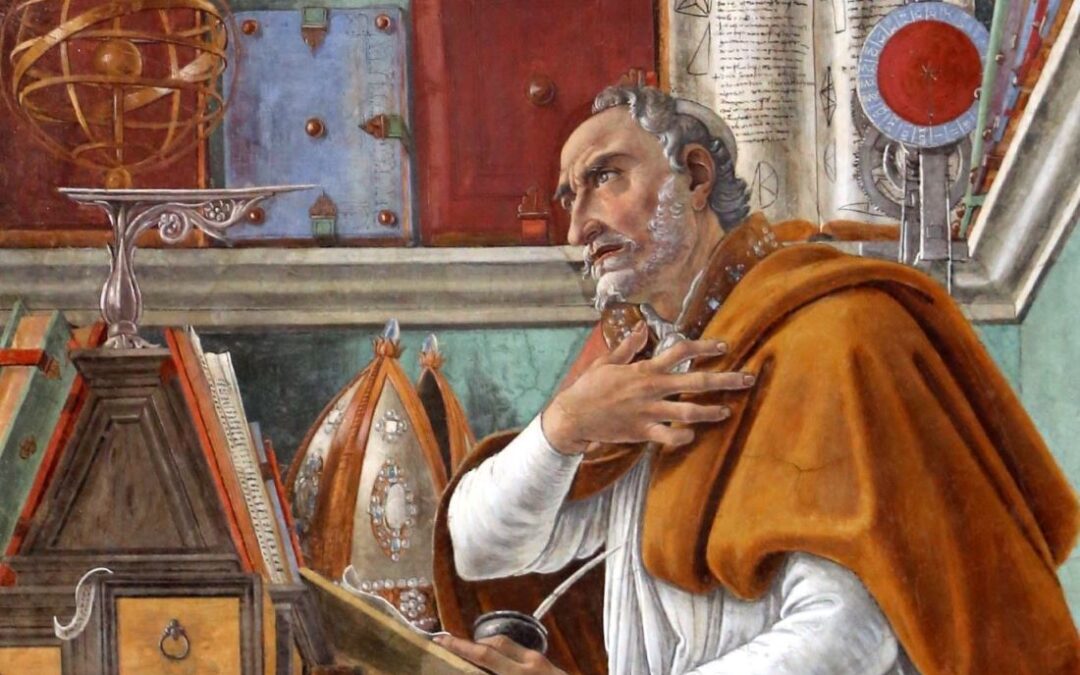
In the long history of the Christian Church, few figures stand as tall as Saint Augustine of Hippo. Throughout his ministry Augustine proved himself to be a brilliant thinker, a prolific writer, a persistent polemicist, and a devoted pastor. Trained in philosophy and rhetoric and living in a time of cultural collapse and ecclesial crisis, Augustine managed to articulate a vision of God, humanity, and the Church that still shapes Christian thought today. He was more than a philosopher or rhetorician, though. Augustine was at heart a pastor-theologian committed to shepherding people toward the love of God, helping them navigate the complex terrain of their own hearts.
From Sinner to Saint
Born on November 13, 354 in the North African town of Thagaste (modern-day Algeria), Augustine grew up in a home marked by both tension and grace. His mother Monica, a devout Christian, prayed ceaselessly for his salvation while his father Patricius, a pagan, encouraged his worldly ambition. Augustine’s intellect was evident from an early age. He pursued rhetorical training in Carthage and later taught in Rome and Milan, gaining a reputation as a gifted speaker and philosopher.
Yet even as his public success grew, Augustine’s soul remained restless. He dabbled in various belief systems, including the dualistic faith of the Manichees and the metaphysical musings of Neoplatonism, all the while struggling with inner conflict. His passions, especially his sexual appetites, clashed with his moral instincts. For years he resisted the Christian faith, fearing it might demand the death of internal desires he could not imagine living without.
Everything changed during his time in Milan. Influenced by the preaching of Bishop Ambrose and the quiet witness of his mother, Augustine came under conviction. As famously captured in his work Confessions, while sitting in a garden he heard a childlike voice say, “Take and read.” Opening the Scriptures to Romans 13:13–14, he found himself pierced by Paul’s call to leave behind the deeds of darkness and put on Christ. He surrendered his life to God in that moment, marking the beginning of the great conversion that would transform him from a restless seeker into one of the Church’s most profound pastor‑theologians.
Augustine was baptized the following year. After returning to North Africa, he was ordained a priest and then appointed bishop of Hippo in 395. He served in that role until his death in 430 during the siege of Hippo by the Vandals, ministering faithfully as the Roman Empire crumbled around him. His final days were spent in prayer, immersed in the Psalms he had loved and preached, embodying to the end the pastoral heart that shaped his life and legacy.
The Bishop at Work
It can be easy to think of Augustine primarily as a scholar behind a desk, but to do so is to miss the heart of his vocation. As a bishop, he oversaw a bustling and burdened church. It was bustling in the sense that the Church in Hippo was a center of spiritual, social, and civic life. People came to the Church not only for worship but for teaching, counseling, charity, and even legal arbitration. Daily preaching drew crowds. Catechumens were trained and baptized in large numbers. The poor and the sick sought help and healing. Clergy under Augustine’s leadership needed continual formation and guidance. The church was teemed with life and activity, a place where theological ideas met human need.
But it was also burdened. The pressures on the North African Church were immense. Political instability and the looming threat of invasion from Germanic tribes created an atmosphere of fear and uncertainty. Heresies like Donatism and Pelagianism fractured communities and required ongoing theological and pastoral responses. Poverty, famine, and illness plagued the people. As bishop, Augustine bore the weight of these burdens as he interceded in civil disputes, provided relief for the destitute, disciplined errant clergy, and defended orthodox doctrine with clarity and conviction. His theological brilliance was not just good teaching but also a tool for tending to the wounds of a weary and often divided flock.
For Augustine, theology was never abstract. It was a tool for formation, healing, and communion with God. His sermons and letters often address the concerns of everyday believers: How should we respond to suffering? What does forgiveness look like in a fractured community? Why does God seem silent at times?
He was deeply aware of human frailty, not just because he saw it in others, but because he had wrestled with it in himself. As bishop, he both a guardian of doctrine and a physician of the soul. His writings pulse with the heart of a pastor who believed that the health of the soul depended on the direction of the heart. To be healed, God’s grace must transform us to love rightly.
Rightly Ordered Love
At the heart of Augustine’s theology lies a profoundly simple insight: we are what we love. For Augustine, the spiritual life is not primarily about following rules or gaining knowledge; rather, it is about the transformation of our desires.
In Augustine’s view, sin is not loving bad things but loving good things in the wrong order. He called this ordo amoris, i.e., the proper ordering of love. Food, family, work, pleasure, even the Church are all good things, but when we elevate them above the love of God, we become disordered. Our souls lose their orientation.
The Christian life, then, is about the reordering of our loves. “You have made us for yourself, O Lord,” Augustine wrote in the Confessions, “and our heart is restless until it rests in you.” The goal is not to extinguish desire, but to direct it rightfully. God is the highest good, the summum bonum, and only when He is loved above all else can we enjoy other goods rightly.
This vision of love flows through all of Augustine’s theology. In his doctrine of grace, we find a God who heals our broken wills so that we can love rightly. In his sermons, we hear a call not simply to believe in God but to delight in Him. In his pastoral practice, we see a bishop guiding people not to mere behavior modification but to the kind of complete inner transformation that comes only from an encounter with divine love.
Augustine’s Greatest Hits
Augustine’s literary output is nothing short of astounding. He wrote more than a hundred books, hundreds of sermons, and numerous volumes of letters. Among these, three works rise to prominence.
Arguably Augustine’s most famous work is his Confessions, which is a spiritual autobiography, a prayer, a theological treatise, and a philosophical meditation all rolled into one book. Although the work stands as the first Western autobiography, it is deeply theological. Augustine uses his own life to explore memory, time, desire, and God’s beneficial work. In it, Augustine recounts his journey from youthful rebellion to Christian faith, but he does not merely tell his story as a reflective narrative. Instead, the book is written as a prayerful confession to God, meant to direct readers to reflect on the status of their own hearts and to God’s grace in their lives. Centuries later, it remains one of the most widely read and beloved Christian texts because of its raw honesty and spiritual depth.
Another noteworthy work in Augustine’s corpus is On the Trinity. In this complex and theologically demanding work Augustine explores the mystery of the triune God, which certainly is no easy task. Drawing on Scripture, reason, and experience, Augustine offers analogies to help explain how Father, Son, and Holy Spirit can be distinct yet one. His famous analogy of the human mind—memory, understanding, and will—illustrates his attempt to ground the Trinity in relational love. His vision of the Trinity as a communion of love profoundly shaped later theological thought. The book remains a cornerstone of Western Trinitarian theology to this day.
If Confessions helps open a window into Augustine’s inner life and On the Trinity reveals the depth of his theological imagination, then The City of God displays the breadth of his public vision. In essence, The City of God is Augustine’s sweeping response to a collapsing empire offering blueprint for how Christians should live as pilgrims on a journey between two worlds. Written after the sack of Rome in 410, The City of God is Augustine’s response to those who blamed Christians for the fall of the empire. In it, he draws a contrast between the “City of Man,” marked by pride and self-love, and the “City of God,” founded on humility and the love of God. This massive and sweeping work provides a theology of history, politics, and God’s providential work (which he shows to be more complicated than mere determinism). Throughout the work Augustine insists that the Church must not place its hope in earthly power. Instead, Christians are citizens of a heavenly city, and their allegiance is to a kingdom not of this world.
Together, these three works—Confessions, On the Trinity, and The City of God—represent the breadth and depth of Augustine’s theological legacy. Through personal reflection, doctrinal clarity, and public vision, they reveal a mind captivated by God and a heart devoted to shepherding the Church in truth and love.
Enduring Legacy
In addition to his own writings, Augustine’s influence extends through centuries and across traditions. Both Catholic and Protestant theologians claim him as a significant father in the faith. Reformers like Martin Luther and John Calvin drew heavily on Augustine’s teachings about grace, sin, and salvation. Luther, himself an Augustinian monk, found in Augustine a kindred spirit who understood the depth of human need and the radical nature of divine grace.
Augustine also profoundly shaped Roman Catholic theology. Thomas Aquinas cited him extensively, and the Council of Trent drew on his thought in defining doctrine. More recently, Vatican II reaffirmed his importance, particularly in articulating the Church’s mission in the modern world.
Contemporary philosophers and theologians continue to draw upon Augustine’s insights. For example, in A Secular Age, Charles Taylor uses Augustine’s understanding of inwardness and identity to explain the modern self. Many of James K.A. Smith’s books have been written to reintroduce Augustine as a guide for navigating the desires and dealing with disillusionments of modern life.
Of course, Augustine is not without flaws. As a bishop, he could be combative in theological disputes. His teachings on predestination and sexuality have sparked many debates, sometimes reflecting the influence of his earlier philosophical and cultural context more than clear biblical exposition. His willingness to align the Church with imperial authority in suppressing heresies has also drawn critique. Despite these shortcomings, what makes him enduringly compelling is the unity of his heart and mind, his pastoral concern, and his relentless pursuit of God. He was not a scholar detached from the life of the Church but a bishop who cried, preached, labored, and loved. His theology was written from the pulpit, the altar, and the bedside of the dying. In all of this, Augustine reminds us that theology is not merely about getting ideas right but also about love rightly ordered, lived out in the messy and beautiful reality of the Church.
In our age of disordered desires, cultural fragmentation, and spiritual longing, Augustine’s voice still calls: Come back to the One who made you. Come back to the God who is your true rest. Learn again how to love, not just broadly or sentimentally, but rightly.
A Final Word
Augustine of Hippo remains one of the most influential voices in Christian history, not simply because of what he wrote, but because of the kind of Christian he was. He was a lover of truth, a shepherd of souls, and a man whose restless heart found its home in God. Through his writings, his sermons, and his legacy he invites us to make that same journey—to reorder our loves, to rest in grace, and to be formed by the beauty of the God who fist loved us.
Jonathan Powers is the Associate Professor of Worship Studies at Asbury Theological Seminary in Wilmore, KY and the Editor-in-Chief for Good News magazine.
by Jonathan Powers | Feb 18, 2026 | Uncategorized
Don’t Take Calling God “Father” for Granted:
Gregory of Nyssa on the Lord’s Prayer
By J. Warren Smith
Today when we hear the term “theologian” people tend to think of a professor in a seminary or in the religion department of a college or university in contrast with the pastor of a local congregation. Yet, in the world of early Christianity, that period between the death of the apostles and the rise of Islam, the men whose theological writings shaped the Church’s fundamental understanding of the Gospel and the God who revealed himself in it were bishops. In antiquity, bishops were not primarily administrators but pastors. Not the least among their duties was preaching. Therefore, some of their most important theological writings that the Church has preserved over a thousand years hence are collections of sermons. One set of sermons that has been preserved was a series on the Lord’s Prayer written by a fourth century bishop from the Roman province of Cappadocia in modern day Türkiye. The bishop’s name was Gregory of Nyssa.
Gregory was from an old Christian family whose ancestors had been converted in the previous century by a missionary named Gregory the Wonderworker from the region of Palestine. Among their ancestors were the Forty Martyrs of Sebaste, a group of Christian soldiers who, for their refusal to offer sacrifices to pagan deities, were thrown into a lake overnight in the cold of winter. Gregory’s father, Basil the Elder, was a teacher of rhetoric and saw to it that his sons were also educated in the arts of oratory and philosophy so that they could follow after him. However, Gregory and his older brother, Basil, known as Basil the Great, entered the priesthood. In time, they became leaders of the Church and defended the Nicene Creed against those preachers – often called “Arians” – who denied that Christ shared the same divine nature as God the Father who begat him. Gregory gained a reputation both for eloquence of his preaching and wisdom of his theology. Eventually, along with his brother Basil and their sister, Macrina, a holy woman who established a religious community and family for women who otherwise would have been homeless, Gregory was canonized as a saint in the Orthodox Church.
In many churches today, it is common for the Lord’s Prayer to be introduced with the words, “And now with the confidence of children we are bold to pray, ‘Our Father…’” In his opening sermons on the Lord’s Prayer, Gregory highlights the paradoxical character of the confident boldness with which we address God. He recognized that, because the words of the Lord’s Prayer have become so common place, we often forget how truly bold it is to address the God and author of the universe with the familiar address “Father.” As Gregory knew, only Jesus, the Father’s coeternal Son, rightly can call God “Father”. Christ alone is Son of God by nature whereas you and I are children of God by grace. Jesus is, as John puts it in his prologue, “the only begotten who is in the bosom of the Father [who] has made him known,” (Jn 1:1). When the Church confesses Jesus to be “the Son of God,” we mean, in the words of the Nicene Creed, that he is “eternally begotten of the Father, God from God, Light from Light, True God of True God, of the same nature with the Father, begotten not made.” Whereas a table is not “begotten” but “made” out of wood and nails and so is of a different nature than the carpenter who made it, by contrast a child, who comes from the egg and seed of her mother and father, is not “made” but “begotten” from her parents. Therefore, she is of the same nature as her parents. Christ, who is begotten by the Father, so shares the same divine nature as the Father. Therefore, he can reveal the Father’s divine glory and goodness to us. This is why, in answer to Philip’s request, “Show us the Father,” Jesus could answer, “If you have seen me, you have seen the Father. For I am in the Father and the Father is in me,” (Jn 14:11); for, “I and the Father are one [in nature],” (Jn 10:30).
We, on the other hand, are not begotten from God but made. Therefore, John says of Christ the Word, “Through him all things [i.e., we] were made and without him was not anything that was made,” (Jn 1:3). All of us are God’s creatures, made in love. But John makes an important but often overlooked distinction between being God’s creatures and being “children of God.” For he goes on to describe the tragic condition of sinful humanity, “[Christ] came to his own and his own received him not…but to everyone who received him he gave the power to become children of God,” (Jn 1:12). In other words, we are not made a child of God by virtue of our creation, but subsequently become children of God by receiving Christ and being born again of water and the Spirit (Jn 3:5). Through the new birth of our baptism, we become children of God; then, as Paul writes to the church at Rome, we receive the Spirit of adoption who reveals that we are children of God by giving our spirit the boldness to cry out in prayer, “Abba, Father,” (Rom 8:15). Because Christ the only Begotten became our brother in the Incarnation and gave us his Spirit, he gives us the privileged of calling his eternal Father, “Our Father.” This is the robustly Biblical foundation of Gregory’s sermons.
In his opening homily, Gregory reminds his congregation that we can address God as “our Father” because Jesus the Only Begotten has become our “Great High Priest” (Heb 4:14-16). He compares prayer to Moses’s ascent of Mt. Sinai. For, prayer is nothing less than ascending to God and coming into his presence even as Moses came into his presence when he encountered God in the impenetrably dark cloud (Ex 19:16-20). Gregory compares the cloud to the Temple containing the Holy of Holies with the Ark of the Covenant, the throne of the Almighty. Yet, Gregory points out, there is a critical difference. Moses ascended Sinai to make intercession for Israel but left the Israelites behind at the foot of the mountain. By contrast, Jesus ascended but did not leave us behind. For, our High Priest ascended on high to intercede for us at the right hand of his Father. But, whereas Moses left the Israelites behind, Christ who unites us to himself in baptism carries us with him into the Holy of Holies on high.
How do we ascend in this life coming into God’s presence and presume to address him with the familial term, “Father”? Afterall when Isiah had his vision of God enthroned in majesty, his reaction was not one of rejoicing but of terror, “Woe is me for I am a man of unclean lips dwelling among a people of unclean lips,” (Is 6:5). Gregory’s answer was that we can enter into fellowship with God because Christ our High Priest has not only taken us up with him but has purified us so that we might be worthy to come into God’s presence. As Jesus told the disciples, “Blessed are the pure in heart, for they shall see God.” So Christ has, by his sacrifice, purified our affections turning our hearts from the vanities of the world to the true glories of the world’s Creator. As a result, although we are but adopted children, through Christ and the gift of his Spirit we actually become partakers of Christ’s divine nature (II Pt 1:4) so that we might be in a sense kin to God. Thus, we fulfill God’s will that we might “be holy as I [the Lord] am holy,” (I Pt 1:16). As children of God, we can be confident that God will hear and answer our prayers according to his wisdom.
Gregory the preacher, however, exhorts his congregation reminding them that they cannot take calling God “Father” lightly. It is a gift, but one that we cannot take for granted. We must receive it in a just manner. In other words, we cannot forget the conditions for that privilege. As a child’s actions reveal the character of her parents, so too, Gregory reminds his listeners, our actions reveal who our true father is. Jesus rebuked the Jews, who rejected him and called him a blasphemer, telling them that his Father was not their father – their father was the Devil, the father of lies,” (Jn 8:44). So too, unless our works reflect the holiness of God, then our father too is the devil. Then our prayers turn out to be addressed, not to God, but to “the father of lies.”
Gregory does not leave his people with that dreadful warning. Instead, he shifts tone reminding his congregants that when we cry out “Father,” we should see ourselves in the position of the prodigal son who approached his father with the words, “Father, I have sinned against you and against heaven, and am no longer worthy to be called your son…”(Lk 15:21). So too, when we pray, “Our Father…” we, like the prodigal, recognize our unworthiness but nonetheless are bold enough to believe that God is quick to forgive and receive us the repentant sinner with mercy (cf. Ps 86:5, 15).
For Gregory, the Christian lives in the tension between confidence and boldness. We are bold because we sinful creatures presume to call the holy God Father and expect him to receive us as his children. At the same time, we can have a childlike confidence in the love of our heavenly Father because of his grace revealed in the Son who claims us as his sisters and brothers, forgives our sins, and sanctifies us that we might be worthy of the title, “children of God.”
Gregory of Nyssa’s Homilies on the Lord’s Prayer can be found at https://www.paulistpress.com/Products/0255-2/18-st-gregory-of-nyssa.aspx?srsltid=AfmBOoqNMabTcGqh1dSenLrkp2LtRMmom_emMbNHA9xY84_Tu2QddMu2
J. Warren Smith is the Professor of Historical Theology and Director of the Th.D. Program at Duke Divinity School in Durham, NC.