
by Steve | Jul 4, 2022 | July-August 2022
By Stephanie Greenwald
A couple of years ago my family and I went ziplining at Findley Lake in the beautiful terrain of Western New York. We effortlessly flew through the air from one station to the next. When we got to the final platform, our guide who was taking care of our little hooks and harnesses said, “Okay, you’ve got two options about how to get down off the platform. You can take the Stairs of Shame or you can step off this ledge and you’ll just tether right down to the bottom.”
It sounded easy enough. I looked at both of our girls and said, “There’s no shame in the Stairs of Shame – but don’t you dare go down the Stairs of Shame. You can step off the ledge and you’ll be totally fine.” After I gave my best pep talk, my oldest daughter just stepped off and went down to the ground. Following another of my pep talks, our younger daughter stepped right off and fluttered down.
I was next. I stepped up to the ledge and for some reason the ground was a lot further away than when I was giving the pep talk. “Are you okay?” our guide asked. “Do you want me to give you a countdown?”
“Yes,” I said. “That would be so helpful.” And then he had the audacity to start at three. I was thinking we were going to start at 10 million or something. That would have been much better. “Three-two-one” and we were all still standing there. I finally said, “I am sorry. I cannot do this.” The guide said, “That’s fine. There’s no shame in the Stairs of Shame.” He unhooked my harness and I walked down the Stairs of Shame and before I got down to the ground, my husband had stepped off the platform and was safely on the ground.
Isn’t it interesting how when God calls us to take a step of faith out of our comfort zone it is so much easier to tell everybody else how to do it than when we are standing on the ledge and have to take the step of faith ourselves.
When the children of Israel were getting ready to live in the Promised Land, it was a hard step of faith. At the beginning of the book of Joshua we see that Joshua gets handed the mantle of Moses. God says, “Be strong and courageous … for the Lord your God will be with you wherever you go” (Joshua 1:9).
We mistakenly think, this is great and it’s so easy. But then we spend the first five chapters of Joshua reading how God prepares the people to take the step. In the next 6 chapters, we read how God and the people conquer the lands. We get to see how God brings them through the Jordan. God is really good at parting seas and bringing people through difficult things that seem impossible. We see the time when they’re conquering the Amorites. And Joshua asks God to make time stand still. “The sun stopped in the middle of the sky and delayed going down for about a full day” (Joshua 10:13). Then we see all of these different kings conquered – 31 kings conquered – and then they get to the place where they have the land and they begin to divide it up and place the borders and send the different tribes into the different lands.
At the end of the book, Joshua gathers everybody back together and he talks about how God brought Abraham out of a land where they worshipped other gods, how he brought Moses and the people out of slavery from the Egyptians, and then he asks them to remember everything that’s happened.
God says, “So I gave you a land on which you did not toil and cities you did not build and you live in them and eat from vineyards and olive groves that you did not plant” (Joshua 24:13).
Then he says, “Now fear the Lord and serve him with all faithfulness. Throw away the gods your ancestors worshiped beyond the Euphrates River and in Egypt, and serve the Lord. But if serving the Lord seems undesirable to you, then choose for yourselves this day whom you will serve … But as for me and my household, we will serve the Lord” (Joshua 24:14-15).
This is a really interesting threshold that God has brought these people to because it’s not just about conquering the Promised Land. It’s not just about receiving the dirt and the land. It’s about how are you going to live in the Promised Land, because conquering it was the easy part. God is asking how will you live and who will you serve in the Promised Land. It’s a threshold that they have to decide whether or not they’re going to step out in faith and do what God has called them to do.
As we think about what that means for us today, God is calling us to embark on a new endeavor. He is calling us to the edge and instead of just telling everybody else how easy it is to do it, he’s asking us to actually take the step. But he’s saying to us, I have conquered so that you can be more than conquerors. I’ve paved the way for you so now you’re going to live in the Promised Land. Whom will you serve in the Promised Land?
Our Promised Land is not one of dirt. It’s not a Promised Land of ground. It’s not a Promised Land with trees. Ours is a Promised Land of souls. It’s a Kingdom. It’s the Kingdom of God that he wants us to be a part of and to live in. But he’s asking us, How are you going to live in the Promised Land? Who will you serve as your king? Because if serving God seems undesirable to you, there’s a lot of other gods to choose from. But whom will you serve as Lord of your life in this Kingdom where Jesus reigns? It’s a threshold.
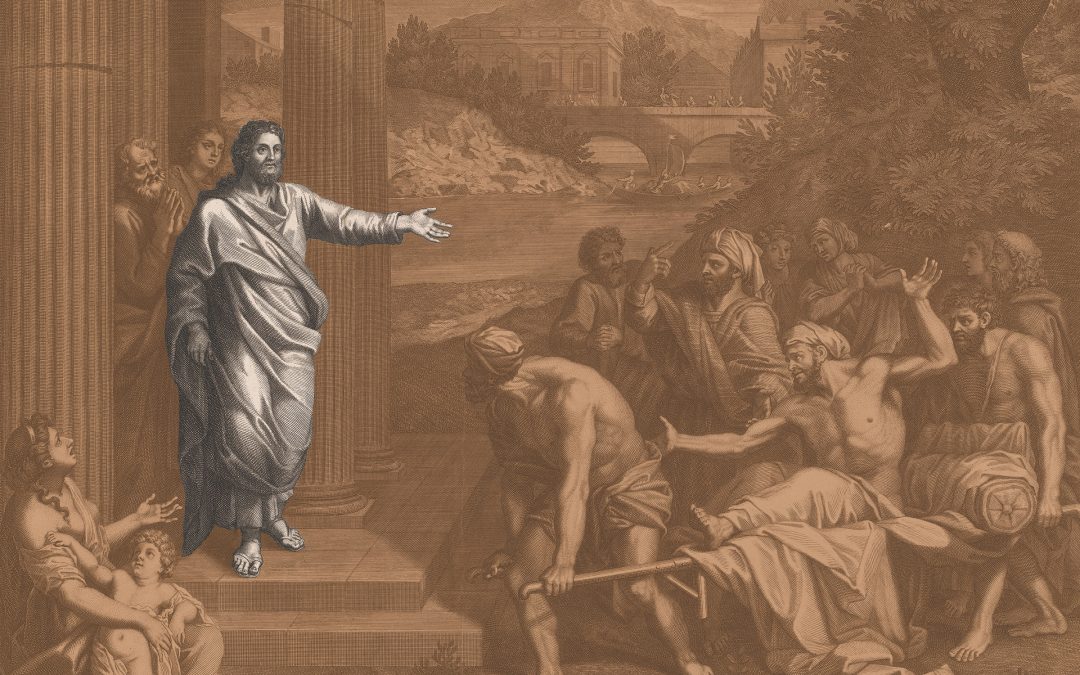
There was a time when a crowd of people brought a man to Jesus who couldn’t hear and could barely speak. They wanted him healed. According to Mark, “After he took him aside, away from the crowd, Jesus put his fingers into the man’s ears. Then he spit and touched the man’s tongue. He looked up to heaven and with a deep sigh said to him, ‘Ephphatha!’ (which means ‘Be opened!’). At this, the man’s ears were opened, his tongue was loosened and he began to speak plainly” (Mark 7:31-35).
First, I find it interesting that Jesus actually took that man away from the crowd. Jesus had the kindness in his heart to pull that man away so the only thing he could see was Jesus.
Second, the way that Jesus healed this man was super weird. But I love it when Jesus does weird things. What we learn from this part of the story is that we are going to have to be ready for the extraordinary. We are going to have to be ready for things that are not normal. Our whole lives we have done normal in The United Methodist Church. But I love it that Jesus is not normal. And Jesus is not boring. If we are going to live in the Promised Land and serve him as our king, we’re going to have to be okay with the extraordinary. We’re going to have to be okay with things that may offend. We are going to have to be okay with doing things that look a lot more like heaven and a lot less like earth.
Third, after Jesus does these strange things, he looks up to heaven and says, “Ephphatha” (translated: “Be opened”). We may think that Jesus is saying that the man’s ears and tongue need to be opened – which I think he probably is – but I love it that Mark writes, “He looked up to heaven” and says, “Be opened” because there is a threshold between heaven and earth. If we are going to live in the Kingdom serving God and allow the Holy Spirit to move in our midst, then we are going to have to cross over into what happens in heaven – and bring heaven to earth. That is what Jesus did. That threshold is Jesus Christ.
When we decide to make the commitment that we are going to serve the Lord faithfully – that we and our house are going to serve the Lord – it changes everything. Jesus is the one who makes that threshold between heaven and earth possible. There was a barrier before and it’s not there anymore. That is why we say, “Let your will be done on earth as it is in heaven.” Because while there may be a separation for a time, it’s not nearly as big as we try to make it.
When God calls us to take a step of faith out of what is comfortable, we have to check ourselves to see if we’re really okay with the extraordinary because heaven is extraordinary and heaven on earth is extraordinary and God really doesn’t do normal. If you wanted normal you should have stayed an unbeliever.
When you cross over that line, when you take that step, there should be no turning back. God is calling you and me and the people in our churches. He’s asking if we can be okay with the extraordinary. You are going to have to be okay with the fact that God is going to open up the heavens. He will. It’s real.
Jesus is the one who makes crossing the threshold possible, but we have got to step up to the plate as believers, his servants, and his friends. We’re going to have to ask God to open the heavens because that’s what we want in our homes and in our churches. God, you are what we want.
So get ready, choose this day whom you will serve. “But as for me in my household, we will serve the Lord.”
Stephanie Greenwald is associate pastor at St. Andrew’s Community United Methodist Church in Oklahoma City, Oklahoma. She is the co-host with Dr. Bob Kaylor of Holy Conversations, the podcast of the Wesleyan Covenant Association. The Rev. Greenwald also serves on the executive board of Light Up the Dark, a nonprofit helping people who struggle with addiction and abuse. This article is adapted from her address to the Wesleyan Covenant Association Global Gathering in Indianapolis in May.
by Steve | Jul 4, 2022 | July-August 2022
By Simon Mafunda
The intriguing and inexplicable ways in which Jesus Christ works reminds me of an incident at my home in Zimbabwe a couple of months ago. I urgently needed to support a couple of my tomato plants which were starting to fall over with fruit. I retrieved a few straight branches of the poinsettia tree that I had pruned and dumped away several weeks earlier. They looked dry but I wanted to be certain to avoid growth competition with my tomatoes as I knew poinsettias grew easily from cuttings, so I drove them into the ground topside down.
To my surprise after just three weeks, all eight “dry” sticks had several healthy new shoots all around them. For me it defied logic that a plant could grow from an upside-down position, but poinsettias do!
We each have our own testimonies of how Jesus has empowered us to do things far beyond our imaginations. “The seventy-two returned with joy and said, ‘Lord, even the demons submit to us in your name.’ He replied, ‘I saw Satan fall like lightning from heaven. I have given you authority to trample on snakes and scorpions and to overcome all the power of the enemy; nothing will harm you. However, do not rejoice that the spirits submit to you, but rejoice that your names are written in heaven.’ At that time Jesus, full of joy through the Holy Spirit, said, ‘I praise you, Father, Lord of heaven and earth, because you have hidden these things from the wise and learned, and revealed them to little children. Yes, Father, for this is what you were pleased to do’” (Luke 10:17-21).
Jesus sent his disciples out to teach, preach, heal, free people from demons, and to do anything else that would further the Kingdom of God. When we read this text, we encounter the disciples returning to Jesus with joyful and marvelous stories to tell.
The disciples were clear that the success they witnessed was not accomplished by their own wisdom or authority, but “in Jesus’ name.” The name of Jesus, our Lord, was the reason they were successful.
These disciples reported: “Lord, even the demons submit to us in your name.” If I were one of them, I would have fallen into the temptation of claiming that, “Lord, even the demons submitted to me.” But Jesus’ disciples knew the demons did not submit to them, the demons submitted to the name of Jesus.
Jesus reminds them that he empowered them; they had been empowered to serve in his movement. As empowered people, Jesus said they will do extraordinary things, they may even become insulated against any harm directed at them. These are indications of Jesus’ empowerment.
The Gospel according to Matthew 7:21-23 says that all these extraordinary demonstrations of power and authority will not be enough for us to enter heaven. These acts and deeds need to be accompanied by a faithful obedience to the will of God.
In the text from Luke, Jesus proclaimed some profound truths of our faith: the things of God are hidden to those who want to use human reason, those who claim to be clever or wise according to human standards, and revealed to those who approach the things of God like little children!
Normally, when we speak of empowerment, we do not see the image of a child as a representation of empowerment. We see images of presidents, bishops, business leaders, influencers, armed soldiers, and other powerful people of our times. But Jesus says empowerment is hidden from all these and revealed to child-like persons.
May we shake off the shackles of institutionalism and regain the childlike faith that believes that all things are possible with God. May we have the courage to stand against the powers and principalities of this world knowing that when we stand with Jesus, the battle belongs to him and he wins the battle!
Our world is on its knees because we have divided people into the categories of those who enjoy privileges and those who carry the burden of responsibilities, instead of creating the conditions where everyone might have access to privileges, and the responsibilities that come with them.
We have the privilege of knowing that we belong to Jesus. We have the privilege of being workers in the Lord’s vineyard. We have the privilege of being ambassadors for our Lord. And we have the privilege of the “name of Jesus” to authenticate the Good News that we proclaim. These privileges also bestow on us many responsibilities.
• Spreading the uncompromised “good news” of Jesus to all parts of the world and to all people, irrespective of where they are and who they are.
• Using the authority that comes with our empowerment by Jesus to bring relief and joy to those who have been shunned by this world and pushed to the margins.
• Trusting God like children who trust their parents and always seek to please them.
• Storming the gates of hell and introducing people to Jesus so He can rescue the perishing.
• Being the church Jesus is building.
Aware of our privileges and responsibilities given to us by our Lord, we are indeed more than conquerors!
In my country, Zimbabwe, we have faced many challenges over just my lifetime. I have seen some of the worst cases of drought in where whole valleys were strewn with the carcasses of both wild and domestic animals. Access to clean and safe water became a national challenge for households in both rural and urban areas.
Zimbabwe has also experienced terrible outbreaks of cholera and typhus as the healthcare system nearly collapsed. And perhaps worst of all, hyperinflation has wreaked havoc on Zimbabwe’s economy. A country once considered the breadbasket of Africa was reduced to the continent’s beggar within a few years. Businesses in all sectors closed while shelves were emptied in our stores. Hundreds of thousands of workers lost their jobs and life savings.
To my knowledge, Zimbabwe is the only country to have issued a 100 trillion dollar bill, but it was practically worthless. We were all billionaires but we could only afford to buy necessities like a loaf of bread. And while we were standing in line to buy the bread, the price would go even higher by the time we got to the head of the queue. Many people fled the country in search of jobs, only to be persecuted and sometimes brutally murdered by people who had developed fear and hatred for my people.
For many days, months, and even years the challenges seemed insurmountable. But I do believe, with all my heart, with all my soul, and with all my mind, that Jesus has called me and many others to teach, preach, heal, and proclaim that Jesus is Lord.
Despite all the challenges and our own limitations, I believe I am – I believe you are – called every day to be about the mission of sharing the Gospel with our words and with our deeds.
And we can go forth to fulfill the mission Jesus has given us because he empowers us. He protects us. He guides us. And he will make us more than conquerors despite all the obstacles we face in in our faith journeys!
When we are transformed by the one who conquerors all things, we can be sure nothing will stand in our way. And when God fills our hearts and minds, we will have some sense of that joy the disciples experienced when they returned to Jesus and shared what had been accomplished by the power of his name.
To be sure, our movement faces great challenges. Right now many of us feel like we have been planted upside down, and so think it is impossible that we will grow roots and sprout new life. But our Gardener is in the business of bringing life from death. He is the miracle worker and the way maker. He is doing a new thing in us and through us, as he empowers us to go forth to be even more than conquerors.
Jesus is calling us and sending us out as an advance team to all the places he plans to visit. We must not tarry consumed by our fears, doubts, or circumstances. Rise up, church!
Simon Mafunda is the Africa Coordinator for the Wesleyan Covenant Association based in Harare, Zimbabwe. Prior to his current role with the WCA, he served as the lay leader of the Zimbabwe East Annual Conference. He was elected by his conference to be a delegate to the 2012 and 2016 General Conferences, and he represented his annual conference at the 2019 special General Conference. This article is adapted from his address to the Wesleyan Covenant Association Global Gathering in Indianapolis in May.
by Steve | Jul 4, 2022 | July-August 2022
By Erik Grayson
Have you ever been lost? My worst experience being lost came several years ago. My college roommate, Robert, and I decided to enter an adventure race. We had never done anything like this before, but were excited at the prospect. It was a race against multiple teams where you had 12 hours to find 30 checkpoints in the wilderness with only a handful of coordinates, a compass, and a topographical map. And by the way, the checkpoints are scattered across the Francis Marion National Forest, which is only a mere 258,000 acres.
A few hours into the race we started to notice a change. We were suddenly separated from the other teams, who were, by the way, searching for the same check points as us. But we kept persevering, trekking through what had become a swamp. Weary, tired, and up to our knees in swamp water, we finally admitted it: we were lost. We couldn’t hear another living soul. The only other living creatures we could hear were the sounds of mosquitoes buzzing in our ears. Everywhere we looked, there were trees, swamp, trees, and the constant fear of snakes and alligators. We didn’t know if were wading in a straight line or going in circles. We were hopelessly lost.
Fortunately, I’ve never been lost like that ever again, but I’ve come to recognize that same feeling of confusion and uncertainty in another aspect of my life. I’ve come to sense that same wilderness wandering coming from our beloved denomination.
Now I want to acknowledge that I love The United Methodist Church. It’s been the denomination that’s nurtured my family for generations. I was baptized as an infant in the church. As a youth I returned to The United Methodist Church and it was there that Jesus touched my heart, renewed my soul, and gave me a new vision of life. It was in The United Methodist Church one night for Sunday evening services, sitting next to my best friend, that I heard a sermon that made me think, “I could do that. I could be a preacher.” After the sermon I leaned over to my friend and told him, “I just had the craziest thought. I was just thinking about being a preacher!” And he said, “No way, me too!” Today we’re both pastors in The United Methodist Church. I will forever be grateful for the profoundly powerful ways that God’s changed my life through this church.
Yet all the while I was experiencing God’s grace through the church, I was also growing aware of a different story. I was learning about the story of our ongoing conflict, our disagreement over sexuality, that we were divided on how to read Scripture, that we didn’t have the same ideas about covenants, vows, and accountability, that we saw salvation differently, and that at times we even disagreed on Jesus.
I felt so torn. I loved the church and all the many ways I had experienced God in this holy place. Yet I also saw that with each successive year the issues plaguing our church grew ever more serious and ever more toxic. Our beloved denomination was stuck, knee deep in a murky mess, wandering in circles, trapped with no obvious way out.
I struggled with those two realizations. On the one hand, I yearned to preach, teach God’s word, and lead God’s people. On the other hand, I was deeply concerned for the church I loved and the Wesleyan tradition that had shaped me. I remember struggling and asking, “what do I do?” As I wrestled with the question, God laid a word on my heart. He told me, “This is where I am calling you right now.” I mulled those words over in my heart. That set me free not to fear for the future. God had something for me to learn in the present. I’ll follow God where he leads next, but this is where I am called right now.
More than 2,000 years ago, the people of ancient Israel found themselves lost as well, though not in a swamp. The people of God had been scooped up by the Babylonians and forcibly taken into exile. They were nowhere near their homes, the Temple, or the Promised Land that God had given them. They had to adjust to living in a strange land among a foreign people. Exile meant being taken away from everything they called home.
Can you imagine how traumatic it would be to be plucked up and taken away from your home, your place of worship, and to lose your sense of community and how you understood the promises of God? The prophet Isaiah refers to the experience as a wilderness.
But the good news is exile doesn’t last forever.
When I was lost in the wilderness I can tell you that my senses perked up, especially my hearing. I started listening for any sound of civilization. I knew there were occasionally service roads in the woods, so I was listening for a car, or a radio. But most of all I was listening for the sounds of voices. I was hoping to hear another team in the distance. That voice would mean I was saved. I would still be in the wilderness, but at least I’d know my journey was coming to a close.
After decades of exile, the people of Israel finally heard a new word from the Lord. In Isaiah chapter 40, God speaks through the prophet, saying “comfort, O comfort my people.” A voice cries out in the wilderness, “she has served her term.” God is announcing that exile is coming to an end. Suddenly those long years of suffering, waiting, and yearning are about to produce something new. The people of God are on the precipice of that new thing God had promised long ago.
Can you imagine what it is to be stuck wandering in a wilderness for decades and finally be told your time of renewal has come? Let’s be clear, this is a word for the people of God – the people of God in ancient Israel and the people of God living today.
Exile is coming to a close.
Now God is giving the people a word before they can embrace the new thing. Exile wasn’t just a holding pattern. It wasn’t just a waiting room. Exile was a space where God was reminding the people who they are. You can’t get to the land of promise if you don’t learn the lessons of the wilderness.
The Lord tells the people that “All people are like grass.” He goes on to say, “the grass withers and the flower fades.” It’s a cheerful message, right? But then he also says, “But the word of our God will stand forever.”
On the one hand this means that we’re finite. Human decisions and choices do not last. How was it that Israel ended up in exile in the first place? One of their enduring problems was poor leadership. They had pre-exilic leaders who didn’t take their God-given responsibilities seriously. The land was polluted with idols. The leaders compromised their values with foreign ideas. They proclaimed, “Peace, peace, when there was no peace.”
Leadership matters. I wonder if we as a denomination have been guilty of those things? Have we brought the idols and ideas of the nations into the house of the Lord? Have our leaders proclaimed “Peace, peace, when there is no peace”?
No enduring movement of God is sustained by human initiative. If we want to see this next phase of Methodism thrive then we’re going to have to heed the second part of Isaiah’s message: the word of our God will stand forever. There are some good ways and some not so good ways that we can put this into practice.
We cannot simply adopt a slogan or catchphrase declaring that we’re a biblical church. We cannot adopt a contextualized reading of scripture that dismisses two thousand years of consistent biblical interpretation. We cannot adopt a regionalized reading of the word that places an iron dome over our culture’s reading and rejects the wider witness across global Christendom.
The new Methodism will need to catechize believers in the faith in such a way where Scripture flows forth from their hearts and minds. We will need to make sure that Scripture is our primary authority in matters of worship, theology, and social witness.
The success of our movement will not be known for some time. In the present we’re all united by a shared experience. We’re going through this transition together. This unites us. The builders of a movement stick together. The real test of our movement will come a generation from now when future Methodists face another thorny issue. Will we have provided them with a shared biblical theology? Will their worship enable the word of God to flow forth from their hearts and minds? In times of trouble will they have spiritual disciplines grounded in the word to fall upon? I believe that the success of this movement will hinge in part on how well we center our common lives around the Holy Scriptures.
Isaiah’s warning to the people is a reminder that no enduring movement of God is ever built on human initiative, but on the word of our God that stands forever. We must learn the lessons of the wilderness to be prepared for exile’s end.
I’ve been reflecting a lot lately on what the end of exile looked like. I’ve always wanted to imagine a very simple and clean end. I want to picture King Cyrus waking up one day and saying, “Okay, everyone go home!” I want to imagine that they just threw their families, their livelihoods, and their communities in the back of a UHaul truck, drove down the road, and enjoyed a move-in ready parsonage.
I hate to admit it, but exile didn’t end that way. The end of Israel’s exile was a little slower and messier. From Cyrus to Nehemiah to Ezra, we know it happened in waves.
I imagine there was a hardy group that was ready to go first. They had been praying for this, watching, and making preparations. As soon as the word came out, they were out the gates. Every movement needs someone to go first.
Yet I imagine there was probably a sizable chunk of people that wanted to make the jump from exile to promised land, but weren’t quite ready. They had to do the hard work of getting their affairs in order, wind down their businesses, and prepare their households. They were eager, but it would take them more time.
Still I imagine another group. I picture them as eager to move but they’re waiting for permission. Just like Nehemiah had to get permission from the king, so too do people have to wait to be released for the new thing.
I wonder how different people decided when they’d leave exile. Yet leaving wasn’t the only thing to consider. The journey itself wouldn’t be a walk in the park. We’re not talking Two Men and a Truck here. Imagine packing together all your earthly possessions, and either riding on a donkey or beast of burden, or a cart if you’re lucky, but likely traveling on foot. You’re on dirty, uneven roads enduring the dangers of the countryside and braving the elements. The journey will be difficult.
And then, on the other side you’re not arriving in luxury. You’re showing up in to begin the real work of rebuilding or building from scratch. Building the Temple. Rebuilding the walls. Standing up the infrastructure. There’s work to be done! Exile didn’t just end. It took time and it was hard work.
There’s no question that moving from exile to promise will at times be challenging, but that’s the wrong question. The question we should be asking is, “Is it worth it?” If we were to ask the people of ancient Israel if it’s worth it, if we could speak to those who got to worship God once more in the Holy City, I believe they would tell you, “yes, it is.” If you were to ask the prophet Isaiah, he would say to you that Israel “has served her term.” And when we ask the Lord, I believe he may very well say, “this is what you are called to do.”
Sybil’s exile comes to an end
The church I pastor is a wonderful congregation located in a very impoverished area. There was this stretch of months where a woman named Sybil had been coming to our church food bank. The lines in her face made it clear she had lived a rough life. She was stuck in a loveless marriage she longed to escape, struggled with substance abuse, and it rained inside her house but her husband was too proud to accept any help. And to add insult to injury, Sybil had convinced herself that she was the worst of all sinners. It was an emotional struggle for her to step on the church grounds just to come to the food bank. Worship was completely out of the question for her. Her own sin and her self-perception of her brokenness made her into an exile, cut off from community.
Each week we had to beg her to accept the food she picked out, saying, “Yes, it’s okay for you to take this.” This went on for countless months until one Sunday, she showed up in the back of the church. You can imagine my surprise when I saw Sybil, sitting on the back pew, tears quietly rolling down her face. Something had happened inside of her. Her exile had come to an end. God was on the move.
Toward the end of the worship service I led communion. At the end of the communion liturgy I asked our servers to come forward, yet this week for some reason no one stood up, with one exception. Sybil rose to her feet and began shuffling down the pew. Every eye in the church was glued on her as she limped down the aisle. You could have heard a pin drop. She got to the chancel steps and paused. She wobbled for a moment and abruptly crumpled over at the waist like a wet noodle. With her hands on the steps, she crawled on all fours up the chancel steps. She reached to the altar and pulled herself up, and she stretched out her hands. And I got to serve her. This is the body of Christ, given for you. And this is the blood of Christ, given for you.
It was the most undignified, awkward, and difficult journey to the altar that I’d ever seen. It was also the holiest.
The journey from exile to God’s new thing will be difficult. There will be challenges, obstacles, and questioning about when and how. Yet despite the challenges, when God calls, we will be more than conquerors.
Erik Grayson is pastor-in-charge at Aldersgate United Methodist Church in North Charleston, South Carolina. Erik and his congregation created a non-profit called Holy City Missions which is pursuing the establishment of a $4 million missions campus and year-round shelter for marginalized people. This article is adapted from his address to the Wesleyan Covenant Association Global Gathering in Indianapolis in May.
by Steve | Jul 4, 2022 | July-August 2022
By Angela Pleasants
I grew up in a small rural church in Guilford County. Worship was a mixture of what we would call Methocostal. It was a blend of Methodist with a bit of flavor of Pentecostal thrown in for good measure. The music was lively with hand-clapping, foot-stomping, and a holy dance we called “shouting.”
The proclamation of the word was an art form. If you will permit me to use my classical music terms, it started with pianissimo to a mezzo forte to forte. The preacher would crescendo to that fever pitch where the dance between the congregation and pastor began.
I am using the musical terms because this was a combination art form between dancing and music. The pastor would give a preaching style called “whooping” in the black church tradition. The history of whooping began with enslaved Africans who brought the tradition to the Americas, and free black pastors picked up the tradition. It was a way of informing the heart and mind.
While the pastor was at the height of his (we only had male pastors during this time) whoop, the congregation would respond in cadence. I recall one of the familiar responses was, “Say so, pastor,” or “You better say so.”
When I was young, I did not know what my elders meant when they said, “Say so.” There was even a prayer with the words sung, “Let the redeemed of the Lord, say so.” It became an amen in our church tradition.
When I was older, I understood what my elders meant when they said, “Let the redeemed of the Lord say so.” These saints came through the tribulation of segregation, discrimination, hatred, and unrest. They fought long and hard and saw victories along the way. They related their plight to the Israelite’s journey from the bondage of Egypt to the Promised Land. What were they saying? They were saying how God is gracious and merciful, powerful and mighty. They were giving their thanksgiving and praise to the God who keeps covenant relationship.
I recall the lyrics to one song of deliverance:
“How I got over?/ How I got over?/ My soul looked back and wondered/ How I got over?/ Just as soon as I see Jesus./ The man who made me free./ It was the man who bled and suffered./ You know he died for you and me./ I wanna thank him because he brought me./ I want to thank him because he taught me./ I wanna thank him because he kept me./ I gonna thank him because he never left me./ I wanna sing hallelujah./ I might shout this evening trouble over./ I gonna thank Jesus for all he’s done for me.”
So, when these saints (my parents included) said, “let the redeemed of the Lord say so,” they were not only talking about their victory from the bondage of oppression, depression, suppression as a black ethnicity but also from the bondage of sin and death. Salvation in Jesus alone has “brought them from a mighty long way” (saying the words of the elder saints in my home church).
“Give thanks to the Lord, for he is good; his love endures forever. Let the redeemed of the Lord tell their story – those he redeemed from the hand of the foe, those he gathered from the lands, from east and west, from north and south. Some wandered in desert wastelands, finding no way to a city where they could settle. They were hungry and thirsty, and their lives ebbed away. Then they cried out to the Lord in their trouble, and he delivered them from their distress. He led them by a straight way to a city where they could settle. Let them give thanks to the Lord for his unfailing love and his wonderful deeds for mankind, for he satisfies the thirsty and fills the hungry with good things” (Psalms 107:1-9).
If you read this entire Psalm, it reads like the cadence of the “whooping” style of black preaching. The people are in peril, and they cry out to God, and God answers.
1. People cry who are lost and perishing – God rescues.
2. People are imprisoned – God sets them free.
3. People are mortally ill and in peril at sea – God hears and responds.
They are lost and found, captive and redeemed, sick and healed. Let the redeemed of the Lord say so.
And what is the response of those redeemed? Their response is thanksgiving and praise. You must read the entire Psalm to capture the full richness that no matter the extreme calamity, God is able to break through to help, especially those who cry out to him.
In Psalm 107, we see the plight of those who are lost, hungry, thirsty, and exhausted. It’s thought the Psalmist was referring to the celebration of the end of exile. These were the Israelites in exile, but it also is typical of any one of us who has not found the satisfaction that comes from knowing God.
What caused Israel to be in exile? God chose Israel not because they were more numerous than any other people. God chose them because he loved them and kept his oath to their ancestors. God brought them out with a mighty hand and redeemed them from the house of slavery when they were in Egypt.
God is good and faithful and maintains his covenant loyalty with those who love him and keep his commandments.
So, what happened to Israel? How did they end up in exile? Israel forgot her first love. God referred to Israel as his vineyard. In Isaiah 5, he called them his “beloved vineyard on a fruitful hill.”
God planted Israel as a choice vine and expected it to bear good grapes. But something happened. Instead of good grapes, it brought forth wild grapes. Instead of guarding their hearts with the words of the Lord, they permitted:
1. Greed
2. Self-indulgence. Instead of paying attention to God and his work, they were giving full attention to material things that were passing away.
3. Cynicism and testing God.
4. Moral perversion. They declared what is right, wrong and what is wrong right. They made up their own morality.
Israel was supposed to demonstrate to the world what a covenant relationship with God looked like, but they did not produce ripe fruit. Overall, the sin was their failure to admit there is someone outside of themselves who has the right to establish the parameters of our existence.
And so, they ended up in a foreign land, “How can we sing the Lord’s song in a foreign land?” By the rivers of Babylon, Israel hung up their harps, sat down, and cried. Their cry became a lament to the God they once turned from, and he heard their cry.
Likewise, today, God also hears our cries. My cry may be different from yours, but it is a cry nevertheless, and God hears our cries. Some of us are crying over what we once knew of a denomination, but God hears our cry. Some of us are grieving over a significant loss; God hears our cry. What is your lament today? Take heart because God hears our cry. Our lament has become a form of intercession, and God hears.
Let the redeemed of the Lord say so.
“For thus say the Lord: Only when Babylon’s seventy years are completed will I visit you, and I will fulfill to you my promise and bring you back to this place. For surely I know the plans I have for you, says the Lord, plans for your welfare and not for your harm, to give you a future with hope.” (Jeremiah 29:10-11).
God has a plan for us. God has a plan for the Global Methodist Church. He is planting us as a choice vine, but we cannot forget our first love. Let us not become so consumed in leaving a current denomination to start a new denomination without first coming before God in complete repentance and consecrating ourselves for what lies before us.
Whenever the Israelites were preparing to be led out by God, they went through a period of consecration. Consecration is separating ourselves from what is impure and unclean to prepare ourselves to deepen our relationship with God. After their period of consecration, God said he would do amazing things before them. God was gracious to them, and he will be toward us.
God’s mercy has no beginning and no end. It endures forever. Our sin required his good mercy, and therefore, we praise him from the depth of our being.
Let the redeemed of the Lord say so.
When we think of deliverance, sometimes our mind first goes to deliverance from illness, deliverance from suffering, or deliverance from oppression in society. But the greatest deliverance of all happened for us on Calvary.
Let the redeemed of the Lord say so.
Jesus said:
1. “I am the way” – meaning he is the access to the Father’s presence in heaven.
2. “I am truth” – meaning the authoritative representative revealer of God. He discloses God exhaustively.
3. “I am the life” – meaning he is the mediator, creating the avenue to God.
We were ransomed from the futile ways inherited from our ancestors, not with perishable things like silver or gold, but with the precious blood of Christ, like that of a lamb without defect or blemish.
We were in sinfulness and bondage, but the price paid was the atoning death of Jesus Christ, who delivered us from sin and death. From our former life, believers have been redeemed, purchased with a price, the blood of Jesus. And now that we are saved, delivered and restored in our relationship with God, we are grateful people, living a life of thanksgiving to God for our new family and now living in awe and wonder and faithfulness before him. We have not just survived. We have thrived and conquered. We are more than conquerors through Jesus Christ who first loved us and continues to shower us with His love.
Let the redeemed of the Lord say so.
Angela Pleasants is Vice President for Clergy and Church Relations for the Wesleyan Covenant Association. She is a clergywoman in the Global Methodist Church, having served as an elder in the North Carolina Annual Conference where she served as a district superintendent, chairwoman of the conference’s board of elders, and was twice elected as a delegate to General Conference. This article is adapted from her address to the Wesleyan Covenant Association Global Gathering in Indianapolis in May.
by Steve | Jul 4, 2022 | July-August 2022
By Rob Renfroe
In 1875 a remarkable woman was born. Her name was Mary Bethune. Both her parents had been slaves. At the age of 5 she began working in the fields. But she took an interest in her own education. And she found a way to attended a small, one room, segregated school in South Carolina.
From there she went to study at Chicago’s Moody Bible Institute. That was a big step, huge, almost unheard of for a young black woman at that time. After graduating, she returned to the south and began to teach. But she didn’t stop there. She had a dream. She felt called to start a college for black students. She wanted young African Americans in the south to get a quality education and to step into extraordinary lives.
She didn’t let the cost stop her. She didn’t let what others said stop her. She didn’t let the fact that she was young or black or a woman stop her. She had a vision. And she discovered that the spirit within her was not a spirit of timidity, but a spirit of power.
In 1904 in Daytona Beach, Florida, at the age of 29, Mary Bethune founded what would become Bethune-Cookman University. For twenty years as a college president, Mary Bethune made the most of her remarkable ability to inspire young people to dream their own dreams, overcome their own obstacles, and win their own battles.
At the graduation exercises each year she would charge her students: “Faith ought not be a puny thing. If you believe, have faith like a giant. And may God grant you not peace, but glory.”
I love that last line. It was Bethune’s way of saying that the battles that matter and the causes that are worthy of our lives are rarely accomplished without difficulty, courage and sacrifice. She was telling her students: You can live a comfortable life or you can live a great life. You can live an easy life or you can live a glorious life. Now, which do you think you were created for? Peace or glory?
And I will ask you the same question: What do you think God created you for? Peace and comfort? Or greatness and glory? Our theme at this conference is living as more than conquerors. Following Jesus in such a way that what we do is triumphant and victorious, great and glorious. What does that mean? To live that way? Fortunately, that’s not hard to determine because Jesus told us what that looks like.
Shortly before his death Jesus told his disciples. “The hour has come for the Son of Man to be glorified. Truly I tell you, unless a kernel of wheat falls to the ground and dies, it remains only a single seed. But if it dies, it produces many seeds. Now my soul is troubled, and what shall I say? ‘Father, save me from this hour’? No, it was for this very reason I came to this hour. Father, glorify your name!” (John 12).
Jesus says: The hour has come for me to be glorified. And immediately he begins to talk about what? Not his power. Not his miracles. Not even his resurrection. He talks about his death.
You want to see glory? You want to see triumph? You want to see what it looks like to conquer in the Kingdom of God? It looks like a man hanging on a cross. It looks like a man with his back scourged and torn apart. It looks like a man giving his life for others. It looks like a man who would rather die than be unfaithful to his Father. It looks like a man enduring the most shameful and painful death the Roman Empire can devise so the unworthy and the undeserving can know they are loved, have their sins forgiven, and be born again to a new and transformed life.
You want to see glory? That’s what it looks like. You want to be victorious, you desire to be more than conquerors, that’s what’s required. Paying a price, giving your life so others may be saved.
Friends, we had hoped to be at a different place. We had hoped that the Protocol would be passed. We had hoped that a fair and just separation would be ratified. We had hoped that those in power who have long lectured us about having a heart of peace would not now be demanding a piece of flesh so we can step into the future God has called us to.
But that’s not how we overcome. That’s not how we conquer and become victorious. We conquer by paying a price to be faithful. We overcome when we stop worrying about our churches and stay committed to serving a lost world with the grace and truth of Jesus Christ. We are glorious when we follow our Lord to a cross and we are willing to bleed for those who need the hope that is found only in Jesus.
The Roman Empire worshipped power and despised weakness. Human life was cheap. Children born deformed or infirmed or even simply female could be discarded in Roman society, left exposed to the elements to die of starvation or mauled and eaten by wild beasts, and there was no shame for the parents who did so. Gladiators fought to the death, the crowds clamoring for more blood and savagery. Slavery was commonplace. The early Christians stepped into this culture and proclaimed a crucified Messiah, who had died in weakness and shame on a Roman cross. They boldly declared Jesus Christ, not Caesar, was Lord. And for the next two and a half centuries they were persecuted, ridiculed, and despised.
And yet, three centuries after it began as a Jewish sect in faraway Palestine, the Roman Emperor Constantine announced his conversion. And before the year 400, Christianity had become the official religion of the Empire, embraced, some estimates state, by nearly half of its inhabitants.
How had a despised sect, with no political power, that appealed at first primarily to the poor and the uneducated, born far from the center of power and culture, that was persecuted severely, and that worshipped a crucified Messiah so change the hearts and minds and eventually the culture of people who were as cynical, hedonistic, crass and crude as the people of our culture?
Simply put, they lived the way Jesus lived, they loved the way Jesus loved, they served the way Jesus served. And when persecuted, they died the way Jesus died, praying for the forgiveness and the salvation of those who had ordered their deaths.
And over time the Romans came to see that the way of life of the early Christians wasn’t just different, it was better – and they saw that it could make them better. They came to believe that the most outlandish thing was true – God was in Christ, reconciling the world to himself, offering life to all who would repent and believe.
How did the early Christians love and serve? The deformed and unwanted babies, left to die; female babies unwanted and discarded because of their gender so much so that there were 50 percent more boys than girls in Roman families, Christians would go into the woods and find those abandoned children, take them into their homes and raise them as their own.
In times of plague, the Romans commonly abandoned their relatives at the first sign of illness, even pushing them into the streets before they died, in hopes of escaping the disease themselves. Not so the Christians, who not only cared for their own, but also took in unbelieving neighbors and strangers, caring for them, even though many early believers in the process contracted the disease and died themselves.
They provided food and assistance to the poor regardless of their faith, and to both sexes, though Roman welfare was given only to males. They were faithful in their marriages and kind to their children. And in the midst of the decadence and the cynicism and the hedonism of Rome, and the emptiness and the loneliness it leaves within the human heart, the Christian way, the way of compassion and purity and service looked like life – real life, a superior kind of life.
And the glory of Rome paled in comparison to the glory of a man hanging on a cross and those who followed him. What was once despised became treasured. And the One crucified in weakness and shame became adored as Lord of all, God in the flesh. And a culture was changed. That’s how the early Christians became and lived as more than conquerors.
I’m convinced the only way we will impact our culture significantly is to believe that when people see a better way of life, when people see Christians whose lives are about love and compassion and service, people will be willing to listen to us. When the one thing that a secular society knows about Christians is not that we are judgmental, or angry, or condemning or arrogant and self-righteous, or that we vote a certain way, but that we are a community of compassion, and that we care more and love more and serve more and sacrifice more than anyone else on the planet, people will come to believe in the one we proclaim, and just maybe then we will have done something glorious with our lives.
I am grateful that I serve on the Wesleyan Covenant Association council. Many of those on the council I have known for years. Others that I didn’t know I have heard their hearts and listened to their visions. What I have seen and what I have heard in them is what I know lives in you. A desire for all to be saved. A yearning to be part of a Spirit-led servant community that is willing to pour its life out for the salvation of the lost and the spread of scriptural holiness. An openness to all people. And a willingness to do hard things, pay a high price and make a great sacrifice if need be so people can see who Jesus is and come into the life that he has for them. A longing to be part of a movement that God will use to change our world the way he used the early Christians to change theirs.
That’s our purpose. That’s who we are. That’s how we conquer. And that is our future. Many of you have a rough road ahead, making your way into the Global Methodist Church. For many of you, it will be unfair and costly.
But never forget, you can have an easy life or you can have a great life. You can have a comfortable life or you can have a glorious life. And you, my friend, were created not for peace but for the glory of God.
Rob Renfroe is the president and publisher of Good News. He has been the preaching pastor at The Woodlands Methodist Church for over 25 years where he has led Quest Men’s Fellowship. He is the author of several books, most recently, Unfailing: Standing Strong on God’s Promises in the Uncertainties of Life. This article is adapted from his address to the Wesleyan Covenant Association Global Gathering in Indianapolis in May