
by Steve | Mar 22, 1989 | Archive - 1989
Archive: At the Lord’s Table
By George Anderson with Ruth A. Snyder
This pastor found Christ through the witness of a laymen’s luncheon in June when I arrived at First Avenue North and North Broadway in downtown Billings. The luncheon took place on the hotel’s second floor where business luncheons normally do. The banquet room was filled with people I had never seen before.
I took my seat next to Willis Jones and looked around the room. The tables were arranged in a U shape. I noticed then that many pastors had not shown up; that was predictable. Both saved and unsaved pastors resent and fear laymen’s efforts to convert them. I don’t think that conversion was their motivation for inviting me to the Northern; it didn’t matter if it were. I was there because the lay leader had asked me to come.
As we were finishing our dessert a young, pleasant-looking man stood up. I learned he was the Presbyterian minister we had been invited to meet that day. As he spoke it became evident he wasn’t there to preach or to talk about his local congregation; he was there to report on a weekly Bible study in Bismarck that was, in essence, a prayer and support group for Governor Bill Guy. The underlying message, though, was that Christ is alive in Bismarck.
Jesus in Bismarck, North Dakota? I thought, How could that be? I thought Jesus was a prophet who lived in ancient Israel. He was a good, selfless man, and to be a Christian was to copy His lifestyle. I believed Jesus was divine, but only with the same spark of deity which resides in us all. I had called Him Emmanuel— “God with us.” By that, I meant that God had represented Himself to us through Him. But I wouldn’t say He was God, because I didn’t believe it.
In my mind I quickly rummaged through my long-held theology. I had gone to seminary with the notion that by serving in ministry I would do something good for my fellow man. But in seminary I concluded that Jesus was not God and that God wasn’t God either. Instead I believed that the story of Jesus was a useful myth and that the God-concept was a useful principle. On these I tried to build a religion of ethics which would help mankind in its struggle to find significance in this hostile world.
However, I had already begun to notice problems with this kind of faith. First, it made little difference in my own life or in the life of anyone else whether we believed it or not. Second, it was hard to preach; few people understood what I was talking about, and those that did often left the faith altogether. (I was basically saying, “Be good and save yourself.”)
This speaker was saying that Jesus Christ is alive and that I could have a personal relationship with God through Him. He was saying our righteousness is not dependent on anything we do but on what Jesus has already done. The secret is not achieving, but believing.
I guess these ideas weren’t totally new to me, but suddenly they made sense. I recognized if Jesus is alive, as this man claimed, then obviously Jesus is God.
I didn’t have a relationship with Jesus, and I was failing in my efforts to be like Him. How could I be sure I was saved?
So I said in my heart, “I do believe, that Jesus is alive and is God, and I accept Him.” It was a quiet, unemotional resolve, but by the time the meeting had ended my enthusiasm was uncontainable.
I returned to my church office and immediately called my wife to tell her the news. We both cried. Already a born-again believer, she had waited patiently for years for me to understand my own spiritual anemia.
An hour later, there was a knock on my office door. It was Louie Kramp (the stranger on the stairway), Louie Sheldon (the luncheon speaker) and Fred Heyn (now a member of my church). They were there for a “follow-up” visit, to begin discipling me. We had a marvelous time; my heart was light as I spoke with them about Jesus. Louie Kramp told me then that my Jesus-is-God proclamation had taken him by surprise. He told me, “I thought, He’s a preacher and he didn’t know that?” We laughed together thinking about the incongruity of the moment.
In talking with these men I began to understand the Billings laypeople’s enthusiasm. Two years earlier Dick Halverson, who later became U.S. Senate chaplain, had brought a group of laypersons from around the country to Billings to meet with the city’s leaders. These men and women, respected in their fields, had flown into town at their own expense to witness to their faith in Jesus Christ.
As a result of this leadership week in 1960, hundreds of the city’s business, professional, academic and labor leaders made public professions of their faith in Jesus Christ.
Another phenomenal thing happened as a result of that weekend. Scores of small groups of laypeople began meeting throughout the city for Bible study and prayer. Some met for breakfast. Some met for lunch. Some met in the evenings. To this day, 28 years later, you can still find at least one Prayer Breakfast group meeting in almost every restaurant in the city, every day of the week.
The well-known National Prayer Breakfast, which takes place each year at the beginning of the congressional session, is only the tip of the iceberg. It is the visible part of a great movement of God among lay people of all faiths, walks of life and nations, drawn together by a common faith in Jesus Christ. Their objectives are to minister to and with the poor, to train up a new generation of leaders from among the young and to help people in leadership achieve maximum effectiveness for Christ in the exercise of their responsibilities.
That June day I had, by chance, been touched by a great laymen’s movement. Realizing Jesus is God changed my life, and now, nearly 27 years later, I say it with the same untainted enthusiasm I had on the steps of the Northern Hotel.
But the story doesn’t end there.
At my wife’s request, we invited three or four youth from our church to dinner with Louie Sheldon that same night. After dinner I asked Louie, “Tell them what you told me today. Tell them about Jesus.” He did. The young people listened politely.
After Louie left, Sherri, a leader in the youth group, told me, “I’ve attended this church all my life, and I have never heard anything like that. It has to be a bunch of baloney.
“My wife and I continued our work with the teens, motivated by our shared zeal for Jesus. One year later Sherri received Christ; she was the first in the group.
Then the enthusiasm for Jesus snowballed, and each of the teens gave his or her life to Christ. The group grew from 15 to 100 members. Some of their parents started attending church. No one could deny that the gospel being preached was attracting a large following.
Twenty-one years ago I moved my family to Washington, D.C., thinking I would leave the pastorate to work fulltime in the Prayer Breakfast Movement. But Jesus won’t let me leave the pulpit. In our 19 years at Mount Oak United Methodist Church we’ve seen workers in the Justice Department, the Pentagon, the Department of Labor, the Postal Service, businessmen and farmers come to know Christ.
As a senior pastor won to Jesus by laypeople, I take pains to wipe out the distinctions between laity and clergy. At least once a month during our worship service a layperson gives his or her testimony. We also offer a 10-week discipleship program to our laypersons.
The other day a visitor commented to me, “We came for several weeks before we could figure out who the pastor is.” That is a great compliment to us all.
George Anderson is pastor of Mount Oak UMC in Mitchellville, Maryland, and a member of the Good News Board of Directors.
by Steve | Mar 21, 1989 | Archive - 1989
Archive: Prison Fellowship
A Light in the Darkness
By Dierdra D. Moran
The prison walls that confined Chuck Colson, a former White House aid, for seven months have become a worldwide mission field for him and thousands of others.
The two staff members and three volunteers that were a part of Prison Fellowship’s humble beginnings in 1976 have watched the ministry explode; it now boasts 225 employees and 25,000 volunteers. The program reaches prisoners in 60 countries.
The busy hands of the workers are not confined to prison cells, however. A number of Prison Fellowship’s programs minister to prisoners’ spouses and children as well.
Project Angel Tree provides Christmas gifts to the children of inmates, and Prison Fellowship’s Family Ministry provides marriage seminars and family counseling for spouses and children. In-prison Seminars include three to five days of evangelism and discipleship meetings inside prisons, and small-group weekly Bible studies follow the seminars. A pen-pal program has enabled thousands of volunteers to correspond with thousands of inmates.
Philemon Fellowships, designed for ex-prisoners, provide practical support for those who have been freed; Aftercare helps these former inmates stay out of prison and gets them involved in local churches.
Justice Fellowship, an affiliate ministry founded in 1983, promotes alternatives to incarceration for offenders of nonviolent crimes based on restitution, reconciliation and community involvement.
On the international scene the needs are more unique. In a prison in Peru, for example, about 50 children live with their incarcerated mothers. Prison Fellowship volunteers provide food, clothing, beds and daily nursery care. One volunteer even picks lice from the children’s hair each day.
New branches of the ministry are sprouting up even now, as Prison Fellowship seeks more ways to meet prisoners’ needs.
A mentoring plan is in the works which provides freed prisoners with Christian mentors who help them adjust to a crime-free lifestyle and hold them accountable to it.
Because more than half of the nation’s prisoners are members of a minority group, Prison Fellowship seeks to work hand in hand with inner-city churches in ministry to prisoners and their families.
The Prison Fellowship International’s board of directors, including 18 members from 14 different countries, recently chartered ministries in Costa Rica, Chile, Uganda and Zimbabwe.
Prison Fellowship volunteers are a rare sort, willing to take the freedom of the gospel into prison cells all over the world. In Colson’s own words, “We pray we can dare to be different, to creatively meet the physical and spiritual needs of the ‘least of these,’ and in the process demonstrate to a skeptical world that the Gospel is real.”
by Steve | Mar 20, 1989 | Archive - 1989
Archive: Is Nothing Worth Dying For?
The transcendent is being stripped out of American culture. People are calling out, ‘What can I believe in anymore?’
By Charles Colson
It’s hard these days to pick up a newspaper without feeling a sense of betrayal. Not long ago the Marine sentries, elite of the elite, guarding our embassy in Moscow were charged with trading secrets for sexual favors. That these young men would do such a thing was bad enough, but the reaction of the congress was equally tragic. Congressmen were not so shocked by the Marines’ breach of trust; they were shocked that the state department would put young, single men in a position where they couldn’t easily satisfy their biological urges.
When I practiced law years ago, stock broker was a badge of honor. Now stock brokers trade insider information, losing their good names but making hundreds of millions of dollars. How does the public respond? According to a Gallup poll, 70 percent of the American people said merely, “That’s business.”
Not long ago congressmen allowed a pay raise to take effect by not voting it down within the prescribed time. The next day, when it was too late, the House of Representatives unanimously voted to kill the pay raise which had automatically taken effect the night before. There was no howl of public outrage; that’s politics.
And, in the saddest breach of trust of all, several ministers of the gospel have tragically broken not only the trust of their supporters but of the Lord, to the great shame of the cause of Christ in this country.
I recently picked up a “Bloom County” cartoon. It was a series of cartoon frames; the first one read, “Last Tuesday Opus was suffering a general crisis of faith.” Opus (the hero of “Bloom County”) is standing in front of the television, watching the announcer say, “Today the President admitted to sending a personally-inscribed copy of Leo Buscaglia’s Living, Loving and Hugging to Ghadafi.” Opus shrugs his shoulders, walks into the next room and says, “Well, I have faith in the forces of capitalism.”
Next, he finds someone reading a newspaper that says, “Today on Wall Street Everybody but the Wiener Vendors was Busted.” Then Opus shakes his head and walks off saying, “Well, there’s always religion.” Then Opus sees someone reading a magazine which says, “Oral Roberts Strangled Jimmy Swaggart And Ran Off With Tammy Bakker’s Drug Counselor.” Opus walks out onto his front porch and shouts, “What can a fellow believe in anymore? Are there no more bastions of purity?”
Finally Opus swings around and sees a very pregnant woman walking toward him with a bag of groceries. He runs over, leans up against her and says, “Ah, motherhood.” She looks down and says, “Surrogate.”
What can a fellow believe in anymore? Are there no more bastions of purity? What’s happened to us? We Christians believe we are sinners, rescued only by the grace of God. So are these merely isolated instances of individual sin or is a pattern emerging?
I believe there is a pattern, and it is simply this: We are abandoning the whole concepts of honor and trust; we are caring only for ourselves and finding nothing to believe in.
What is honor? Honor is believing in and caring about a cause greater than one’s self. For some 2,000 years Western civilization has functioned on the premise that there is a God, and that God defines responsibilities. But in the latter decades of the 20th century we’ve experimented for the first time with defining responsibilities without reference to that transcendent God.
More than 100 years ago Friedrich Nietzsche predicted that by the end of the 20th century God would be dead. Nietzsche didn’t argue that there wasn’t a God; Nietzsche argued that man would kill God, that man would learn to live as if there were no God.
Recently Robert Bellah, a sociologist, did a study to determine what values make Americans tick. He described American values today as “utilitarian individualism.” He said, “The goals of life in America today are personal success and vivid personal feelings.” According to his discoveries marriage is looked upon as a vehicle for personal development; work, as a vehicle for personal advancement; and the Church, as the vehicle for personal fulfillment
Bellah’s work shows we have done exactly what Nietzsche predicted. We have decided that God no longer exists; we live as if there were no God. We live only for ourselves. We have become the most self-centered culture in history.
Yet 80 percent of Americans claim to be Christian. More people attend church than ever before. God, evidently, is still alive in our church pews; He’s just dead in our streets.
A well-known television anchor interviewed a young lawyer who argued the creationists’ case for the state of Louisiana. The lawyer’s responses were brilliant. Finally the interviewer was so trapped that he leaned into the monitor and said, “But isn’t it true that those people sponsoring that legislation in Louisiana were devout Christians?”
His implication, or assumption, was that religion should stay out of public life. I thought of the debate over slave trade 200 years ago, when William Wilberforce had the courage to stand up in the House of Parliament and declare, “I as a Christian cannot countenance this, no matter what it means to the British Empire.” And Lord Melbourne stood up and said, “Things have come to a pretty pass when religion is allowed to invade public life.”
If religion had not been “allowed to invade public life,” we would still have slave ships bringing slaves from Africa to the Western hemisphere. Religion had better invade public life! We sometimes blame the media, but the media is not solely responsible for our situation. Since the early 60s the courts have progressively narrowed the role of religion in public life.
Consider the public school in Evansville, Indiana, where teachers were holding a Bible study among themselves. The school board told them they could not, and the situation was taken to court. One school administrator argued, “We can’t have the teachers walking into school with their Bibles; that might give the wrong impression to students.” The court then asked. “Supposing they only held their Bible studies before school began?” The school board said it could still be dangerous: “They might leave one of their Bibles lying around in the school.” The court upheld the school board.
Paul Vitz’s study of public school textbooks shows how even historical references to religion have been on the decline for years. There is virtually no reference to religion in modern textbooks.
Vitz writes of a student who reported to his mother, “Thanksgiving was a time in which we gave thanks to the Indians.” And the mother said, “No, no. Thanksgiving was the time that we gave thanks to God.” She called the school principal and said, “What are you teaching our children? Thanksgiving was the time we gave thanks to God, not to the Indians.” And the school principal said, “I can only do what the textbook said.”
To quote Richard Neuhaus, “We have virtually stripped the public square naked of religious values.” We continue in our churches to sing hymns, preach sermons and hold Bible studies, but we’re talking to ourselves. Out in the streets religious influence is gradually being excised from American life. Western culture is in terrible danger; society cannot exist without godly influence. During the time President Carter was trying to reinstitute draft registration, newspapers all over the United States carried a front-page picture of a Princeton student parading a huge placard which said, “Nothing is worth dying for.” Some might see that placard as a celebration of life. But the truth is, that placard exposes the bankruptcy of our society. If nothing is worth dying for, nothing is worth living for.
Of course we have no honor; of course we have an unprecedented rash of spy secrets; of course people are doing insider trading deals and breaking trust; of course we see the moral foundation and framework of our society collapsing—because if nothing is worth dying for, nothing is worth living for, and the whole heart of a society has been stripped.
It’s easy for us to blame the government, blame the media, blame the courts or blame someone else. But in the final analysis, the responsibility for bringing a transcendent influence to society belongs to the Church. When the transcendent value system is being destroyed in our society it means we aren’t doing our jobs, and there’s a problem in the Church.
Two polarized phenomena are taking place in the Church today. On the one hand, some Christians believe the only way to restore Christian values in America is politically, through legislation. As one Christian leader pronounced at the end of a recent session of Congress, “We have been legislated out of revival.” (I wrote him and said, “I don’t know about the God you worship, but I know the God I worship is stronger than the United States Congress!”)
But if some churchmen believe faith must be totally political, others insist it be totally private. A few years ago Mario Cuomo, governor of New York, gave a brilliant and eloquent speech in which he, a professing Roman Catholic Christian, defended his pro-choice position. As a practicing Catholic, he said, he subscribed to the Church’s teachings on abortion. But as a keeper of the people’s trust he could not impose his views on others. Then he went on to say, in effect, that until the majority of the people of his state are opposed to abortion, he can be for it. That’s like saying the Word of God is subject to a majority vote of the people!
But both of these positions, political and private, deny the lordship of Christ. Both are sellouts of historic Christianity, and both fail to take into account that what Jesus came to do was not to proclaim a new legal code and a more comfortable way to live but to announce the kingdom of God. That kingdom came in Him, and since we’re His citizens, we’re to make a difference in our society.
If we’re going to bring transcendent values back into the public square we’ve got to learn to live by the laws of the kingdom. People understand what it means to be citizens and to live by the laws of the nation-state; what they don’t understand is what it means to be citizens of the kingdom of God.
Donald Bloesch, in his book Crumbling Foundations, writes that secularism advances when orthodoxy retreats. According to a Gallup poll, only 42 percent of evangelicals said that they believe that Jesus was fully God and fully man.
The problem is, orthodoxy is in retreat. We must return to the fundamental, basic beliefs in the gospel of Jesus Christ, to orthodoxy. What’s the real tragedy of recent scandals in the Church? Not sexual lust; that happens in every church. Not the taking of exorbitant salaries; people misuse money. And not the issue abuse of power; power corrupts. So what has gone wrong? The retreat of orthodoxy; the advance of a false gospel. We’ve been hearing that God will give us anything we want, and some have begun to believe it!
The Gospel comes to convict us of sin, to call us to repentance in faith, to challenge us to live a Christian life because Jesus is true, not because there’s something in it for us. That’s orthodoxy. And when you lose orthodoxy you lose the guts and the heart of the Church. So the first thing we must do is restore orthodoxy.
Second, we must truly be the Church. The Church has dissolved to little more than a spectator sport. It reminds me of a bunch of Monday-morning quarterbacks, only instead of discussing football plays and players they’re saying, “I don’t like what the pastor said ” or “I don’t like the music minister.”
That’s not the Church! The Church isn’t something you watch. The Church is the people of God. It is you and me. It’s the community of the redeemed, of the citizens of God who live as a holy nation, a witness of the kingdom to come, a transcendent influence. That’s the Church.
Third, we must learn to think and act like Christians. The first paragraph of the book The Christian Mind, by Harry Blamires, consists of just five words: “There is no Christian mind.” His point is simple. We get into our little huddles and talk to one another as Christians, but we don’t use what we believe to be truth as a yard stick against the values of our society. Our job is to use Christian truth as the base for evaluating every principle of public policy and every value system in our culture. If we don’t, we’re not doing our jobs as citizens of the kingdom of God.
Fourth, Jesus gives us a command to go and make disciples, baptize them, and take the Good News to all of the world That’s the Great Commission. But Jesus gave us another commission, too. He said, “You are the salt of the earth. … You are the light of the world. … Let your light shine before men in such a way that they may see your good works, and glorify your Father who is in heaven ” (Matt. 5:13-16).
In Zambia not long ago I walked into the worst prison I have ever entered in my life. The stench was overwhelming. I was with a group of Prison Fellowship volunteers and a former inmate who said, “I want to show you my old cell block.” Each block held about 60 men. The prisoners were expected to sleep in a ten-by-twelve cell, 15 men per cell; they had to take turns lying down. The container in which water was brought in was the same container that carried waste out.
As we walked through that prison, I suddenly heard a beautiful African melody. “What is that?” I asked. My guide replied, “That’s my cell block. They’re singing for you.” When the gate was swung open, I saw 60 men against the backdrop of a chalk, white-washed wall, singing. They had the most radiant expressions on their faces. And on the immense chalk wall behind them, I saw, etched in charcoal, Jesus on the cross—the suffering Christ. That’s the light, even in places of darkness. That’s what happens when we live the gospel.
In 1983 Jack Eckerd, owner of the second-largest drugstore chain in America, was marvelously converted. One day he walked into one of his 1,700 Eckerd drug stores and saw Playboy and Penthouse magazines in the racks and said, “Take those out of my drugstores.” That began a sequence of events which resulted in Playboy and Penthouse being removed from 12,000 drugstores and retail outlets across America. What I like best about the story is, when I asked Jack, “Did you do that because you’d become a Christian?” he replied, “Why else would I give away a couple million dollars? God wouldn’t let me off the hook.” That is the greatest definition of the lordship of Christ I’ve ever heard.
So there’s our challenge. The transcendent is being stripped out of American culture. People are calling out, crying the same thing Opus is crying, “What can a fellow believe in anymore? Are there no more bastions of purity?”
Are there any values? Is there anything that matters? Yes! Something is worth dying for because Jesus died for the human race. Therefore, something is worth living for.
But if our society is going to change, it won’t be because of the press or the government or the courts. It will only happen because the citizens of the kingdom of God have the courage to live by the values Jesus Christ proclaimed.
Adapted from a speech delivered by Chuck Colson to the Christian Booksellers’ Convention in July 1987.
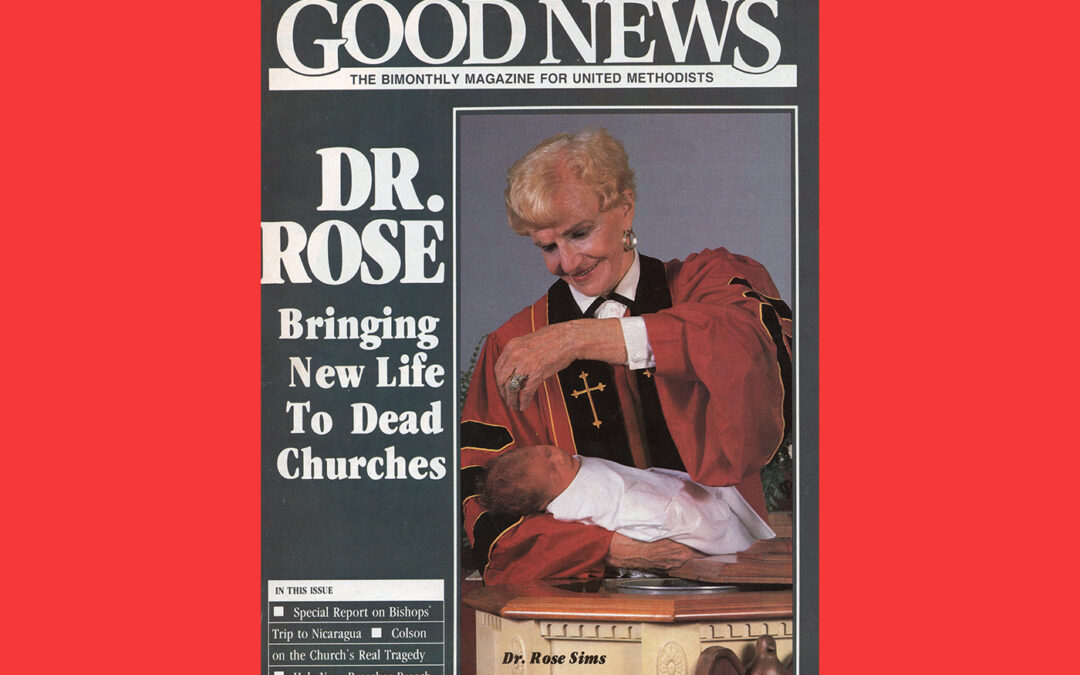
by Steve | Mar 20, 1989 | Archive - 1989
Dr. Rose: She has an unshakeable Hope for Dying Churches
By Sara L. Anderson
March/April 1989
Have a country church with waning membership, a dilapidated building and no hope? Don’t call the coroner, call Dr. Rose.
While the United Methodist Church has closed more than 4,000 churches, mostly rural ones, in the last 20 years, Rose Grindheim Sims has been in the resurrection business. Her determination and commitment to evangelism and mission have left vital congregations where the doors were once nearly nailed shut. “You can’t save the whole world, but you can save your own little corner of it,” said Dr. Rose.
Take Trilby United Methodist Church, Dr. Rose’s latest congregation. In the fall of 1984 when the good doctor walked into this little crossroads church in Florida’s rural Pasco county, she found a run-down, turn-of-the-century-vintage sanctuary with a rusty roof and a ramshackle lean-to. The handful-sized membership list indicated certain death. But to Rose Sims this was a challenge, not a source of despair. “From the minute I walked in,” she recalled, “I saw it filled with people.”
So she and her husband, Jim, retired from the Air Force, rolled up their sleeves, knocked on doors (“Knuckle Power”), and offered people Christ. They also began meeting the physical needs of that impoverished community 30 miles north of Tampa.
Now a new, debt-free plant built with volunteer labor and valued at $400,000 stands at the crossroads. The old building has been refurbished and turned into a fellowship hall, the lean-to has become a church parlor. Trilby facilities house a mission with a clothes distribution center. There’s also a free clinic staffed by the Pasco County Health Department where expectant mothers come for prenatal care and toddlers receive vaccinations. Trilby is home to a Scout troop, an Alcoholics Anonymous group, a dinner theater, senior citizens’ activities, and adult education classes. An Evangelism Explosion program and a thriving singles’ group which packs up and distributes hundreds of pounds of food monthly to needy families are also part of the ministry.
Membership stands at more than 226, mostly on professions of faith, and worship attendance fills the sanctuary. And, in a gesture that would warm any annual conference treasurer’s heart, the church pays its yearly apportionments in full – in January. The congregation has decided that its facilities are open for community use as long as users do not violate the principles of Christ. After all, Dr. Rose says, “It’s not our church; it’s God’s church.” Trilby members also believe the facilities should be put to good use instead of being carefully preserved for Sunday use alone.
Children with grubby hands and dusty feet are not shushed and directed out the door of the lovely sanctuary. “This is the most beautiful building in our community,” Dr. Rose says. “We want the children to see that God’s house can be beautiful.” Besides, she adds, “If we wear out this building, we’ll build another one.”
Members and visitors find the congregation extremely warm, accepting and non-judgmental – folks are embraced despite their hurts, problems or status in the community. Dr. Rose explains, “God doesn’t clean his fish before he catches them.”
Perhaps that’s why Dr. Rose has seen such success. She focuses on what’s important instead of on petty things that alienate people and divide congregations.
“Love them, help them let them know there is salvation in Jesus Christ,” she said.
So impressive is this country congregation that Dr. Rose and Trilby have been extensively covered by local and regional newspapers. The congregation has headed Florida UM churches on professions of faith ratio and has led its dynamic pastor to Methodism’s Circuit Rider Award for church growth.
Oscar Grindheim would be proud. You see, when Rose fell in love with this Norwegian church-growth pioneer more than 45 years ago, she also made his vision for opening dying churches her own. For 27 years, first as Baptists, then as Methodists, they revived dead Midwest country churches. With three of their own children, two adopted and several foster children on their way to maturity, the Grindheims were looking forward to teaching in a Missouri college (Rose had just earned a doctorate in educational psychology) and opening yet another country church called New Hope.
But Oscar, dying of Lou Gehrig’s Disease in 1971, encouraged Rose to lead New Hope and gave her this charge: “Make Methodists see that it can happen anywhere, and it must happen everywhere.” Reluctant at first, she was approached by 14 families who had received Christ under her fledgling ministry and who pledged funds and labor for construction of the church. New Hope lived up to its name, and she left a thriving congregation because “people got saved, people got loved, people got caring.”
Dr. Rose believes this can happen anywhere if you offer people Christ, meet their physical needs, and receive help and encouragement from the body of Christ. One of her favorite proposals is, “I’d like to offer you the opportunity to do something significant that will last for eternity.”
Individuals and larger churches have responded to the challenge by contributing time, money, and used furnishings. What happened at Trilby is an example of the pattern she and Oscar had seen happen over and over again.
After Dr. Rose married Jim Sims (her second husband also died), the couple moved to Florida to golf, sail, and enjoy retirement. After six months, at the call of God and Jim’s urging, Dr. Rose took Trilby Church. She considered her years of experience in church growth and education and put them to work. “You can’t take these skills, see a need and not use them,” she said.
Yet, she would never consider the work a burden. She recalls how she and Jim sat in the sanctuary one evening just to look at that beautiful church. His rhetorical question summed up that ministry for both of them. “Haven’t we had fun doing this? Haven’t we been blessed?!”
When this was published in 1989, Sara Anderson was associate editor of Good News.

by Steve | Mar 13, 1989 | Archive - 1989
Archive: Unpacking Charles Wesley’s “O For A Thousand Tongues”
By Riley B. Case
March/April 1989
Good News
If there were a hymn that might claim the title “The Methodist National Anthem” it would be “O For a Thousand Tongues to Sing.” For two hundred years this hymn has been the first in the Methodist hymnal.
“O For a Thousand Tongues to Sing” was based on a remark by Peter Bohler, a friend of the Wesleys, who commented one day, “If I had a thousand tongues I’d praise Christ with them all.”
The resulting hymn was written by Charles Wesley with eighteen verses. In the interest of brevity, recently hymnals have carried only six verses. However, because of the potency of the hymn’s message, the new 1989 hymnal has printed nearly all of the original verses. To sing the hymn is to worship the living God and give testimony to the heritage United Methodists hold as precious.
My gracious master, and my God,
assist me to proclaim,
to spread thro’ all the earth abroad
the honours of Thy name.
Charles Wesley wrote “O For a Thousand Tongues to Sing” in May 1739. The original title was: “For the Anniversary Day of One’s Conversion.” A year earlier, in May 1738, both John and Charles Wesley had come by faith to a relationship with Jesus Christ.
John’s was a dramatic conversion. After a strict religious upbringing, a disciplined devotional life, ordination as a priest in the Church of England, and a trip to America to save the Indians, he realized he did not have the faith about which he preached. A Moravian friend, Peter Bohler, helped Wesley realize salvation depends on the merits of Christ alone.
On May 24, 1738, while attending a small group in a room off Aldersgate Street in London, John Wesley felt his heart “strangely warmed.” He knew the assurance of salvation for the first time.
On this glad day the glorious Son
of Righteousness arose,
on my benighted Soul He shone,
and fill’d it with repose (vs. 2).
John’s record of his Aldersgate experience is found in his journal for May 24, 1738: “I felt I did trust in Christ, Christ alone for salvation, and an assurance was given me He had taken away my sins, even mine, and saved me from the law of sin and death.”
Sudden expir’d the legal strife,
‘twas then I ceas’d to grieve,
my second, real, living life
I then began to live (vs. 3).
Charles Wesley’s conversion, though not so dramatic, was no less real. Like John, Charles had had a strict, religious upbringing; had belonged to the same rigidly-disciplined “Holy Club”; had been ordained a priest in the Church of England and had gone to America as a missionary. And just as with John, Charles came first to a commitment to the doctrine of salvation by faith. He wrote in his journal for Wednesday, May 17, 1738:
“Who would believe our church had been founded on this important article of justification by faith alone? I am astonished I should ever think this a new doctrine; especially while our Articles and Homilies stand unrepealed …. From this time I endeavored to ground as many of our friends as came into this fundamental truth, salvation by faith alone.”
A few days later Charles came to a living faith.
Then with my heart I first believ’d,
believ’d with faith divine,
power with the Holy Ghost receiv’d
to call the Savior mine. (vs. 4)
In the year following the conversions of John and Charles Wesley, the Methodist revival began to spread. The Wesleys’ message centered on Jesus Christ.
Jesus! The name that charms our fears,
that bids our sorrows cease,
‘tis music in the sinners ears,
‘tis life, and health, and peace (w. 9).
This Jesus-centered message was in contrast to the deism, rationalism, and sacramentalism (which stressed the sacraments) that characterized the religious thinking of much of 18th century England. Methodism’s evangelical message centered on the Reformation doctrine of salvation by faith alone.
Look unto Him, ye nations, own
your God, ye fallen race!
Look, and be sav’d, thro’ faith alone;
be justified by grace (vs. 13).
In contrast to confessionalism (a form of Protestant scholasticism which stresses creeds and right beliefs), Methodism’s evangelical message stressed a new birth that could be experienced personally.
I felt my Lord’s atoning blood
close to my soul applied;
Me, me He lov’d – the Son of God
for me, for me He died (vs. 5)!
In contrast to the deadness which characterized the church of Wesley’s day, Methodism’s evangelical message spoke of power and joy.
Hear Him ye deaf, His praise ye dumb
your loosen’d tongues employ,
the blind, behold your Savior come,
and leap, ye lame, for joy (vs. 12).
The Methodist movement defined the word evangelical as the understanding of Christianity being centered on the person and work of Jesus Christ, particularly (in the words of the Abingdon Catechism) His “incarnate life, atoning death, and glorious resurrection.” But evangelicalism was more than an “understanding.” It was a message preached and lived: salvation by faith, the new birth, holy living and a desire to reach the lost.
He breaks the power of cancell’d sin,
He sets the prisoner free:
His blood can make the foulest clean;
His blood avail’d for me (vs.10)
Whenever he could, John Wesley preached this salvation message in the established churches of England. But because his message was thought to be controversial, invitations to preach were often withdrawn. In such instances Wesley joined his friend George Whitefield to preach in the open air.
It was there, among miners, poor people and common people, that the revival began to spread around England. The journals of both John and Charles are filled with reference to hundreds crying to God for mercy.
“O For a Thousand Tongues Sing” became a reflection on the conversion of many Methodists. And the hymns of Wesley were often the testimonies, the teachings, and even the altar calls of the revival from which Methodism was born.
See all your sins on Jesus laid;
the Lamb of God was slain,
His soul was once an offering made
for every soul of man (vs.14).
To appreciate “O For a Thousand Tongues to Sing” it is helpful to ask three questions.
1. What is the hymn about? Often we sing “O For a Thousand Tongues to Sing” as an opening hymn of praise in worship. But the hymn is about more than praise to God. It is about specific praise to Jesus for what has been accomplished on the cross and for the new life in Christ available to us. This is followed by a compassionate appeal to the unsaved to believe in Jesus Christ. Actually, this is song is about the gospel.
2. Who is speaking? We, of course, think church attenders are speaking. For Wesley, however, church attenders were Christians at some point on their Christian journeys.
In “O For a Thousand Tongues to Sing” we celebrate the new-found joy of salvation (the hymn, remember, was originally titled, “For the Anniversary Day of One’s Conversion”). And from the vantage point of a new convert, we follow the new believer’s testimony through several stages on the way to salvation: sin (vs. 2 ), justification (vs. 3), free grace (vs. 4), assurance (vs. 5) and regeneration (vs. 5).
3. Who is being addressed? Prior to Wesley many of the hymns in the hymnal were addressed to the Church or the worshiping community. Wesley hymns introduce an additional feature: verses are addressed to sinners; that is, the lost outside the saving grace of Christ. By addressing sinners Wesley introduced to the evangelical world the invitation hymn.
Without sounding judgmental these hymns, in an unusually compassionate tone, beckon the broken heart to “come,” which has become one of the most precious words in the evangelical faith. The following familiar verse is an example.
Come, O my guilty brethren come,
groaning beneath your load of sin!
His bleeding heart shall make you room;
His open side shall take you in.
He calls you now, invites you home:
Come, O my guilty brethren, come!
With Methodist societies singing this invitation across the fields and in the homes of 18th-century England, it is easy to understand why there was revival.
“O For a Thousand Tongues to Sing” actually addresses several audiences: the triune God addressed in praise (verse 1 ); the congregation (or the world) addressed with the testimony of salvation (verse 2); Jesus addressed in petition (verse 8); the congregation (or the world) addressed with the gospel message (verses 9-11); the spiritually deaf, blind, and lame invited to believe (verse 12); the nations invited to believe (verses 13-14); harlots, publicans and thieves invited to believe (verse 15); murderers and sons of lust and pride invited to believe (verse 16).
Recognizing its diversified audience, we can understand how “O For a Thousand Tongues to Sing” was used of God to bring about revival.
At the publication of this article, Riley B. Case was district superintendent in the North Indiana Conference, a Good News board member, and author of Understanding Our New United Methodist Hymnal. Portrait of Charles Wesley is public domain.