by Steve | May 20, 1995 | Archive - 1995
Archive: Hosannas in Havana
By Thomas C. Oden
My first Sunday evening in Cuba took me to an Afro-Caribbean Methodist church on the outskirts of Havana. An exuberant charismatic revival was clearly in progress. The church was crammed full; no seats anywhere. People of all ages were standing in the front, back, and along the walls.
Although conditions have improved, being a Christian in Cuba is still a risky business. No one witnesses without peril. Hence, most Cuban Christians are willing to be martyrs in the classic sense of that word. This charges every baptismal decision, even every church service, with radical seriousness. It helps the church to understand precisely what is its most important task and to examine all other options accordingly. Cuban believers are learning firsthand where their most compelling accountability lies: to their risen Lord.
I was ushered to the front row and squeezed in. People were kneeling, facing the pew, and praying aloud with an unpretentious abandon that caught me off guard. The Lord’s Table was set. Directly in front of me was a Casio keyboard, two large conga drums, a tangle of electronic musical equipment, and a rococo trap set. Cuban revivalism, I could tell, would have a strong Afro-Caribbean beat.
As the spirited praise music increased, kids from the street began peering in the windows. A whole baseball team of adolescent eyes were transfixed by the service of Holy communion, scrutinizing every move, every syllable. The liturgical form of the Lord’s Supper was the old Book of Common Prayer-based Methodist liturgy, which I have known since childhood, adapted to the Afro-Cuban culture.
Six “glory singers” led congregational singing. Younger kids especially joined in with heartfelt praise, hands held high. This was a family event, a neighborhood happening.
As the music mounted in exuberance, the lights went off unexpectedly, leaving us in a blackout—a chronic symptom of Cuban life today. But the singing, rocking congregation never skipped a beat as a kerosene lantern was brought in to reilluminate the event.
From day one I could see that a dynamic, no-nonsense revival was taking place. Contrition, repentance, faith, and new birth were in the air. It was a scene that could not be faked, an unfeigned work of God. Emotion flooded my heart. These were my brothers and sisters—members of the body of Christ in which I live and breathe.
A Youthful Pentecost
The sermon was as ardent as the prayers and singing. Its focus: We are in a war with Satan. We already know the end, but the struggle goes on. You are invited to make a decision. It could be the most important decision of your life: accept Jesus in your heart. Trust him for forgiveness of your sins.
Those ready to follow Christ wholeheartedly were asked to raise hands quietly. God bless you, the preacher said repeatedly, maybe 20 times. The Spirit was ricocheting through that packed hall. More than a dozen came forward—many of them adults under 25, educated on a diet of socialist and atheistic ideology.
Whatever the ideological obstacles, they are not blocking the work of the Spirit in Cuba. No human power can do that. There is an incurable religiousness embedded in the Cuban consciousness. It has been there all along, frozen for some decades by the socialist revolution, but now showing itself as a vigorous survivor, like a seed planted in winter.
It is the Cuban youth who are busy leading their people in religious revival. The movement is youth-led because it is the hopes of youth that have been most fiercely undermined by the regime. Even state-managed television, replete with the bravado of socialist ideology, is less interesting than self-made music, dancing, reading, self-education, and family entertainment.
Roberto, born Methodist, educated in the atheistic school system, is lean and bony—gaunt, as are many Cuban young people. Along with seven colleagues in his central Cuban youth group, Roberto prayed on his knees well into the night, seeking the baptism of the Holy Spirit.
“At first we were a little afraid of it. Then we said together, as with one voice, to God: ‘We are going to remain on our knees until you baptize us with your Spirit.’ I was like Jacob wrestling with the angel, pleading: ‘I am not going to let go of you until you reveal yourself.’
“That night, when our pastor discovered that we were searching for this experience, he chided us, saying that nothing was going to happen, that we were wasting our time. But when he saw that some of us were receiving the gifts of the Spirit, he then joined in with us in our prayer vigil. Soon the pastor was asking the Spirit to anoint him as well. That night was the start of a ministry of the gifts of the Spirit: of discernment, of love, of understanding, and even of healing.”
As the young man spoke, my mind could not help turning to Acts 2. Were the events of Pentecost being replayed in the churches of this troubled republic?
Roberto beamed as he informed me that his youth group has 128 kids, and that 50 people would be joining his church the following Sunday. His faith was contagious.
Choosing Life
The only entree for Americans to Cuba is by invitation. This has resulted in a long train of liberal ecclesial sycophants traveling to Cuba to pay homage to Castro and condemn American policy. When my invitation came out of the blue from Methodist Bishop Joel Ajo, I was glad to learn that this sort of quasi-political game-playing was no longer necessary.
With the revolution came an influx of leftist philosophies to the church. Prior to Castro’s regime, Protestant missions in Cuba were shaped by Anglican evangelicals, Reformed individualists, and Wesleyan revivalists. The majority of lay Cuban Christians remain basically conservative and evangelical. Yet, ironically, the only link between these lay congregations and the North American Christian laity has been through an ultra-liberal church bureaucracy whose liberation-theology rhetoric now sounds passe to Cuban ears.
Staying its course amid the ideological fog has been the Methodist Church of Cuba, an autonomous church that has been evolving with practically no help from the outside world for more than 30 years. This has freed the church to rediscover its own distinctive Caribbean evangelical identity, and now it is growing profusely. Once down to 6,000 members, Cuban Methodism now numbers more than 50,000. One local church in central Cuba has 26 house churches averaging more than 50 persons per home.
Cuba’s house-church movement is a prime example of the explosive growth taking place among evangelical believers. Born out of the repressive policies of the revolution, house churches evolved as Christians spontaneously began inviting people to their homes for prayer, hymn singing, and Bible study. As with the early Christian church, the threat of persecution became an impetus for expansion.
One thing is certain: in a crisis of life or death, Cuban evangelicals have chosen life—the life lived through the power of the Spirit.
Thomas C. Oden is the Henty Anson Buttz professor of theology and ethics at the Theological School, Drew University. He is an ordained UM minister, author of numerous books, and a contributing editor of Good News. This article first appeared in Christianity Today, April 25, 1994.
by Steve | May 17, 1995 | Archive - 1995
Archive: What is Biblical Revival?
By Peter H. Davids
Christians today are praying for revival, books are being written about it, and crowds gather at revival conferences. But what does revival look like in the Bible? John White defines revival as “an action of God whereby he pours out his Holy Spirit, initially upon the church; and it comes as an alternative to his judgment which is about to fall on the church and on the secular world.” We may break down our definition of revival into four parts:
- God initiates it,
- it creates widespread repentance, including the conversion of unbelievers,
- it changes society in some significant way, and
- it averts God’s judgment.
Where do we find any good biblical examples?
Old Testament revivals
While we will not see many references to the Spirit of God being poured out in the Old Testament, we do see the hand of God creating revival among his people. Space limits us to discussing three important examples. Joash‘s revival. In II Kings 11-12 and II Chronicles 23-24 we read of the revival under Joash. In this case, Judah’s rulers had imposed Baal worship. There’s no visible move of the Spirit reported. Instead, the high priest Jehoiada creates a type of revival through political intrigue. Baal worship is destroyed and over time the temple is restored. Unfortunately, Baal worship returns even before the king dies, for as Joash followed Jehoiada much of his reign, so he followed others (who were influenced by the northern kingdom) after the death of that good priest. Nevertheless, the next three kings of Judah were all reasonably godly individuals. The return of Baal worship was apparently temporary and confined to the upper classes. What can we learn from this revival? First, in some revivals the up front leaders are not the real leaders. Second, revival from the grassroots will likely last longer than a revival that comes mainly from the leaders. Even bad leaders will usually not be able to fully put out widespread public devotion.
Hezekiah’s revival. Hezekiah’s revival was quite different. In this case one man, Hezekiah, appears to have inspired the revival (II Kings 18). We do not read of any repentance among the people, although the troubles of the previous years may have prepared them. Nor do we discover any reason why Hezekiah surpassed his father. According to II Chronicles 30:10-12, the people fully supported his leadership. This revival had a widespread social effect, both with the removal of idolatry, including longstanding private Yahweh shrines, and with the reformation of the temple services (II Chronicles 31:1-10). We hear nothing about any powerful acts of God until after the revival has already purified the land: Sennacharib invades and God acts to defeat him. Unfortunately, Hezekiah’s son Mannaseh, who was probably co-regent with him for the last 12 to 15 years of his reign, appears to have undone the effects of the revival.
What can we say about this revival? First, it was probably as much a political revival as a spiritual one. While Hezekiah acted out of zeal for God, his support among the people was likely out of hatred of the Asyrians. Second, because of this, even during the revival period God prophecies the demise of Judah. Spiritually, things seemed to be going well, but in the eyes of God they were not going well at all. Third, the people who had followed their leader into “revival”‘ were ready to follow another leader. Mannaseh, into idolatry. He could introduce it easily because he also was viewed as anti-Assyrian.
Josiah’s revival. In II King 23 we read of Josiah, who began to reign at 8 years old and at 18 began to restore the temple. One can only speculate why he started cleaning up the temple. Perhaps Hezekiah’s time had been a time of deliverance and Manasseh’s had been one of subjugation, so Josiah wanted to restore the political independence of the former time. Perhaps it was because he was under the influence of unnamed advisors who were loyal to Yahweh. Whatever the case, he began by simply restoring temple worship. It was only after the discovery of the Law (at least Deuteronomy) that he begins revival work in earnest. That leads to a number of reforms throughout his realm, including the destruction of pagan altars and the celebration of the Passover.
The people joined him in his covenant before Yahweh, yet we learn two further things: (1) Yahweh did not turn from his anger, and (2) there was a quick return to pagan forms of worship after Josiah’s death. Because Pharaoh, an ally of Assyria, killed Josiah the people may have deemed worship of Yahweh as powerless to bring deliverance from Assyria as it had in Hezekiah’s day. When the next king suggested a different tactic, the people agreed.
What can we learn from this revival? First, simple obedience to Scripture can drive revival. There is no mention of God’s Spirit in this revival except the Spirit in the Word; in fact, God seems set on destroying Judah. Second, while revival is defined as an alternative to judgment, it often only holds off judgment. Third, people will often join in a revival because of the benefits it seems to offer, and will quickly abandon the revival if some other course seems more profitable.
Nehemiah s revival. In the first seven chapters of Nehemiah we see a leader who inspires others, but seems to be the only person with vision. He struggles against the odds to lead the people to rebuild the walls. Then in chapter eight we get something of a revival, for Ezra reads the Law and the people respond with repentance. Significant social change ensued, although it was short-lived. When Nehemiah returns in chapter 13 he needs to redo some of the very things that were the focus of the revival teaching in the previous chapters. Still, eventually the revival teaching took root. After the time of Ezra the basic shape of New Testament Judaism appears, applying the very laws that were so important for Nehemiah.
What can we learn from this revival? First, revival took place after extensive groundwork and developed over many years, although there was a point of breakthrough and spontaneous repentance. Second, the work of the revival did not “stick” all at once. It had to be repeated. The instant repentance of a revival situation may need to be worked out or even repeated later. Finally, this revival was based on the people understanding scripture. While not all revival preachers have been great Scripture interpreters, a solid understanding of Scripture forms the best foundation on which to build revival practices.
New Testament revivals
Revival in the New Testament differs from that in the Old. First, we are dealing with a supra-national people of God rather than the national people. Second, we have the Spirit poured out upon all Christians rather than just upon anointed leaders. Yet we have fewer examples of revival: at the end of the century less than 10 percent of the people in most areas were converted; there was no marked social change; and the church was more or less underground, often persecuted. These are not the marks of revival. Yet, in Jerusalem and Ephesus we find something like revival.
Jerusalem revival. The church started in Jerusalem in a revival-like situation. Large numbers of people were converted in a relatively short time. If the permanent population of Jerusalem was only about 25,000, a group of 5,000 Christians (Acts 4:4) was a very significant factor in the city. The level of the miraculous was highly significant (Acts 5:12-16), and this was obvious to all from the sick being laid in the streets. Internally, the church was in good shape, as indicated from their sharing and their ability to come to a unified, trusting decision over an explosive topic (Acts 6). All this probably took place within the first year after Jesus’ resurrection without church buildings, without modern communication, without even large venues for gathering.
What was the outcome of this revival?
There was remarkable church growth, including the conversion of many priests, yet the outcome of it was the scattering of the church. The church did not keep on growing until it became the most influential force in the city. Instead, the church was attacked and scattered. Even if only the Greek-speaking Jewish Christians were scattered (which is likely) the explosive growth slowed. There were mighty signs and wonders and great growth, but it led to eventual rejection, not eventual triumph.
Ephesian revival. In Acts 19:10-12 we read that because of Paul’s activity in Ephesus, all who lived in the whole province of Asia heard the gospel and that extraordinary miracles occurred over the period of two years. The depth of the repentance shows in the burning of magic books (Acts 19:18-20), for these people were making a decisive, expensive break with the past. These are certainly revival phenomena, although revival started more slowly than in Jerusalem.
The outcome of this revival is similar to that in Jerusalem. It ended, not with the conversion of the city leaders of Ephesus (although some were converted, Acts 19:31), but with persecution. Paul, who speaks of his being crushed and despairing of life (II Cor. 1:8-9), ends up leaving town quickly (Acts 20:1) and the last picture we get of the church is of a doctrinally correct group in which the Christians no longer love one another (Rev 2:4-5).
Conclusions
What can we conclude from this brief description of revival in the Bible? Let us draw together some of the threads.
Revivals often relate to sociological phenomena. In the Old Testament we noted that many of the revivals had political oppression or similar sociological phenomena as preparation. Jerusalem had many people in its pilgrim throngs who longed for a Messiah to end the Roman oppression. Just because one can point to these phenomena does not mean that revival can be explained away. God prepares people for revival in many ways, not least of which is through various forms of oppression. People join in revivals for a variety of reasons. Some people join because their hearts are truly turning to God. Others join because they see in it the hope of (political or social) freedom. Still others join because they want to be in on what is happening or simply to be close to the power of the leader. Involvement in revival phenomena doesn’t reliably measure a person’s true heart condition.
Revivals may start suddenly or may develop gradually. Pentecost started with an explosive one-day conversion of 3,000 people. The persecution probably started no more than a year later. In Ephesus the revival seems to have started slowly, but before the end of two years, extraordinary power was being displayed.
Repentance often precedes or accompanies revivals. This was true at Pentecost and in many, but not all, of the Old Testament examples. In all of these cases it was Jews, the people of God, who were repenting. Yet in Ephesus, the repentance (seen in the burning of the books) seems to have followed the development of the revival. Likewise, some of the Old Testament revivals began by powerful movements of repentance, while in the case of Nehemiah’s revival it was a late feature of the movement. We cannot create revival by repentance, but if revival runs its course we will likely see the people of God purified.
Revivals usually have a strong leader as a central figure. Revivals usually center on a person, often a charismatic individual, who has, or is seen to have, power. Even Joash’s revival fits the pattern, for although he was himself led by others, the nation as a whole saw him as a leader. In Jerusalem there were 12 apostles, but it was Peter’s shadow that people wanted to fall on them. In Ephesus Paul had close colleagues around him, but it was his “handkerchiefs” that were curing people.
Thus, if God sends revival, strong leaders will likely emerge—even in groups that want to discourage such charismatic figures.
Revivals often have a strong biblical base. Whether it was the case of a prophet pointing people back to the ancient traditions, Josiah discovering anew the law, or Peter proclaiming the relationship of the Old Testament to the life and death of Jesus, revival is normally based on the Bible and rooted in a new appreciation of the biblical text. Revival phenomena will not likely produce lasting good unless they drive people to a deeper study of the Scripture resulting in a more devoted living of Scripture. Revivals’ effects depend upon what happens to the majority of the people. When large numbers of people change their lives, revival lasts. If people only change while around the revival leaders or while the influence of these leaders is felt, then it is unlikely that the revival will produce lasting good. The best place to measure the real effect of the revival is at the grassroots, not among the leaders of the movement.
Revivals end. All the revivals we have observed ended, some after a short time and some after a longer time. Revivals are not the normal state of God’s people, but extraordinary visitations that give the normal work of the people of God a boost.
Revival may lead to persecution as easily as to triumph. It is untrue that if enough signs and wonders occur and enough people are converted then the culture as a whole will turn to Christ. This may appear superficially true in the Old Testament, for it was usually the cultural leaders (the king, among others) who were leading the revival.
But both New Testament examples ended in persecution. Revival heightens the action of God, but it also heightens the resistance of those against God’s move. Revival may lead to triumph, but the New Testament examples show that they also may lead to being crushed.
This is a sobering—but realistic—note to end on. We long for revival, but at the same time we know that it has its price. However, would we not endure being crushed like Paul if our “all Asia” heard the gospel? Even so, Lord, bring revival.
Peter Davids is a researcher and theological teacher on staff at the Langley Vineyard Christian Fellowship in Langley, BC, Canada. He is also a visiting professor at Regent College in Vancouver, BC, Canada.
by Steve | May 16, 1995 | Archive - 1995
Archive: When Will It Stop?
by Dennis F. Kinlaw
The Spring 1970 Asbury College Ambassador carried this column written by then president, Dennis Kinlaw. His answer to the question posed in the title has new significance 25 years after the Asbury College Revival.
Two questions have been common in the last six weeks as those of us at Asbury have talked with others. The first was “When will it end?”
When it became obvious that the presence of the Spirit on the campus was continuing, the question then became “How long will it last?” Of course most have meant the special services that have accompanied the revival. But does the revival end when special services stop? Not necessarily and hopefully not. God’s works are not acts of passing fancy, but movements with long-range designs.
The most exciting part of this period of blessing is yet to come. Many people, both young and old, have come to know pardon, peace, heart purity, and the presence and power of God. They have found new relationships with their fellows as well as with God. They have also found a new perspective of purpose for themselves. More clearly than ever they have heard God’s voice saying “Whom shall I send and who will go for us?” Their faces are now lifted to the future and to the problems that confront our world. Revival time is a time of gathering of workers. Always when the Spirit has moved in power, men have felt a call to service.
The problems that face us today are enormous. The population explosion with its unevangelized millions, the increasing breakdown in our society of moral restraint, the bitterness that extends from race to race and class to class and nation to nation, the low value placed upon human life, the despair that grips our world—all threaten to destroy us. The State and the Church have talked long and fervently about these and yet have failed to offer any significant help in their solution. In the past when revival has quickened men, they have turned to confront seemingly impossible tasks and, with God’s help, have done wonders.
In the past, revival times have prepared the Church for persecution or for service. The purpose of the present movement may be for both. Let us pray that it will at least accomplish the latter.
Reprinted with permission.
by Steve | May 15, 1995 | Archive - 1995
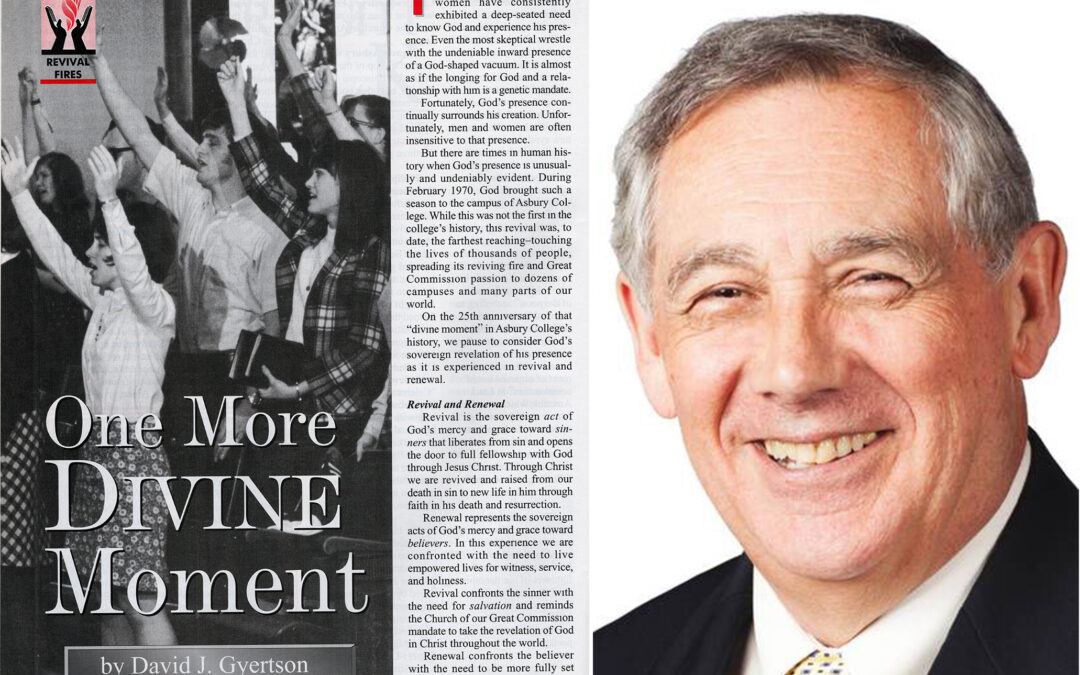
Archive: One More Divine Moment
By David J. Gyertson, 1995 —
Throughout history, men and women have consistently exhibited a deep-seated need to know God and experience his presence. Even the most skeptical wrestle with the undeniable inward presence of a God-shaped vacuum. It is almost as if the longing for God and a relationship with him is a genetic mandate.
Fortunately, God’s presence continually surrounds his creation. Unfortunately, men and women are often insensitive to that presence.
But there are times in human history when God’s presence is unusually and undeniably evident. During February 1970, God brought such a season to the campus of Asbury College. While this was not the first in the college’s history, this revival was, to date, the farthest reaching – touching the lives of thousands of people, spreading its reviving fire and Great Commission passion to dozens of campuses and many parts of our world.
On the 25th anniversary of that “divine moment” in Asbury College’s history, we pause to consider God’s sovereign revelation of his presence as it is experienced in revival and renewal.
Revival and Renewal
Revival is the sovereign act of God’s mercy and grace toward sinners that liberates from sin and opens the door to full fellowship with God through Jesus Christ. Through Christ we are revived and raised from our death in sin to new life in him through faith in his death and resurrection.
Renewal represents the sovereign acts of God’s mercy and grace toward believers. In this experience we are confronted with the need to live empowered lives for witness, service, and holiness.
Revival confronts the sinner with the need for salvation and reminds the Church of our Great Commission mandate to take the revelation of God in Christ throughout the world.
Renewal confronts the believer with the need to be more fully set aside for holy purposes and service (sanctified) – reminding us of our Great Commandment responsibilities to live Spirit-filled lives marked by sacrificial love for God and our fellow man. These two major interventions of God are particularly important. They put us in touch with the heart, mind, and will of God.
We must, therefore, responsibly seek God for these sovereign works. Though we cannot manufacture them, we can prepare for them. When God moves in revival and/or renewal among us, we must be ready to fully participate and completely receive.
The sixth chapter of Isaiah suggests three identifying effects that accompany the revival and renewal God brings to his people.
1. A Grander Revelation of God’s Nature
Renewal and revival open our spiritual eyes and ears more fully to comprehend the nature of God in creation, in the Scriptures, and in Jesus Christ. Our understanding of God’s nature intensifies in three ways.
First, his omnipotence is more evident (Isaiah 6:1-4). We see God high and lifted up, and we clearly discover that everything in heaven and earth is under his divine influence and control. In revival, worship, and testimony, we realize that his throne is the most powerful in all of creation. His “train” (his influence) fills all of creation. His spoken truth shakes the foundations and doorposts of our thoughts and imagination.
When revival and renewal really come, they reveal the absolute power of God to all who participated. All worry, fear, and doubt in his ability dissipate. Divine power is demonstrated and appropriated.
Secondly, revival and renewal amplify God’s holiness and reveal his motives and desires. While his thoughts toward us are always those of deepest care and purest desire, in revival we grasp a greater faith to really trust his plans and purposes for us. We discover that God is not only able (omnipotent), but he is also willing (holy).
Thirdly, genuine revival brings the revelation of God’s ready willingness to forgive and forget. To our amazement and relief, we learn intimately that God does not have to be begged or badgered. His nature is to respond immediately to sincere repentance (Isaiah 6:5). His response is to cleanse us at the altar of sacrifice, casting our sin into the sea of his forgetfulness for all eternity.
2. A Greater Recognition of Our Need
Real revival and renewal also produce a greater recognition of our need. The power, holiness, and forgiveness of God shed a perfect light on the true nature of our separation from God. While each of us seeks to know God, we also fear the result of encountering God in his fullness. In psychology we call this an approach avoidance conflict. We instinctively know that revelation will be bi-directional. Not only do we see God for who he really is, we see ourselves for who we really are – sinners incapable of redeeming ourselves. As a result the call to revival and renewal is often received with mixed emotions. But we must come willing to see the whole truth about ourselves as well as the full truth about God.
True revival also reveals mankind’s universal desperation. We are brought face to face with both the fullness of God and the foulness of all mankind. While sin distorts and defaces the image of the Creator in every one of us, that divine imprint within us calls us to divine reconciliation. But we are unable to bring the reunion between God and ourselves to completion. History is full of the stories of desperate attempts to find God.
In renewal and revival we finally discover that though we cannot find him because of our limitations of ability and will, God is seeking us. He initiates the divine solution to our desperate situation.
In revival we finally admit that “It is not through works of righteousness that we have done but according to his mercy he has saved us” (Ephesians 2:9). And in renewal we discover that our righteous works are really “filthy rags” in God’s sight (Isaiah 64:6).
Finally, in personal renewal Isaiah embraced God’s solution to mankind’s deliverance. When revival really comes, we begin to see each individual as well as every cultural and ethnic group within God’s redemptive possibility and prerogative.
We discover that all of humanity is not just universally depraved but universally deprived. Our attitude is transformed from rejection of self and others to the redemptive acceptance of any and all who will admit their sin and embrace Jesus Christ.
3. A Gripping Responsiveness to God’s Call
One of the humbling mysteries of revival is that God desires to include each of the redeemed in his most important work – the restoration of the relationship between himself and humanity. In renewal we realize that God has a place and plan for everyone in the greatest work of eternity – the reaching of the lost.
Genuine renewal demands a counting of the cost. In the intensity of emotion that comes from gratitude for all that God is doing for us, we, like Isaiah, may almost be too quick to respond with “Here am I, send me!”(Isaiah 6:8). But God mercifully sobers our emotion by asking us to first fully assess the price of committing to the Great Commission.
Isaiah was challenged to aggressively share the message of God within a culture unresponsive and resistant to his message. Not much has changed thousands of years later. The work of God’s kingdom demands courage, discipline, sacrifice, and commitment. We run a life-long marathon, not just the 100-yard dash. Our venue may change as time passes and aging limits, but we will be continuously about this Great Commission work until he comes to take us home.
During times of real revival and renewal, the commands and the demands of living a fully surrendered life confront us. We are faced with the challenge expressed in I Corinthians 10:31 – “whatever you do, do it all for the glory of God.”
Revival’s Current Call
The signs of renewal are once again stirring on our campus, across the nation, and around the world. A great, earth-shaking, life-changing revival cannot be far behind. Renewal of God’s people often precedes the outpouring of great revival. Already the harbingers of what could be the greatest in-gathering of souls in church history are at our doors.
As you remember with us the great outpouring of God’s spirit on our campus 25 years ago, join with us today in asking God to do it again – and again – and again until the whole world has been touched – in and through you and our Lord’s Church.
David Gyertson was the president of then-Asbury College in Wilmore, Kentucky, from 1993-2000. Previously, he served as the president of Regent University in Virginia Beach, Virginia. Most recently, he served as Distinguished Leader in Residence at Asbury Theological Seminary. He is the editor of One Divine Moment: The Asbury Revival, 25th Anniversary Edition (Fleming H. Revell/Asbury College, 1995). This article appeared in the May/June 1995 issue of Good News.
by Steve | Mar 5, 1995 | Archive - 1995
Archive: A Wesleyan View of the Episcopacy
By Kenneth Cain Kinghorn
The roots of the United Methodist episcopacy reach back to September 1, 1784 when—in a private home in Bristol, England—John Wesley “set apart” the Anglican clergyman Dr. Thomas Coke as “superintendent” of the Methodist work in America. Wesley instructed Coke to ordain Francis Asbury when he arrived in America, and subsequently, to consecrate him as co-superintendent of American Methodism. Thus, Thomas Coke and Francis Asbury became Methodism’s first two bishops.
At the time of American Methodist beginnings, there were relatively few Anglican clergymen ministering in the colonies, and most Anglican priests were not keen on giving the Methodists holy communion.[1] Although on several occasions John Wesley urged the bishops of his church to send more clergy to the American colonies and to consecrate an American episcopacy, England’s bishops procrastinated. Wesley lamented, “They had nothing to do with America” (Letters, VII, 262).[2] When the War of Independence severed America’s political ties with England, many of the Anglican priests returned to England or migrated to Canada, leaving the American Methodists with virtually no access to the sacraments. As things stood, with out an Anglican bishop the Methodist preachers had no possibility of ordination. Wesley knew that if the Methodists in America were to have an ordained clergy it was up to him to provide it. So he consecrated Thomas Coke as a superintendent (bishop) for the American Methodists.
Wesley’s View of the Episcopacy
John Wesley’s consecration of Thomas Coke as Methodism’s first bishop resulted in the birth of a new denomination—the Methodist Episcopal Church. Although the American Methodists incorporated the word Episcopal into the name of their church, the Methodist episcopacy differed from that of Anglicanism. As was the case with many other matters, John Wesley’s view of the episcopacy influenced American Methodism.
First, John Wesley rejected the doctrine of apostolic succession. This theory maintains that the New Testament apostles, through the laying on of hands, transmitted the Holy Spirit to an unbroken succession of bishops. Allegedly, all who are not in the continuous line of succession are not valid Christian bishops. In 18th century England a number of Anglican bishops charged those who denied apostolic succession with “rank atheism.” Nevertheless, Wesley contended that apostolic succession was “a fable, which no man ever did or can prove” (Letters, VII, 284).
Moreover, Wesley did not accept the concept of “a third ministerial order” — a supreme prelate who governs the entire church. In contrast to those traditions which accept a pope, a patriarch, or an archbishop, Wesley found no biblical basis for a preeminent episcopal chair which bestows upon the occupant certain powers greater than that of the other bishops.[3]
Second, John Wesley held that the episcopacy is an office, not an order. In his early ministry Wesley believed that the offices of bishop and presbyter were two distinct orders (or ranks) of the ordained clergy (Letters, I, 274; II, 55). However, study and pragmatism[4] led Wesley to the conviction that the New Testament uses the terms “bishop” and “presbyter” synonymously (Journal, III, 232).[5] According to the Wesleyan tradition, if a separate order of bishops were necessary, “It would follow that [denominations without bishops] are no parts of the Church of Christ!—a consequence of shocking absurdity” (1862 edition of British Conference Minutes, I, 36).
The United Brethren and Evangelical Churches’ views of the episcopacy corresponded with the Wesleyan view. Referring to the consecration of the first two bishops of the Church of the United Brethren in Christ (William Otterbein and Martin Boehm), historian A. W. Drury noted, “That office, and not order, is meant no one will question.”[6] Similarly, the former Evangelical Church elected bishops, but never as a separate ministerial order.[7] When in 1946 those two denominations merged to form the E.U.B. Church, the bishops were designated “agents of supervision, not a separate order,”[8] and they were subject to the church’s General Conference (1947 E.U.B. Discipline, ¶ 437).
Third, John Wesley opposed an imperial episcopacy. Many 18th century Anglican bishops had little contact with the church, claimed special privileges, and refused accountability. A number of these bishops held plural offices which entitled them to several “livings” at the same time. Bishops with multiple livings compounded personal wealth, while they doled out pittances to others who looked after the churches. Bishop Richard Watson of Llandaff, for example, lived almost all his life at Windermere, while holding a university chair at Cambridge and maintaining 14 other widely scattered livings.[9]
In Wesley’s day the Anglican episcopacy was often obtained through political maneuvering, trading favors, and bribery.[10] Some bishops sat in the House of Lords and engaged in secular enterprises which yielded them money, pleasure, and power. However, they gave little thought to the churches for which they were responsible.[11] One historian noted, “The interests of the dioceses and the needs of the people do not seem ever to have been considered, nor would any bishop have been criticized for staying only a few months in a diocese if the chance of preferment to a more lucrative [bishopric] came his way.”[12]
Wesley insisted, “The plea for the divine right of Episcopacy was never heard of in the primitive Church” (Letters, III, 182). For Wesley, a bishop—in order to be effective—must maintain regular contact with the thoughts and needs of the lay and clergy members of the church. He had little patience with those imperial bishops whose arrogance, venality, and absence of biblical convictions caused them to place reason above Scripture and to neglect the flocks which they were obligated to feed.[13]
The early American Methodists agreed with Wesley’s conviction that bishops should move among the laity, and the new church’s first conference made accessibility a requirement of the episcopacy (1785 Discipline, p. 7). On one occasion, General Robert E. Lee, president of Washington College, at Lexington, Virginia, invited Methodist Bishop Enoch Marvin to deliver the school’s commencement address. Following the ceremony General Lee claimed Bishop Marvin as his dinner guest, but the bishop declined the invitation, explaining that he had promised “to break bread with Brother Senseny” the village blacksmith.[14] Because Methodism’s bishops traveled among, and conversed with, the lay people and clergy, the episcopacy understood the church’s needs and opportunities.
The British Methodist Conference of 1769 summarized the Wesleyan view of ecclesiastical supervision. The Methodist preachers agreed:
“1. To devote ourselves entirely to God; denying ourselves, taking up our cross daily, steadily aiming at one thing, to save our own souls, and them that hear us. 2. To preach the old Methodist doctrines, and no other, contained in the minutes of the Conference. 3. To observe and enforce the whole Methodist discipline laid down in the said minutes” (Minutes, 1812 edition, I, 87-89).
Thus, three elements emerge as the Wesleyan view of spiritual leadership—personal consecration to God, fidelity to Methodism’s doctrines, and patient fortitude. These components were profoundly to influence American Methodism’s concept of the episcopacy.
The Episcopacy According to the United Methodist Discipline
Building on the foundations of Scripture and the Wesleyan tradition, the United Methodist Discipline outlines the responsibilities of those whom the church elects as its bishops (¶ 514. 1-8). The church recognizes that the episcopacy is a demanding ministry, and the Discipline calls for bishops with specific gifts and graces. Three episcopal qualifications stand out as particularly important.
First, the United Methodist Discipline calls for bishops who are committed to God and to a disciplined spiritual life. Episcopal leadership “should rise out of nurtured and cultivated spiritual disciplines and patterns of holiness” (Discipline, ¶ 502.1). The requirement that spiritual leaders dedicate themselves to God and to holy living reaches back to God’s law revealed at Sinai: The priests “must consecrate themselves or the Lord will break out against them” (Ex. 19:22).[15] Religious leaders must “be holy to their God, and not profane [God’s] name” (Lev. 21:6). They “should guard knowledge … for [they are] messenger[s] of the Lord of hosts” (Mal. 2:7). In short, all that the priests did and said must be “for Yahweh.”[16]
Likewise, the New Testament stresses the spiritual and moral qualifications for church leaders, especially bishops. Bishops “must be blameless; [they] must not be arrogant or quick-tempered … or greedy for gain; but [they] must be … lover[s] of goodness, prudent, upright, devout, and self-controlled” (Titus 1:7-8). “A bishop must be above reproach” (I Tim. 3:2). According to Scripture, character is primary. For that reason, the church stipulates that bishops must be persons of “spiritual discipline” (Discipline, ¶ 502.3).
The Wesleyan Covenant Service contains the following prayer of commitment for all United Methodist Christians, and the bishops of the church should model its spirit: “I am no longer my own, but thine. Put me to what thou wilt, rank me with whom thou wilt; put me to doing, put me to suffering; let me be employed for thee or laid aside for thee, exalted for thee or brought low for thee … I freely and heartily yield all things to thy pleasure and disposal.”
Second, the United Methodist Discipline expects the episcopate to instruct the church and to uphold the biblical revelation. Bishops are to serve as theological teachers to the church (Discipline, ¶ 514.4). Accordingly, they must take time for study and self-renewal (¶ 502.2). The Discipline supports racial, cultural, and ethnic pluralism, but not doctrinal pluralism (¶ 16). There is but “one Lord, one faith, one baptism, one God and Father” (Eph. 4:6). The requirement of orthodox faith echoes the New Testament charge to Christian leaders to “contend for the faith once for all delivered unto the saints” (Jude 3).
In Wesley’s day, some of the Anglican bishops regarded it their first duty to be doctrinally tepid and theologically ambiguous. Some boasted, “There must be no enthusiasm, no heroics.”[17] Certain members of the episcopal “bench” feared more being suspected of believing too much, than of doubting everything. The Discipline, by contrast, calls for bishops who welcome the challenge to “guard, transmit, teach, and proclaim, corporately and individually, the apostolic faith” and who accept the commission to “support the evangelistic witness of the whole Church” (Discipline, ¶ 514.1, 7).
Third, the United Methodist Discipline stipulates that the church’s bishops be prophetic and courageous. Despite the few who object to military images, the church is at war against sin, injustice, and evil. Jesus declared, “I have not come to bring peace, but a sword” (Matt. 10:34). Paul contended, “Our struggle is not against flesh and blood, but against the rulers, against the authorities, against the powers of this dark world and against the spiritual forces of evil in the heavenly realm” (Eph. 6: 12). Because Christianity is locked in cosmic warfare against evil, its bishops must courageously “lead and oversee” the church militant until it becomes the church triumphant (Discipline, ¶ 514.1).
Jesus foretold that there would arise “false prophets in sheep’s clothing” (Matt. 7:15) who would “lead many astray” (Matt. 24:11). Peter also warned against those false teachers and leaders “who will secretly bring in destructive opinions [and] will even deny the Master who bought them” (II Pet. 2: 1-3). Paul grieved over those leaders who “desiring to be teachers” do not understand “either what they are saying or the things about which they make assertions” (I Tim. 1:7). Bishops are to stand forthrightly in the front line against false doctrines and unholy practices which seek to insinuate themselves into the church. Episcopal leaders must have “a firm grasp of the word that is trustworthy in accordance with the [apostolic] teaching, so that [they] may be able both to preach with sound doctrine and to refute those who contradict it” (Titus 1:9).
Jesus is, of course, the “chief shepherd and bishop (episkopos)” of the church (I Pet. 2:25, KJV), and he calls earthly overseers to lead his followers. The Wesleyan tradition understands the episcopacy as consisting of persons who are holy in their lives, catholic in their faith, and apostolic in their courage. Paul articulated an important reality when he quoted an epigram that circulated among the early Christians: “Whoever aspires to the office of bishop desires a noble task” (I Tim. 3:1).
Kenneth Cain Kinghorn is vice-president at-large of Asbury Theological Seminary in Wilmore, Kentucky. He is an ordained UM minister and author of numerous books, the most recent being The Gospel of Grace (Abingdon, 1992).
Notes
[1] S. D. McConnell, History of the American Episcopal Church, 10th ed., London: A. R. Mowbray & Co., 1916, p. 170.
[2] References to John Wesley’s Letters are to the John Telford edition, 8 vols., London: The Epworth Press, 1931.
[3] See British Conference Minutes, 1862 ed. (1744-1798), I, 36.
[4] See Henry D. Rack, Reasonable Enthusiast: John Wesley and the Rise of Methodism, Philadelphia: Trinity Press International, 1989, p. 295.
[5] References to John Wesley’s Journal are to the Nehemiah Curnock edition, 8 vols., London: The Epworth Press, 1938.
[6] A. W. Drury, History of the United Brethren Church, third revised ed., Dayton: The Otterbein Press, 1953, p. 185. See also John Lawrence, The History of the Church of the United Brethren In Christ, 2 vols., Dayton: United Brethren Publishing House, 1888, II, 51.
[7] Raymond W. Albright, A History of the Evangelical Church, Harrisburg, PA: The Evangelical Press, 1942, p. 174.
[8] Paul Himmel Eller, These Evangelical United Brethren, Dayton: The Otterbein Press, 1950, p. 121.
[9] J. H. Whitleley, Wesley’s England: A Survey of XVIIIth Century Social and Cultural Conditions, London: The Epworth Press, 1938, pp. 296-97.
[10] C. J. Abbey and J. H. Overton, The English Church in the Eighteenth Century, 2 vols., London: Longmans, 1878, II, 26.
[11] John H. Overton and Frederick Relton, The English Church from the Accession of George I to the End of the Eighteenth Century, London: Macmillan and Co., LTD, 1906, p. 95.
[12] John R. H. Moorman, A History of the Church in England, New York: Morehouse-Barlow, 1959, p. 279.
[13] See J. Wesley Bready, England Before and After Wesley, London: Hodder & Stoughton, 1939, pp. 62-63.
[14] Paul Neff Garber, The Romance of American Methodism, Greensboro, NC: The Piedmont Press, 1931, pp. 117-18.
[15] Except when noted, Scripture quotations are from the New Revised Standard Version.
[16] See Gerhard von Rad, Old Testament Theology, 2 vols., trans. from the German by D.M.G. Stalker, New York: Harper & Row, 1962, 1965, I, 242.
[17] W. H. Fitchett, Wesley and His Century: A Study in Spiritual Forces, New York: Eaton & Mains; Cincinnati: Jennings & Graham, 1908, p. 144.