
by Steve | Oct 1, 1970 | Archive - 1970
Archive: Strategies for Solution of the Church Crisis
Part One
Condensed from an address by Dr. Charles W. Keysor
Editor, Good News
Pastor, Grace United Methodist Church, Elgin, Illinois
We must “contend for the faith” by yielding ourselves to Christ, so that He can fight for truth through us.
The New Testament Letter of Jude was written to a Church in crisis, back sometime in the First Century. The Church, then, was plagued with apostacy; Christians renouncing beliefs they once professed … teachers presenting falsehood in the guise of truth.
Church history has a strange way of repeating itself. The old illnesses of the early Church come back to plague us – dressed, of course, in new clothes and speaking in contemporary accents. But underneath they are the same old heresies. Always they grow out of some deficient or perverted understanding of the Word of God.
From the Letter of Jude, Dr. Woodson and I shall each lift up one short passage as a kind of “hook.” Upon each hook we will hang several suggested strategies for solution of the Church crisis.
I call your attention to Jude, verse 3: “My dear friends! I was doing my best to write to you about the salvation we share in common, when I felt the need of writing you now to encourage you to fight on for the faith which once and for all God has given to his people.”
This obscure verse holds an important key to constructive action for solving the Church crisis.
“Contend for the faith,” or as J. 8. Phillips paraphrases it, “put up a fight for the faith.”
What does it mean for Christians to “fight on “? How shall we United Methodists fight on? Like Carl McIntyre? Like the Ecumenical Institute? Like Billy James Hargis? Like the political infighters in United Methodists for Church Renewal?
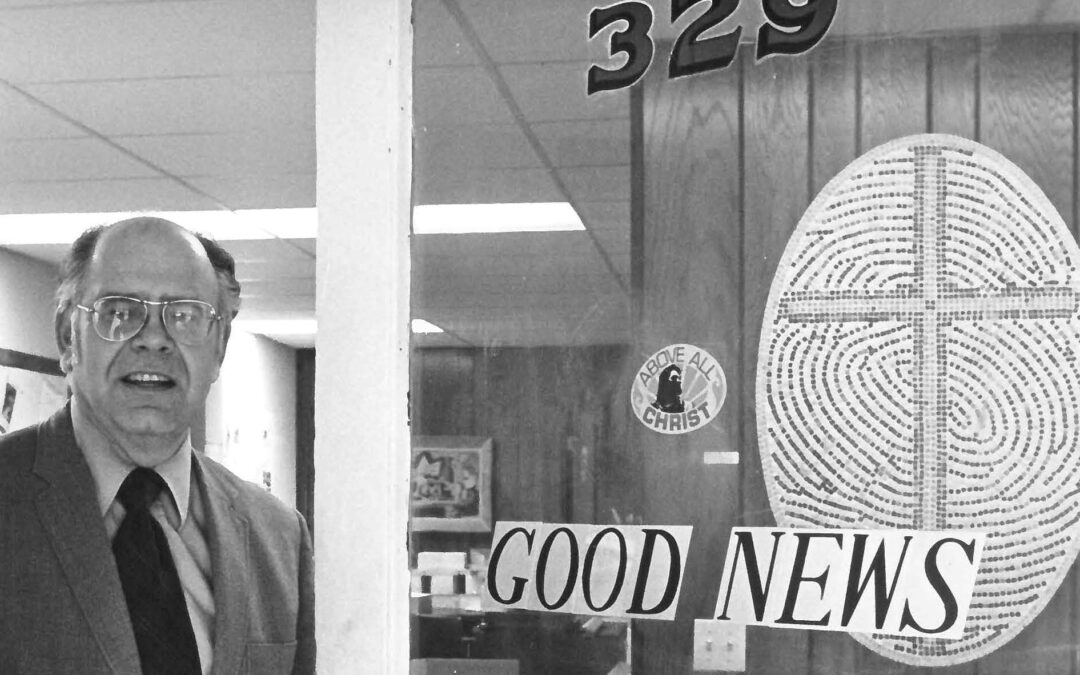
 I believe that the “Good News” emblem offers a clue to how God expects us to “fight on” for the faith.” The emblem is, first of all, a fingerprint, symbolizing humanity. Each individual is a unique and special creation of God.
That fingerprint stands for our humanity, and over that fingerprint we have superimposed a cross. Because the Cross of Jesus Christ redeems our humanity – makes it what God intends it to be. By faith, the sinful self is nailed to Christ’s cross, where the fallen, carnal “me” is crucified with Christ. So it is not I who live, but Christ who lives in me, as the inspired Apostle Paul wrote to the churches in Galatia. “And the Iife I now Iive, I Iive by faith in the son of God … who loved me and gave Himself for me” (Galatians 2:20).
We can only fight in the right way when our humanity has been set right through the Cross of Jesus Christ. If we fight in the carnal spirit of the self un-crucified, then our fighting cannot possibly honor God. In that case, we would deserve to lose. But if we fight as redeemed men and women, then it is not we who fight. Then it will be Jesus Christ who fights or contends for the faith through us.
So let us prepare to do battle by making full surrender to Jesus Christ. Let every motive be purged clean of desire for power, prestige, or self-glory. Let self be nailed to the cross.
What will combat be like as we fight on to restore a greater degree of faithfulness to Jesus Christ and to those great Wesleyan principles of Scriptural Christianity (principles which we promised to uphold, as laymen and as pastors)?
Take the matter of church school literature. I thank God for one great principle upon which the local church rests in United Methodism. When the merger came in 1968, the new church plan of union emphasized greater freedom for the local church to be in mission — “to do its own thing” for Jesus Christ. Long experience had proved the sterility and futility of a bureaucratic structure where people in church agency offices, remote from the reality of the local church, hand down wisdom from on high … wisdom often given ex cathedra. This system has proved its futility. And so the 1968 merger wisely set the local church free from subservience to bureaucrats in faraway places. I thank God for the wisdom of General Conference, at this point.
I have heard two top officials from the curriculum-producing portion of our Board of Education say the United Methodist Discipline does not compel United Methodist Churches to use Nashville’s literature. I heard a bishop say that he would not force any church to use official literature – providing that church had made thorough and intelligent study of its mission and of the literature.
Brothers and sisters, we have been set free! Liberated from bondage!
In places, there is pressure to conform. And I wish that the Board of Education would send a letter to all District Superintendents explaining what has been said privately that use of Nashville literature is not mandatory.
Let us contend for the faith, in this matter, simply by following common sense and our Discipline, which opens wide the doorway to responsibility for the local church.
Let each church make a serious study of its educational needs and resources. Then let the Holy Spirit direct each church in making a thorough investigation of the various curriculum materials. And when you do this, please do not overlook the Bible. As far as I know, the Bible is “approved” literature for United Methodists.
How shall we put up a fight for the faith in the matter of money?
There is no issue that generates more consternation than this. But it is a very real issue today. I would not be realistic in speaking about “strategies for the Church in Crisis ” if I ignored this – even though it’s like grabbing hold of a red hot frying pan.
I do not like that term “withholding.” For when we talk of holding back money, this sounds to me like waging war on the carnal level, the level of unregenerate power politics. Just because our Board of Missions resorts to economic boycott as a means of pressure to gain its way, this does not mean that you and I have any right to do so. Even if General Conference approves the Board of Missions’ boycott technique.
I suspect that we may be letting the devil fight through us, not Christ, when we talk of withholding. I do not see how anyone can reconcile the idea of boycott, withholding, when our Lord says, “When someone asks you for something, give it to him.
How then, should we fight on for the faith, as far as church giving is concerned? Is the only recourse to send in our money, no matter how strongly we disagree with how that money is used?
There is another way … a more excellent way.
Let’s face it, we have been lazy stewards. Most of us do not bother to learn how our money is being used. We just give it. It isn’t a matter of trust; no, it is plain old-fashioned laziness. We just don’t take the trouble to study our Conference and World Service budgets.
This is sluff-off stewardship. It has laid the groundwork for our present money trouble. For if people don’t care how their money is being spent, who can really blame the church agencies for spending our dollars as they see fit?
The need is for responsible stewardship. This means believing that every dollar you give to Jesus Christ is a sacred trust. We had better care where every dollar goes. We had better care very much! Because our Lord, who multiplied the loaves and fishes to feed a hungry multitude, can use each dollar or dime to advance His eternal Kingdom. Remember how harshly Jesus condemned stewards who were careless about handling the Master’s money?
Let us contend for the faith with our dollars, yes. Let each United Methodist know whether or not dollars from the local church are being used in a way that agrees with the principles of Holy Scripture, conforms to our United Methodist doctrines and with our United Methodist Discipline.
It is simply a matter of responsible, practical stewardship. Each Christian must invest God’s money wisely, where it will really serve Jesus Christ.
The opposite side of this truth is that a good steward will not invest God’s money where it is not doing God’s work.
Let us fight on for the faith, in the financial arena. But let us go into this combat as crucified men and women whose single desire is to use every resource to the best advantage of our Lord and Savior.
I want to mention one final way in which we may fight on in the Spirit of Christ. Please notice that I said one way, not the way. This involves politics. It is strange what ambivalent reactions that idea of political action seems to stir up when we evangelicals start talking about it! On one hand, the social activists condemn us because we are not enough interested in the politics of Washington, D.C., the state capital, or city hall. But let any evangelical mention the need for political action in the church, and we are immediately branded as polarizers, troublemakers, boat rockers, disloyal Methodists!
There is nothing inherently wrong or sinful or un-Christian about the political process. At this point I happen to agree with some of my friends in United Methodists for Church Renewal. They are very candid in saying that politics is the practical way things get done in an organization. I agree. The way politics are practiced and used may be wrong. The methods. But not the politics, per se.
There are two kinds of church politicians, that I have been able to identify. One is the unregenerate and carnal church politician. Such was a ministerial brother who led a skillful campaign to defeat another United Methodist minister’s bid for election to the 1968 General Conference. Later the defeated candidate met the victor in the hallway. Said the winning United Methodist minister to the losing United Methodist minister, “We shot you down, you S.O.B.” Such is the mood, the method, of unregenerate church politics.
The second sort of church politician is one whose politics have been redeemed by Jesus Christ. This church politician believes that United Methodism’s system guarantees to all the right of fair representation. That each group within the church is entitled to fair representation, proportional to that group’s membership constituency.
This church politician sees nothing wrong in seeking fair representation for a point of view that is solidly anchored in Methodist doctrines and Discipline. He believes it is part of his duty as a loyal Methodist to increase by the political process, (among other ways) the influence of historic Christianity, and those who uphold it.
Let us not talk of another caucus. But let us not shrink from claiming our rightful representation as United Methodists within the United Methodist system. It is simply a matter of treating other people the way we want other people to treat us.
I, for one, never want to deny representation to any group, even though it may not agree with me. But under God, I am compelled to put up a fight against the wheeler-dealers who demand not only their representation, but mine as well.
I have mentioned three areas of combat, three theaters of warfare, where we are able to serve God by fighting on for the faith, as Jude’s letter puts it so relevantly: church politics, money, and church school literature. These are only three of many opportunities that you and I have to serve our God, by fighting for His truth in ways that will reform, serve and strengthen our beloved Church.
But hear me well – we must do it by letting our Lord do the fighting in us and through us.
by Steve | Jan 1, 1969 | Archive - 1969
Archive: Faith Crisis in the Methodist Ministry
By Charles W. Keysor, Editor
Crisis is all about us, it seems. Church leaders wax eloquent about an assortment of woes:
*Shortage of ministers.
*Dwindling professions of faith.
*Sagging church school attendance.
*Rejection of the church by young adults and teens.
*Failure to be involved in the so-called “gut issues” of poverty, race, war and de-humanization.
All these are real crises. But we hear nobody saying much about THE crisis which is the root cause of all the rest: the faith crisis in our ministry.
Jesus said, “one blind man cannot lead another one; if he does, both will fall into the ditch.” (Luke 6:39). And the “ditch” of faith-lessness is where we find ourselves today, as United Methodists.
Ask the laymen who hear their preachers declaring, “Jesus Christ is not necessary.”
Ask the minister who was voted into full conference membership without ever being questioned about the nature of his faith.
Ask the grieving widow who received this consolation from a “relevant” minister: “Everlasting life is a myth … a superstition of the 19th century. Nobody knows what happens after death.”
Ask the teen-agers who were encouraged by their adult counselor at a Methodist camp to swim nude—boys and girls together.
Ask any believer who has experienced three years in a Methodist seminary.
Ask the congregations who have heard ministers insist that Playboy Magazine is more important than the Bible, as a vehicle of truth.
Ask the delegation of Methodist laymen who, in consternation, heard their own bishop admit that he was powerless to deal with faith-deficient ministers under his supervision.
To all whose heads are not hopelessly buried in illusion, the ministerial faith crisis is a malignant reality. Its bitter fruit is everywhere … at all levels.
The problem, of course, is that ministers who are deficient in New Testament faith breed faith-deficient congregations. And so it goes ad infinitum—a vicious circle of unbelief that grows more serious with each passing generation.
The first step in meeting any crisis is to recognize that there is a crisis. For this reason, “Good News” offers on the following pages a seven-part feature on Methodism’s faith crisis.
The causes of this crisis go back many years, to a gradual abandonment of the whole New Testament Gospel, starting before 1800. Progressively, little-by-little, Methodism drifted away from its sound Wesleyan heritage. Decade after decade, seminaries and the ministry led Methodism farther and farther away from “Christ and Him crucified” … toward the current attitude of “Christ is not necessary.” Those interested in the sorry story ought to read and ponder, “The Theological Transition In American Methodism” by Robert E. Childs. (Abingdon 1965, $4.00).
The causes of our ministerial faith crisis are complex, deep-rooted, and longstanding. But common-sense points to some sound principles that could help solve the problem.
First: Methodist seminaries ought to strengthen Christian faith in budding ministers … not uncertainty, bitterness, doctrinal ignorance, and hatred for the Church of Jesus Christ. (See page 16).
Second: Boards of Ministerial Training and Qualification should demand that all candidates for Methodist ordination understand and believe “our doctrines,” as specified in our Articles of Religion.
Third: Every ordained Methodist minister ought to be required a glad, spontaneous, and genuine personal confession of faith in Jesus Christ as Savior and Lord.
Fourth: Ministers not able to make this minimal New Testament faith-profession should be relieved of their credentials until conversion has become a fact. (Are empty pulpits more to be feared than faith-less preachers? Certainly there are many laymen able to preach the Good News.)
Fifth: Let bishops and district superintendents lay aside less vital matters and concentrate on strengthening the faith of ministers in their charge.
Sixth: Let ministers come together for prayer, study and discussion of the faith. Declare a moratorium on conference gossip, ecclesiastical politics, and griping about low salaries.
Seventh: Let ministers who already know Christ help other ministers experience the new birth.
Eighth: Let laymen be aware that large numbers of ministers privately doubt or deny the faith professed at ordination.
Ninth: Let laymen minister to faith-deficient pastors in a Christ-like spirit. Remember that two laymen of the First Century, Priscilla and Aquila, helped an off-beat preacher named Apollos by explaining “to him more correctly the Way of God.” (Acts 18:26).
Tenth: Let all God’s people pray without ceasing that God will increase the faith of His ministers. (Would the faith crisis have developed in our ministry if multitudes of laymen had prayed faithfully for their ministers?)
Eleventh: Let each local church exercise care in “launching” candidates into the ministry. Be sure each person seeking church endorsement knows Christ through vital experience and is basically grounded in the essential truths of Scripture.
Too often the local church has defaulted in Its crucial role as “first hurdle” into the ministry. The demands of the Gospel must become a reality at every step in the long process of preparing men to serve Christ as ordained ministers of the United Methodist Church. We must wake up to the crippling faith crisis that has brought the Church to open apostasy.
We must face this crisis boldly. Guided by the Holy Spirit, we must seek what is best for the Kingdom of God, the Church, and the persons who are involved. Impossible? Too huge a task?
The Lord of the Church reminds us, “This is impossible for men; but for God everything is possible.” (Matthew 19:26).
by Steve | Nov 9, 1967 | Uncategorized
A Death to ponder
Editorial by Charles Keysor
November/December 1976
Death often leads us to ponder, to reflect upon the earthly life and labors of one now departed. We remember what he or she has accomplished between the terminal points of birth and death. We consider how the world may be different because of this one particular life.
On July 30 this year, Rudolf Karl Bultmann died in Marburg, West Germany. He was 71 years old.
Probably Bultmann was the greatest theological giant of our times. Alongside him in the pantheon of the central 20th century theology, would be Karl Barth, Paul Tillich, and Reinhold Neibuhr. But Bultmann’s influence was surely the greatest. There is little doubt it will be the longest-lasting, for the disciples of Rudolf Bultmann permeated theological education in the Western World. They transmitted Bultmann’s thinking to several generations of highly influential church leaders preachers, teachers in colleges and seminaries, writers, editors, bureaucrats, and bishops.
Rudolf Bultmann was deep and complex, to say the least. That he was a great mind, none can question. But what matters is not so much his massive intellect as the presuppositions he held concerning ultimate realities.
“It is no longer possible for anyone seriously to hold the New Testament view of the world,” Bultmann declared. “In fact, there is no one who does.”
Christianity Today, in an editorial commenting on his death, offered this cogent summary: “His presuppositions began with a conscious rejection of theological orthodoxy. [He] did not allow for the presence of a personal, transcendent God who acts decisively and historically to redeem His people and who speaks in an intelligible manner to reveal Himself and His ways to men and women. He excluded the supernatural by definition from his system, as also any real intervention of the living God into the affairs of the world. Therefore [for Bultmann] the concept of miracle was ruled out, including the greatest miracle of all, the resurrection of our Lord Jesus Christ …. ”
“Wedding his theology to the existentialist philosophy of the early Martin Heidegger, Bultmann assumed the most radical tradition of Biblical criticism. He denied the historicity of all but a few basics of the life of Jesus (the “thatness”) and essentially dismissed the Old Testament and all Jewish elements in the Bible as irrelevant for Christian theology.”
This statement is accurate. It correctly describes Bultmann’s philosophical life-blood, and so it helps us to understand better his powerful influence on three generations of seminary professors and students.
“The tragedy of his influence and the painful burden it bequeathed to us stems from a good intention and a much-needed corrective gone amiss,” explains Rev. Dr. Paul Mickey, Associate Professor of Pastoral Theology, Duke Divinity School, and Chairman of the Good News Task Force on Theology. “His was a concern for the sofa fides principle, salvation by faith alone. This was nobly lifted up by Martin Luther during the Protestant reformation.”
As a Lutheran himself, Bultmann was eager to reaffirm this principle in opposition to 19th century liberalism. He correctly perceived the need to reaffirm that salvation is sofa fides, by faith alone. But he went too far. He jumped on a ‘faith bandwagon’ and rode off into existential psychologism, away from history.”
Here is where heresy enters Bultmann’s work, the Duke professor said. “For Bultmann, atonement [i.e., the death of Christ on the cross in payment for our sins] was reduced to ‘self-understanding’ and history was pushed aside. The same principles which whisked away the historicity of the Bible also made history irrelevant for the modern believer.”
What is our faith apart from its history? A cross that may have happened, if you choose to believe this. A tomb that was really empty only to those who make it so by believing that “He lives!” A record of early church growth and witness which may be only propaganda that was concocted to sell Christianity as a miracle religion.
If the Bible record of events is not reliable, then those who trust it are really fools and simpletons — as Bultmannians sometimes suggest.
Time Magazine for October 19, 1976, reported a major archaeological find at ancient Ebia in Syria — a large number of clay tablets dating between 2400 and 2250 B.C. Describing the first discovery, Time reflected the wide spread assumption that Biblical events and places are really not historical: ” … it [the discovery] also provides the best evidence to date that some of the people described in the Old Testament actually existed ….
“The Biblical connections appear to be numerous. The tablets contain accounts of the creation and the flood, which are strikingly similar to those found in both the Old Testament and Babylonian literature. They refer to a place called Urusalima, which scholars say is clearly Ebla’s name for Jerusalem. (If so, it is unquestionably the earliest known reference to the Holy City, predating others by hundreds of years.)
“We always thought of ancestors like Eber as symbolic,” says [ David Noel Freedman, a University of Michigan archaeologist who worked in the excavations], “at least until these tablets were found. Fundamentalists could have a field day with this one.”
Such is the common assumption: Biblical places, people, and events probably did not actually exist. Bultmann has done more than any other, in our time, to increase this distrust in the Bible’s historicity.
“If history is at best irrelevant theologically,” Dr. Mickey observed, “if not untrue, then the atonement, the idea of God as Creator and the notion that we have social responsibilities in obedience to God — all these are lost and gone forever! Bultmann’s heresy was not his affirmation of sola fides, but his exclusivism which rejected history and good works.”
Everything was reduced to subjectivism, or to purely personal judgment and opinion, Dr. Mickey said. Under Bultmann’s thinking, there was “no need or power for good works and a lively social witness. Without history there is no social order.
“Thus the epithet, ‘Faith without history and good works is dead heresy’ may be the final judgment of Christian history on Professor Bultmann.”
Rudolf Bultmann tore the very heart out of Biblical Christianity, and this same characteristic is widely evident in our church today. Shortly after Bultmann’s death, a tribute was given by Dr. F. Thomas Trotter, staff executive for the UM Board of Higher Education and Ministry (in charge of our colleges and seminaries). UM Communications circulated a story about this tribute. It reported that Dr. Trotter had said that the church, if it is to survive and compel the attention of modern persons, will need theologians like Bultmann. Why? To keep the church thinking about its mission and its gospel, Dr. Trotter declared. He also observed that Bultmann’s legacy to the church is his care for the authority of the Word of God, spoken in modern situations and in speech direct enough that the personal meaning will not be missed.
“Such scholar-prophets [as Bultmann] will have their detractors and they will risk our displeasure,” Trotter confessed. “But what they have to say to us is this: if our language is archaic, our response to the Gospel is merely formal, and our preaching is vacuous, then the power of God’s possibilities for men and women will be absent from the world.”
“The world does not require so much to be informed as reminded,” Hannah Smith once said. The church is reminded, upon the death of Rudolf Bultmann, that men die in a few swift years, but the truth of God survives. In Eternity, when a final accounting is made, belief will be judged more enduring than doubt. That is why Paul wrote to young Timothy: “The time is coming when people will not endure sound teaching, but having itching cars they will accumulate for themselves teachers to suit their own likings, and will turn away from listening to the truth and wander into myths” (II Timothy 4:3, 4). N
by Steve | Jun 1, 1967 | Archive - 1967
Archive: Our Lost Sheep
June 1967
Editorial by Charles W. Keysor, 1967
The air is thick, these days, with suggestions for what The Methodist Church needs most. If we may be so bold as to add our voice to the clamor for church renewal, we suggest that some thing must be done to win millions of indifferent Methodists to vital faith in Jesus Christ.
Most of us Methodist pastors have to admit that large numbers of the names on our membership rolls represent people who are members in name only. At best, they have a Christmas and Easter nodding acquaintance with their Creator and His Church. They are strangers to God’s Word. And they have no inkling that Jesus Christ requires anything from those who bear His name as Christians.
To put it bluntly, these marginal millions are atheists — even though we number them as Methodists. For to ignore God is the same thing as denying that God exists, practically speaking. The scandal of lukewarm Christianity is what makes the Church so tragically impotent today. Vital, New Testament faith seems the exception, rather than the rule, among us. Our educational enterprise is withering. Our membership is sagging even though the population of our country is increasing. And we Methodists rank almost at the bottom, in per capita giving of money. What else can we expect?
Serious commitment to Jesus Christ and His Gospel has become the mark of eccentricity. Millions of Methodists love God so little they aren’t willing to worship for even one hour each week. Can we expect that their lives, during the week, will reflect anything except the carnal worldliness of unregenerate men and women?
Yes, we have Methodist lost sheep — millions of them. (Backsliders, in the now-archaic language of historic Methodism.) We have a very big obligation to these sheep of Christ’s, lost and straying from His fold. Love of the brethren ought to cause us to tremble when we think of their effrontery before God. For every indifferent Methodist has “taken the name of the Lord in vain.” In vain has the backslider become a Christian. In vain does God seek his or her service. In vain has the backslider promised loyalty to the One who died in order that the ingrate might not perish but have everlasting life.
The Lord will not hold guiltless those who take His name in vain! So the inactive Methodist lives under the holy anger of a righteous God, and each “backslider” must personally be reconciled to God. Indifference is sure proof of estrangement. And those who are estranged from God face a hopeless future.
The Church must show its love by helping inactives “flee from the wrath to come” (to use a time-honored Methodist phrase which remains valid as long as God’s Word is true).
But let not the Church feel self-righteous! The blood of every inactive Methodist lies heavy on our hands. For decades, we have permitted millions of inactives to slumber, blissfully unaware of their eternal peril. We have been content to regard them as mere statistics, rather than persons needing redemption. We have, alas, been afraid to jeopardize their nominal giving by demanding that promises made to God must be taken at least as seriously as pledges made to pay off auto loans and home mortgages.
Yes, we have failed, as a church, to warn our marginal millions that God holds them personally accountable … and that unfaithfulness to God is the worst of all sins. We have forgotten that it is our prophetic responsibility to challenge the unfaithful to turn from their materialistic idols and serve, instead, the living God.
But perhaps our greatest sin, as a church, is that we have failed to be “the household of faith,” a place where people can encounter the living Christ in worship, in study, in service. The church is not always the place where we rub shoulders with people who have become new persons through the miracle of rebirth in Christ.
Confessing the magnitude of our failure and recognizing the plight of our lost sheep is the first step. Beyond this lies the very practical matter of evangelizing our marginal millions. This cannot be accomplished by a gigantic church-wide “program.” Nor by setting up new committees. Nor by beefing up agencies of the church. This is a job of continuing, personal evangelism for the local church. Pastors and people must unite to remedy decades of neglect. The Holy Spirit must dynamite our apathy and give the remnant of faithful Methodists a zeal for salvation for those who have gone astray. We must go to them in love. Empowered by the Holy Spirit, we must offer Christ as the one source of life that is abundant and eternal.
Charles W. Keysor (1925-1985) was the founder and editor of Good News.
by Steve | Mar 1, 1967 | Archive - 1967
Archive: There is Good News
By Charles W. Keysor, Editor
March 1967
We invite you to share a dream.
We have dared to dream that evangelical Methodists might united in fellowship across the Church.
We have dared to dream this fellowship might have a publication, knitting us closer to each other, and to Jesus Christ our Lord.
We have dared to dream that such a koinonia will strengthen the Church we love and serve.
We have dared, even, to dream that our voices may be heard as we seek to articulate historic Methodism: forever relevant, forever vital.
How did this dream begin?
It started with an article in Christian Advocate for July 14, 1966. The feature, “Methodism’s Silent Minority,” brought a flood of mail from pastors and laymen across the U.S.A. We were startled. But we were delighted to discover a remarkable unity of spirit in these letters. They revealed that many Methodists remain true to Jesus Christ, the eternal Son of God … true to the Holy Scriptures as God’s inspired and inspiring Word … and true to Methodism’s timeless proclamation of Jesus Christ incarnate, crucified, risen, and coming again. Also, these letter writers expressed a deep hunger for fellowship with other Methodist evangelicals.
Good News attempts to minister to this spiritual hunger. We believe these letter-writers have voiced the opinion of many other Methodist laymen and pastors. And we are increasingly conscious of the need for a journalistic “mission” to Methodism’s “silent minority.”
So, we have dared to publish this first issue of Good News. If God is willing … if we have correctly gauged the need, then there will be more issues. It is our prayer that Good News may truly express the bedrock, Scriptural faith which God’s own Spirit places in Methodist hearts. To Him and His glory, we dedicate these pages. Our prayer is that of Ephesians 3:20, “Now to him who by the power at work within us is able to do far more abundantly than all that we ask or think, to him be glory in the church and in Christ Jesus to all generations, for ever and ever. Amen.”